Principal investigators and lab managers hiring a clinical psychology lab assistant need someone who will treat participants with care, follow study protocols exactly and keep data clean. A letter that says you're "passionate about mental health and eager to learn" doesn't show any of that. One task you did reliably, like recruiting a hard-to-reach sample or keeping a study's retention high, does.
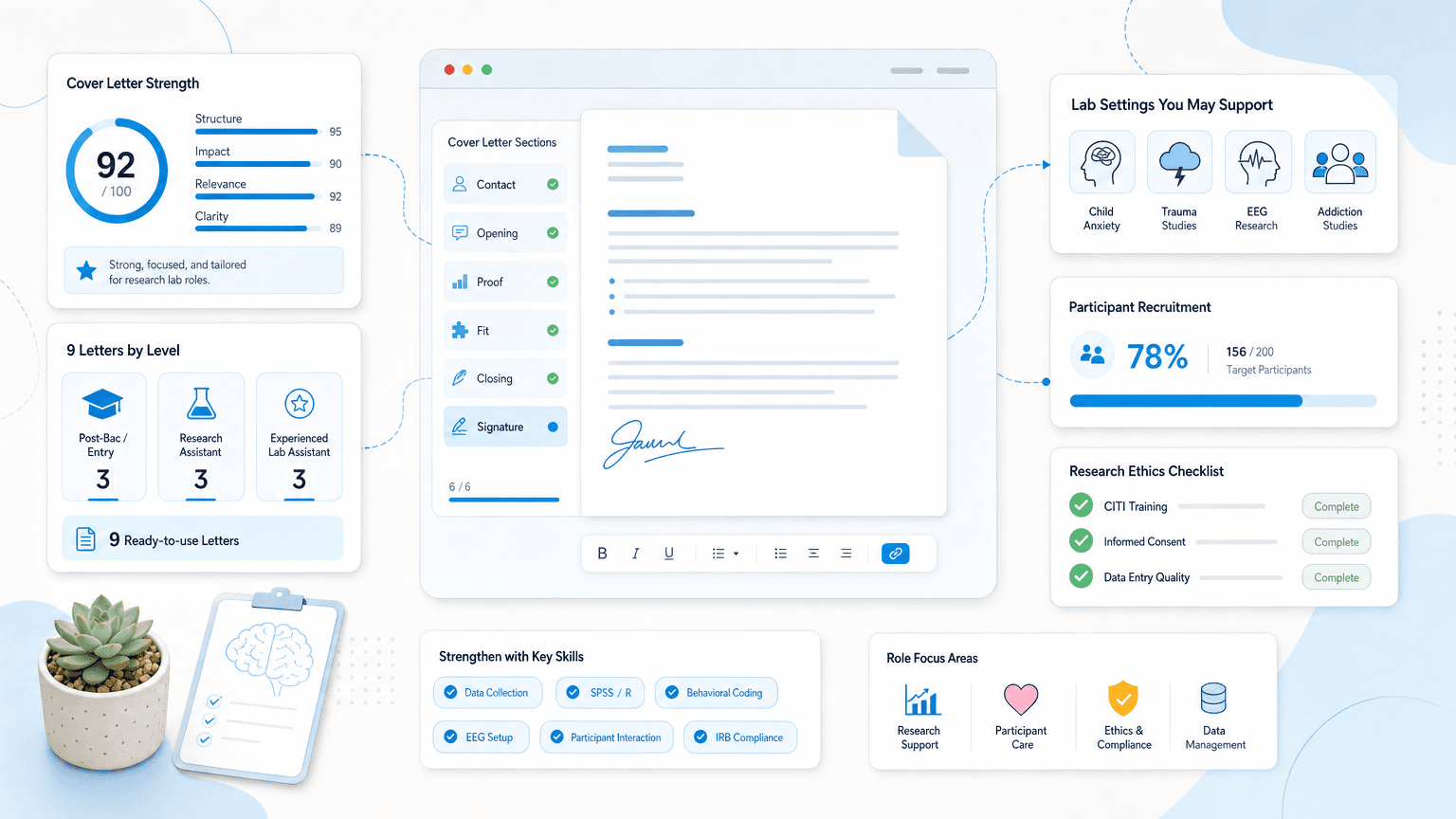
This guide gathers nine clinical psychology lab assistant cover letters. Six are written for specific labs: an adult depression trial, a child anxiety lab, a trauma research program, an EEG lab, an addiction study and an early psychosis clinic. Three come from an undergraduate research assistant, a new graduate and a behavioral technician moving into research. Two short notes explain each letter. Further down: what principal investigators look for, how to shape every paragraph next to a sample page, how to present ethics training and graduate school plans, a bracketed draft and the slips that cost lab applicants interviews.
| If you are applying to... | Start with | What it proves |
|---|---|---|
| A clinical trial or treatment study | Depression Trial or Addiction Study examples | Recruitment, retention and protocol fidelity |
| A child, trauma or psychosis lab | Child Anxiety, Trauma or Early Psychosis examples | Careful work with vulnerable participants |
| A psychophysiology or imaging lab | EEG Lab example | Technical data quality |
| As a student or career changer | Undergraduate, Graduate or Behavioral Technician examples | Research readiness before a paid lab role |
Clinical Psychology Lab Assistant Cover Letter Examples by Lab Type
The six letters below are complete and ready to adapt. All labs, people and figures are fictional.
Clinical Trial Research Coordinator Cover Letter Example (Depression)
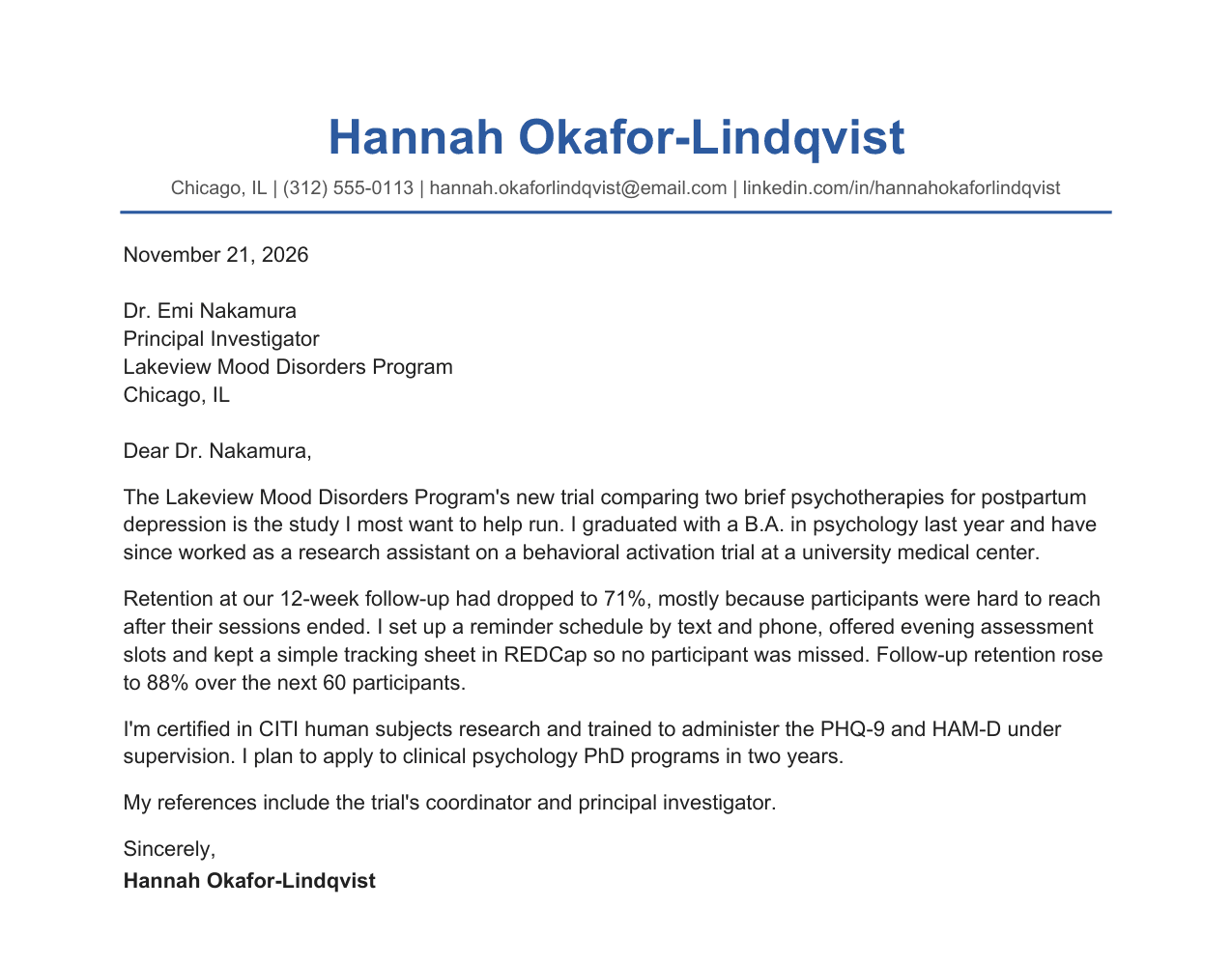
Dear Dr. Nakamura,
The Lakeview Mood Disorders Program's new trial comparing two brief psychotherapies for postpartum depression is the study I most want to help run. I graduated with a B.A. in psychology last year and have since worked as a research assistant on a behavioral activation trial at a university medical center.
Retention at our 12-week follow-up had dropped to 71%, mostly because participants were hard to reach after their sessions ended. I set up a reminder schedule by text and phone, offered evening assessment slots and kept a simple tracking sheet in REDCap so no participant was missed. Follow-up retention rose to 88% over the next 60 participants.
I'm certified in CITI human subjects research and trained to administer the PHQ-9 and HAM-D under supervision. I plan to apply to clinical psychology PhD programs in two years.
My references include the trial's coordinator and principal investigator.
Sincerely,
Hannah Okafor-Lindqvist
Why it works:
- Naming the lab's specific new trial shows the applicant has read beyond the job posting.
- Retention from 71% to 88% is the number trial principal investigators worry about most, and the method behind it is clear.
Child Anxiety Lab Research Assistant Cover Letter Example
Dear Dr. Fairweather,
Your lab's goal of bringing proven anxiety treatment to children in rural schools, where few therapists practice, is the reason I'm applying for the research assistant position. I've spent two years as a research assistant in a developmental psychology lab and a year as a camp counselor for children with anxiety.
In my current lab, I administer structured diagnostic interviews with parents and children. After training, my ratings matched the senior assessor's on 23 of 25 reliability interviews, and I now help train new assistants. I also coordinate school visits, which means working with principals, teachers and families on tight schedules.
I'm comfortable working with children who are nervous about new adults and with parents who have questions.
I can share a poster I presented on parent-reported avoidance at our state psychology conference.
With appreciation,
Lucía Brennan-Achebe
Why it works:
- The lab's mission is matched by two years of child research and direct experience with anxious children.
- Reliability on 23 of 25 interviews is the kind of concrete measure assessment-heavy labs look for.
Trauma Research Assistant Cover Letter Example
Dear Dr. Whitcombe,
CITI certified, trained in the SCID-5 and the CAPS-5, two years as a research assistant on a veterans' PTSD study: that's the background behind my application to the trauma research program at Riverside Health Sciences.
On my current study, I've conducted 140 diagnostic interviews with veterans under supervision. Our lab checks interview reliability every quarter, and my agreement with the gold-standard rater has stayed above 0.85 on every check. I also manage the participant safety protocol, which means knowing exactly when and how to contact the on-call clinician.
I've learned to give participants time and space when an interview touches painful memories.
I would welcome the chance to discuss how I could support your treatment studies.
Respectfully,
Marcus Delgado-Pryce
Why it works:
- Trauma labs screen on ethics and interview training first, and both lead the letter.
- High reliability across 140 interviews, plus safety protocol experience, shows the care trauma research demands.
EEG Lab Research Assistant Cover Letter Example
Dear Dr. Lindgren,
Your posting says the lab's EEG sessions are losing too much usable data to movement and electrical noise. I worked on that same problem for a year as a research assistant in a psychophysiology lab, after earning a B.S. in neuroscience.
When I started, only 64% of our sessions produced usable data. I rewrote the setup checklist, tested electrode impedance before every task, added short practice blocks so participants learned to sit still, and coached two new assistants on the routine. Usable sessions rose to 91% across the next 80 participants.
I preprocess data in EEGLAB and MATLAB and keep a log of every session's notes.
The setup checklist and our data quality summary can come with me to an interview.
Regards,
Priya Ramanathan-Ross
Why it works:
- Restating the lab's data loss problem shows the applicant read the posting and has fixed the same issue.
- Usable sessions rising from 64% to 91% is a direct, measurable gain for any psychophysiology study.
Addiction Research Assistant Cover Letter Example
Dear Dr. Okonjo,
Our opioid treatment study reached its target of 120 participants two months ahead of schedule after I moved recruitment into community clinics and syringe service programs. I'm a research assistant with two years on substance use studies, and the Brightwater Addiction Research Center's open position fits that experience closely.
Recruitment had stalled at hospital sites because many eligible people didn't trust research teams. I built relationships with staff at four community programs, spent regular hours on site and explained the study in plain language. I also kept screening logs in REDCap so we could report recruitment by site each week.
I treat every participant with respect and without judgment, and I follow the study's confidentiality protocol closely.
My supervisor at the current study can speak to my recruitment work.
Kind regards,
Joel Asante-Whitfield
Why it works:
- Opening with a recruitment target met early gives the reader a concrete result immediately.
- Community trust-building shows the human skills addiction research needs, alongside good data practice.
Early Psychosis Research Assistant Cover Letter Example
Hello Dr. Pemberton,
Dr. Rachel Moreau, who supervised my undergraduate thesis and collaborates with your early psychosis program, encouraged me to apply for the research assistant position. I graduated last spring with a B.A. in psychology and have worked since then as a data assistant in a schizophrenia research lab.
When I joined, about 6% of our assessment entries in REDCap had errors that took weeks to find. I built validation rules for every key field, set up a double-entry check for clinical ratings and ran a weekly error report for the team. Entry errors fell below 1%, and our quarterly data lock now happens on time.
I'm interested in how early intervention changes outcomes, and I plan to apply to clinical psychology programs.
I'd be glad to share my thesis as a writing sample.
Best regards,
Sophie Mensah-Lowe
Why it works:
- A referral from a collaborator of the principal investigator earns close attention.
- Data errors cut from 6% to under 1% shows the reliability every clinical lab depends on.
Undergraduate, Graduate and Career-Change Lab Assistant Cover Letter Examples
These three letters come from an undergraduate research assistant staying in the same department, a new psychology graduate and a behavioral technician moving into research.
Undergraduate Research Assistant Cover Letter Example
Dear Dr. Castellanos,
For the past three semesters I've volunteered in the department's Emotion and Health Lab, and I'd like to move into the paid research assistant position on your new sleep and mood study as I start my senior year.
In Dr. Hartley's lab, I score questionnaires, run participants through computer tasks and enter data in Qualtrics and SPSS. I noticed that some participants skipped pages of our online survey, so I suggested required-response prompts on key items. Missing data on our main measures fell from 12% to 3% in the next wave.
I've completed CITI training, statistics and research methods courses, and abnormal psychology.
Dr. Hartley has offered to serve as a reference.
Thanks,
Nadia Achterberg-Moss
Why it works:
- An internal applicant already knows the department's procedures, and the letter says so in the first line.
- Missing data cut from 12% to 3% shows initiative that improved the lab's research.
Recent Psychology Graduate Lab Assistant Cover Letter Example
Dear Dr. Abernathy,
My honors thesis began when a friend told me she stopped going to therapy because the waiting list was eight months long. I surveyed 310 students about wait times and help-seeking and found that students waiting more than two months were half as likely to start treatment at all.
After presenting those findings at the campus research symposium, I finished my psychology B.A. in May. I'm applying for the clinical research assistant position at the Westbrook Center for Anxiety and Mood because your work on brief, low-cost interventions speaks to the problem my thesis found.
I analyzed the data in R, managed survey ethics approval and wrote the thesis under supervision.
My thesis and analysis code can serve as a writing sample.
Thank you,
Ethan Moyo-Fairbanks
Why it works:
- A personal question that led to a real study shows research curiosity and initiative.
- A clear finding from 310 participants, connected to the center's work, gives the reader evidence and fit.
Behavioral Technician to Lab Assistant Cover Letter Example
Dear Dr. Okafor,
I'm applying for the research assistant position in your autism intervention lab after three years as a registered behavior technician, because I want to help test which interventions work best for families.
As a technician, I've delivered therapy sessions with 14 children and recorded behavioral data at every session. I noticed that our clinic's paper data sheets made trends hard to see, so I moved our team to a shared tracking sheet with weekly graphs, which our supervising analyst now uses for every case review. I've also completed CITI training and a research methods course this year.
I'm comfortable working with children, coordinating with parents and recording data consistently.
My clinical supervisor can speak to my data collection and my work with families.
Best,
Rosa Delacroix-Whitmore
Why it works:
- Stating the move and the reason first answers the reader's question about motivation.
- Data recorded across 14 children and a tracking system adopted by the team show research-ready habits. For presenting clinical work on a research CV, the career change resume article offers a framework.
What Principal Investigators Look For in a Lab Assistant Cover Letter
Principal investigators and lab managers read for reliability, care with participants and fit with their research. Many assistants use the role as preparation for graduate study: the BLS notes on its path to becoming a psychologist that clinical psychologists typically need a Ph.D. or Psy.D., and that Ph.D. programs center on research. The field is growing too, with psychologist employment projected to rise 6% from 2025 to 2035.
- Research setting. Trials, assessments, psychophysiology or survey studies.
- Participant care. Recruitment, retention, safety protocols and confidentiality.
- Data quality. Accurate entry, reliability and missing data kept low.
- Training. CITI or similar ethics training, structured interviews and scoring.
- Fit. Interest in the lab's research question and population.
How to Write a Clinical Psychology Lab Assistant Cover Letter
Write it like a short methods section about yourself: the setting, what you did and the result. The guidance below takes one paragraph at a time, with a flat example and a stronger one.
Lab Assistant Cover Letter Format
One page in academic letter style, with your CV's contact details on top.
- Contact details: name, email, phone and city.
- Date.
- Salutation to the principal investigator or lab manager.
- Opening: degree, research setting and the lab's focus.
- Task paragraph: one research task and its measured result.
- Fit paragraph: the lab's research and your interest in it.
- Close: a writing sample, poster or reference, then your name.
Write 250 to 350 words. A file name like "Hannah-Okafor-Research-Assistant.pdf" helps a lab manager keep applications in order. Here is how the clinical trial research coordinator example looks on the page.
Salutation: Address the Principal Investigator
Lab websites list the principal investigator and often a lab manager. Use "Dr." and the surname. If the posting names a lab manager as the contact, write to them.
Weak:
To Whom It May Concern,
Strong:
Dear Dr. Nakamura,
Check the spelling of names and titles on the lab website. A small error there suggests the same carelessness with data.
Opening: Degree, Setting and Their Research
Principal investigators sort applicants by preparation and fit. Put your degree, your research or clinical setting and the lab's focus in the first paragraph. Opening styles that work:
- Their study: "Your new trial comparing two brief psychotherapies is the study I most want to help run."
- A result first: "Our study reached its recruitment target two months ahead of schedule."
- Training first (assessment-heavy labs): "CITI certified, trained in the SCID-5 and the CAPS-5."
- A research question you followed (for graduates): what started your thesis.
Weak:
I am passionate about mental health and eager to learn more about clinical psychology.
Strong:
Psychology B.A., then a year assisting on a behavioral activation trial at a medical center.
Task Paragraph: One Research Task, Measured
Pick the task closest to the job. Describe the problem, what you did and the result. Useful measures:
- Recruitment: participants enrolled, targets met, sites added.
- Retention: follow-up completion rates.
- Data quality: entry errors, missing data, usable sessions.
- Reliability: agreement with expert raters.
- Scale: interviews, assessments or sessions run.
Weak:
I have experience with data entry and participant interaction.
Strong:
I set up a reminder schedule and evening slots, and follow-up retention rose from 71% to 88%.
Ethics Training and Graduate School Plans
Name your CITI or equivalent training in one sentence, along with any structured interview or assessment training. If you plan to apply to PhD or PsyD programs, say so briefly, since many principal investigators hire post-baccalaureate assistants with that goal.
Weak:
I am interested in possibly attending graduate school someday.
Strong:
I plan to apply to clinical psychology PhD programs in two years.
Fit Paragraph: Their Research
Read two or three of the principal investigator's recent papers and connect one to your interests or experience. Lab websites often list current studies and the populations they recruit, so check which ones are actively enrolling and mention the one where your experience fits best. Keep the ad, since lab postings vanish quickly. Upplai's Application Tracker holds each one beside your letter, so the study details are still there for the interview.
Weak:
I am very interested in your research.
Strong:
Your work on brief, low-cost interventions speaks to the problem my thesis found.
Close: Offer a Sample or Reference
End with something the lab can use: a writing sample, a poster or a reference from a previous research supervisor.
Weak:
Thank you so much for reading my letter.
Strong:
My thesis and analysis code can serve as a writing sample.
What to Write Without Lab Experience
Many lab assistants arrive with experience from classes, volunteering or clinical support jobs. Describe it in research terms:
- Class research project: "I surveyed 310 students about wait times and help-seeking."
- Volunteer lab work: "I suggested required-response prompts that cut missing data from 12% to 3%."
- Crisis line or peer support: "I completed 60 hours of crisis line training and followed strict confidentiality rules."
- Behavioral technician work: "I recorded data across 14 children and built a tracking sheet the clinic adopted."
If you're an international student applying to U.S. labs, the international student resume guide covers presenting visa status and overseas coursework.
Clinical Psychology Lab Assistant Cover Letter Template
Fill each bracket with details from your own research or clinical work.
Dear Dr. [Principal investigator's surname],
[Hook: their study, a result or your referrer.] I hold a [degree] and have [research or clinical experience].
[One task: the problem, what you did and the measured result.]
Your work on [research focus] interests me because [reason]. [Optional: graduate school plans.]
[A writing sample, poster or reference] is available on request.
Sincerely,
[Full name]
Draft your lab assistant letter in seconds
Upload your resume and the lab assistant posting, and Upplai drafts a letter for that role and shows your match score.
Common Clinical Psychology Lab Assistant Cover Letter Mistakes
Writing About Wanting to Help People, Not Research
Wanting to help is good, but labs hire for research skill. Show a task you did reliably: a recruitment push, an assessment you learned to score accurately, a data problem you caught. Principal investigators read dozens of letters about compassion and very few about missing data.
"Passionate About Mental Health" With No Evidence
Every applicant says it. A retention or reliability number proves you're ready, because it shows you can turn care for participants into consistent research practice.
Weak:
"I'm deeply passionate about mental health and helping others."
Strong:
"My interview ratings matched the senior assessor's on 23 of 25 reliability checks."
Not Reading the Principal Investigator's Work
A generic letter suggests you haven't looked. Name one study or paper.
Sharing Identifying Participant Details
Never include details that could identify a participant, even in passing. Describe the work, not the person. A principal investigator who sees a confidentiality slip in a cover letter will assume it happens in the lab too.
Retelling Your CV
Your CV lists your courses and roles. Use the letter for one task.
Overstating Your Clinical Role
Lab assistants work under supervision, and principal investigators will check. "I treated veterans with PTSD" is wrong if you ran research interviews. Write "I conducted 140 diagnostic research interviews under supervision." AI writing tools sometimes overstate clinical roles like this. Upplai writes only from facts on your resume and shows each edit, so your letter stays accurate.
Forgetting Ethics Training
Labs can't start you with participants until training is done. If you've finished CITI or similar, say so.
Quick fix:
Add one sentence naming your ethics training and when you completed it.
Write a Matching Cover Letter Faster
Post-bac hiring season usually means applying to a handful of labs at once, each studying a different population with different methods, and each deserving its own letter. Upplai shortens that work: share your CV and one lab's posting, and in under 10 seconds you'll have a draft written for that position, at no cost once your resume is tailored. The draft puts your most convincing research result first, invents nothing beyond your CV, and mirrors your resume's template and design so the two documents read as a pair. Edit the wording yourself, or ask the AI to try again, before downloading.
Applicants who include a letter reach the interview stage 1.9X as often. A free account lets you tailor 3 resumes, each with its own companion letter, and asks for no payment information.
A tailored letter for every lab you apply to
Add your resume and a clinical psychology lab posting to get a cover letter written for that role.