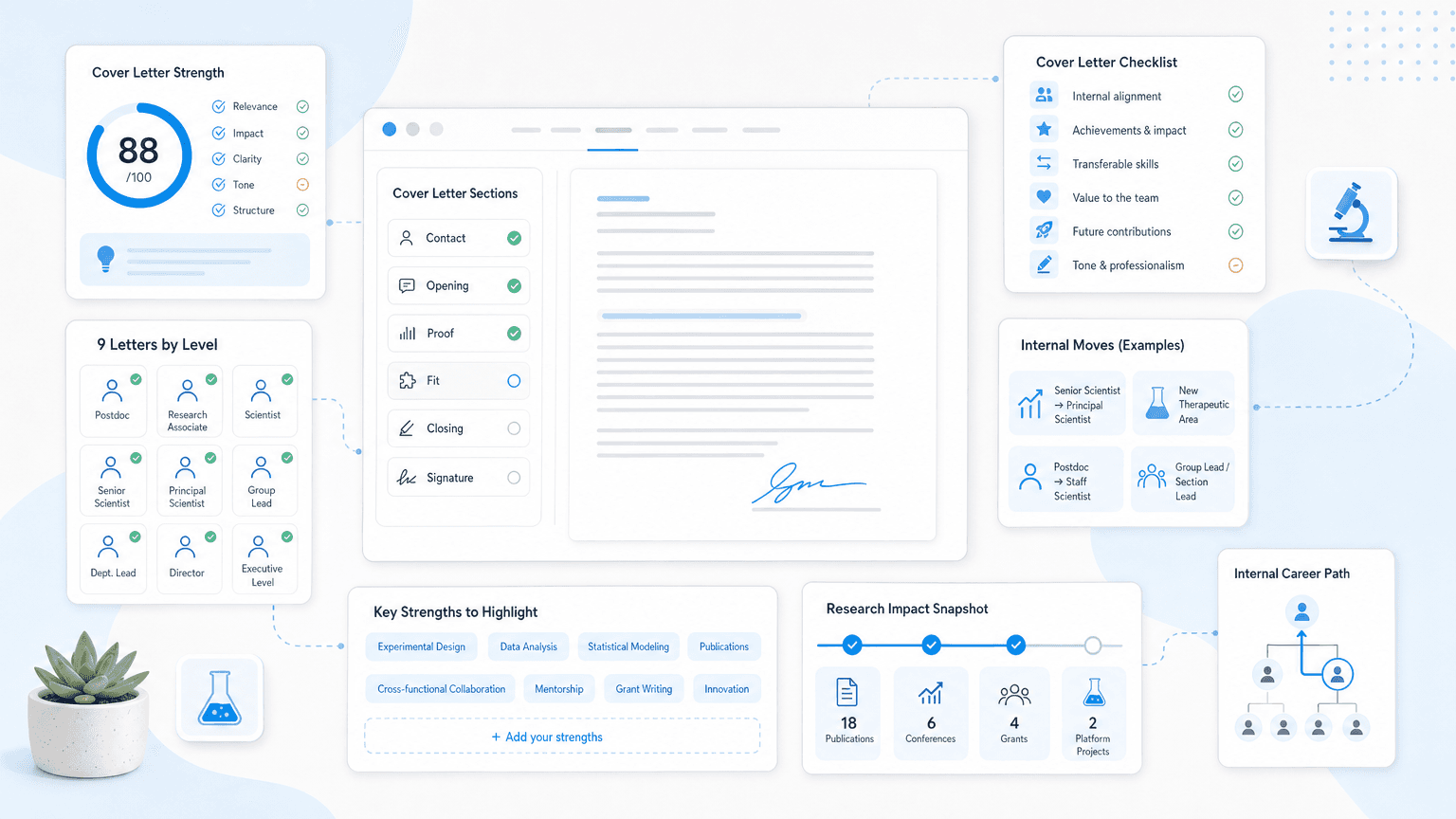
Applying for a research scientist position inside your own organization is different from applying from outside. The hiring manager may have seen you present, read your reports or sat in the same program meetings. What they still need to know is why you want this role, what you'd bring from your current team and whether the move would leave a gap behind you. A letter that restates your CV doesn't answer those questions. A focused letter that does can make the difference between two strong internal candidates.
Here are nine research scientist cover letters written for internal positions. The first six cover promotions and moves between teams: senior to principal scientist, a lateral move to a new therapeutic area, a postdoc converting to staff, a materials scientist joining a battery group, a machine learning scientist moving to a research team and a national lab scientist applying to lead a group. The last three cover a research associate, a lab technician and a quality control scientist moving into research. Two points under each explain its strengths. After the letters, you'll find what internal hiring managers look for, how to handle your current manager and handover, a fill-in draft and the mistakes internal candidates make.
| If you are... | Start with | What it proves |
|---|---|---|
| Applying for promotion | Senior to Principal or Group Lead examples | Readiness for broader scope |
| Moving to another team | Therapeutic Area, Battery Group or ML Research examples | Transferable skills and real interest |
| Converting a temporary role | Postdoc to Staff example | Continuity and proven output |
| Stepping up from a support role | Associate, Technician or QC examples | Scientific contribution before the title |
Internal Promotion and Transfer Cover Letter Examples
The six letters below are full drafts for experienced scientists moving within their organization. All names, programs and figures are invented.
Senior Scientist to Principal Scientist Cover Letter Example
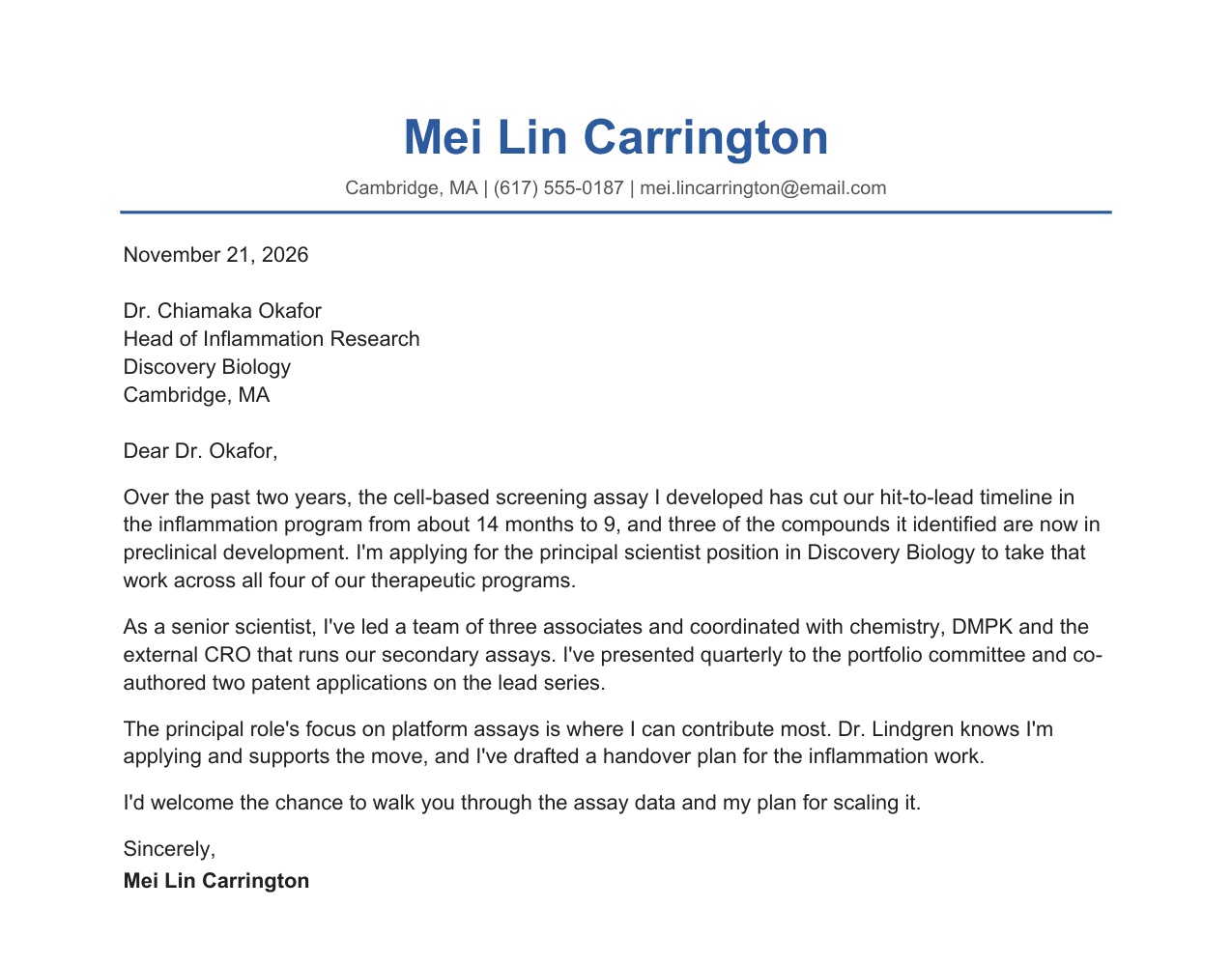
Dear Dr. Okafor,
Over the past two years, the cell-based screening assay I developed has cut our hit-to-lead timeline in the inflammation program from about 14 months to 9, and three of the compounds it identified are now in preclinical development. I'm applying for the principal scientist position in Discovery Biology to take that work across all four of our therapeutic programs.
As a senior scientist, I've led a team of three associates and coordinated with chemistry, DMPK and the external CRO that runs our secondary assays. I've presented quarterly to the portfolio committee and co-authored two patent applications on the lead series.
The principal role's focus on platform assays is where I can contribute most. Dr. Lindgren knows I'm applying and supports the move, and I've drafted a handover plan for the inflammation work.
I'd welcome the chance to walk you through the assay data and my plan for scaling it.
Sincerely,
Mei Lin Carrington
Why it works:
- Leading with a program-level result shows the scientist already works at the scope a principal role demands.
- Stating that the current manager supports the move, with a handover plan, removes the hiring manager's biggest worry about internal transfers.
Lateral Move to a New Therapeutic Area Cover Letter Example
Hello Anna,
Our company's decision to build a neuroscience pipeline from scratch over the next three years is the reason I'm applying for the research scientist role on your new team. I've spent four years in our oncology group developing patient-derived organoid models, and I think the same approach could speed up early neuroscience target validation.
In oncology, I built an organoid panel from 40 patient samples that predicted response to our lead compound with 80% accuracy in a retrospective analysis, which helped the clinical team choose trial sites. Brain organoids are a newer field, but the culture methods, imaging pipeline and analysis code I've built transfer directly.
My manager, Javier, has agreed to a two-month overlap so my current studies continue without interruption.
Could we find 30 minutes to talk about how organoids might fit your first target campaign?
Kind regards,
Rafael Mbeki-Strand
Why it works:
- Opening on the company's new strategic priority shows the scientist understands why the team exists.
- An organoid panel with a measured predictive result proves the skill is real, and the letter explains why it transfers.
Postdoc to Staff Research Scientist Cover Letter Example
Dear Dr. Abernathy,
I've spent three years as a postdoctoral fellow in the Center's Immunology Program, and I'm applying for the staff research scientist position in the same program so I can continue the T-cell exhaustion work we've built together.
During my fellowship, I led the single-cell sequencing study that identified 2 exhaustion markers now used in all 6 of the program's labs, published as first author with a second paper under review, and wrote the methods section of our renewed NIH grant. I've also trained 5 graduate students on the single-cell pipeline.
As staff, I'd keep the pipeline running for the whole program and build the collaboration with the clinical team that we discussed at the last retreat.
I'd be glad to discuss the role and the next phase of the project.
Best regards,
Thomas Adeyemi-Lowe
Why it works:
- A postdoc applying to stay in the same program has unique context, and the letter makes that its opening point.
- Markers adopted across the program, papers and grant work show contributions that would be costly to lose.
Materials Scientist to Battery Group Cover Letter Example
Dear Dr. Sørensen,
The internal posting for a research scientist in the Battery Materials group says the team needs to reduce cathode cracking during fast charging. I've worked on a closely related problem for three years in our Coatings group, where I develop thin protective layers for metal parts.
Last year I adapted our atomic layer deposition process to coat nickel-rich cathode particles for a cross-group pilot with your team. Coated cells retained 89% of their capacity after 500 fast-charge cycles, compared with 74% for uncoated cells, and the results went into the group's quarterly review.
I'd bring the deposition know-how and equipment access from Coatings, which could shorten your coating experiments considerably.
I can walk you through the pilot data and a proposal for the next round.
Regards,
Elena Varga-Holt
Why it works:
- Restating the team's stated problem shows the scientist read the internal posting closely and already has a relevant result.
- A cross-group pilot with measured capacity retention makes the transfer feel like a natural next step.
Machine Learning Applied to Research Scientist Cover Letter Example
Hello Kenji,
Three first-author papers at peer-reviewed machine learning venues. Four years shipping recommendation models for our product teams. An internal award for the 2025 ranking work. Those are my credentials for the Foundations Research scientist opening.
On the applied side, I built a ranking model that improved recommendation click-through by 7% across our main product, which led me to a research question about learning from biased feedback. I've written two papers on it with members of your team, and one is now part of our internal training curriculum.
Moving to Foundations would let me work on that question full time. My manager supports the move, and my applied work is documented for the team that will take it over.
I'd welcome a conversation with you and Priya about the team's agenda for next year.
All the best,
Aditi Ramaswamy-Clarke
Why it works:
- Research teams screen on publications first, and the opening gives them along with an internal award.
- Linking a product result to a research question shows the scientist has a genuine reason to move. For presenting ML research on a resume, see the AI engineer resume examples.
National Lab Group Lead Cover Letter Example
Dear Dr. Whitfield,
Dr. Ramon Castillo, who leads our division and has supervised my work for six years, encouraged me to apply for the group lead position in Environmental Sensing. I've been a staff scientist in the group for six years and have served as acting lead since March.
As acting lead, I kept the group's three projects on schedule, brought in a new $1.8M agency grant as principal investigator and hired two postdocs. Before that, I led the field deployment of our groundwater sensor network across 22 sites, which now feeds data to two state agencies.
I'd keep the group focused on field-ready sensing and build the partnership with the hydrology group that we started this year.
I would be glad to share my plan for the group's next three years.
Respectfully,
Grace Mensah-Hartley
Why it works:
- A recommendation from the division director, plus acting lead experience, shows the candidate has already done the job.
- A new grant and a field network feeding state agencies show leadership results in a research setting.
Associate, Technician and QC to Research Scientist Cover Letter Examples
These three letters are for scientists moving into a research scientist title from support or adjacent roles inside their organization.
Research Associate to Research Scientist Cover Letter Example
Dear Dr. Lindqvist,
Four years ago I joined the Protein Engineering team as a research associate with a master's degree, running expression screens for the senior scientists. Last month I defended my PhD, completed part time with the company's support, and the antibody stability work at its center came straight from our team's projects.
During that time I designed a stability screen that let us test 384 antibody variants per week instead of 48, and two variants it found are now in the team's development candidate list. I've presented the work at two internal research days and one external conference.
I'm applying for the research scientist position on the same team so I can lead projects of my own.
My dissertation and the screen data are available whenever useful.
Thanks,
Sofia Nakamura-Reid
Why it works:
- The story of earning a PhD while working on the team's projects shows commitment and growth.
- A screen that raised throughput eightfold and found development candidates proves independent scientific contribution.
Lab Technician to Research Scientist Cover Letter Example
Dear Dr. Pemberton,
Our institute's commitment to developing affordable diagnostics for tuberculosis in low-income countries is why I've stayed here for seven years, and why I'm applying for the research scientist position in the Diagnostics group.
As a senior lab technician, I've run sample processing for the group and, over the past two years, taken on method development. I adapted our sputum processing protocol so it works without a centrifuge, which cut processing time by 35% and made the test usable in field clinics during last year's pilot. I'm second author on the resulting paper and recently completed a master's in microbiology.
I know this group's methods and partners well, and I'd like to contribute as a scientist.
I'd value the chance to discuss how I'd lead the field validation work.
With appreciation,
Joseph Oyelaran-Banks
Why it works:
- The mission line is backed by seven years at the same institute, which makes it believable.
- A protocol change that made a test field-ready shows scientific contribution beyond technical support.
Quality Control to R&D Research Scientist Cover Letter Example
Dear Mr. Fairbanks,
I'm applying for the research scientist position in Formulation R&D after five years as a quality control scientist at our manufacturing site.
In QC, I investigate out-of-specification results, and I noticed that one product's dissolution failures followed a pattern linked to a particular excipient lot. I designed a small study with the R&D team, showed that particle size in that excipient drove the failures and helped write a new incoming specification. Dissolution failures for that product fell from 11 a year to 1, and the work was presented at our site's science day.
I understand how formulations behave at manufacturing scale, which is where many R&D products run into trouble.
My investigation report and the study data are ready to share.
Best,
Rachel Delgado-Mwangi
Why it works:
- Naming the move from QC to R&D up front, with a real investigation behind it, answers the reader's first question.
- A specification change that cut failures from 11 to 1 shows research thinking applied to a real product. Moving between functions has a resume side too, covered in the career change resume article.
What Hiring Managers Look For in an Internal Research Scientist Application
Internal hiring managers read for contribution, fit with the new team and a clean transition. Research careers often grow inside one organization: the BLS reports that about 32% of medical scientists work in research and development, and the occupation is projected to grow 13% from 2025 to 2035, so internal moves between teams and up the ladder are common.
- A result they recognize. Something from your current work the new team can see value in.
- A real reason to move. Scientific interest or growth, not dissatisfaction.
- Transferable methods. Skills, equipment or data that carry over.
- Manager support and handover. Evidence the move won't leave a gap.
- Readiness for scope. Leadership, funding or independence for promotions.
How to Write an Internal Research Scientist Cover Letter
An internal letter is a short proposal: what you've done, why you want the new role and how the move works for everyone. Below, each paragraph gets its own short guide, with a flat line and a better one.
Internal Cover Letter Format
Keep it short, at most one page, using your organization's normal letter or email style.
- Header: name, current title, team and internal contact details.
- Date.
- Greeting to the hiring manager, using the tone your organization uses.
- Opening: one result and the role you're applying for.
- Contribution paragraph: your current work and what carries over.
- Transition paragraph: why you want to move, manager support and handover.
- Close: an offer to discuss data or a plan, then your name.
Aim for 200 to 350 words. Use the file name your internal system expects, or something like "Mei-Lin-Carrington-Principal-Scientist.pdf." Here is how the senior scientist to principal scientist example looks on the page.
Greeting: Match Your Organization's Tone
In many research organizations, colleagues use first names, so "Hello Anna" is fine. In more formal settings, or when you've never worked with the hiring manager, use "Dr." and the surname.
Weak:
To Whom It May Concern,
Strong:
Dear Dr. Okafor,
Never use a generic greeting for an internal role; it signals you didn't bother to find out who's hiring.
Opening: One Result and the Role
You don't need to introduce the organization. Open with the result most relevant to the new team, then name the role. Openings that work internally:
- A result first: "The screening assay I developed cut our hit-to-lead timeline from 14 months to 9."
- The organization's strategy: "Our decision to build a neuroscience pipeline is why I'm applying."
- The posting's problem: "The internal posting says the team needs to reduce cathode cracking."
- A recommendation: "Our division director encouraged me to apply for the group lead position."
Weak:
I am writing to express my interest in the internal research scientist position.
Strong:
I'm applying for the principal scientist position in Discovery Biology to take the assay across all four programs.
Contribution Paragraph: What Carries Over
Describe one piece of work and how it connects to the new team. Useful measures:
- Pipeline progress: candidates advanced, timelines shortened.
- Output: papers, patents, grants, internal reports.
- Methods: throughput, accuracy, protocols adopted by others.
- Impact: product, clinical or field outcomes.
- People: associates trained, collaborators supported.
Weak:
I have contributed to many successful projects in my current group.
Strong:
I built an organoid panel that predicted response to our lead compound with 80% accuracy.
Manager Support and Handover
Internal hiring managers worry about taking a colleague's best scientist mid-project. If your manager knows and supports the move, say so. Then describe the handover in a sentence: an overlap period, documentation or a named successor.
Weak:
I would be able to start immediately.
Strong:
My manager has agreed to a two-month overlap so my current studies continue without interruption.
Fit Paragraph: Their Team's Agenda
Read the team's recent presentations, internal reports or strategy documents, and connect one item to your work. Keep the posting saved; Upplai's Application Tracker files it with your letter, which helps if the internal process stretches over several weeks.
Weak:
I've always admired the work your team does.
Strong:
I'd bring the deposition know-how and equipment access from Coatings.
Close: Offer Data or a Plan
End with something concrete: data, a recent presentation, a project proposal or a plan for the team.
Weak:
Thank you for your time and consideration of my application.
Strong:
I would be glad to share my plan for the group's next three years.
What to Write Without a Research Scientist Title
Associates, technicians and scientists from other functions often move into research roles internally. Show your scientific contribution:
- Research associate: "My stability screen raised throughput from 48 to 384 variants a week."
- Lab technician: "I adapted a protocol to work without a centrifuge, so the test could run in field clinics."
- Quality control: "My investigation linked dissolution failures to excipient particle size."
- Data or engineering roles: "I built the analysis pipeline the team now uses for every imaging study."
International staff on work visas should check with HR before applying, since a role change can affect visa status; the international student resume guide covers presenting authorization on paper.
Internal Research Scientist Cover Letter Template
Fill each bracket with details from your current work and the new role.
Dear [Hiring manager's name],
[Opening: one result from your current work.] I'm applying for the [role] in [team] to [what you want to do there].
[Current work: what you've done, the measured result and what carries over to the new team.]
[Why the move: scientific interest or growth.] [Manager awareness and handover plan.]
[Data, a presentation or a plan] is ready to share whenever suits you.
Best regards,
[Full name, current title]
Draft your internal application letter fast
Upload your resume and the internal research scientist posting, and Upplai drafts a letter for that role and shows your match score.
Common Internal Research Scientist Cover Letter Mistakes
Writing as If They Don't Know You
Introducing the organization or your CV from scratch wastes space. Assume shared context and focus on what's new.
Complaining About Your Current Team
Criticizing your manager or group in an internal letter will get back to them. Frame the move around the new opportunity.
Weak:
"I'm looking for a team that values my contributions more."
Strong:
"Moving to Foundations would let me work on that research question full time."
Skipping the Handover
Hiring managers don't want to create a problem for a colleague. Describe how your current work will continue.
Assuming the Job Is Yours
Internal candidates still compete. Treat the letter as seriously as an external one.
Retelling Your CV
The hiring manager can see your record. Use the letter for one result and your reasons.
Claiming the Team's Discovery
Inside an organization, everyone knows who did what. "I discovered the lead compound" will be noticed if you ran the assay that found it. Write "My screening assay identified the lead series." Generic AI writers can turn an assay into a discovery. Upplai limits itself to your resume's facts and marks every change, which keeps the credit where your colleagues know it belongs.
Forgetting to Tell Your Manager
If your manager hears about your application from someone else, it can sour the move. Tell them first, then mention their support.
Quick fix:
Add one sentence confirming your manager knows about your application.
Write a Matching Cover Letter Faster
Internal moves often come with short application windows, sometimes only a week or two. Upplai turns your resume and the internal posting into a letter for that position in under 10 seconds, free each time you tailor your resume. Your headline result opens the letter, each claim maps to something on your resume, and the formatting borrows your resume's template and design. Polish it by hand or through the AI before you download it.
Interview odds climb 1.9X once a letter is part of the file. The free tier covers 3 tailored resumes, each paired with a letter, and never asks for a card.
A tailored letter for your next internal move
Add your resume and an internal research scientist posting to get a cover letter written for that role.