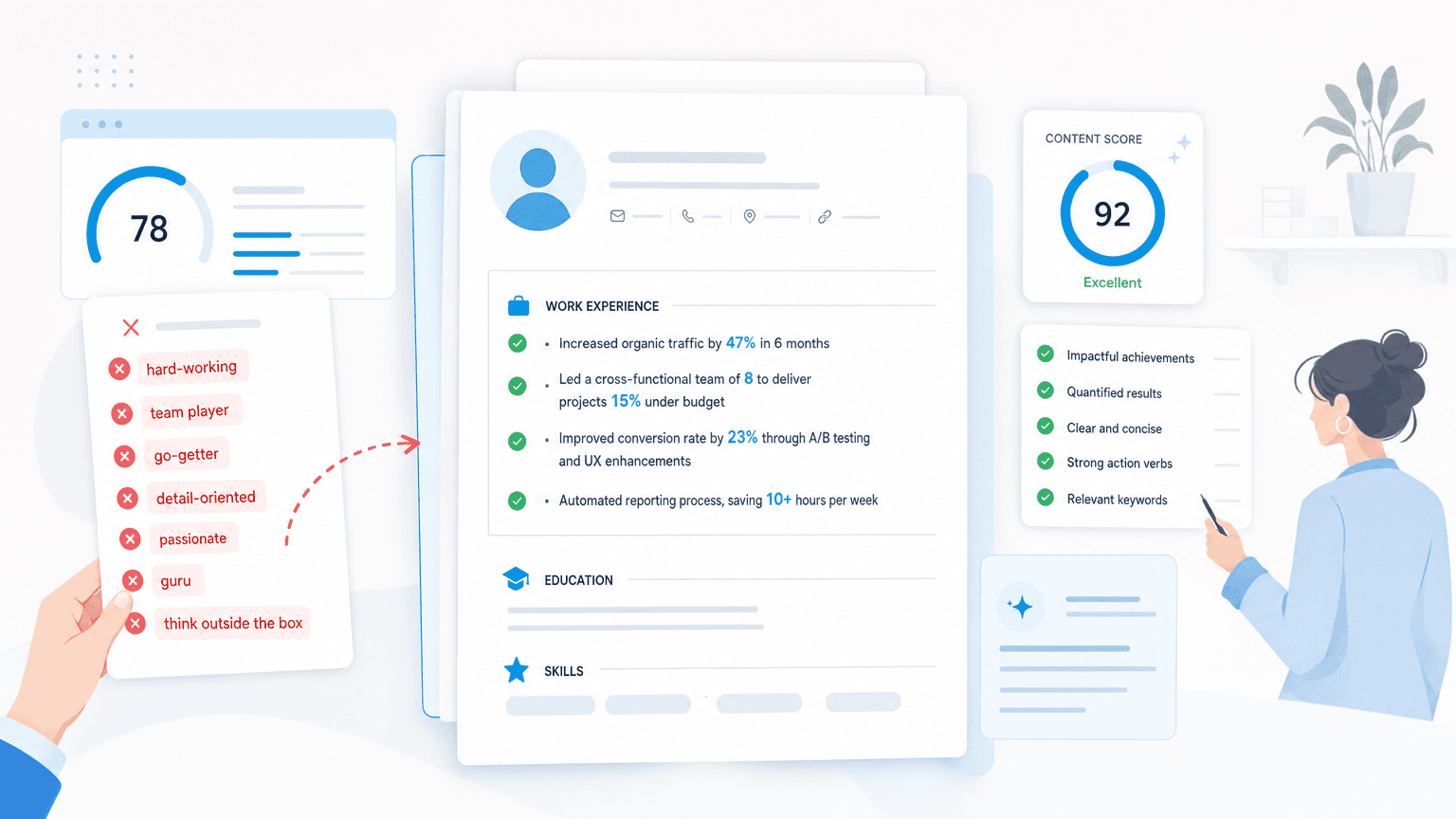
Buzzwords on resumes are everywhere, but are they helping or hurting your chances? While some hiring managers dismiss them as meaningless filler, others expect certain keywords to prove you understand industry standards. The truth is more nuanced: the right words in the right context can strengthen your application, while overused phrases without substance will get you filtered out by both ATS algorithms and human recruiters.
What Are Resume Buzzwords?
Resume buzzwords are trendy phrases and descriptors that job seekers use to describe their skills, work style, or achievements. They fall into two categories:
Meaningless buzzwords are vague, overused adjectives that don't communicate specific value:
- "Results-oriented professional"
- "Team player with excellent communication skills"
- "Detail-oriented self-starter"
- "Passionate about innovation"
Strategic keywords are specific terms from the job description that demonstrate relevant qualifications:
- Technical skills (Python, Salesforce, Six Sigma)
- Industry certifications (PMP, CPA, AWS Certified)
- Methodologies (Agile, Lean Manufacturing)
- Measurable competencies (budget management, stakeholder engagement)
The problem isn't using industry terminology, it's relying on empty descriptors instead of demonstrating capabilities through concrete examples.
Why Overused Resume Buzzwords Hurt Your Application
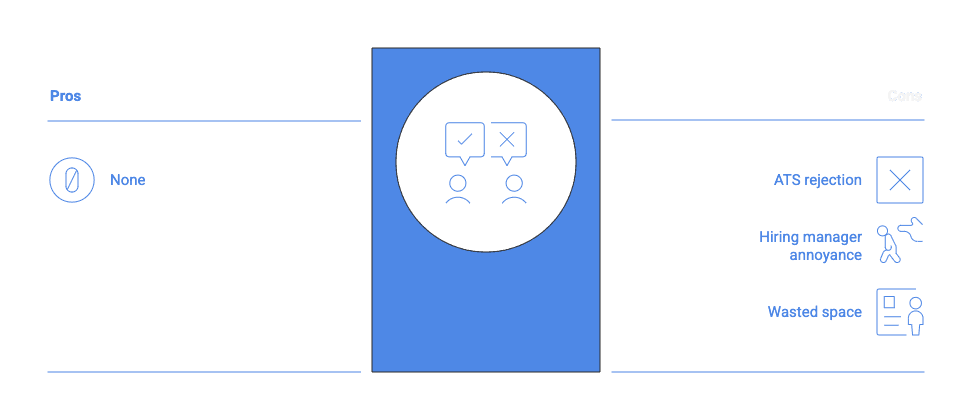
They Trigger ATS Filters
Applicant tracking systems scan for specific, job-relevant keywords, not generic personality claims. When you fill valuable resume space with phrases like "dynamic team player," you're missing opportunities to include the technical skills and qualifications the ATS is actually searching for.
What ATS looks for:
- Exact skill matches (Java, not "coding expertise")
- Certifications and credentials
- Years of experience with specific tools
- Industry-standard terminology
What ATS ignores:
- Subjective personality descriptors
- Vague soft skill claims without context
- Creative synonyms for standard terms
They Annoy Hiring Managers
Recruiters spend an average of 7 seconds on initial resume reviews. When they see the same tired phrases on every application, your resume blends into the pile. Worse, buzzwords without supporting evidence signal that you don't have concrete achievements to share.
As one hiring manager put it:
"If you tell me you're 'detail-oriented,' I assume you have nothing specific to say about your work. Show me you caught a $50K accounting error instead."
They Waste Prime Real Estate
Your resume has limited space, typically one page for early-career professionals, two for experienced candidates. Every line should communicate specific value. Buzzwords consume space that could showcase quantifiable achievements, technical proficiencies, or relevant project outcomes.
Space wasted:
"Results-driven marketing professional with excellent communication skills"
Space used well :
"Increased email campaign conversion rates by 34% through A/B testing and audience segmentation"
Every resume section, from your work experience to your skills section, should prioritize substance over buzzwords.
The Most Overused Resume Buzzwords to Avoid
LinkedIn's annual analysis of millions of resumes consistently identifies these offenders. If you're using them, you're saying the same thing as thousands of other applicants:
| Buzzword | Why It Fails | Better Alternative |
|---|---|---|
| "Results-oriented" | Everyone claims this; no one proves it | Show actual results with metrics |
| "Team player" | Vague and expected in most roles | Describe specific collaborative projects |
| "Hard worker" | Subjective and impossible to verify | Demonstrate work ethic through achievements |
| "Self-starter" | Overused and meaningless without context | Share examples of initiatives you launched |
| "Detail-oriented" | Generic claim that everyone makes | Cite specific quality improvements or error reductions |
| "Passionate" | Emotional language that doesn't prove capability | Let your accomplishments demonstrate commitment |
| "Innovative" | Buzzword that rarely comes with evidence | Describe actual innovations you implemented |
| "Strategic thinker" | Abstract claim without substance | Explain strategies you developed and their outcomes |
| "Expert" | Often exaggerated; let credentials speak | List certifications, years of experience, specific expertise areas |
| "Best-in-class" | Subjective and unverifiable | Provide rankings, awards, or comparative metrics |
Resume Keywords That Actually Work
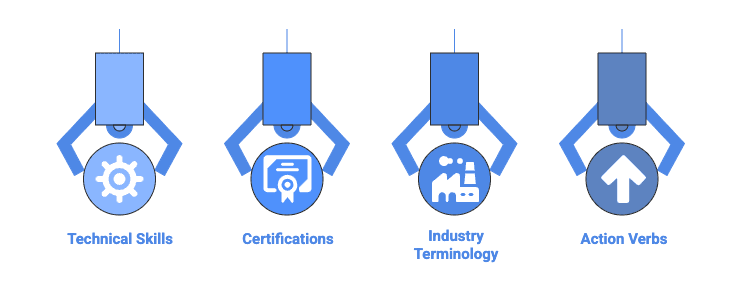
Not all industry terminology is bad. Strategic keywords, especially those pulled directly from job descriptions, help you get past ATS filters and signal relevant expertise to hiring managers.
Technical Skills and Tools
These are concrete, verifiable competencies that ATS systems actively scan for:
- Software: Salesforce, SAP, Adobe Creative Suite, Tableau, AutoCAD
- Programming languages: Python, JavaScript, SQL, R, C++
- Platforms: AWS, Azure, Google Cloud Platform, HubSpot
- Methodologies: Agile, Scrum, Lean Six Sigma, Design Thinking
Certifications and Credentials
Professional certifications carry weight because they're third-party validated:
- Project Management Professional (PMP)
- Certified Public Accountant (CPA)
- Professional in Human Resources (PHR)
- Google Analytics Certified
- AWS Solutions Architect
Industry-Specific Terminology
Using the right vocabulary for your field demonstrates insider knowledge:
- Finance: P&L management, variance analysis, GAAP compliance, financial modeling
- Marketing: SEO/SEM, conversion rate optimization, marketing automation, customer acquisition cost
- Healthcare: HIPAA compliance, EMR systems, patient care coordination, clinical protocols
- Manufacturing: Supply chain optimization, quality assurance, continuous improvement, production scheduling
Action Verbs That Demonstrate Impact
Replace weak verbs with stronger alternatives that convey specific actions:
Leadership & Management:
- Directed, orchestrated, spearheaded, championed, mentored, cultivated
Achievement & Results:
- Achieved, exceeded, accelerated, maximized, generated, delivered
Improvement & Optimization:
- Streamlined, enhanced, transformed, restructured, modernized, revitalized
Creation & Innovation:
- Developed, engineered, designed, launched, pioneered, architected
Analysis & Strategy:
- Analyzed, evaluated, forecasted, identified, strategized, assessed
How to Replace Buzzwords on Your Resume
The short answer is- using achievement focused language. The solution isn't eliminating descriptive language, it's backing up claims with evidence. Here's the transformation process:
The Formula: Action + Context + Result
- Buzzword version: "Results-oriented sales professional with excellent communication skills"
- Achievement-focused version: "Exceeded quarterly sales targets by 23% through consultative selling approach and strategic account management of 50+ enterprise clients"
Before and After Examples
Generic Buzzwords
- Team player who collaborates effectively across departments
- Detail-oriented with strong organizational skills
- Passionate about customer service excellence
Achievement-focused alternative:
- Coordinated cross-functional product launch involving engineering, marketing, and sales teams, delivering project 2 weeks ahead of schedule
- Reduced invoice processing errors by 47% by implementing automated validation checks and standardized review protocols
- Improved customer satisfaction scores from 3.2 to 4.6 (out of 5) by redesigning support ticket escalation process
The Quantification Test
If you can't attach a number, timeframe, or specific outcome to a statement, it's probably a buzzword. Ask yourself:
- How much? (percentage, dollar amount, volume)
- How many? (clients, projects, team members)
- How fast? (ahead of schedule, reduced time by X%)
- Compared to what? (exceeded target, improved from baseline)
When metrics aren't available, provide concrete context: specific projects, technologies used, scope of responsibility, or recognized outcomes (awards, promotions, expanded responsibilities).
Balancing ATS Keywords with Authentic Communication
Here's the challenge: you need keywords to get past ATS filters, but you also need authentic, achievement-focused content to impress human recruiters. The solution is strategic integration.
The Three-Layer Approach
Layer 1: Skills Section
Include a dedicated technical skills or core competencies section with job-relevant keywords. This satisfies ATS requirements without cluttering your experience descriptions.
TECHNICAL SKILLS
- Project Management: Agile, Scrum, JIRA, MS Project, risk mitigation
- Data Analysis: SQL, Python, Tableau, statistical modeling, data visualization
- Certifications: PMP, Certified Scrum Master (CSM)
Learn how to effectively list your skills on a resume for both ATS and human readers.
Layer 2: Experience Bullet Points
Weave keywords naturally into achievement-focused descriptions:
"Led Agile transformation for 15-person development team, reducing sprint cycle time by 30% and improving on-time delivery rate from 67% to 94%"
Layer 3: Summary or Profile
If you include a professional summary or resume headline, front-load it with high-priority keywords from the job description while maintaining readability:
"Senior Financial Analyst with 8+ years of experience in financial modeling, variance analysis, and FP&A for Fortune 500 companies. Expert in SAP, Hyperion, and advanced Excel; proven track record of identifying cost savings opportunities averaging $2M+ annually."
Keyword Density Guidelines
ATS systems look for keyword presence, not excessive repetition. Follow these principles:
- Include each critical keyword 2-3 times across your entire resume
- Use variations naturally: "project management," "managed projects," "project manager"
- Don't keyword stuff: Forced repetition hurts readability and can trigger spam filters
- Prioritize job description language: Use the exact terms from the posting when possible
AI-powered resume optimization platforms like Upplai can analyze keyword density and identify which terms from the job description are missing from your resume, helping you strike the right balance between ATS optimization and human readability.
Learn more about optimizing your resume for ATS systems beyond keyword density.
Industry-Specific Keyword Strategies
Different fields require different approaches to resume keywords and terminology.
Technology & Engineering
Prioritize: Specific programming languages, frameworks, tools, and methodologies.
Example:
"Developed microservices architecture using Node.js, Docker, and Kubernetes, reducing deployment time by 60%"
Avoid: Generic phrases like "tech-savvy" or "innovative problem solver"
Marketing & Creative
Prioritize: Platforms, metrics, campaign types, and creative tools.
Example:
"Managed $500K annual Google Ads budget across 12 campaigns, achieving 3.2% CTR and $42 cost per acquisition"
Avoid: Vague claims like "creative thinker" or "brand storyteller" without portfolio evidence
Finance & Accounting
Prioritize: Certifications, regulatory knowledge, financial systems, and analysis types.
Example:
"Performed variance analysis on $50M annual budget, identifying $3.2M in cost reduction opportunities through process optimization"
Avoid: Generic terms like "numbers person" or "financially savvy"
Healthcare
Prioritize: Certifications, compliance standards, patient care metrics, and clinical systems.
Example:
"Maintained 99.8% HIPAA compliance rate across 200+ patient records while reducing documentation time by 25% through Epic EMR optimization"
Avoid: Emotional appeals like "passionate about patient care" without clinical outcomes
Smart Keyword Shortcut
Identifying which buzzwords to remove and which keywords to add for a given job, can easily take 30-40 minutes. When you're customizing resumes for different roles, that level of optimization becomes time-consuming. Resume optimization platforms like Upplai automatically scan job descriptions to highlight missing keywords, flag overused buzzwords, and suggest achievement-focused alternatives, ensuring your resume passes ATS filters while staying authentic.