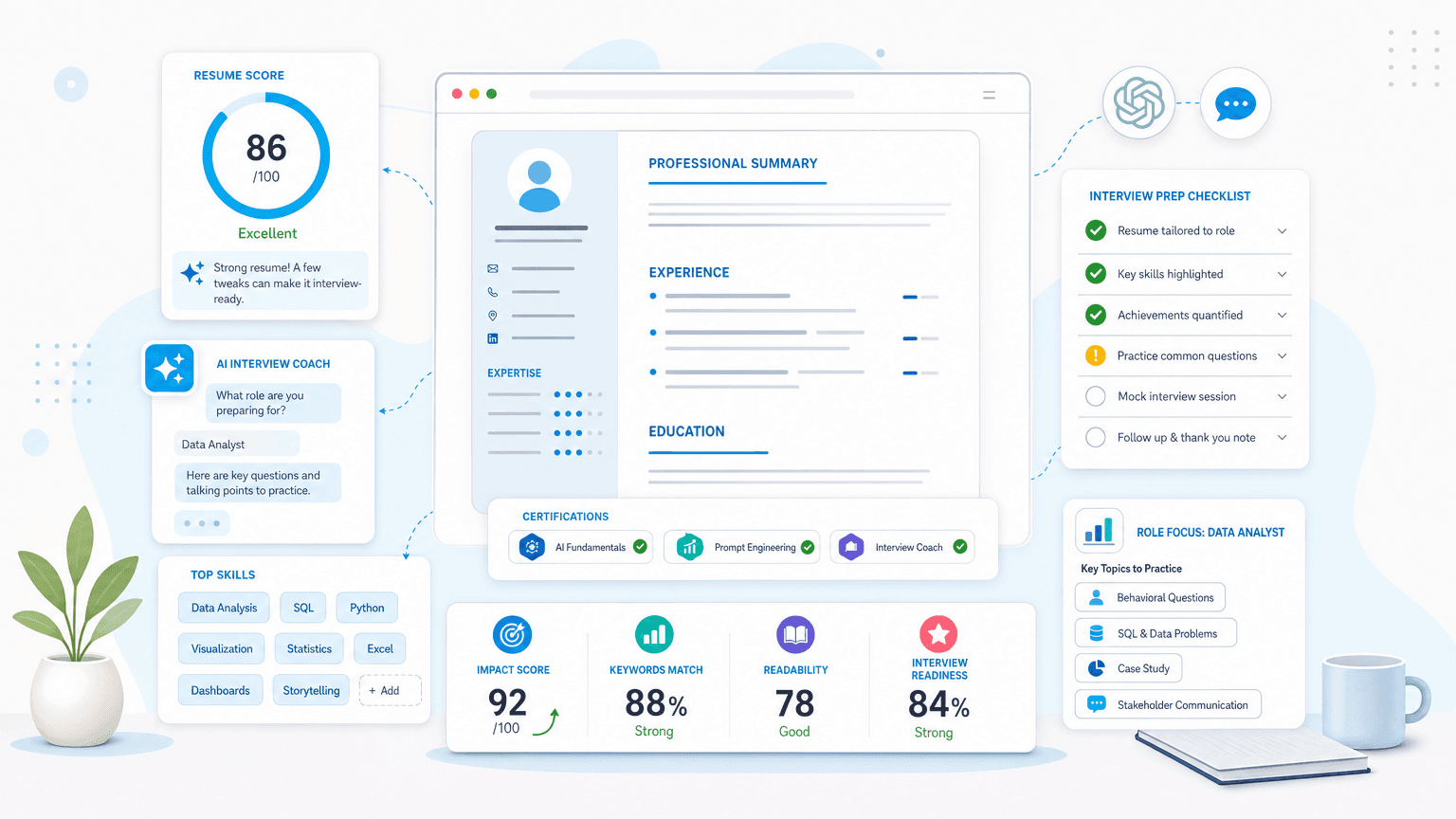
The best interview coach might be one you already have open in another tab. ChatGPT can research a company, predict the questions you will face, and run mock interviews on demand, at two in the morning if that is when the nerves hit. It never gets bored, and it never judges a rough first answer.
The catch is that it only helps as much as you direct it. Ask it a vague question and you get generic advice. Give it the job description, the company, and your real experience, and it becomes a sharp, personalized prep partner. This guide covers the ways to use ChatGPT to prepare for an interview, the questions to be ready for, a mock-interview prompt you can copy, and the few things you should not rely on it for.
How to Use ChatGPT to Prepare for an Interview
Research the company and the role
Walking in knowing the company sets you apart, and ChatGPT can compress an hour of reading into a few minutes. Paste the job description and the company name, and ask for a briefing: what the company does, its likely priorities, recent news, and how this role fits. A prompt that works is "Summarize what [company] does, their main products, and any recent news, then explain how a [role] contributes to their goals."
One caution: ChatGPT can be out of date or simply wrong about a specific company, so treat its summary as a starting point to verify rather than gospel. Confirm the important facts on the company's own site or recent press, and focus your deepest prep on the two or three companies you most want.
Predict the questions you'll be asked
Most interview questions are predictable if you read the job description closely, and ChatGPT is very good at this. Paste the full posting and ask it to generate the 15 to 20 questions you are most likely to get, split into behavioral, situational, and role-specific. It can reliably surface the bulk of what an interviewer will actually ask, which turns "I hope they don't ask about X" into a list you can practice against.
Ask it to explain why each question is likely, and to flag the two or three that would be hardest for someone with your background. That tells you exactly where to spend your time. The same prompt discipline that makes ChatGPT useful for resumes applies here; our guide to ChatGPT resume prompts covers the basics of writing a good one.
Common questions to prepare for every interview
Beyond the role-specific questions, a handful come up in nearly every interview. Prepare a strong answer for each of these before you walk in, and ask ChatGPT to drill you on them:
- "Tell me about yourself." A 60-second pitch: who you are professionally, one or two highlights, and why this role. Do not simply recite your resume.
- "Why do you want to work here?" Tie a specific thing about the company to what you want to do next. This is where your company research pays off.
- "Why are you leaving your job?" Keep it positive and forward-looking, and never badmouth a current or former employer.
- "What is your greatest strength?" Pick one that matches the job and back it with a quick example.
- "What is your greatest weakness?" Name a real one and what you are doing about it. Skip the fake "I just work too hard."
- "Tell me about a time you faced a challenge or conflict." A STAR story with a clear result. Have two or three ready.
- "Tell me about a time you failed." Show what you learned and changed. Honesty beats a non-answer.
- "Why should we hire you?" A tight summary of the two or three reasons you fit, mapped to the job's priorities.
- "Where do you see yourself in five years?" Show growth that fits the role and the company, and avoid hinting you will leave in a year.
- "What are your salary expectations?" Give a researched range and stay calm. Practice saying it out loud.
- "Do you have any questions for us?" Always have two or three good ones ready. Silence here reads as low interest.
Ask ChatGPT to run this list as a rapid-fire round, then critique your answers one at a time.
Run a full mock interview
This is where ChatGPT earns its keep. Ask it to act as the interviewer for your specific role and company and to ask one question at a time, waiting for your answer before moving on. Answer out loud or by typing, and after each one, have it give you feedback on clarity, structure, and whether you actually answered the question.
Because it never tires, you can run five or ten rounds and watch your answers tighten. If you have access to ChatGPT's voice mode, use it for a few sessions, because speaking your answers under a little pressure is far closer to the real thing than typing them.
Turn your stories into strong STAR answers
Behavioral questions ("tell me about a time...") are best answered with the STAR method: Situation, Task, Action, and Result. Most candidates nail the first three and fumble the last one, describing what they did without landing the result. ChatGPT is a great editor here: give it a rough story and ask it to restructure it into a tight STAR answer and to push you on the measurable result.
The efficient move is to build a library of 8 to 10 strong stories, because the same story can answer many questions. One project can cover "a challenge," "a conflict," and "a time you led." Ask ChatGPT to map your stories to the common behavioral themes so you know which one to reach for. Give it your real examples, though, and do not let it invent achievements you will have to defend in the room.
Prepare smart questions to ask them
"Do you have any questions for us?" still counts, and interviewers read your questions as a signal. Ask ChatGPT to suggest thoughtful questions based on the role and company, then pick the few you genuinely want answered. The good ones show you understand the role and are already thinking about how you would succeed in it.
Skip anything you could answer with a ten-second search, and steer away from pay and time off in a first round. Ask ChatGPT to flag which of its suggestions might come across the wrong way.
Rehearse the tough ones
Every interview has a few questions that make people freeze: your greatest weakness, a gap in your resume, why you are leaving, or your salary expectations. Rehearse these specifically. Ask ChatGPT to play a tough interviewer and drill you on the ones you dread, then help you shape honest, composed answers.
For salary in particular, ask it to help you research a realistic range for the role and location, then practice giving that range without underselling yourself. The goal is to have said the words out loud once before you have to say them for real.
A Mock Interview Prompt You Can Copy
Vague prompts give generic practice. This one sets up a realistic session:
"You are an experienced interviewer hiring for a [role] at [company]. Here is the job description: [paste]. Here is my background: [paste your resume or a short summary]. Interview me one question at a time, starting with a warm-up and moving into behavioral and role-specific questions. Wait for my answer before asking the next one. After each answer, give me brief, honest feedback on structure, clarity, and whether I actually answered the question, then continue. Keep going until you have asked ten questions."
Follow up with edits like "ask harder follow-up questions" or "focus on leadership scenarios." For other tools that do this, including dedicated interview apps, see our roundup of the best ChatGPT apps for job seekers.
What ChatGPT Can't Do for Your Interview
ChatGPT is a rehearsal room, and the real interview is still yours to carry. A few limits are worth keeping in mind. It does not know your actual interviewers, the team's real dynamics, or what happened in the room last week, so its company insight is a starting point you verify rather than take as the final word. It cannot read your tone, body language, or nerves, which are a big part of how you actually come across. And it will confidently make up details, so any fact it gives you about the company or the role needs a second source.
The biggest risk is over-scripting. If you memorize ChatGPT's answers word for word, you will sound rehearsed and stiff, and you will stumble the moment the interviewer asks a follow-up. Use it to structure your thinking and practice out loud, then walk in and have a real conversation.
Get the Interview First: Where Upplai Fits
All of this assumes you have an interview to prepare for, and getting there is the step before the prep. The fastest way to earn more interviews is a resume tailored to each role so it clears the applicant tracking system and lands in front of a human. That is what Upplai does: it scores your resume against a specific job, surfaces the keywords you are missing, and tailors it while keeping it yours.
It also helps once the callbacks start. Upplai's application tracker saves the tailored resume, cover letter, and job description for every role you apply to, so when an interview is booked, the exact posting you need for your ChatGPT prep is already there instead of lost in a closed tab. Land more interviews, keep every application organized, then use the prep in this guide to walk in ready.
Get more interviews to prepare for
Tailor your resume to the job with Upplai, land more interviews, and keep every posting saved for your prep.