In today's global job market, language skills can be the differentiator that lands you an interview, or the missed opportunity that costs you one. Yet most job seekers either undersell their linguistic abilities or misrepresent them, both of which hurt their chances.
Why Language Skills Matter More Than You Think
Language proficiency is a hard skill that directly impacts your value to employers. Bilingual employees earn 5-20% more per hour than monolingual counterparts. More importantly, 90% of US employers rely on employees who speak languages other than English, and 56% report their demand for bilingual speakers will increase over the next five years.
But here's the catch: recruiters spend an average of 7 seconds scanning your resume. If your language skills are buried in a paragraph of text or described with vague terms like "conversational Spanish," you've wasted a valuable opportunity to stand out.
The stakes are even higher when Applicant Tracking Systems (ATS) are involved. These systems scan for specific keywords and formatting patterns. If a job description asks for "fluent French" and you've listed "good at French," the ATS may filter you out before a human ever sees your application, even if you're perfectly qualified.
Where to List Languages on a Resume

The placement of your language skills depends on their relevance to the target role. Here's how to decide:
Option 1: Dedicated "Languages" Section
Best for: Roles where language skills are essential or highly valued (translator, international sales, customer support, diplomacy)
Place this section prominently, typically after your work experience or skills section. Use this format when you speak multiple languages or when the job description specifically mentions language requirements.
Example:
Languages
• Spanish: Native proficiency • English: Professional working proficiency (TOEFL iBT: 110/120) • French: Limited working proficiency (DELF B1)
Option 2: Within Your Skills Section
Best for: Roles where languages are a bonus but not central to the position
Integrate language skills into your existing skills section alongside technical and soft skills. This works well when you have 1-2 languages beyond your native tongue.
Example:
Skills
Technical: Salesforce, HubSpot, SQL, Tableau Languages: English (native), Mandarin (professional working proficiency – HSK 5) Soft Skills: Cross-cultural communication, negotiation, stakeholder management
Option 3: In Your Resume Header
Best for: Bilingual or multilingual professionals where language skills are a core qualification
Include language proficiency directly in your resume headline just after your contact information when it's a primary selling point.
Example:
Maria Rodriguez
New York, NY | (206) 555-0147 | m.rodriguez@email.com | linkedin.com/in/maria.r
Senior Account Manager | Bilingual (English/Spanish)
Results-driven Account Manager with 8+ years of experience building relationships with Fortune 500 clients across diverse markets. Proven track record of exceeding revenue targets by 25% through strategic client engagement and cross-cultural communication. Native Spanish speaker with advanced business fluency, specializing in expanding market reach within Hispanic communities and Latin American partnerships.
Don't do this: Never bury language skills in your work experience descriptions unless you're providing specific examples of how you used them to achieve results.
How to Describe Language Proficiency Accurately
Vague descriptors/buzzwords like "fluent" or "conversational" mean different things to different people. Use standardized frameworks that recruiters and ATS systems recognize.
The ILR Scale (Interagency Language Roundtable)
Used by U.S. government agencies and many corporations, the ILR scale ranges from 0-5:
| ILR Level | Description | What You Can Do |
|---|---|---|
| 0 - No Proficiency | No practical ability | Cannot function in the language |
| 1 - Elementary Proficiency | Basic courtesy phrases | Handle simple social situations |
| 2 - Limited Working Proficiency | Routine professional topics | Discuss familiar topics with confidence |
| 3 - Professional Working Proficiency | Complex discussions | Participate in formal/informal conversations on practical, social, and professional topics |
| 4 - Full Professional Proficiency | Fluent and accurate | Speak with precision, vocabulary, and cultural references |
| 5 - Native or Bilingual Proficiency | Equivalent to educated native speaker | Complete mastery including cultural nuances |
The CEFR Framework (Common European Framework of Reference)
Widely recognized in Europe and increasingly used globally, CEFR uses six levels:
| CEFR Level | Description | Resume Language |
|---|---|---|
| A1-A2 | Basic user | Elementary proficiency |
| B1-B2 | Independent user | Intermediate to upper-intermediate proficiency |
| C1-C2 | Proficient user | Advanced to native-like proficiency |
Resume-Friendly Terminology
Match your actual ability to these commonly accepted terms:
- Native/Bilingual Proficiency: Spoke from childhood or equivalent mastery
- Full Professional Proficiency: Can work entirely in this language without limitation
- Professional Working Proficiency: Can handle complex work discussions with occasional difficulty
- Limited Working Proficiency: Can manage routine work conversations
- Elementary Proficiency: Basic phrases and simple conversations
Pro tip: If you have official test scores (TOEFL, IELTS, DELF, HSK, etc.), include them. They provide objective validation that both ATS systems and recruiters trust.
Language Skills Resume Examples
Example 1: Multilingual Professional (Dedicated Section)
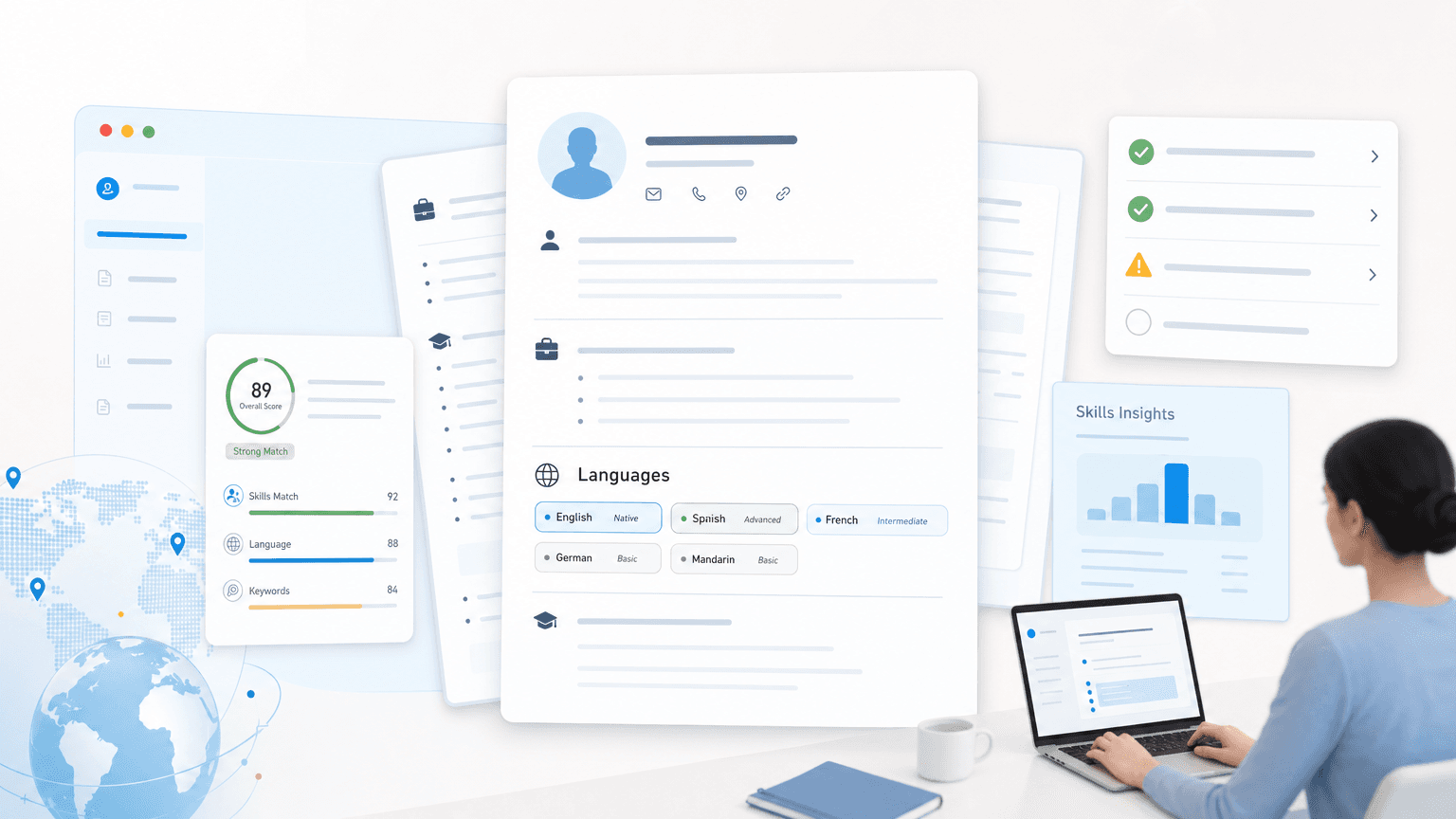
Languages
- English: Native proficiency
- Mandarin Chinese: Professional working proficiency (HSK 6, ACTFL Advanced High)
- Spanish: Limited working proficiency (DELE B2)
- French: Elementary proficiency (DELF A2)
Example 2: Bilingual Professional (Integrated)
Core Competencies
• Customer Relationship Management • Technical Support & Troubleshooting • Bilingual Communication: English (native), Portuguese (native) • Salesforce & Zendesk Administration • Process Improvement & Documentation
Example 3: Language Skills with Context
Professional Experience
International Sales Manager GlobalTech Solutions | 2026–Present
- Expanded the Latin American market by 340% ($2.1M to $9.2M ARR) by conducting sales presentations and contract negotiations in Spanish and Portuguese
- Built relationships with C-suite executives across 12 countries, leveraging native-level English and professional working proficiency in Spanish (DELE C1) and Portuguese (CELPE-Bras Advanced)
- Trained a 15-person sales team on cross-cultural communication strategies for Spanish-speaking markets
Language Certifications That Matter to Employers
Official certifications provide objective proof of your language proficiency. Here are the most recognized:
English
- TOEFL iBT: 120-point scale, widely accepted in North America
- IELTS: 9-band scale, preferred in UK/Commonwealth countries
- Cambridge English: Multiple levels (B2 First, C1 Advanced, C2 Proficiency)
Spanish
- DELE: Official certification from Instituto Cervantes (A1-C2)
- SIELE: Digital certification recognized globally
French
- DELF/DALF: Official French Ministry of Education certification (A1-C2)
- TCF: Test de Connaissance du Français
Mandarin Chinese
- HSK: 6-level proficiency test (HSK 1-6)
- HSKK: Oral proficiency test
German
- Goethe-Zertifikat: Official certification (A1-C2)
- TestDaF: For academic and professional contexts
When to include certifications: Always include the certification name, level, and year obtained if it's within the last 3-5 years. Older certifications are still valuable but consider retaking if your skills have improved significantly.
See our comprehensive guide on how to list certifications on your resume for formatting and placement best practices.
Common Mistakes That Hurt Your Application
Mistake 1: Overstating Your Proficiency
Claiming "fluent Spanish" when you can barely hold a conversation will backfire spectacularly if the interviewer switches to Spanish mid-interview. This happens more often than you think.
Fix: Be honest. "Limited working proficiency" is impressive for a language you've studied independently. Recruiters respect accuracy over exaggeration.
Mistake 2: Using Inconsistent Terminology
Listing "fluent French" and "conversational Spanish" on the same resume creates confusion. What does "fluent" mean to you? What's the difference between "fluent" and "conversational"?
Fix: Use standardized frameworks (ILR or CEFR) consistently across all languages you list.
Mistake 3: Listing Languages You Studied But Don't Remember
Putting "Spanish: 4 years of high school classes" signals that you probably can't actually use Spanish in a professional setting. If you can't hold a work conversation in the language, don't list it.
Fix: Only include languages where you have at least elementary proficiency (A2/ILR 1+). If you're actively learning, you can mention it in your cover letter or LinkedIn profile instead.
Mistake 4: Ignoring ATS Keyword Matching
If the job description says "bilingual Spanish/English required" and you write "speaks Spanish," the ATS may not make the connection.
Fix: Mirror the language from the job description. If they say "bilingual," use "bilingual." If they specify "fluent Spanish," use "fluent Spanish" (assuming it's accurate).
Mistake 5: Formatting That Breaks ATS Parsing
Graphics, text boxes, and tables sometimes confuse ATS systems, causing your language skills to be missed entirely.
Fix: Use simple formatting with clear headers. Test your resume through an ATS checker to ensure your language skills section is being parsed correctly.
How to Tailor Language Skills to Job Requirements
Not all language skills are equally relevant to every role. Here's how to emphasize what matters:
Scenario 1: Language Required for the Role
Job description: "Must be fluent in English and Spanish for client-facing communications"
Your approach:
- Place language skills prominently (dedicated section or header)
- Include certifications if you have them
- Provide specific examples in work experience of using both languages professionally
- Match the exact terminology from the job description
Scenario 2: Language as a Competitive Advantage
Job description: "Spanish proficiency a plus"
Your approach:
- Include in skills section rather than creating dedicated section
- Mention in cover letter how your language skills add value
- Quantify impact if possible (e.g., "expanded customer base by serving Spanish-speaking clients")
Scenario 3: Language Irrelevant to Role
Job description: No mention of language requirements
Your approach:
- Include languages in skills section only if space permits
- Don't emphasize or create dedicated section
- Focus resume real estate on more relevant qualifications
Time Saving Tip
Manually tailoring your resume for each application takes 40-60 minutes. AI resume builders like Upplai can analyze the job description, identify which skills to emphasize (including language skills0, and reorganize to match what the ATS is scanning for, reducing this process to minutes while ensuring you don't miss critical keywords.