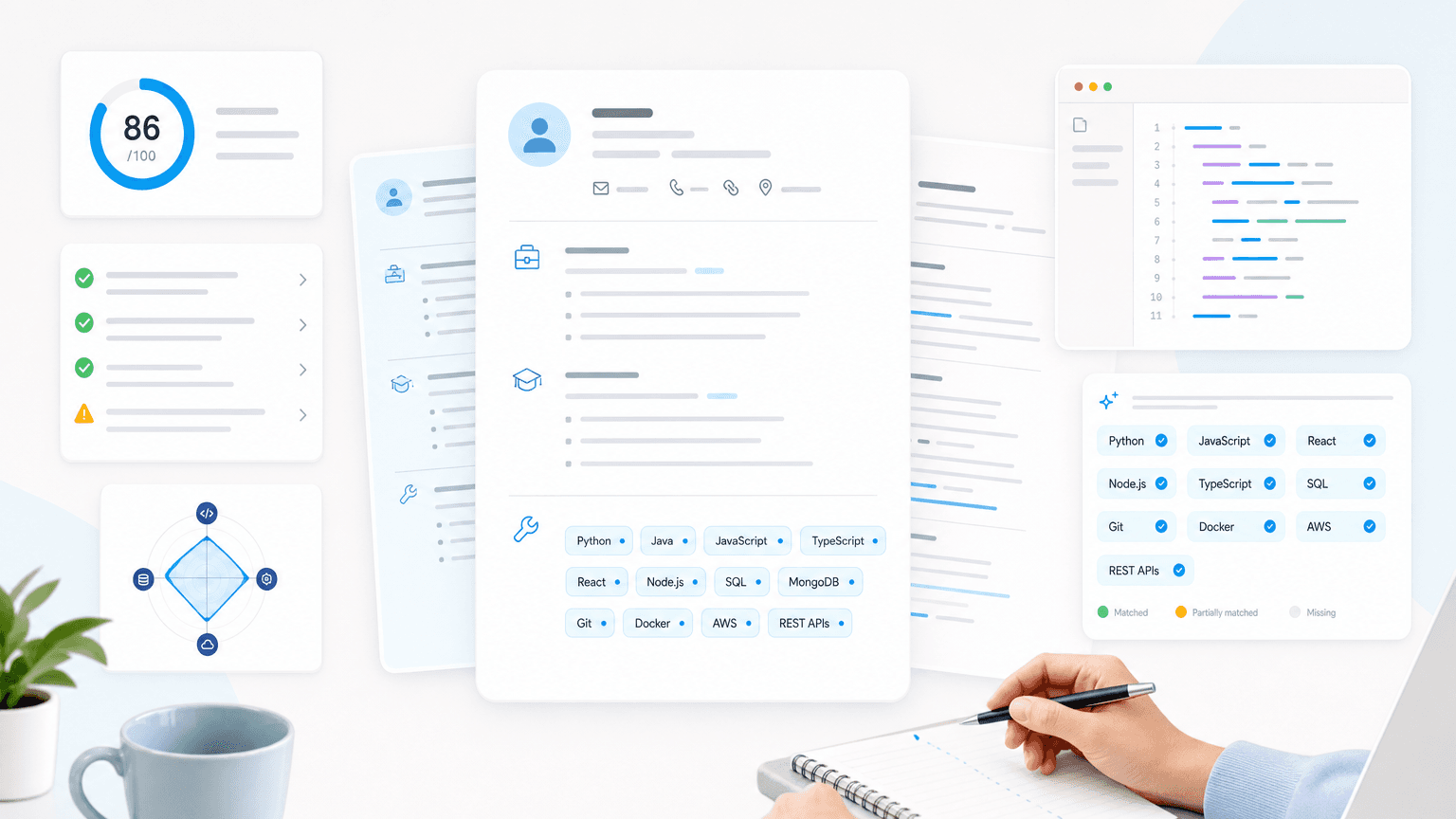
You've spent years mastering programming languages, debugging code at 2 AM, and building projects that actually work. But when it comes to your resume, listing "Python, Java, JavaScript" in a bullet point doesn't capture your expertise, and it definitely won't get you past the ATS filters that 75% of large employers use for resume screening.
What Programming Skills Should You Include on Your Resume?
Not all programming languages carry equal weight. The skills you highlight should align with three factors: market demand, job requirements, and your actual proficiency.
According to the Stack Overflow Developer Survey, the most in-demand programming languages are:
| Programming Language | Use Case | Typical Roles |
|---|---|---|
| JavaScript (66%) | Web development, full-stack applications | Frontend Developer, Full-Stack Engineer |
| HTML/CSS (62%) | Web design and structure | Frontend Developer, Web Designer |
| SQL (59%) | Database management, data analysis | Data Analyst, Backend Developer, Database Administrator |
| Python (58%) | Data science, machine learning, automation | Data Scientist, ML Engineer, Backend Developer |
| Bash/Shell (49%) | DevOps, automation, system administration | DevOps Engineer, Site Reliability Engineer |
| TypeScript (44%) | Large-scale web applications | Senior Frontend Developer, Full-Stack Engineer |
| Java (29%) | Enterprise applications, Android development | Software Engineer, Android Developer |
| C# (28%) | Game development, enterprise software | Game Developer, .NET Developer |
The key principle: Tailor your resume to emphasize the programming languages mentioned in the job description. If a role lists Python and SQL as requirements, those should appear prominently, not buried in a generic "Skills" section.
Where to List Programming Skills on Your Resume
Programming skills should appear in multiple strategic locations across your resume sections, not just one 'Skills' section. ATS systems scan your entire resume for keywords, and recruiters look for technical validation throughout your experience.
Option 1: Dedicated Technical Skills Section
Place the Skills section near the top of your resume (after your resume summary but before work experience) if you're applying for technical roles where programming is the primary requirement.
Technical Skills
- Languages (Proficient): Python, JavaScript, TypeScript, SQL
- Languages (Familiar): Java, C++, Bash/Shell
- Frameworks & Tools: React, Node.js, Django, PostgreSQL, Git, Docker
- Specializations: RESTful API Design, Database Optimization, Test-Driven Development
Why this works: Organizing by proficiency level sets honest expectations while still capturing ATS keywords. The framework and specialization categories provide context that a simple language list can't convey.
Option 2: Integrated Within Work Experience
For senior developers or those with extensive experience, demonstrate programming skills through achievements in your work experience section rather than simply listing them as skills:
EXPERIENCE
Senior Software Engineer TechCorp | 2026–Present
- Architected a microservices platform using Python and FastAPI, reducing API response time by 40% and supporting 2M+ daily requests
- Led a frontend modernization initiative with TypeScript and React, improving code maintainability scores from 62 to 89 (SonarQube metrics)
- Optimized SQL queries and database indexing strategies, cutting report generation time from 3 minutes to 12 seconds
Why this works: You're not just claiming you know Python, you're proving it with quantifiable results. This approach works especially well for experienced developers where "years of experience" matters more than "list of languages."
Option 3: Hybrid Approach (Recommended for Most Developers)
Combine both methods: a concise technical skills section for ATS optimization, plus skill-integrated bullet points in your work experience for human readers.
How to Organize Programming Skills by Proficiency Level
Honesty about your skill level prevents interview disasters while still maximizing your ATS score. Here's how to categorize your programming expertise:
Proficient/Advanced: You've used this language professionally for 2+ years, can debug complex issues independently, and would be comfortable being the go-to expert on your team.
Intermediate/Familiar: You've completed substantial projects (work or personal) in this language, understand core concepts, but might need documentation for advanced features.
Basic/Learning: You've taken courses or built small projects but haven't used it in production environments. Consider omitting these unless the job specifically mentions "willingness to learn" as acceptable.
Example categorization:
Skills by Proficiency Level
Expert Level JavaScript (ES6+), Python, SQL, HTML/CSS 5+ years of production experience
Proficient TypeScript, React, Node.js, PostgreSQL, Git 2–4 years of production experience
Working Knowledge Java, C#, Bash/Shell, Docker Used in multiple projects; comfortable with fundamentals
Pro tip: If a job description lists a language you're "familiar" with but not expert in, don't hide it. Instead, demonstrate learning agility: "Rapidly acquired TypeScript proficiency to migrate legacy JavaScript codebase, completing transition 3 weeks ahead of schedule."
Best Practices for Listing Programming Languages
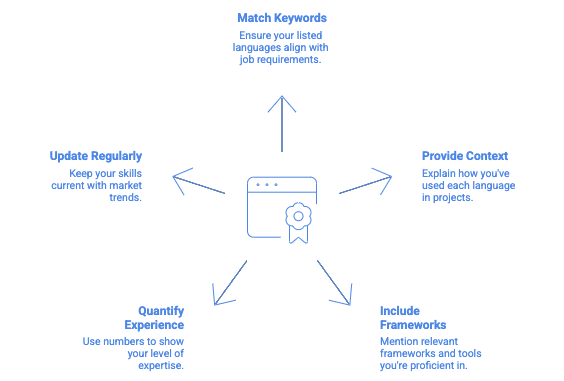
1. Match the Job Description Keywords Exactly
ATS systems look for exact matches. If the job posting says "JavaScript," don't just list "JS." If it mentions "Bash/Shell scripting," use that exact phrasing.
Before (ATS-unfriendly):
- JS, React framework, Postgres DB, Shell scripting
After (ATS-optimized):
- JavaScript, React, PostgreSQL, Bash/Shell
2. Provide Context Beyond the Language Name
Programming languages don't exist in isolation. Show what you've built with them:
Generic:
- Python, Django, REST APIs
Specific and Achievement-Focused:
- Python (Django): Built RESTful APIs serving 500K+ requests/day with 99.9% uptime
3. Include Relevant Frameworks and Tools
Modern development isn't just about languages, it's about ecosystems. Group related technologies together:
Backend Development: Python, Django, FastAPI, PostgreSQL, Redis
Frontend Development: JavaScript, TypeScript, React, Next.js, Tailwind CSS
DevOps & Tools: Git, Docker, Jenkins, AWS (EC2, S3, Lambda), Bash/Shell
4. Quantify Your Experience When Possible
Numbers make your expertise tangible:
- "Python: 5+ years professional experience"
- "JavaScript: 10,000+ lines of production code maintained"
- "SQL: Managed databases with 50M+ records"
5. Update Based on Current Market Trends
Programming skill relevance changes. TypeScript has surged in demand over the past three years. Python dominates data science roles. Make sure your resume reflects current market realities, not what was popular when you graduated.
Learn more about ATS keyword optimization beyond programming skills
Common Mistakes When Listing Programming Skills
Mistake 1: The "Kitchen Sink" Approach
Listing every language you've ever touched dilutes your expertise. If you took one Java class in college five years ago and haven't used it since, leave it off. Recruiters will assume equal proficiency across all listed skills.
Mistake 2: Ignoring ATS Optimization
75% of resumes get filtered out by ATS before human review. If your programming skills are formatted as an image, hidden in a sidebar, or use non-standard section headers ("My Tech Stack" instead of "Technical Skills"), the ATS might miss them entirely.
Mistake 3: No Evidence in Work Experience
Claiming "Expert in Python" in your skills section but showing zero Python-related achievements in your work history creates credibility gaps. Your experience section should validate your skills section.
Mistake 4: Outdated Technologies Without Context
If you're listing legacy languages (COBOL, Fortran, Visual Basic), provide context: "COBOL: Maintained legacy banking systems during modernization project, facilitating migration to Java-based architecture." This shows you're not stuck in the past, you're bridging it to the present.
Mistake 5: Vague Proficiency Claims
"Proficient in multiple programming languages" tells recruiters nothing. Be specific. ATS systems can't score vague claims, and hiring managers won't bother following up.
Programming Skills Resume Examples by Role
Example 1: Frontend Developer
Sarah Chen | Frontend Developer
San Francisco, CA | sarah.chen@email.com | github.com/sarachen
Technical skills
- Languages: JavaScript (ES6+), TypeScript, HTML5, CSS3
- Frameworks & Libraries: React, Next.js, Vue.js, Tailwind CSS, Redux
- Tools & Platforms: Git, Webpack, Vite, Figma, Chrome DevTools
- Testing: Jest, React Testing Library, Cypress**
Professional experience
Senior Frontend Developer | DesignTech | 2026–Present
- Rebuilt an e-commerce platform using React and TypeScript, improving page load speed by 60% and increasing conversion rate from 2.1% to 3.4%
- Implemented a responsive design system with Tailwind CSS, reducing CSS bundle size by 40% and ensuring consistent UI across 50+ components
- Established frontend testing standards using Jest and Cypress, achieving 85% code coverage and reducing production bugs by 35%
Example 2: Data Engineer
Marcus Johnson | Data Engineer
Austin, TX | marcus.j@email.com | linkedin.com/in/marcusjohnson
Technical Skills
- Languages: Python, SQL, Bash/Shell, Scala
- Data Technologies: Apache Spark, Airflow, Kafka, Hadoop
- Databases: PostgreSQL, MongoDB, Redshift, Snowflake
- Cloud & DevOps: AWS (S3, EMR, Lambda, Glue), Docker, Terraform
Professional Experience
Data Engineer | DataCorp | 2026–Present
- Architected ETL pipelines using Python and Apache Airflow, processing 5TB of data daily with 99.8% reliability
- Optimized SQL queries and database schemas in PostgreSQL, reducing report generation time from 45 minutes to 4 minutes
- Built a real-time data streaming solution with Kafka and Spark, enabling sub-second analytics for 2M+ daily events
Example 3: Full-Stack Developer (Career Changer)
Alex Rivera | Full-Stack Developer
Denver, CO | alex.rivera@email.com | Portfolio: alexrivera.dev
Professional summary
Former project manager who transitioned into full-stack development through intensive bootcamp training and two years of freelance projects. Specialized in building scalable web applications using modern JavaScript frameworks and Python-based backends.
Technical Skills
- Frontend: JavaScript, React, HTML/CSS, TypeScript
- Backend: Python, Node.js, Express, Django
- Database: PostgreSQL, MongoDB, SQL
- DevOps: Git, Docker, AWS, CI/CD (GitHub Actions)
Technical Experience
Freelance Full-Stack Developer | Self-Employed | 2026–Present
- Developed 8 client websites using React and Node.js, delivering projects 15% under budget while maintaining a 4.9/5 client satisfaction rating
- Built an inventory management system with Python (Django) and PostgreSQL, reducing client manual data entry by 20 hours per week
- Implemented RESTful APIs and database schemas for an e-commerce platform handling 1,000+ daily transactions
How to Tailor Programming Skills for Each Application
Generic resumes don't get responses. The programming skills you emphasize should shift based on the specific role:
For a Python-focused data science role:
- Lead with Python, SQL, and data science libraries (pandas, NumPy, scikit-learn)
- De-emphasize frontend skills unless the job mentions data visualization
For a JavaScript-heavy frontend position:
- Prioritize JavaScript, TypeScript, React, and related frameworks
- Include HTML/CSS prominently (some developers forget these foundational skills)
For a full-stack role:
- Balance frontend and backend skills equally
- Highlight your ability to work across the entire stack
Time Saving Tip
Manually tailoring your resume for each application takes 40-60 minutes. AI resume builders like Upplai can analyze the job description, identify which programming skills to emphasize, and reorganize your technical skills section to match what the ATS is scanning for, reducing this process to minutes while ensuring you don't miss critical keywords.