A lateral move is not an ordinary job change. The receiving agency may compare your resume with an official application, personal history statement, training file, credential record, employment history, and background interview. A polished bullet cannot repair a contradiction among those records.
The resume still has an important job when an agency requests or reviews one. It helps a hiring panel understand what kind of officer you have been, where your authority applied, which assignments and systems you know, and how that experience relates to the opening. This guide focuses on experienced officers pursuing lateral roles. It does not replace the agency's application, civil-service, certification, medical, psychological, physical, or background requirements.
Confirm That the Agency Wants a Resume
Read the announcement before choosing a format. Lateral police hiring is not standardized. An agency may:
- require a resume as an attachment;
- accept one as optional supporting material;
- ask for a resume later in the process;
- require a complete online application and supplemental questionnaire regardless of the resume; or
- tell applicants not to substitute a resume for required application fields.
Follow the most specific instruction. If the agency asks for both an application and resume, complete both fully. Do not write See resume in a required employment-history field unless the form expressly permits it.
Establish Your Lateral Eligibility Without Overstating It
Credential language changes across states and agencies. Avoid broad labels such as POST certified when your record provides a more precise name. List:
- the exact certificate or credential;
- the issuing state, commission, or authority;
- the award or issue date; and
- an expiration date when the credential has one.
Do not add Active or Current to an ordinary valid credential. If reciprocity, a waiver, academy placement, additional training, or another receiving-state decision is pending, state that stage separately.
These lines describe materially different situations:
California POST Basic Certificate, awarded December 2020
Oregon certification waiver review pending, application submitted July 2026
The first line records a credential already awarded. The second records an unfinished receiving-state process. Neither should be rewritten to imply automatic transfer.
Academy completion is also different from an awarded professional certificate. Copy the exact course, academy, certificate, or eligibility document your record supports instead of converting one into another.
Write a Summary That Makes Prior Service Comparable
A lateral summary should orient the reader in two or three sentences. Include the facts that determine fit:
- years of sworn experience;
- jurisdiction and agency type;
- primary assignment or specialty;
- exact credential when it is central to eligibility; and
- the lateral role or agency environment you are pursuing.
Experienced law-enforcement professional seeking a challenging position with opportunities for growth.
Patrol officer with seven years of municipal law-enforcement experience across calls for service, incident reporting, collision response, public contact, and community meetings. California POST Basic Certificate awarded December 2020. Targeting a lateral patrol role with a community-focused municipal agency.
The stronger version gives the panel a jurisdiction, assignment, evidence categories, exact certificate, and direction. It does not promise reciprocity, borrow investigative authority, or rely on generic traits.
Define Assignment and Workload Before Using Metrics
Numbers become useful only when the reader understands the unit, period, source, and your role. Calls for service, reports, traffic contacts, arrests, cases, community contacts, training hours, and court appearances are not interchangeable.
Handled more than 1,000 calls and maintained an excellent report record.
Served as the primary responding unit on 1,146 calls for service in 2025 according to CAD records, coordinating with dispatch, supervisors, fire, emergency medical services, and partner agencies as required.
The revised bullet defines the year, source, and officer role. It does not claim sole resolution or turn every call into an enforcement result.
Report evidence can show documentation scope without pretending the first draft was perfect:
Authored 312 incident reports in 2025; records quality review accepted 304 on initial submission and accepted eight after correction.
Use the agency's real review category. Do not replace it with error-free, legally sufficient, or another conclusion the record does not support.
Treat Enforcement and Case Outcomes as High-Risk Claims
Force, complaint, arrest, crime-rate, clearance, charging, prosecution, and conviction measures depend on definitions and decisions that often extend beyond one officer. A complaint may be pending, sustained, not sustained, exonerated, unfounded, informal, or classified another way. An arrest is not a charge, and a charge is not a conviction.
Use one of these measures only when an approved record establishes:
- the exact category and denominator;
- the period and comparison population;
- the source and review owner;
- the disposition, when relevant;
- your contribution rather than the agency's entire result; and
- permission to disclose it publicly.
When that record is unavailable, calls, reports, training, documentation, public contact, and team coordination can provide credible scope without forcing a dramatic outcome onto the page.
Preserve Agency, Supervisor, Investigator, and Court Boundaries
Describe the actions you performed within assignment. An officer may respond, document, conduct an initial interview, preserve or submit evidence, refer a matter, coordinate with another unit, and prepare for court. Supervisors, investigators, prosecutors, courts, dispatchers, analysts, and partner agencies may own other decisions and outcomes.
The same boundary applies to community work. A meeting attendance count shows reach. It does not prove trust, sentiment, crime reduction, or a unique number of residents unless a separate record supports that conclusion.
Remove Operational and Personal Information
A public resume should not expose:
- victims, witnesses, suspects, juveniles, informants, complainants, or protected personnel;
- active-case details or evidence specifics;
- precise beat boundaries, schedules, routes, access points, or staffing patterns;
- tactics, vulnerabilities, response plans, or surveillance placement;
- database-query methods, credentials, radio codes, or internal review material; or
- combinations of date, place, assignment, and outcome that can identify a protected event.
A fact can be true and still be inappropriate for a public resume. When an exact system, assignment, or event adds little hiring value, use a safe category such as agency RMS and CAD, digital evidence upload, or authorized investigative assignment.
Lateral Police Officer Resume Examples
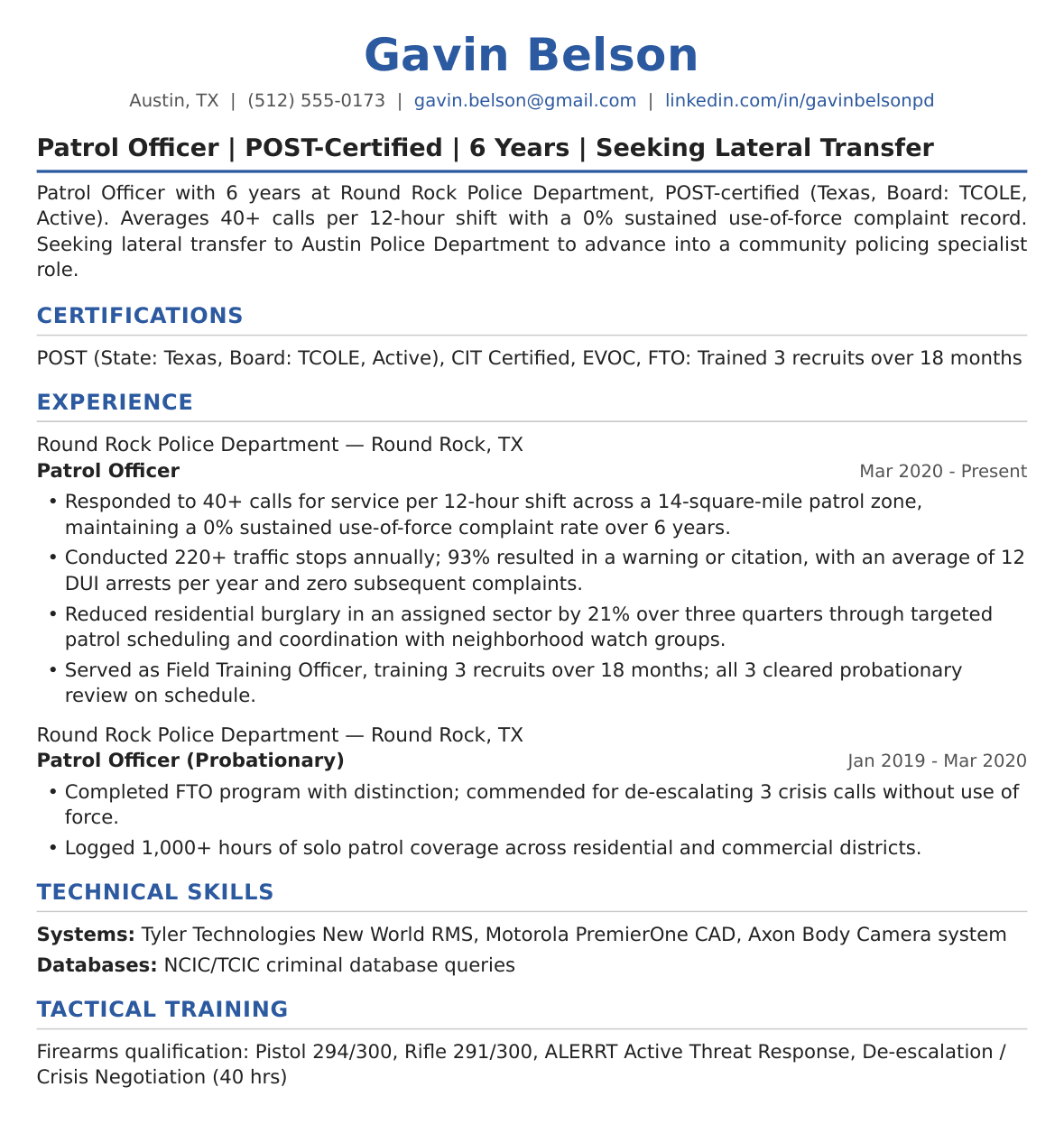
The two examples below cover experienced officers. The first emphasizes patrol scope for a lateral move. The second changes the evidence order for an investigative assignment. Use the structure for inspiration, then replace every fact with your own verified record.
Patrol Officer: Lateral Transfer
This example leads with the officer's credential and municipal patrol scope. It uses calls, reports, community work, and training without publishing sensitive operational details or unsupported force and complaint claims.
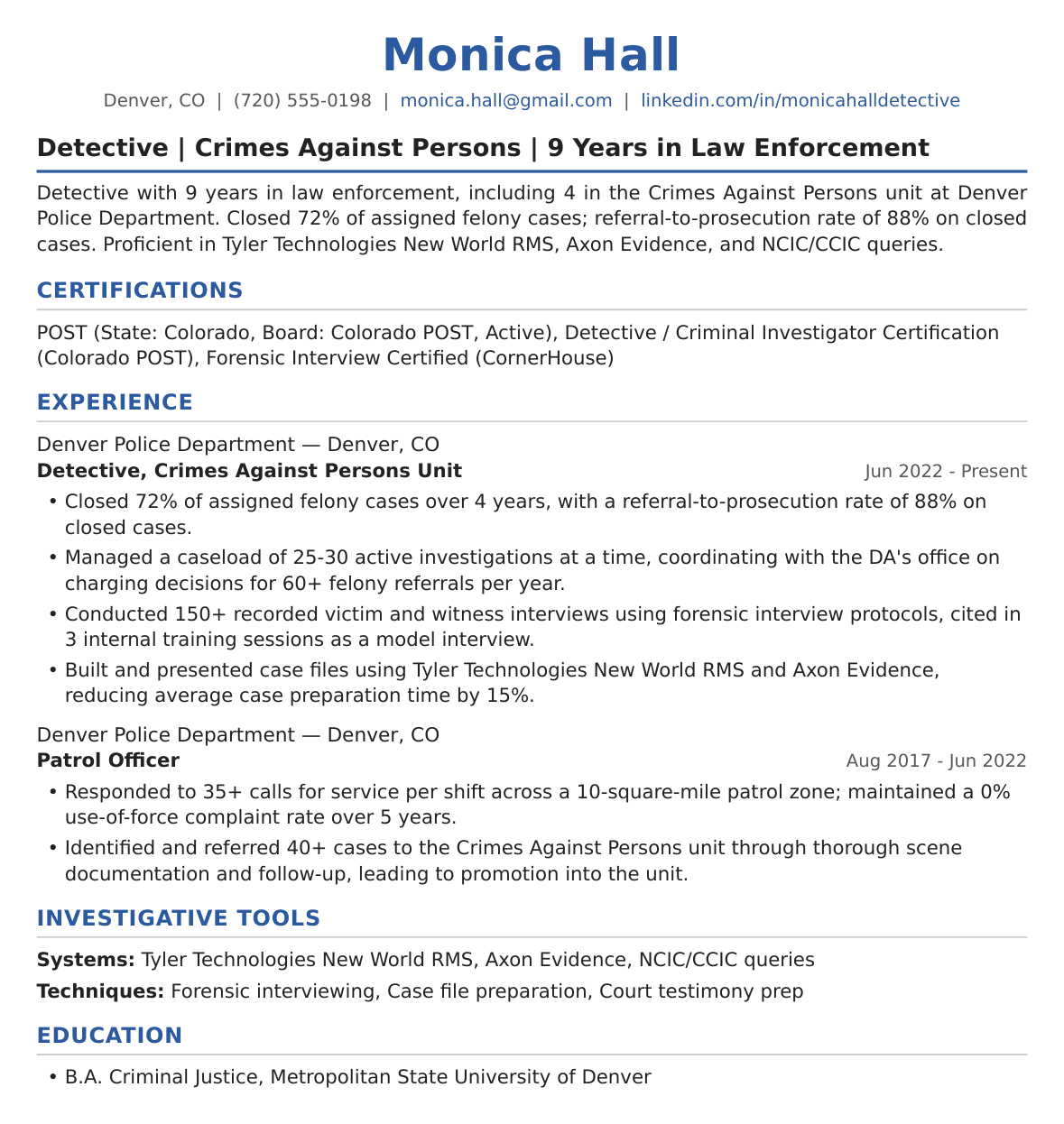
Detective or Investigative Assignment
An experienced detective or investigator should foreground the assignment, safely generalized matter scope, investigative work products, evidence handling, referrals, systems, and team decisions. Do not publish protected cases or treat charging and court results as personal outcomes.
Use Keywords Only When Your Record Supports Them
The posting is your best vocabulary source. Match its exact role, credential, assignment, training, documentation, and system terms when they accurately describe your record.
| Category | Examples to verify against your record |
|---|---|
| Credential and training | Exact state certificate, academy or course title, field training, crisis intervention, de-escalation, first aid/CPR |
| Assignment | Municipal patrol, traffic, community engagement, school resource, investigations, field training |
| Documentation | Incident reports, scene documentation, property submission, court preparation, records review |
| Systems | Agency RMS, CAD, body-worn camera, digital evidence upload, radio communications |
| Public service and coordination | Calls for service, welfare checks, collision response, community meetings, interagency coordination |
Do not add a named system because you used a similar product, a specialty because you worked beside that unit, or a credential because the posting prefers it. Important terms should appear in the experience or credential evidence that proves them, not only in a keyword list.
Run an Official-Record Consistency Check
Before submitting, compare the resume with every required application record. Check:
- employer names and employment dates;
- official titles, sworn or reserve status, and assignments;
- academy, field-training, and probation dates;
- certificates, courses, providers, dates, and hours;
- separation reasons and employment gaps when the application asks for them; and
- performance measures or specialty claims that may be verified.
The resume may be selective. A personal history statement may require a much longer history. Selection does not permit a changed date, upgraded title, omitted required disclosure, or invented reconciliation between conflicting records. If your records disagree, verify the controlling record and follow the agency's correction or disclosure process.
Customize the Resume for Each Lateral Opening
Two lateral postings may value different experience. A patrol opening may emphasize calls, reports, traffic, public contact, and shift work. A school resource role may emphasize youth contact, presentations, school collaboration, and the exact assignment or training required. An investigative opening may emphasize work products, evidence, referrals, interviews within authority, and case-management systems.
Tailor the order and emphasis, but keep the facts fixed. Use the posting's exact terms only where your record supports them, and follow the requested file format and attachment instructions.
An online resume tool can help compare the posting with your draft and surface terms or evidence you may have overlooked. Review every suggestion against your official records before accepting it. A tool should not invent arrests, outcomes, certifications, training, system experience, or authority.
Compare your resume with a lateral posting
Review the role requirements, keyword coverage, and resume structure before you submit.
A lateral resume succeeds when a receiving agency can understand your prior service without guessing and verify every important statement against the official process. Make the credential exact, define the work, protect people and operations, and keep the complete application record consistent.