"Product Lead" doesn't mean the same thing on your resume as it does on the job posting you're staring at. At one company it's a senior individual contributor title with no direct reports. At another, it's the first real people-management rung above Senior PM. If you've spent the last few years owning a product line, mentoring a couple of junior PMs informally, and presenting trade-offs to Directors without ever holding a formal title that says so, you already know how confusing this gets when a resume has to commit to one version of the story.
This guide shows exactly how to translate that real scope onto the page, without overclaiming authority you don't have and without underselling leadership you already do. You'll get a self-check to figure out which flavor of Product Lead a given posting is actually evaluating for, section-by-section guidance for your summary, skills, and experience bullets, and a bullet library organized by sub-role so you can match your examples to the job in front of you.
Along the way, you'll see the exact phrases that separate a Lead-level bullet from a PM-level one, how to quantify scope when you don't have a clean revenue number, and the formatting mistakes that get a genuinely qualified resume filtered out before a human ever reads it.
Product Lead vs. Product Manager vs. Product Owner: What Hiring Managers Actually Expect
"Product Lead" doesn't mean the same thing at every company. Some use it as a synonym for a senior IC PM: a Lead or Staff PM with no direct reports. Others treat it as the first formal people-management rung above Senior PM. A hiring manager reading your resume needs to see instantly which one you're aiming for, and that your experience matches it, because the two paths call for different evidence and different proof points on the page.
Here's how the three titles differ in scope:
| Product Owner | Product Manager | Product Lead | |
|---|---|---|---|
| Scope | One team's backlog | One product or feature | A product line or portfolio |
| Focus | Sprint execution, ticket prioritization | Roadmap execution, delivery | Portfolio strategy, trade-offs across products |
| People leadership | Rarely any | Usually none | Often mentors or manages other PMs (varies by company) |
| Stakeholder reach | Dev team | Cross-functional (eng, design) | Executive-facing (Directors, CPO) |
| Reports to | Product Manager or PM lead | Varies: Group PM, PM Lead, or Director | Director of Product or CPO |
A Product Owner is more tactical still: it translates customer needs into a backlog for a single Scrum team, one sprint at a time. It stays close to execution rather than strategy, and its wins are measured sprint by sprint. A Product Lead owns the bigger picture: it aligns multiple PMs or product lines with company strategy and makes portfolio-level trade-offs, not feature-level ones. Its wins get measured in quarters and revenue, not sprints.
That difference shows up directly in resume language. Where a PM resume says "delivered feature X," a Product Lead resume says "aligned 3 PMs across the billing product line, delivering $2M in retained revenue." A PO resume leans on backlog and sprint terms and ticket counts; a Product Lead resume leans on strategy, cross-product prioritization, and stakeholder influence, with numbers that show portfolio impact instead of individual feature wins.
Which one are you? Quick self-check:
- Do you own more than one product, feature set, or "pod," even informally? That's Product Lead scope, and it belongs in your summary line, not buried in a bullet.
- Are you mentoring or unblocking other PMs, even without formal authority over their reviews or headcount? Say so on the resume. It counts, even without a people-manager title, and hiring managers read it as readiness for the next rung.
- Do you regularly present priorities or trade-offs to Directors or a CPO, instead of just your immediate eng and design team? That's the stakeholder signal hiring managers look for, so name the audience explicitly in your bullets and quantify what was at stake in dollars or timeline.
How to Write a Product Lead Resume That Gets Interviews
Write a Summary That Leads with Scope, Not Just Skills
Your summary has three jobs. It needs to name the scope of what you own (a product line or portfolio, not a single feature), show some form of leadership scope (a team you mentor, PMs you guide, cross-functional groups you align), and land on one business outcome a hiring manager would actually care about.
Most PM summaries skip straight to skills and tools, which reads as interchangeable with every other PM applying. A Product Lead summary needs to establish scope in the first sentence.
A weak summary looks like this:
"Experienced Product Manager skilled in Agile, roadmapping, and cross-functional collaboration. Strong communicator with a track record of delivering successful products."
A stronger one looks like this:
"Senior Product Manager with 7 years of experience owning the Billing & Payments product line at a Series C SaaS company. Mentor 2 junior PMs and coordinate a 12-person cross-functional pod (eng, design, data). Reduced involuntary churn 18% by leading a portfolio-wide dunning and retry strategy across 3 product surfaces."
Notice the strong version never claims a formal manager title she doesn't have. "Mentor 2 junior PMs" is honest and still signals leadership. If you're genuinely unsure whether your target role wants a people-manager or a senior IC, write the summary around scope and mentorship first. Both flavors of Product Lead value that.
Build a Skills Section That Signals Leadership, Not Just Craft
A Product Lead skills section should read differently from a standard PM resume: less "tools I know," more "scope I operate at." Group your skills so a recruiter scanning for 7 seconds sees strategy and leadership before they see software.
Strategy & Portfolio Management Product line roadmapping, portfolio prioritization, OKR setting across pods, pricing and packaging strategy, build-vs-buy decisions, competitive positioning
People & Cross-Functional Leadership Mentoring junior PMs, coaching on prioritization frameworks, running cross-functional pod rituals, resolving eng/design/data trade-offs, influencing without authority, onboarding new PMs
Technical & Analytical Tools SQL, Amplitude or Mixpanel, Looker, A/B testing platforms, RICE and weighted scoring models, JIRA/Confluence at portfolio scale
Stakeholder & Executive Communication Quarterly business reviews, board-level metric reporting, roadmap trade-off negotiation with Directors/CPOs, cross-portfolio dependency mapping
Only list what you can genuinely defend in an interview. Recruiters and hiring managers will ask you to walk through any item here, so skip anything you've only touched once.
Pull the exact wording from the job description where it matches your real experience. If a posting says "portfolio prioritization" and you've been calling it "roadmap sequencing," switch to their term. It's the same skill and it helps you clear keyword-matching filters.
Certifications like CSPO or Pragmatic Institute's PMC/PLC can add a light trust signal in this section, especially if your title history is ambiguous. They're not gating for this role the way a license would be for a regulated profession. Skip them if you'd rather use the space for a real leadership skill.
Write Achievement-Focused Experience Bullets That Show Scope
Use this formula for every experience bullet: action verb, then a specific strategic or portfolio-level task, then a quantified scope or business result.
A weak bullet looks like this:
"Led product strategy and worked with engineering to deliver key features on time."
A stronger one looks like this:
"Directed roadmap strategy across 3 product lines generating $4.2M ARR, aligning 4 PMs and a 15-person cross-functional team, cutting release cycle time 30% over two quarters."
The word "led" without a number attached is the single most common tell of a resume that hasn't been rewritten for a Lead-level role. If you can't attach a metric, the verb is doing all the work and doing it poorly.
If you don't have clean revenue or output numbers, quantify scope instead: number of PMs you mentor, number of product lines or surfaces you own, the size of the cross-functional team you coordinate, or the budget you influence. "Mentored 2 PMs across a 3-product portfolio" is a legitimate, honest metric even without a dollar figure attached.
Forgotten numbers usually live in places you've stopped checking: retention or churn dashboards, old roadmap docs with headcount listed by pod, OKR trackers from past quarters, and even your own 1:1 notes with the PMs you mentor. A five-minute scroll through any of these often surfaces a number you'd otherwise leave off the page.
Organize Your Work History to Show Progression Into Leadership
Keep roles in reverse-chronological order. If you've held the same title for several years but your scope grew, show that growth by restructuring your bullets, not by inflating your title. Under each role, consider splitting bullets into sub-headers like "Portfolio Leadership" and "Product Delivery" so a reader sees the shift from execution to ownership even within one job.
For example, under "Senior Product Manager, 2022-Present," your first sub-header might cover mentoring and portfolio-level roadmap decisions, while a second covers the delivery work you still own. This lets the resume tell a progression story instead of a flat list of responsibilities.
If your company's internal title doesn't match the market-standard "Product Lead," a parenthetical clarifier in your resume header can help a recruiter parse your scope faster: "Senior Product Manager (Product Lead, Billing & Payments)." Use this only when it honestly reflects your actual scope of ownership. Never add a clarifier that implies authority or a portfolio you didn't actually run.
Product Lead Resume Examples
"Product Lead" reads differently depending on what you own and who reports to you. Match your bullets to the sub-role closest to your actual scope, not the job title alone.
Portfolio/Platform Product Lead
Owns several products or surfaces under one platform and coordinates the PMs running each piece.
- Aligned 4 product pods (12 PMs and engineers total) across a shared platform roadmap, cutting cross-team dependency delays by 30%.
- Consolidated 3 overlapping internal tools into one platform surface, reducing engineering maintenance load by 25% and unifying the roadmap for 6 downstream product teams.
People-Manager Product Lead
Has PMs as formal direct reports, with hiring, coaching, and performance review responsibility layered on top of product strategy.
- Managed and coached a team of 5 PMs, running quarterly calibration reviews that lifted 2 direct reports into Senior PM roles within 18 months.
- Rebuilt the team's onboarding and roadmap-review process for 5 direct reports, cutting new-PM ramp time from 12 weeks to 6.
Growth Product Lead
Owns acquisition, activation, or retention surfaces and is judged on funnel metrics more than feature delivery.
- Directed a 3-PM growth pod through 40+ onboarding experiments in a year, lifting activation rate from 22% to 31% and adding $2.4M in incremental ARR.
- Owned retention strategy across the free-to-paid funnel, reducing 90-day churn by 18% through a re-engagement email and in-app nudge program.
Data/AI Product Lead
Owns a data platform or ML-powered product line and translates model capability into a roadmap non-technical stakeholders can act on.
- Led a 4-person pod (2 PMs, 2 ML engineers) shipping a recommendation model that increased average order value by 14% across 3 product surfaces.
- Set the data quality and labeling roadmap for an AI product line generating $8M ARR, cutting model retraining cycle time from 6 weeks to 2.
Product Lead Resume Templates
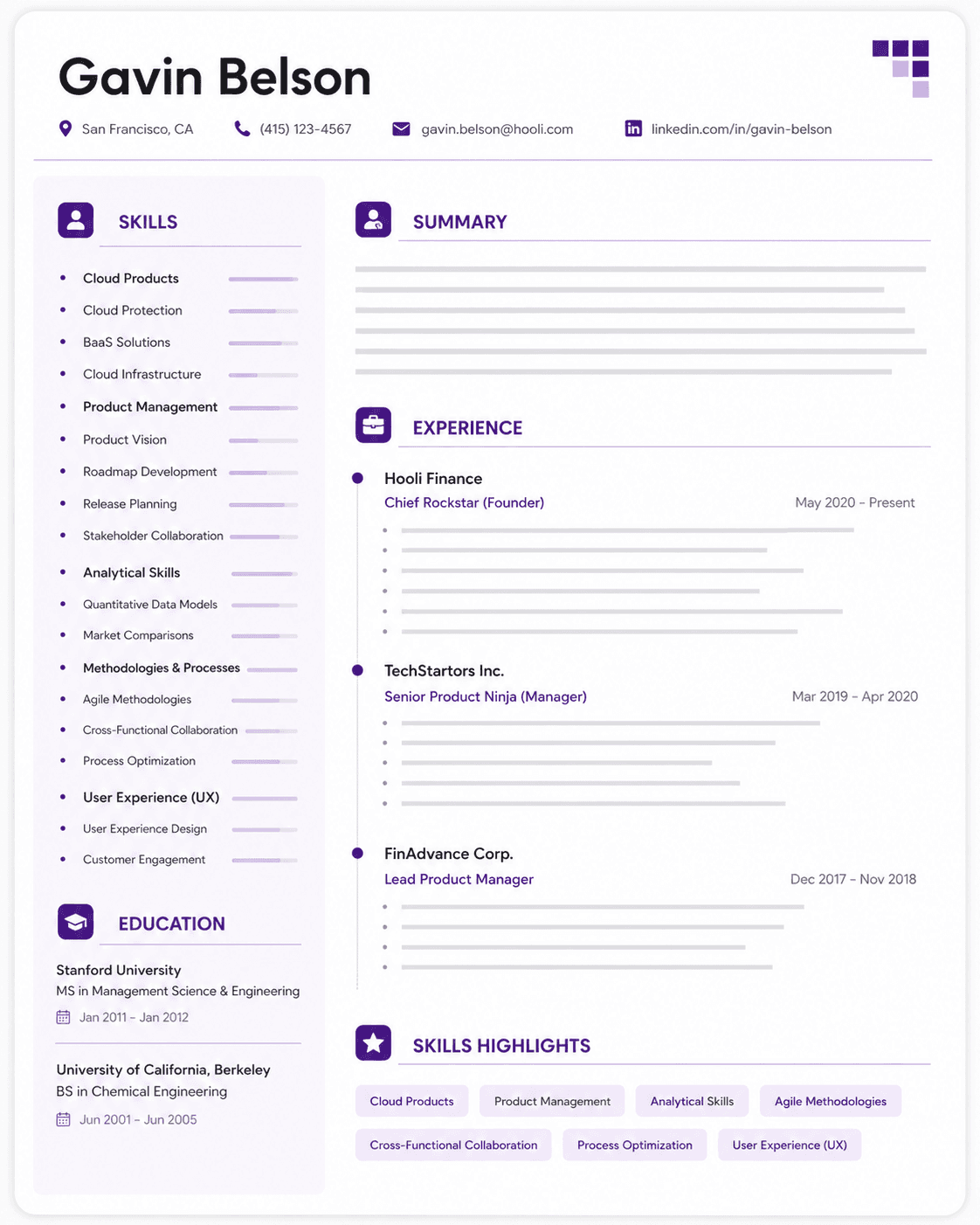
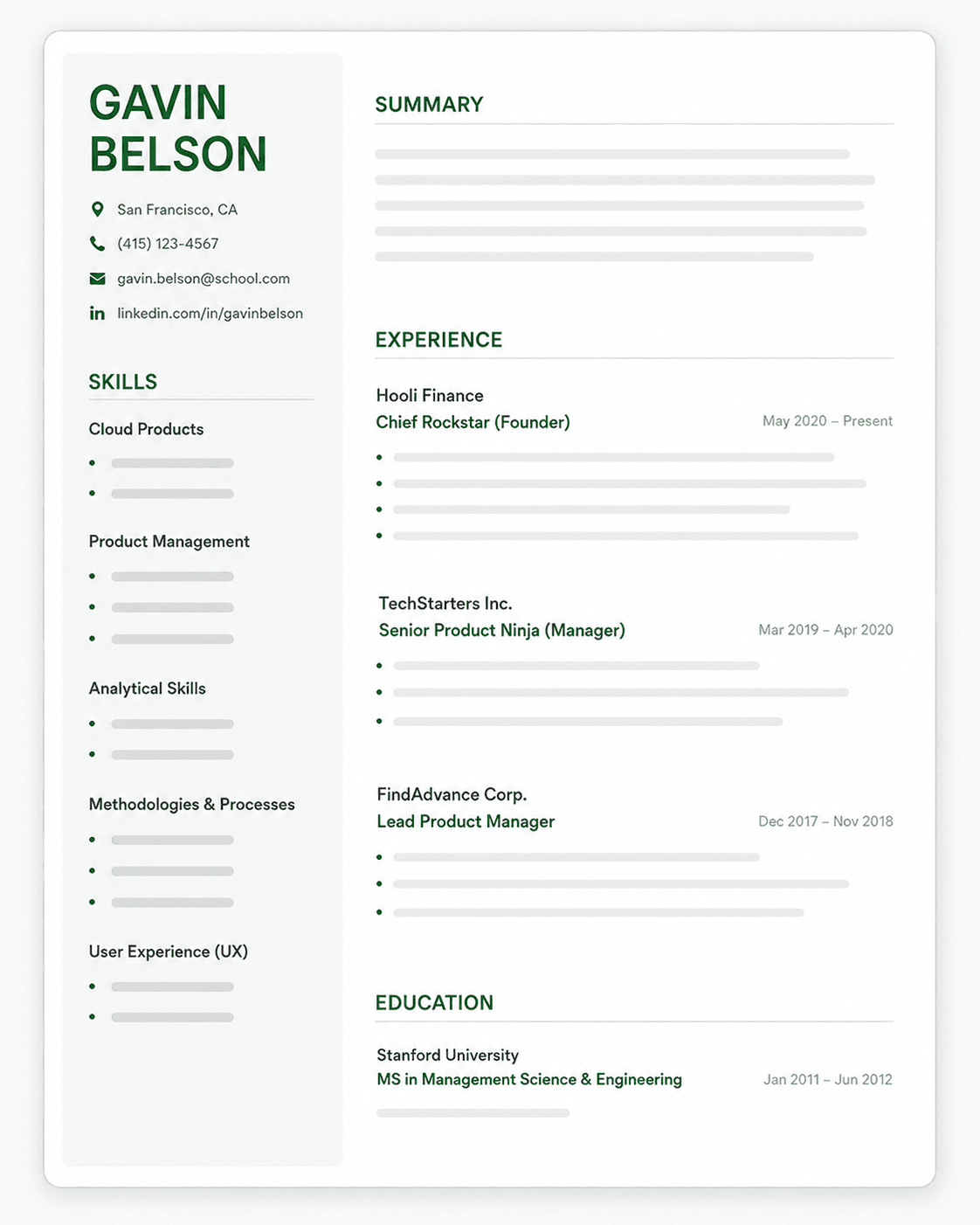
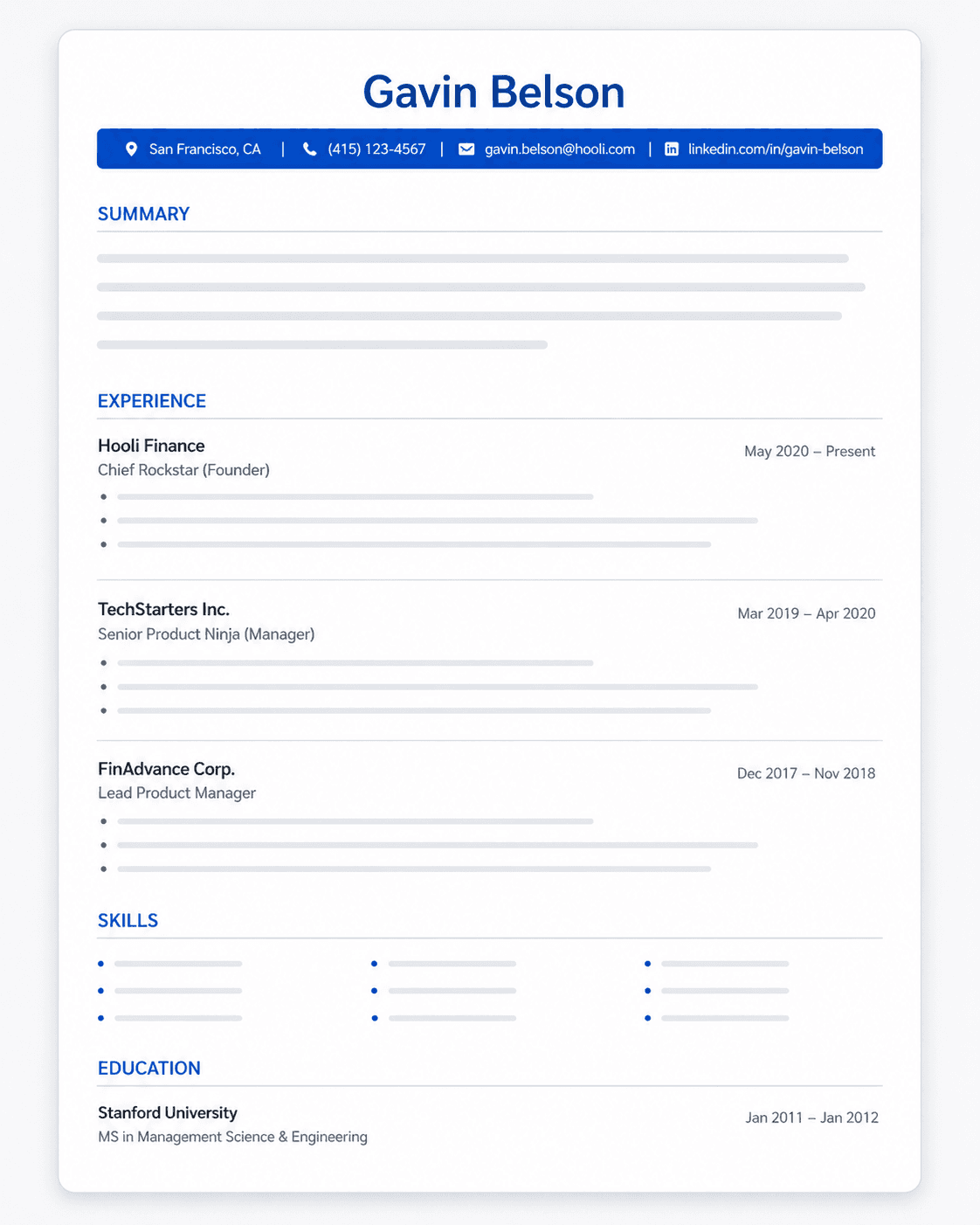
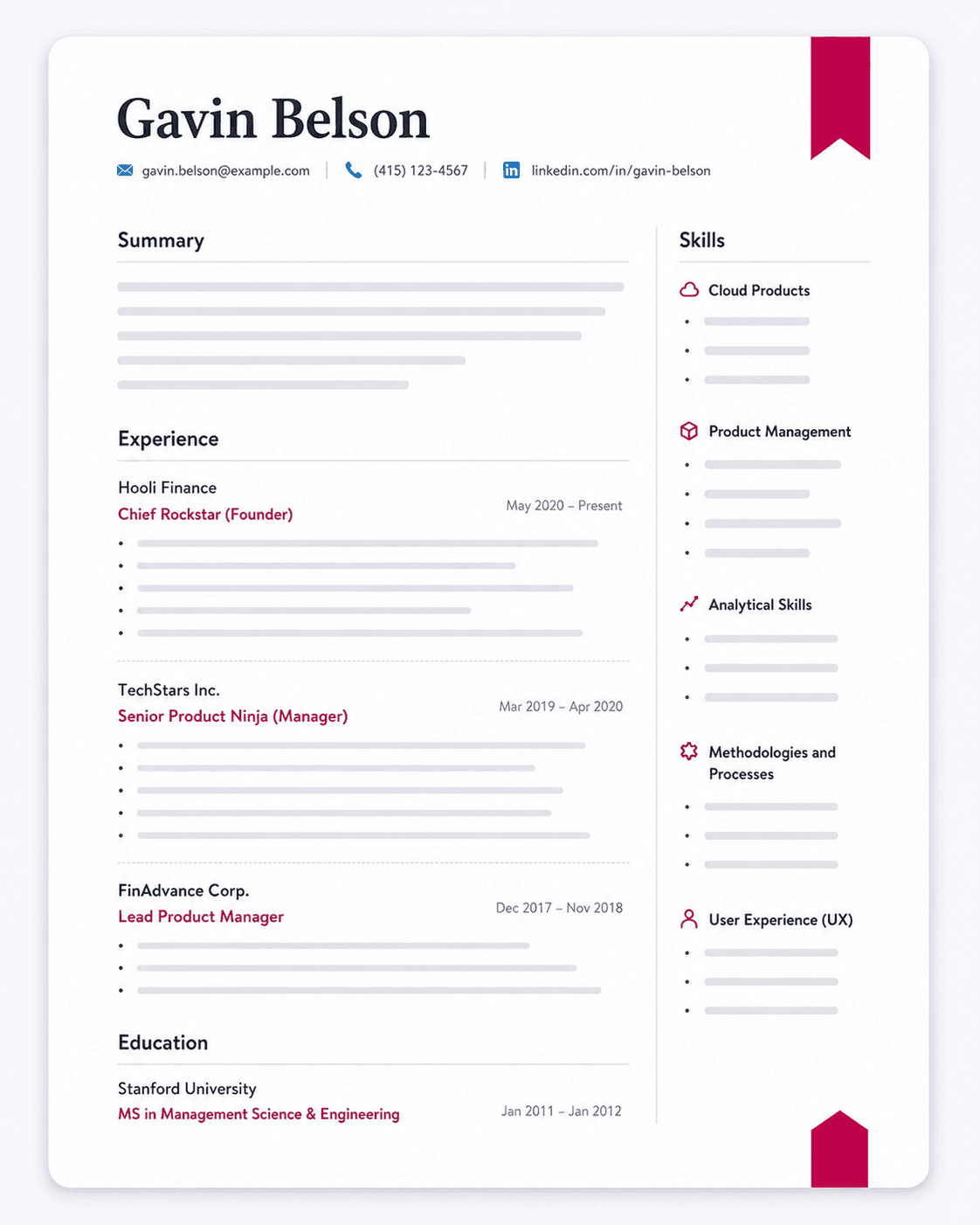
Product Lead resumes differ mainly by whether the candidate is stepping into product-line leadership for the first time or already managing a broader portfolio and other PMs. The two examples below reflect those realistic career stages, with each one emphasizing the scope and leadership signals hiring managers expect.
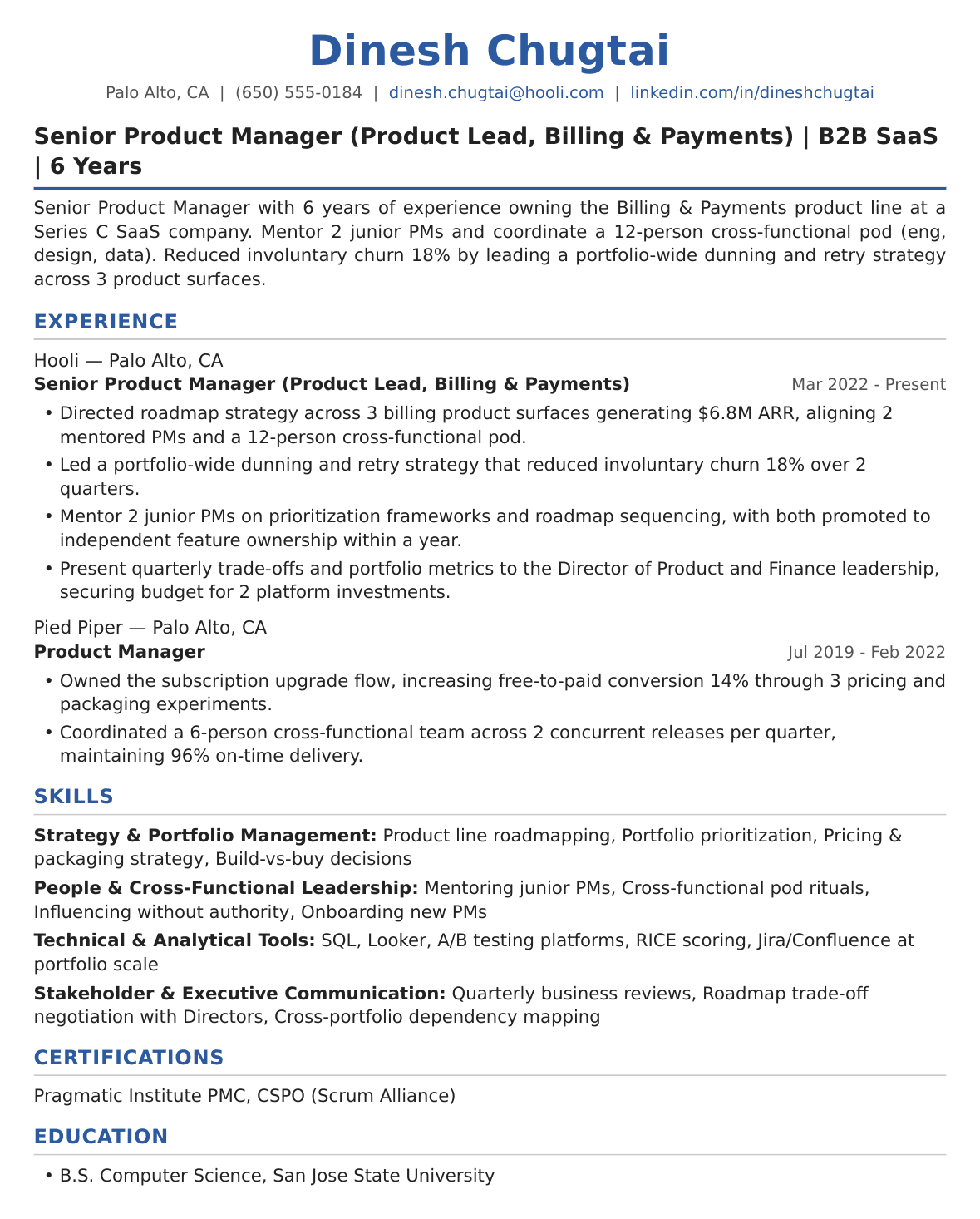
First-Time Product Lead Resume Example
This example is for a Senior Product Manager moving into a first Product Lead role. It shows readiness through ownership of several related product surfaces, mentorship of junior PMs, measurable product-line results, and regular communication with senior stakeholders, without overstating formal people-management experience.
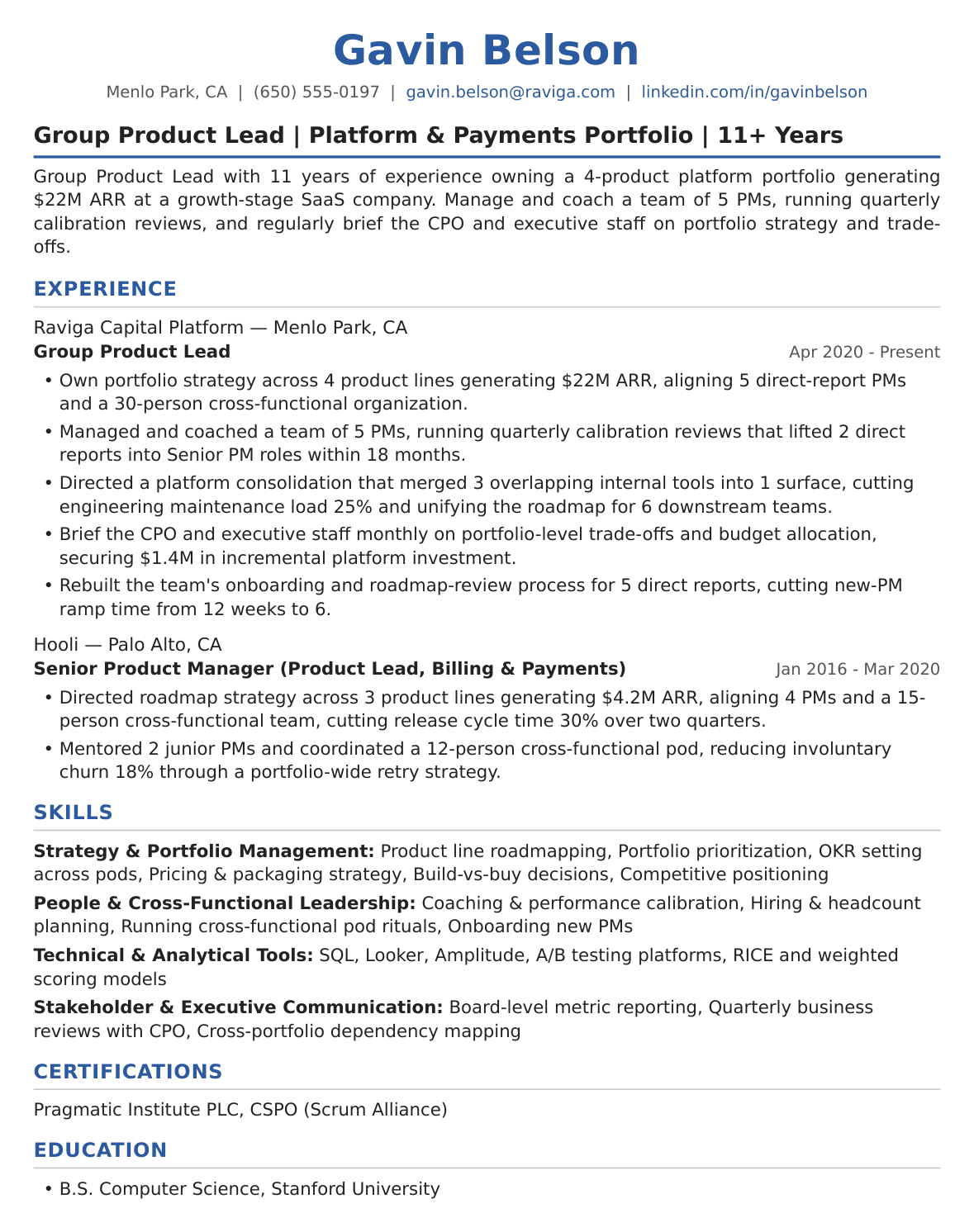
Group Product Lead Resume Example
This example fits an established Product Lead overseeing multiple product lines and managing other PMs. It leads with portfolio revenue, direct-report scope, cross-functional organization size, budget influence, and executive communication to demonstrate leadership beyond a single product or team.
Product Lead Resume Keywords
Product Lead postings blend strategy, people leadership, and analytics language. Every keyword you use should sit next to an outcome, since hiring managers at this level discount bare skill lists.
| Category | Keywords |
|---|---|
| Strategy | Product strategy, Product vision, Roadmap ownership, Product-market fit, Go-to-market strategy, Pricing and packaging, Platform strategy, 0-to-1 launches |
| Leadership | PM team leadership, Mentoring and coaching, Cross-functional leadership, Stakeholder alignment, Executive communication |
| Data & experimentation | OKRs, North star metrics, A/B testing, Product analytics, SQL, Amplitude, Mixpanel, Retention and churn analysis, Activation funnels |
| Execution | Agile/Scrum, Prioritization frameworks (RICE, WSJF), User research, Customer discovery, Backlog governance, Revenue and ARR impact |
Quantifying Impact When Your Numbers Are Under NDA
This guide tells you to put revenue and portfolio metrics on everything, and then your employment agreement tells you the actual numbers are confidential. Both are right. The resume move is proving magnitude without disclosing figures.
Use relative metrics: "+38% activation," "cut onboarding drop-off by a third," "grew the billing line to a 9-figure ARR run rate." Percentages and bands demonstrate impact while disclosing nothing a competitor can use. Anonymize scale the same way: "a top-3 payments platform by volume" says enough. Recruiters read this fluently; they see NDA-shaped resumes daily.
Before you decide what's safe, reread your agreement's definition of confidential information. Most NDAs bar specific figures and roadmap details, not the existence of your results; if yours is stricter, ranges sourced from public statements are your ceiling. Then use the interview deliberately: "I can walk through the mechanics and relative lift; I keep exact figures confidential, as I would for you." That sentence has never cost a strong candidate an offer, and it quietly demonstrates the judgment the title requires.
Common Product Lead Resume Mistakes to Avoid
Writing PM-Level Tasks Instead of Portfolio Scope
Bullets that read "wrote user stories" or "managed sprint backlog for [feature]" describe a single-product PM, not a Lead. If your resume lists day-to-day execution tasks without naming the product line, portfolio, or set of PMs your work touched, a hiring panel will read you as still operating at the PM level regardless of your job title.
Using "Led" or "Managed" Without a Number
"Led the product strategy" tells a reader nothing about scope. Attach a number every time: PMs mentored, product lines owned, pods aligned, or the size of the initiative in revenue or users. If you cannot attach a number to a "led" bullet, that bullet is not ready to be on a Lead-level resume.
Mixing Product Lead, PM, and Product Owner Language
If your header says "Product Lead" but every bullet underneath describes backlog grooming, sprint ceremonies, and ticket writing, the resume reads as a Product Owner in disguise. Keep the vocabulary consistent with the scope you're claiming: strategy, trade-offs, and cross-team alignment for Lead-level bullets, not sprint-level execution language.
Sending the Same Resume to Every Job Posting
A portfolio/platform Product Lead posting and a people-manager Product Lead posting are evaluating for different evidence, even when the title matches. Reusing one static resume means you'll either under-sell people-leadership experience you do have or over-claim direct-report management you don't. Adjust which bullets lead and which keywords appear based on what each posting actually asks for.
Listing Frameworks and Tools Without the Outcome
Naming RICE, OKRs, Agile, or JIRA on a skills list only tells a reader you've heard of them. What separates a Lead-level candidate is showing what using that framework produced: a prioritization call that redirected a roadmap, an OKR that aligned three teams around one metric. Pair every framework mention with a result somewhere in the experience section.
Ignoring ATS Formatting
ATS-unfriendly formatting, including tables, multi-column layouts, text boxes, and content placed in headers or footers, can prevent applicant tracking systems from parsing your resume correctly, even when it looks clean to a human reader. Parsers frequently misread or drop this content entirely, sometimes losing whole sections. Stick to a single-column layout with standard section headings so both the parser and the recruiter can read the same document.
Omitting Stakeholder and Executive-Facing Experience
If every bullet stops at "worked with engineering and design," you're leaving out the part of the job that most separates a Lead from a PM: who you briefed, influenced, or got buy-in from above your immediate team. Even without a director title, naming the executives or cross-functional leaders you regularly reported to or aligned with signals the stakeholder scope Lead-level roles expect.
How AI Resume Builders Can Simplify Your Product Lead Resume
Every posting calls for different scope and leadership language, and tailoring a Product Lead resume by hand for dozens of applications is tedious. Many candidates end up settling for one generic version that gets filtered out before a recruiter ever sees it.
An AI resume builder built for this kind of tailoring offers:
- Real-time ATS scoring: see your ATS and recruiter scores update as you edit, with no download/re-upload cycle needed to check progress.
- Transparent suggestions: every edit comes with a plain-language "Why this change?" explanation, and you accept or reject each one individually. The AI never fabricates or silently rewrites your experience.
- Automatic formatting: full design control across multiple ATS-friendly templates and color themes, with unlimited downloads in PDF, DOCX, and TXT.
- Structure guidance: content gets reordered for relevance, action verbs get strengthened, achievements get quantified, resume length gets managed, and potential bias triggers get flagged.
- Preference memory: your formatting, metric, and reordering choices persist across sessions, so you're not resetting preferences on every application.
Pricing stays honest for a search that has an actual end date: the free plan includes 200 ATS scans per month, 3 tailored resumes, and unlimited downloads, with no credit card required to start. If you need more than the free allotment, additional resumes cost $0.50-$1.00 each, with no subscription attached.
Tailor your Product Lead resume in minutes
Get a real-time ATS and recruiter score, see every suggested change explained, and download a tailored resume and cover letter for free.
A Product Lead resume earns its title the same way a Product Lead earns the role: by showing scope a hiring manager can verify, not by borrowing language from a job posting. Once your summary, skills, and bullets consistently point to the product line you own, the PMs you guide, and the outcomes tied to that scope, the resume stops reading like a PM application and starts reading like the next step up. Revisit each section against the mistakes list before you send anything, since one stray sprint-level bullet can undo an otherwise strong page. Small, honest adjustments made consistently across the whole document matter more than one dramatic rewrite.