Your account executive resume is competing against dozens of others claiming the same quota-crushing, relationship-building language, and a hiring manager screening a stack of them for one seat has learned to skim past it. Numbers that hold up under a follow-up question, and a resume that signals exactly which segment you sold in, are what separate a callback from a pass.
This guide shows you how to write a summary that leads with attainment instead of duties, build a skills section around the CRM and methodology terms an ATS and a recruiter both scan for, and write bullets that prove you closed rather than just worked a territory. You'll also get a breakdown of how SMB, mid-market, and enterprise AE resumes differ under the same title, a bullet library organized by segment and career stage, a keyword table, and the mistakes that get AE resumes set aside before anyone reads past the summary.
What Makes an Account Executive Resume Effective?
A hiring manager reviewing AE candidates wants evidence a specific person can carry a specific quota in a specific selling environment, not proof of being well-rounded. Generic resume advice (strong action verbs, a tidy summary, "quantify your achievements") doesn't get at that. Sales roles remain a large, competitive category: the U.S. Bureau of Labor Statistics counts over 1.6 million people in the closest adjacent occupation nationally, so your resume is competing on volume as much as quality.
Three things separate a resume that gets a callback from one that gets skimmed and set aside.
Attainment, not activity. An AE resume lives or dies on quota and revenue numbers: percentage to plan, deal count, ARR closed, self-sourced pipeline share. A resume leaning on effort metrics instead (calls made, meetings booked, demos run) reads like it was written for a prospecting role, not a closing one. The section below on writing the summary and bullets covers which numbers to lead with and how to handle ones you can't fully document.
Terminology an ATS and a recruiter both recognize. Sales recruiting tools scan for named CRM and sales-engagement platforms (Salesforce, HubSpot, Outreach, Gong) and named methodologies (MEDDIC, Challenger, Sandler), not soft-skill phrases like "relationship builder." A resume missing that vocabulary can get filtered out before a human reads it, even a genuinely qualified one.
Fit for the right segment. "Account executive" covers different jobs across SMB, mid-market, and enterprise, each with its own deal size, cycle length, and pipeline source. A resume built for one segment can undercut a candidate applying into another; a bullet that reads as strong at one tier reads as a mismatch at the next. That problem gets its own section below, since it shapes most other decisions on the page.
How to Write an Account Executive Resume That Gets Interviews
Hiring managers reading an AE resume are checking for four things in the first pass: what you closed, what tools and methodology you ran, what segment you sold in, and whether the numbers hold up under a follow-up question. Here's how to build each section so those four things are impossible to miss.
Write a Summary That Leads With Attainment, Not Duties
Your summary has three jobs: name your segment (SMB, mid-market, enterprise), give a quota or attainment number tied to a real timeframe, and name the deal size or ACV you closed at. Skip the personality traits. A hiring manager screening 40 resumes for one seat isn't looking for "results-driven" or "relationship builder," they're looking for a number they can compare against the other 39.
A weak summary looks like this:
"Results-driven account executive with excellent communication skills and a proven ability to build strong client relationships and close deals."
A stronger one looks like this:
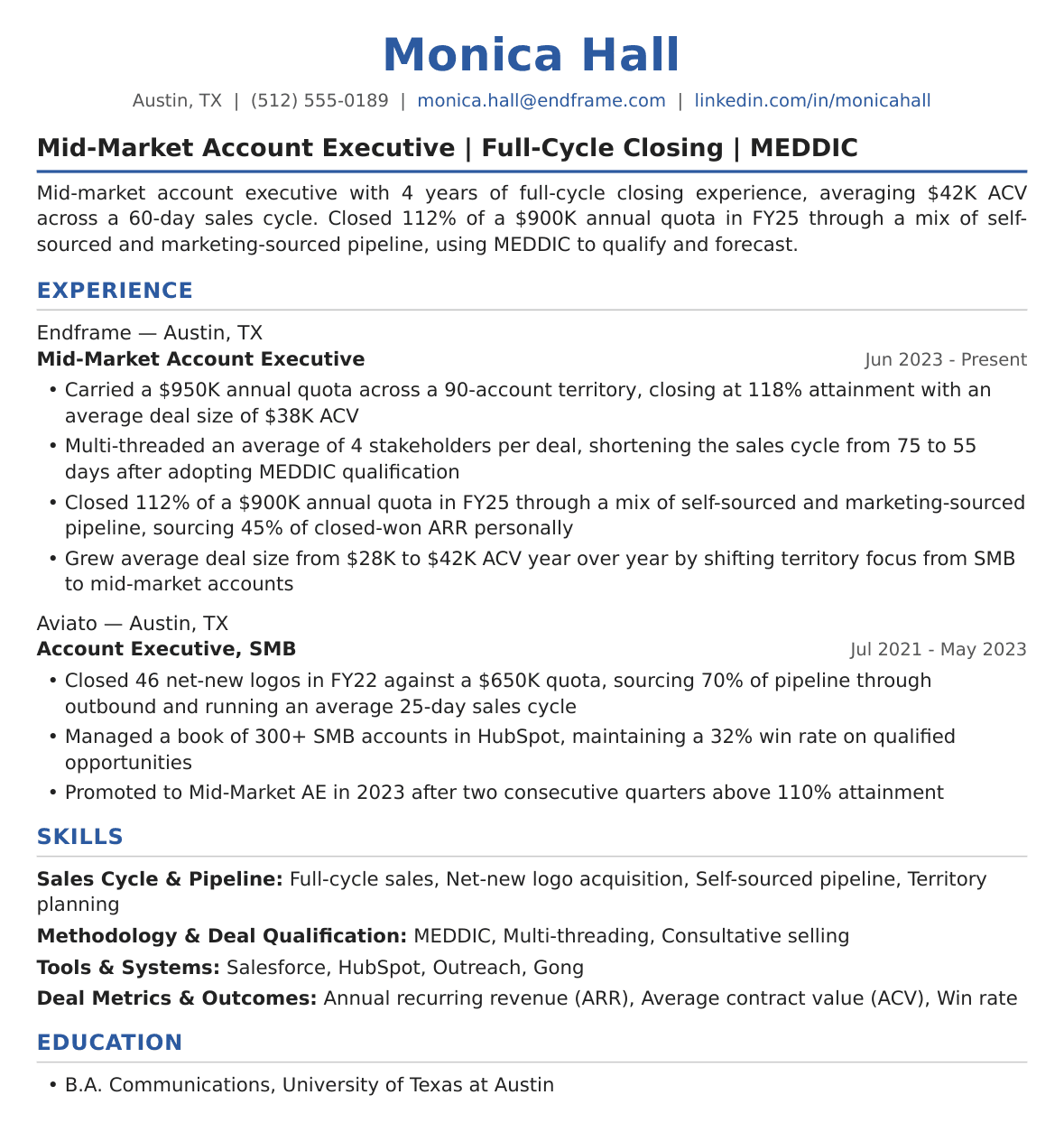
"Mid-market account executive with 4 years of full-cycle closing experience, averaging $42K ACV across a 60-day sales cycle. Closed 112% of a $900K annual quota in FY25 through a mix of self-sourced and marketing-sourced pipeline, using MEDDIC to qualify and forecast."
If you're moving from SDR to AE for the first time, your summary carries different weight, it needs to sell the promotion itself, not a full year of closing history you don't have yet.
SDR-to-AE transition summary example:
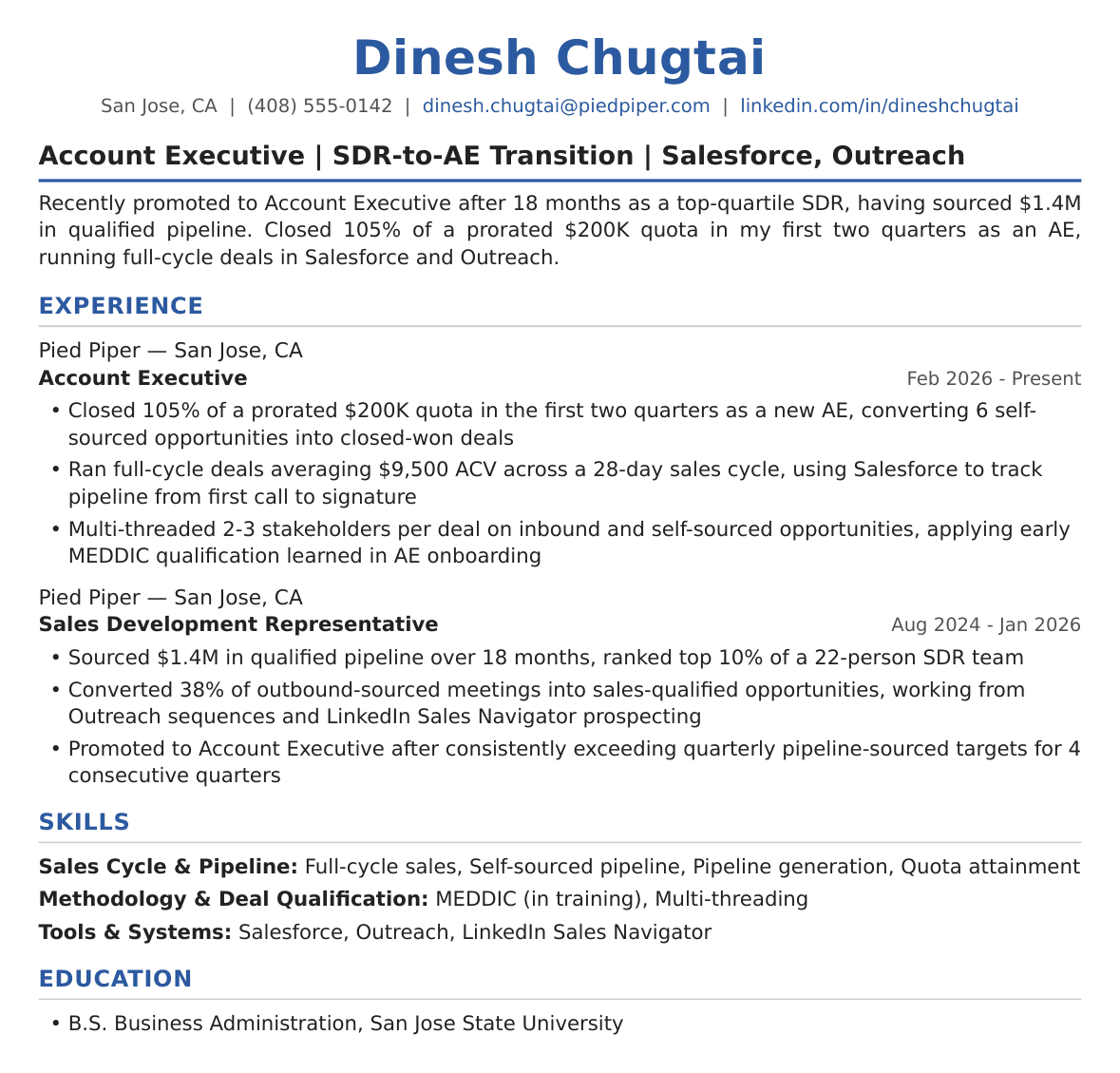
"Recently promoted to Account Executive after 18 months as a top-quartile SDR, having sourced $1.4M in qualified pipeline. Closed 105% of a prorated quota in my first two quarters as an AE, running full-cycle deals in Salesforce and Outreach."
Build a Skills Section Around CRM, Sales Engagement Tools, and Methodology
An AE skills section isn't the place for "team player" or "strong communicator." Group it by category so a recruiter scanning for specific skills finds the exact terms an ATS is scanning for too.
- Sales Cycle & Pipeline: Full-cycle sales, Net-new logo acquisition, Self-sourced pipeline, Pipeline generation, Quota attainment, Territory planning
- Methodology & Deal Qualification: MEDDIC, MEDDPICC, Challenger Sale, Sandler Selling System, SPIN Selling, Multi-threading
- Tools & Systems: Salesforce, HubSpot, Outreach, Salesloft, Gong, LinkedIn Sales Navigator
- Deal Metrics & Outcomes: Annual recurring revenue (ARR), Average contract value (ACV), Win rate, Renewal rate, Upsell/cross-sell
Only list a tool or methodology you've actually used to run a live deal, not one you sat through a single training on. Mirror the exact wording a target posting uses (if the JD says "MEDDPICC," don't write "MEDDIC" and hope it counts as a match). And name the actual CRM and sales-engagement platform, since "CRM experience" alone won't match an ATS scanning for "Salesforce" or "HubSpot" by name.
Write Experience Bullets That Prove You Can Close
Every experience bullet should follow the same formula: [action verb] + [deal or account scope] + [quantifiable outcome]. A duty tells a reader what your job was. An outcome tells them what you're worth hiring for.
A weak bullet looks like this:
"Responsible for managing a book of accounts and closing new business."
A stronger one looks like this:
"Closed 38 net-new deals averaging $28K ACV against a $780K annual quota, sourcing 65% of pipeline through outbound prospecting and Salesforce-tracked follow-up."
Use the bullets below as templates for your own segment, then swap in your real numbers.
SMB / Transactional
- Closed 46 net-new logos in FY25 against a $650K quota, sourcing 70% of pipeline through outbound and running an average 25-day sales cycle
- Managed a book of 300+ SMB accounts in HubSpot, maintaining a 32% win rate on qualified opportunities
Mid-Market
- Carried a $950K annual quota across a 90-account territory, closing at 118% attainment with an average deal size of $38K ACV
- Multi-threaded an average of 4 stakeholders per deal, shortening the sales cycle from 75 to 55 days after adopting MEDDIC qualification
Enterprise
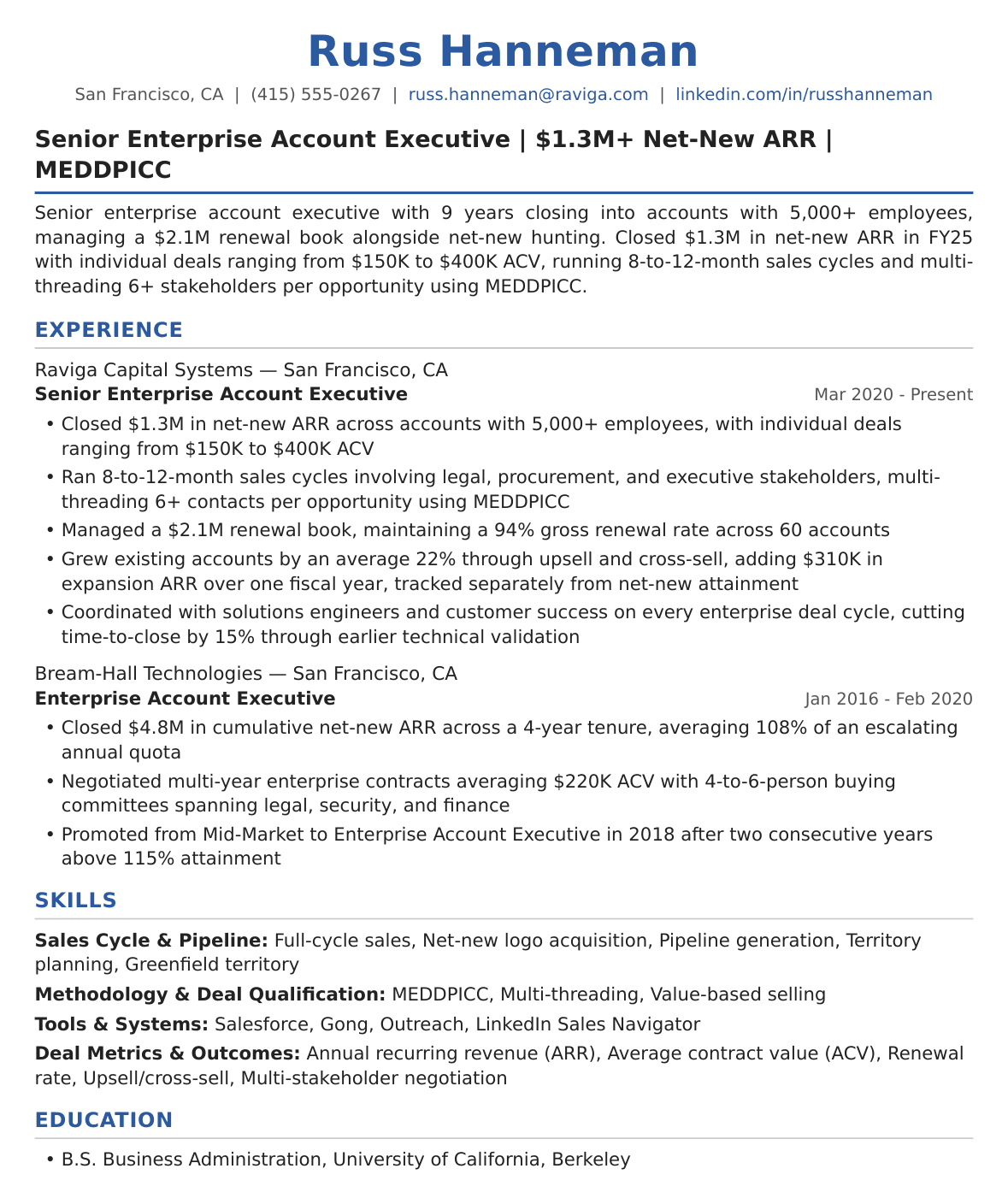
- Closed $1.3M in net-new ARR across accounts with 5,000+ employees, with individual deals ranging from $150K to $400K ACV
- Ran 8-to-12-month sales cycles involving legal, procurement, and executive stakeholders, multi-threading 6+ contacts per opportunity using MEDDPICC
SDR-to-AE Transition
- Promoted to AE after sourcing $1.4M in qualified pipeline as an SDR over 18 months, ranked top 10% of the team
- Closed 105% of a prorated $200K quota in the first two quarters as a new AE, converting 6 self-sourced opportunities into closed-won deals
Renewal / Expansion
- Managed a $2.1M renewal book, maintaining a 94% gross renewal rate across 60 accounts
- Grew existing accounts by an average 22% through upsell and cross-sell, adding $310K in expansion ARR over one fiscal year
If a full year of clean numbers isn't available, quantify scope instead: book size, number of accounts, average deal count per quarter. Pull these from your CRM dashboard, commission statements, or quarterly business review decks, which usually hold numbers you've forgotten you have.
Quantify a Quota You Can't Hand Over Documentation For
Every AE resume runs on numbers a candidate can't formally prove. You signed an NDA, your CRM access ended when you left, or your manager isn't returning calls to confirm your attainment. Employers already know this, and some have built their own verification step around it. HubSpot's Small Business AE application doesn't just take a resume claim at face value, it asks candidates to self-report attainment in bands (0-50%, 51-89%, 90-99%, 100%+) and self-sourced pipeline percentage in bands of 50/60/70/80/90%+, rather than accept a free-text number. A recurring TeamBlind thread on listing high-profile client work without violating an NDA confirms this worry is common, not something unique to your situation.
Two things follow from that. First, a bucketed or rounded number ("consistently closed 100%+ of quota over six quarters") reads as more credible than a suspiciously precise one you can't back up, and it matches the format employers are already asking for. Second, describe the deal instead of naming the client: "closed a $180K deal with a national logistics company" carries the same weight as naming the account, without the NDA risk. If a hiring manager pushes for more detail in an interview, offer a reference who can confirm the number rather than a document you're not allowed to share.
Position Sales Methodology Training as a Credential
MEDDIC, MEDDPICC, Challenger, Sandler, and SPIN aren't soft skills, they're trained frameworks, and naming the one you learned tells a hiring manager you already speak the qualification language their team runs on. Treat it the way you'd treat a certification: name it specifically, don't fold it into a vague "strong communicator" line.
Place it in two spots: once in your skills section under methodology, and once tied to a result in your experience bullets, such as "shortened forecast-to-close accuracy after adopting MEDDIC qualification." A bare mention of a methodology with no outcome attached reads as a keyword you added for the ATS scan, not a skill you actually apply. If a target posting names a specific framework and you were trained in a different one, say so rather than staying silent, most hiring managers care more that you have structured qualification habits than that you match their exact framework by name.
SMB, Mid-Market, or Enterprise: The Same Title, Three Different Resumes
"Account Executive" on a job board hides three different jobs under one label. HubSpot's careers page has posted Small Business AE roles built around a book of roughly 450 accounts, a pipeline that's 80 to 90% self-generated through outbound, and an average 30-day sales cycle. Gong's careers page has posted Enterprise AE roles requiring 8+ years of closing experience, a track record of $1M+ in net-new ARR built from six-figure ($250K+) deals, and sales cycles of 9 months or longer, sold into accounts with 4,000+ employees. Same title, opposite metric profile.
| Dimension | SMB | Mid-Market | Enterprise |
|---|---|---|---|
| Book size | 300-450+ accounts | 25-90 accounts | Single-digit to low-dozens of accounts |
| Cycle length | 25-30 days | 45-90 days | 9+ months |
| Pipeline source | 70-90% self-sourced | Mixed self-sourced and marketing | Multi-threaded, partner and outbound |
| Stakeholders per deal | 1-2 | 2-4 | 6-8+ |
An unsegmented resume forces the reader to guess which of these environments you actually operated in, and a wrong guess reads as a mismatch rather than a strength. A 25-day sales cycle listed without context looks thin at the enterprise tier and looks exactly right at the SMB tier; the same number needs a label to be read correctly. Naming your segment explicitly, alongside book size, cycle length, and pipeline source, is what lets a hiring manager place your experience in the right column before they've read a single bullet.
Account Executive Resume Examples
Below is guidance for what a resume should look like at three points in an AE career: entry-level SDR-to-AE, mid-level SMB or mid-market, and senior enterprise. Use whichever matches your actual seat, not your title.
Entry-Level / SDR-to-AE Transition
This resume solves one problem: proving you can close when your history is mostly prospecting. Lead the summary with the transition ("Promoted to Account Executive after 18 months as an SDR") plus a pipeline number, since you likely lack a full year of closing data. Rewrite any kept SDR bullets to end in an outcome (pipeline sourced, meetings converted), not activity counts. Weight the experience section toward your first AE quarters: a prorated quota number ("105% of a prorated quota in Q1-Q2") outweighs a year of SDR call volume. List your CRM and sales engagement tools prominently, but only claim methodology training you actually completed.
Mid-Level (SMB or Mid-Market)
This is 2 to 5 years of full-cycle experience, read as a track record across multiple quarters, not one good one. The summary needs a segment label, average deal size or ACV, cycle length, and an attainment number spanning a full fiscal year. Bullets should show progression: quota size, account count, or self-sourced pipeline percentage growing role to role. This is where methodology training earns its place, tied to a measurable result (forecast accuracy, win rate) rather than listed bare. Moving from SMB into mid-market, reframe deal size and cycle length explicitly; don't let the reader infer the segment.
Senior (Enterprise)
At enterprise level the resume shifts from proving you can close to proving you can navigate complexity. The summary should lead with net-new ARR or book value managed, account size (employee count or revenue tier), and cycle length in months. Drop SDR-era or early-AE content entirely; it undercuts the seniority signal. Bullets need multi-threading (stakeholders managed per deal), renewal or expansion negotiation, and cross-functional coordination with solutions engineers or customer success. Separate renewal and expansion numbers from net-new rather than blending them, since a hiring manager wants to know how much came from hunting versus farming.
All three levels share the same backbone: a quota or scope number in the summary, tools and methodology named specifically, and bullets that end in a closed or expanded deal. If your experience straddles two levels, build the resume around the segment you're targeting next, using its framing for deal size and cycle length even if your history there is thinner.
Account Executive Resume Keywords
Sales ATS platforms and recruiter keyword searches scan for the exact vocabulary a posting uses, not a paraphrase of it. An AE resume that says "sold products to customers" instead of "full-cycle sales" or "net-new logo acquisition" can get filtered before a human ever opens it. The table below covers the terminology; your summary, skills section, and bullets still need to carry the actual numbers behind each term. Before you submit, run your resume through Upplai's free ATS scan to confirm the terms you've listed actually match what a given posting is scanning for.
| Category | Keywords |
|---|---|
| Sales cycle & pipeline | Full-cycle sales, Net-new logo acquisition, Self-sourced pipeline, Pipeline generation, Quota attainment, Sales cycle management, Territory planning, Greenfield territory |
| Methodology & deal qualification | MEDDIC, MEDDPICC, Challenger Sale, Sandler Selling System, SPIN Selling, Value-based selling, Consultative selling, Multi-threading |
| Tools & systems | Salesforce, HubSpot, Outreach, Salesloft, Gong, LinkedIn Sales Navigator, Microsoft Excel |
| Deal metrics & outcomes | Annual recurring revenue (ARR), Average contract value (ACV), Win rate, Deal size, Renewal rate, Upsell/cross-sell, Multi-stakeholder negotiation |
Not every term belongs in every application. Pull the methodology and tools rows straight from the posting's own language, and drop any term you can't back up with a real deal you closed. For a deeper walkthrough of how ATS keyword matching works across roles, see Upplai's guide to ATS resume keywords. A resume padded with methodology names you've never applied reads as keyword-stuffing the moment a hiring manager asks a follow-up question in the interview.
Common Account Executive Resume Mistakes to Avoid
Leading With Prospecting Activity, Not Closed Revenue
A resume opening with dials made, emails sent, or meetings booked reads like an SDR resume with a new title on top. Hiring managers assume you can generate activity; they're screening for whether you can close what it produces. Lead every bullet with the deal outcome and push activity counts, if kept, to a supporting clause.
Vague "Responsible For" Language
"Responsible for managing accounts and closing deals" describes a job description, not a candidate, and gives a screener nothing to compare you against. Name the number attached to that responsibility: how many accounts, what quota, what percentage you hit.
No Signal of Which Segment You Sold In
A bullet with no deal size, cycle length, or account tier forces the reader to guess your deal profile, and a wrong guess costs you the interview. State the segment explicitly, SMB, mid-market, or enterprise, plus average deal size and cycle length.
A Round Quota Number With Nothing Behind It
"Achieved 150% of quota" with no deal count and no timeframe reads as invented, especially at a suspiciously tidy 100, 125, or 150. Attach a supporting detail a fabricated number wouldn't bother with, like the quota dollar figure, deal count, or the fiscal year it covers.
Naming a Client Anywhere Outside the Resume Line Itself
Anonymizing the resume bullet solves half the problem; the other half is where candidates slip up later. Naming the confidential client on a LinkedIn post announcing the win, in a portfolio deck, or off-hand in an interview follow-up question undoes the exact protection the resume line was written to give. If a hiring manager asks "who was that Fortune 500 logistics account?" in an interview, the safe answer is the same anonymized framing you used on the resume, not the real name.
Listing Every CRM and Tool You've Ever Opened
A skills section padded with every platform you've clicked through in a demo, not the ones you ran a pipeline in, is easy to expose in a first interview question. Keep the list to what you used to source, manage, and close real deals, matching the target posting's exact product names.
Skipping the Sales Methodology the Target Company Runs
If a posting names MEDDIC, MEDDPICC, Challenger, or Sandler and your resume says nothing about methodology, you read as untrained in the process the team already runs. Name the methodology you trained in and where, so the reader isn't left assuming you'll learn their framework from scratch.
How AI Resume Builders Can Simplify Your Account Executive Resume
You've read a sales pitch or two. Here's the honest version of this one: tailoring a resume to every posting, matching methodology keywords, rewriting deal history into ATS language, takes time most AEs don't have between quota calls. An AI resume builder built for this can speed that up, but it still needs your real numbers to work with.
An AI resume builder helps in five ways:
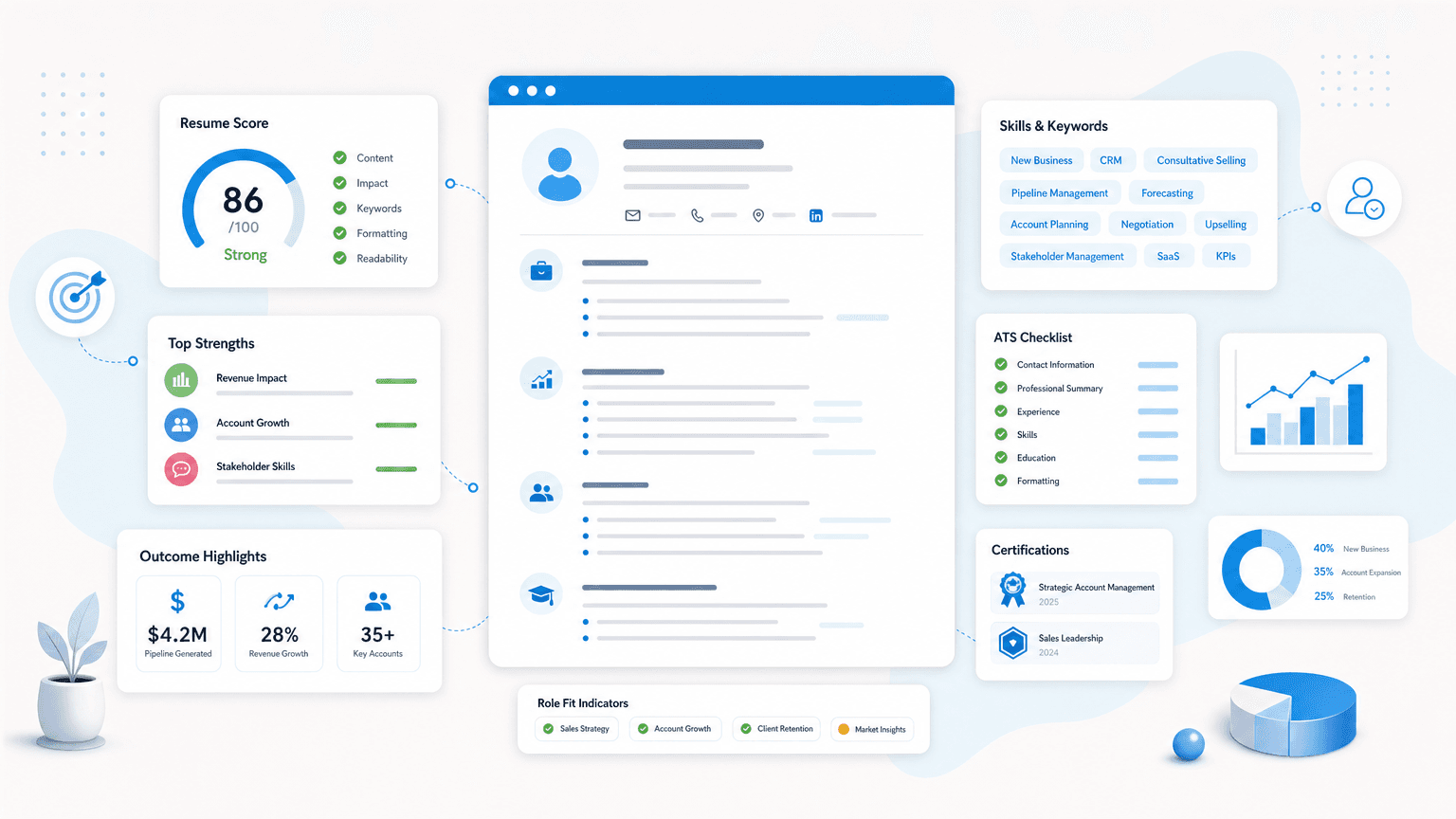
- Real-time ATS scoring: your ATS and recruiter match score update as you edit, so you can see if a rewritten bullet or an added methodology keyword actually moved your score, without downloading and re-uploading to check.
- Transparent suggestions: every AI edit comes with a plain-language explanation, and you accept or reject each one. It won't quietly swap your attainment number or invent a deal size you never closed.
- Automatic formatting: your resume gets cleaned up into ATS-friendly structure, so a formatting quirk doesn't cost you a callback before a recruiter reads your quota line.
- Structure guidance: suggestions reorder content for relevance, strengthen action verbs, and flag missing keywords against the specific job description, including sales methodology and CRM terms hiring teams search for.
- Preference memory: your formatting and reordering choices carry over between applications, so tailoring your tenth version doesn't start from zero.
Pricing stays honest for a job search with an end date: the free plan includes 200 ATS scans a month, 3 tailored resumes with matching cover letters, and unlimited downloads, no credit card required. Extra resumes run $0.50 to $1.00 each, no subscription.
An account executive resume earns a callback when the numbers on it can survive a follow-up question, and when the page signals which segment you actually sold in. Pick the summary formula, bullet library, and keyword table that match your real quota, deal size, and cycle length rather than the seat you wish you had. The segment framing matters more than a longer bullet list ever will.
Ready to tailor your account executive resume?
Upload your resume and a target job posting to see your ATS and recruiter score, plus which quota, tool, and methodology keywords are missing.