Company secretary covers a wide range of jobs under one title. You might be the sole CS at a 150-employee private company running the entire secretarial function alone, or one member of a group secretariat team managing governance across a dozen subsidiaries inside a listed multinational. A resume built for one of those scopes reads as underqualified or overstated for the other.
Hiring managers in this field evaluate a short list of things: your governance credential status, evidence of board-level judgment, and a track record of statutory compliance without missed deadlines. Generic resume advice built for administrative or clerical roles does not address any of these. A company secretary is not an executive assistant; the overlap in job titles causes real confusion, but the work itself is a compliance and governance function.
Your ICSA/CGI, ICSI, or equivalent qualification gets you shortlisted, since most job postings treat it as a hard filter before anything else gets read. But the credential alone does not separate you from every other qualified candidate in the pile. The resume has to prove governance judgment and compliance outcomes (statutory registers maintained without findings, board packs delivered on time, filings met without exception), not just list the duties you were assigned.
How to Build a Company Secretary Resume Template That Gets Interviews
Choose the Right Format and Structure for a Company Secretary Resume/CV
Use a reverse-chronological format. Hiring committees for governance roles want to see your career progression clearly (trainee to assistant CS to CS), and chronological layouts are the easiest for both a Head of Governance and an ATS to parse. Skip functional or "skills-based" formats; they hide the timeline a governance panel wants to check and read as a workaround.
If you're applying in the UK or a Commonwealth market, a two-page CV is standard practice past 3-4 years of experience. US employers still expect one page for early-career candidates. Pick the convention your target market uses and stay consistent.
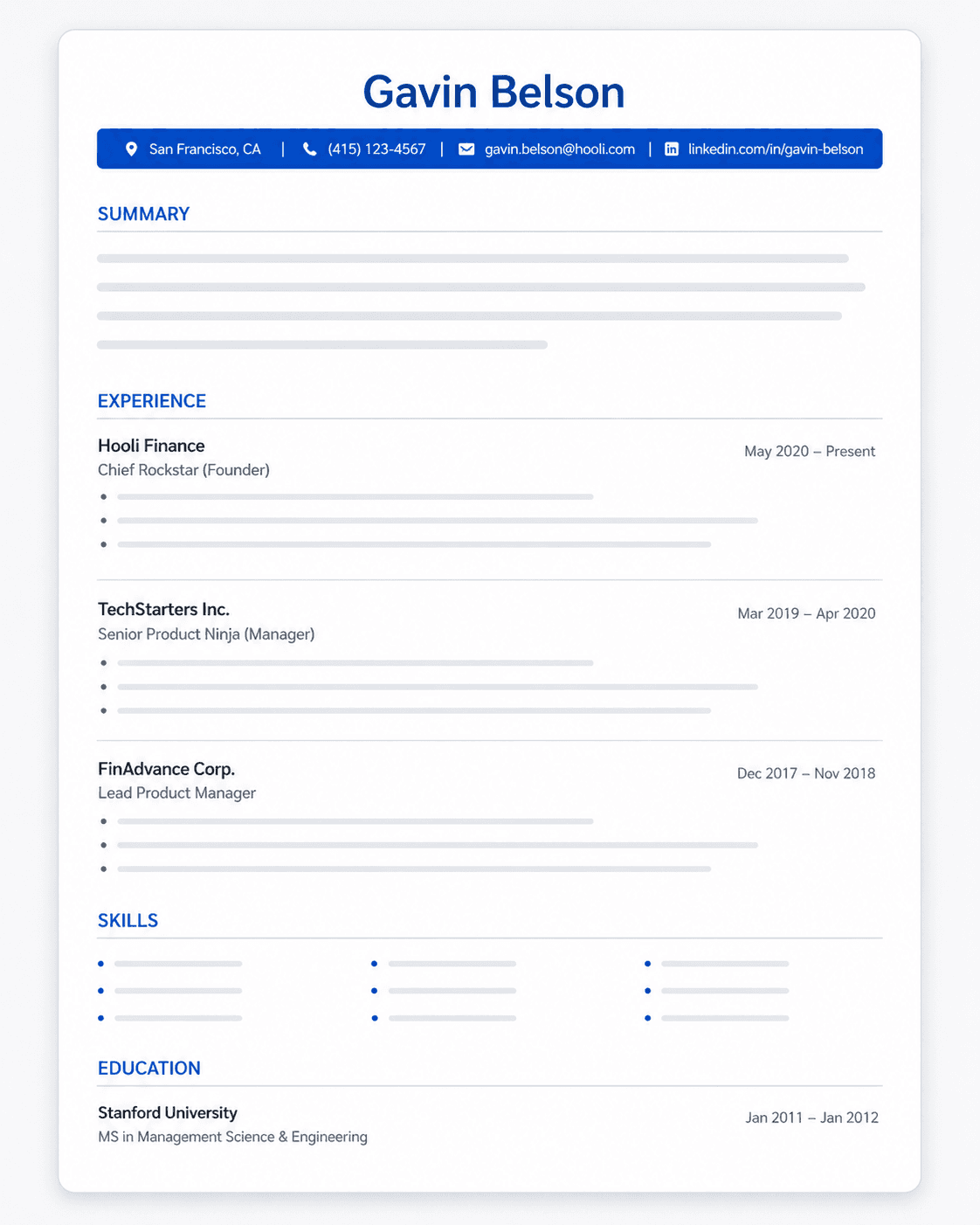
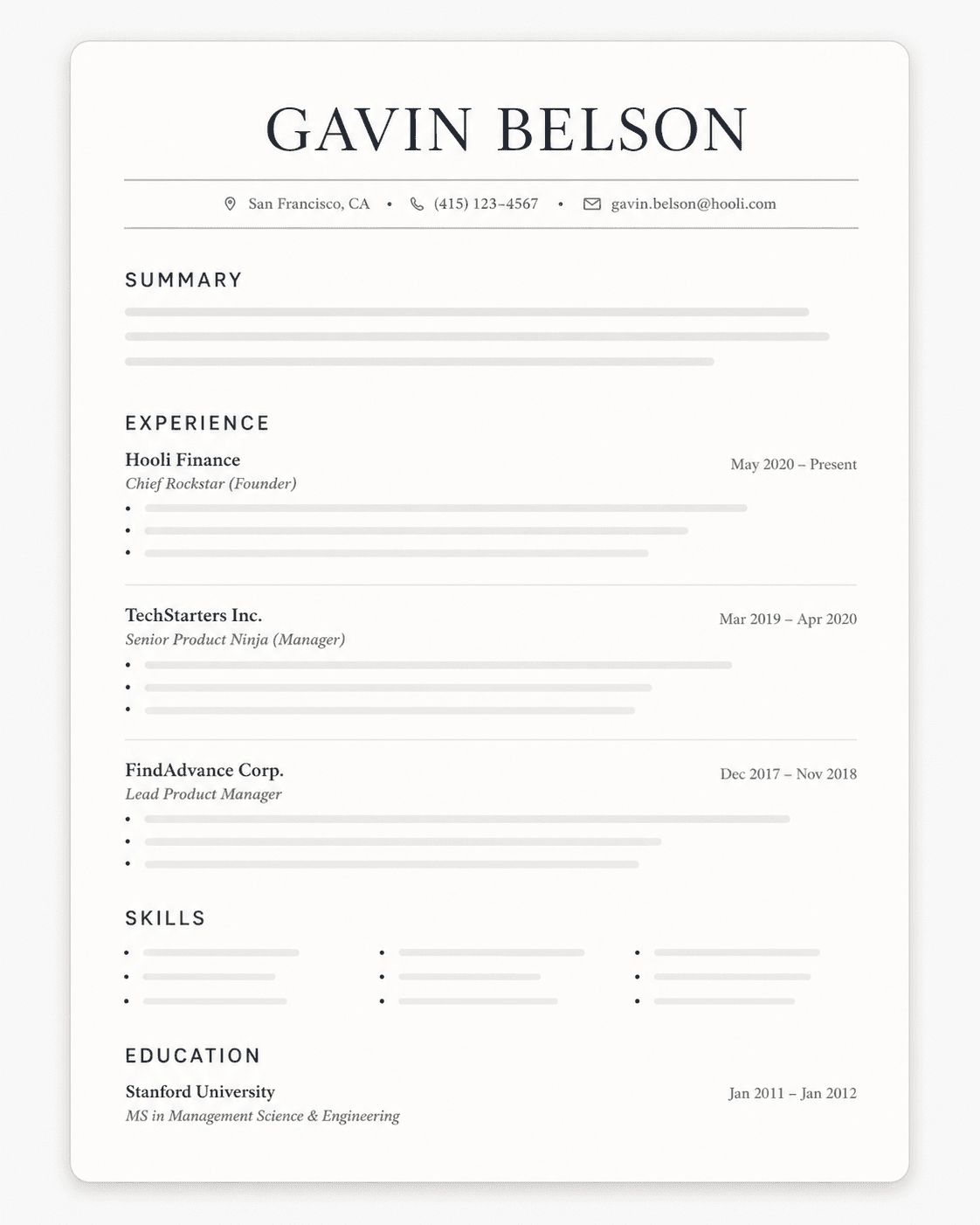
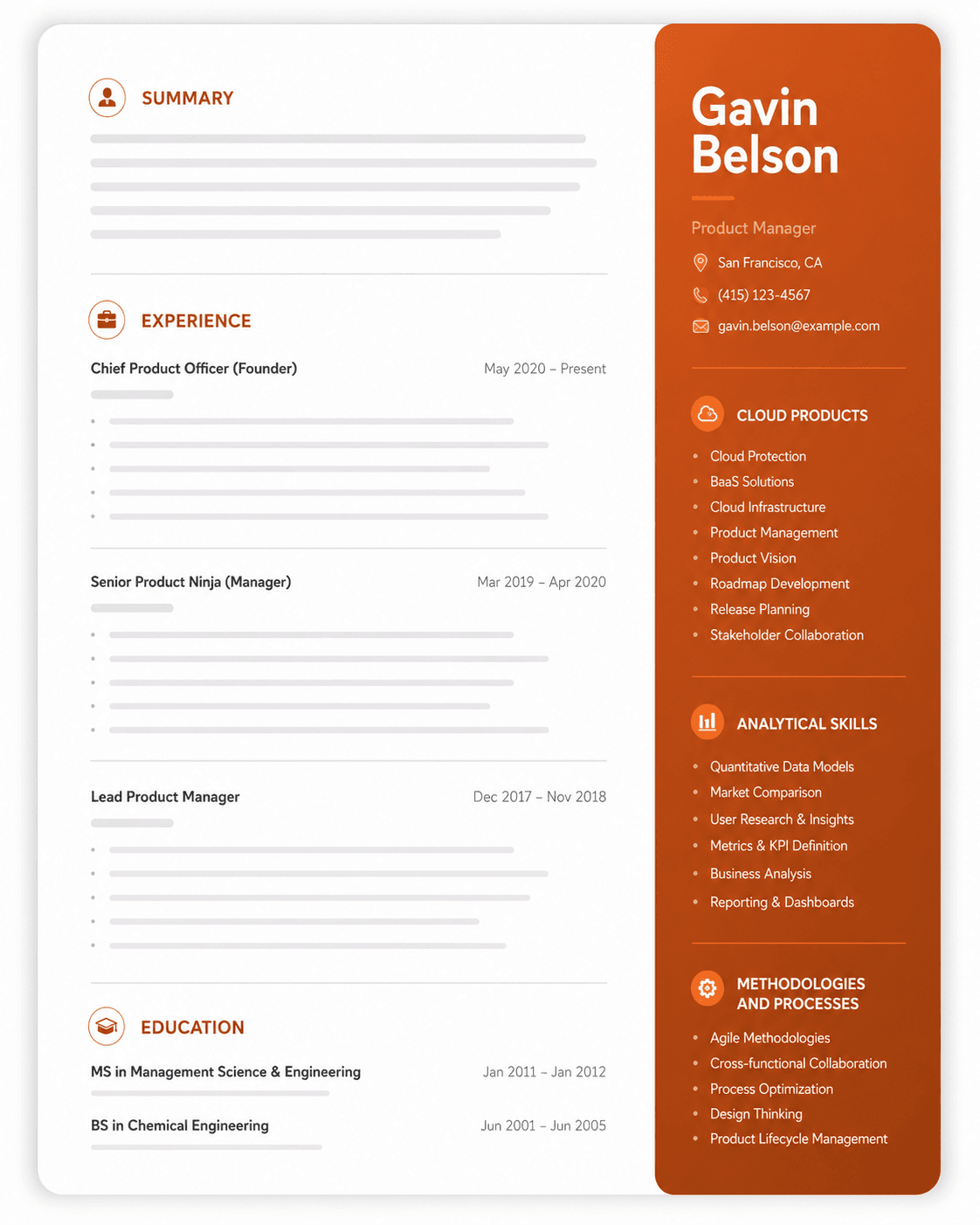
Keep the visual layout plain. Save tables, text boxes, and multi-column layouts for a print-only version; most ATS platforms still parse those elements incorrectly, scrambling dates or dropping text. A single-column layout with standard section headings (Summary, Skills, Experience, Qualifications) is the safest choice when you don't know what system a company uses to screen applications.
Your contact block goes at the top: name, phone, email, city/region, LinkedIn if relevant. Directly beneath it, or as the first line of your summary, place your credential status: ICSA/CGI, ICSI, or equivalent. This is the one detail hiring managers scan for first, so don't bury it in a skills list halfway down the page.
Write a Targeted Summary or Objective
Your summary has three jobs: establish the scope of governance you've handled (one entity or twelve, private company or listed group), state your credential status plainly, and prove one measurable compliance or efficiency outcome. Skip generic adjectives. A governance professional reading dozens of these wants facts, not tone.
A weak summary looks like this:
"Organized and detail-oriented company secretary with strong communication skills and a passion for corporate governance."
A stronger one looks like this:
"Part-qualified Company Secretary (ICSA/CGI, final stage) with 3 years supporting board and committee governance for a 200-employee private company. Coordinated 18 board and subsidiary meetings annually, maintained statutory registers for 4 group entities, and cut board-pack distribution time from 10 days to 4 by restructuring the review process."
If you're a trainee or have no paid CS experience yet, an objective works better than a summary. Use it to connect your academic progress to the responsibilities you're targeting.
Trainee/entry-level objective example:
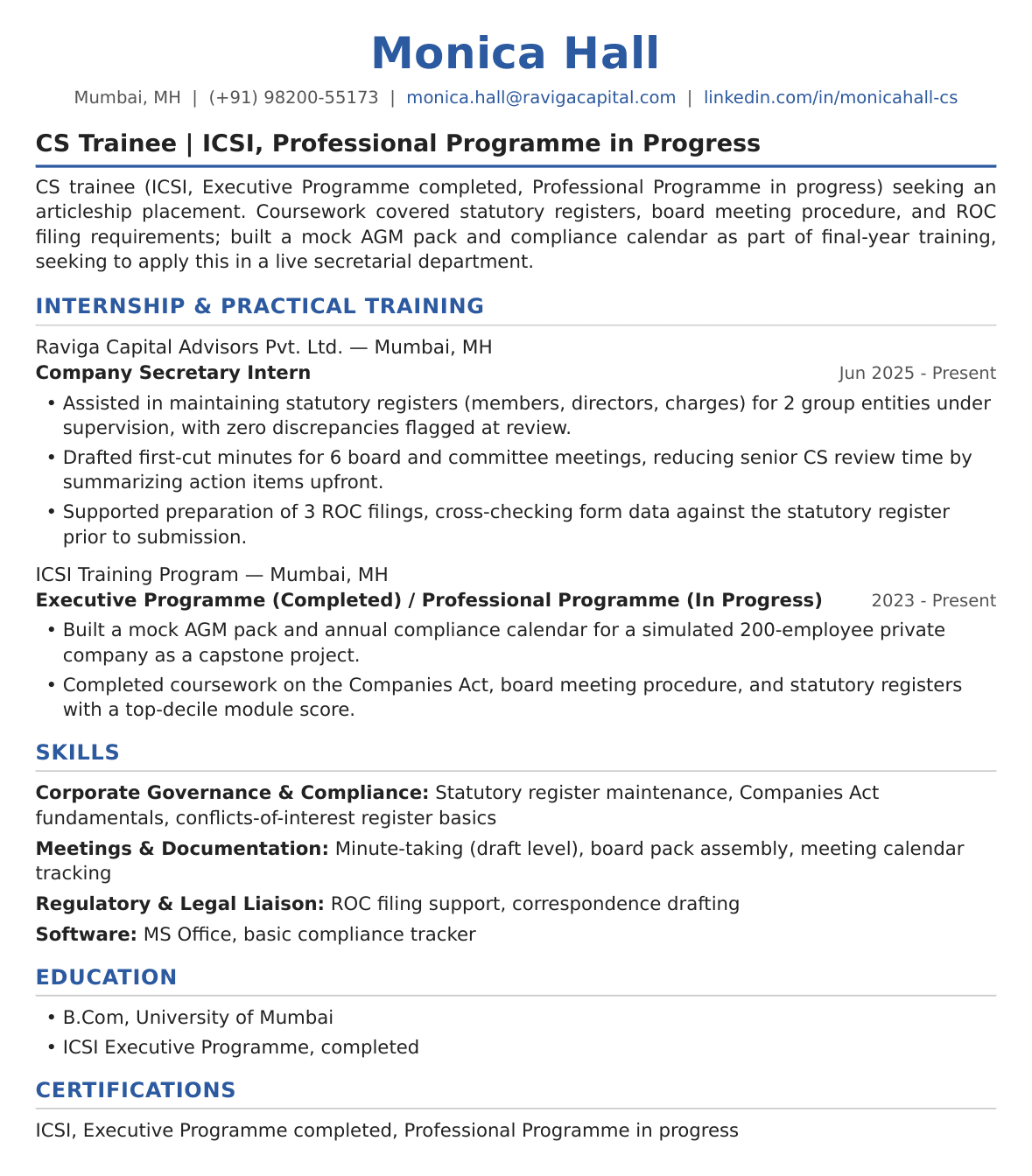
"CS trainee (ICSI, Executive Programme completed, Professional Programme in progress) seeking an articleship placement. Coursework covered statutory registers, board meeting procedure, and ROC filing requirements; built a mock AGM pack and compliance calendar as part of final-year training, seeking to apply this in a live secretarial department."
Show Your Qualification and Credential Status Clearly
For this role, credential status is often the first filter a recruiter applies before reading anything else. Place it in your summary and, if you have space, repeat it as its own labeled line just under your name (e.g., "Chartered Governance Institute (CGI), ACG" or "ICSI, ACS"). Don't make a reader hunt for it in a paragraph of prose.
Name the issuing body and your exact status rather than the vague word "qualified":
- Trainee/student: "ICSI, Executive Programme completed; Professional Programme in progress"
- Part-qualified: "ICSA/CGI, final stage (Board Dynamics module outstanding)"
- Fully qualified: "ICSI, Associate Company Secretary (ACS)" or "Chartered Governance Institute (CGI), ACG"
- Fellow-level/senior: "ICSI, Fellow Company Secretary (FCS)" or "CGI, FCG"
If your qualifying body varies (a national equivalent, for instance), use the same structure: body name, then status, not just "certified." CGI is the modern name for what was historically ICSA, so an older membership can read "CGI (formerly ICSA), ACG" or the historic ACIS/FCIS designation, matched to your actual certificate.
Build a Skills Section That Speaks to Hiring Managers
Group your skills so a hiring manager can scan for exactly what they need. Pull exact phrasing from the job description where it matches your real experience: regulatory-filing terminology (ROC, Companies House, SEC-equivalent) varies by market, and mirroring the JD helps both ATS parsing and human skim-reading.
Corporate Governance & Compliance Statutory register maintenance (members, directors, charges), Companies Act compliance, corporate governance code adherence, conflicts-of-interest register management, share capital administration
Meetings & Documentation Board and committee minute-taking, AGM/EGM planning and logistics, board pack preparation and distribution, resolution drafting, meeting calendar management across multiple subsidiaries
Regulatory & Legal Liaison Regulatory filings (Companies House, ROC, SEC-equivalent), liaison with external auditors and legal counsel, correspondence with regulators on statutory deadlines, due diligence support for M&A and restructuring
Interpersonal & Board-Level Skills Discretion with confidential board matters, coaching directors on governance obligations, stakeholder communication across executive and non-executive directors, diplomacy in escalating compliance risks
Only list software you've used unaided, not tools you've merely observed a senior CS operate. If you've worked in Diligent Boards, BoardPad, Blueprint OneWorld, or a similar governance/board-portal platform, name it specifically rather than writing "board software" or "office tools."
Write Achievement-Focused Experience Bullets
Use this formula for every bullet:
[Action verb] + [specific governance/compliance task] + [quantifiable result or scope].
Duties alone read like a job description; a result or scope tells the reader what changed because you were there.
A weak bullet looks like this:
"Responsible for taking minutes and helping with statutory filings."
A stronger one looks like this:
"Drafted and circulated board minutes for 12 board and committee meetings annually, achieving zero compliance queries from auditors across 3 consecutive years."
Sub-role bullet library
The four variants below cover the scope differences that matter most for this role: how many entities you support, whether you're the sole CS or part of a team, and where you sit in the qualification pathway. Match to the variant closest to your actual role, then adapt the numbers to your own record. If your experience spans more than one variant, pull one bullet from each and adjust the framing to show the progression.
1. Junior/Assistant Company Secretary
- Supported statutory filings for a 6-entity group, maintaining a 100% on-time submission record across 40+ Companies House filings per year.
- Prepared board packs for 10 board meetings annually, reducing director query turnaround from 3 days to 1 by standardizing the pack template.
2. Company Secretary (sole CS, private company)
- Managed the full company secretarial function for a 150-employee private company, including statutory registers, AGM organization, and board minute-taking for all 8 annual board meetings.
- Led the company's transition to digital statutory registers, cutting annual audit preparation time by 30% and eliminating 2 recurring compliance findings.
3. Group/Listed-Company Secretary
- Coordinated governance across a 14-subsidiary listed group, managing board and committee calendars for 25+ meetings per year across 3 time zones.
- Partnered with legal counsel on a group restructuring affecting 6 subsidiaries, delivering all statutory filings ahead of a 90-day regulatory deadline with zero exceptions.
4. Part-Qualified/Semi-Qualified CS transitioning to full qualification
- Took on lead minute-taker responsibilities for board and audit committee meetings while completing final-stage ICSA/CGI modules, supporting governance for 2 subsidiary entities.
- Independently managed the statutory compliance calendar for 5 group entities, maintaining a zero-miss record across 60+ filing deadlines over 18 months.
If you don't have a clean metric, quantify scope instead: the number of board meetings you ran per year, the number of entities you supported, or a run of statutory deadlines met without a miss. If you can't find any numbers, check your board pack distribution logs, compliance calendar, and prior audit reports; these almost always contain a count, a deadline record, or a turnaround time you can reuse.
Organize Your Work History the Right Way
List roles in reverse-chronological order with employer, location, and dates. For each role, lead with the governance scope (how many entities, what level of the business you supported) before listing individual duties, so a reader can size up the role in one glance.
If you're moving into CS work from a legal, paralegal, or audit background, frame prior roles around the governance-adjacent parts: statutory research, compliance tracking, document drafting for board or regulatory purposes. Don't rewrite your title, but rewrite your bullets to surface governance relevance. A paralegal bullet like "Drafted contracts and reviewed compliance documentation" can become "Reviewed statutory compliance documentation for 3 corporate entities and drafted board resolutions ahead of quarterly filing deadlines" without overstating what you actually did.
If your actual job title undersells your scope ("Secretary" when you were effectively running the governance function), add a one-line clarifier beneath the title, such as "Sole Company Secretary function for a 150-employee private company." Do the same for career gaps or lateral moves: a one-line note on context beats leaving a reader to guess.
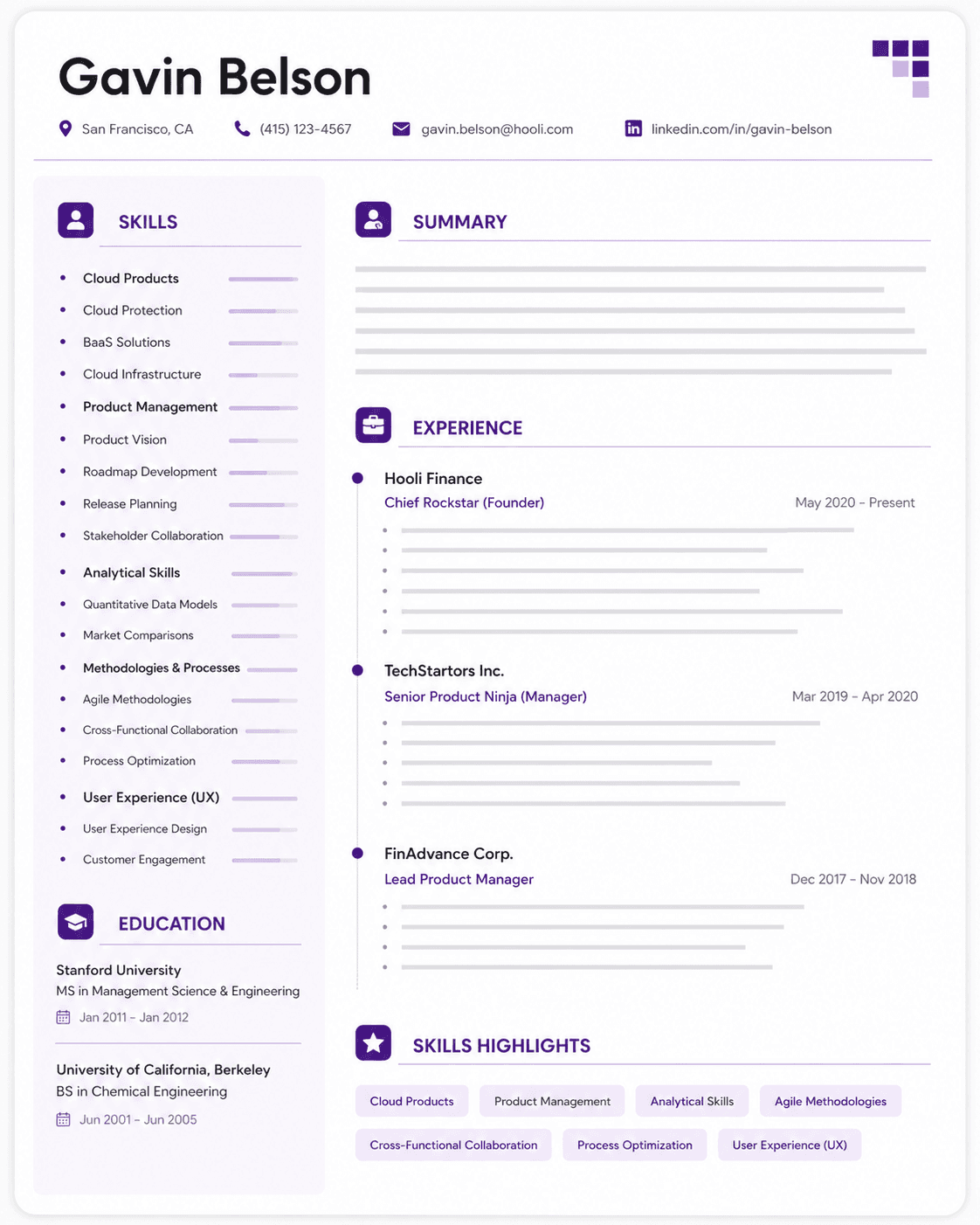
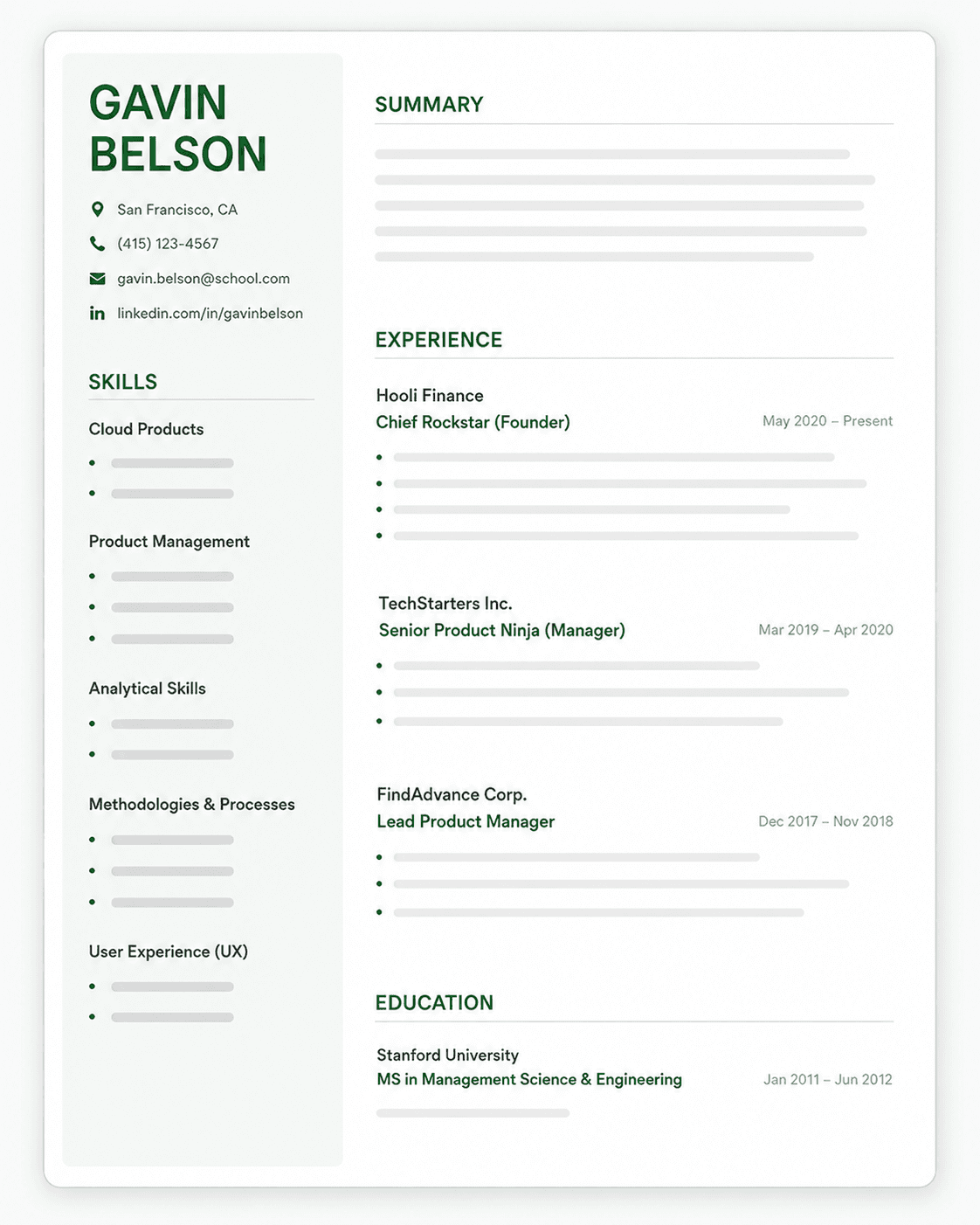
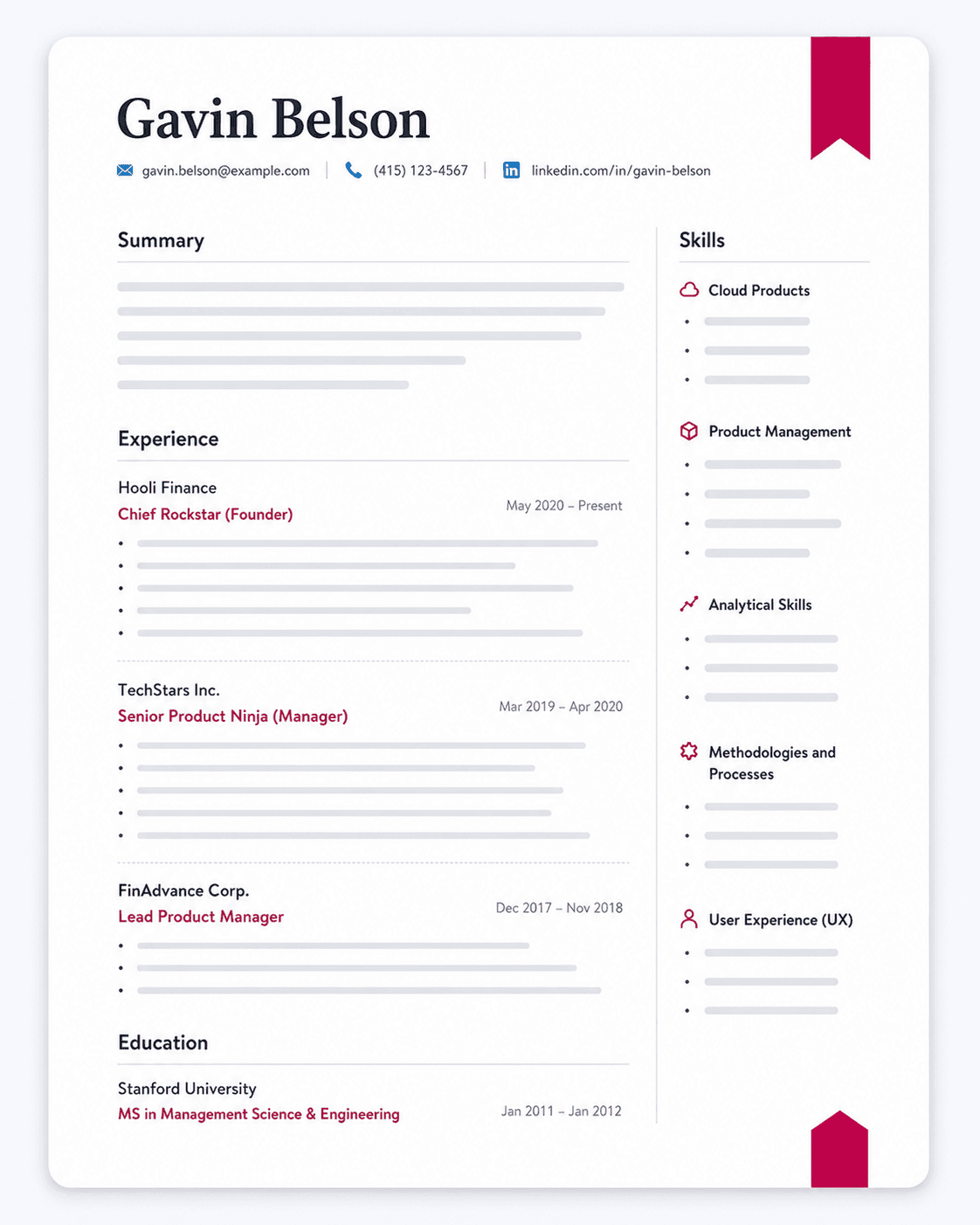
Company Secretary Resume Examples
Seeing a resume built for your exact career stage makes formatting decisions easier. Use these three tiers as starting points, then adjust for your own experience.
Entry-Level / Trainee Template
Built for CS trainees applying for articleship or their first placement, with emphasis on academics, internships, and ICSI training modules.
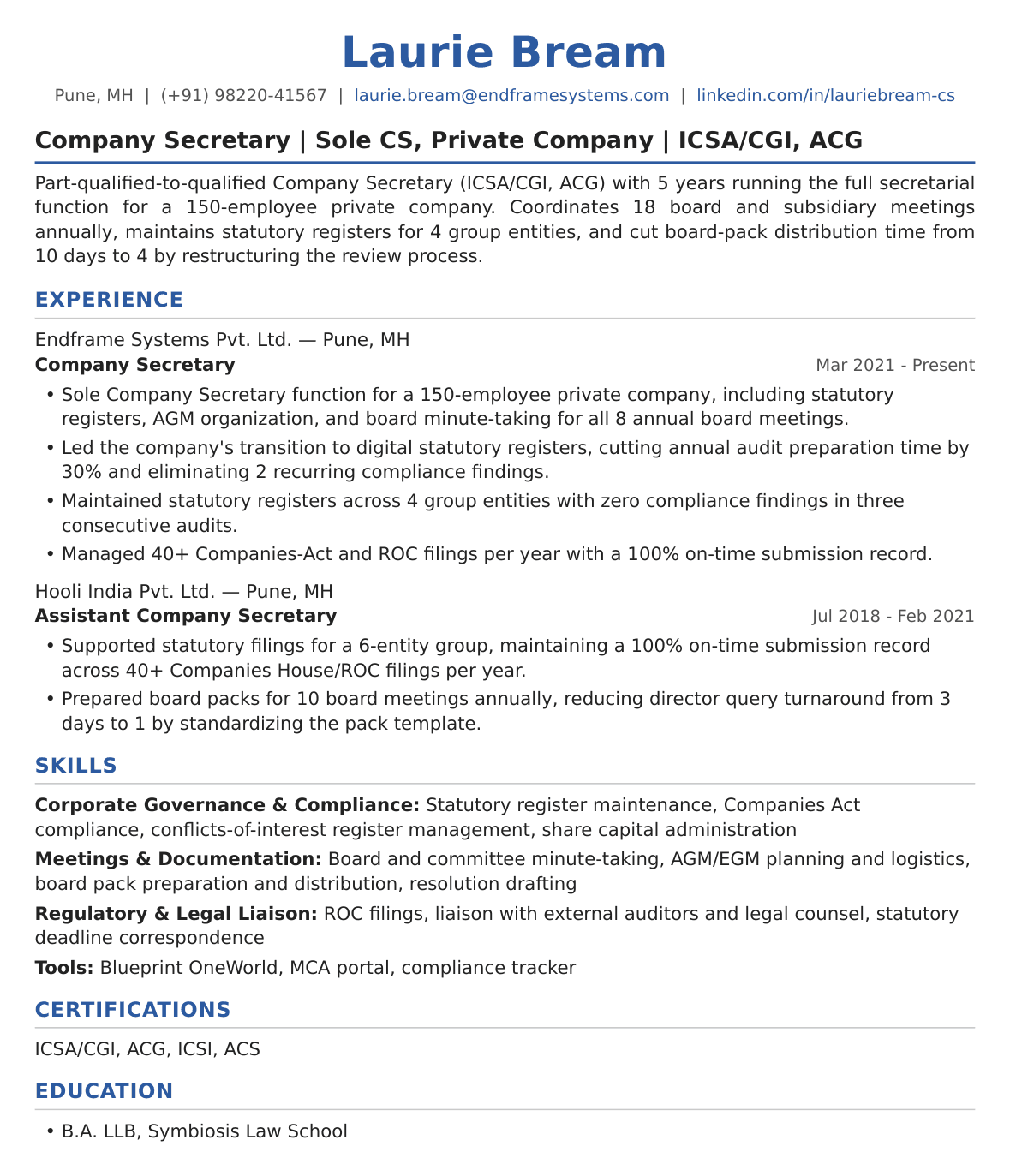
Mid-Career (Sole CS, Private Company) Template
Built for a sole Company Secretary at a private company, highlighting board support, compliance ownership, and ROC filings handled independently.
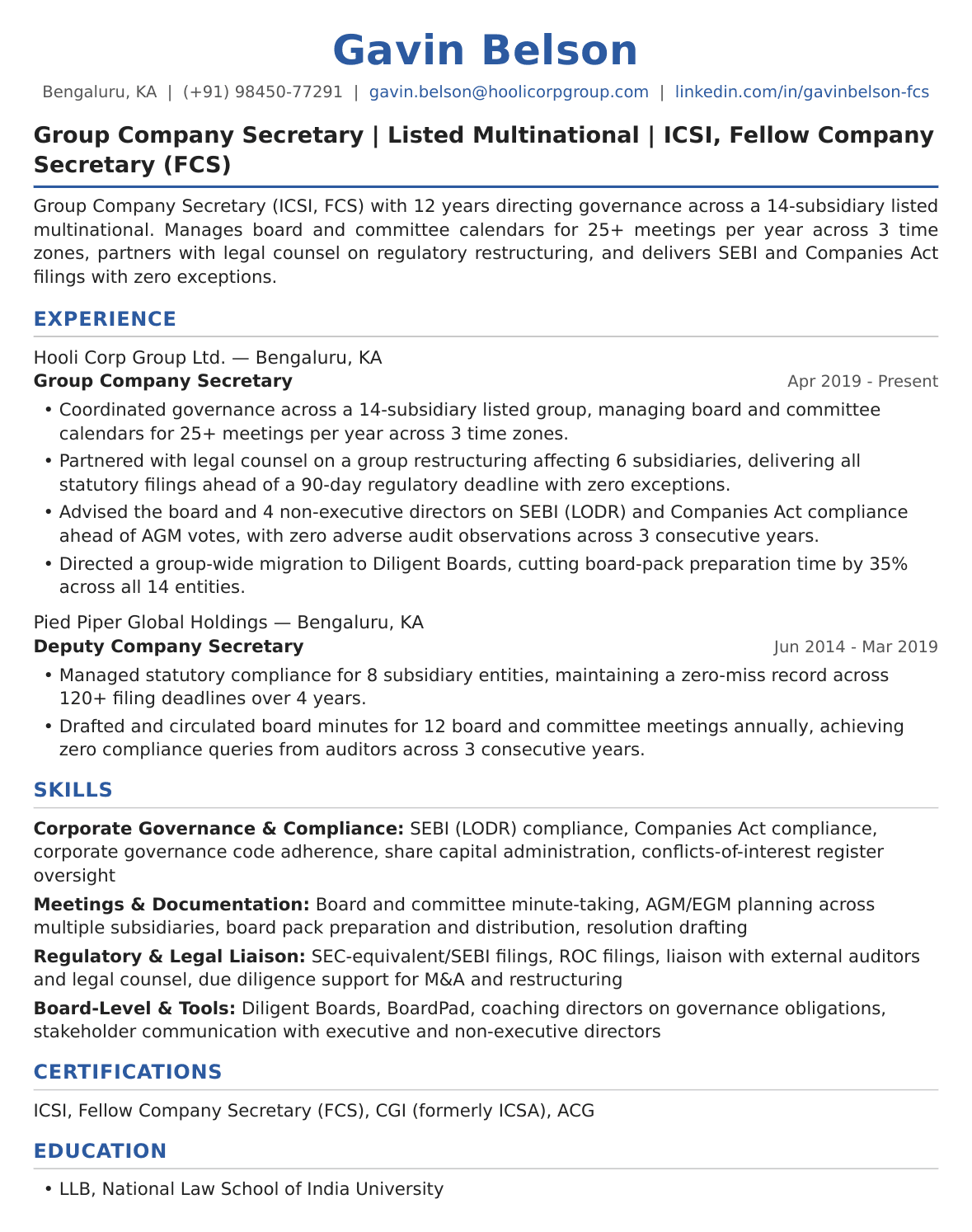
Senior (Group/Listed-Company) Template
Built for Group Company Secretaries or listed-company secretaries managing multi-entity governance, SEBI compliance, and board-level stakeholder management.
Company Secretary Resume Keywords
Governance recruiters search for statute names, filing types, and board-support language. Use the terms below where they reflect your work, and swap in the exact statutes and regulators for your jurisdiction.
| Category | Keywords |
|---|---|
| Governance & board support | Corporate governance, Board meeting administration, Minute-taking, Board resolutions, AGM/EGM coordination, Board pack preparation |
| Compliance & filings | Statutory compliance, Companies Act filings, Annual returns, Statutory registers, Regulatory filings, Listing and disclosure compliance, Insider trading compliance |
| Advisory & transactions | Corporate restructuring, Due diligence, Shareholder communications, ESG reporting, Entity management |
| Tools & soft skills | Board portal software (Diligent, BoardEffect), Discretion and confidentiality, Stakeholder management, Drafting and documentation |
Applying in a Different Country? How to Present Your CS Qualification
A company secretary qualification is national, not global. If you qualified under ICSI in India and are applying in the UK, Canada, New Zealand, or the Gulf, the hiring company may not know what your credential covers, and the statutes you cite will be the wrong ones for their market.
Two things fix this on the resume. First, state your qualification with its reciprocity path: ICSI and the Chartered Governance Institute (CGI) hold mutual recognition agreements, so an ICSI Associate can write "ACS (ICSI), eligible for CGI membership via ICSI–CGI MoU" or name the in-progress route, such as the three additional modules CGI Canada requires. That one line tells a foreign employer your credential converts.
Second, translate your experience out of home-market statute names. "Ensured Companies Act 2013 and SEBI LODR compliance" means little to a London recruiter. Reframe by function: "managed statutory filings, listing-rule disclosures, and board governance for a listed company." Keep one mention of the original statute for accuracy, but lead with the universal governance language every market shares.
Common Company Secretary Resume Mistakes to Avoid
Describing Duties Instead of Governance Outcomes
"Prepared board minutes and maintained statutory registers" tells a hiring manager what you were assigned, not what you delivered. A stronger version names the result: "Maintained statutory registers across 6 subsidiaries with zero compliance findings in three consecutive audits." Every duty should show what changed because you did the job.
Using One Generic Resume for Every Company Type and Size
A resume built for a sole-CS role at a small private company reads very differently from one aimed at a group secretariat position inside a listed group. Sending the same document to both underplays your autonomy or overstates your scope. Adjust the summary and top bullets to match the employer's entity structure.
Burying or Omitting Credential Status
Don't tuck "ICSA part-qualified" into a footnote under education. Recruiters scan for qualification status first, the same way they'd scan for a nursing license. State it near your name or summary line: "ACS, ICSI" or "Part-qualified, ICSA/CGI, exams complete 2026." If you're still training, say so plainly.
Naming "Communication Skills" Instead of Board-Level Discretion
Every admin resume claims communication skills. What actually differentiates a company secretary is discretion with confidential board matters and the judgment to advise directors on governance points without overstepping. Write "advised board members on governance compliance ahead of AGM votes" instead of "strong communicator."
Ignoring ATS Formatting
Many UK CV templates lean on tables, text boxes, and multi-column layouts that scramble when an ATS parses them, sometimes putting job titles and dates out of order. Stick to single-column, standard headings, and no embedded text boxes.
Vague "Assisted with Compliance" Language
"Assisted with compliance" could mean filing paperwork or running a full regulatory audit. Name the actual filings: "Filed annual confirmation statements and updated PSC registers" or "Coordinated ROC filings across group entities." Specificity separates a credible governance track record from filler.
Framing Yourself as an Executive Assistant or Secretary
If your resume's language leans on calendar management, travel booking, and correspondence, a recruiter will read you as an EA rather than a governance professional, even if your actual job involved statutory compliance. Keep the framing consistent. This is a compliance and governance function, not a clerical one. Carry that from your title line through your first bullet.
How AI Resume Builders Can Simplify Your Company Secretary Resume
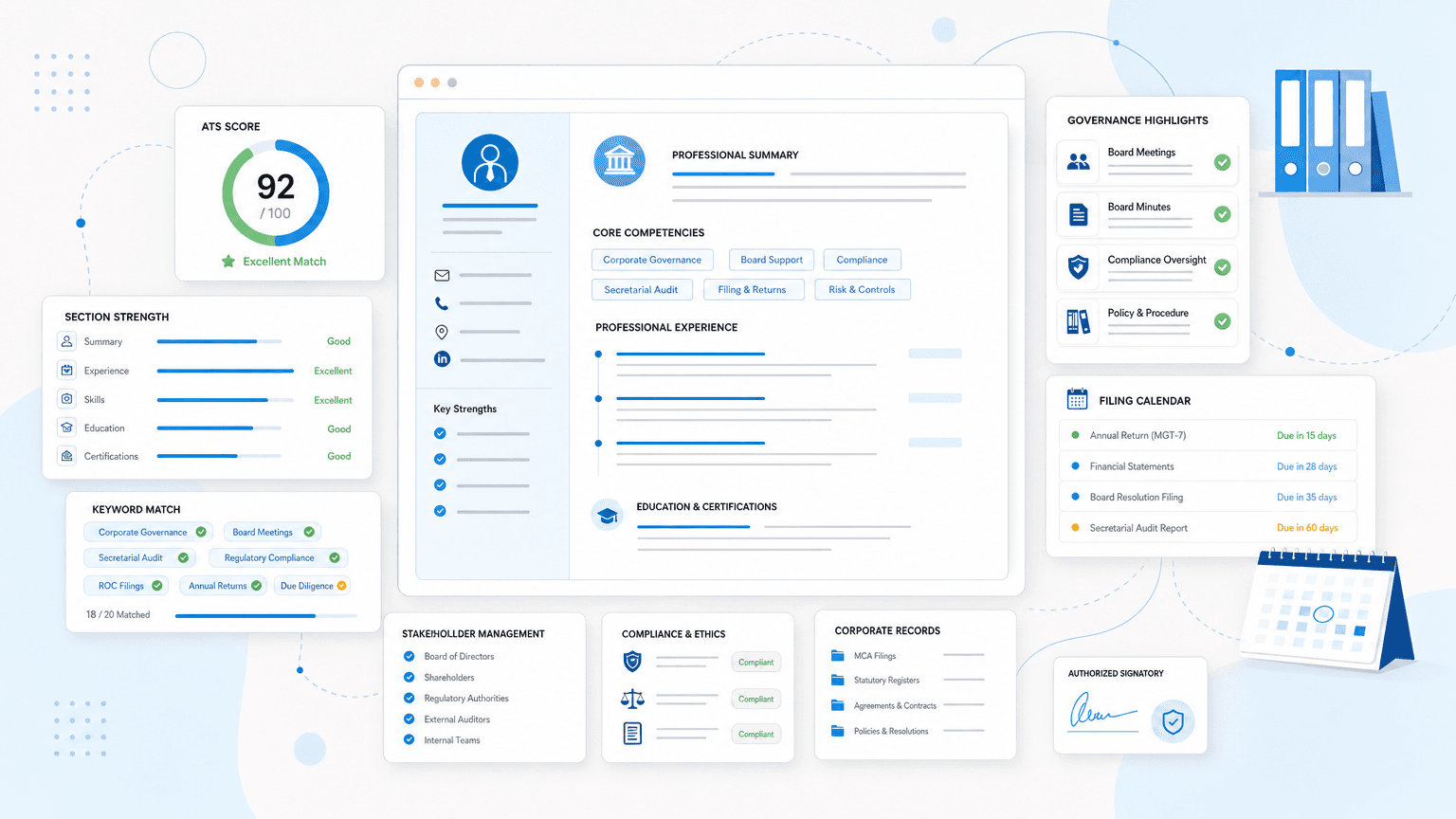
Tailoring a resume for every private-company, listed-company, or jurisdiction-specific role takes real time, and a generic version often gets filtered by ATS software before a governance-savvy hiring manager ever opens it. Upplai handles this without replacing your judgment on what belongs in the resume.
- Real-time ATS scoring: see your ATS and recruiter scores update as you edit, so you know how a compliance-heavy resume is performing without a download-and-reupload cycle.
- Transparent suggestions: every edit comes with a plain-language "why this change?" explanation, and you accept or reject each one individually. Nothing is invented, which matters when the resume covers board minutes, statutory filings, or regulatory deadlines.
- Automatic formatting: choose from multiple ATS-friendly templates so board-meeting summaries, compliance calendars, and filing histories stay readable to both parsers and recruiters.
- Structure guidance: get recruiter best-practice suggestions on ordering and phrasing, plus bias-trigger flagging, so the resume reads as precise and professional.
- Preference memory: bookmark separate master resumes for different job types, useful if you're maintaining one version for private-company applications and another for listed-company roles with different disclosure and governance expectations.
On pricing: the free plan gives you 3 tailored resumes with matching cover letters as a one-time allotment, plus 200 ATS scans a month, with no credit card required. If you need more tailored resumes beyond those 3, add-on packs start at $5 and work out to $0.50 to $1.00 per resume, with no subscription.
Build a company secretary resume that gets past ATS filters
Run a free ATS check on your resume in under a minute.
A company secretary resume earns its shortlist the same way the job itself works: through visible governance judgment, not a longer duty list. Lead with your credential status, back it with entity counts and compliance outcomes you can defend in an interview, and match the tier of detail to the company type you are targeting. The format matters less than whether a reader can tell, in the first ten seconds, what governance scope you actually held.