If you're applying to MBB, Big 4, or a boutique consulting firm, you already know your resume needs the right keywords to get past the first screen. What you might not know is that most keyword lists online stop at generic buzzwords like "leadership" and "problem-solving," without showing you how to prove those traits in a way an ATS and a recruiter both credit.
This guide gives you the complete keyword list by firm type and function, then shows you exactly how to place each keyword so it reads as evidence instead of a label, with weak-vs-strong bullet examples for every experience level from a first-time applicant with no formal consulting title to a Manager owning a seven-figure engagement budget.
Start with the full list below, then use the sections that follow to match it to your target firm and translate it into bullets that actually move your resume forward.
Consulting Resume Keywords: The Complete List
If you're searching for consulting resume keywords, here's the full list, organized by category, before anything else.
| Category | Keywords |
|---|---|
| Strategy & Problem-Solving | MECE (Mutually Exclusive, Collectively Exhaustive), hypothesis-driven problem solving, issue tree / logic tree, root cause analysis, business case development, market entry strategy, competitive landscape analysis |
| Analytics & Tools | Excel (advanced formulas, pivot tables, VBA), SQL, Tableau, Power BI, Alteryx, financial modeling, statistical analysis |
| Client & Leadership Skills | Stakeholder management, client-facing engagement, cross-functional collaboration, workstream ownership, executive presentation, team leadership |
| Certifications | PMP, Six Sigma (Green/Black Belt), CFA, CPA, CBAP, SHRM-CP |
| Firm-Specific Terms | Personal impact, entrepreneurial drive, results orientation, practical impact, inclusive leadership |
Not every keyword on this list belongs on every resume. An MBB strategy analyst leans hard into MECE, hypothesis-driven thinking, and issue trees, because that vocabulary signals case-ready structured reasoning to a screener who will test for it in interviews. A Big 4 digital-transformation associate needs a different mix: change management, operating model design, and program management carry more weight than case-cracking terms, since the work itself is implementation, not pure strategy.
If you don't have a formal consulting title yet, the list still applies. It just needs translation. A research assistant who structured a messy dataset into clean categories was doing root cause analysis. A student org treasurer who rebuilt a budget model was doing financial modeling. The sections below show how to make that translation specific, and how to pick the right row for your target firm.
Why Keywords Decide Whether a Consulting Resume Gets Seen
How ATS and Recruiters Screen Consulting Resumes in Under 30 Seconds
Before a human ever opens your resume, software usually decides whether it survives. 99% of Fortune 500 companies and 75% of large employers use an ATS to screen candidates, and up to 80% of resumes are eliminated automatically before a recruiter sees them.
The ones that pass don't get much more attention. Recruiters spend just 3 to 7 seconds on an initial scan. For MBB firms, this filter matters even more: each cycle draws application volumes in the hundreds of thousands for a limited number of analyst and associate seats, so the keyword match has to be exact on the first pass. There's rarely a second look.
The Four Traits Every MBB and Big 4 Resume Gets Screened Against
Consulting recruiters aren't hunting for buzzwords. They're screening for four underlying traits: Problem-Solving, Personal Impact, Entrepreneurial Drive (often paired with Leadership), and Quantitative Rigor.
A term like "hypothesis-driven" only earns credit when a bullet shows you framing a problem and testing a solution. "Led" only counts when it's attached to a team size, budget, or outcome.
So when this article lists keywords, treat each one as shorthand for a trait you still have to prove in context. A resume that names MECE or Alteryx without ever demonstrating structured thinking or quantified results reads as keyword-stuffed, not qualified, and both the ATS and the recruiter behind it are built to catch the difference.
Consulting Keywords by Function and Firm Type
MBB, Big 4, and boutique firms don't screen for the same vocabulary. A strategy analyst and a Big 4 digital-transformation associate are proving different things to different reviewers. Use the table that matches your target practice, not all three.
Strategy & MBB-Style Keywords
MBB-style resumes need to signal structured thinking before a case interview even happens. These terms show a reviewer you already think the way the firm works.
| Keyword | Signals |
|---|---|
| Corporate Strategy | Enterprise-level decision framing |
| Market Entry Strategy | New-market or new-segment analysis |
| Competitive Landscape Analysis | Benchmarking, positioning |
| Hypothesis-Driven Problem Solving | Case-style analytical approach |
| MECE | Structured, non-overlapping categorization |
| Issue Tree / Logic Tree | Breaking problems into components |
| Root Cause Analysis | Diagnostic rigor |
| Business Case Development | Recommendation building, ROI framing |
MECE deserves special attention. It signals that your resume itself, not just your bullets, is organized without gaps or overlaps. Screeners at MBB firms read that as proof you already think like a consultant.
Big 4 & Implementation-Focused Keywords
Big 4 advisory and implementation roles reward execution vocabulary over pure analysis. These terms show you can carry a recommendation through delivery.
| Keyword | Signals |
|---|---|
| Digital Transformation | Technology-enabled change programs |
| Change Management | Adoption, stakeholder readiness |
| Process Improvement | Operational redesign |
| Operating Model Design | Org structure, governance |
| Risk Advisory | Controls, risk frameworks |
| Regulatory Compliance | Audit-adjacent, regulated industries |
| Program Management | Multi-workstream delivery |
If your background is in implementation rather than pure strategy, lead with these. Reviewers at Big 4 firms are checking for delivery experience, not case-cracking language.
Boutique & Practice-Area Keywords
Boutique and specialist firms hire against a specific practice area. List the row for the practice you're targeting, not the whole table.
| Practice | Keywords |
|---|---|
| Due Diligence & M&A | Valuation, Synergy Analysis, Post-Merger Integration |
| Operations | Supply Chain Optimization, Lean, Six Sigma |
| Financial Services | Credit Risk, Regulatory Capital |
| Healthcare | Value-Based Care, Payer Strategy |
A candidate targeting an M&A boutique gains nothing from listing Value-Based Care, and a healthcare-focused applicant gains nothing from Synergy Analysis. Match the row to the firm.
Analytics, Tools, and Technical Keywords Recruiters Search For
Consulting recruiters now expect a working analytics toolkit, even for candidates targeting pure strategy roles. Big 4 and data-and-analytics practices screen for this explicitly. MBB firms increasingly do too, especially for roles touching implementation or data-heavy diligence work.
| Category | Keywords to include |
|---|---|
| Spreadsheet and modeling | Excel (Advanced Functions, Pivot Tables, VBA), financial modeling, scenario analysis |
| Presentation | PowerPoint (executive-ready decks), storyline development, data visualization |
| Data and analytics | SQL, Python, R, statistical analysis, regression analysis |
| BI and visualization | Tableau, Power BI |
| Workflow automation | Alteryx workflow automation |
The specificity rule: name the exact tool. "Data analysis tools" tells an ATS and a recruiter nothing. "Alteryx workflow automation" or "SQL queries for client data extraction" tells them exactly what you can do on day one. Generic category words get skipped by keyword-matching systems built around specific tool names, and they read as vague to a human reviewer doing a 3-7 second scan. If you used a tool, name it. If you built something in it, say what.
This matters most for Big 4 candidates and boutique applicants targeting data-and-analytics or operations practices, where a named tool can be the difference between passing and failing the first-pass filter. It matters less, but not zero, for MBB strategy roles, where even one well-placed technical keyword signals you can support your own analysis rather than depending entirely on a team.
Never list tools bare in a Skills section only. Embed at least one inside an Experience bullet, where ATS and recruiters weight it more heavily:
Weak:
"Skills: Excel, SQL, Tableau."
Strong:
"Built an Alteryx workflow automation pipeline to consolidate five regional data sources, cutting a manual reporting process from three days to two hours."
The second version proves the tool was used to produce a real outcome, not just listed.
Client-Facing and Leadership Keywords
Stakeholder management, client-facing engagement, executive presentation, cross-functional collaboration, workstream ownership, team leadership, mentoring, business development. Every MBB and Big 4 rubric screens for these traits, and nearly every competing article stops at listing them as bare words. A bare label tells a recruiter nothing about what you actually did.
The fix is to prove the trait inside a bullet, with a scope, an action, and a quantified result attached. "Stakeholder management" on its own could mean anything from a weekly status email to running a C-suite steering committee. Name the audience, the mechanism, and the outcome, and the keyword becomes evidence instead of a claim.
Weak:
"Responsible for client communication and stakeholder management."
Strong:
"Presented weekly progress updates to a 12-person C-suite steering committee across three business units, aligning stakeholders on a workstream that cut reporting cycle time by 30%."
The second version still contains the keywords (client-facing, executive presentation, stakeholder management, cross-functional) but embeds them in context an ATS can match and a recruiter can verify in a 30-second scan.
Apply the same logic across the category. "Team leadership" becomes owning a 4-person analyst pod and a specific deliverable. "Mentoring" becomes onboarding two new analysts and cutting ramp-up time. "Business development" becomes contributing a proposal section that helped win a named-size engagement (or an anonymized equivalent, if client-confidential). "Workstream ownership" becomes naming the workstream, the timeline, and who you reported to.
If you are early-career and have no formal consulting title, this same discipline applies to research projects, internships, and student-org leadership. Translate "led a team" into the same shape: scope, action, quantified result. The vocabulary matters less than showing you can operate at that level, in context, not just claim it.
Certifications and Credentials Worth Listing
Certifications are not a gating requirement in consulting the way a professional license is in engineering or law. No MBB or Big 4 firm will screen out a resume for lacking one. That said, the right certification signals depth in a specific practice area, and at the margin it can separate two otherwise similar candidates.
The key is placement. A certification buried inside a Skills list reads as an afterthought. Give it a dedicated Certifications line near the top third of the resume, where a recruiter scanning in under ten seconds will actually see it.
| Certification | Where it matters most |
|---|---|
| PMP | Project and program-heavy roles, large-scale transformation work |
| Six Sigma Green/Black Belt | Process improvement, operations, and ops-focused consulting |
| CFA | Financial services practices, valuation and deal-advisory work |
| CPA | Finance transformation, Big 4 audit-adjacent advisory |
| CBAP | Business analysis, requirements-heavy engagements |
| SHRM-CP | HR and people-consulting practices |
| CISSP / CISA | Technology risk, cybersecurity, and IT audit consulting |
Match the certification to the practice area you are targeting. A CFA carries real weight in a financial services or valuation-focused application and almost none in an operations-strategy one. Listing a certification that has nothing to do with your target role reads as padding.
If you hold none of these, do not fabricate urgency around getting one before you apply. A strong bullet history of quantified, methodology-specific work outweighs a credentials line every time.
Weak vs. Strong Bullet Examples by Experience Level
Entry-Level / No Direct Consulting Experience
If you have no formal consulting title yet, the fix is translation, not fabrication. Take the research, student-org, or internship work you already did and describe it the way a case team would: name the hypothesis, the method, and the outcome.
Weak:
"Helped student consulting club analyze a local business's growth strategy."
Strong:
"Led a 4-person team applying a hypothesis-driven framework to assess a local retailer's expansion options, presenting a market entry recommendation projected to lift revenue 15% within one year."
The strong version keeps the same underlying activity but adds structure (hypothesis-driven), scope (team size), and a quantified, clearly labeled projection.
Analyst / Associate (2-4 Years)
At this stage, recruiters expect you to prove you can own an analysis workstream and connect it to a business outcome, not just "support" a project.
Weak:
"Worked on a market entry project for a client in the consumer goods space."
Strong:
"Built a MECE market entry analysis across five geographies for a consumer goods client, using competitive benchmarking and Porter's Five Forces to identify a target market that generated $8M in projected first-year revenue."
The strong bullet names the framework, the scope (five geographies), and a specific dollar outcome, three things ATS systems and human reviewers both scan for.
Manager / Engagement Manager (5+ Years)
At the manager level, the bar shifts from individual analysis to owning budget, team, and client outcomes across a full engagement.
Weak:
"Managed a team on a client transformation project and helped improve efficiency."
Strong:
"Led a 12-person cross-functional team and a $1.2M engagement budget on a digital transformation program for a Fortune 500 manufacturer, redesigning core operating processes that reduced cycle time by 30% and delivered $4M in annualized cost savings."
This version quantifies team size, budget ownership, and two distinct outcome metrics, signaling engagement-level accountability rather than task-level contribution. The three resumes below show these same bullets assembled into complete, one-page documents at each stage of the consulting ladder.
Consulting Resume Examples by Experience Level
Each example below pulls the framework and keywords covered so far into a full, one-page resume. Match the level closest to your own background, then use it as a structural template, not a script: keep the section order and the discipline of pairing every keyword with a quantified bullet, but swap in your own firms, metrics, and scope.
Business Analyst Resume
This is the entry-level template for a candidate with no formal consulting title, targeting a Business Analyst or Associate Consultant seat straight out of school. The summary is written as a targeting statement rather than a track record, and the resume pulls its evidence from a student-consulting club and a research assistantship rather than a prior consulting job. Every bullet still names a framework (MECE, hypothesis-driven) and a quantified outcome, because that discipline matters more than the source of the experience.
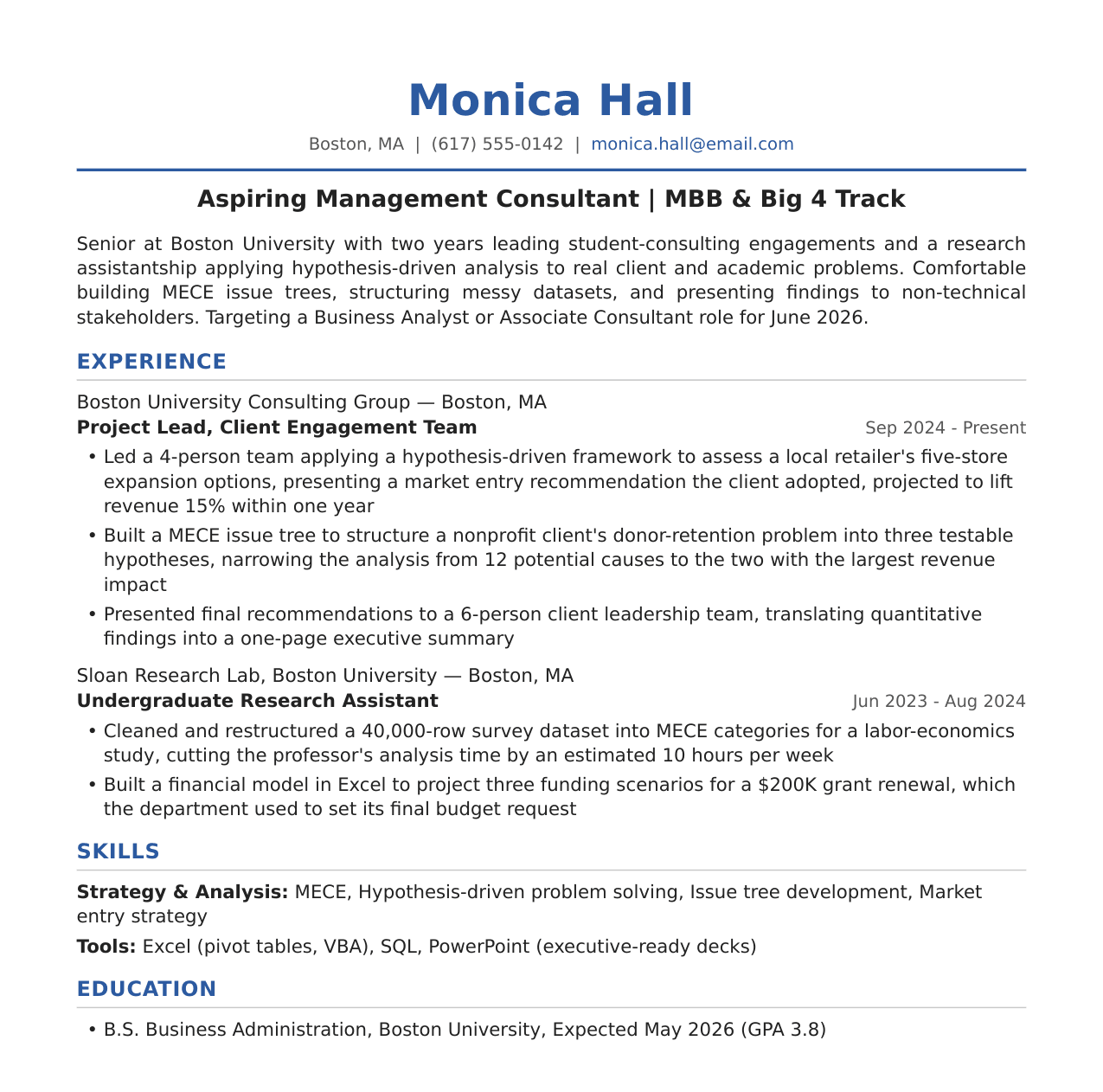
What's working here: the objective names a specific target role instead of a vague "seeking opportunities" line, the skills section separates frameworks from tools so an ATS can match both, and every bullet keeps the scope, action, and quantified-result shape the rest of this guide teaches, even though the underlying experience is a student club rather than a client engagement.
Consultant Resume
This is the two-to-four-year template for someone who already holds a consulting title and needs the resume to prove workstream ownership, not just participation. The summary opens with years of experience and firm type, then names a dollar-value outcome up front. The experience section carries the weight: two roles, three to four bullets each, with at least one bullet naming a specific tool (Alteryx, SQL) tied to what it produced, following the specificity rule covered earlier in this guide.
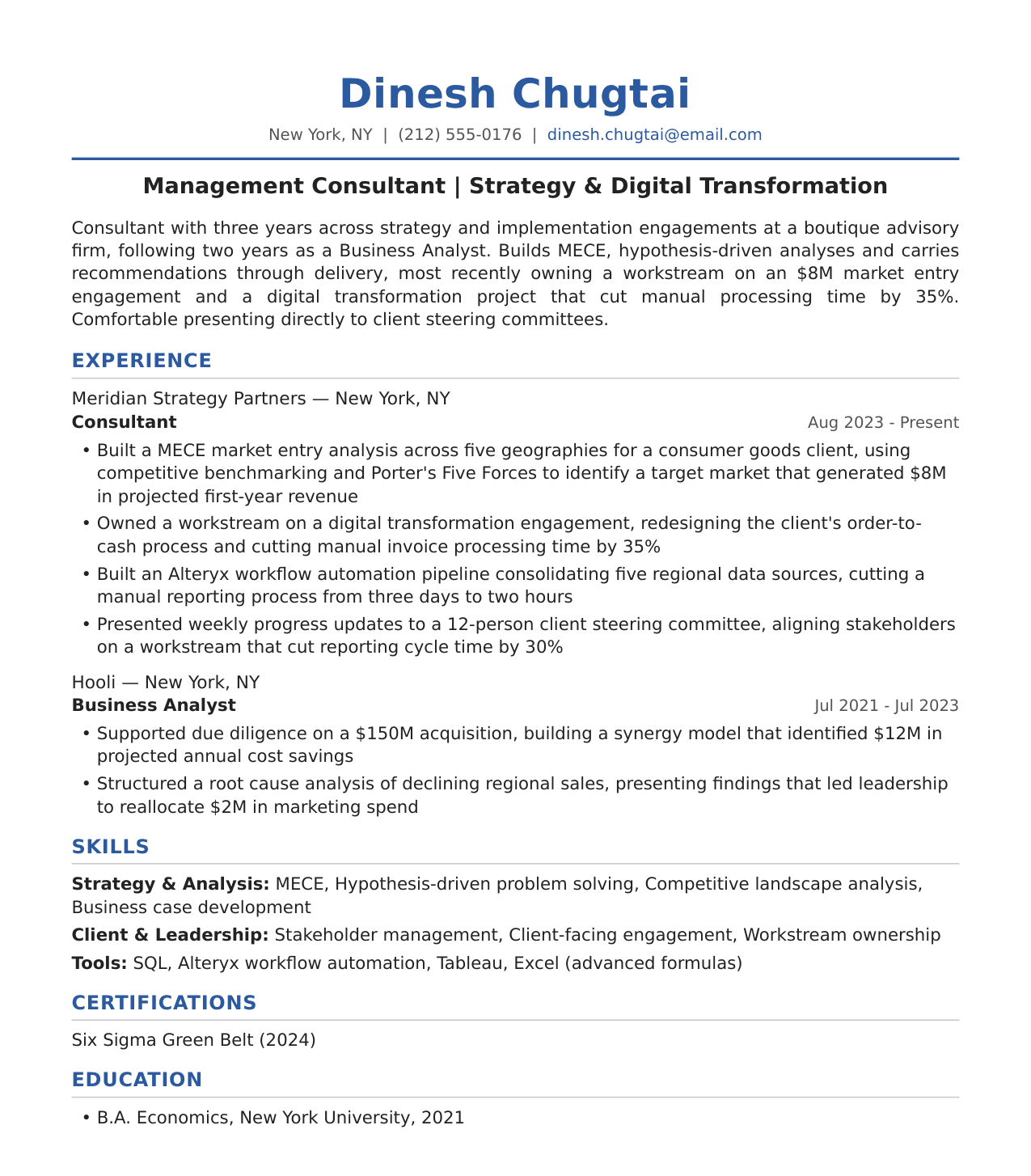
What's working here: the certification (Six Sigma Green Belt) gets its own dedicated line instead of being buried in Skills, the tool name sits inside a bullet next to the outcome it produced rather than sitting alone in a list, and the client-facing bullet names the audience size and the metric moved, not just "presented to stakeholders."
Engagement Manager Resume
This is the senior-level template for a candidate owning engagement budget, a delivery team, and the client relationship end to end. Even at this level the resume holds to one page, matching the one-page norm this guide covers for consulting specifically, so every bullet has to earn its place with a budget figure, a team size, or a business outcome. The summary leads with the largest engagement led, then the experience section shows a second, earlier role to establish trajectory rather than padding the page with a third.
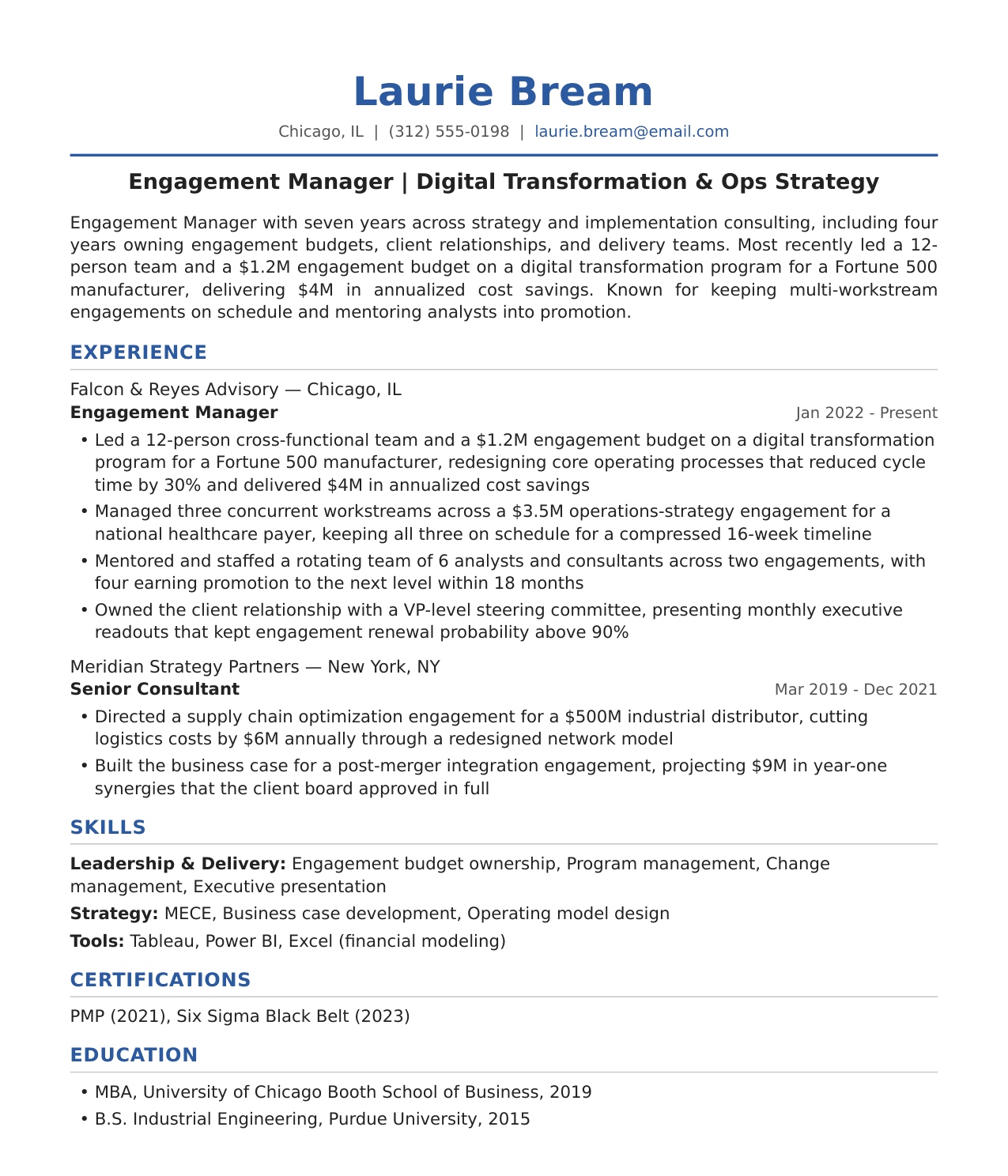
What's working here: the certifications line pairs PMP with Six Sigma Black Belt to signal both program-management and process-improvement range, the mentoring bullet quantifies promotion outcomes rather than just claiming "developed team members," and every engagement gets a named budget figure instead of a vague "large-scale" descriptor.
Across all three levels, the pattern holds: a framework or tool named specifically, a scope number attached to it, and a result an ATS and a recruiter can both verify in a few seconds. If you sit between two levels, for example two years of experience but a title that already reads as Consultant, borrow the mid-level structure and keep your scope numbers honest rather than inflating them to match the level you want next.
Placement, Formatting, and Common Mistakes
Where Each Keyword Type Belongs
Your Summary or Profile section holds two or three of your strongest trait keywords (problem-solving, quantitative rigor) stated in one line, not a full list. Save the detail for Experience bullets, where keywords need to appear embedded in context: a tool name next to what you built with it, a methodology next to the problem it solved.
Skills and Certifications sections exist for scanability, not proof. List Excel, SQL, Tableau, or PMP there so both ATS and a fast human scan can confirm you have them.
But ATS scoring models and recruiters both weight a keyword mentioned inside an Experience bullet, with a verb and a result attached, well above the same word sitting alone in a Skills list. A Skills list confirms exposure. A bullet proves impact.
Formatting Conventions Specific to Consulting Resumes
Consulting resumes stay to one page, almost without exception, even for Manager and Engagement Manager candidates with a decade of experience. This differs from tech or academic resumes, where two pages are normal past a certain seniority.
The layout stays plain: single column, no tables, no graphics, no logos, no color blocking. Consulting resumes have historically read closer to black-and-white legal documents than the visually designed resumes common in creative or marketing fields.
Keep tense consistent (past tense for past roles, present tense only for your current one) and avoid first person entirely ("led," not "I led"). Beyond the ATS parsing risk that tables and graphics create, breaking these conventions signals to an MBB or Big 4 recruiter that you have not done basic homework on the industry, which is its own red flag separate from any parsing issue.
Common Mistakes Recap
- Listing trait words (leadership, problem-solving) bare, with no bullet showing them in action
- Stuffing keywords into a bullet without a quantified result attached
- Loading every possible keyword onto one resume instead of matching the specific firm or practice area you're targeting
- Leaving certifications out entirely instead of giving them a dedicated line
- Ignoring the one-page norm, even at senior levels
- Writing generic language that could describe almost any resume, rather than consulting-specific methodology, tools, and outcomes
How Upplai Finds the Consulting Keywords Your Resume Is Missing
Consulting job descriptions bury the keywords that matter inside dense language about "structured problem-solving," "client-facing engagements," and "cross-functional stakeholder management." Upplai's ATS Resume Checker runs a gap analysis against the specific job description you're targeting, breaking it down into work experience, hard skills, soft skills, education, and nice-to-haves, then showing which ones your resume meets or misses.
You get a dual score: an ATS score and a recruiter score, so you can see both whether the parsing software will pass you through and whether the actual fit reads as strong to a human reviewer. Missing keywords aren't just flagged as present or absent. They're shown with context, so you understand where and how a term like "stakeholder alignment" or "P&L ownership" should appear. As you edit, the score updates in real time, no download and re-upload cycle required.
This matters more for consulting resumes than most. Framing client work precisely, without overstating scope or inventing outcomes you didn't own, is part of the job itself. The AI Resume Optimizer explains every suggested change in plain language, so you can judge whether a rewording still reflects what you actually did before accepting it. Nothing gets invented or hallucinated on your behalf.
Tailored resumes produce 6X more interviews than generic ones, and for consulting applications, where every reviewer is scanning for the same handful of signals, precision in the details is what separates a callback from silence.
Getting the keyword list right is the first step. The second is making sure the rest of your resume, the format, the tense, the one-page discipline, doesn't undercut the work you just put into it.
Check your resume for missing keywords
See exactly which consulting keywords your resume is missing, with a dual ATS and recruiter score, in under ten seconds.