You've led the concept, sold it to the client or the VP, and watched your name stay off the credit line while someone with "Director" in their title signed off. Your book is strong. Your reviews are strong. But every time you apply for creative director roles, the resume that got you promoted internally doesn't seem to be enough to get you shortlisted externally, and it's not obvious why.
Craft rarely closes that gap. Proof does. Hiring managers scanning a creative director resume are looking for scope, budget, and team leadership fast, and if your bullets read like a senior designer's, that's exactly how you'll get leveled, no matter how good the portfolio link at the top turns out to be.
This article shows you how to close that gap. You'll get a clear answer to the "should my resume look creative" question, a section-by-section build (summary, portfolio placement, skills, achievement bullets, work history), a bullet library written for five different creative-director contexts including the associate-to-director jump, and the mistakes that keep strong candidates stuck at "impressive designer" instead of "ready director."
What Makes a Creative Director Resume Effective?
Hiring committees read a creative director resume looking for two different things at once, and most candidates only prove one of them.
The first is craft credibility: can this person recognize great work, push a concept past the obvious first draft, and hold a creative bar across a team? The second is business leadership: have they managed people, owned a budget, and moved metrics that matter to a CMO or CEO? A resume packed with award names but no team size or budget figure signals a senior designer rather than a director. One packed with headcount and revenue but no signature work reads like an operations manager who happens to sit in a creative department.
This creates a real tension. If you're a creative director, shouldn't your resume look creative? It's a fair instinct, but most Applicant Tracking Systems parse resumes as plain text, and a heavily designed layout (custom columns, icons, graphics) can scramble or drop your work history before a human ever opens it.
Resolve it by keeping the two artifacts separate. Your resume should be a clean, ATS-parseable document: standard headings, clear dates, no graphics competing with the copy. Your visual proof lives in a curated portfolio, linked prominently in your header, showing 5 to 6 strong pieces rather than a sprawling archive.
Read that way, the resume's job is narrow: prove scope, budget, team size, and business results fast enough that a recruiter clicks through to see the work. The portfolio does the rest.
How to Write a Creative Director Resume
Write a Targeted Summary or Objective
A creative director summary has three jobs. It states your years of experience and scope (team size, budget, number of markets or brands), names a specialization or industry (brand campaigns, digital-first product marketing, entertainment, retail), and leads with one outcome a hiring manager can picture without opening your portfolio.
Skip the adjectives. "Visionary" and "passionate" tell a hiring manager nothing they can verify. A number does.
A weak summary looks like this:
"Creative visionary with a passion for design excellence and a proven track record of leading teams to produce award-winning creative work across multiple channels."
A stronger one looks like this:
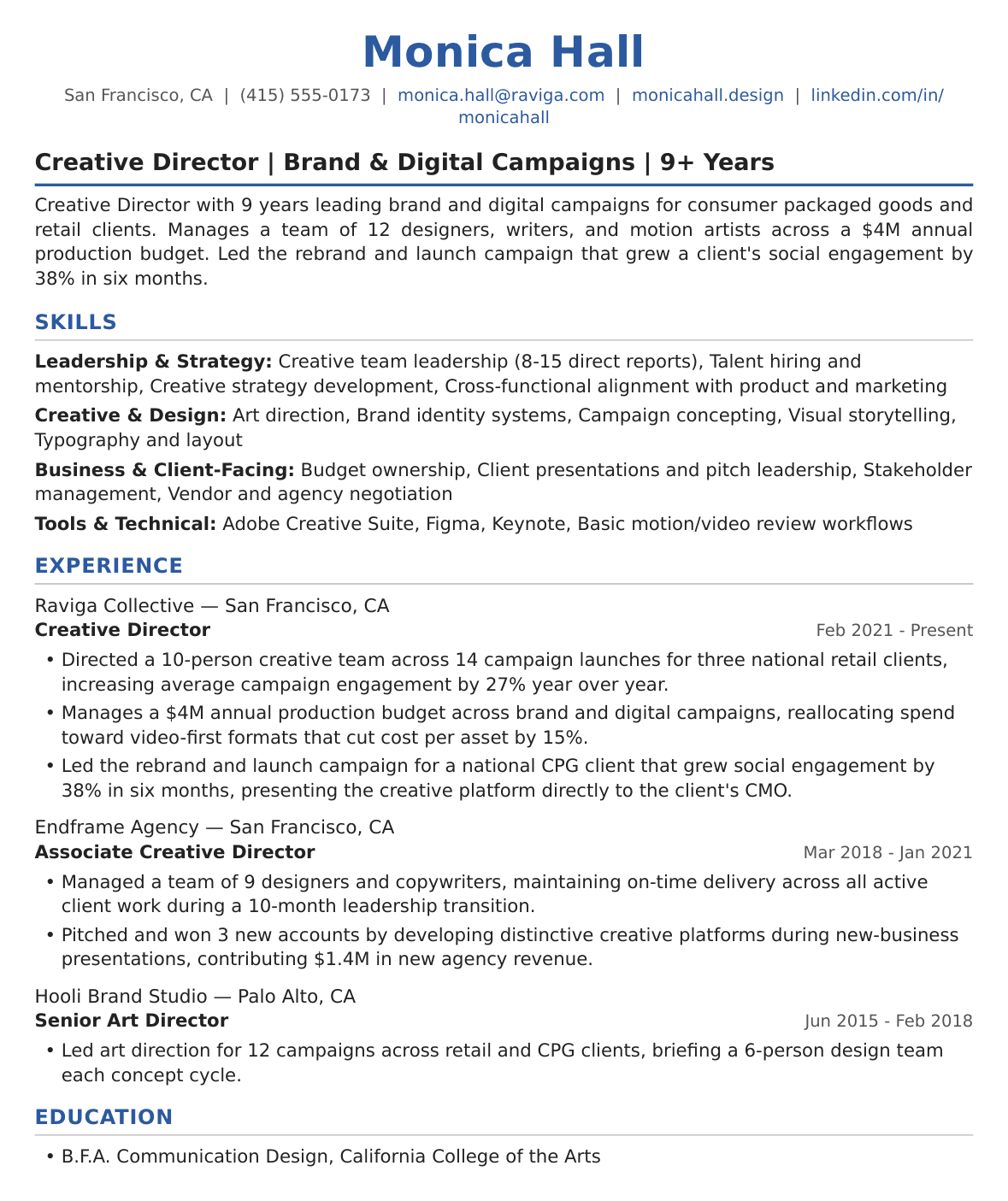
"Creative Director with 9 years leading brand and digital campaigns for consumer packaged goods clients. Manages a team of 12 designers, writers, and motion artists across a $4M annual production budget. Led the rebrand and launch campaign that grew a client's social engagement by 38% in six months."
The second version works because it's specific enough to be checked and confident enough to skip qualifiers.
One format note: creative careers rarely move in a straight line. You might have freelanced between agency stints, or jumped from in-house to consultancy and back. A strict reverse-chronological resume can make that path look scattered. A hybrid format, summary up top, then a skills block, then chronological experience, lets you lead with scope and specialization before a hiring manager has to piece together your timeline. That's a legitimate structure for non-linear creative careers, not an excuse to skip a timeline.
Showcase Your Portfolio the Right Way
For a creative director, the portfolio carries the weight of the application. The resume's job is to get someone to open it.
Put the link in the header, next to your name and contact information. Not in the summary, not at the bottom of the page after your work history. A reviewer scanning for thirty seconds should see it before they decide whether to keep reading.
Format matters more than people expect. A clean personal domain (yourname.com or yourname.design) reads as intentional and easy to remember. A well-named Behance or Dribbble URL (behance.net/janemartinez) works almost as well. What hurts you is a long, unedited platform link full of ID strings and query parameters. It looks like you copied it in a hurry, and it makes the reviewer do work they'd rather not do.
Curate hard. Five or six strong pieces beat twenty decent ones. Hiring managers reviewing creative portfolios often form an opinion within the first handful of projects, so every piece in that first screen needs to earn its place. If you have to ask "should this go in," leave it out.
Each piece should do more than look good. It should tell the reviewer three things: the business problem you were solving (a stalled product launch, a brand that had lost relevance with a younger audience), the creative direction you specifically set (not just what the team produced, but the call you made and why), and the outcome (a metric, a client reaction, an award, a renewal). A beautiful spread with no context reads as someone else's work you happened to be near. Context is what makes it yours.
Build a Skills Section That Speaks to Hiring Managers
Group your skills instead of listing them alphabetically or by whim. A flat list makes a reviewer hunt for what they care about; categories let them find leadership signal and craft signal in seconds.
Creative & Design Art direction, brand identity systems, campaign concepting, visual storytelling, typography and layout
Leadership & Strategy Creative team leadership (8-15 direct reports), talent hiring and mentorship, creative strategy development, cross-functional alignment with product and marketing
Tools & Technical Adobe Creative Suite, Figma, Keynote, basic motion/video review workflows
Business & Client-Facing Budget ownership, client presentations and pitch leadership, stakeholder management, vendor and agency negotiation
A few rules keep this section honest and useful.
Only list what you can actually do in a working interview. If someone asks you to walk through a Figma prototyping decision and you've only opened the tool twice, that's a gap that shows immediately.
Mirror the job description's exact wording where it's true. If the posting says "creative strategy" and your resume says "creative vision," an ATS or a fast human scan may not connect them. Match the language when the skill is real.
Don't bury leadership skills below craft skills. At the director level, a reviewer is checking for management and business fluency first, craft judgment second (they'll confirm craft in the portfolio anyway). Put Leadership & Strategy near the top of the block, not as an afterthought after software names.
Write Achievement-Focused Experience Bullets
Every bullet should follow the same shape: action verb, then the specific task or method, then a quantifiable result or scope. Skip any bullet that only describes a responsibility, since a responsibility without an outcome tells a hiring manager what you were supposed to do, not what happened when you did it.
A weak bullet looks like this:
"Responsible for leading the creative team and overseeing campaign development for major clients."
A stronger one looks like this:
"Directed a 10-person creative team across 14 campaign launches for three national retail clients, increasing average campaign engagement by 27% year over year."
The formula holds across contexts, but what counts as a strong result looks different depending on where you've worked. Use the library below as a starting point and swap in your own numbers.
Agency Creative Director
- Led creative direction for a portfolio of 6 client accounts spanning retail, finance, and CPG, managing a cross-functional team of 15 designers, copywriters, and producers with a combined annual billing of $8M.
- Pitched and won 4 new accounts in one fiscal year by developing distinctive creative platforms during new-business presentations, contributing $2.1M in new agency revenue.
In-House Brand Creative Director
- Rebuilt the brand's visual identity system across 30+ markets, cutting asset production time by 40% through a new centralized template library.
- Partnered with product and marketing leadership to launch a global campaign that drove a 22% lift in brand awareness within the target demographic, per post-campaign brand tracking.
Associate Creative Director (moving up)
- Stepped in as acting Creative Director for 8 months during a leadership transition, managing a team of 9 and maintaining on-time delivery across all active client work.
- Mentored 4 junior art directors and designers into senior roles over two years, while personally leading concept development for the agency's top-billing account.
Freelance-to-Full-Time Creative Director
- Built an independent creative practice serving 12 clients over 3 years, delivering brand identity and campaign work that led two clients to convert their engagement into retained monthly contracts.
- Directed a distributed team of 5 freelance collaborators (designers, illustrators, editors) on a rebrand for a regional hospitality client, completed on a 6-week timeline and adopted across 9 properties.
Chief Creative Officer
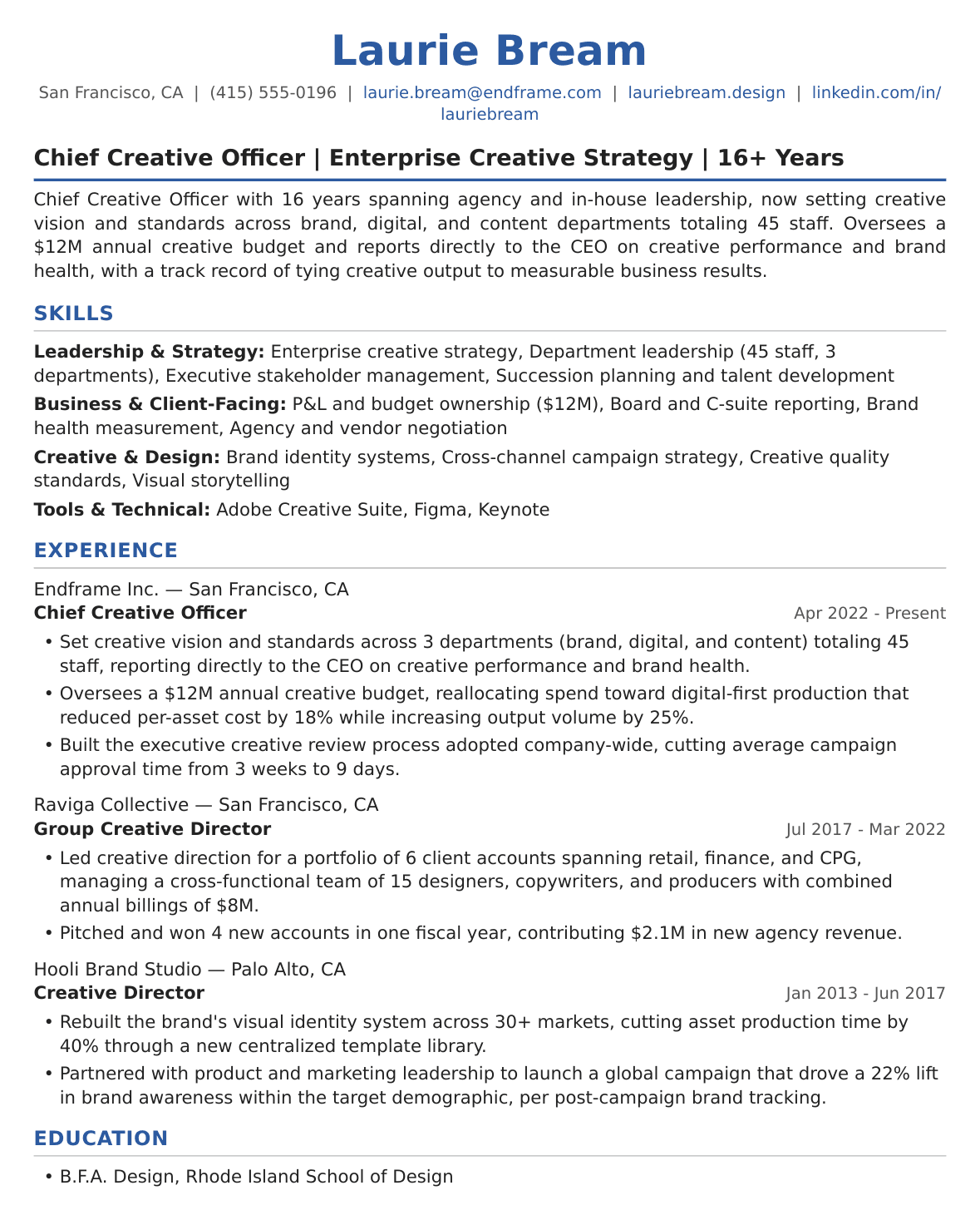
- Set creative vision and standards across 3 departments (brand, digital, and content) totaling 45 staff, reporting directly to the CEO on creative performance and brand health.
- Oversaw a $12M annual creative budget, reallocating spend toward digital-first production that reduced per-asset cost by 18% while increasing output volume by 25%.
If you don't have clean metrics sitting in front of you, the number probably still exists. You likely just haven't gone looking yet. Team size, number of campaigns or markets touched, and budget range are all reasonable substitutes for a hard performance metric, and they're usually easy to reconstruct even years later. Check old project retros and performance reviews for numbers you reported at the time. Reread LinkedIn recommendations from former colleagues and clients too. People often mention specifics there, like campaign names, results, and scope, that you'd otherwise forget you had.
Organize Your Work History the Right Way
If you were promoted within the same company, stack the titles under one company header instead of listing each promotion as a separate job. Show the date range for each title underneath the company name, most recent title first:
Agency Name Creative Director, 2023-Present Associate Creative Director, 2020-2023 Senior Art Director, 2017-2020
This reads as a growth story instead of job-hopping, and it's the format Resume Worded and Enhancv both point to for candidates with internal promotion history.
If your current or most recent title doesn't map cleanly to "Creative Director" for an outside reader, use a title clarifier rather than inflating your title outright. For example: "Associate Creative Director (functioned as de facto Creative Director for the North America team)." This keeps your resume accurate while making sure the scope of what you actually did isn't lost in a title that undersells it.
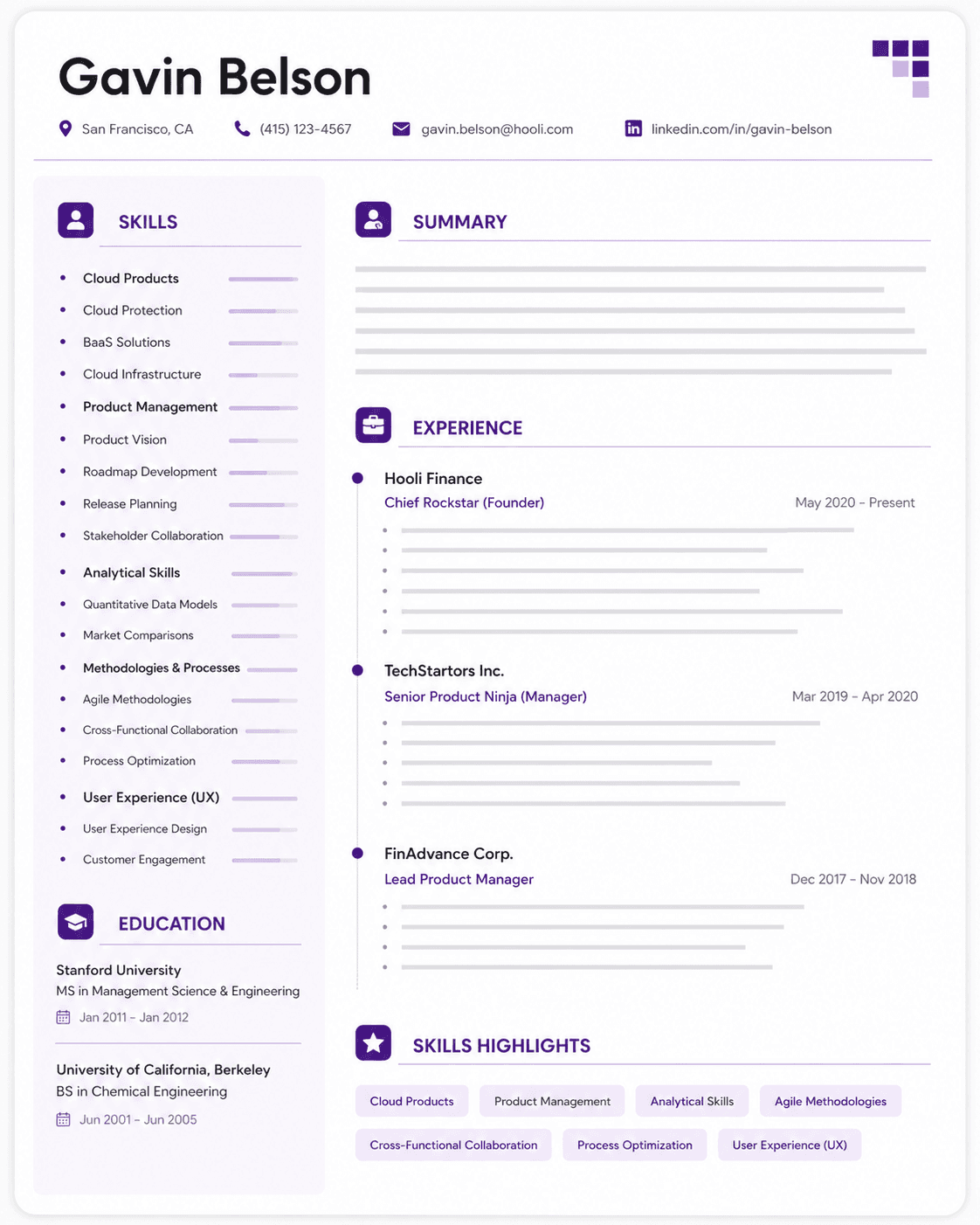
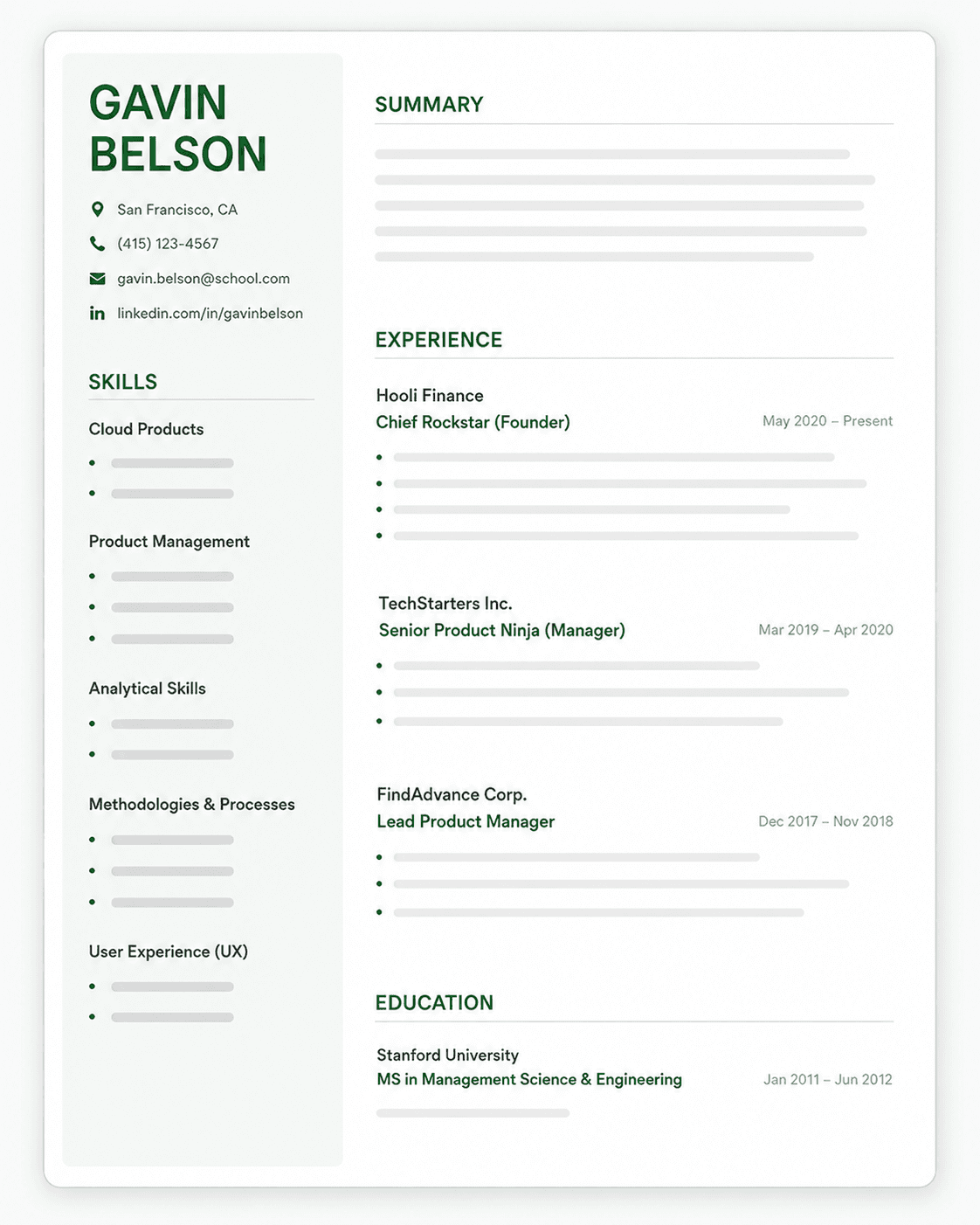
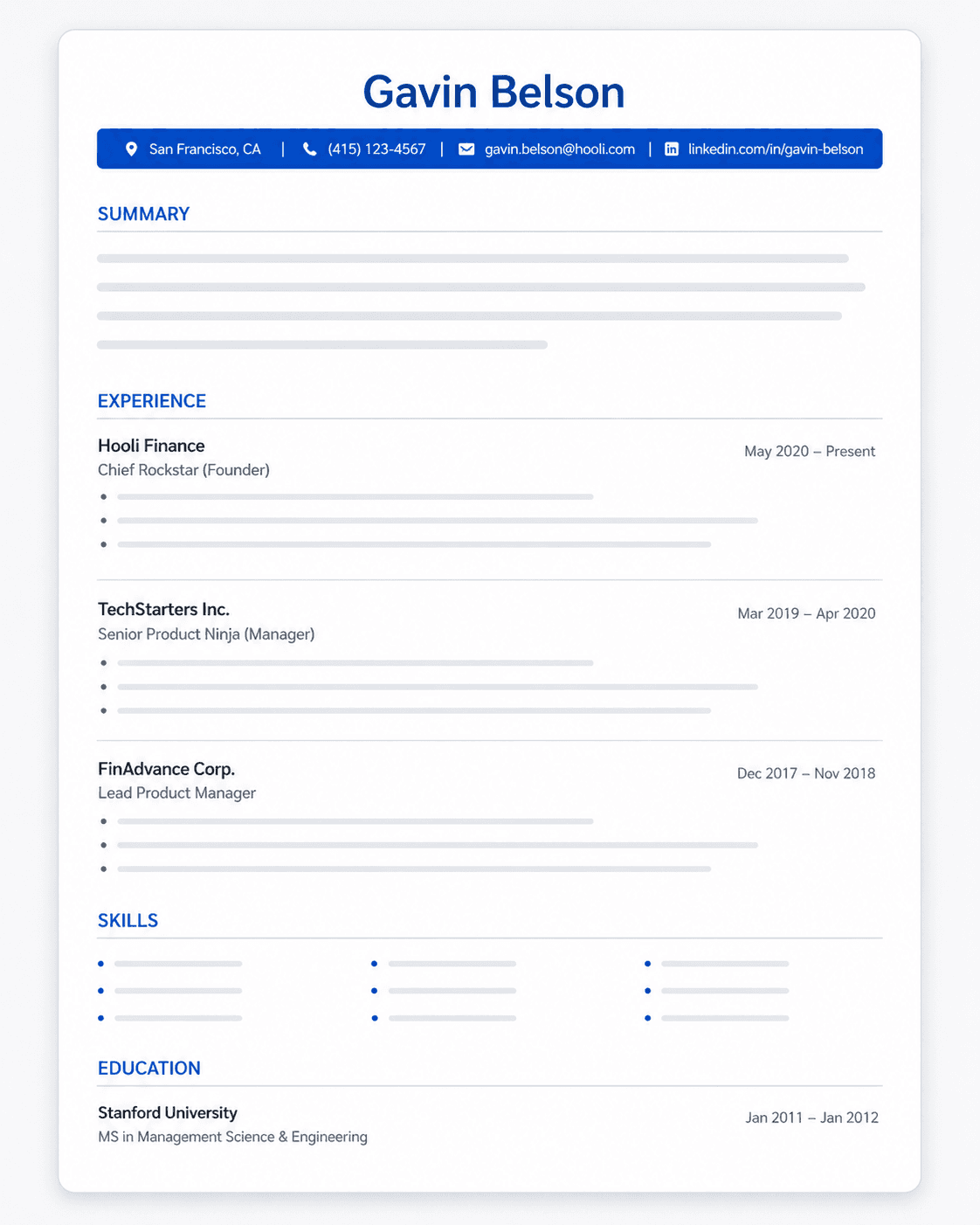
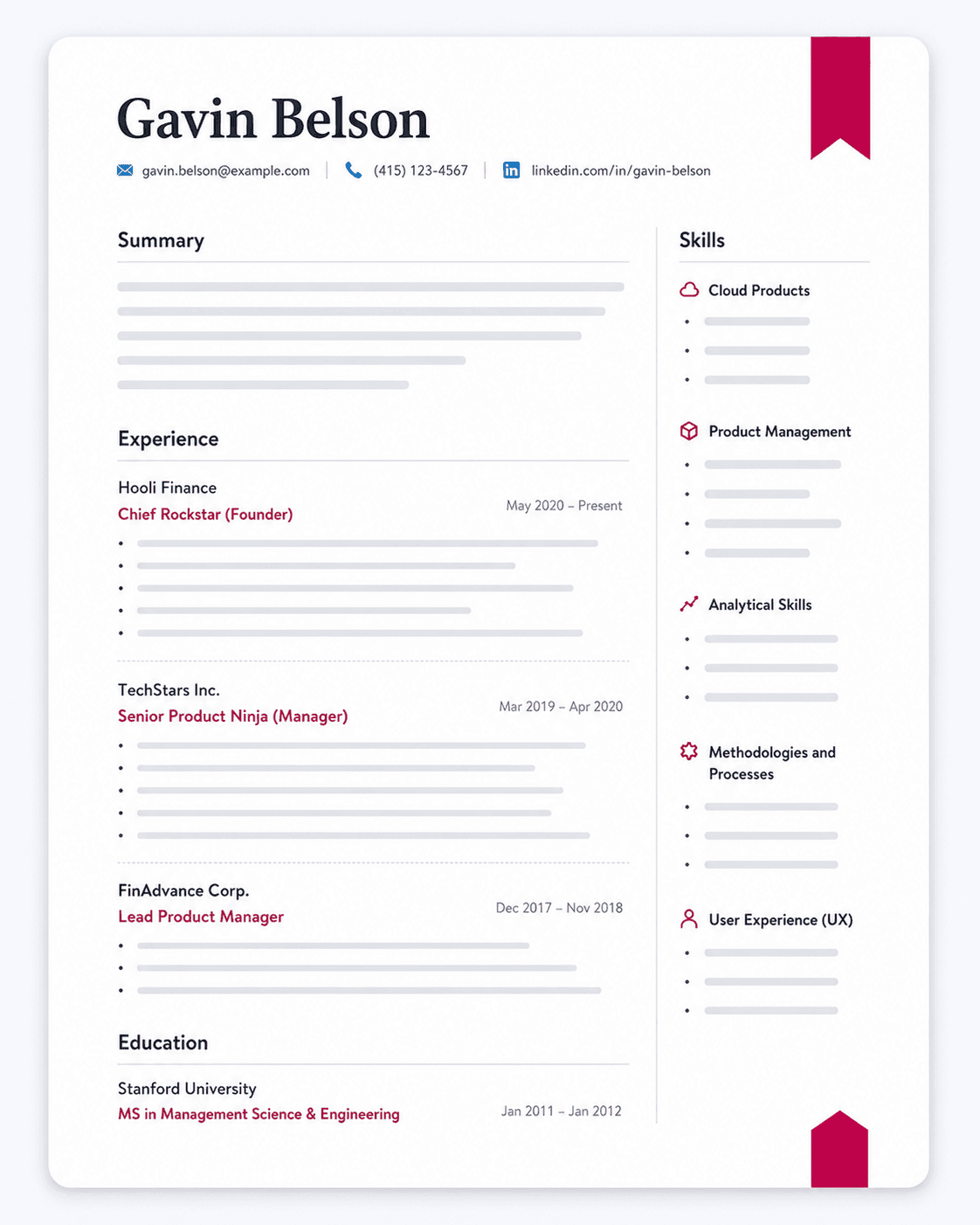
Creative Director Resume Examples
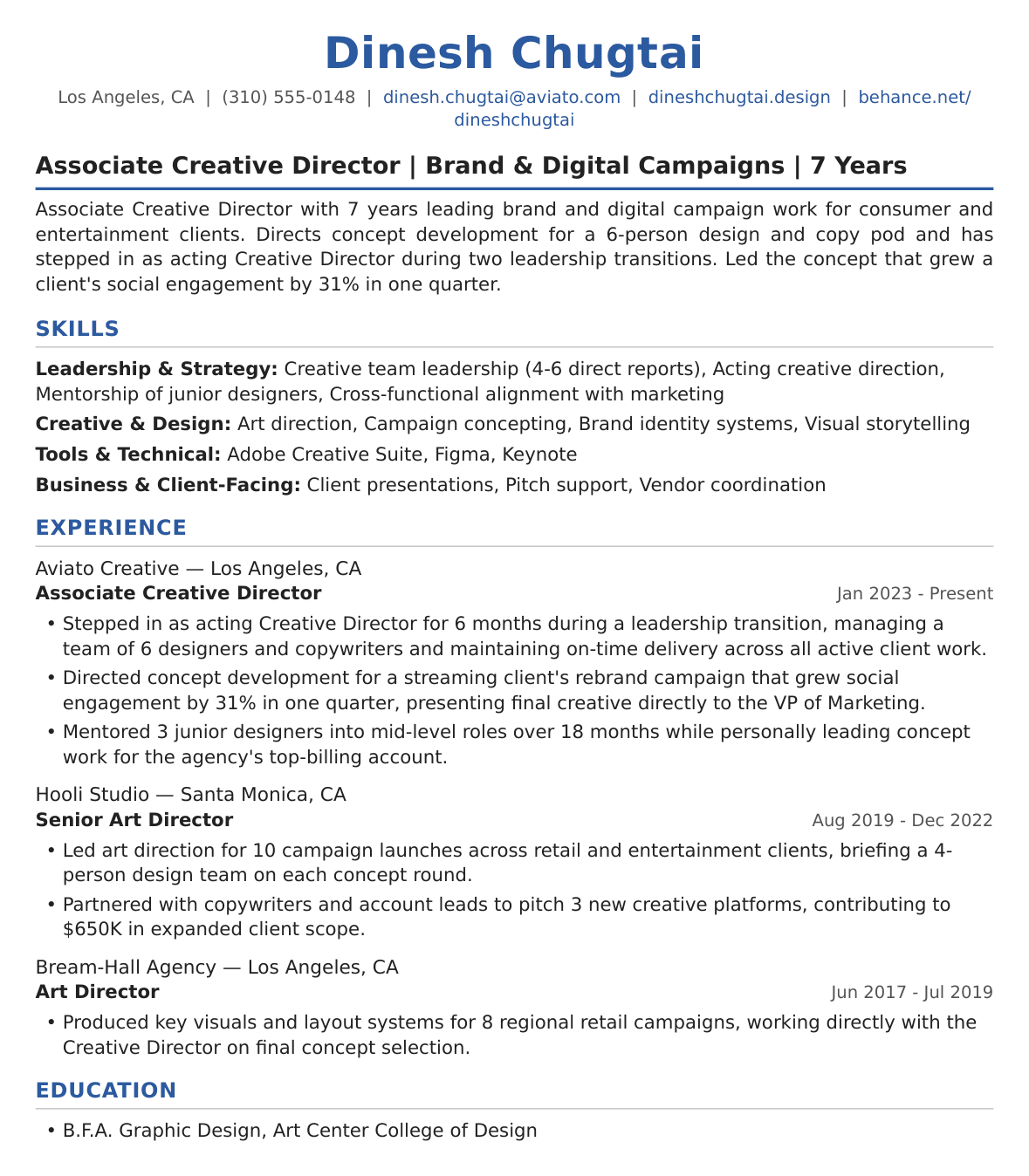
The right example depends on where you sit. An Associate Creative Director resume needs to prove readiness to lead, showing growing scope from individual contributor to team supervision. A Creative Director resume shows full ownership of creative output tied to business results. A Chief Creative Officer resume centers on enterprise-wide creative strategy and executive stakeholder management.
Below are reference points for each level. Use them to gauge structure and emphasis, not as a fill-in-the-blank template.
ACD Creative Director Resume Example
Creative Director Resume Example
CCO Creative Director Resume Example
These examples are illustrative starting points, not a mandate to copy the format exactly.
Creative Director Resume Keywords
Creative leadership resumes get screened for strategy and leadership language first, craft terms second. Pair these keywords with the campaign outcomes they produced rather than listing them bare.
| Category | Keywords |
|---|---|
| Strategy & leadership | Brand strategy, Creative strategy, Creative team leadership, Art direction, Campaign development, Integrated campaigns, Creative briefs, Budget management |
| Craft & execution | Brand identity, Concept development, Visual storytelling, Typography, Design systems, Motion design, Video production oversight, Copywriting direction |
| Tools | Adobe Creative Suite (Photoshop, Illustrator, InDesign), After Effects, Figma, Keynote |
| Business impact | Client pitches, Rebranding, Go-to-market creative, Performance creative, A/B testing, Cross-functional collaboration |
Writing a Creative Director Resume After 20+ Years in the Industry
The average creative-department employee is 28. Senior creatives report that the same resume that proves depth also dates them out of the shortlist, and some only started getting callbacks after trimming their history. You shouldn't have to hide your career, but you can stop volunteering the math.
Cap your experience section at roughly the last 15 years. Earlier roles compress into one line, "Earlier career: art director and senior designer roles at [agencies]," with no dates. Drop graduation years from your education section entirely. Neither move is dishonest; both remove the subtraction a screener does in the first five seconds.
Then make the top third of the page read current. Lead with work that answers this year's brief: short-form and social-first campaigns, performance creative, AI-assisted production workflows if you've run them. A 25-year CD whose first bullet is a TikTok-native campaign that moved revenue reads as an asset. The same CD leading with a 2009 Super Bowl spot reads as history, however good the spot was.
Common Creative Director Resume Mistakes to Avoid
Describing Tasks Instead of Impact
"Oversaw creative production for client accounts" tells a hiring manager what you were near, not what you did with it. Compare that to "Led a 6-person design team that cut campaign turnaround from 3 weeks to 9 days while raising client retention to 92%." The second version is checkable and specific. If a bullet could apply to anyone who held the job title, rewrite it.
Using One Generic Resume for Every Application
A resume built for a holding-company agency and one built for an in-house brand team should not read the same way. Agencies want pitch wins, client roster breadth, and new-business impact. In-house roles want brand consistency, cross-functional influence with product and marketing, and speed to market. Swapping in the right emphasis for each application matters more than swapping in keywords.
Listing Tools Without Proficiency Context
"Adobe Creative Suite, Figma, Keynote" at the bottom of a resume tells a reviewer nothing about depth. A creative director who names Figma because they run design systems across teams is different from one who lists it because they can open a file. Tie tools to what you built or managed with them, or fold them into a skills line with a leadership or strategy skill next to them for context.
Ignoring ATS Formatting
Text boxes, multi-column layouts, and embedded graphics look sharp in Photoshop and often get scrambled or dropped by applicant tracking systems. Save the visual expression for the portfolio and keep the resume file itself a clean, single-column document an ATS can parse correctly.
Burying or Omitting the Portfolio Link
A portfolio link buried at the bottom of a two-page resume, or left out entirely, forces a reviewer to go hunting for the one thing that proves your craft. Put it next to your name and contact details at the top, and make sure it points to 5 to 6 strong, current pieces rather than a decade of unsorted work.
Vague "Visionary" Language With No Metrics
Calling yourself a "visionary, passionate creative leader" says nothing a hiring manager can verify. Replace the adjective with the evidence: campaigns launched, awards won, revenue influenced, audience growth. Let the numbers carry the claim instead of the label.
Underselling Scope and Team Size
Leaving out team size, budget ownership, or the scale of what you managed makes a director-level candidate look like an individual contributor on paper. State it plainly: "Managed a $2M production budget and a team of 8 designers and copywriters across 4 brand lines."
How AI Resume Builders Can Simplify Your Creative Director Resume
At the creative director level, every application deserves a resume tailored to the specific studio, brand, or agency, since the role hinges on matching your creative vision and leadership record to their needs. A generic resume gets filtered out by ATS software or skimmed past by recruiters comparing you to other portfolios. An AI resume builder built for transparency can carry that weight without adding hours to a search that's already stretched thin by portfolio prep.
Upplai's approach includes:
- Real-time ATS scoring: see your ATS and recruiter scores update as you edit, with no download/re-upload cycle.
- Transparent suggestions: every edit comes with a plain-language "Why this change?" explanation, and you accept or reject each one; nothing is invented or silently rewritten.
- Automatic formatting: ATS-friendly templates and full design control so your resume reads cleanly to both software and hiring managers.
- Structure guidance: content reordered for relevance, action verbs strengthened, achievements quantified, and potential bias triggers flagged.
- Preference memory: your formatting, metric, and reordering choices carry over across sessions, so repeat edits go faster.
Pricing stays honest: the free plan includes 200 ATS scans a month, 3 tailored resumes, and unlimited downloads, with no credit card required. Beyond that, additional resumes cost $0.50 to $1.00 each, with no subscription.
Ready to tailor your creative director resume?
Try Upplai free and see your ATS and recruiter scores update in real time.