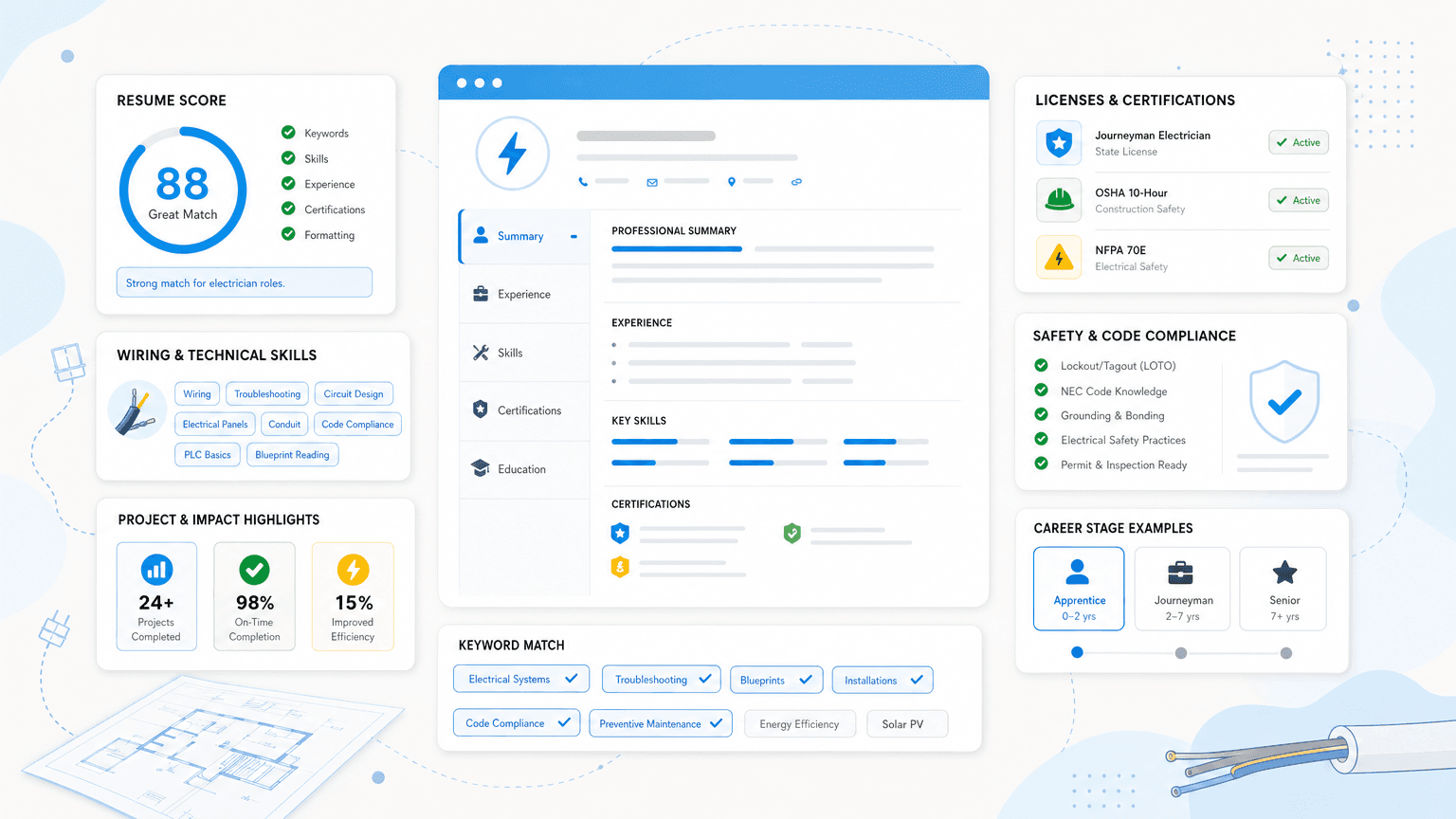
You know your resume will get scanned for one thing before anything else: can you legally and safely do this work. A contractor sorting through a stack of resumes for one opening isn't reading top to bottom, and if your license or apprenticeship standing isn't obvious in the first few seconds, the resume gets set aside before your experience ever gets a look.
This guide shows you exactly where that information goes and how to back it up. You'll get the section order that puts your license and safety credentials ahead of skills, the bullet formula that replaces vague duties with scope and outcome, and electrician resume examples for an apprentice, a journeyman, and a master electrician.
It also covers the questions that don't have a single answer in this trade: when one page is enough versus when two pages serve you better, how to turn apprenticeship hours into real resume content if your paid work history is thin, and how to handle a resume when you're working union halls, merit-shop contractors, or both.
How to Write an Electrician Resume That Gets You Hired
What Hiring Managers and Contractors Actually Scan For First
A hiring manager looking at your resume is checking whether you can legally and safely do the work, fast.
That's a different scan than most office jobs get. On Electrician Talk, one contractor described sorting through roughly 30 resumes to fill a single industrial electrician opening. With that volume, nobody reads top to bottom. They scan for three things, in roughly this order:
- License or apprenticeship standing. Are you a journeyman or apprentice, what jurisdiction or Local issued the credential, and is it current? Make that answer easy to find.
- Safety training and record. OSHA Outreach cards, documented employer electrical-safety training, and any safety record you can substantiate. This trade carries real injury risk, so make your relevant training easy to verify.
- Real scope of work. What voltage classes, panel sizes, or project types have you actually touched? "Installed electrical systems" tells a contractor nothing. Conduit size, square footage, and system type tell them everything.
Generic "skills" language (team player, hard worker, detail-oriented) gets skipped entirely. A senior member on Mike Holt's Forums, replying to a Michigan apprentice studying for the journeyman exam, modeled what actually reads as credible: bullets that named pipe sizes, square footage, and exactly which systems the apprentice was responsible for. That's the bar. Specifics first, adjectives never.
Job-hopping is also an explicit red flag this audience screens for. On Electrician Talk, a contractor describing what they look for in a prospective apprentice's resume put it bluntly: "First thing I look at is work history. If a someone has had 10 jobs in 2 yrs, I'm not interested." Work history is checked early and weighed heavily. If your work history has gaps or short stints, plan to address that elsewhere on the resume (more on that in the mistakes section). Give it context before a scanning eye catches it cold.
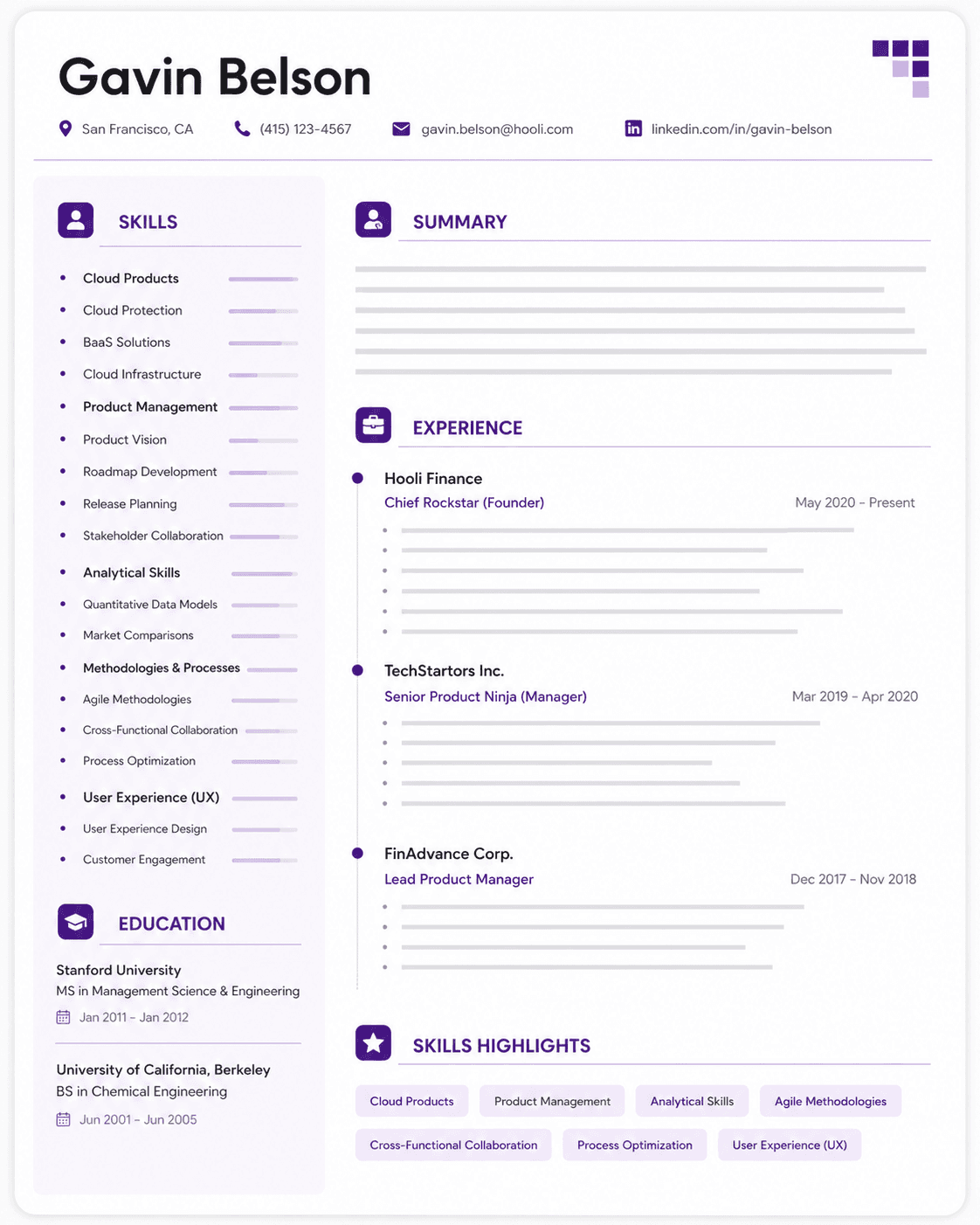
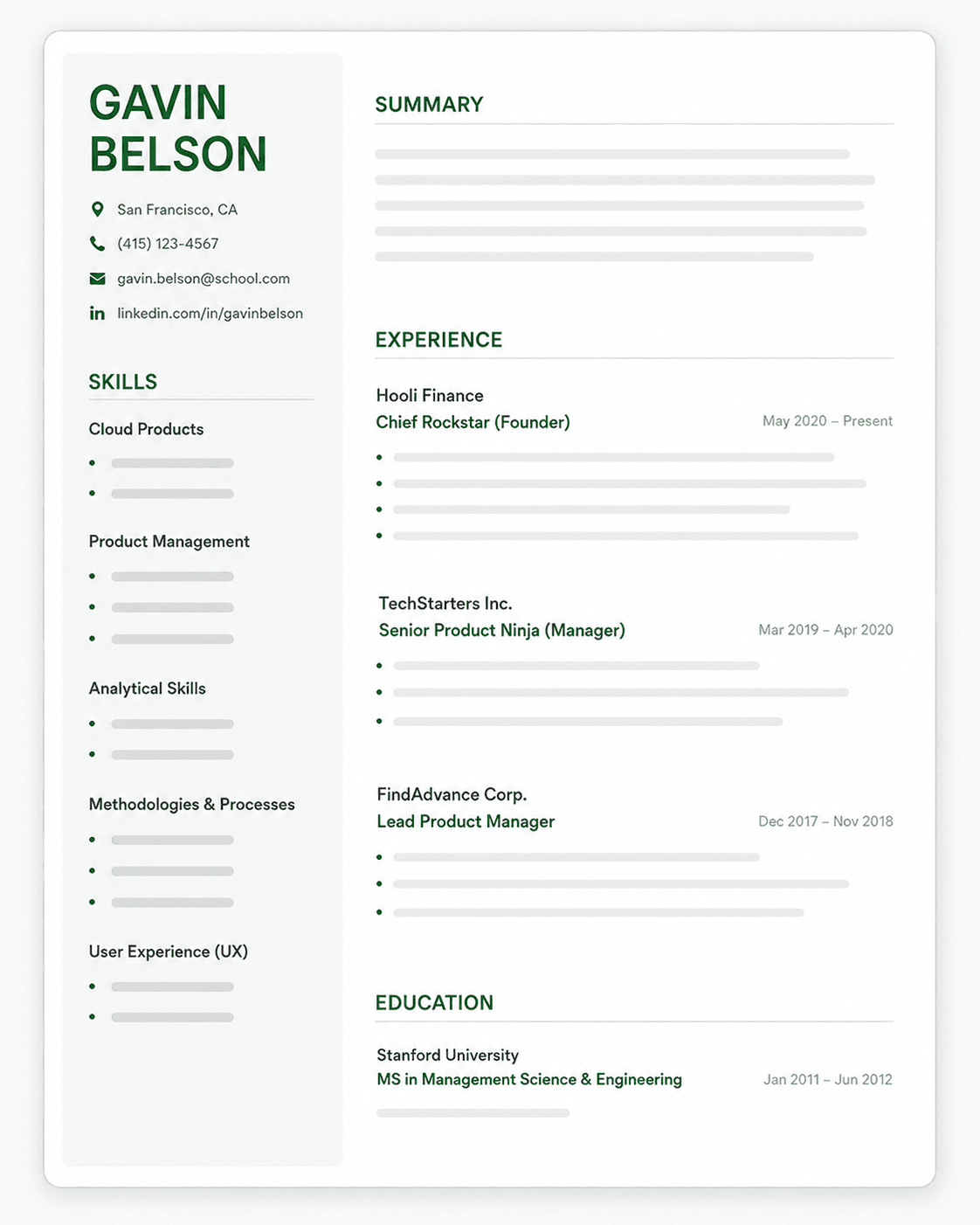
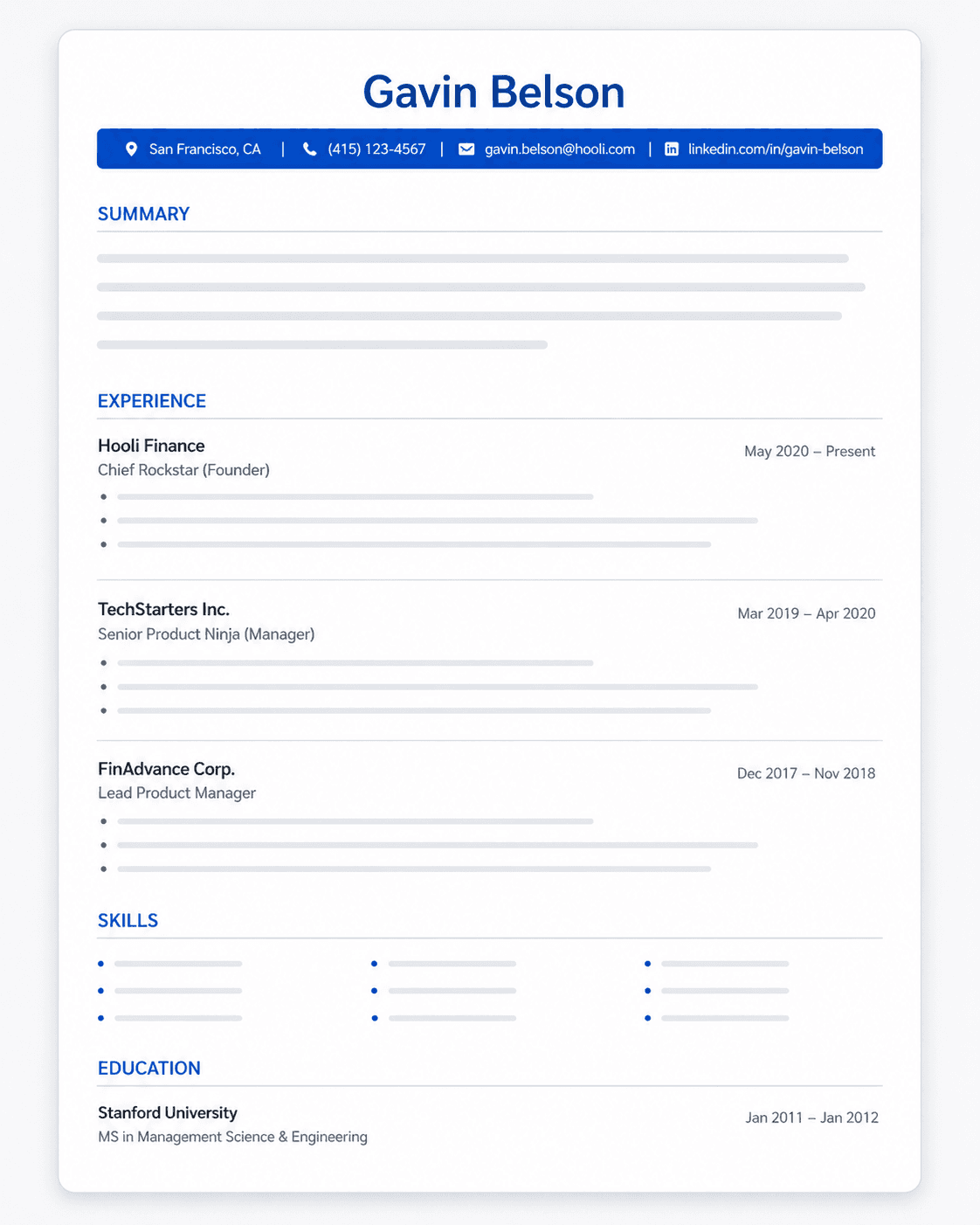
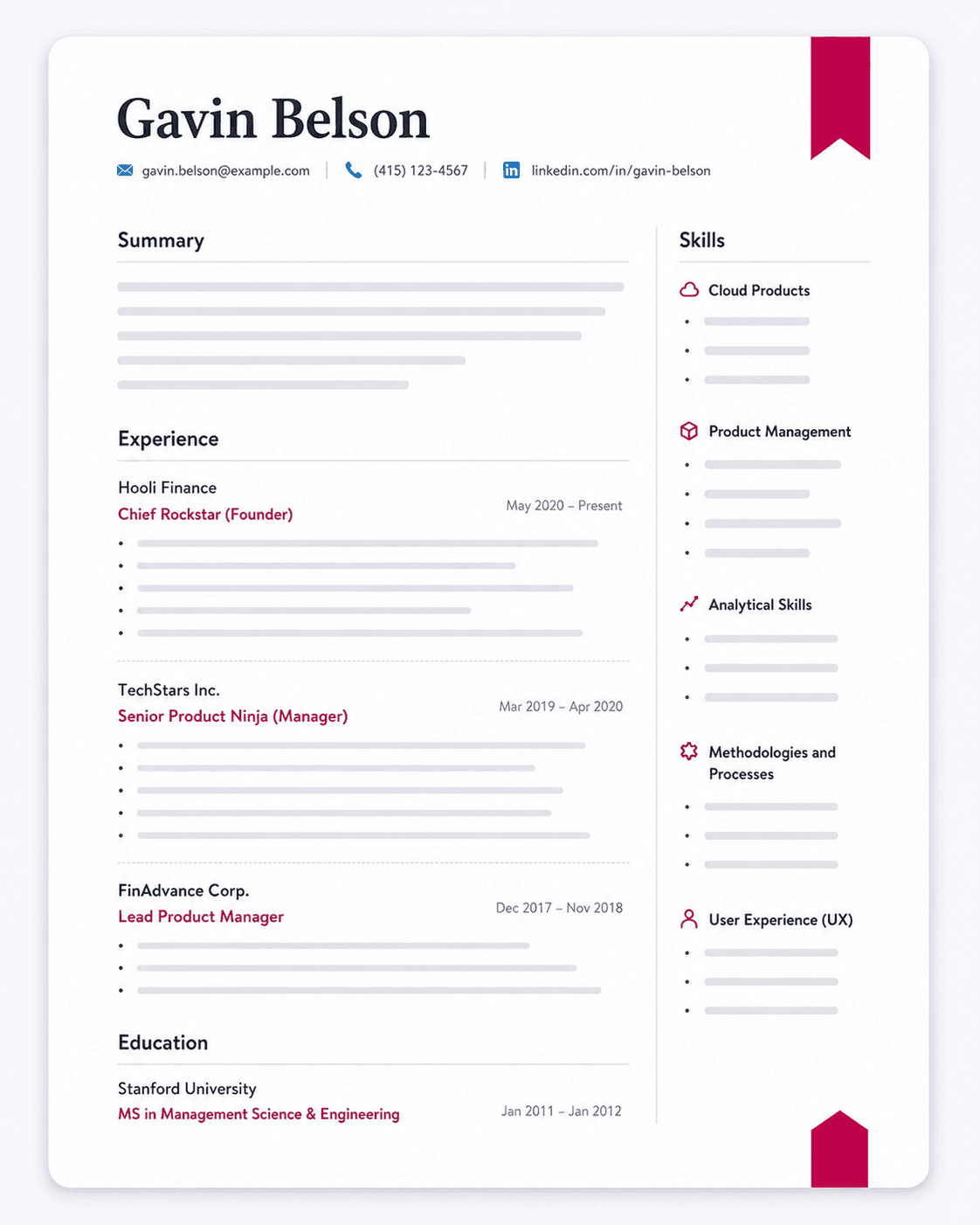
The Sections Your Resume Needs, in Order
Once you know what's being scanned for, the section order writes itself. Put the highest-stakes information closest to the top, where a five-second scan will actually land on it.
- Header. Name, phone, email, city/state. Keep it clean and leave off a photo; U.S. employers generally do not need one to evaluate your qualifications.
- Summary. Two to three lines proving your license level, specialty, and one quantified proof point. This earns the reader's decision to keep going.
- Licenses, training, and safety credentials. License type, issuing jurisdiction, license number, and status, plus relevant OSHA Outreach and employer electrical-safety training. This gets its own section above skills because a license or apprenticeship standing can be an eligibility gate. Full detail on what to list and how lives in the next section.
- Skills. Organized by category (code/compliance, tools/equipment, soft skills), not one long undifferentiated list. Covered in depth in its own section later.
- Experience. Reverse-chronological, with bullets that lead with scope and end with outcome. Its own dedicated section follows later in this guide.
- Education and training. Trade school, JATC coursework, apprenticeship program. For apprentices with thin paid work history, this section can carry real weight.
That's the skeleton. Each of these gets its own deep treatment later in this guide, so for now, just lock in the order: license and safety credentials come immediately after your summary, ahead of skills, every time.
One Page or Two? The Honest Answer
Most resume advice gives you a flat "always one page" rule. The truth, based on real peer feedback in this trade, is more conditional than that.
If you're an apprentice or early-career journeyman with one or two employers behind you, one page is the right call and the safer default. You don't have enough distinct project history yet to justify more, and a tight one-pager reads as organized rather than padded.
But that rule breaks down once you have real project history to show. On r/electricians, one poster pushed back directly on the one-page dogma: "It's okay to stretch the resume to two pages and give some space to make it look neat rather than try to stuff everything into one page." For a journeyman or master with multiple employers, several project types, or a move between residential, commercial, and industrial work, compressing that into one page often means cutting the exact scope details that prove you can do the job.
Density is what actually sinks a resume. In another r/electricians thread, a poster who had just finished trade school shared their resume for feedback, and the top-voted reply, from a self-described former hiring manager, told them flatly: "you got way to many bullet points for me." Two pages of focused, well-chosen bullets beats one cramped page of duplicated phrasing. Every line should earn its place. If you're trimming a two-page resume, cut redundant bullets and repeated skills before you ever shrink the font or margins to force a fit.
Write a Targeted Summary That Proves You're Qualified
Your summary is the first three lines a hiring manager reads after your name. It either earns the next thirty seconds of attention or it doesn't. Given that some contractors are sorting through dozens of resumes for a single opening, three vague sentences about being a "hardworking team player" cost you the read.
The 3 Things Your Summary Must Establish
A summary that works does three things, in this order, in two to three sentences:
- License level. Apprentice, journeyman, or master, plus the issuing jurisdiction if you are licensed. This can be an eligibility gate, so it has to be unmistakable on the first pass.
- Specialty. Residential, commercial, industrial, or a mix. A contractor staffing a data center build doesn't want to guess whether your experience is service-panel swaps or three-phase systems.
- One quantified proof point. A project size, a panel or voltage class, a crew size, or an inspection outcome. One real number does more work than five adjectives.
You don't need to list every certification or every tool here. Those get their own sections further down. The summary just needs to signal that the detail exists and point the reader toward it.
A weak summary looks like this:
"Hardworking and dependable electrician with experience in residential and commercial wiring. Strong work ethic and great with people. Looking for a new opportunity to grow my career."
That tells a hiring manager nothing they can act on. No license level, no state, no scope, no number. It could describe almost anyone in the trade, which means it gets skimmed past in the same five seconds it took to write.
A stronger one looks like this:
"Licensed Journeyman Electrician ([Issuing Jurisdiction]) with [X] years on commercial crews, including tenant fit-outs up to 6,000 sq ft and 277/480V panel installs. Contributed to [X] projects that passed final inspection on the first visit. OSHA 30-Hour Construction Outreach course completed [Month/Year]."
This version front-loads the license type and issuing jurisdiction, names the specialty (commercial), includes a verifiable project result, and identifies the safety course precisely. A contractor can see the candidate's fit in one read.
The formula scales down too. If you're a final-year apprentice without a license number yet, lead with your apprenticeship standing and hours instead of a license: "Fourth-year electrical apprentice with [X] OJT hours logged, on track to test for journeyman in [month/year]. Experience running EMT and PVC on industrial retrofits." Same structure, same three elements, just swapped for what you actually have at this stage.
If you're a journeyman moving from residential into commercial or industrial work, the specialty line is where you make that pivot explicit rather than letting the reader assume you only do what your last job title suggests. Name the systems you've touched, even if the bulk of your hours are still residential.
If you have no electrical experience yet and you're applying to get into an apprenticeship program rather than applying for a job as an electrician, skip the summary format above entirely and use a short objective statement instead. An objective statement tells the reader what you're trying to do and why you're ready to start, without claiming experience you don't have yet.
"Motivated entry-level candidate seeking placement in a [union/non-union] electrical apprenticeship program. Comfortable with hand and power tools from [prior trade/construction/military/relevant work]. Own reliable transportation, basic hand tools, and PPE. Available to start immediately and complete OSHA 10 training before day one if the program or employer requests it."
Keep it to two sentences. Name where your readiness comes from (a construction job, a maintenance role, the military, even serious hobby electrical work) instead of leaving "motivated" to do all the work on its own. If you don't have tools or transportation lined up yet, leave that line out rather than guessing at what a contractor wants to hear.
Write it last, after you've drafted the rest of your resume, whichever version fits your stage. It's easier to pull your single best proof point from your experience section once you've actually written it than to invent one cold.
Licenses, Training, and Safety Credentials (Put Them Near the Top)
What to List and How
A hiring manager scanning this section wants four facts, in order: license type, issuing jurisdiction, license number, and current status. Give them all four when they apply.
Write it as one clean line, not a paragraph buried in a skills bullet:
Licensed Journeyman Electrician. License #[XXXXXX], [Issuing State, City, or County]. Active through [Month/Year].
If you're a final-year apprentice without a license number yet, the same line structure still works. Swap in your standing instead of a license:
4th-Year Electrical Apprentice. IBEW Local [#]. Apprenticeship completion expected [Month/Year].
Always name the issuing jurisdiction. Electrical licensing can be statewide, city- or county-level, or tied to a particular type of work, so do not assume that a credential transfers automatically. The Bureau of Labor Statistics directs workers to check their state licensing board requirements, while New York City, for example, licenses Master and Special Electricians through its Department of Buildings. Check your jurisdiction's requirements before you apply. If you hold more than one license, list each on its own line with its expiration date. Don't compress them into a single vague "licensed in NY and NJ" sentence; that forces the reader to ask follow-up questions you could have answered up front.
If your license has lapsed or is up for renewal soon, say so plainly rather than letting it surface later. "Renewal in progress, expected [month/year]" reads as someone managing their credentials responsibly. A hiring manager who finds out about a lapsed license after an interview, instead of on the resume, will read it as something you tried to hide.
Safety Training That Matters: OSHA Outreach vs. NFPA 70E
These two get confused constantly. Describe them precisely on your resume so an employer can verify what you completed.
OSHA 10 and OSHA 30 are Outreach Training Program course-completion cards, not licenses or certifications. OSHA 10 is intended for entry-level workers; OSHA 30 offers more depth for supervisors or workers with safety responsibility. OSHA describes the program as voluntary and says it does not replace the employer's job-specific training obligations. Some employers, unions, states, and cities still require an Outreach card for particular work. OSHA's Outreach guidance explains the distinction.
NFPA 70E is an electrical-safety standard covering hazards such as shock and arc flash, electrical safe-work practices, and lockout/tagout. It is not an individual license. OSHA requires employers to train employees who face electrical hazards in the relevant safety-related work practices; NFPA 70E training may be part of how an employer meets that need. OSHA's electrical training rule and NFPA 70E's overview provide the underlying standards context.
List the safety training the role asks for and that you have actually completed. An OSHA Outreach card demonstrates broad safety awareness; documented electrical-safety or NFPA 70E training can show relevant exposure to electrical hazards. Do not imply that an OSHA card alone qualifies you for a specific task or that NFPA 70E training makes you a licensed electrician.
List them by name and number, not as a vague "safety trained" line:
OSHA 30-Hour Construction Outreach course completed [Month/Year]. NFPA 70E Electrical Safety Training, [Provider or Employer], completed [Month/Year].
If your NFPA 70E training came through an employer or a specific course, naming the provider and completion date gives the employer a verification point. If you do not have formal NFPA 70E training, do not claim it. List the training you have and describe any lockout/tagout experience accurately.
Specialty Certifications Worth Naming
Specialty certifications earn their place on this resume only when they match the work you're targeting. Listed without context, they read as padding; named against a specific job, they prove you can step into specialized scope without ramp-up time.
- NICET certification matters if you're targeting fire alarm systems or low-voltage work. A residential journeyman applying to a commercial fire alarm contractor with a NICET Fire Alarm Systems certification is signaling direct, verifiable readiness for that scope to a hiring manager who'd otherwise have to take a general background on faith.
- NABCEP certification matters if you're targeting solar or renewable energy installation. As panel and battery storage work grows, a NABCEP credential tells a solar contractor you already understand PV system design and installation standards on day one.
- BICSI certification matters if you're targeting structured cabling or low-voltage data work, like network cabling in commercial buildings. It signals you can read and execute structured cabling standards without a separate low-voltage specialist on the job.
If you're applying for general residential or commercial electrical work and you hold one of these certs from an unrelated specialty, it's fine to leave it off this section entirely or move it down to education. A NABCEP credential on a resume for a service-panel residential opening doesn't help the reader and adds clutter to the one section that's supposed to be the fastest part of the scan.
Build a Skills Section That Speaks to the Trade
Most electrician resumes run their skills section as one flat line: wiring, teamwork, communication, troubleshooting, customer service. A hiring manager scanning that list has to read every word to figure out which skills are technical, which are about working with people, and whether any of it actually proves you know the code. That's slow, and slow gets your resume set aside in favor of the next one in the stack.
The fix is splitting skills into categories that map to what's actually being evaluated. Group them into code and compliance knowledge, tools and equipment, and soft skills, and a hiring manager can check each category in a glance instead of parsing one long line for buried proof points.
Code & Compliance NEC (current edition), blueprint and schematic reading, conduit fill calculations, load calculations, local permit and inspection procedures
Tools & Equipment Multimeters, megohmmeters, conduit benders, thermal imaging cameras, PLCs, wire pullers, clamp meters
Soft Skills Client communication, coordinating with inspectors, teamwork on multi-trade crews, training junior apprentices, troubleshooting under time pressure
Notice what each category is doing. Code and compliance proves you can work within the rules an inspector will hold you to. Tools and equipment proves you've actually used the gear a job posting lists, with named equipment instead of generic "hand tools" language. Soft skills, last and shortest, covers the parts of the job that aren't technical but still get you re-hired: explaining a delay to a homeowner, flagging a code issue to an inspector without it turning into a standoff, keeping a four-person crew moving on schedule.
Keep each category tight. Five or six items per category is plenty; a 20-item wall under one header is just a flat list with a label on it. Pick the skills you can actually back up in an interview or in your experience section, and drop anything that's true of every electrician on the market (the megohmmeter line earns its place; "hardworking" doesn't, and it belongs in this section even less than it belongs in your summary).
If you're an apprentice without much field time yet, the tools and equipment category is the one to lean on. List what you've used in JATC coursework or trade school labs, even if it was supervised. A hiring manager reading "megohmmeter, multimeter, conduit bender (trade school lab)" gets a concrete, verifiable picture of your hands-on exposure in five words.
The category headers also do work the items alone can't. A contractor staffing a job that needs someone who already knows local permitting procedures can jump straight to Code & Compliance and get an answer in two seconds. One that needs someone who can run a thermal imaging camera unsupervised checks Tools & Equipment. Three quick glances instead of one long read, and the resume comes out ahead either way.
Write Achievement-Focused Experience Bullets
Most electrician resumes list duties: "Installed electrical systems", "Performed maintenance and repairs", "Assisted journeyman with wiring tasks." None of that tells a hiring manager what you actually touched or what happened because of your work.
The Formula
A strong resume bullet states the scope of the work, then the measurable result. Scope means the system, the size, the voltage class, or the project type. Result means what changed because you did it: an inspection passed, downtime dropped, a crew got faster, a deadline got hit.
Build each bullet in that order: action verb, then scope (system, size, voltage, project type), then the outcome.
A weak bullet looks like this:
"Responsible for installing and maintaining electrical wiring and equipment at various job sites."
It's a duty with no system, no size, and no number. It could describe almost anyone who's held a tool, and a hiring manager reading this learns nothing they can act on.
A stronger version looks like this:
"Installed and terminated 277/480V panel feeds for a 12,000 sq ft commercial tenant fit-out; the project passed final inspection on the first visit with no electrical punch-list items assigned to my scope."
This version names the voltage class, the project size, and a result the candidate can verify without claiming sole credit for an inspector's decision. A contractor can picture the exact scope of work in one read.
Bullet Examples by Role
Your bullets should look different depending on where you sit in the trade. An apprentice with thin paid work history leans on hours, training, and supervised scope. A journeyman or master leans on project scale, crew leadership, and measurable outcomes. Use the pair below that matches your level, or use both pairs across your career stages if your resume spans more than one role.
Apprentice
- Logged [XXX] OJT hours running EMT and PVC conduit on a 4-person residential crew, completing assigned rough-in work under journeyman supervision.
- Assisted journeyman on 120/240V panel upgrades for [XX] single-family homes, completing terminations independently after month [X] of the rotation.
Residential Journeyman
- Led service panel upgrades (100A to 200A) for [XX] single-family homes per month; [XX] of those projects passed final inspection on the first visit.
- Diagnosed and resolved intermittent circuit faults on [XX] service calls per week, cutting average callback rate by [X]% over [X] months.
Commercial Journeyman
- Installed and terminated 277/480V panel feeds for a [XX],000 sq ft tenant fit-out; the project passed final inspection on the first visit with no electrical corrections assigned to my scope.
- Ran overhead EMT conduit for lighting and fire alarm circuits across a [X],000 sq ft combination office and warehouse, coordinating directly with the general contractor to hold a [X]-week schedule.
Industrial Electrician
- Maintained and troubleshot PLC-controlled motor control centers across [X] production lines, reducing unplanned downtime by [X]% over [X] months.
- Performed lockout/tagout procedures and followed the site's arc-flash safety program on 480V three-phase equipment for a crew of [X], with zero recordable incidents on my assigned work over [X] years.
Master Electrician
- Supervised a crew of [X] journeymen and apprentices across [X] simultaneous commercial projects, delivering all jobs on schedule and within a combined budget of $[X.X]M.
- Reviewed and submitted electrical plans for [XX] permitted projects per year; [XX] were approved without an electrical plan revision.
Where to Find Your Numbers
If you're staring at these examples wondering where anyone gets numbers like that, you're not missing some trick. Most electricians don't walk around with their first-pass inspection rate memorized. You pull it from records you've probably already touched.
Start with your apprenticeship logbook if you're tracking hours toward a license or program milestone. It already breaks your time down by task and rotation, which makes it the fastest source for hours-based bullets. Punch lists and project completion records are next. They'll tell you the actual square footage, panel sizes, and timelines you worked on, instead of leaving you to guess. Inspection reports, if you or your employer kept copies, can substantiate a project outcome. Timesheets and job logs can reconstruct crew size, project count, or how many service calls you ran in a given stretch.
If none of that is on hand, ask. A former supervisor or the office manager who handled scheduling can often pull project counts, crew sizes, or completion timelines faster than you can reconstruct them from memory. Performance reviews, if you've had one, sometimes already contain a number you forgot you earned. Pull a real figure wherever you can find one. A specific number you can defend in an interview beats a rounder one you can't.
Choose the Resume Format That Shows Off Your License
There are three standard resume formats, and the labels matter less than what each one does to your license and certification info.
A reverse-chronological resume leads with your most recent job and works backward through your work history, with everything else (skills, education) stacked below it. A functional (or skills-based) resume groups your abilities into categories up top and minimizes or removes the job-by-job history entirely. A hybrid (or combination) format puts a short credentials-and-skills block near the top, then still runs your work history in reverse-chronological order underneath it. Most general resume advice defaults to straight reverse-chronological, because for a lot of white-collar roles, the most recent job title tells the reader almost everything they need to know.
That default doesn't fit this trade.
Why Pure Reverse-Chronological Can Bury Your Credentials
A pure reverse-chronological resume puts your header, then jumps straight into job history. License status, OSHA cards, NFPA 70E training: all of that gets pushed down into a skills section or an education line near the bottom, after two or more paragraphs of work history.
That ordering fights against how this trade actually gets read. Earlier in this guide, you saw that hiring managers and contractors scan for license validity first, before anything else on the page. One contractor on Electrician Talk described sorting through roughly 30 resumes for a single industrial electrician opening. At that volume, a reader isn't going to dig through your entire job history to confirm you're licensed. If your license and safety credentials sit below the fold, on the second page, or after three job entries, some readers will set the resume aside before they ever reach it.
A pure functional resume has the opposite problem for this trade. It minimizes the job-by-job history that proves you've actually worked the panel sizes, voltage classes, and project types your bullets claim. Hiring managers in this field already weigh real scope of work heavily, and a format built to play down that history works against the exact thing that earns you the next look.
When a Hybrid or Functional Format Makes Sense
The hybrid format solves the burial problem directly. The section order this guide already walked you through, header, summary, licenses and certifications, skills, experience, education, is a hybrid format. Your credentials sit in their own block near the top, ahead of skills, so a five-second scan lands on your license before it lands on anything else. Your work history then runs in reverse-chronological order underneath, so a reader who wants to verify your scope still gets a clean, dated record to check it against.
That's the right default for almost everyone reading this: final-year apprentices, newly-licensed journeymen, and masters and specialists alike. You have real work history. The hybrid format makes sure your credentials get seen first without hiding that history.
A more fully functional format, where job history shrinks to a short list of employers and dates with no real bullets, is a narrower call. It can make sense for a true career-changer pre-apprentice: someone with no electrical work history at all, applying to get into an apprenticeship program rather than applying for a job as an electrician. If your prior work was in a different field entirely, a functional format lets you lead with transferable skills (tool use, physical work, reliability) without forcing a reader through job titles that have nothing to do with electrical work.
Stay cautious here. Hiring managers in skilled trades tend to be suspicious of fully functional resumes, because a resume with no real timeline can look like it's covering up gaps or short stints, and job-hopping is already something this audience screens for explicitly. If you have any electrical work history, even thin apprenticeship hours from a single employer, use the hybrid format and let your experience section carry real dates. Save the functional approach for the one case it's built for: zero relevant work history, applying to start.
Turn Apprenticeship Hours and Training Into Resume Experience
If you're a pre-apprentice or an apprentice still early in your program, your paid work history is probably thin. That's normal at this stage, and it doesn't mean you have nothing to put on the page. Your apprenticeship hours, your coursework, and your rotations are real, trackable work. Treat them like a job history, not like a footnote under education.
List Total Hours, JATC/Trade-School Coursework, and Rotations Like Work History
Hours and documentation requirements vary by apprenticeship program and licensing jurisdiction. Use the logbook or tracking system your program uses, then list your verified total hours, the program or JATC you logged them through, and the specific rotations or assignments within that, the same way you'd list a job: with dates, what you did, and the scope of the work.
A rotation entry should look like a work-history entry, not a course title:
Residential Wiring Rotation, [JATC Local #] Apprenticeship Program [Month/Year] to [Month/Year] Logged [XXX] hours running romex and installing service panels on new-construction single-family homes under a licensed journeyman. Completed rough-in and trim-out on [XX] units.
Notice what that entry does. It names the rotation, gives a date range, states the hours, and describes the actual scope of what you touched, panel installs, new construction, a unit count. Compare that to just writing "Residential Wiring, JATC Program" under an education header with no dates or detail. The first version reads like proof of work. The second reads like a class you sat through.
Your total hours belong somewhere prominent too, not just buried inside a rotation list. Required hours vary by jurisdiction and program, so confirm your own requirement with your apprenticeship sponsor or licensing authority. Frame your number against that verified requirement rather than a universal figure: "[X,XXX] of [your program's total] required OJT hours completed" tells a hiring manager exactly where you stand without them having to ask.
Trade-school coursework gets the same treatment. Don't just list a course name. Name what you actually built, tested, or troubleshot in the lab, and how many hours or weeks the course ran. "Electrical Theory II, [Trade School], 120 classroom hours: completed motor control wiring labs and three-phase circuit troubleshooting projects" tells a reader more than "Electrical Theory II" ever will.
Personal or Volunteer Electrical Projects Count Too
A volunteer wiring project is real, verifiable electrical work, and it belongs on your resume. Helping a family member rewire a garage, running a circuit for a friend's workshop, or doing electrical work on a Habitat for Humanity build all count as legitimate experience when your paid history is short. List them the same way you'd list a rotation: what you did, where, and roughly when.
Volunteer Electrical Work, Habitat for Humanity (Local Build) [Month/Year] Ran and terminated branch circuits and installed switches and receptacles for a new-construction single-family home, working under a licensed electrician on-site.
The detail that matters most here is honesty about supervision and scope. This audience reads resumes for exactly this kind of overstatement, and getting caught inflating it costs you more credibility than the entry was ever worth. If a licensed electrician was on-site directing the work, say so. If you wired your own garage solo on a permit you pulled yourself, say that instead, and be ready to describe exactly what you did if asked in an interview. Don't describe a supervised volunteer shift as if you ran the job unsupervised, and don't describe pulling a permit and doing the work yourself as if you were still under someone else's license. State what actually happened. The specific, accurate version is more convincing than a vague one anyway, because it's the kind of detail a hiring manager can ask a follow-up question about and trust your answer.
Keep these entries to what's genuinely relevant. A single wiring project for a relative's shed is worth one line in a dedicated "Additional Electrical Experience" section near your education, not a bullet stretched to fill space. If you have several of these, group them under one header rather than giving each its own block. The goal is showing a hiring manager you've been doing the work even when nobody was paying you for it, not padding the page to look busier than you are.
Union (IBEW) vs. Non-Union: Does Your Resume Change?
If you're not sure whether to write this resume for a union shop, a merit-shop contractor, or both, you're asking the right question. The two paths hire differently, and that changes what your resume is actually for.
How Union Hiring-Hall Dispatch Changes What a Resume Needs to Do
Many IBEW locals use a referral or hiring-hall process. Official Local procedures show that job calls can be filled from an out-of-work list by classification, but the details—including registration, bidding, qualifications, and re-sign rules—are local-specific. IBEW Local 104's referral procedure is one example. Before you rely on any general advice, read your own Local's current referral rules or ask the hall.
That does not mean a resume is irrelevant. You may still need one for direct applications, specialized roles, a contractor's internal hiring process, or career moves outside the referral system. Keep it current, but do not assume a contractor or hall will collect or use resumes in the same way everywhere.
Some Locals permit written foreman-by-name requests subject to specific qualifications and referral rules; IBEW Local 11's dispatch procedure illustrates how narrow those conditions can be. Treat this as a reason to document your qualifications clearly, not as a reason to bypass your Local's referral process.
What to Highlight Either Way
The same three things matter on either path: your license or apprenticeship standing, your relevant safety training, and real scope of work you can back up. If a resume is requested, it should make those facts easy to verify.
For a union-side application or a resume your Local requests, be specific about your standing. State your IBEW Local number and your membership or apprenticeship-completion status clearly. If you are a final-year apprentice, name your expected completion date. If you are a journeyman, name the credential you hold and when you completed it. Put this information near the top so a reader can verify it quickly.
4th-Year Electrical Apprentice. IBEW Local [#]. Apprenticeship completion expected [Month/Year].
Journeyman Wireman, IBEW Local [#]. Card holder since [Month/Year].
For a non-union application, use the same credentials-forward structure: identify the license or apprenticeship standing required by the posting, name the jurisdiction, then show relevant systems, project scope, and verified outcomes. Tailor the skills and examples to the work the contractor is staffing.
If you work both sides, keep one clean, credentials-forward master resume and tailor it to the audience. For union work, follow your Local's referral process and only provide a resume where requested. For non-union work, tailor the document to the contractor and job posting.
Electrician Resume Examples by Specialty and Level
The sections above walk through how to build each part of your resume. Here's what that looks like assembled, at three different career stages. Pull the structure, not the exact numbers; the hours, dates, and figures below are illustrative, so swap in your own license number, employer, and project specifics rather than copying them as written.
Apprentice Electrician resume example
This example fits a third-year apprentice with one employer behind them and a journeyman exam on the horizon. Paid work history is still thin, so OJT hours and trade-school coursework carry real weight here.
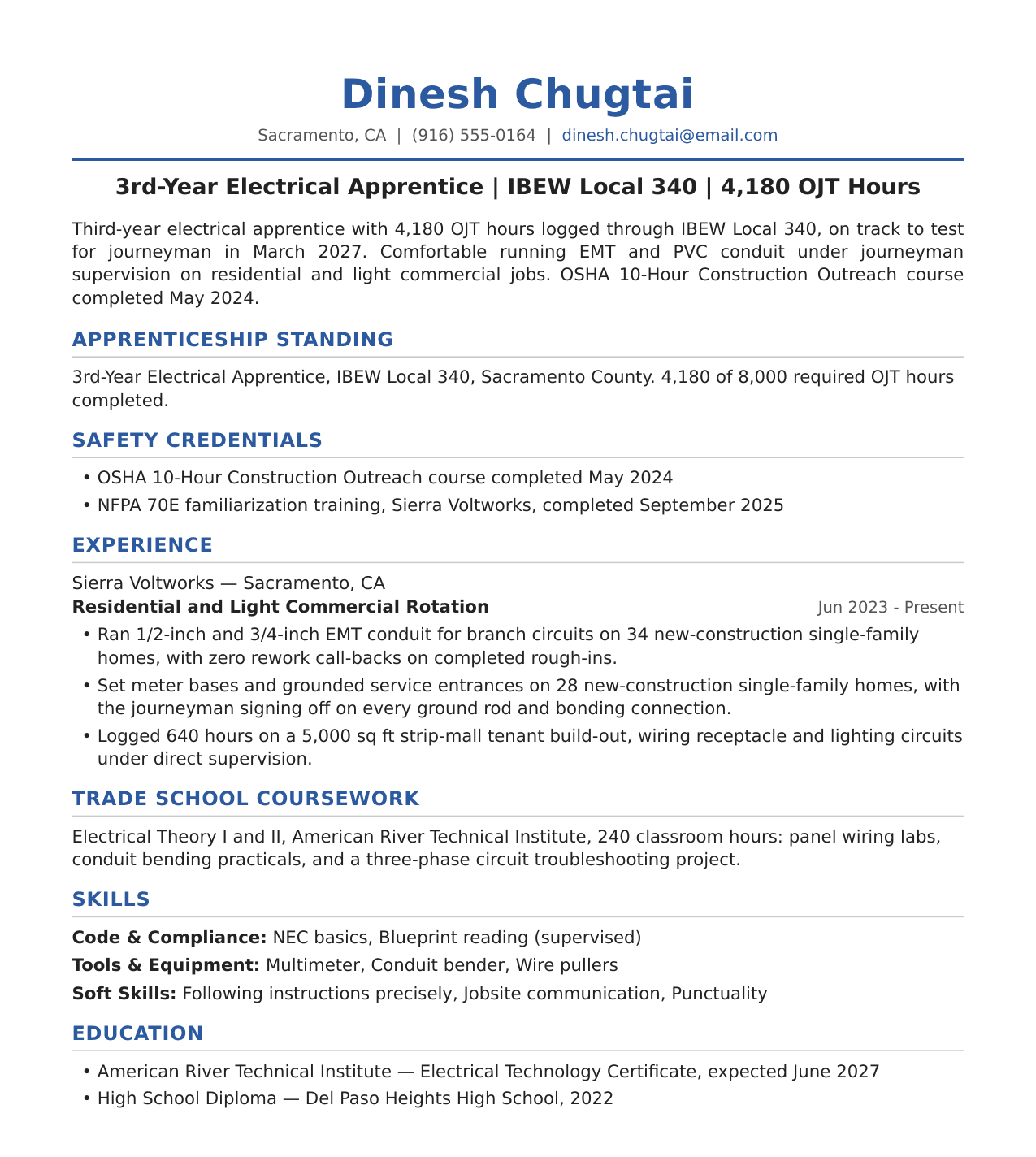
What makes this work for an apprentice: the objective leads with hours and an expected test date instead of apologizing for limited experience, the apprenticeship standing line sits where a license would go on a more senior resume, and the rotation entry names conduit sizes and a project type instead of just "assisted with wiring." Trade-school coursework gets listed with real lab content, not just a course title, which gives a hiring manager something concrete to evaluate before this candidate has a license number to lean on.
Journeyman Electrician resume example
This example fits a journeyman two years past their license exam, with enough project history to lead every bullet with scope and a measurable result.
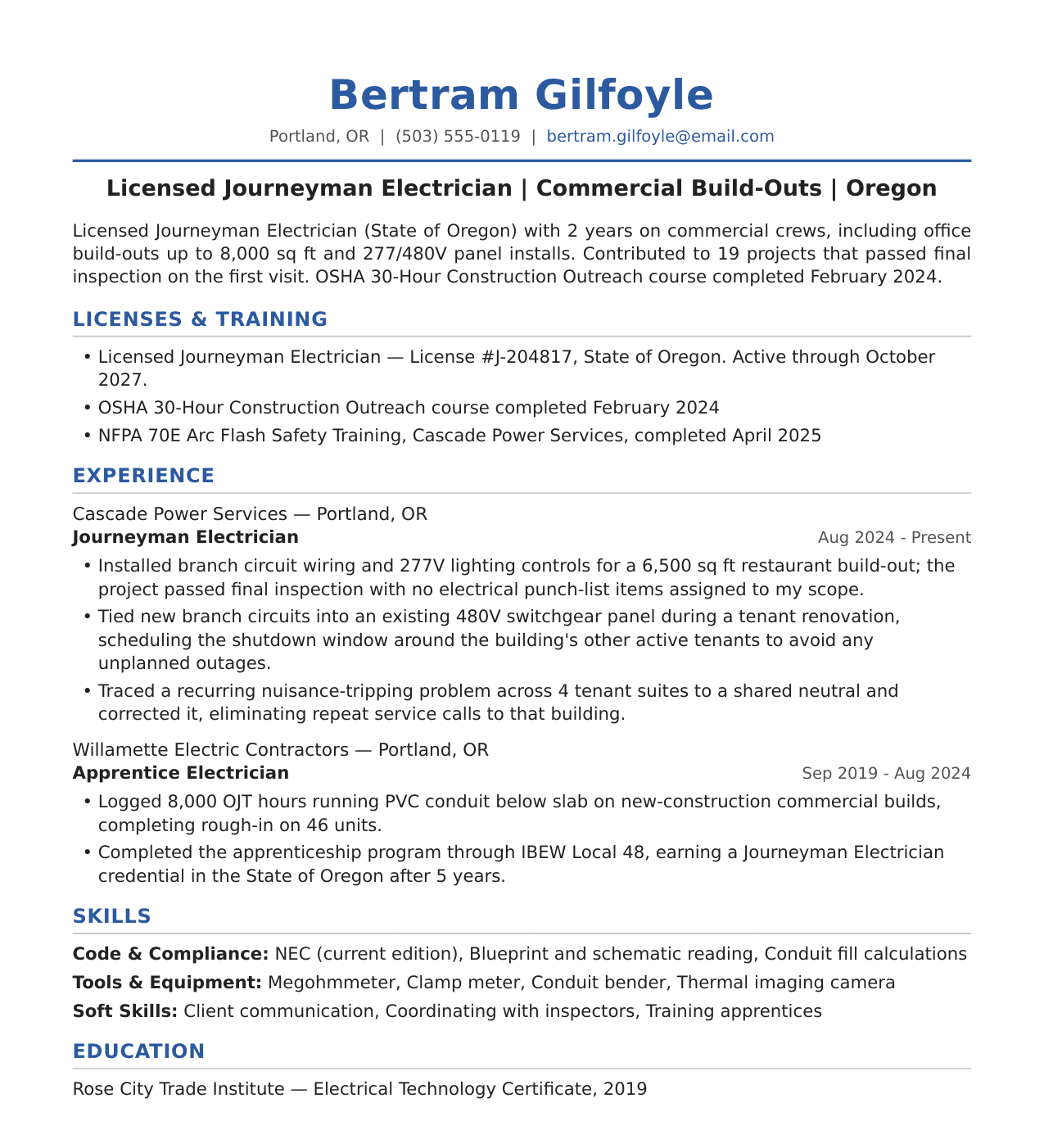
What makes this work for a journeyman: the summary puts the license and jurisdiction in the first five words, names the specialty (commercial), and backs it with a documented project outcome instead of an adjective. Every experience bullet follows the same pattern: scope first (voltage class, square footage, system type), result second (project outcome, callback rate, schedule held). The apprenticeship entry stays in the work history instead of getting dropped, since it documents how the credential was earned.
Master Electrician resume example
This example fits a master electrician with supervisory and code-review responsibility, the kind of scope that should push a resume to two pages rather than get compressed into one.
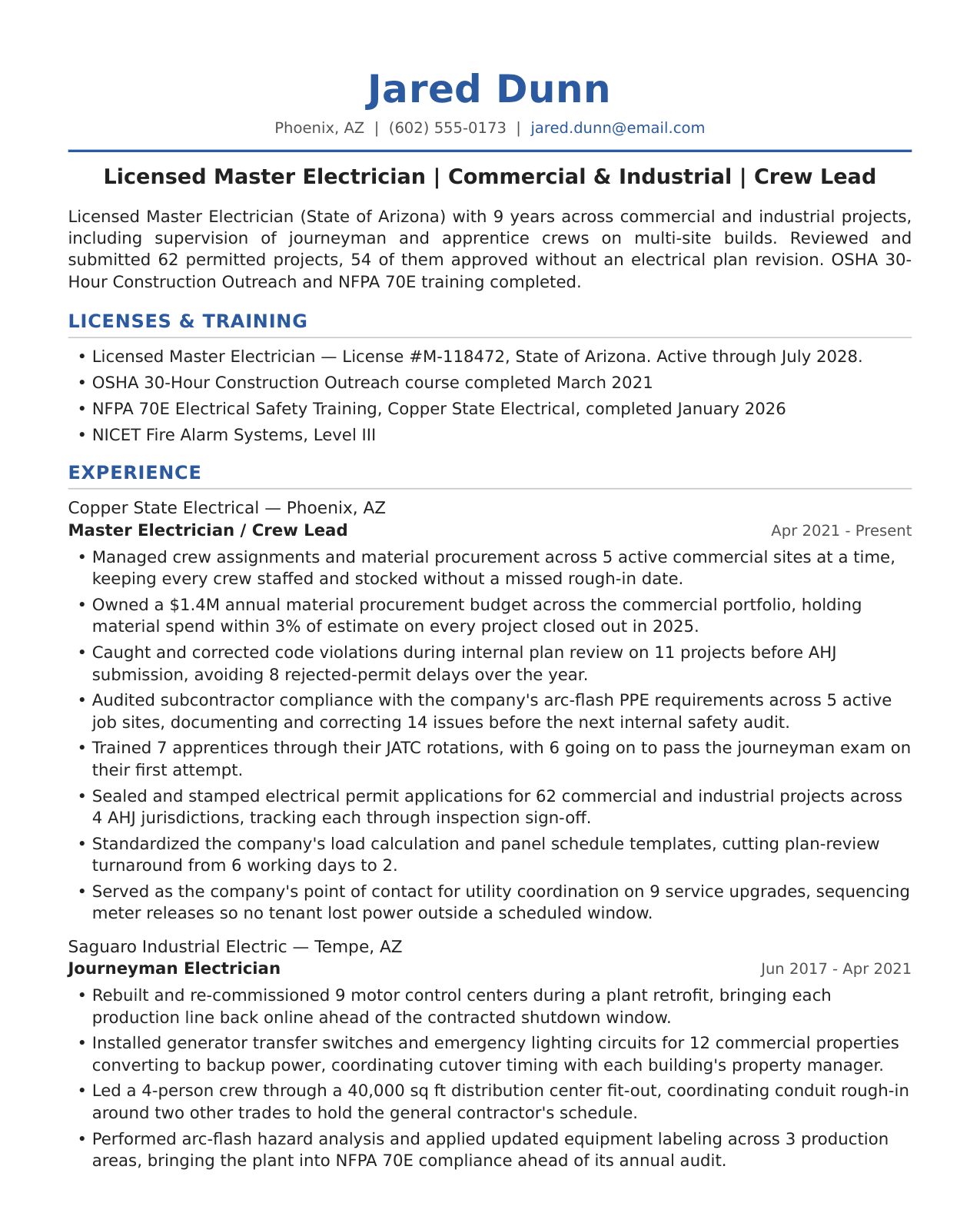
What makes this work for a master electrician: the summary and bullets shift from individual task scope to supervisory and code-review scope, crew size, budget, and approval rate, because that's what a master-level hiring decision actually weighs. The two-job history also makes the case for letting this resume run past one page; compressing nine years of progression into a single page would mean cutting the exact detail (plan review numbers, crew size, safety record) that proves this candidate is ready for master-level responsibility.
Residential vs. Commercial vs. Industrial: What Changes
The three examples above all use the same skeleton. What changes underneath it is the setting, and that's not a cosmetic difference. A residential service call, a commercial tenant build-out, and an industrial production line get evaluated against different code sections, different equipment, and different safety stakes. A resume that doesn't reflect that reads as generic to a hiring manager who's staffing a specific kind of work.
| Residential | Commercial | Industrial | |
|---|---|---|---|
| Typical voltage class | 120/240V | 277/480V | 480V three-phase and higher |
| Common project types | Service panel upgrades, new-construction wiring, service calls | Tenant fit-outs, office and retail build-outs, fire alarm circuits | PLC-controlled motor control centers, production line maintenance, plant retrofits |
| Codes/equipment to name | NEC residential wiring methods, romex, service panels | NEC commercial provisions, EMT conduit, lighting and fire alarm circuits | NEC industrial provisions, three-phase systems, PLCs, arc-flash rated PPE |
| Safety emphasis | General OSHA jobsite safety, basic lockout/tagout | OSHA Outreach training where requested, documented electrical-safety training, coordination with inspectors | Employer electrical-safety program, lockout/tagout on energized equipment, verified safety records |
Carry that distinction into your summary first. Naming residential, commercial, or industrial in the first sentence tells a contractor immediately whether your background matches what they're staffing, instead of leaving them to guess from your job titles. A summary that just says "electrician with wiring experience" forces the reader to dig through your bullets to find out which kind of work you've actually done.
It carries into skills next. A residential electrician's tools and equipment list should lean on service panels and romex. A commercial electrician's should name conduit types and fire alarm circuits. An industrial electrician's should name PLCs and motor control centers. Listing the same generic "wiring, troubleshooting, electrical repair" line across all three settings undersells whichever one you're actually targeting.
And it carries into your bullets last, where the difference matters most. Residential bullets should center on service panel sizes, unit counts, and callback rates. Commercial bullets should center on square footage, voltage class, and inspection outcomes. Industrial bullets should center on equipment type, production line count, and downtime or safety metrics. The same apprenticeship hours or journeyman experience can be written three different ways depending on which setting you're applying into, and naming the right equipment and code section for that setting is what tells the reader you've actually done that kind of work.
If you've worked across more than one setting, don't flatten that into one undifferentiated resume. Lead with whichever setting matches the job you're applying for, and let the others show up as additional, clearly labeled experience further down. A contractor staffing an industrial maintenance role doesn't need your residential service-call history minimized, but they do need to see your industrial scope first.
Electrician Resume Keywords
Electrical contractors and ATS filters screen for licenses, code language, and system types before anything else. List the terms that match your license level and the work you have actually done.
| Category | Keywords |
|---|---|
| Licenses & safety | Journeyman electrician license, Master electrician license, OSHA 10/OSHA 30, NFPA 70E arc flash, Lockout/tagout (LOTO), NEC code compliance |
| Installation & systems | Rough-in wiring, Panel installation and upgrades, Conduit bending, Motor controls, Low-voltage systems, EV charger installation, Solar/PV installation, Generator installation |
| Troubleshooting & maintenance | Circuit troubleshooting, Preventive maintenance, Multimeter and megger testing, PLC troubleshooting, Service calls |
| Planning & documentation | Blueprint reading, Electrical schematics, Load calculations, Residential/commercial/industrial wiring, IBEW apprenticeship |
Moving Off the Tools: Rewriting Your Resume for Estimator and PM Roles
The trade's own career ladder, apprentice to journeyman to foreman, ends at a desk for many electricians: estimator, project manager, superintendent, inspector. The problem is that a field resume lists systems installed, and an office role buys something different, so the transition resume has to translate.
Reframe field experience into the units estimating and PM work is measured in: project dollar values, schedules, headcount, and change orders. "Ran a 4-electrician crew on a $2.1M tenant improvement; walked the job with the GC weekly and priced 14 change orders" is PM language. "Installed panels and pulled wire for commercial TI" is not, even if both describe the same year.
Use a hybrid format: a skills-and-scope summary up top (takeoffs, bid support, scheduling, code compliance, crew coordination), then your field history beneath it. You're not hiding the tools; you're leading with the office-relevant slice of them. And if you've done any informal estimating, priced side jobs, or built material takeoffs for a foreman, that's estimating experience. Name it.
Common Electrician Resume Mistakes to Avoid
Most of the mistakes below aren't typos or formatting slips. They're judgment calls that read wrong to the specific audience scanning this resume: contractors and hiring managers who already know this trade and can spot a generic answer in seconds. Here's what trips people up most often, and what to do instead.
Listing duties instead of quantified outcomes
"Installed electrical systems" and "performed maintenance and repairs" are duties, not proof. They name a task without naming the scope (voltage class, panel size, square footage) or the result (a documented project outcome or lower callback rate), so a hiring manager has little to evaluate. Use the achievement-bullet formula from earlier in this guide: action verb, then scope, then outcome. Go back through your experience section and test every bullet against that formula. If a bullet only describes what your job title already implies, rewrite it with a real number or a specific, defensible result.
Confusing OSHA and NFPA 70E
Writing "safety certified" without naming the course or training, or treating OSHA Outreach and NFPA 70E as interchangeable, creates avoidable confusion. OSHA 10 and OSHA 30 are voluntary Outreach course-completion cards, while employers remain responsible for job-specific OSHA training. NFPA 70E is an electrical-safety standard, not a license. List only training you actually completed, using precise wording such as "OSHA 30-Hour Construction Outreach course completed [Month/Year]" or "NFPA 70E Electrical Safety Training, [Provider], completed [Month/Year]."
Burying your license
Your license is the single most load-bearing line on this resume, and putting it inside a skills list or near the bottom of the page treats it like a minor detail instead of the eligibility gate it actually is. A hiring manager sorting through a stack of resumes scans for license validity first, and if it isn't obvious in the first few seconds, the resume gets set aside before anything else on the page gets read. Wording alone won't fix that: the fix is structural, so give licenses, certifications, and safety credentials their own section, placed right after your summary and ahead of skills, every time.
Treating electrician as one role
Generic trade-resume advice with "electrician" swapped in for whatever trade it was written for is the most common failure mode in competitor content, and it produces resumes that could describe almost anyone in the field. Apprentice, journeyman, and master are different audiences for a hiring manager; residential, commercial, and industrial work get evaluated against different code sections and equipment; union and non-union paths run different hiring processes entirely. A resume that doesn't name which of these you are, in the first few lines, forces the reader to guess or move on to the next resume in the stack. Name your license level, your specialty, and your path explicitly instead of assuming your job title will do that work for you.
Rigid one-page rule
A flat "always one page" rule ignores how much this varies by career stage. It's the right call for an apprentice or early-career journeyman with thin work history, where a tight page reads as organized. But for a journeyman or master with real project history across multiple employers or settings, forcing that onto one page usually means cutting the exact scope details (panel sizes, project counts, inspection rates) that prove you can do the work. Match page count to how much real, provable scope you actually have, and trim redundant bullets before you ever shrink a font to force a fit.
Same resume to union and non-union employers
Sending the identical resume to every audience can miss the information each one needs. If a union Local or signatory contractor asks for a resume, lead with your Local, standing, and the qualifications relevant to that request; always follow the Local's referral rules. For a non-union application, lead with the license or apprenticeship standing required by the posting, including the issuing jurisdiction. Keep one credentials-forward master resume, then tailor the leading details and relevant experience to the job.
Inflating numbers you can't back up
There's a real cynicism in this trade about resume exaggeration, including one Reddit commenter who advised, bluntly, to lie because "everyone else does." Don't take that advice. An inflated inspection rate, a padded crew size, or a project count you can't describe in detail falls apart the moment an interviewer asks a follow-up question, and getting caught costs you more credibility than the inflated number was ever worth. The bracketed placeholders used throughout this guide, [XX] jobs, [X,XXX] hours, exist so you swap in figures you can actually defend, not round numbers that sound impressive. Pull real numbers from logbooks, punch lists, and inspection records, and if you don't have a number yet, leave the bullet as scope without one rather than inventing a figure you can't stand behind in an interview.
How AI Resume Builders Can Simplify Your Electrician Resume
Everything in this guide points to the same conclusion: a resume built for a residential service-call opening should not read the same as one built for an industrial maintenance role. Rewriting your summary, skills, and bullets for each posting takes time, but it makes the relevant voltage class, safety training, and work history easier for a hiring manager to find.
Upplai is built to close that gap without asking you to start from a blank page each time. It tailors your resume to a specific job description, optimizing for ATS keywords and recruiter best practices, and shows you every change it makes with a plain-language explanation. Nothing gets rewritten silently.
- Real-time ATS scoring. Your ATS and recruiter match scores update live as you edit, so you can see whether a change to your summary or skills section actually moved your score, with no download-and-reupload cycle to check it.
- Transparent suggestions. Every suggested edit comes with a "Why this change?" explanation, and you accept or reject each one individually. The AI never fabricates experience, certifications, or numbers you didn't provide, which matters in a trade where an interviewer will ask you to back up exactly what's on the page.
- Automatic formatting. Choose from multiple ATS-friendly templates with full design control, and download unlimited copies in PDF, DOCX, or TXT. A matching cover letter comes with every tailored resume at no extra cost.
- Structure guidance. Upplai reorders content for relevance, strengthens action verbs, helps you quantify achievements instead of listing duties, manages overall length, and flags potential bias triggers, on top of applying recruiter best practices.
- Preference memory. Your formatting, metric, and reordering choices carry over across sessions, and you can bookmark separate master resumes for different settings, residential, commercial, industrial, union, non-union, so you're never rebuilding from scratch when you switch which kind of job you're targeting.
The free plan costs nothing and doesn't ask for a credit card: 200 ATS scans a month, three tailored resumes with matching cover letters, and unlimited downloads in PDF, DOCX, or TXT. If you need more than three tailored resumes, additional ones cost $0.50 to $1.00 each depending on pack size, one-time, with no subscription and no auto-renewal.
The resume that gets you the next job proves your license, your safety record, and your real scope at a glance. That holds at every stage: testing for the journeyman exam, building a track record as a journeyman, or leading crews as a master. Get that structure right once, and it carries you through every application instead of starting from scratch each time.
See how your electrician resume scores before you send it
Get your ATS and recruiter score in about 10 seconds, no credit card required.