IT project management resumes carry a built-in tension: hiring managers need to see that you understand the systems being delivered (cloud migrations, SDLC, ERP rollouts) while also proving you can own budget, timeline, and people without either side slipping. Lean too hard into the technical vocabulary and you read as an engineer who happens to manage a Jira board. Lean too hard into leadership language and you read as a generalist who couldn't survive a sprint planning meeting. Most resumes pick one lane. The ones that get interviews prove both at once.
This guide walks you through building a resume that holds that balance, section by section, so nothing you write reads as generic or incomplete.
You'll get guidance on positioning certifications like PMP, CAPM, and CSM so they gate you in rather than get skipped over, building a skills section that separates methodology and tool fluency from leadership strengths, and writing experience bullets with the budget, team-size, and delivery metrics that actually move a screener. You'll also find example bullets by seniority level, from associate PM to program lead. A final section covers the mistakes that most often stall an otherwise qualified IT PM: vague summaries, flat skills lists, and unquantified achievements.
How to Write an IT Project Manager Resume That Gets Interviews
An IT project manager resume has to prove two different things at once. Hiring managers want evidence you understand the systems being delivered (cloud migrations, SDLC, ERP rollouts) and evidence you can run the budget, timeline, and people side without either falling apart. Miss either half and you read as incomplete. Here's how to build each section so it carries both.
Write a Targeted Professional Summary
Your summary needs four things in three sentences: certification status, years of experience, methodology, and one metric that proves scope. Skip the adjectives. A recruiter scanning 200 resumes for a PMP-gated role is looking for the credential and the number, not "results-driven."
A weak summary looks like this:
"Experienced IT project manager with strong leadership and communication skills, dedicated to delivering successful projects on time."
A stronger one looks like this:
"PMP-certified IT project manager with 8 years leading Agile and hybrid Waterfall software delivery teams. Managed a $3.2M infrastructure portfolio across 6 concurrent projects, hitting 96% on-time delivery over the last two fiscal years."
If you're pivoting into IT project management from an adjacent role (developer, business analyst, IT support lead, or a PM background outside tech), the summary needs to work differently. Lead with the transferable scope and name the systems experience directly, since you won't have "IT project manager" in a past title to lean on.
Career-changer summary example: "PMP-certified project manager with 6 years delivering cross-functional initiatives in financial services operations, now applying that background to IT delivery. Led the coordination between engineering and business stakeholders on a core banking system upgrade affecting 1,200 users, and completed CompTIA Project+ and hands-on Jira administration to support the transition into IT-specific project work."
Lead With Certifications and Credentials
Certifications aren't a formality on this resume, they're often the gate. Many IT PM job postings screen for PMP before a recruiter reads anything else, so this section belongs near the top, right under your summary, not buried near education.
PMP (Project Management Professional, PMI) is the anchor credential most employers expect from mid-to-senior candidates. If you're not there yet, CAPM (Certified Associate in Project Management) signals you're on the PMP path and is a legitimate stand-in for less experienced candidates. CSM or PSM (Scrum Master certifications) matter heavily if the role is Agile-shop specific. ITIL shows IT service management fluency, which carries weight in enterprise or regulated environments. SAFe (Scaled Agile Framework) matters for large-scale, multi-team delivery. PRINCE2 shows up more in UK/EU-based postings and international companies.
If you hold a newer or non-PMI credential like the Google Project Management Certificate, list it honestly as what it is: a certificate rather than a certification equivalent to PMP. Format it as "Google Project Management Certificate, Google/Coursera, [year]" rather than implying parity with PMI credentials. It's still worth including, particularly if you're early-career or transitioning, but pair it with any hands-on tool experience so it doesn't stand alone.
For every credential, list the issuing body and current status (active, in progress, renewal date) so recruiters and ATS parsers can verify at a glance. "PMP, PMI, active through 2027" tells a recruiter more in five words than "PMP certified" does.
Build a Skills Section That Balances Technical and Leadership Strengths
A flat skills list ("Communication, Leadership, Problem-solving") reads as generic and does nothing for ATS matching. Split your skills into categories so both the technical and business sides of the role show up clearly.
Methodologies: Agile, Scrum, Waterfall, hybrid delivery, SAFe, Kanban
Tools & Platforms: Jira, Microsoft Project, Confluence, Smartsheet, ServiceNow
Technical & Systems Fluency: AWS/Azure cloud environments, ERP systems (SAP, Oracle), CRM platforms (Salesforce), SDLC stages, basic SQL/API literacy
Leadership & Business: Stakeholder management, budget ownership, vendor management, risk management, cross-functional team leadership
Only list what you can speak to in an interview. If a job posting names a specific tool (ServiceNow, Smartsheet, a particular ERP), mirror that exact wording if you genuinely have the experience, since ATS systems and human screeners both scan for literal matches.
Write Achievement-Focused Experience Bullets With Real Scope
Every experience bullet should follow the same formula: action verb, plus the specific task or method, plus a quantifiable result or scope. For IT project managers, the default metrics that matter most are budget size, team size, number of concurrent projects, and percent on-time or on-budget delivery.
A weak bullet looks like this:
"Responsible for managing IT projects and coordinating with stakeholders."
A stronger one looks like this:
"Led a cross-functional team of 14 engineers and analysts through a $1.8M ERP migration, delivering the project 3 weeks ahead of schedule and 6% under budget."
If you don't have a clean dollar figure or percentage, quantify scope instead: number of systems migrated, number of end users affected, number of environments (dev/staging/prod) managed, or number of stakeholders coordinated across departments. Go back through old status reports, sprint retros, and budget approvals to find numbers you've forgotten you tracked. Most IT PMs have this data sitting in a project charter or closeout doc they haven't looked at in a year.
Address Software and Systems Proficiency Specifically
"Proficient in project management software" tells a recruiter nothing. Name the actual tools and say how you used them. Jira for sprint planning and backlog management is different from Jira for enterprise-wide issue tracking across 10 teams, and that distinction matters to a hiring manager evaluating fit.
Be specific about context: "Administered Jira workflows and dashboards for a 20-person Agile team across 3 sprints per release cycle" tells a much sharper story than "Jira." Same with Microsoft Project for Waterfall-heavy scheduling and resource leveling, or Confluence for documentation and stakeholder-facing project spaces. If you've worked in ServiceNow for ITSM ticketing or change management, name that too. Naming the tool plus the use case is what separates a resume that reads as technically credible from one that just lists software like a keyword dump.
IT Project Manager Resume Examples by Experience Level
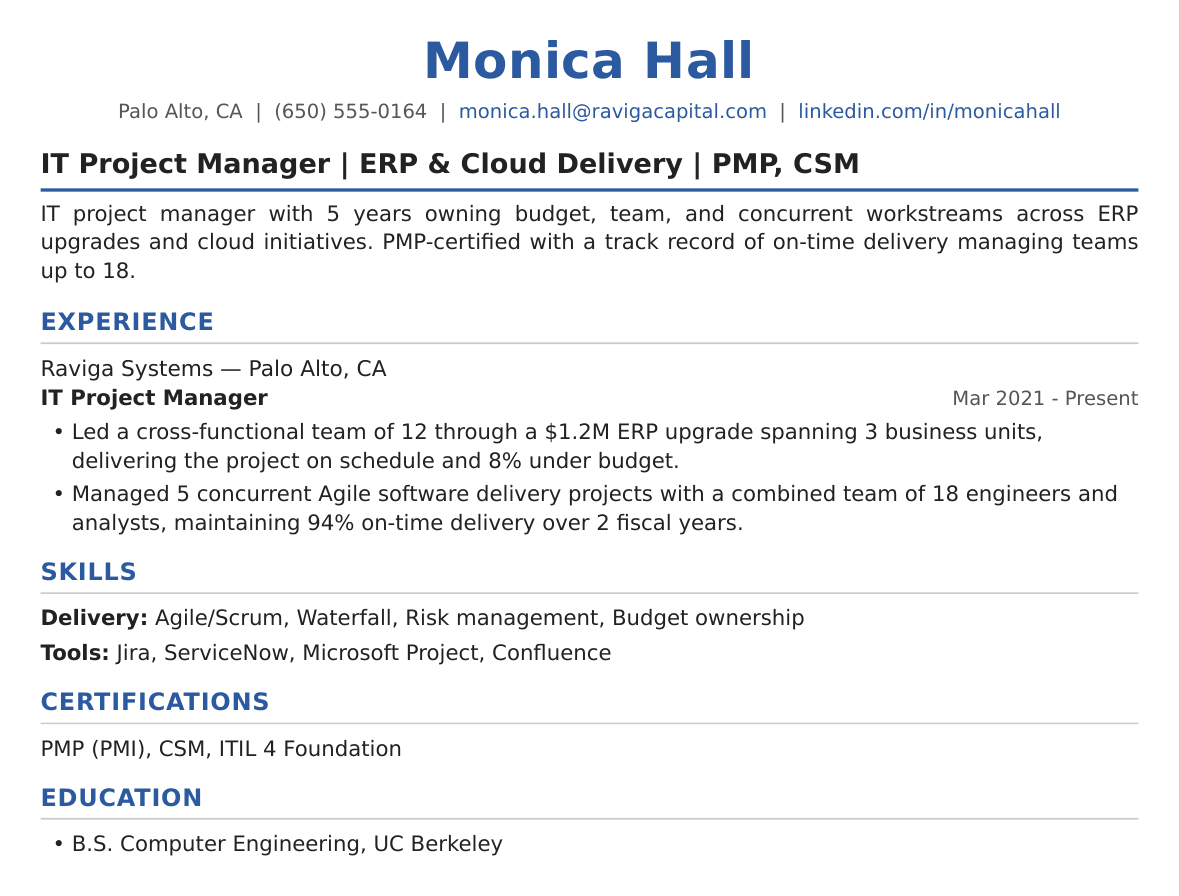
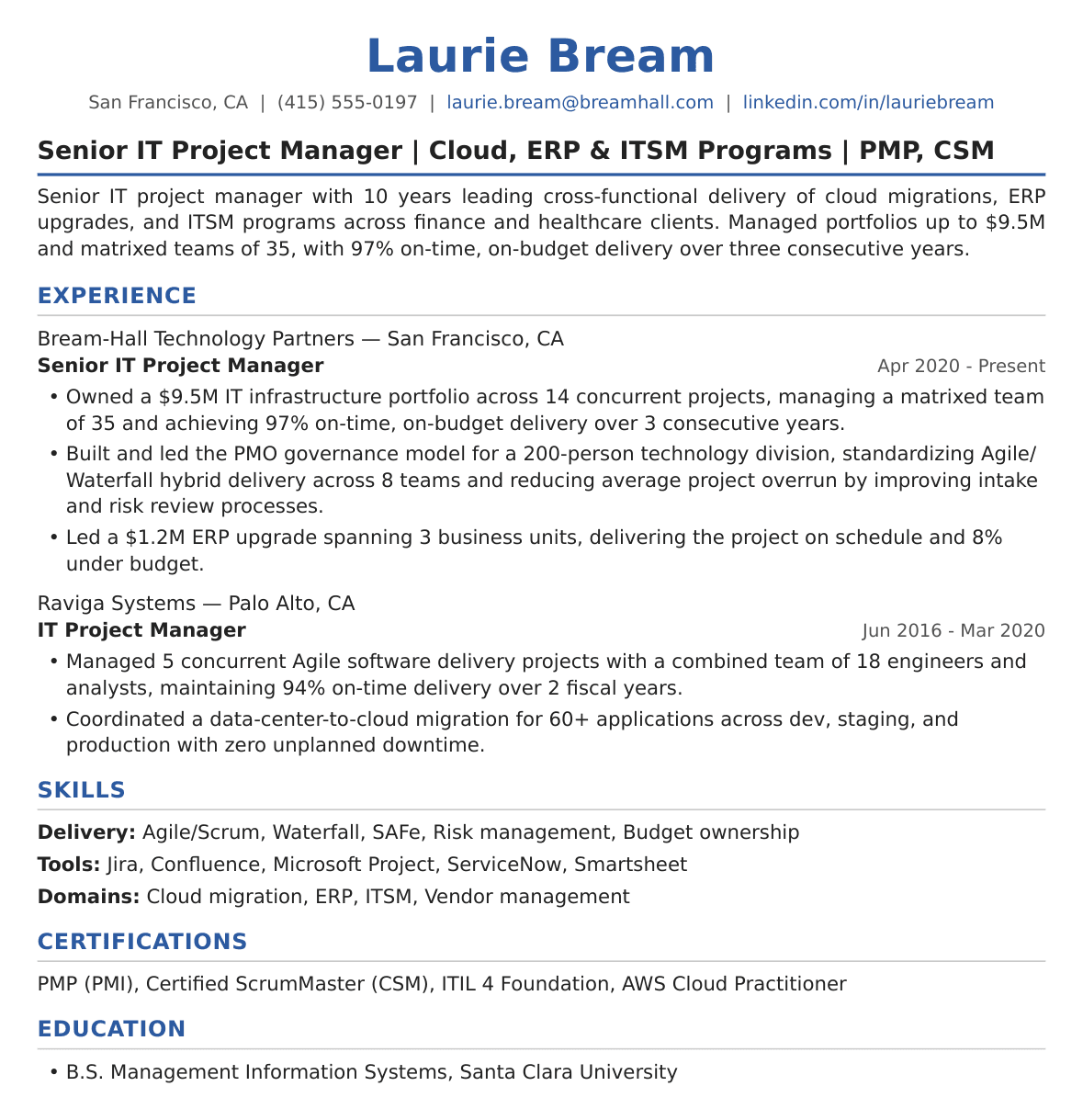
IT project manager covers a wide band, from coordinator fresh off a CAPM to a program lead running an eight-figure portfolio. Match your bullets to where you actually are rather than borrowing language from a level above or below you.
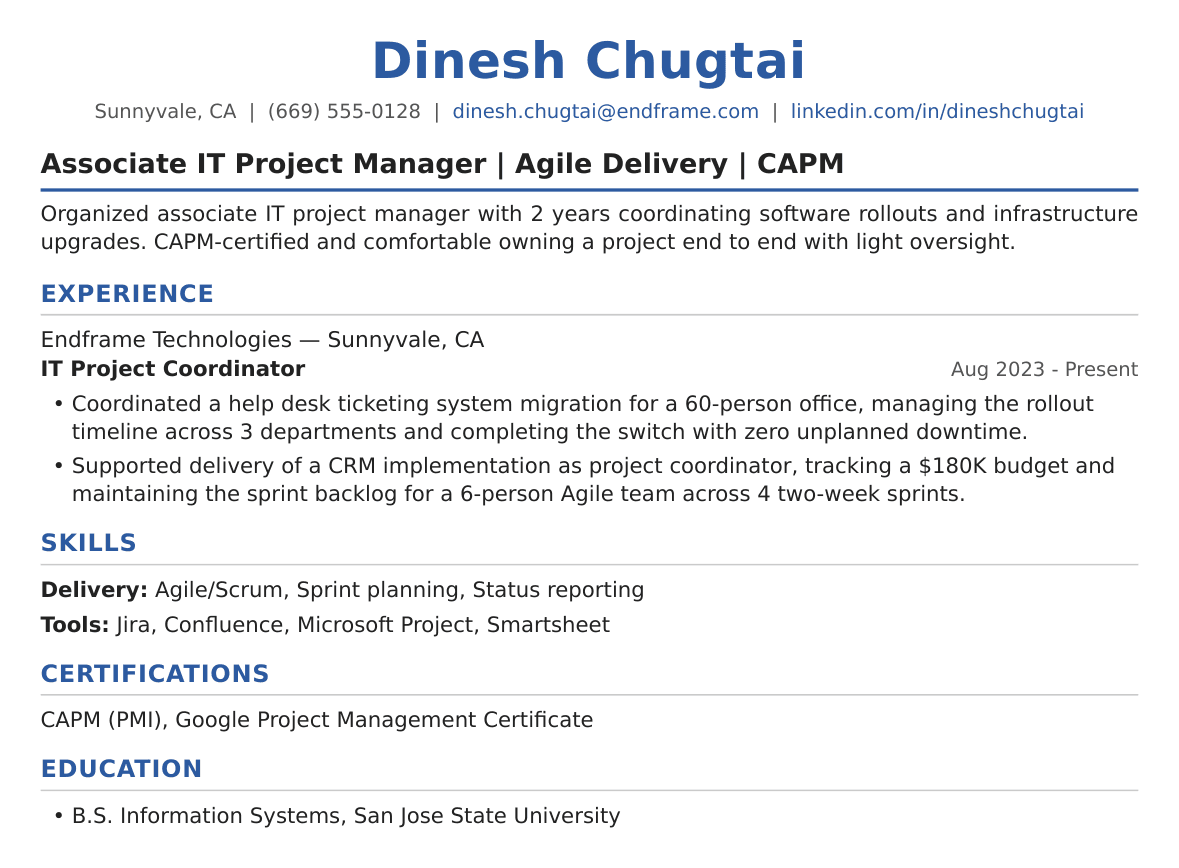
Associate / Junior IT Project Manager
At this stage you're proving you can own a project end to end, even a small one, without heavy oversight.
"Coordinated a help desk ticketing system migration for a 60-person office, managing the rollout timeline across 3 departments and completing the switch with zero unplanned downtime."
"Supported delivery of a CRM implementation as project coordinator, tracking a $180K budget and maintaining the sprint backlog for a 6-person Agile team across 4 two-week sprints."
Mid-Level IT Project Manager
Here the bullets should show independent ownership of budget, team, and multiple concurrent workstreams.
"Led a cross-functional team of 12 through a $1.2M ERP upgrade spanning 3 business units, delivering the project on schedule and 8% under budget."
"Managed 5 concurrent Agile software delivery projects with a combined team of 18 engineers and analysts, maintaining 94% on-time delivery over 2 fiscal years."
Senior / Program-Level IT Project Manager
At the senior tier, bullets need to reflect portfolio-level scope, budget authority, and influence over process or strategy, not just individual project delivery.
"Owned a $9.5M IT infrastructure portfolio across 14 concurrent projects, managing a matrixed team of 35 and achieving 97% on-time, on-budget delivery over 3 consecutive years."
"Built and led the PMO governance model for a 200-person technology division, standardizing Agile/Waterfall hybrid delivery across 8 teams and reducing average project overrun by improving intake and risk review processes."
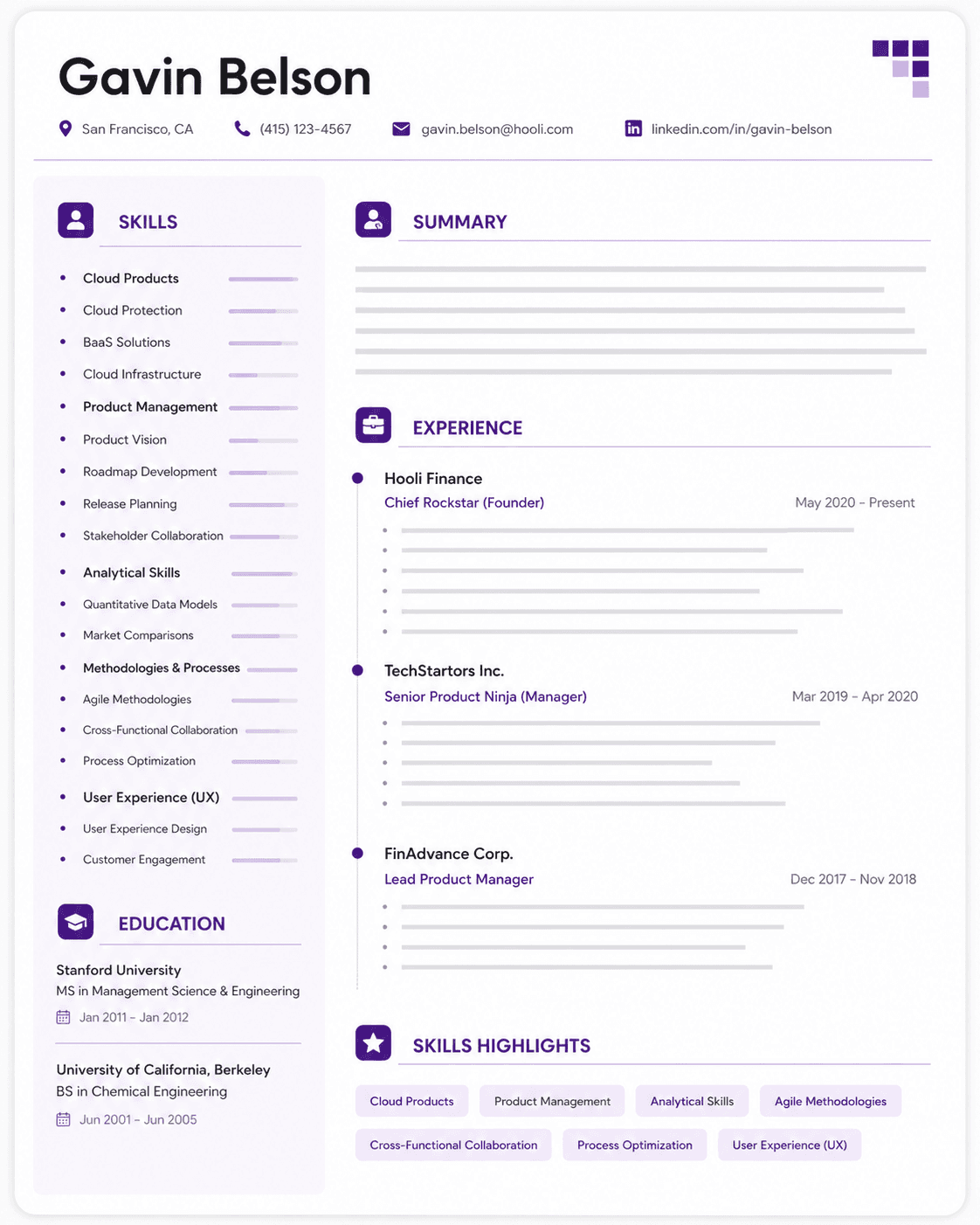
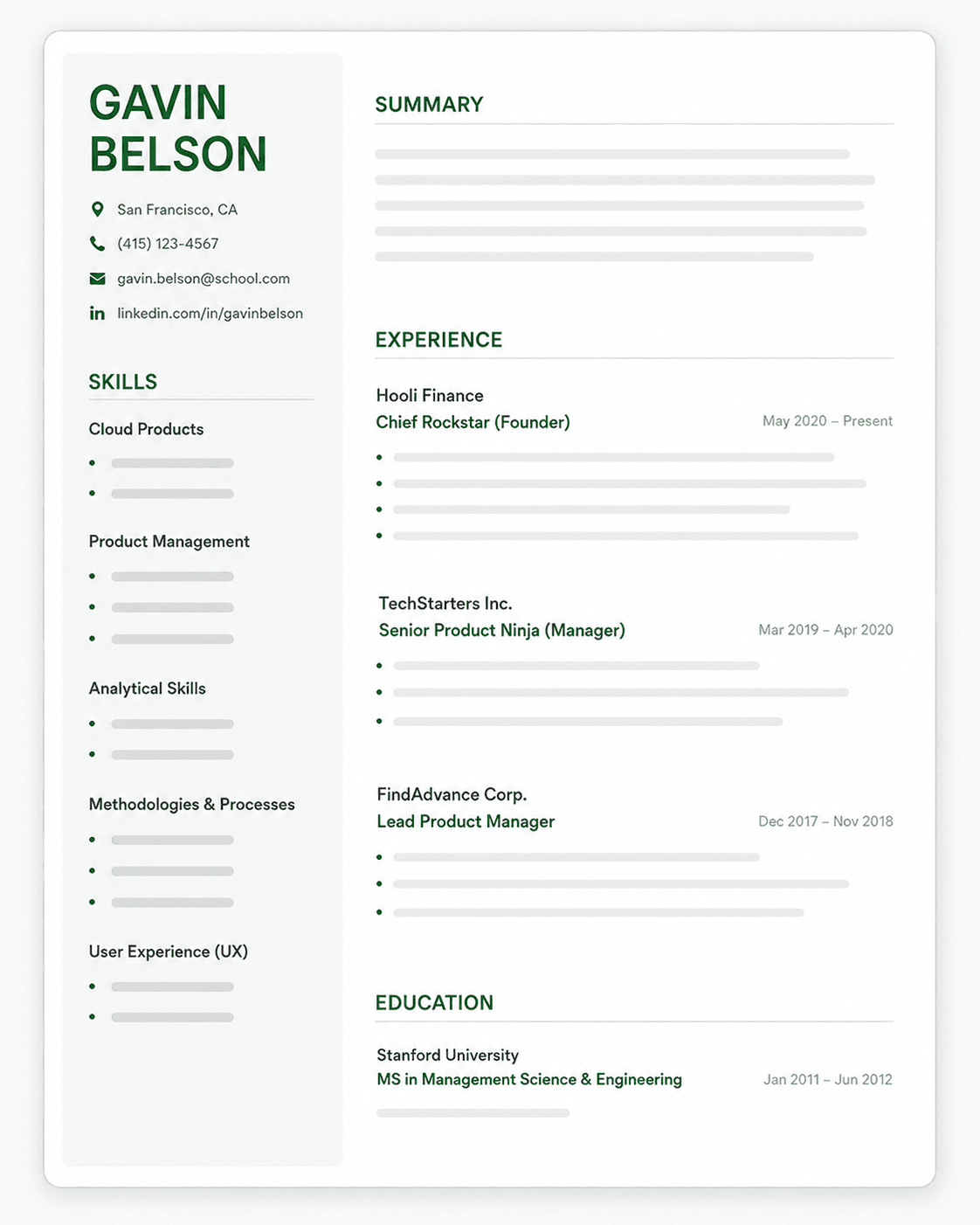
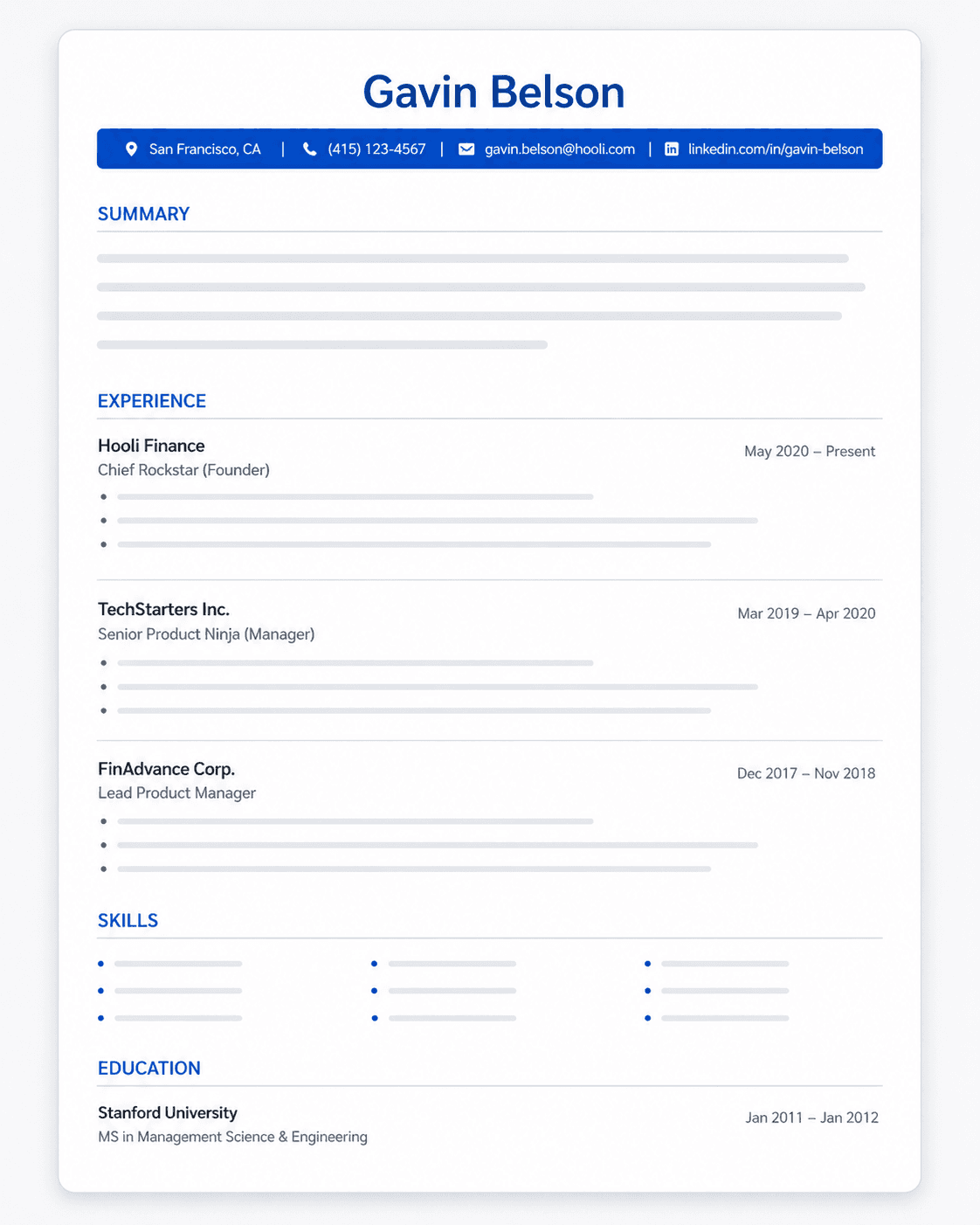
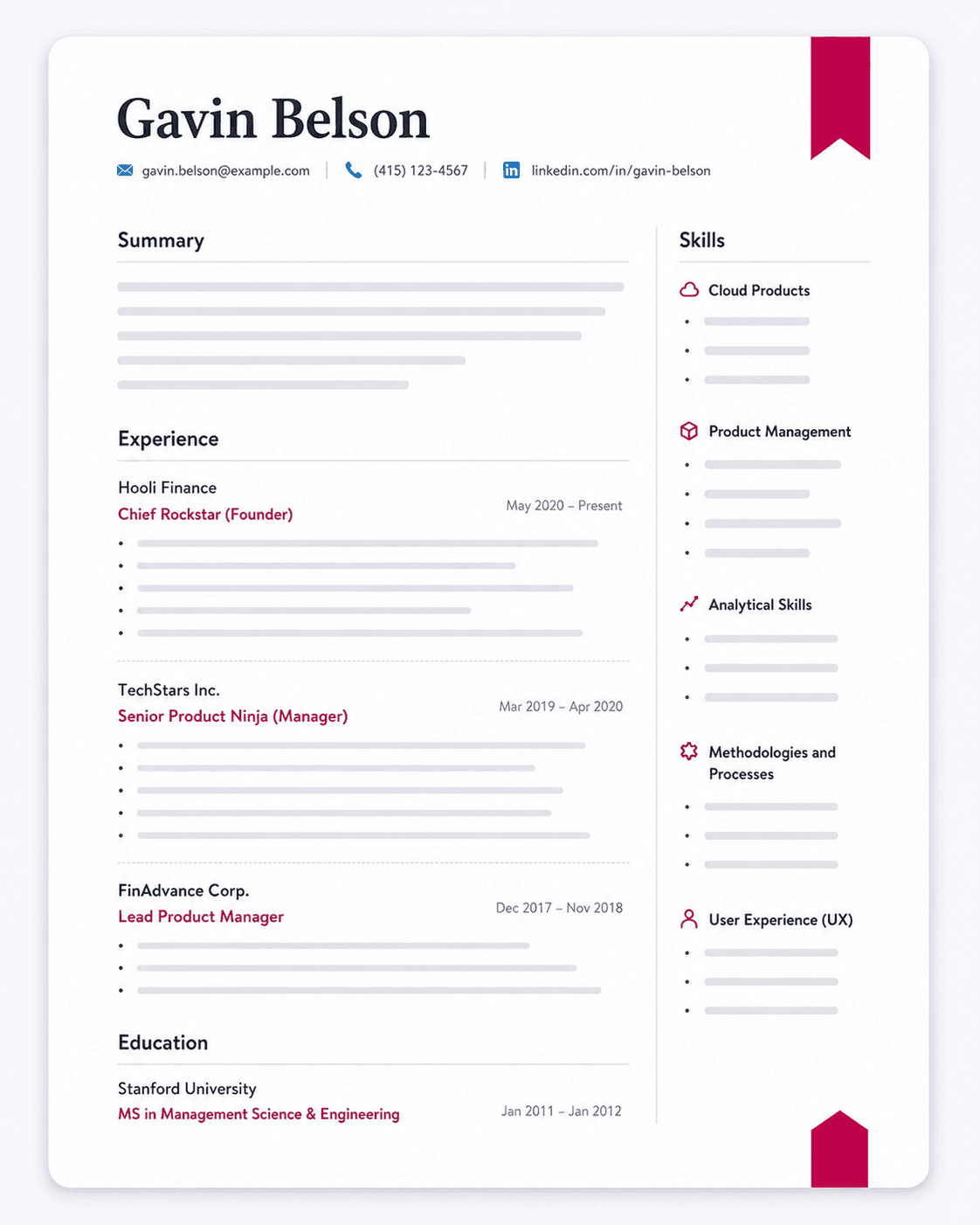
Each level above pairs with a downloadable resume template built for that career stage, formatted and ready to adapt.
Associate / Junior IT Project Manager Resume Example
Mid-Level IT Project Manager Resume Example
Senior / Program-Level IT Project Manager Resume Example
IT Project Manager Resume Keywords
IT PM postings are dense with methodology, certification, and tooling terms, and ATS filters check for all three. Mirror the delivery approach each posting names rather than listing every methodology you have touched.
| Category | Keywords |
|---|---|
| Methodologies | Agile, Scrum, Kanban, Waterfall, Hybrid delivery, SAFe, SDLC |
| Certifications | PMP, PRINCE2, Certified ScrumMaster (CSM), ITIL |
| Planning & control | Project scheduling, Sprint planning, Backlog management, Risk management, Budget management, Resource allocation, Scope management, Change management, Go-live and cutover planning |
| Tools | Jira, Confluence, Microsoft Project, Azure DevOps, ServiceNow, Smartsheet |
| Leadership & delivery | Stakeholder management, Cross-functional team leadership, Vendor management, Executive reporting, KPIs and OKRs, Cloud migration, Software implementation |
How to Put a Cancelled Project on Your Resume
A large share of IT projects get killed, merged, or descoped before launch, which means many IT PMs need to decide how to present those projects on their resume when the work never shipped. Hiding those projects creates gaps; listing them badly reads as failure. Neither is necessary.
Cancellation is usually a portfolio decision, not a performance verdict: budgets shift, vendors change, strategy pivots. Interviewers know this. What they're reading for is what you controlled, so write the bullet around your contribution, not the outcome: "Led a 14-month ERP migration through vendor selection and data-mapping phases; program cancelled in enterprise-wide budget consolidation. Delivered reusable data dictionary adopted by the successor project."
The salvage line is the strongest move available: what survived the cancellation because of you. Reusable architecture, a clean vendor exit that avoided penalty clauses, staff redeployed without attrition. If your shutdown was orderly, say so; winding a project down well is a rarer skill than launching one.
Never write "project cancelled" as the bullet's last word. End on what you delivered, learned, or protected, and be ready to tell the fuller story in the interview, where cancelled projects make excellent stakeholder-management answers.
Common IT Project Manager Resume Mistakes to Avoid
Describing Responsibilities Instead of Measurable Outcomes
"Responsible for managing IT projects" tells a hiring manager nothing about whether those projects landed on time or on budget. IT PM roles are evaluated on delivery performance, so every bullet without a number reads as unproven. Fix: rewrite each bullet with budget, team size, or on-time percentage attached to the action.
Using One Generic Resume for Every IT PM Role
A hospital IT department and an early-stage SaaS startup are screening for different vocabulary, different tools, and different compliance context. Sending the same resume to both signals you didn't read the posting closely. Fix: adjust methodology language, named tools, and system types (ERP, cloud, ITSM) to match each job description before applying.
Listing Certifications or Tools Without Context or Status
"PMP" alone doesn't tell a recruiter if it's active, expired, or in progress, and "Jira" alone doesn't say whether you administered it for one team or twenty. A recruiter or ATS scanning that line has no way to confirm the credential is current or that the tool reflects meaningful scope, so the listing loses its persuasive weight. Fix: always pair each credential and tool with status or scale.
Burying Your PMP or Scrum Certification Below Education
Many IT PM postings use PMP or CAPM as an automatic screening filter before a human reads further. Placing certifications near the bottom, after education, means an ATS or a fast-scanning recruiter may miss the one credential that gets you through the gate. Fix: move certifications directly under your summary, not below your degree.
Ignoring ATS-Safe Formatting in a Keyword-Dense Resume
IT PM resumes tend to carry long lists of tools, acronyms, and methodologies, which makes ATS-safe formatting especially important. Tables, columns, or graphics-heavy templates are prone to parsing failures. An ATS that can't parse your skills section won't surface you for the keyword match at all. Fix: use a single-column layout with standard headings and no embedded tables or icons.
Overloading Soft Skills at the Expense of Technical Specificity
Leading with "strong communicator" and "natural leader" without naming a single system, tool, or methodology fails the technical-credibility half of this resume's dual test. IT hiring managers check for SDLC, cloud, or ERP fluency alongside leadership language throughout the resume. Fix: pair every soft skill claim with a technical or scope-based detail in the same bullet.
Why You Should Customize Your IT Project Manager Resume for Each Role
Before applying, adjust three things: the methodology language in your summary and bullets, the named tools you lead with, and which metric you foreground.
Match methodology language to the environment. A regulated Waterfall shop wants compliance vocabulary (HIPAA, validation protocols, change control boards) and evidence of fixed-scope, phase-gated delivery. A SaaS company running Agile sprints wants sprint velocity, backlog ownership, and release cadence, and may read heavy Waterfall phrasing like "managed project phases through formal sign-off gates" as slow and rigid rather than as a strength.
Swap the tools you lead with: ServiceNow and change management for regulated shops, Jira and sprint metrics for Agile teams.
Foreground the metric that matters to the reviewer. On-time delivery carries more weight in regulated environments, while velocity or release frequency carries more weight in Agile ones.
A resume tuned for one environment will underperform in the other, even with identical experience underneath. Making these three adjustments before each application closes that gap.
How AI Resume Builders Can Simplify Your IT Project Manager Resume
Adjusting methodology language, named tools, and lead metrics for every posting takes real time, and a resume that reads generic to any single hiring manager gets filtered before it reaches a human. An AI resume builder can handle that tailoring work directly:
- Real-time ATS scoring: see your ATS and recruiter scores update as you edit, so you know whether a rewritten bullet or a swapped tool name actually improved your match, without downloading and re-uploading.
- Transparent suggestions: every edit comes with a plain-language explanation of why it was made, and you accept or reject each one individually. Nothing gets rewritten silently, and nothing is invented.
- Automatic formatting: resumes are built in ATS-friendly templates and design themes, so single-column, parseable structure isn't something you have to think about separately.
- Structure guidance: suggestions reorder content for relevance, strengthen action verbs, quantify achievements, manage length, and flag potential bias triggers, based on recruiter best practices.
- Preference memory: your formatting, metric, and reordering choices persist across sessions, so tailoring your fifth application doesn't mean starting from scratch.
Pricing is honest: the free plan includes 3 tailored resumes with matching cover letters and 200 ATS scans and resume match scores a month, with unlimited downloads and no credit card required. Beyond that, resume packs start at $5, working out to $0.50 to $1.00 per tailored resume depending on pack size, with no subscription attached.
Tailor your IT PM resume for your next application
Get an ATS and recruiter score on your IT project manager resume in seconds, then tailor it to the specific methodology and tools each posting asks for.
An IT project manager resume earns interviews when it proves you can speak both languages: the systems being delivered and the budget, timeline, and people that carry them there. Certifications establish the gate, scoped achievement bullets establish the evidence, and tailoring each application to the specific methodology and tools in the posting is what separates a resume that gets read from one that gets filtered. Put in that work once per role, and the resume starts doing the persuading for you.