You have the forklift cert, the WMS experience, the safety record. So does everyone else applying for the same material handler posting. Certifications and equipment experience get you past the initial screen, but they don't explain why a hiring manager should call you instead of the next candidate with the same credentials listed the same generic way.
This guide shows you how to write a material handler resume that turns those credentials into evidence: a summary that leads with your facility type and scale, a skills section categorized by equipment, software, and safety rather than dumped into one list, and achievement bullets quantified for your specific environment.
You'll also find certification guidance, a sub-role bullet library covering distribution centers, manufacturing, retail, cold storage, and general warehouse work, an entry-level path if you're coming from retail or the military, and the formatting details that keep your resume readable by kiosk and staffing-agency parsers.
What Makes a Material Handler Resume Effective?
Hiring managers reading a material handler resume aren't scanning for polished prose. They're checking whether you can move product safely, hit volume targets, and operate the equipment their facility runs on.
That means three things matter more here than in most resumes. First, safety record: attendance, incident-free streaks, audit scores. Warehouses lose money and time to injuries, so a clean safety history tells them you're low-risk before you even interview.
Second, physical-demands signaling. Lifting 50 lbs repeatedly, standing for 8-10 hour shifts, working in cold storage or extreme heat, these details prove you understand the job's realities, not just its title.
Third, scale metrics tied to your specific environment. "Picked orders accurately" says nothing. "Maintained 99.7% picking accuracy across 400+ orders per shift in a 3PL fulfillment center" tells a hiring manager exactly what you can replicate for them.
Generic resume advice (strong verbs, clean formatting) still applies, but it won't separate you from other applicants. What separates you is proving, with specifics, that you're reliable, physically capable, and productive in the exact type of facility they're hiring for.
How to Write a Material Handler Resume That Gets Interviews
Hiring managers scan a material handler resume for a handful of specifics: what kind of facility you worked in, what equipment you ran, what certifications you hold, and whether your numbers prove you can handle volume safely. Here's how to build each section so those specifics jump out.
Write a Targeted Summary or Objective
Your summary has three jobs: name the environment you worked in (warehouse, DC, manufacturing plant, cold storage), give your years of experience plus one scale metric (units per hour, order volume, inventory accuracy), and name the equipment or software you actually run. Skip personality traits. Hiring managers want proof, not adjectives.
A weak summary looks like this:
"Hardworking and reliable material handler with good attention to detail and a strong work ethic."
A stronger one looks like this:
"Material handler with 3 years in high-volume distribution center operations, processing 150+ orders per shift using RF scanners and a WMS platform. Certified forklift operator (sit-down and reach truck) with a 99.7% inventory accuracy record and zero safety incidents."
If you're entering the field from a different background, use an objective instead of a summary. It should point at the job you want, not the job you had.
Entry-level objective example:
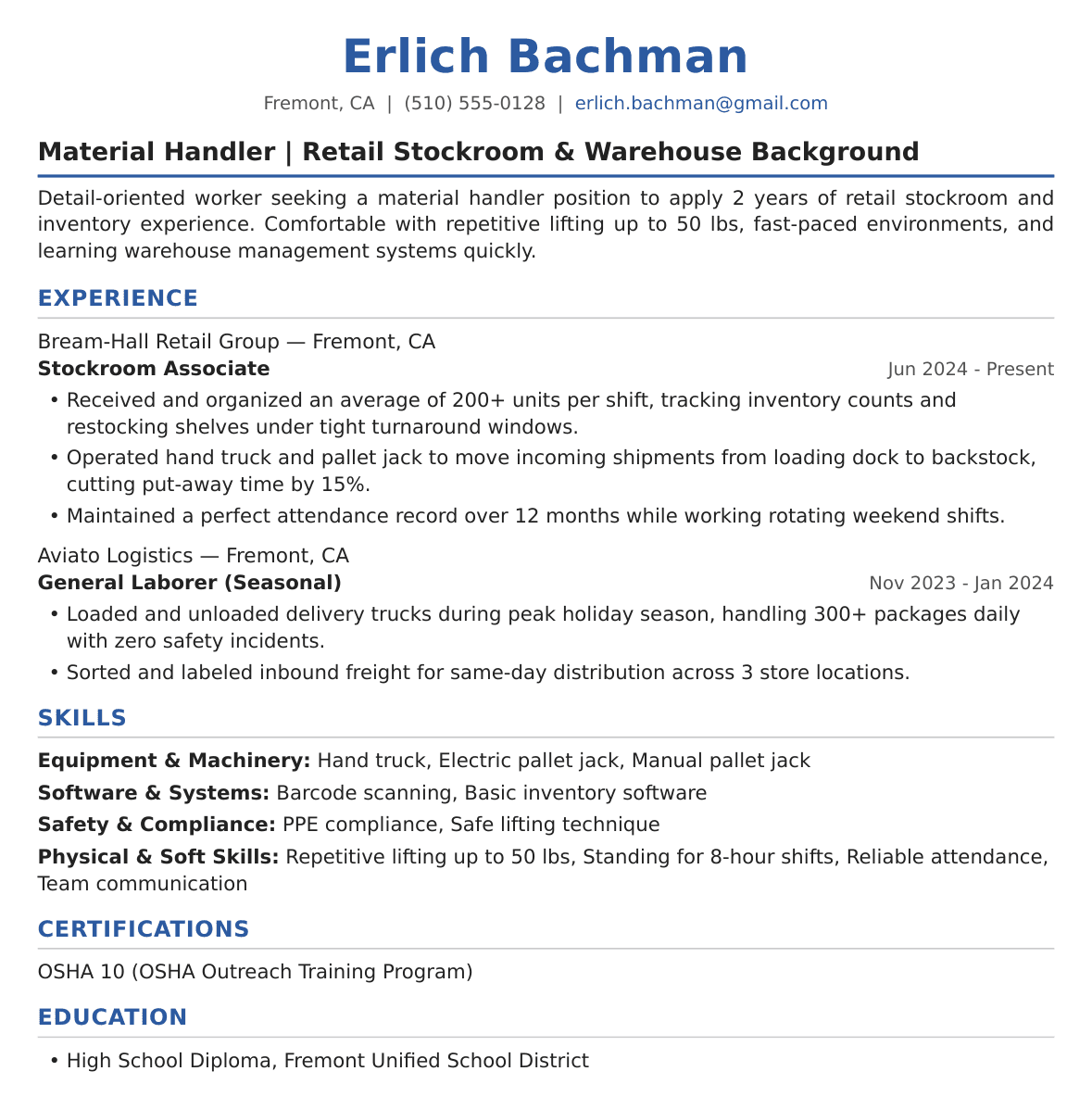
"Detail-oriented worker seeking a material handler position to apply 2 years of retail stockroom and inventory experience. Comfortable with repetitive lifting, fast-paced environments, and learning warehouse management systems quickly."
Build a Skills Section That Speaks to Hiring Managers
Don't list "hardworking" and "team player" and call it done. Group your skills so a recruiter scanning for 6 seconds can find exactly what they need.
- Equipment & Machinery: Sit-down forklift, reach truck, order picker, electric pallet jack, hand truck, conveyor systems
- Software & Systems: SAP WMS, RF scanner units, barcode scanning, cycle counting software, Microsoft Excel
- Safety & Compliance: OSHA 10 certified, HAZMAT handling, PPE compliance, lockout/tagout (LOTO) procedures
- Physical & Soft Skills: Repetitive lifting up to 50 lbs, standing for 8-10 hour shifts, cross-team communication, shift-report accuracy
Three things to keep in mind. Only list equipment you can operate unaided, not machines you watched someone else run. Mirror the exact wording from the job posting (if the JD says "cherry picker," don't write "order picker" instead). And name the specific software or system, not just "computer skills," since ATS systems scan for exact terms like "WMS" or "RF scanner."
Showcase Certifications and Licenses
In this field, certifications aren't just a bonus. They're often the gate that gets your resume past the first screen. Put them near the top of your resume, either in the summary or in a standalone certifications block just below it.
List each one with the issuing body and status:
- Forklift Certification (OSHA-compliant, employer-issued or third-party, note expiration if applicable)
- OSHA 10 or OSHA 30 (OSHA Outreach Training Program)
- HAZMAT Handling Certification (if applicable to your facility type)
- Certified Logistics Technician (CLT) (MSSC, Manufacturing Skill Standards Council)
If a certification has lapsed, either renew it before applying or leave it off. A hiring manager who calls to verify an expired cert is a red flag you don't want.
Write Achievement-Focused Experience Bullets
Every experience bullet should follow the same formula: [action verb] + [specific task or method] + [quantifiable result or scope]. Tasks describe what you did. Results prove you did it well.
A weak bullet looks like this:
"Responsible for moving materials and operating forklift in warehouse."
A stronger one looks like this:
"Operated reach truck to move an average of 200 pallets per shift across a 250,000 sq ft distribution center, maintaining a 99.5% order accuracy rate with zero equipment incidents."
Use the examples below as templates and swap in your own numbers.
Distribution Center / 3PL
- Picked and packed 180+ orders daily using RF scanner and WMS, consistently exceeding productivity targets by 15%
- Coordinated inbound/outbound freight for a facility processing 40+ truckloads weekly, reducing dock wait times by 20%
Manufacturing Plant
- Delivered raw materials to 6 production lines on a staggered schedule, reducing line downtime caused by material shortages by 30%
- Maintained inventory accuracy across a 15,000-SKU parts warehouse through weekly cycle counts
Retail / Grocery Backroom
- Received and stocked an average of 3,000 units per shift, organizing backstock to cut restocking time by 25%
- Processed daily vendor deliveries and reconciled counts against invoices with zero discrepancies over 6 months
Cold Storage
- Operated pallet jack and forklift in sub-32°F environment to fulfill 100+ daily orders while maintaining food safety compliance
- Rotated perishable inventory using FIFO procedures, reducing spoilage-related loss by 18%
General Warehouse
- Loaded and unloaded up to 25 trailers per week, maintaining a perfect safety record across 2 years
- Trained 4 new hires on RF scanner use and warehouse safety protocols
If you don't have clean metrics, estimate scope instead: how many people were on your shift, how large the facility was, how many SKUs you managed. Shift reports, inventory counts, and end-of-quarter summaries are good places to dig up numbers you've forgotten you had.
What to Include With No Material Handling Experience
If you're coming from retail, general labor, or the military, you likely have more relevant experience than you think. The work translates, you just have to name it in warehouse terms.
- Retail stockroom or receiving: "Received and organized incoming shipments, tracked inventory counts, and restocked shelves under tight turnaround windows" becomes proof you can handle receiving and inventory accuracy.
- General labor or construction: "Loaded and transported materials on job sites, operated hand trucks and pallet jacks" shows equipment familiarity and physical readiness.
- Military logistics or supply roles: "Managed supply inventory for a 30-person unit, coordinated equipment transport and accountability" maps directly to inventory control and material movement.
Lead with a skills section and objective rather than a thin work history. Include any equipment training, even informal, and any environment where you handled physical inventory under time pressure.
Organize Your Work History the Right Way
List your work history in reverse-chronological order, most recent job first. For each entry, include your job title, employer, location, and dates.
If your actual title differed from "material handler" but the work matches, clarify it. Someone whose title was "Warehouse Associate" but who spent most of their shift moving pallets and running a forklift can list the title as given, then use the first bullet to establish the material-handling scope of the role. Don't change your official title, but do make sure the bullets underneath it read like material handling work.
Across different employers, keep the framing consistent: equipment used, volume handled, accuracy or safety outcomes. That consistency is what lets a hiring manager compare your last three jobs at a glance, even if the job titles varied.
Day Labor and Lumper Gigs: Listing Work a Background Check Can't Find
Plenty of material handlers got their reps unloading trailers on lumper crews or through day-labor pools, cash-paid, agency-defunct, or never W2'd. The work was real, but warehouse employers verify employment, and the industry's high resume-falsification rate makes an unverifiable entry look invented even when it isn't.
List the entity that paid you, not the warehouse you worked inside: "Freight Unloader, [Lumper Service/Labor Pool], serving [region] distribution centers." If the payer no longer exists or can't be verified, keep the entry honest but move it into a clearly labeled "Additional Warehouse Experience" block, separate from your verifiable employment history. Screeners treat a labeled section as context; they treat an unverifiable entry in your main history as a red flag.
Keep whatever paper trail exists, pay stubs, gate logs, even text threads with crew chiefs, and note a reachable human where you can ("crew lead reference available"). One verifiable detail attached to informal work is often the difference between "checks out" and "couldn't confirm."
Material Handler Resume Examples
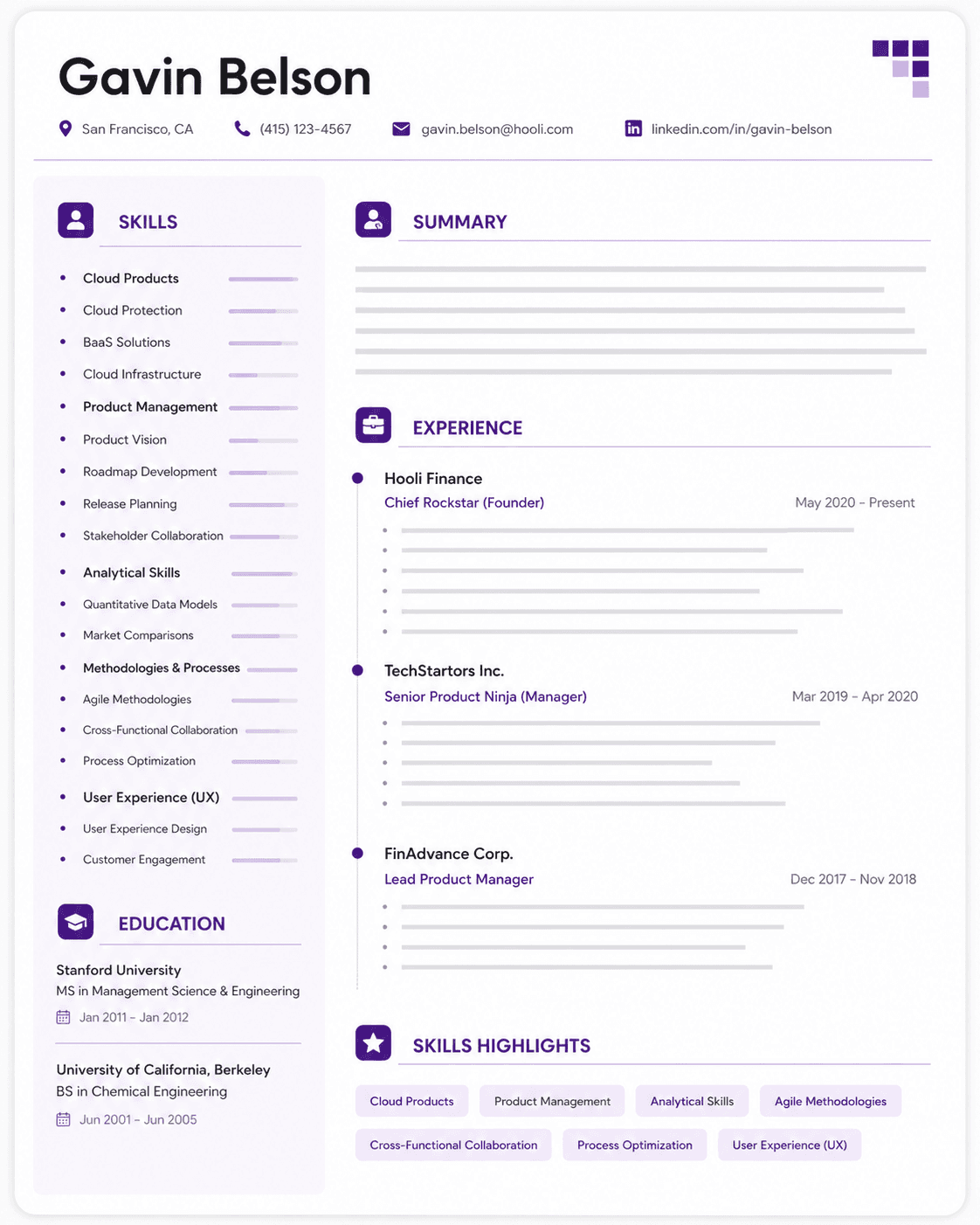
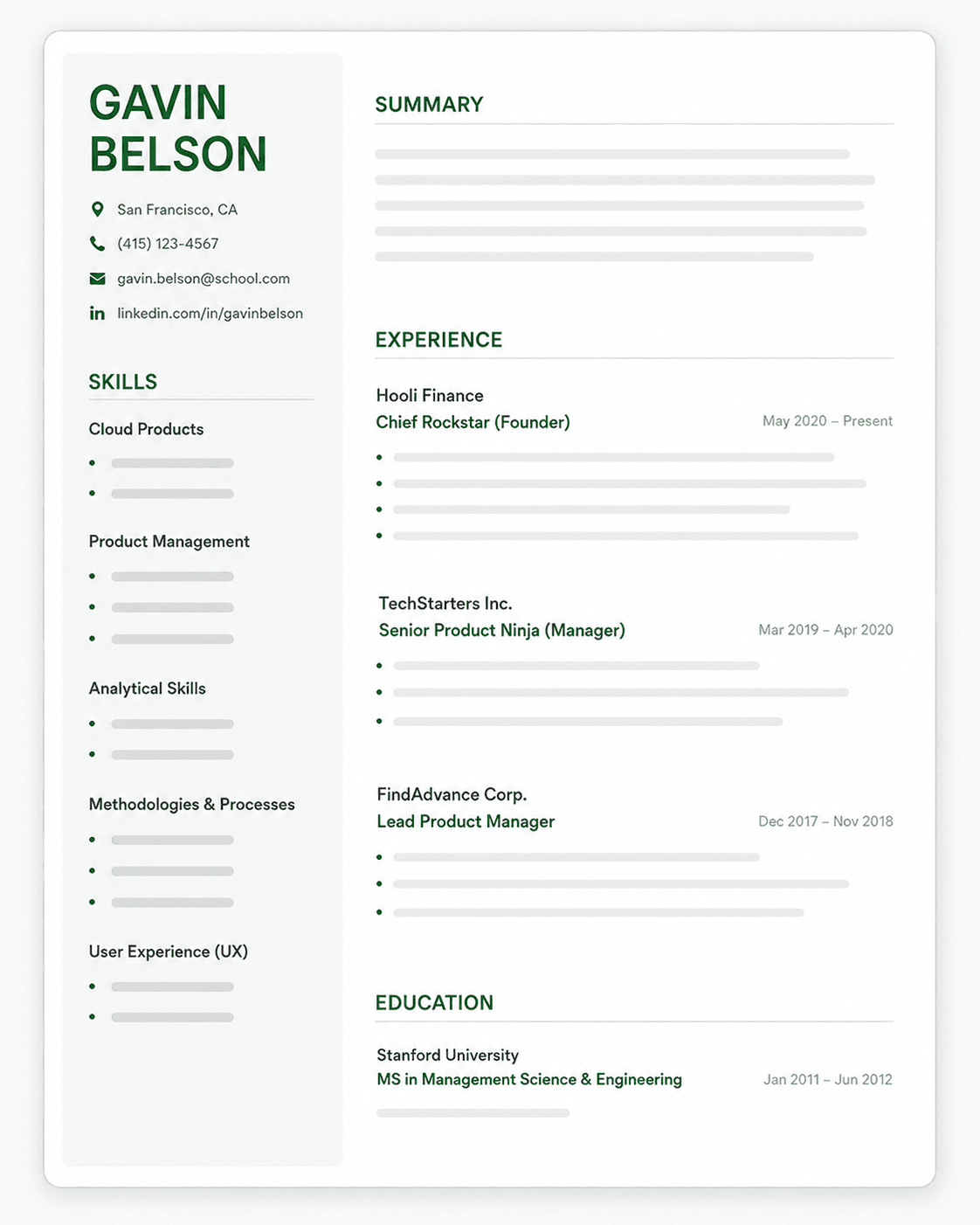
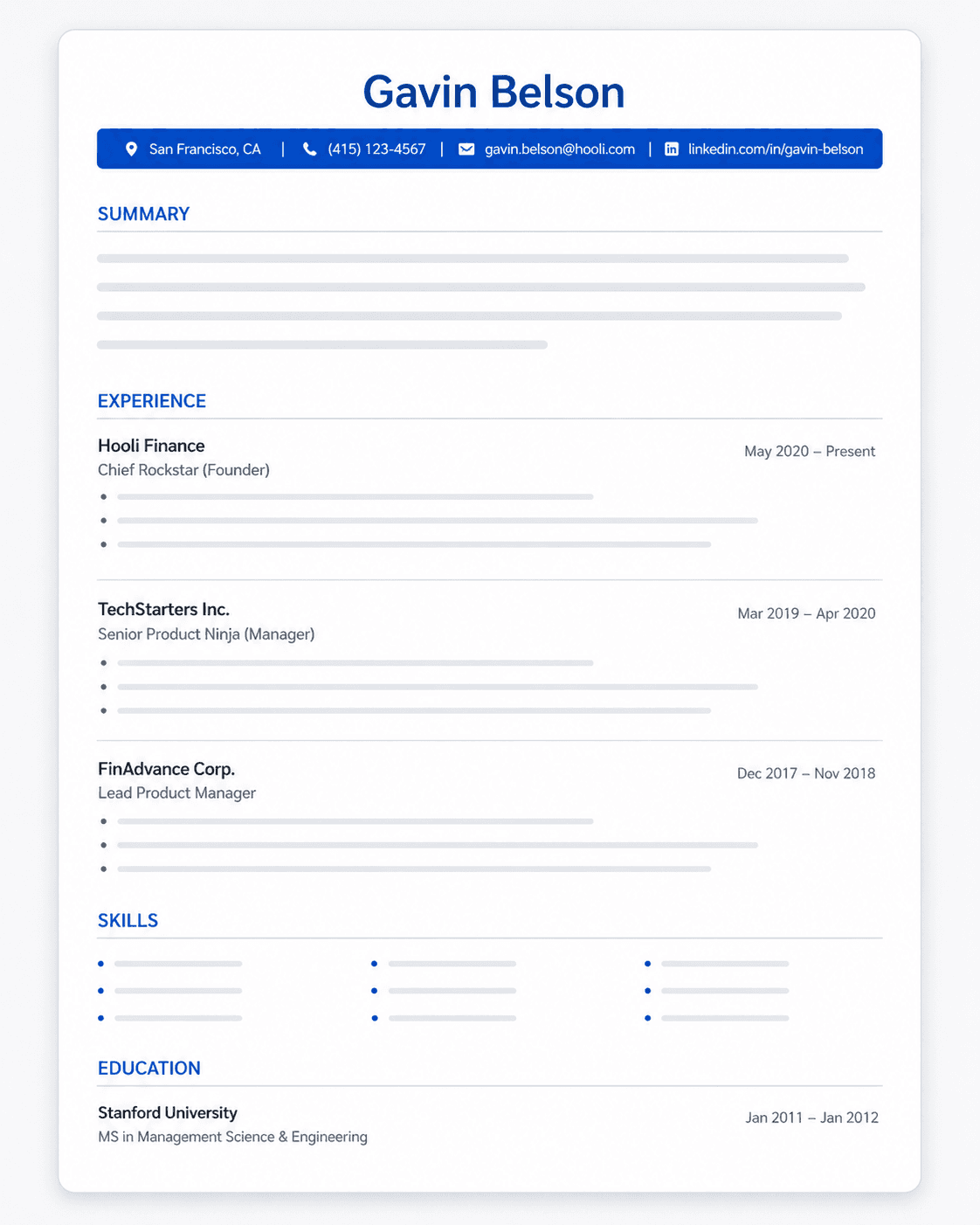
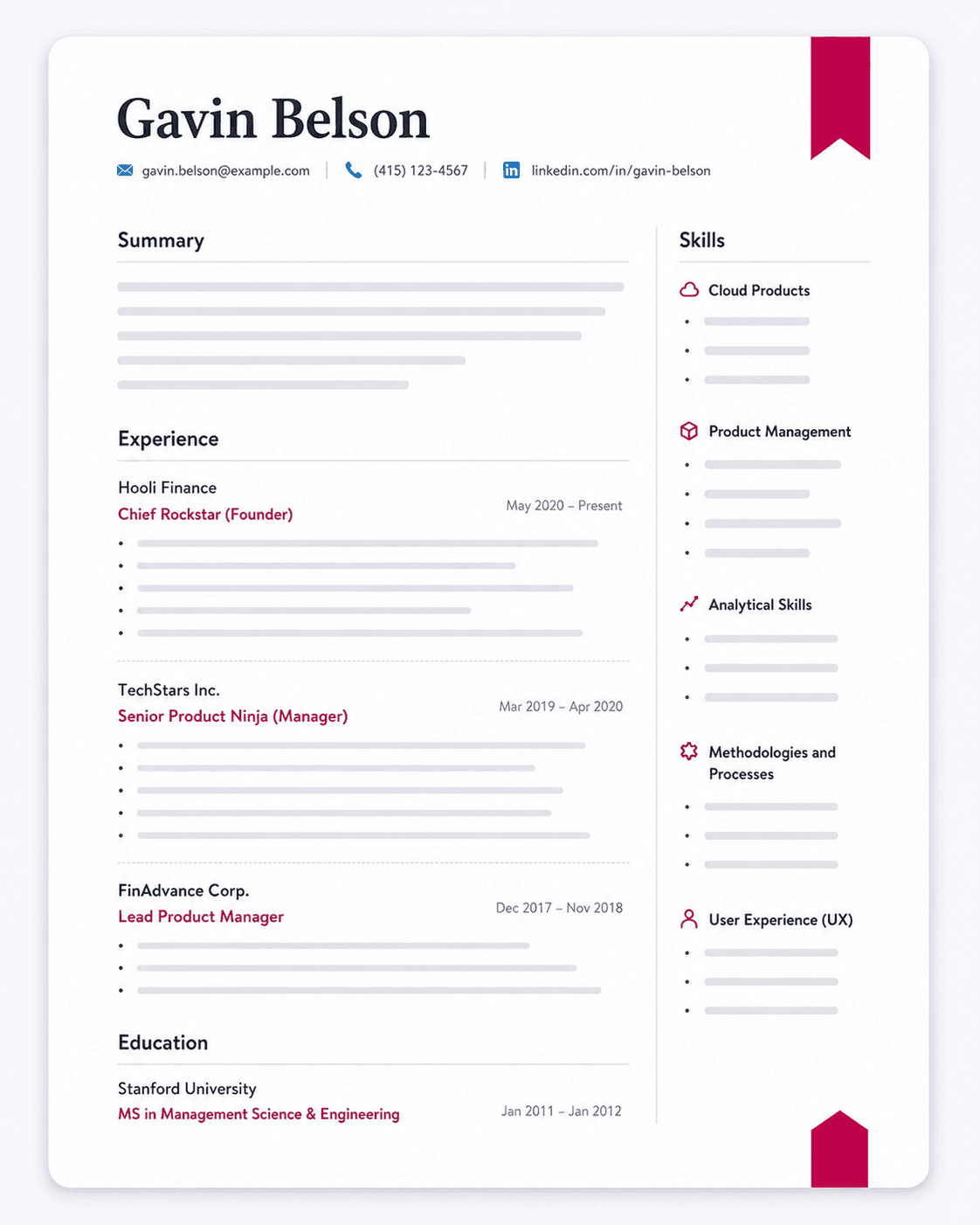
Reading a resume is faster than reading advice. Here is what a strong material handler resume looks like at three career stages.
Entry-Level Material Handler Resume Example
Lead with an objective statement instead of a summary, since you do not have material handling metrics to lead with yet. Pull transferable skills from retail, general labor, or military service: lifting and carrying, operating equipment (pallet jacks, hand trucks), following safety protocols, working shifts, meeting quotas. List any certifications you already hold, even if earned outside a warehouse job, such as a forklift card from a training course or OSHA 10. Keep the layout simple: objective, skills, education/certifications, then any work history reframed around reliability and physical readiness.
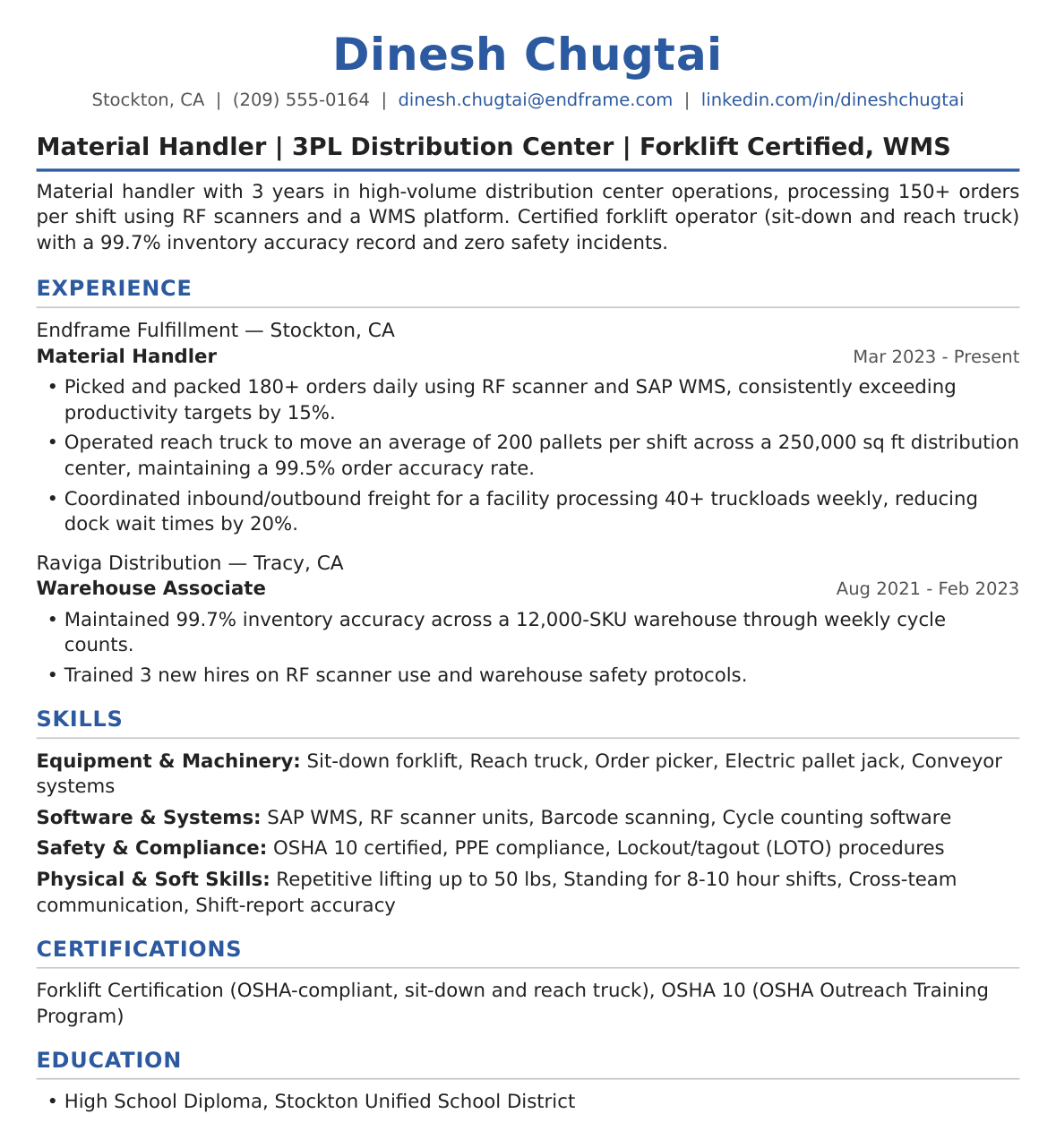
Mid-Level Material Handler Resume Example
Replace the objective with a professional summary that names your setting (DC, 3PL, manufacturing plant), years of experience, and one scale metric, like units picked per hour or order accuracy rate. Name the actual equipment you run (reach truck, order picker, sit-down counterbalance forklift) and the actual software you use (specific WMS platform, RF scanner model if relevant). Every bullet in your experience section should carry a number: units moved per shift, inventory accuracy percentage, on-time shipment rate, or safety record. This is the resume most people searching this keyword need.
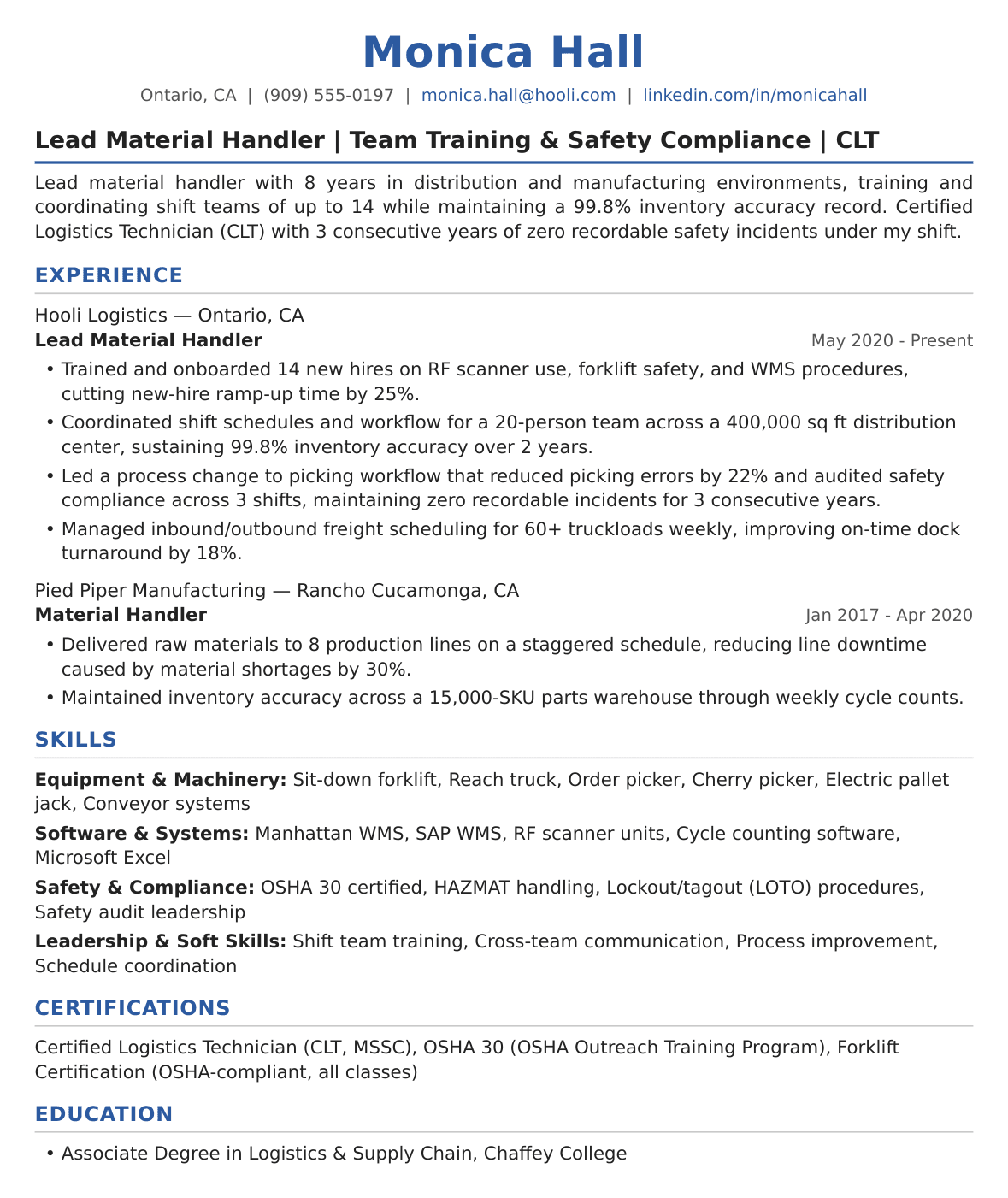
Senior Level Material Handler Resume Example
Shift the summary and bullets toward ownership: training new hires, coordinating shift schedules, auditing safety compliance, and improving process flow. Use titles like "Lead Material Handler" or "Material Handling Supervisor" if that reflects your actual scope, even informally. Quantify leadership impact where you can, such as team size trained, reduction in picking errors after a process change you introduced, or consecutive months with zero recordable incidents under your shift. This version should read like a hiring manager could hand you a team on day one.
Each level shares the same backbone: setting, scale, equipment, and safety. What changes is which of those four you lead with and how much proof you have behind it. If you are between levels, for example two years of experience but no leadership yet, borrow the summary structure from mid-level and keep the achievement bullets modest but specific rather than inflating your title or scope.
Material Handler Resume Keywords
Using the right industry terminology ensures that your resume never gets ignored by automated systems or recruiters. Material handler postings repeat the same core terms across employers. Cover the operations and systems rows below, and let your bullets carry the volume and accuracy numbers.
| Category | Keywords |
|---|---|
| Core operations | Shipping and receiving, Order picking and packing, Loading and unloading, Freight staging, Kitting, Cross-docking, Putaway |
| Inventory & systems | Inventory control, Cycle counts, RF scanners, Warehouse management systems (SAP, Manhattan), FIFO rotation, Bin location management |
| Equipment & safety | Forklift certification, Electric pallet jack, OSHA safety compliance, Ability to lift 50 lbs |
Common Material Handler Resume Mistakes to Avoid
Describing Tasks Instead of Impact
"Responsible for moving pallets and loading trucks" tells a hiring manager nothing about how well you did it. Rewrite duties as outcomes: units moved per shift, error rate, on-time load percentage. A bullet like "Loaded 40+ trucks daily with zero shipping errors over six months" proves reliability in a way a duty list never can.
Using One Generic Resume for Every Application
A DC posting emphasizing RF-scanner accuracy and a manufacturing plant posting emphasizing line-side replenishment call for different emphasis, even from the same work history. Sending the identical resume to both means one version always reads as a mismatch. Adjust your summary and top bullets to mirror the equipment, software, and pace mentioned in each job description.
Listing Equipment and Software Without Specificity
"Operated machinery" and "used warehouse systems" tell a recruiter nothing. Name the reach truck, order picker, or forklift class you're certified on, and name the WMS platform (SAP, Manhattan, Oracle) or RF-scanner system you've used. Specificity is what gets you past both a keyword-scanning parser and a skeptical hiring manager.
Ignoring ATS and Application-System Formatting
Many material handler applications get submitted through a kiosk, a phone, or a staffing agency portal running a basic parser, not a polished corporate ATS. ATS-unfriendly formatting, including columns, tables, graphics, and text boxes, often gets scrambled or dropped entirely. Stick to a single-column layout, spell out abbreviations at least once, and save your file as a .docx or text-based PDF.
Burying Certifications or Listing Them as Active When They've Lapsed
Forklift certification, OSHA 10/30, or HAZMAT training are often the first thing a recruiter screens for. Hiding them in a skills paragraph near the bottom risks getting your resume skipped, and claiming an expired cert as active creates a credibility problem the moment it's verified. Give certifications their own labeled section near the top, and note the issuing body and status honestly.
Omitting Safety and Attendance Signals
Reliability and safety compliance are things hiring managers specifically screen for in this field. Leaving out a clean safety record or strong attendance history skips a credibility signal competitors are actively including.
Why You Should Customize Your Resume for Each Material Handler Role
A material handler resume for a 3PL distribution center reads differently than one for a manufacturing plant, a cold storage facility, or a retail backroom. A DC recruiter wants to see WMS platforms, pick rates, and RF-scanner speed. A manufacturing employer cares more about production-line replenishment and inventory accuracy. Cold storage wants proof you can work in sub-zero conditions without safety incidents. Retail backroom roles care about stock rotation and truck unload times.
Job level shifts the resume too. An entry-level posting wants reliability and trainability; a role that lists "lead" or "senior" wants proof you've trained others or handled inventory audits.
A resume built for one posting and mass-submitted everywhere misses these cues. Reading the job description and matching your summary, skills order, and top bullets to what that specific employer values gets you past the first scan and into the interview pile.
How AI Resume Builders Can Simplify Your Material Handler Resume
Every warehouse posting wants something different: one distribution center leads with RF scanner and WMS experience, another wants forklift certifications up top, a manufacturing floor cares more about safety record and cycle counts. Tailoring each version by hand for every application eats time you don't have, and a resume that reads generic gets filtered before a recruiter ever sees it.
An AI resume builder built for this kind of tailoring helps in five ways:
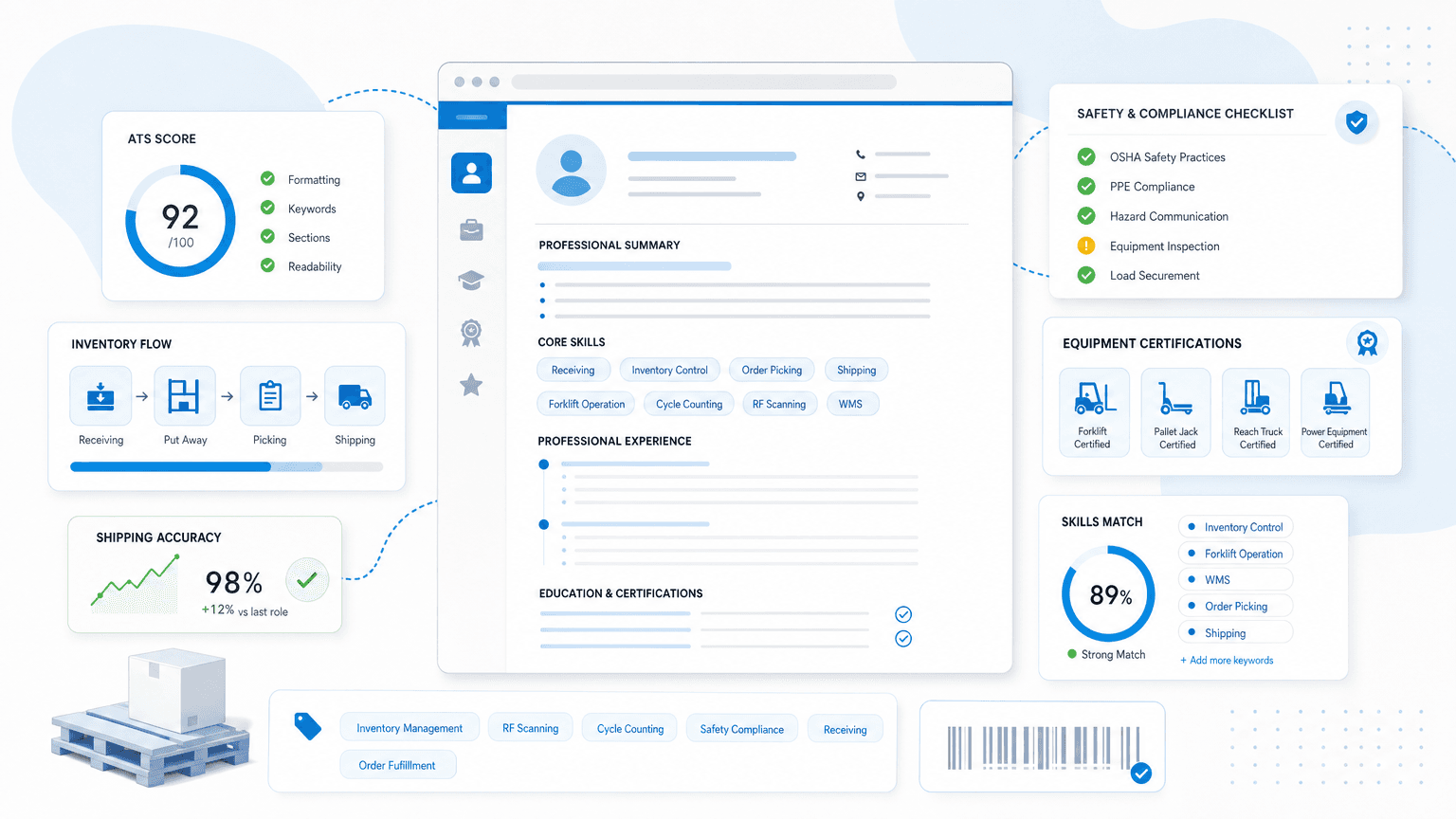
- Real-time ATS scoring: see your ATS and recruiter match score update as you edit, so you know if a change to your equipment list or certifications actually moved the needle, no downloading and re-uploading to check.
- Transparent suggestions: every AI edit comes with a plain-language "why this change" explanation, and you accept or reject each one individually. Nothing gets rewritten or invented behind your back.
- Automatic formatting: your resume gets cleaned up into ATS-friendly structure and design, so tables, headers, or layout quirks that confuse scanning software don't cost you a callback.
- Structure guidance: suggestions reorder content for relevance, strengthen action verbs, quantify throughput or safety numbers, and flag language that could trigger bias, all based on recruiter best practices.
- Preference memory: your formatting, metric, and reordering choices carry over between sessions, so tailoring your fifth application doesn't mean starting from scratch.
Pricing stays honest for a job search that has an end date. The free plan includes 200 ATS scans every month, plus a one-time allotment of 3 tailored resumes with matching cover letters and unlimited downloads, no credit card required. Need more versions for different facility types? Extra resumes run $0.50 to $1.00 each, with no subscription attached.
Try it on your own resume
Run a free ATS check in under three minutes and see what's holding your resume back.
A material handler resume earns an interview when it reads like a shift report: what you moved, how fast, how safely, and with what equipment. Pick the certifications, metrics, and sub-role bullets from this guide that match the facility you're targeting, and leave the rest out. The details you cut matter as much as the ones you keep.