Every other applicant in your nursing residency cohort has a similar degree, similar clinical hours, and no paid RN experience either. Hiring managers and nurse residency screeners know that going in, so they aren't reading new grad resumes for a work history that doesn't exist yet. They're reading for training quality and clinical readiness, and that changes what belongs on the page.
This guide walks through every section of a new grad nurse resume: how to write an objective that leads with your training, how to format clinical rotations so they read as real experience, how to handle your license status before NCLEX results land, and how to build a skills section and work history that hold up against an ATS and a busy screener. You'll get bullet examples organized by rotation type, the mistakes that get new grad resumes set aside, and a clear answer on resume length.
How to Write a New Grad Nurse Resume That Gets Interviews
What Hiring Managers and Nurse Residency Screeners Actually Look For
A nurse residency screener evaluates a new grad differently than a nurse with five years on a med-surg floor, since there's no tenure to weigh. What replaces it: which units you rotated through, how you performed under a preceptor, and what certifications you're walking in with. Those signals need to surface in the first few lines of your resume, not get buried under generic objective language.
Hiring managers spend about 7 seconds skimming a new grad resume before deciding whether to keep reading. For a new grad resume, those seconds go to three things: your target unit match, your license/certification status, and whether your clinical experience reads like real work or like a summary of classes you attended. Get those three signals onto the page clearly, and you've already separated yourself from the stack of resumes that just list "Nursing Clinical Rotation" with no detail.
Write an Objective (Not a Summary) That Leads With Training
A resume summary sells achievements you've already proven on the job. As a new grad, you don't have that track record yet, so a summary built around "results-driven" or "compassionate caregiver" language rings hollow. An objective does something more useful: it states your credential, your clinical exposure, and the specific role you're targeting, so a screener immediately knows what they're looking at.
Use this formula: credential or expected credential + clinical settings you trained in + 2-3 key skills + the target role or unit. For example: "BSN graduate (NCLEX-RN scheduled August 2026) with 720+ clinical hours across med-surg, telemetry, and critical care rotations. Skilled in patient assessment, IV insertion, and EHR documentation. Seeking a position in the Memorial Health New Grad RN Residency Program, Cardiac Care track."
A weak objective looks like this:
"Hardworking and compassionate nursing graduate looking for a rewarding opportunity to use my skills and grow as a nurse."
A stronger one looks like this:
"ADN graduate (NCLEX-RN pending, results expected July 2026) with 600 hours of clinical training in pediatrics and emergency care. Proficient in pediatric vital sign assessment, medication administration, and Epic charting. Seeking an entry-level RN position on a pediatric unit where I can apply hands-on preceptorship experience."
Showcase Your Licenses and Certifications Near the Top
Certifications and license status belong in their own section near the top of your resume, right after contact information or your objective, not buried near the bottom with hobbies and references. This is one of the few places where a small wording choice carries real legal weight.
If you haven't passed the NCLEX-RN yet, do not list yourself as "RN" and do not list a license number. In most states, calling yourself an RN before you're licensed misrepresents your credentials, and hiring managers in healthcare notice. Instead, use exact, honest framing:
- "RN License Pending, NCLEX-RN scheduled [date]"
- "ADN Candidate, expected licensure [date]" or "BSN Candidate, expected licensure [date]"
Once you've passed and have your license number, update it to "Registered Nurse (RN), License #[number], [State]." Below that, list your other certifications by full name with the abbreviation in parentheses: Basic Life Support (BLS), Advanced Cardiac Life Support (ACLS) if you've completed it, Pediatric Advanced Life Support (PALS) if relevant to your target unit. Include the issuing body and expiration date for each. A screener checking this section should know exactly where you stand, with nothing to guess at.
Turn Clinical Rotations and Preceptorships Into Real Experience
Your clinical rotations are your work experience. Format each one exactly like you'd format a job: facility name, unit or specialty, dates, total hours completed, then 2-3 experience bullets that describe the clinical work you performed under supervision.
Example format:
St. Joseph's Medical Center, Medical-Surgical Unit Clinical Rotation, January-April 2026, 180 hours
- Managed a patient load of 4-5 patients per shift under RN preceptor supervision, performing full head-to-toe assessments and documenting findings in Epic
- Administered medications via oral, IV, and subcutaneous routes for 30+ patients with zero medication errors
- Earned a 95/100 clinical competency score from preceptor evaluation across communication, time management, and clinical judgment
The difference between a forgettable rotation entry and one that reads as real experience comes down to verb choice. Passive language signals you stood at the edge of the room. Active language signals you did the work.
A weak rotation bullet looks like this:
"Shadowed RN and observed patient care, assisted with vital signs."
A stronger one looks like this:
"Performed vital sign monitoring and head-to-toe assessments for a 4-patient assignment each shift, flagging two early signs of patient deterioration that preceptor confirmed required escalation."
Since you don't have revenue or headcount numbers to lean on, quantify with what you do have: patient ratios per shift, total clinical hours per rotation, number of procedures performed, and preceptor evaluation scores. These numbers do real work. They turn a vague claim into something a screener can compare against other candidates.
Build a Skills Section That Speaks to Hiring Managers
A skills section that lists "communication, teamwork, compassion" and nothing else tells a hiring manager nothing they couldn't assume about any nursing graduate. Skip the generic soft-skill list. Build a categorized section instead, with specific tools and techniques you can actually perform.
Clinical Skills: Head-to-toe assessment, wound care and dressing changes, IV insertion and management, Foley catheter insertion, medication administration (oral, IV, IM, subcutaneous), Braden Scale skin assessment, telemetry monitoring
EHR & Technical: Epic, Cerner, electronic medication administration records (eMAR), vital signs monitoring equipment, glucose monitoring devices
Patient Care & Safety: Fall risk assessment, infection control protocols, patient and family education, de-escalation techniques
Collaboration & Communication: SBAR handoff reporting, interdisciplinary care team coordination, charge nurse communication during shift changes
Name the actual systems and scales you've used. "EHR documentation" says less than "Epic charting." "Skin assessment" says less than "Braden Scale skin assessment." That specificity is what separates a resume that sounds like every other new grad from one that sounds like it was written by someone who was actually in the unit.
What to Include With No Nursing Experience Yet
If you're applying before your clinical rotations start, or you're coming from a non-healthcare background entirely, you still have content worth including. List your simulation lab hours and the scenarios you practiced (code response, medication administration, patient handoff), relevant coursework (pharmacology, pathophysiology, health assessment), and any volunteer work in a healthcare-adjacent setting, such as a free clinic or blood drive.
Non-healthcare jobs still belong on the resume if there's truly nothing clinical yet. Retail and food service jobs build transferable skills that matter in nursing: working under pressure, handling difficult people calmly, managing multiple tasks at once. Reframe the bullet around the transferable skill, not the job title. "Resolved customer complaints in a high-volume retail environment, de-escalating frustrated customers while maintaining service standards" reads as relevant. The plain task description doesn't.
Organize Your Work History the Right Way
Although standard work histories use reverse-chronological order, order your clinical rotations by relevance to the job you're applying for, not strictly by date. If you're applying to a pediatric residency, your pediatric rotation leads, even if it happened earlier than a med-surg rotation. Non-healthcare jobs go below your clinical experience, listed briefly, with transferable skills called out rather than full job descriptions.
One page is the default for a new grad resume. Most of your content (objective, licenses, 2-3 rotations, skills, education) fits comfortably within it. If you genuinely have more clinical rotations than fit, a second page is acceptable, but only for additional clinical experience, not for restating your objective or padding coursework. Add a clear pointer at the bottom of page one: "Additional student clinical experiences listed on page 2." That tells the screener exactly what they'll find if they keep reading. They won't have to wonder whether the resume just ran long.
New Grad Nurse Resume Examples
The right bullet for your resume depends on which unit you trained in and which unit you're applying to. A pediatric residency screener wants to see pediatric-specific clinical work, not a generic line that could describe any rotation. That specificity matters even more when you're competing against dozens of other applicants for a handful of slots in one named residency cohort, where reviewers are actively looking for a reason to set a resume aside. Below is a bullet library organized by rotation type, so you can pull the example that matches your actual clinical background instead of adapting someone else's med-surg story.
Intensive Care Unit (ICU) Rotation
Riverside General Hospital, Medical ICU Clinical Rotation, September-December 2025, 200 hours
- Monitored hemodynamic status for 1-2 critically ill patients per shift, including arterial line readings and titrated vasopressor drips under preceptor supervision
- Documented findings from 6 rapid response interventions in Cerner and presented SBAR updates to the charge nurse at every shift handoff
Pediatrics Rotation
Children's Hospital of Newark, General Pediatrics Unit Clinical Rotation, February-May 2026, 160 hours
- Completed weight-based medication calculations for 6-8 pediatric patients per shift and cross-checked every dose against the unit's two-nurse verification protocol
- Educated 15+ parents on home care instructions for conditions including asthma and gastroenteritis; preceptor feedback specifically noted fewer follow-up calls to the unit than the rotation average
Emergency Department Rotation
Lakeside Community Hospital, Emergency Department Clinical Rotation, August-October 2025, 144 hours
- Performed triage assessments using the Emergency Severity Index for 10-12 incoming patients per shift and prioritized care based on acuity level
- Assisted in 4 trauma resuscitations by gathering supplies, documenting real-time vitals, and maintaining sterile field protocol throughout each case
Medical-Surgical Rotation
Crestwood Regional Medical Center, Surgical Step-Down Unit Clinical Rotation, October 2025-January 2026, 168 hours
- Managed post-operative care for 5-6 patients per shift, including incision site assessments, pain management documentation, and early ambulation support
- Coordinated discharge teaching for 20+ patients on wound care and medication schedules; charge nurse feedback cited fewer repeat questions to the unit's call line
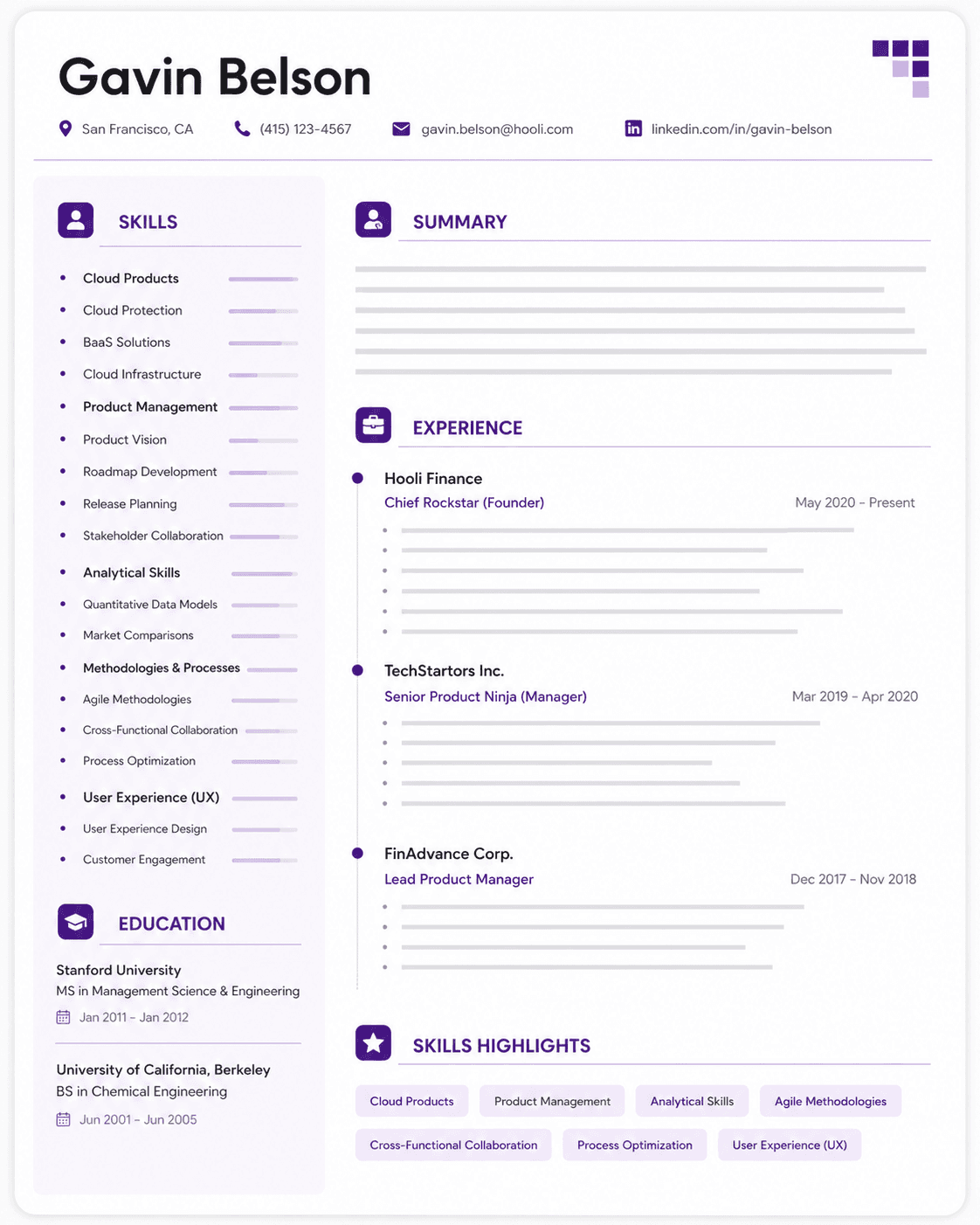
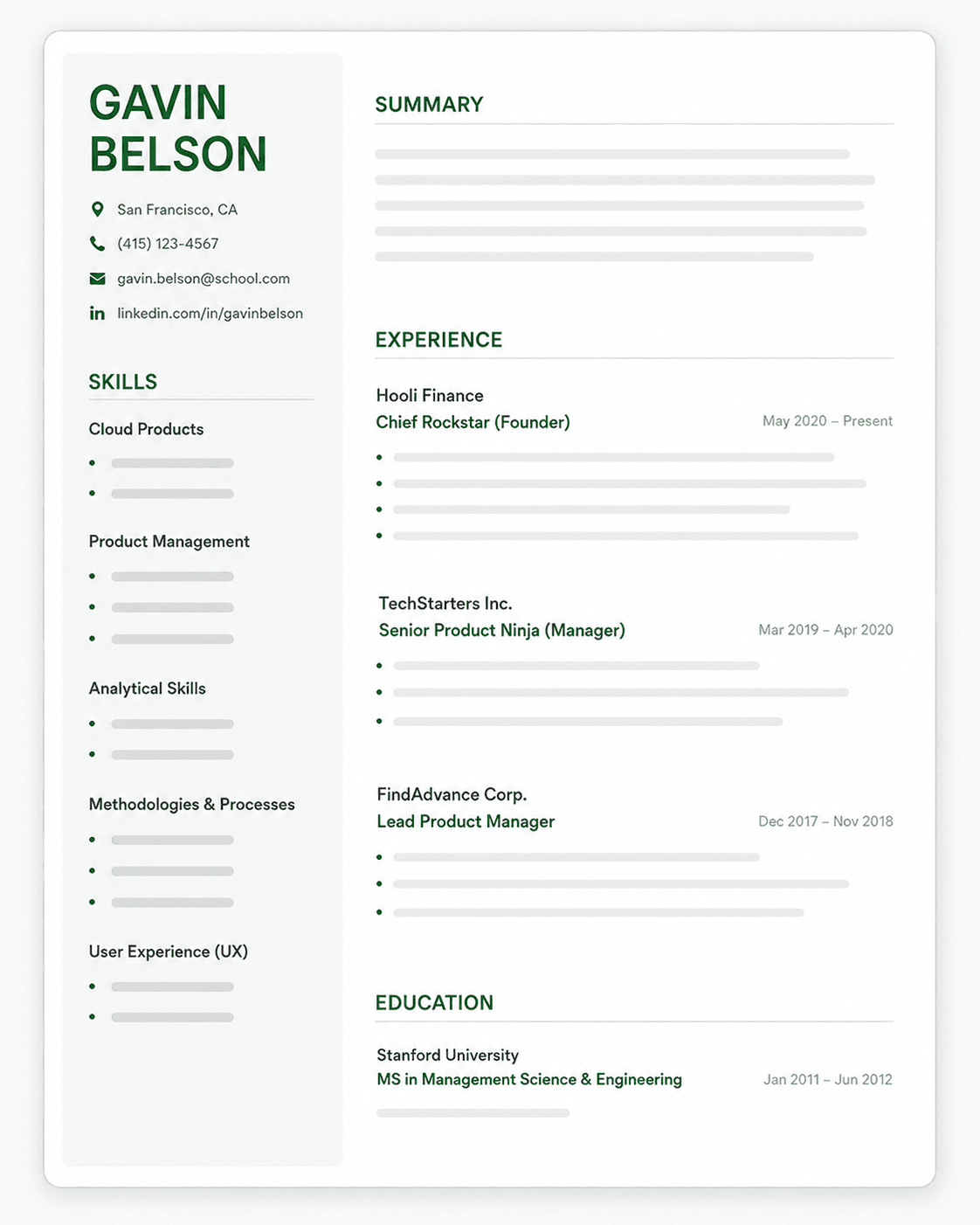
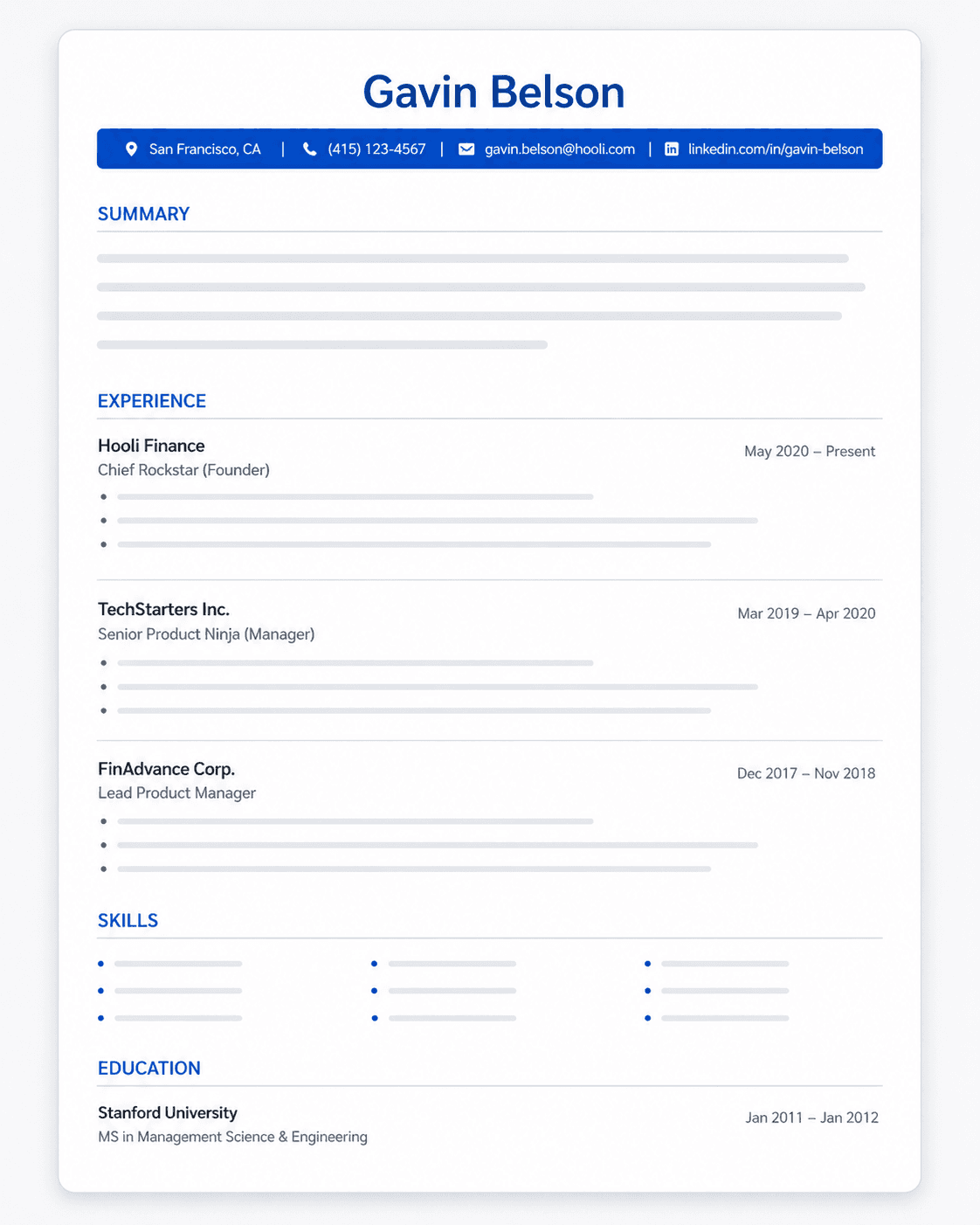
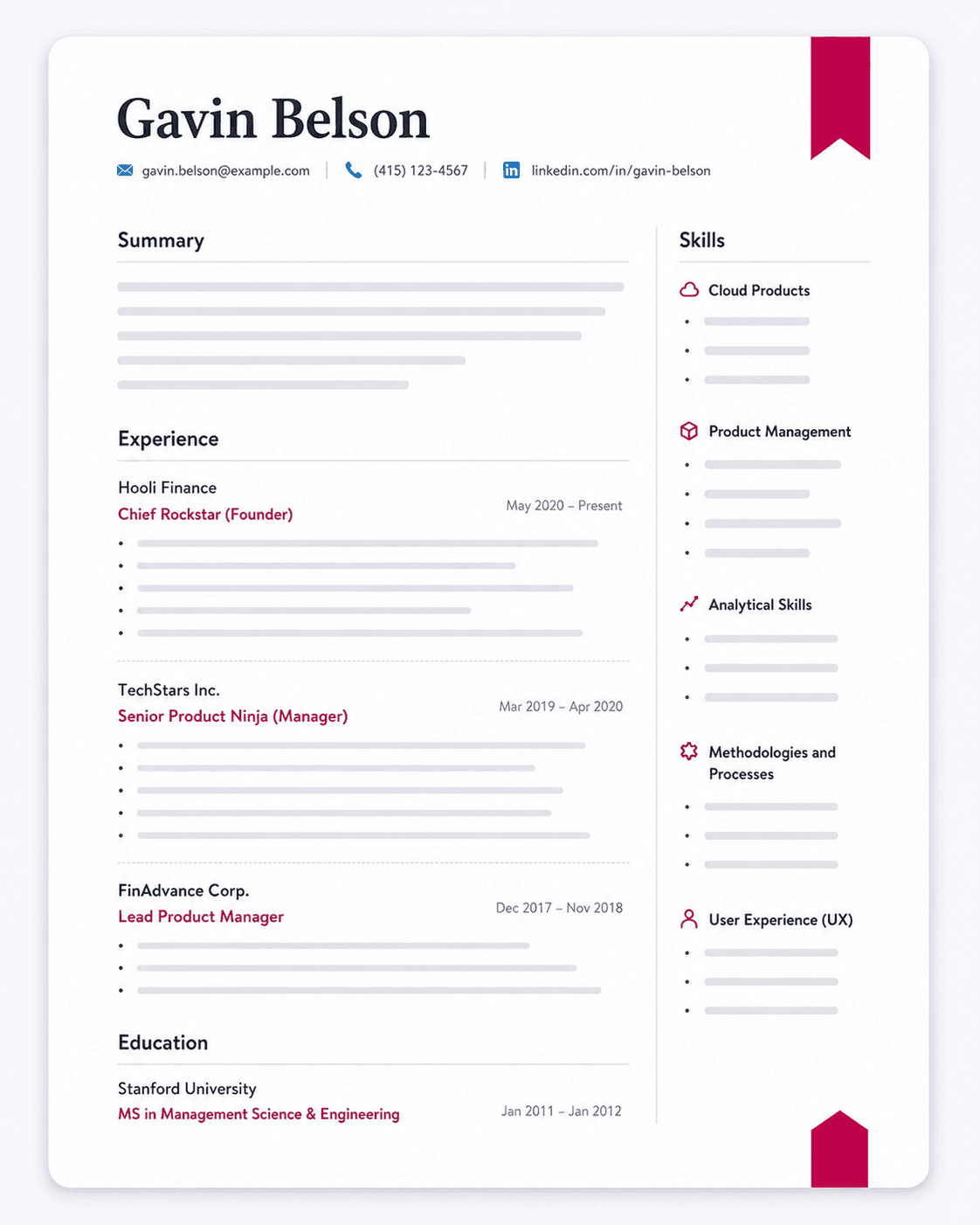
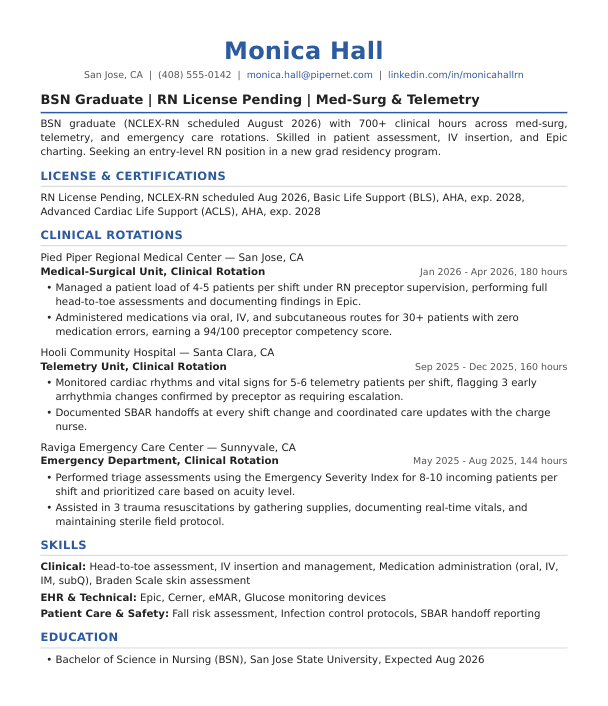
Once you have bullets that match your target unit, drop them into a layout a screener can scan in seconds. A clean entry-level template, with sections ordered exactly as covered above, gives you that structure without starting from a blank page.
Entry-Level New Grad Nurse Resume Example
New Grad Nurse Resume Keywords
Using job specific keywords in your resume ensures that your resume doesn't go unseen. Nurse recruiters and ATS filters check licensure first, then clinical and systems experience from your rotations. List certifications exactly as abbreviated below and name the EHR you charted in.
| Category | Keywords |
|---|---|
| Licensure & certifications | RN license, BSN/ADN, NCLEX-RN (passed), BLS, ACLS, PALS |
| Clinical skills | Patient assessment, Medication administration, IV insertion and therapy, Wound care, Vital signs monitoring, Telemetry, Infection control, Patient safety protocols |
| Systems & documentation | Epic, Cerner, Meditech, Electronic health records (EHR), Charting accuracy, HIPAA compliance |
| Communication & teamwork | SBAR communication, Patient education, Interdisciplinary collaboration, Clinical rotations and preceptorship, Prioritization and time management |
The New Grad Clock: You Can Age Out of Residency Programs
Nurse residency programs define "new grad" narrowly, and the definition has a deadline. Most require graduation within the last 12 months (some stretch to 18) and under 6–9 months of paid RN experience at application. Cedars-Sinai caps it at 12 months and under 9 months' experience; Sharp allows 18 months; UCLA wants under 6 months of inpatient work. Miss the window and the residency track closes, while standard postings still want experience you don't have.
Two consequences for your strategy. First, apply wide and early, including out-of-region cohorts, because the clock runs whether or not your local hospital posts a cohort this quarter. A residency 200 miles away beats aging out at home.
Second, if you're already 10+ months out, stop writing a residency resume. Screeners at that point read for evidence you've kept clinical skills warm, so per-diem shifts, long-term care, clinic work, flu clinics, and active certifications (ACLS, PALS) move to the top. The resume shifts from "trained and ready to be developed" to "kept practicing while the market was slow," which is a story hiring managers respect when it's told directly.
Common New Grad Nurse Resume Mistakes to Avoid
Listing Tasks Instead of Outcomes
A bullet that reads "performed wound care and vital signs" tells a screener what your day looked like, not how well you did it. Add the number, the scope, or the result every time: how many patients, how many procedures, what the preceptor scored you. A task description and an achievement can describe the same shift. Only one of them gets you an interview.
Sending the Same Resume to Every Unit and Program
A resume built for a generic "RN position" reads as generic to a residency screener comparing 40 applicants for one cardiac cohort. Reorder your rotations so the one closest to the target unit leads, and swap in skills language that matches the specific job posting. Five minutes of tailoring per application beats one resume mailed everywhere.
Listing Certifications and Software Without Specifics
"BLS certified" and "EHR experience" say less than they should. Name the issuing body and expiration date for certifications, and name the actual system: Epic, Cerner, or whatever you charted in during clinicals. Vague entries make a hiring manager wonder if you're padding a list rather than reporting what you actually used.
Formatting in Ways ATS Software Can't Read
ATS-unfriendly formatting, including tables, text boxes, columns, and headers or footers, can scramble or vanish when a hospital's applicant tracking system parses your resume. Stick to a single-column layout with standard section headers in the body of the document. A beautifully designed resume that an ATS reads as blank text never reaches a human.
Claiming "RN" Before Passing the NCLEX
Listing yourself as a Registered Nurse or including a license number before your NCLEX results land is a credibility and, in most states, a legal problem. The correct pre-licensure framing is covered in detail above. Treat this one as a final formatting check before you submit, not a place to improvise.
Using Outdated or Imprecise Clinical Terminology
Peer reviewers on allnurses have flagged resumes that say "nursing home" instead of Skilled Nursing Facility, or "skin day" instead of naming the actual tool, the Braden Scale assessment. These small word choices signal whether you trained recently and precisely or learned the field secondhand. Use the term your unit actually used on the floor.
Padding Bullets With Suspiciously Round Statistics
A bullet claiming "97% patient satisfaction" with no source behind it reads as invented, and nursing peer reviewers call this out specifically when round, unsourced percentages show up on a new grad's resume. If you can't trace a number back to an actual evaluation, scorecard, or preceptor comment, leave it off or replace it with one you can verify.
How AI Resume Builders Can Simplify Your New Grad Nurse Resume
Tailoring a resume by hand for every unit and residency program eats hours you don't have during application season, and a single generic new-grad resume often gets filtered out before a recruiter ever sees it.
Upplai, the transparent resume AI, tailors your existing resume to each specific job posting and explains every change in plain language so you stay in control.
- Real-time ATS scoring: see your ATS and recruiter scores update as you edit, with no download-and-reupload cycle.
- Transparent suggestions: accept or reject every change individually, each with a plain-language explanation of why it was suggested.
- Automatic formatting: clean, ATS-friendly formatting applied across multiple templates.
- Structure guidance: recommendations based on recruiter best practices, including bias flagging.
- Preference memory: your formatting, metric, and reordering choices persist across sessions, so each new application goes faster than the last.
The free plan gives you 200 ATS scans and resume match scores per month plus 3 tailored resumes with matching cover letters as a one-time allotment, unlimited downloads, and no credit card required. Additional resumes cost $0.50 to $1.00 each depending on pack size, with no subscription.
As Stan Szeto, Solutions Consulting, put it: "Upplai has saved me countless hours by automatically customizing resumes and cover letters in seconds. I love how it quickly scores whether I'm a good fit for the job. Now I can strategize and focus on the job search while Upplai does the heavy lifting."
A resume that proves your training, states your license status correctly, and matches the unit you're applying to is what moves you from the maybe pile to the interview pile.
Ready to tailor your new grad nurse resume?
Upload your resume and a job posting to see your ATS score and tailored suggestions in minutes.