The healthcare industry is growing faster than almost any other sector. According to the U.S. Bureau of Labor Statistics, medical assistant jobs are projected to grow by 12% annually between 2024 and 2034 — much faster than the average across all occupations.
But here’s the catch: more opportunities also mean more competition. And with most employers using Applicant Tracking Systems (ATS) to screen applications, as many as 75% of resumes never reach a human recruiter.
Your medical assistant resume needs to do two things simultaneously: get past automated filters and convince human recruiters you're the right fit. This guide shows you exactly how to write a medical assistant resume that accomplishes both.
What Makes a Medical Assistant Resume Effective?
An effective medical assistant resume demonstrates both clinical competencies and administrative capabilities while highlighting patient care skills. Recruiters typically spend 5-7 seconds on an initial resume scan, looking for specific certifications, relevant experience, and technical proficiencies.
Key elements that make medical assistant resumes stand out:
- Relevant certifications prominently displayed (CMA, RMA, CCMA)
- Quantifiable achievements showing impact on patient care or clinic efficiency
- Technical skills including EHR software proficiency (Epic, Cerner, Meditech)
- Balance of clinical and administrative experience
- ATS-friendly formatting that passes automated screening
The difference between a resume that gets interviews and one that gets filtered out often comes down to how well you've tailored your application to match the specific job description.
Medical Assistant Resume Examples
Entry-Level Medical Assistant Resume
For recent graduates or those transitioning into healthcare, your resume should emphasize education, certifications, and transferable skills from clinical rotations or related experience.
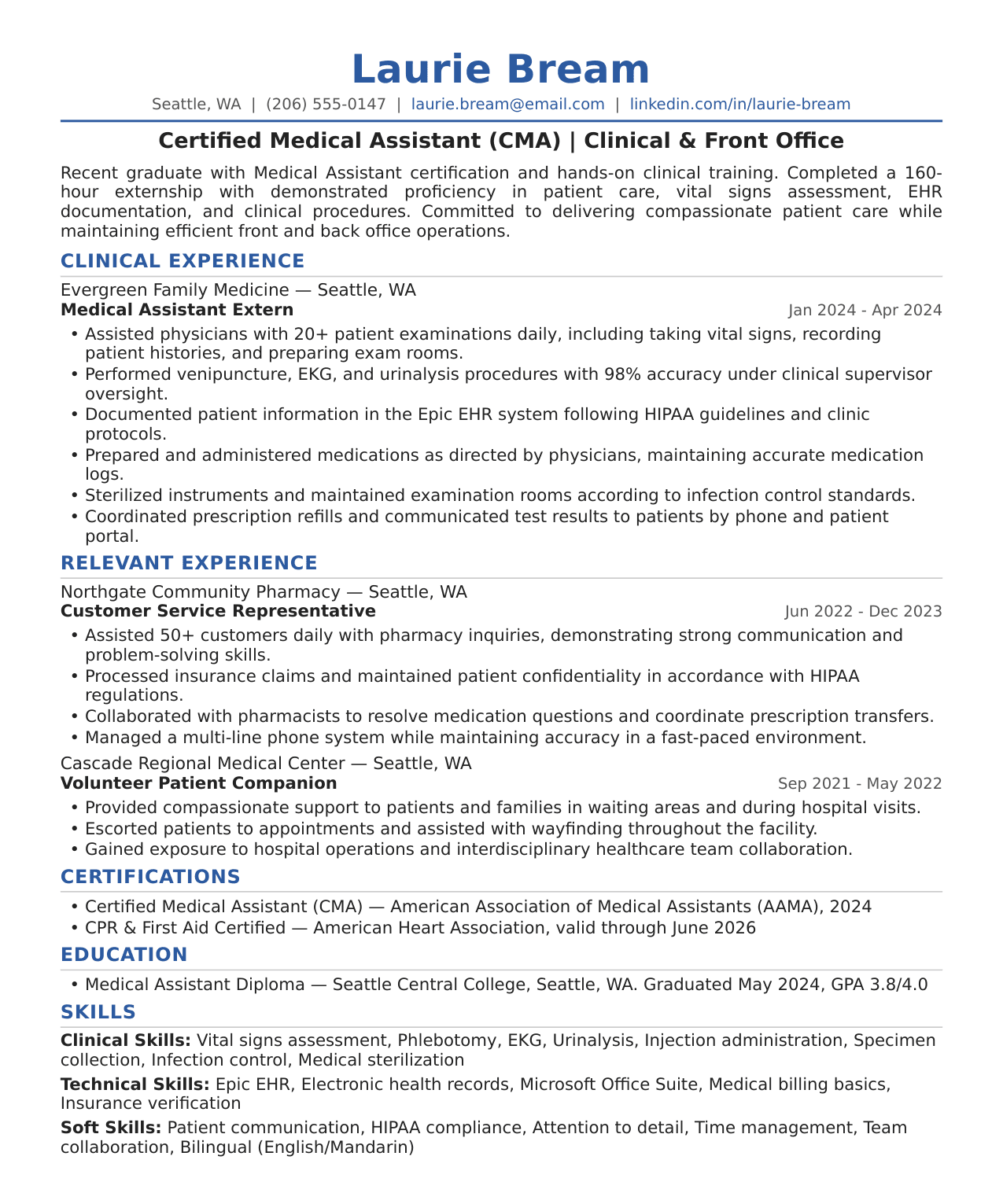
Key Features This Resume Demonstrates:
- Strong certifications prominently displayed - CMA credential right after education
- Externship positioned as real experience - Detailed accomplishments with specific metrics
- Transferable skills highlighted - Customer service and volunteer work show relevant soft skills
- Clinical competencies front and center - Specific procedures and technical skills listed
- Career objective - Quickly establishes qualifications despite limited experience
- Bilingual ability - Valuable asset that sets candidate apart
This format works well for entry-level candidates because it maximizes educational achievements and clinical training while demonstrating transferable skills from non-medical roles.
Experienced Medical Assistant Resume
Experienced medical assistants should emphasize measurable achievements, specialized skills, and progressive responsibility.
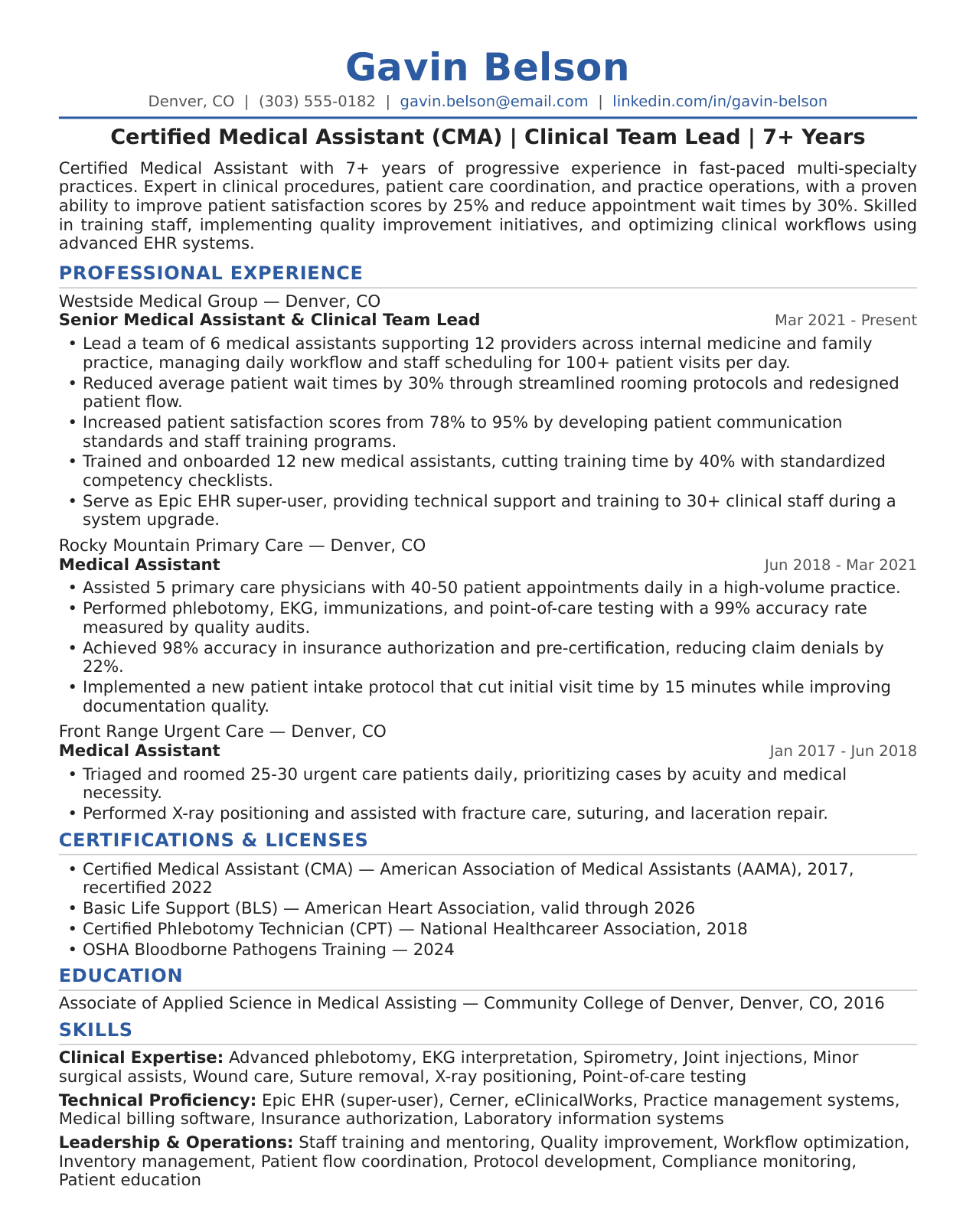
Key Features This Resume Demonstrates:
- Quantifiable achievements - Specific percentages and metrics throughout (25% improvement, 30% reduction, etc.)
- Progressive responsibility - Shows career advancement from MA to Senior MA/Team Lead
- Leadership experience - Training, mentoring, and supervising other staff
- Specialized skills - Advanced procedures like joint injections and surgical assists
- Systems expertise - EHR super-user status and technical proficiency
- Quality improvement - Process optimization and measurable patient satisfaction improvements
- Diverse experience - Multiple practice settings (primary care, multi-specialty, urgent care)
For more resume examples and free ATS-friendly resume templates, take a look at this article.
For more examples, expert tips, and free ATS-friendly resume templates, take a look at our ATS Resume Examples guide.
How to Write a Medical Assistant Resume That Gets Interviews
If you’re wondering how to write a medical assistant resume that stands out, the process can be broken into five simple steps:
1. Start With a Targeted Resume Objective or Summary
Your opening statement should immediately communicate your value proposition. For entry-level candidates, use a resume objective that highlights your certification and career goals. For experienced medical assistants, use a professional summary that emphasizes achievements and specialized expertise.
Entry-level objective example: "Recently certified Medical Assistant (CMA) with clinical training in patient care and EHR documentation seeking to contribute strong organizational skills and compassionate patient service to a family practice setting."
Experienced summary example: "Certified Medical Assistant with 5+ years in orthopedic specialty practice. Reduced patient intake time by 25% while maintaining 98% accuracy in medical documentation. Expert in X-ray positioning and casting procedures."
The key is specificity. Generic statements like "hardworking medical assistant seeking opportunities" don't differentiate you from hundreds of other applicants.
2. Highlight Relevant Medical Assistant Skills
Medical assistant positions require a unique combination of clinical, administrative, and interpersonal skills. Organize your skills section to reflect what the job description emphasizes.
Clinical Skills to Include
- Vital signs measurement and documentation
- Phlebotomy and specimen collection
- EKG administration and interpretation
- Injection and immunization administration
- Wound care and dressing changes
- Sterilization and infection control
- Point-of-care testing (glucose, urinalysis, rapid strep)
Administrative Skills to Include
- EHR systems (specify which: Epic, Cerner, Meditech, Athenahealth)
- Medical coding (ICD-10, CPT)
- Insurance verification and authorization
- Patient scheduling and registration
- Medical records management
- HIPAA compliance
Soft Skills that Matter
- Patient communication and education
- Multitasking in high-volume environments
- Attention to detail
- Cultural competency
- Team collaboration
Don't just list skills- demonstrate them through your experience bullets with specific examples and metrics.
3. Format Your Medical Assistant Resume for ATS
Applicant Tracking Systems scan resumes for keywords and formatting compatibility before human recruiters ever see them. Healthcare employers increasingly rely on ATS to manage high application volumes.
ATS-friendly formatting guidelines:
| Element | Best Practice | Avoid |
|---|---|---|
| File type | .docx or PDF (if specified) | Images, graphics, tables |
| Fonts | Standard fonts (Arial, Calibri, Times New Roman) | Decorative or script fonts |
| Section headers | Clear, standard headers (Experience, Education, Skills) | Creative headers ("My Journey") |
| Bullet points | Simple bullets (•) | Symbols, icons, graphics |
| Dates | Consistent format (Jan 2020 - Present) | Abbreviations without context |
| Contact info | Standard header placement | Text boxes, headers/footers |
Keyword optimization matters: Applicant Tracking Systems rank resumes based on how well they match the job description. If the posting mentions "Epic EHR" five times and you only list "electronic health records," your resume may score lower even if you have Epic experience.
The solution isn't keyword stuffing—it's strategic alignment. Use the same terminology the job description uses, incorporate required skills naturally throughout your experience section, and ensure your certifications are clearly labeled.
4. Write Achievement-Focused Experience Bullets
The difference between a mediocre resume and one that generates interviews often comes down to how you describe your experience. Compare these two bullets:
Weak: "Responsible for taking patient vital signs and updating medical records"
Strong: "Collected and documented vital signs for 30+ patients daily with 99% accuracy, contributing to improved clinical workflow efficiency"
The strong version includes specific metrics, demonstrates impact, and shows the scope of responsibility. Healthcare recruiters want to see how you've contributed to patient care quality, operational efficiency, or team performance.
Formula for strong bullet points:
[Action verb] + [specific task] + [quantifiable result or impact]
Examples:
- "Reduced patient wait times by 20% by streamlining intake procedures and optimizing exam room turnover"
- "Achieved 98% first-stick success rate for phlebotomy across 500+ blood draws"
- "Trained 6 new medical assistants on EHR documentation protocols, improving team data entry accuracy by 15%"
Even if your role didn't involve obvious metrics, you can quantify scope (number of patients, procedures performed, team size) to give context to your responsibilities.
5. Showcase Certifications and Continuing Education
Medical assistant certifications significantly impact hiring decisions. Many employers require CMA (Certified Medical Assistant), RMA (Registered Medical Assistant), or CCMA (Certified Clinical Medical Assistant) credentials.
How To List Certifications
Place certifications prominently—either in a dedicated section near the top of your resume or immediately after your name in the header. Include the certifying organization and expiration date if applicable.
Example:
- Certified Medical Assistant (CMA) – American Association of Medical Assistants (AAMA), 2023
- BLS Certification – American Heart Association, Valid through 2025
- HIPAA Compliance Training – Completed 2024
Continuing education matters: Healthcare evolves rapidly, and employers value candidates who stay current. Include relevant continuing education, specialized training (phlebotomy certification, EKG technician training), or additional credentials that differentiate you.
For more tips, tricks, and best practices, refer to this free Resume Writing Guide.
Common Medical Assistant Resume Mistakes to Avoid
1. Generic content: Sending the same resume to every position rarely works. A resume optimized for a pediatric clinic should emphasize different skills than one for an orthopedic surgery center. Tailoring takes time- typically 40-60 minutes per application if done manually- but it's the difference between getting filtered out and landing interviews.
2. Missing or buried certifications: If you're a CMA, RMA, or CCMA, that credential should be immediately visible. Don't bury it in the middle of your resume. Many ATS systems specifically scan for these certifications.
3. Vague responsibilities instead of achievements: "Assisted physicians with patient care" tells recruiters nothing about your capabilities. "Supported 3 physicians in family practice serving 40+ patients daily, maintaining 96% patient satisfaction scores" demonstrates scope and impact.
4. Formatting that breaks ATS systems: Creative resume templates with graphics, text boxes, or unusual layouts may look appealing but often can't be parsed by ATS software. Stick with clean, simple formatting.
5. Typos or inconsistent formatting: Healthcare requires attention to detail. A resume with spelling errors or inconsistent date formatting raises red flags about your accuracy in clinical documentation.
Optimizing Your Medical Assistant Resume for Specific Roles
Different medical assistant positions emphasize different skill sets. Your resume should reflect the specific requirements of your target role.
Specialty Practice Considerations:
| Specialty | Skills to Emphasize | Relevant Experience |
|---|---|---|
| Cardiology | EKG, stress testing, Holter monitors, cardiac event monitoring | Experience with cardiac patients, specialized testing procedures |
| Pediatrics | Immunization schedules, growth monitoring, child communication | Work with children, vaccination administration, parent education |
| Orthopedics | Casting, splinting, X-ray positioning, DME fitting | Musculoskeletal injury care, assisting with procedures |
| Dermatology | Skin lesion documentation, biopsy assistance, laser safety | Cosmetic and medical dermatology procedures |
| OB/GYN | Prenatal care, PAP smears, patient education | Women's health, reproductive health knowledge |
Review the job description carefully and adjust your skills section and experience bullets to highlight the most relevant qualifications for that specific practice.
How AI Tools Can Streamline Medical Assistant Resume Optimization
Creating a tailored, ATS-optimized resume for every application is time-consuming but necessary. AI-powered resume optimization platforms like Upplai can help identify which keywords from the job description should be incorporated, suggest achievement-focused bullet points with metrics, and ensure formatting passes ATS screening—all while keeping you in control of the final content.
The key is using tools that maintain transparency about what changes are being made and why, rather than black-box AI that generates content without explanation. Your resume should still authentically represent your experience; AI should simply help you present it more effectively.