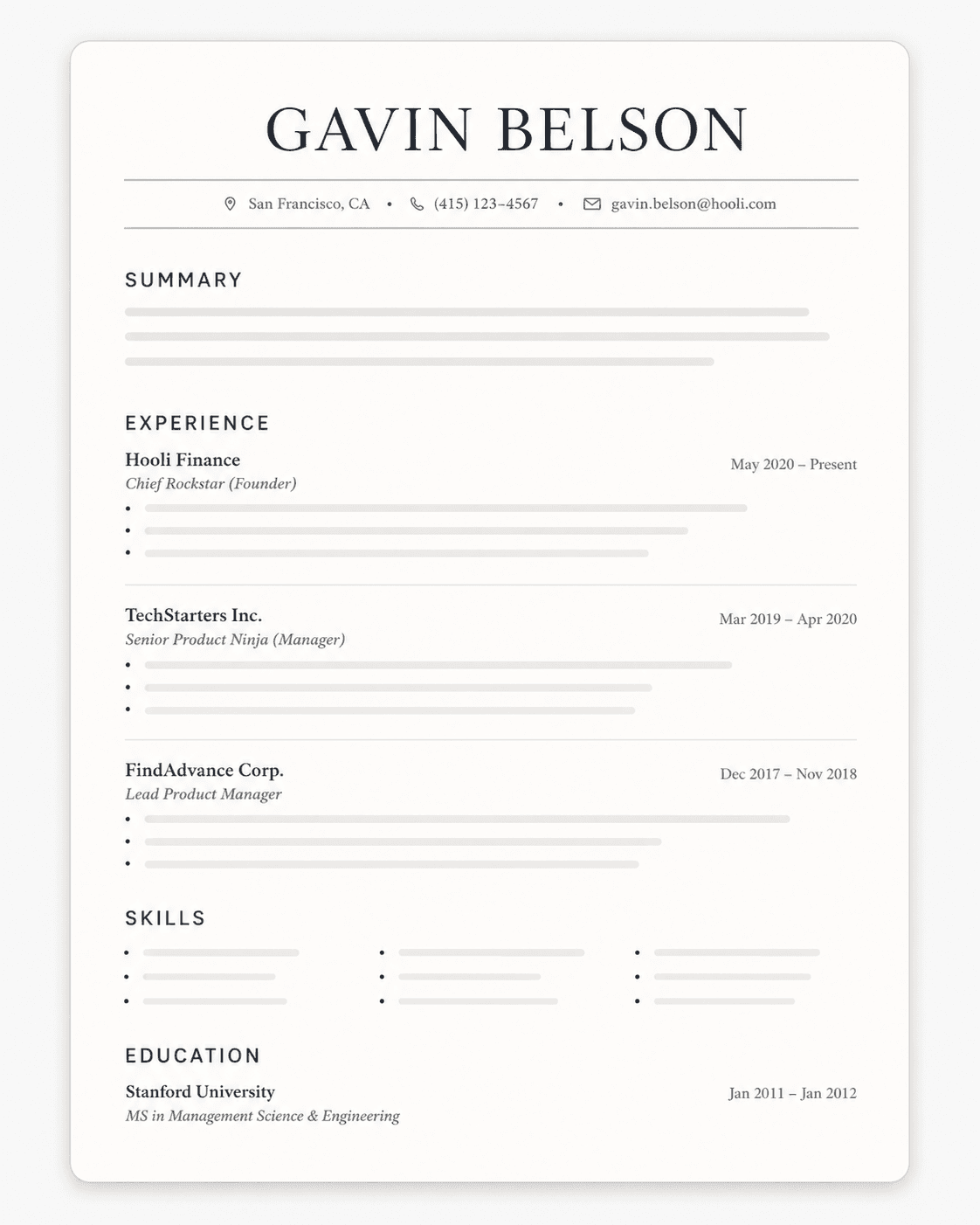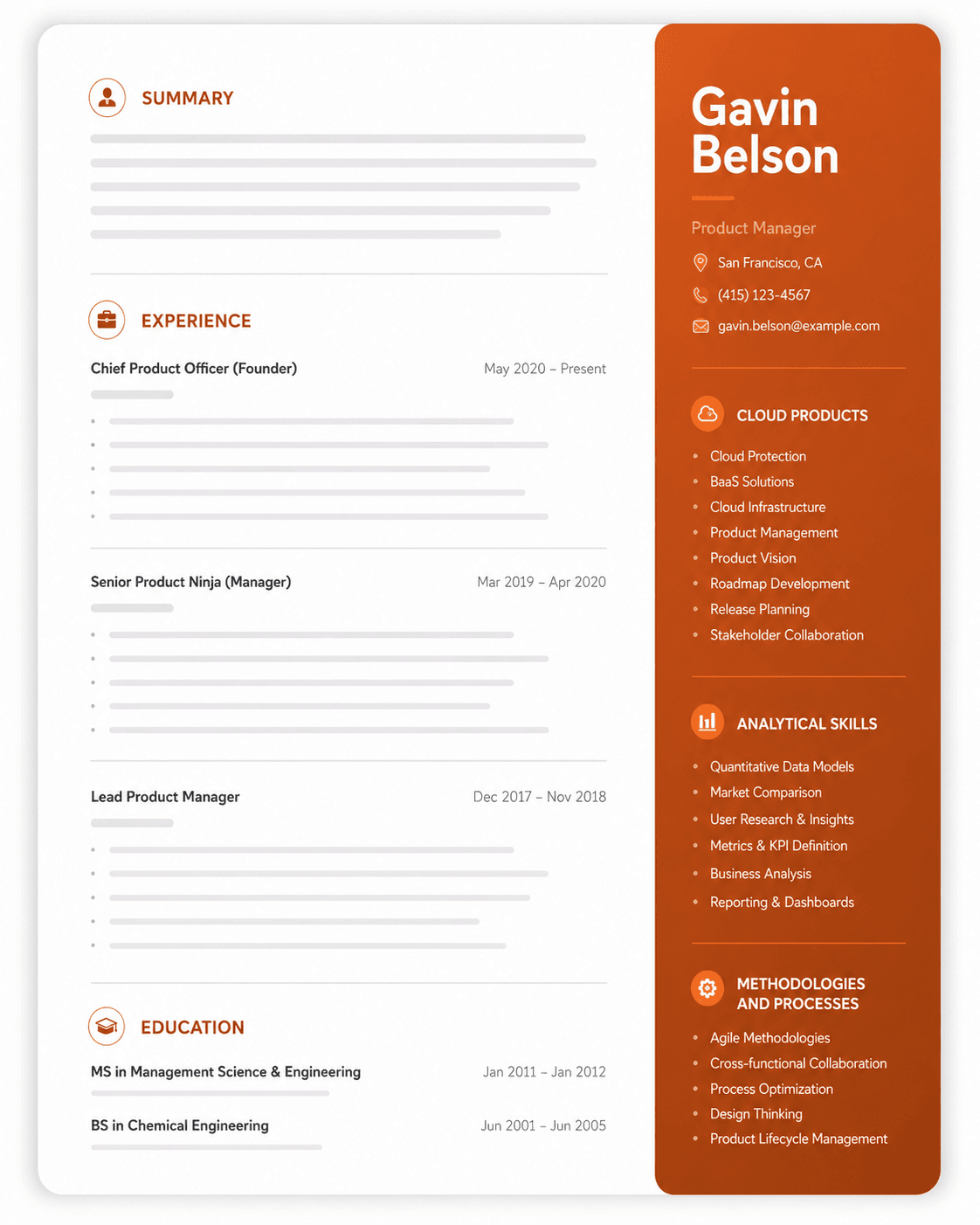
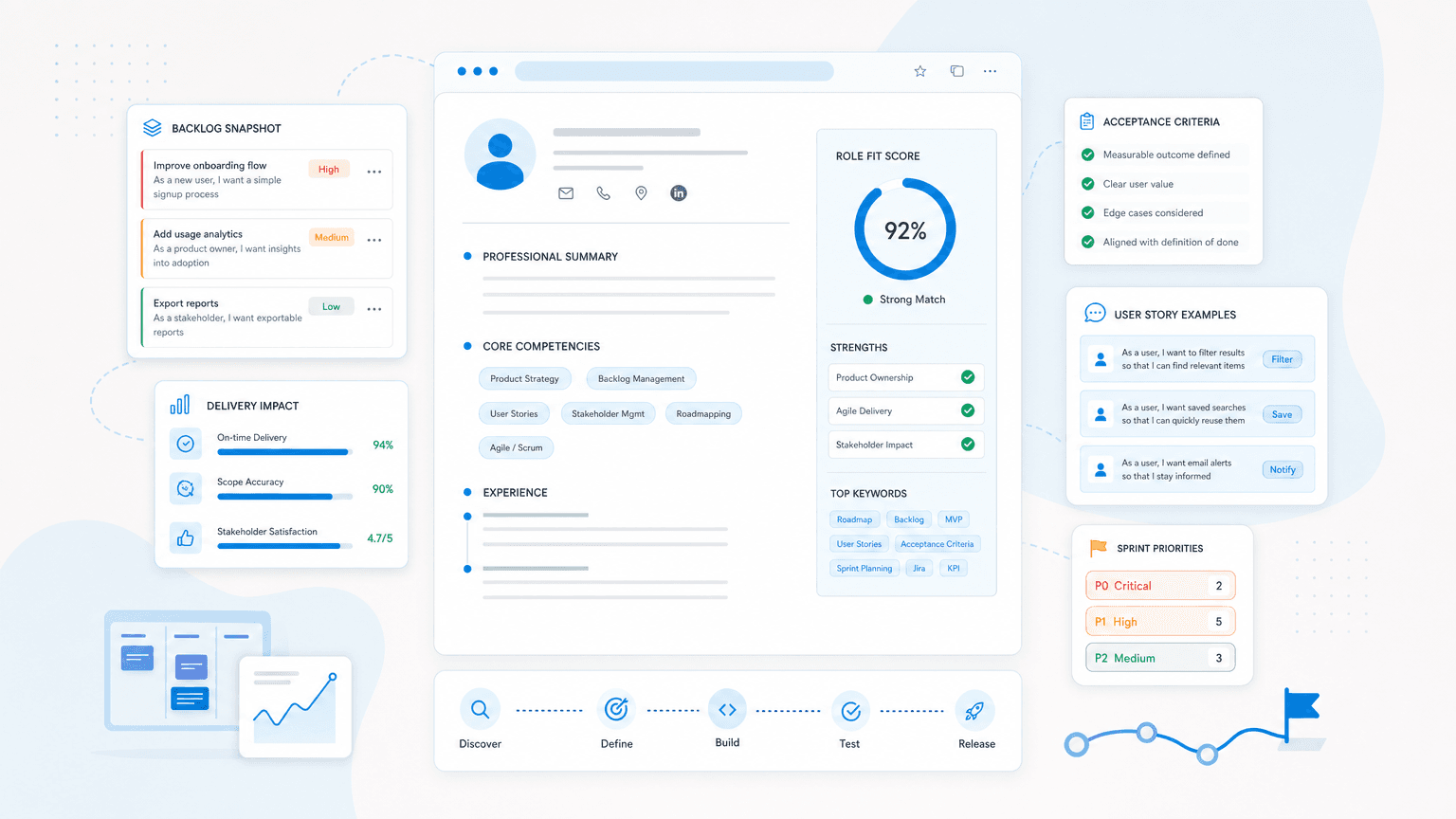
If you've spent two to four years running sprints, grooming backlogs, and translating stakeholder requests into user stories, you already know the job. What you're probably struggling with is turning that into a resume that reads like business impact instead of a list of Scrum ceremonies. It's a common gap for POs who came up through BA, QA, or coordinator roles: you're fluent in the mechanics, but not yet in the language hiring managers actually scan for.
This article gives you a full path to a stronger product owner resume. You'll get the exact difference between how a PO resume and a PM resume should read, a summary formula that leads with outcomes, a skills section built for both ATS and human reviewers, and a bullet-writing formula backed by a five-tier library of real examples. We'll also cover certifications, level-specific resume shapes, and the mistakes that quietly sink otherwise solid applications.
By the end, you'll have a clear structure to rebuild your resume around, whether you're applying for your next PO role or making the jump to Senior Product Owner or Product Manager.
How to Write a Product Owner Resume (Product Owner vs. Product Manager, and What Hiring Managers Look For)
To write a product owner resume that gets interviews, lead with outcomes your backlog produced (adoption, cycle time, revenue, defect rates) rather than a list of Scrum ceremonies you ran. Hiring managers skim for evidence you shaped product decisions, not just executed sprint logistics. The rest of this guide breaks down how to reframe each part of your experience that way.
Product Owner vs. Product Manager: Which Resume Language to Use
Search results and job boards blur these two roles constantly, and it puts you in an awkward spot. Your title says Product Owner. Your actual work might include roadmap input, stakeholder negotiation, or pricing conversations that look a lot like Product Manager territory.
Use the language that matches your responsibilities, not just your title. If you own backlog prioritization, write acceptance criteria, and are the daily decision-maker for one Scrum team, keep "Product Owner" and own it. If you also influence strategy, run discovery, or work across multiple teams, say so explicitly in your bullets, even while keeping Product Owner as your title. A Product Manager hiring manager wants strategy and market judgment. A Senior PO hiring manager wants sharper backlog ownership and stakeholder management. Mismatch the language and either reader skips your resume.
The real problem underneath this confusion: most PO resumes read like a task list of ceremonies. Backlog grooming. Running stand-ups. Writing user stories. Attending sprint planning. None of that tells a reader what changed because you were in the room.
Fixing that means translating each ceremony into the decision or outcome behind it, and that's the work the sections below walk through.
Write a Product Owner Summary That Signals Business Impact, Not Just Ceremonies
Most Product Owner summaries describe a role, not a result. They list Scrum ceremonies and tools instead of what changed because you ran them. Hiring managers skim this section first, so it needs to earn the rest of the read.
Weak vs. Strong Summary Examples
The fix is simple: replace responsibilities with outcomes. Compare these two openings for the same person.
A weak summary looks like this:
"Results-driven Product Owner with strong communication skills and a passion for Agile methodologies. Skilled in backlog grooming, sprint planning, and cross-functional collaboration. Team player who thrives in fast-paced environments."
A stronger one looks like this:
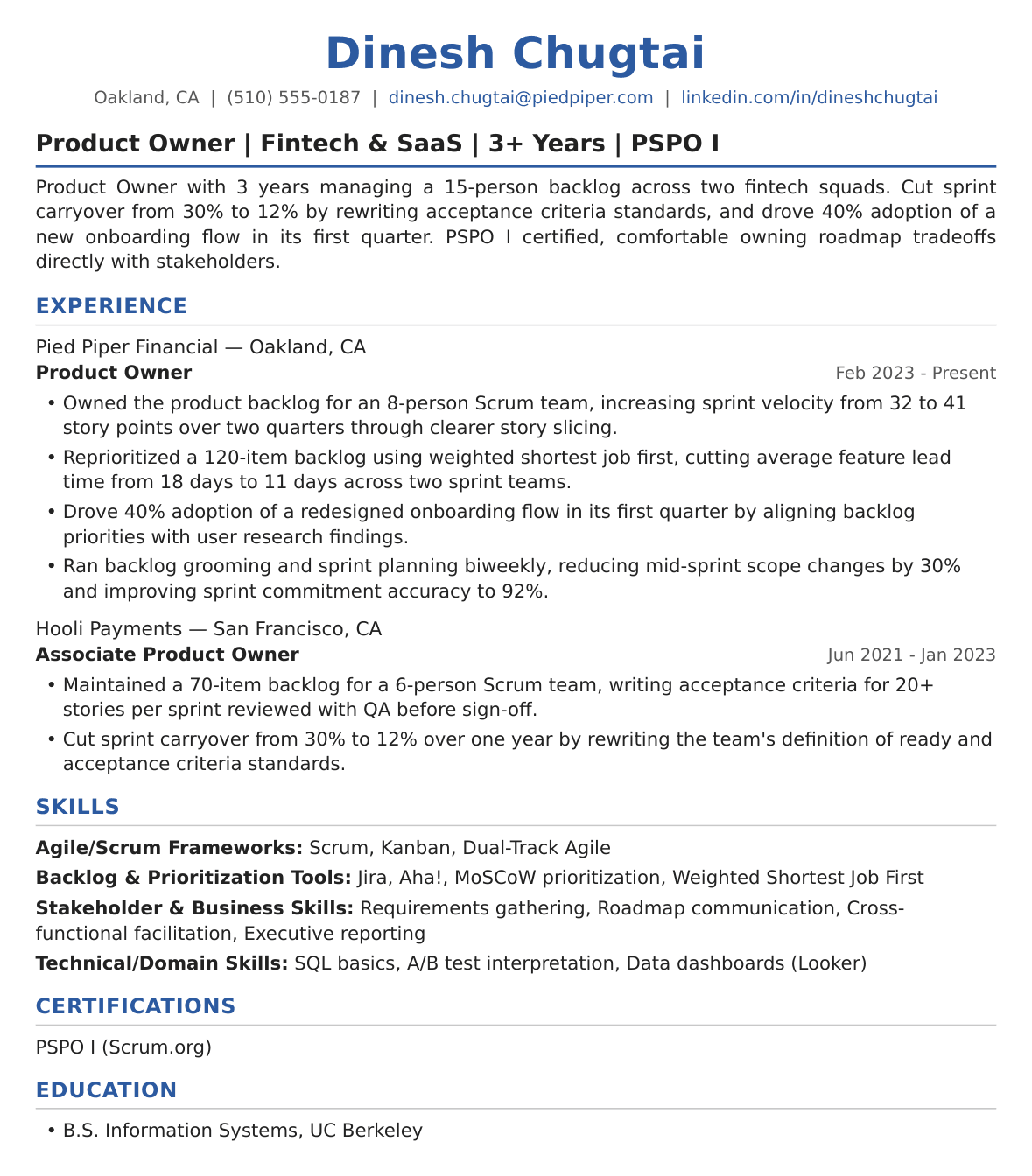
"Product Owner with 3 years managing a 15-person backlog across two fintech squads. Cut sprint carryover from 30% to 12% by rewriting acceptance criteria standards, and drove 40% adoption of a new onboarding flow in its first quarter. PSPO I certified, comfortable owning roadmap tradeoffs directly with stakeholders."
The second version names the domain, the scope, and two numbers a hiring manager can picture. That is the bar every summary should hit.
Entry-Level and Career-Changer Objective Variant
If you are moving into Product Owner work from a BA, QA, or Scrum Master role, you likely do not have a PO title yet, and that is fine. Use an objective statement instead of a summary, and anchor it in the PO-adjacent work you already do: writing acceptance criteria, running backlog refinement, or translating stakeholder requests into stories.
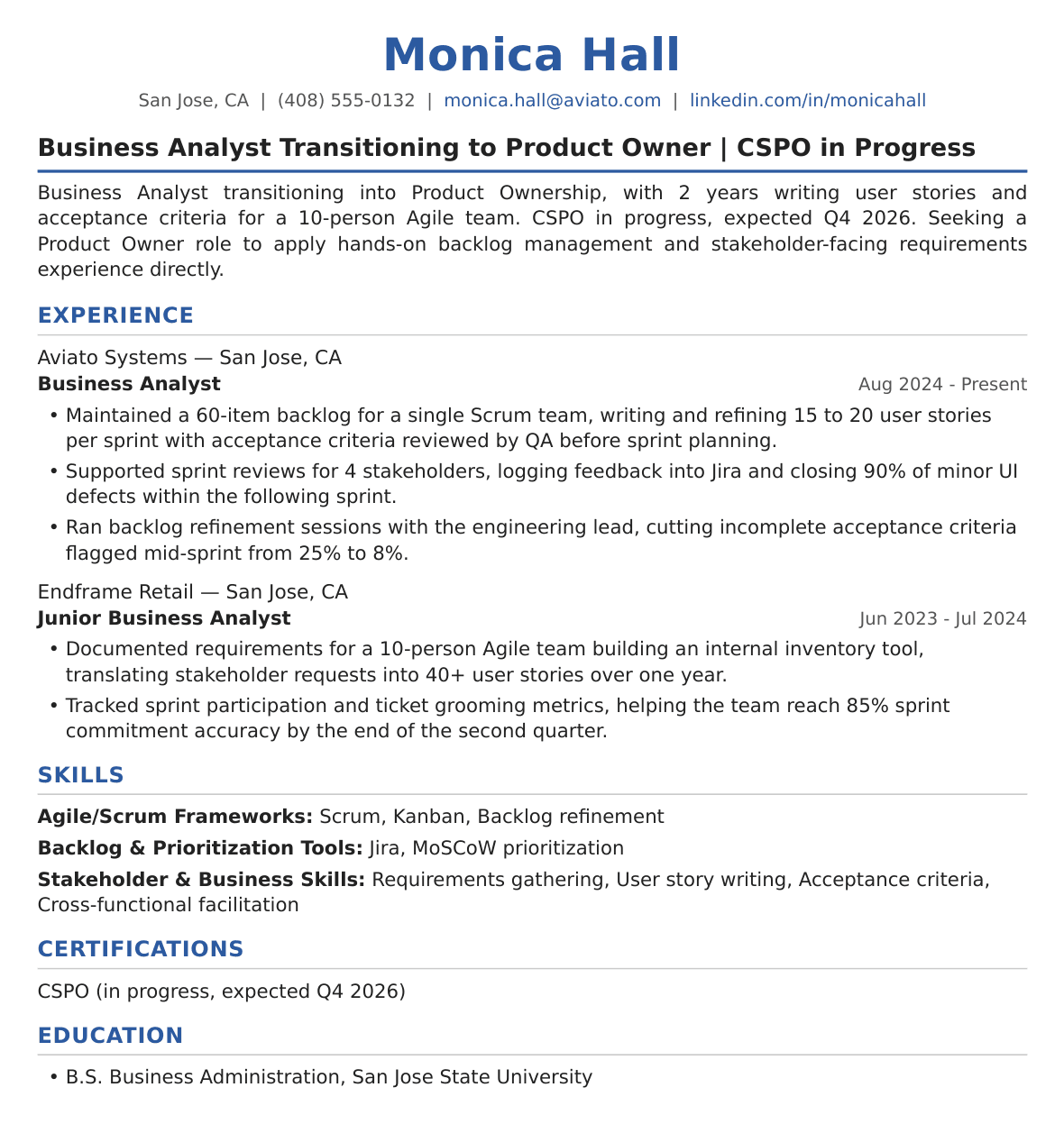
"Business Analyst transitioning into Product Ownership, with 2 years writing user stories and acceptance criteria for a 10-person Agile team. CSPO in progress. Seeking a Product Owner role to apply hands-on backlog management and stakeholder-facing requirements experience directly."
Keep it to two or three sentences. Name the certification if you have started it, and be specific about which PO tasks you already perform under a different title.
Build a Skills Section Hiring Managers and ATS Both Recognize
A skills section earns its place only when it is specific. Group your skills into categories, and mirror the exact wording from the job description wherever it genuinely applies, since many ATS platforms match on literal phrasing. Only list tools you can operate unaided in an interview, not ones you observed a teammate use once.
Categorized Skills Employers Look For
Group related skills so a reviewer can scan them in seconds rather than parsing a wall of keywords.
Agile/Scrum Frameworks Scrum, Kanban, SAFe, Lean Product Development, Dual-Track Agile
Backlog & Prioritization Tools Jira, Azure DevOps, Aha!, ProductBoard, MoSCoW prioritization, Weighted Shortest Job First
Stakeholder & Business Skills Requirements gathering, User story writing, Roadmap communication, Cross-functional facilitation, Executive reporting
Technical/Domain Skills SQL basics, API concepts, Wireframing (Figma), A/B test interpretation, Data dashboards (Looker or Tableau)
Drop any category that does not reflect real experience. A thin, honest list beats a padded one that falls apart under interview questions.
Certifications That Matter (CSPO, PSPO I/II, SAFe POPM)
Certifications like CSPO, PSPO I/II, or SAFe POPM carry weight for Product Owner roles, and recruiters often scan for them first. Place yours near the top of the resume, either in the header line next to your name or in a dedicated credentials line just below your title.
If you are actively studying for one, list it as "in progress" with an expected completion date rather than leaving it off entirely. This signals momentum without overstating where you are.
If you have no certification and none planned soon, do not force one into the resume. Lean harder on demonstrated backlog ownership, sprint outcomes, and stakeholder work instead. A hiring manager reading real evidence of backlog prioritization will usually weigh that above a certification with no track record behind it.
Write Experience Bullets That Turn Backlog Work into Business Outcomes
A resume that lists Scrum ceremonies reads like a job description. A resume that shows what changed because of your backlog decisions reads like a hire. This section covers the formula and gives you a full bullet library by sub-role.
The Bullet Formula
Use this structure for every experience bullet:
[Action verb] + [specific task or method] + [quantifiable result or scope]
The verb shows ownership, the method shows how you work, and the result shows why it mattered.
Skip vague duty statements. Every bullet should answer "so what happened."
Responsible for managing the product backlog and prioritizing features for the development team.
Reprioritized a 120-item backlog using weighted shortest job first, cutting average feature lead time from 18 days to 11 days across two sprint teams.
Sub-Role Bullet Library
Pick the tier closest to your actual experience, then adapt the numbers to your reality.
Associate/Junior Product Owner
- Maintained a 60-item backlog for a single Scrum team, writing and refining 15 to 20 user stories per sprint with acceptance criteria reviewed by QA before sprint planning.
- Supported sprint reviews for 4 stakeholders, logging feedback into Jira and closing 90% of minor UI defects within the following sprint.
Scrum-Team Product Owner (mid-level, single team)
- Owned the product backlog for an 8-person Scrum team, increasing sprint velocity from 32 to 41 story points over two quarters through clearer story slicing.
- Ran backlog grooming and sprint planning biweekly, reducing mid-sprint scope changes by 30% and improving sprint commitment accuracy to 92%.
Technical Product Owner
- Translated API and platform requirements into 25+ technical user stories per quarter, coordinating with 3 engineering leads to cut integration defects by 22%.
- Partnered with architects to sequence a microservices migration backlog, maintaining 95% sprint-ready story quality across 6 consecutive sprints.
SAFe/Enterprise Product Owner
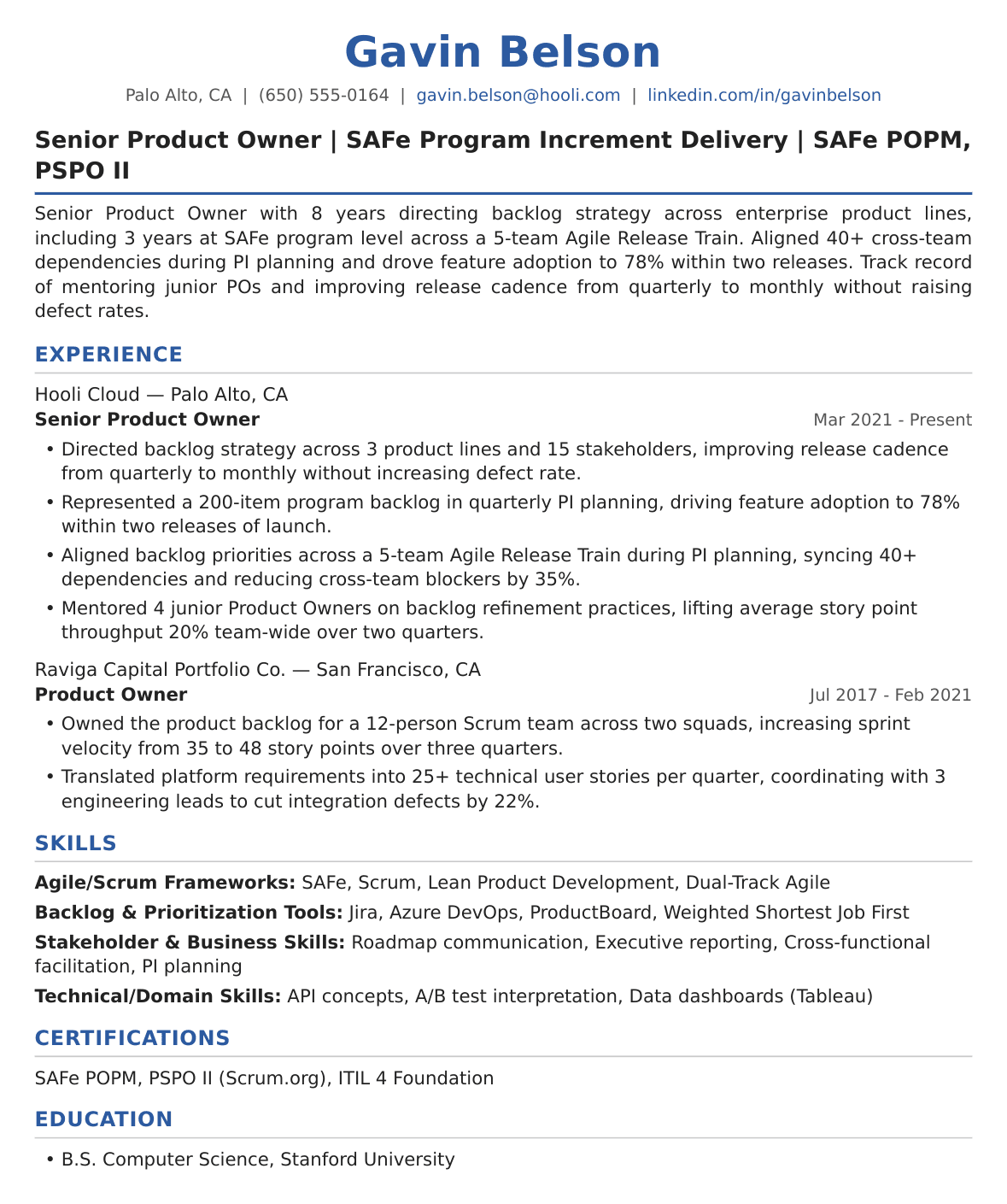
- Aligned backlog priorities across a 5-team Agile Release Train during PI planning, syncing 40+ dependencies and reducing cross-team blockers by 35%.
- Represented a 200-item program backlog in quarterly PI planning, driving feature adoption to 78% within two releases of launch.
Senior/Lead Product Owner
- Directed backlog strategy across 3 product lines and 15 stakeholders, improving release cadence from quarterly to monthly without increasing defect rate.
- Mentored 4 junior POs on backlog refinement practices, lifting average story point throughput 20% team-wide over two quarters.
Metrics Product Owners Should Quantify
If you do not have revenue or customer numbers to point to, pull from the metrics that already exist in your delivery data:
- Sprint velocity change (story points per sprint, before and after)
- Backlog health or readiness (percentage of stories meeting definition of ready)
- Story point throughput across a quarter or release
- Feature adoption rate after launch
- Stakeholder or team scope (number of teams, stakeholders, or backlog items owned)
- Release cadence improvement (frequency or lead time)
Most of these numbers already exist somewhere. Check sprint retro notes, Jira or Azure DevOps velocity and burndown reports, old stakeholder update emails, and project closeout documents. A five-minute search through these usually turns up the exact figure your bullet is missing.
Product Owner Resume Examples by Level
A Product Owner resume should look different depending on where you are in your career. The keyword targets change, but the shape of the page changes just as much.
Entry-Level / Associate Product Owner Resume Example
This resume runs one page, no exceptions. Since you likely have limited direct PO experience, lead with a summary that connects prior work (business analysis, QA, coordination, or a related internship) to product ownership skills like backlog management and stakeholder communication. Education, certifications (CSPO or similar), and relevant coursework carry more weight here than they will later, so place them near the top rather than at the bottom. Quantification will be thinner. It is fine to measure process contributions (sprint participation, tickets groomed) rather than big business outcomes.
Mid-Level Product Owner Resume Example
Still one page in most cases, occasionally spilling to a page and a half if you have multiple product lines. The summary shifts from "I can do this job" to "here is what I have shipped." Work experience leads the page, with 2 to 3 roles shown and bullets built around outcomes: features launched, backlog throughput, stakeholder alignment across teams. Certifications and skills move down to supporting sections. Quantification should be consistent across most bullets, not just the top one.
Senior / SAFe Product Owner Resume Example
Can extend to two pages, especially with SAFe program-level scope (multiple Agile Release Trains, program increments, cross-team dependencies). The page opens with a summary that signals scope: how many teams, what portfolio, what business impact. Older or junior-level roles get compressed to single lines so recent, high-scope work gets the space. Quantification should be business-level: revenue, retention, adoption, or program velocity, not just sprint mechanics.
Product Owner Resume Keywords
PO screeners check for backlog ownership language, agile certifications, and prioritization frameworks. Frame ceremony keywords around business outcomes, not just process participation.
| Category | Keywords |
|---|---|
| Backlog & delivery | Product backlog ownership, Backlog refinement, User stories, Acceptance criteria, Definition of done, Release planning, Sprint planning, UAT coordination |
| Agile & certifications | Scrum, SAFe, CSPO, PSPO, Scrum ceremonies, Velocity tracking |
| Prioritization & strategy | WSJF, MoSCoW, RICE, Roadmapping, Product discovery, Customer feedback loops, Requirements gathering |
| Collaboration & tools | Jira, Azure DevOps, Stakeholder management, Cross-functional collaboration, Product KPIs, Value delivery and ROI |
Applying to PM Roles as a PO: Repositioning for a Consolidating Market
The market is merging the PO layer into product management. Companies that adopted SAFe's PO/PM split are unwinding it, and org-design writing now openly questions dedicated backlog-owner roles outside large enterprises. Practically, that means many POs are applying to PM postings, where the screener reads PO history as execution without strategy unless the resume corrects them.
Rewrite your bullets from ceremony to outcome. "Owned backlog and ran refinement for two teams" becomes "Owned the checkout product area: prioritized against revenue-per-session, shipped 14 releases, lifted conversion 11%." Same job, but the second version answers what PM screeners are scanning for: a metric you owned and moved.
Surface every scrap of upstream work you did, because you did more than your title said: customer interviews, discovery spikes, pricing input, roadmap proposals. Those go in the top half of the resume. And target deliberately: SAFe-heavy enterprises, banks, and government contractors still hire POs as POs, while product-led SaaS mostly won't, so know which posting you're writing for and lead accordingly.
Common Product Owner Resume Mistakes to Avoid
Describing ceremonies instead of outcomes
Listing "facilitated sprint planning" or "ran daily stand-ups" tells a hiring manager what you attended, not what you decided. Every ceremony bullet should end at a result: a reprioritized backlog that cut cycle time, a refinement session that surfaced a scope risk before it hit production. If the bullet stops at the activity, cut it or rebuild it around the decision you made.
One generic resume for every PO flavor
A SAFe enterprise PO, a startup PO, and a technical PO are not interchangeable roles, even though the title is the same. Sending the same resume to all three signals you have not read the posting closely. Adjust scope language (program increments vs. scrappy roadmap calls vs. API-level tradeoffs) and vocabulary to match the environment the employer is actually hiring for.
Certifications with no context
A CSPO or PSPO badge sitting alone in a list proves you passed a course, not that you can do the job. Without a date, it looks stale. Without a bullet elsewhere showing you applying that framework, it reads as decorative. Pair each certification with at least one piece of evidence in your experience section that shows the training in action.
Ignoring ATS formatting
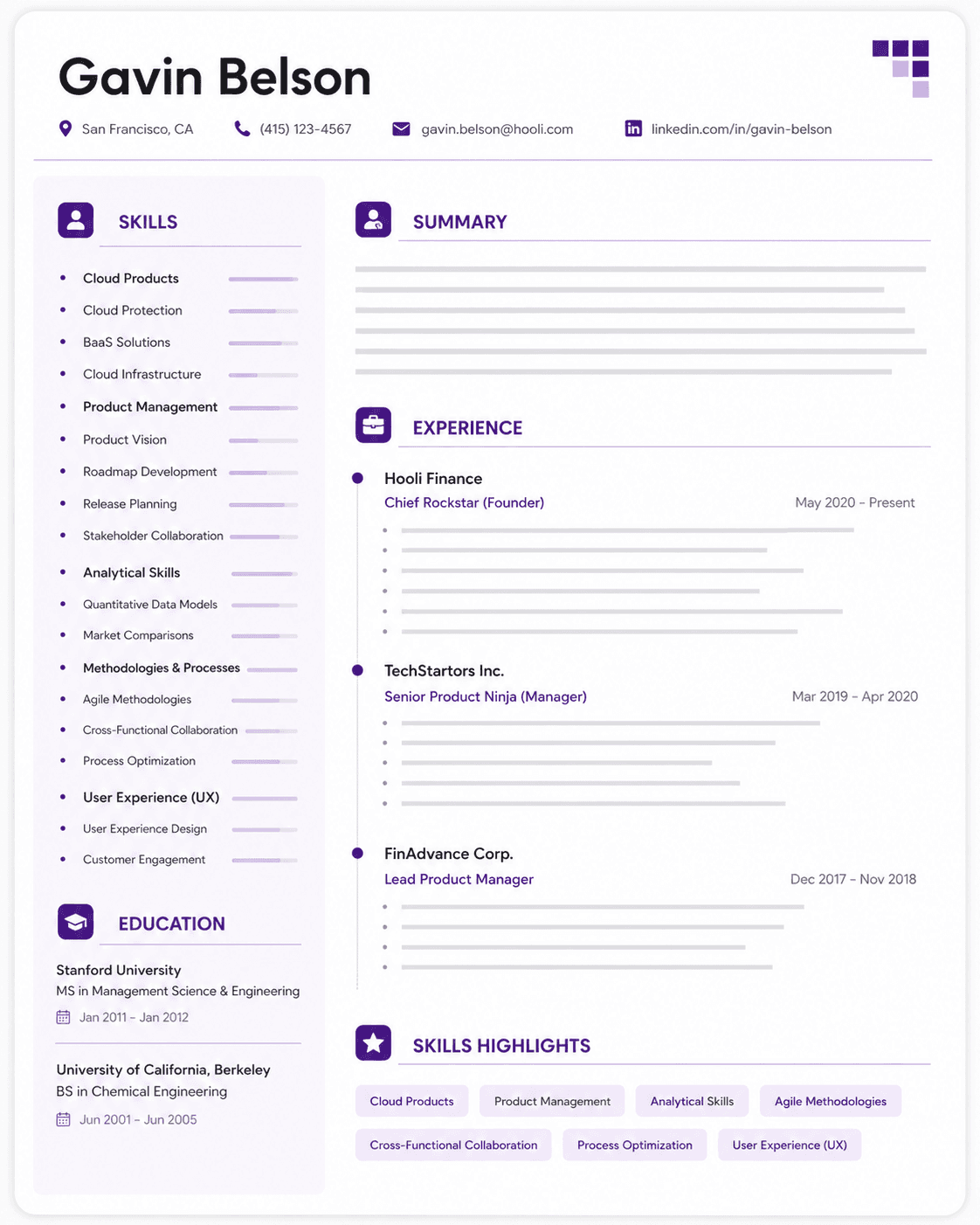
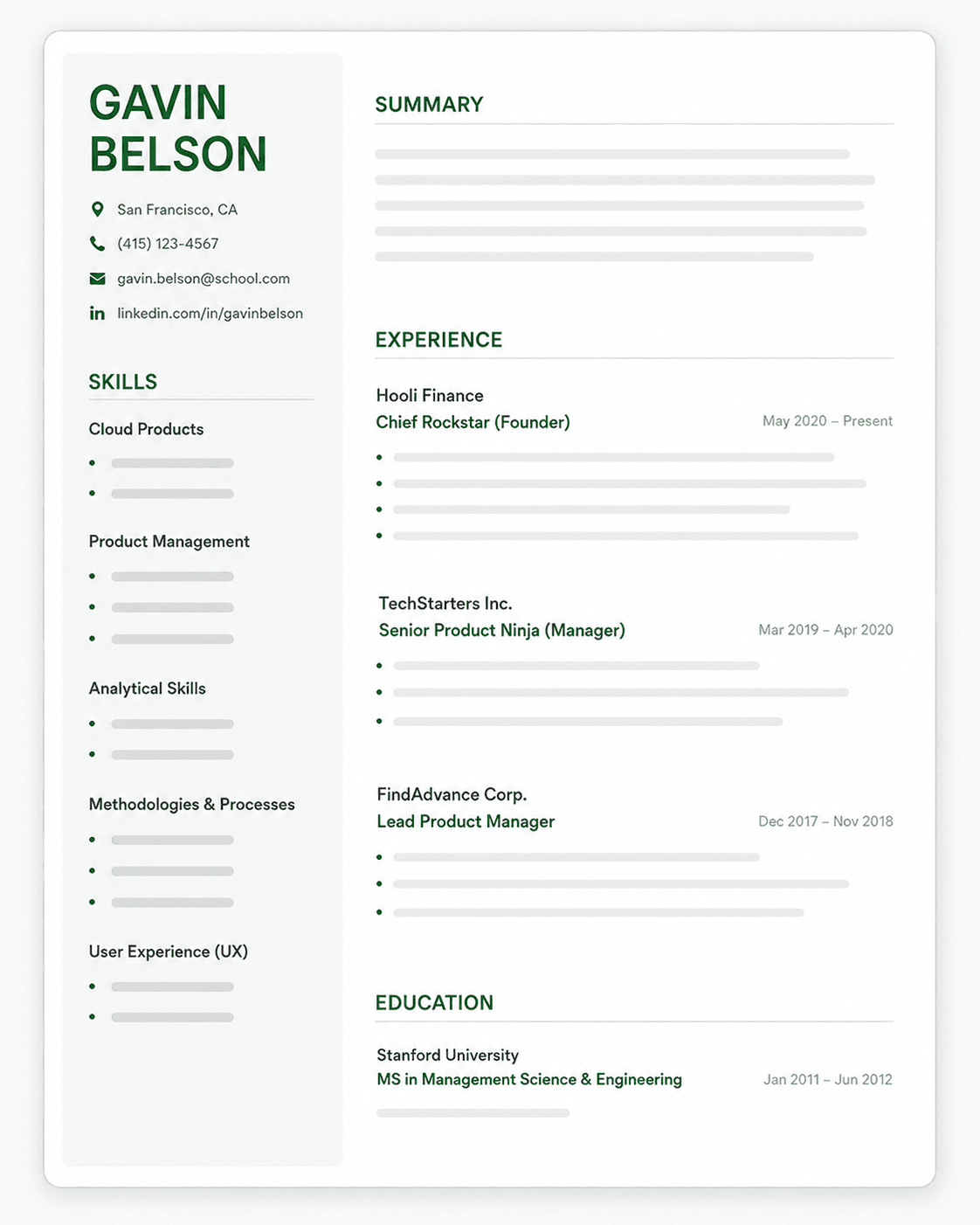
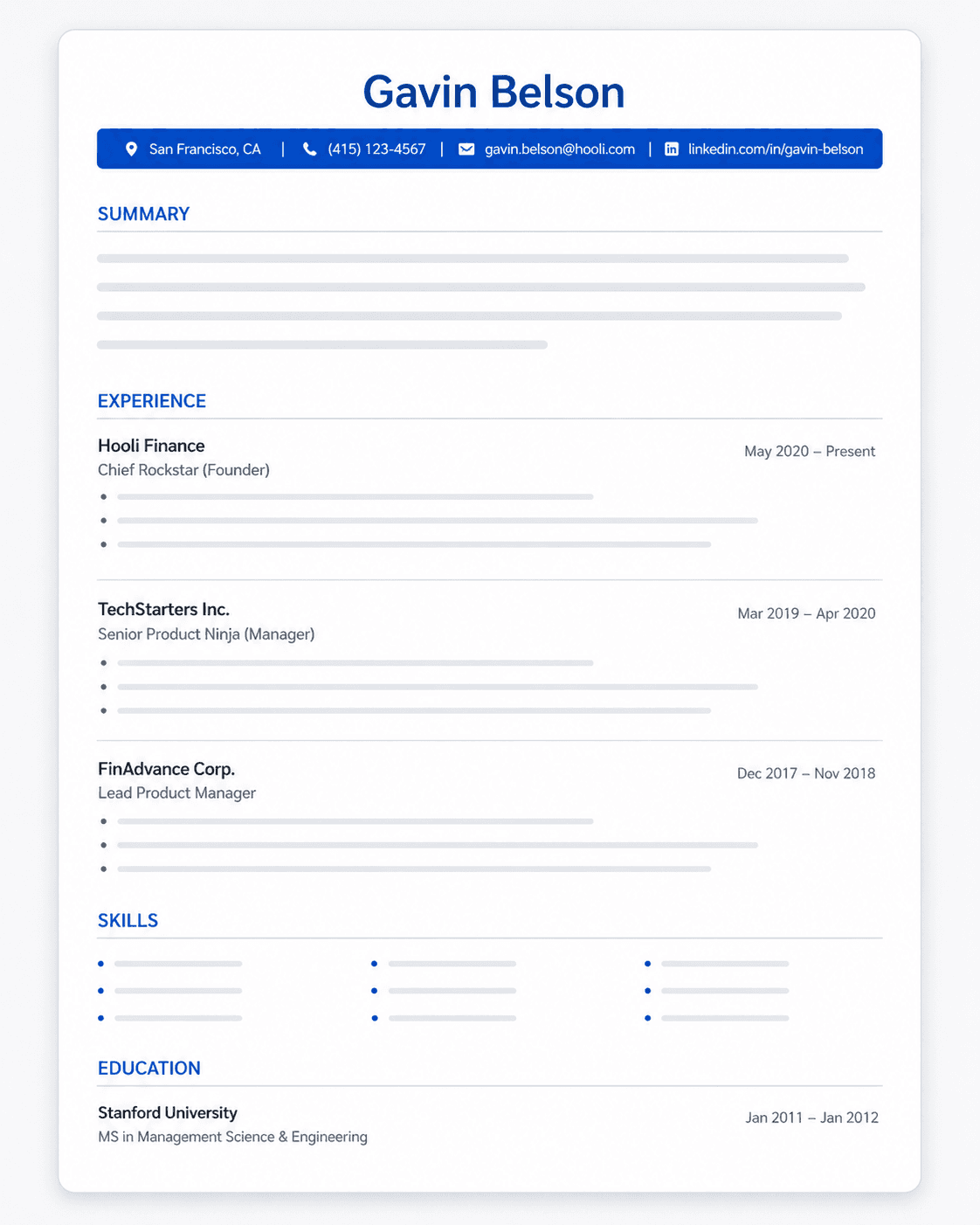
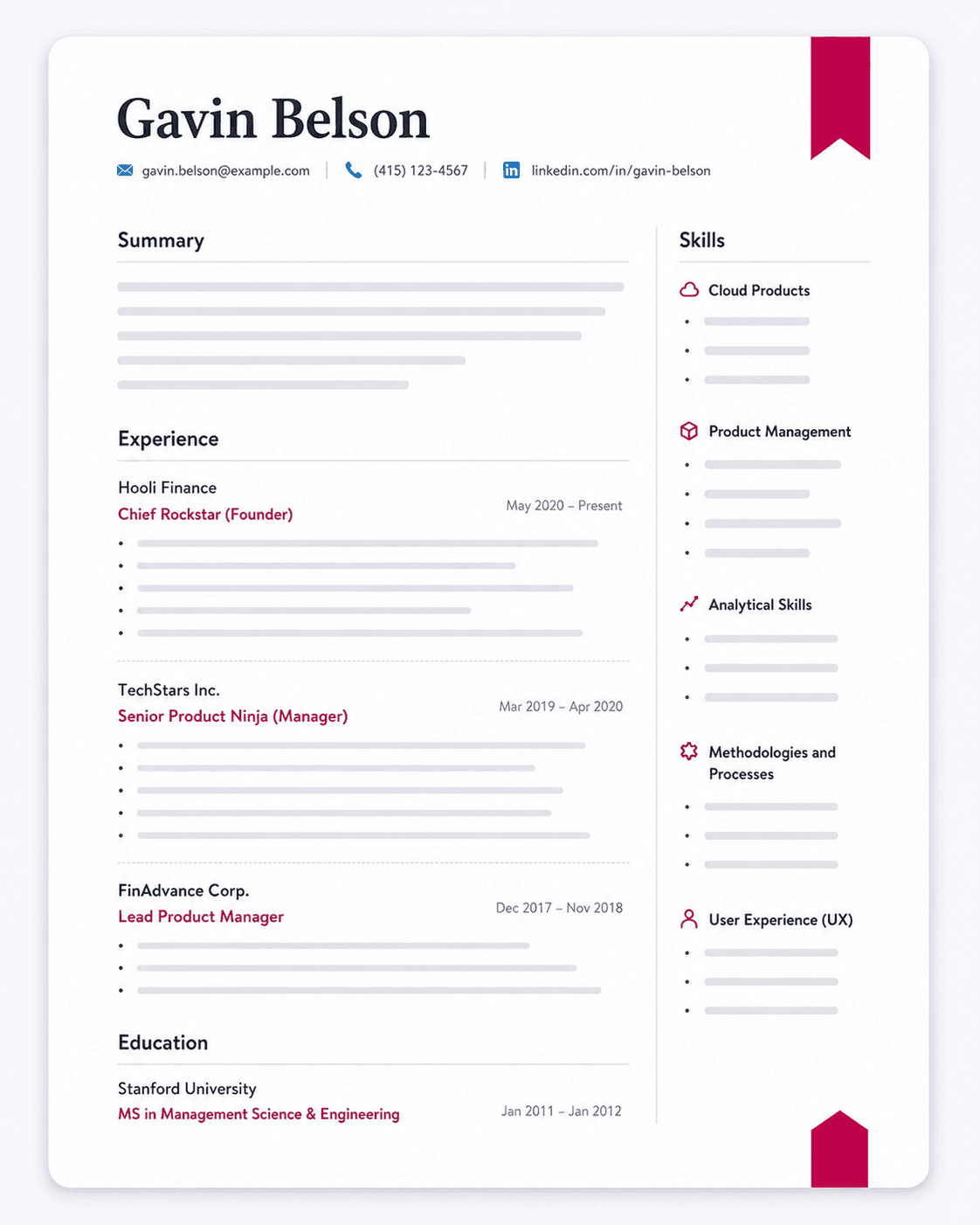
ATS-unfriendly formatting, including tables, multi-column layouts, headers, footers, and icons, can look sharp to a human eye and still get mangled or dropped entirely by an applicant tracking system. This trips up strong candidates constantly, not just careless ones. Stick to a single-column layout, standard section headers, and plain text so nothing you wrote gets lost before a person ever sees it.
Soft-skill buzzwords with no proof
"Team player," "results-oriented," and "dynamic self-starter" say nothing an employer can verify. Every recruiter has read these phrases hundreds of times, and none of them answer what you actually did. Replace the label with the evidence: instead of "strong communicator," show the stakeholder conflict you resolved and what shipped because of it.
Inconsistent PO and PM language
If your header says Product Owner but your bullets describe market sizing, pricing strategy, and roadmap ownership, you are undermining the exact distinction this resume needs to make clear. The same problem shows up in reverse when a PM candidate leans too hard on backlog and sprint language. Pick the title you are targeting and keep the language throughout the resume consistent with it.
How AI Resume Builders Can Simplify Your Product Owner Resume
Tailoring a resume for every Product Owner flavor, associate, technical, SAFe, or senior, takes real time, and a generic resume often gets filtered out before a recruiter ever sees it.
Upplai, the transparent resume AI, takes your existing resume and tailors it to a specific job description. It optimizes for ATS keywords and recruiter best practices, and shows you every change with a plain-language explanation. You accept or reject each suggestion individually. The AI never fabricates or silently rewrites your content.
Here is what that looks like in practice:
- Real-time ATS scoring. Your score updates live as you edit, so there is no download and re-upload cycle.
- Transparent suggestions. Every edit comes with a "why this change?" explanation. You accept or reject each one on its own.
- Automatic formatting. ATS-friendly templates handle formatting fixes for you.
- Structure guidance. Content gets reordered for relevance, action verbs get stronger, achievements get quantified, and potential bias triggers get flagged.
- Preference memory. Your formatting, metric, and reordering choices carry over across sessions.
Upplai's free plan gives you 3 tailored resumes with matching cover letters as a one-time allotment, plus 200 ATS scans and resume match scores every month. If you use the ChatGPT app, you also get 20 ATS scoring credits inside it. Downloads in PDF, DOCX, or TXT are unlimited, and no credit card is required to start.
Once you use up your one-time resumes, additional packs start at $5 and cost $0.50 to $1.00 per tailored resume depending on the pack size. Upplai does not have subscriptions or auto-renewals. The idea is simple: a job search is not a subscription, so you should stop paying the moment you stop searching.
Ready to rebuild your product owner resume?
Upplai turns your PO experience into outcome-driven bullets in minutes.
Your experience as a Product Owner is already there. The work now is translation: turning ceremonies into outcomes, ownership into evidence, and certifications into proof. Use the formulas and examples above as a starting structure, then adjust them to match your actual scope and metrics.