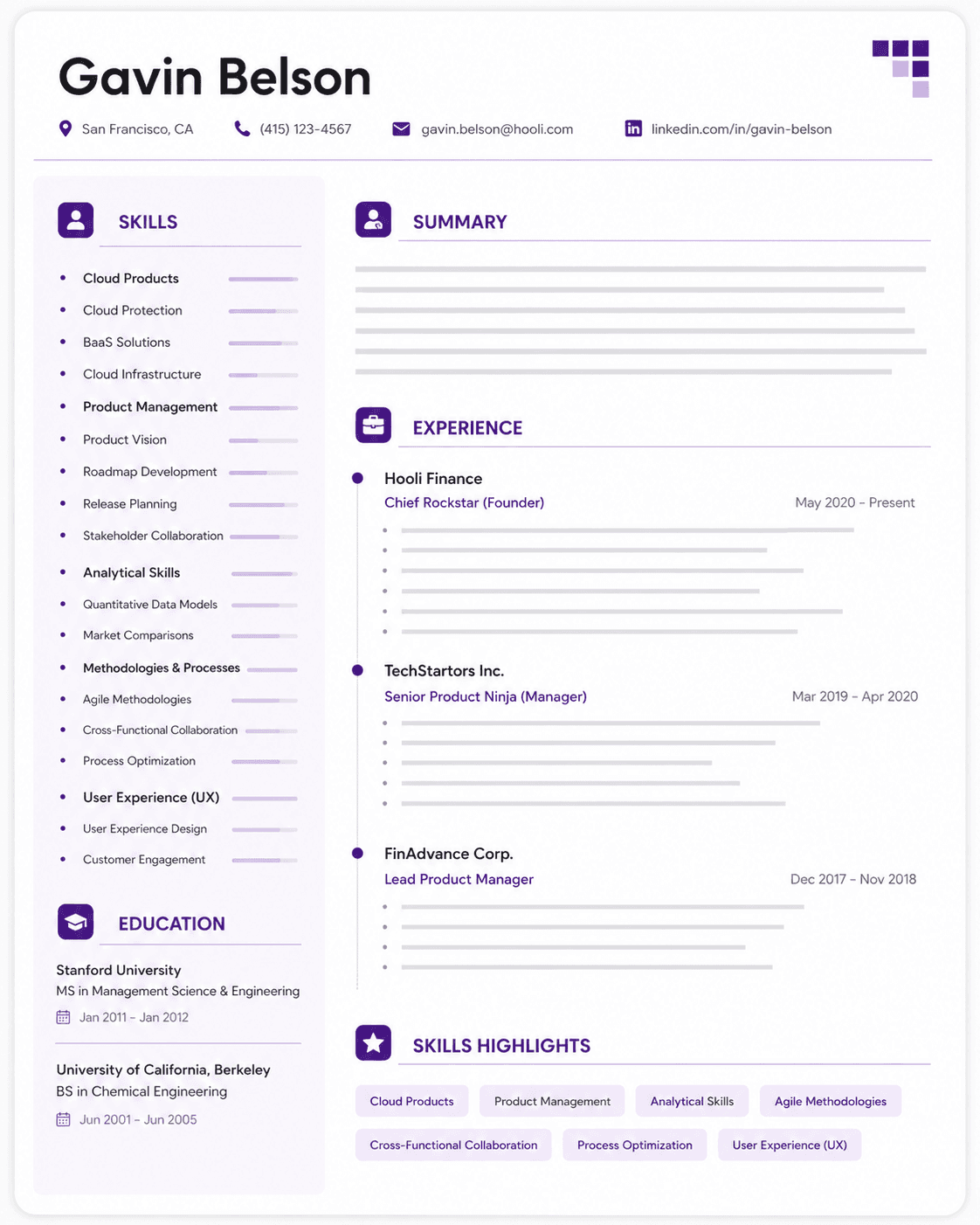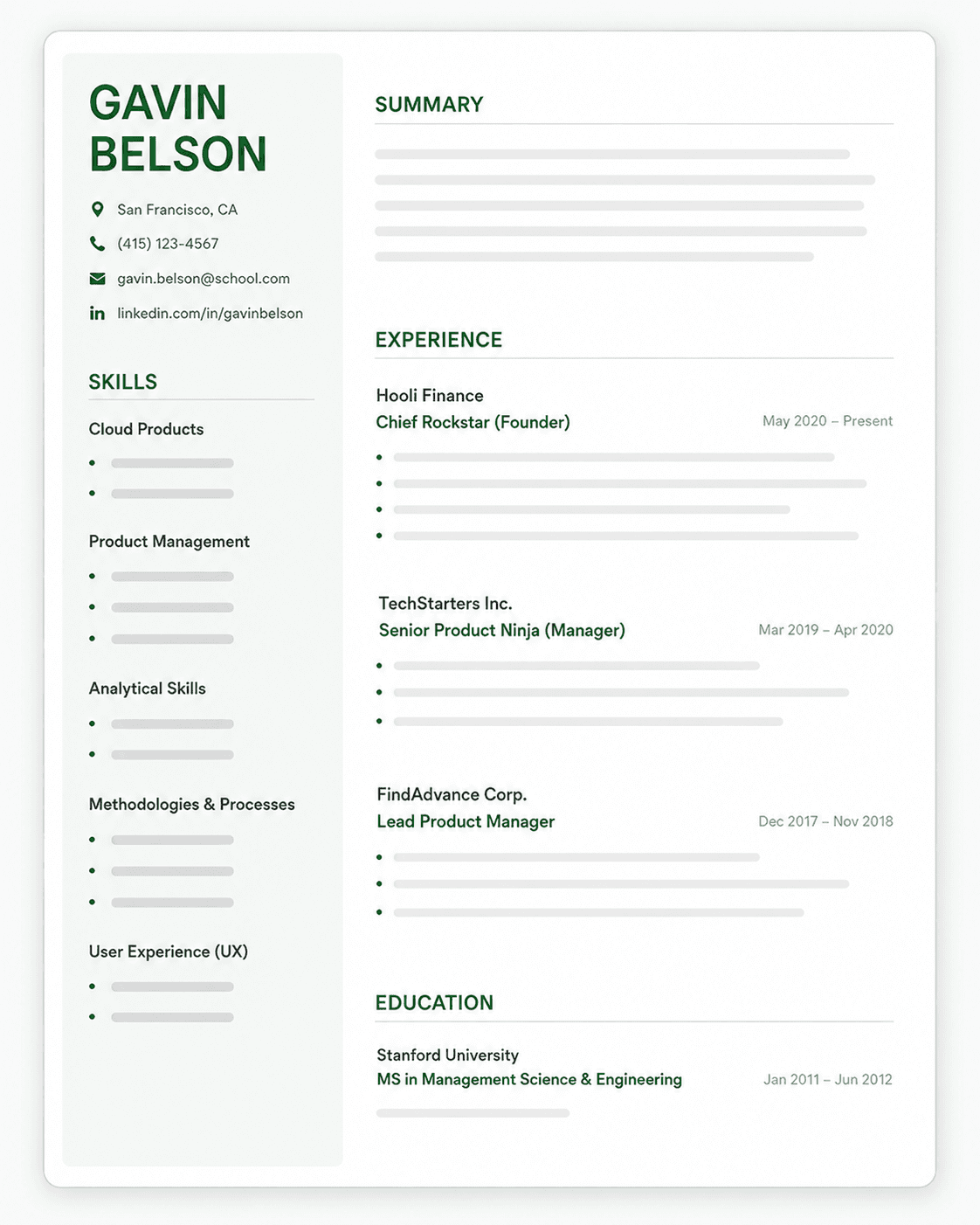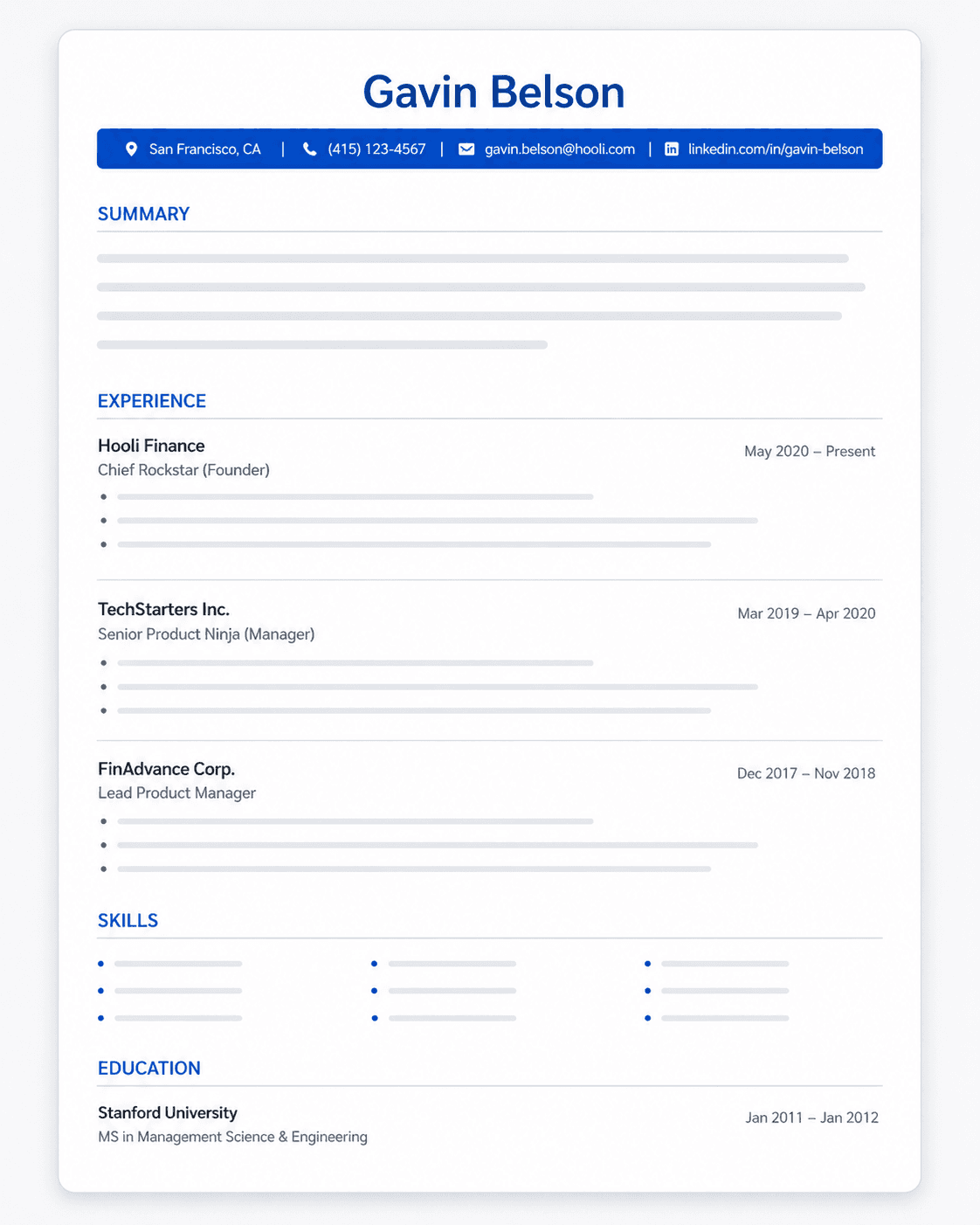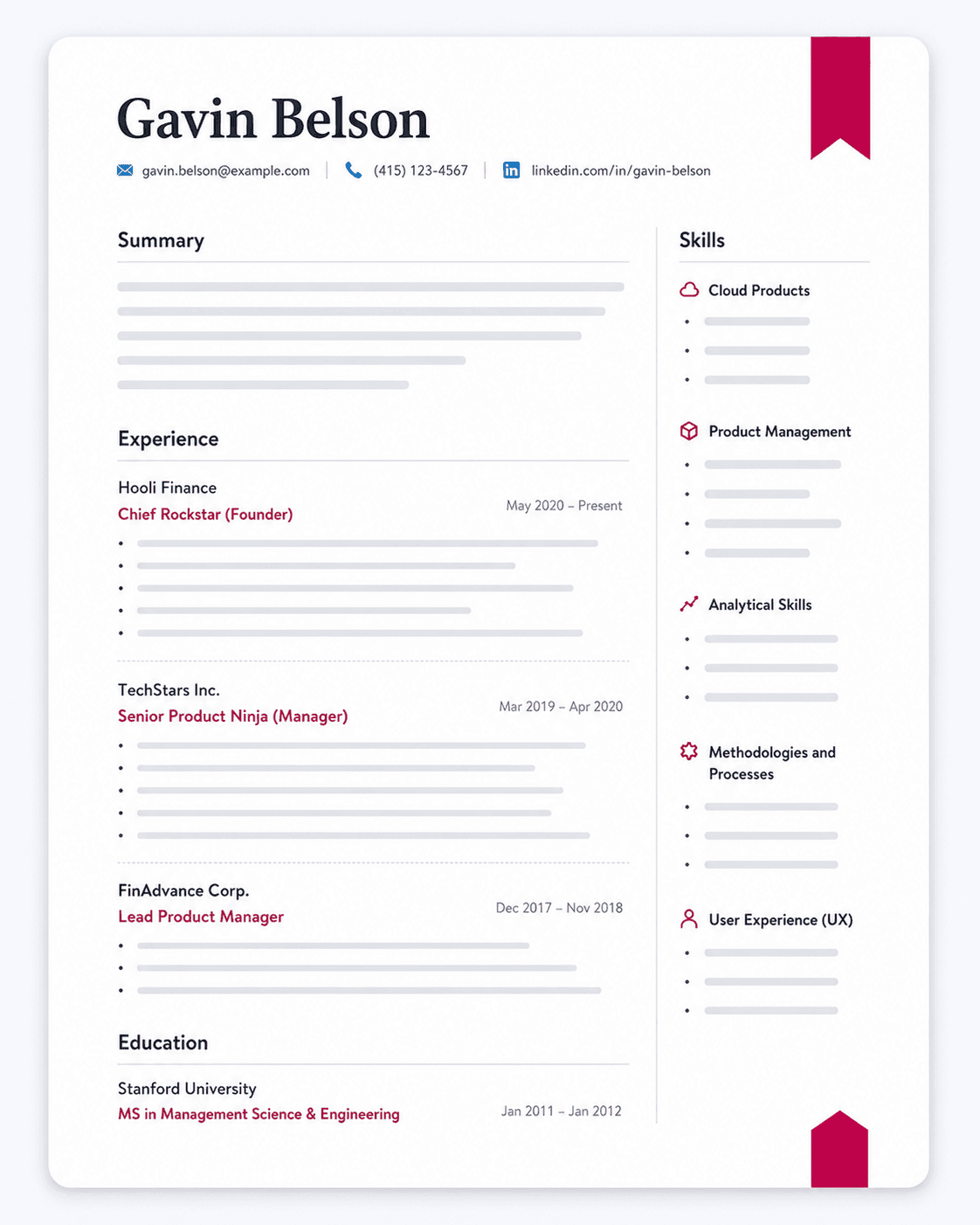
You have spent years managing a classroom, tracking IEP and 504 accommodations, and talking families through hard conversations. None of that shows up as "counselor" on your resume yet, and that gap can feel bigger than it actually is when a district posting asks for someone with counseling experience.
This guide shows you how to build a school counselor resume that translates what you already know how to do into language a hiring committee recognizes, whether you're finishing certification this year or updating a resume you have used for a while. It covers how to lead with your certification status, write a summary and bullets that hold up under a 10-second skim, reframe teaching or social work experience without hiding the job titles that got you here, and format for the ATS systems districts actually use.
How to Write a School Counselor Resume That Gets Interviews
Write a Targeted Professional Summary
Your summary is three sentences, but it has to do three jobs at once. First, it needs to signal which level you're aiming for (elementary, middle, or high school), since the tone and priorities shift by setting. Second, it needs to state your certification status plainly. Third, it needs one real, measurable outcome, not a personality trait.
If you're finishing your master's and certification now, say so directly: "certified school counselor (K-12), state certification expected [month/year]" is a normal, credible thing to write. Hiring committees read a lot of these and know what "in progress" looks like.
A weak summary looks like this:
"Caring and dedicated professional with strong communication skills, seeking a school counselor position where I can make a difference in students' lives."
A stronger one looks like this:
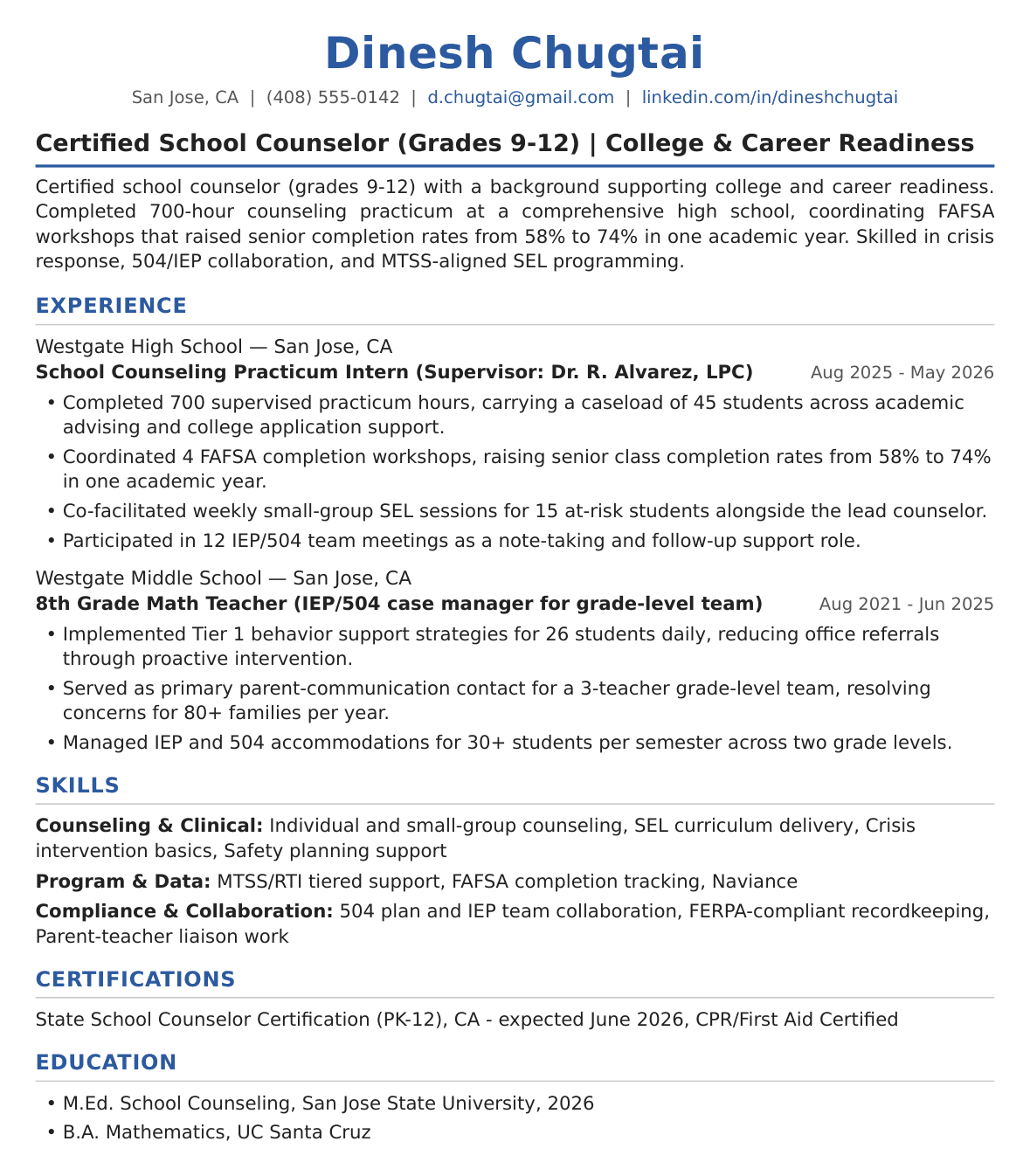
"Certified school counselor (grades 9-12) with a background supporting college and career readiness. Completed 700-hour counseling practicum at a comprehensive high school, coordinating FAFSA workshops that raised senior completion rates from 58% to 74% in one academic year. Skilled in crisis response, 504/IEP collaboration, and MTSS-aligned SEL programming."
Notice the strong version never uses the word "passionate." It names a level (9-12), a credential detail (practicum hours), and a number tied to a real outcome (FAFSA completion). That's the whole formula: setting, status, proof.
If you're a teacher moving into counseling and don't have a counselor job title yet, don't force one. Use an objective statement instead of a summary. This reframes your classroom years as directly relevant preparation rather than something to explain away.
Career-changer objective (teacher to counselor):
"Certified school counselor transitioning from 6 years as a middle school English teacher, where I managed IEP and 504 accommodations for 30+ students per semester and served as the primary parent-communication contact for two grade-level teams. Completed school counseling practicum with direct experience in small-group SEL facilitation and academic advising. Seeking a middle school counselor role to apply classroom-tested behavior support and family engagement skills in a full-time counseling capacity."
This version does the same three jobs (setting, certification, one outcome) but leads with the classroom experience as an asset instead of burying it. You'll build on this reframing more in the work history section below.
Lead With Your Certification and Licensure
For this role, certification functions as a gate more than a formality. Put it near the top of the resume, either directly under your name and contact info or as the first line of a dedicated "Certifications" section right after your summary. Don't wait until the bottom of the page, where a screener skimming for 10 seconds might miss it.
Name the credential precisely. "Certified" alone tells a hiring committee nothing. Use the actual type:
- State school counseling certificate or license (name the state and grade span it covers, e.g., "PK-12 School Counselor Certification, [State], valid through [year]")
- National Certified Counselor (NCC), through the National Board for Certified Counselors
- Licensed Professional Counselor (LPC), if you hold clinical licensure alongside your school credential
- ASCA's Advanced Certification for School Counselors (ACSC), which you can reference on your resume for five years after you earn it
For each one, list the issuing body and current status (active, pending, expiration date). "State certification, pending, expected June 2026" is a perfectly fine thing to write if that's where you are.
If you're applying through a staffing agency or considering teletherapy-track roles, note whether your license or certification is portable across states, or whether you're pursuing reciprocity. Multi-state readiness matters to agencies placing counselors in contract or remote school-based positions, and it's worth one line if it applies to you.
Build a Skills Section That Speaks to Hiring Committees
Skip the generic list. A skills section that reads "communication, teamwork, organization" tells a hiring committee nothing they can't assume. Group your skills into categories a counseling supervisor will actually recognize, and name real tools and interventions inside each one.
SKILLS
- Counseling & Clinical: crisis intervention and safety planning, individual and small-group counseling, SEL curriculum delivery, suicide risk assessment protocols
- Program & Data: MTSS/RTI tiered support, ASCA National Model program design, Naviance or similar student information systems, attendance and outcome data tracking
- Compliance & Collaboration: 504 plan and IEP team collaboration, FERPA-compliant recordkeeping, parent-teacher liaison work, mediation and conflict resolution
- Additional Strengths: college and career readiness advising, classroom management, multicultural competency, bilingual family communication
Only list what you can actually do without supervision. If a posting mentions a specific tool (Naviance, PowerSchool, a particular SEL curriculum), mirror that exact wording where it's true for you. ATS systems used by districts (Frontline, TalentEd) match on literal keywords, so precision here helps both a human reader and the parsing software.
Order matters inside each category too. Lead with whatever the posting emphasizes first: if a high school posting opens with college-application support, put your readiness-advising line at the top of Additional Strengths; if a middle school posting leads with behavior intervention, move tiered-support experience to the top of Program & Data. A hiring committee scanning quickly reads the first line of each category most closely.
Write Achievement-Focused Experience Bullets
Every experience bullet should follow the same formula: [action verb] + [specific task or method] + [quantifiable result or scope]. Skip "responsible for" entirely. It describes a job description, not what you did.
A weak bullet looks like this:
"Responsible for helping students with academic and social-emotional needs."
A stronger one looks like this:
"Facilitated weekly small-group SEL sessions for 24 at-risk students, reducing disciplinary referrals among participants by 35% over one semester."
Not every accomplishment has a clean percentage attached, and that's fine. When you don't have a before/after metric, quantify scope instead: caseload size, number of students served, number of sessions run, number of families contacted, size of the program you built or ran.
If you're struggling to find any numbers at all, look in places you wouldn't think to check first: attendance logs, disciplinary referral counts, and FAFSA completion rates. These exist in nearly every school building and translate directly into a bullet, even if you never thought of them as "your" data at the time.
Organize Your Work History the Right Way
Default to reverse-chronological order, most recent role first. Hiring committees expect this format and anything else slows down their review.
If your work history includes adjacent roles, teaching, social work, or school psychology, don't hide them or relabel them as something they weren't. Instead, add a brief title clarifier and let the bullets do the reframing. "8th Grade English Teacher (IEP/504 case manager for grade-level team)" tells a reader exactly why this job belongs on a counselor's resume. Follow it with bullets that translate the transferable skill directly: classroom management becomes behavior support, casework becomes student advocacy, lesson planning becomes program development. The goal is context, not concealment.
If your history includes jobs from before you entered education entirely, retail management, food service, corporate work, keep them brief and push them toward the bottom. One line with a title, employer, and dates is enough for anything more than about ten years old or unrelated to schools, counseling, or human services. The exception is a pre-teaching job that still supports your case, such as prior crisis-line work, camp counseling, or youth program coordination; those belong further up and deserve a full bullet even if they're a decade old, because they speak directly to the role.
If there's a gap in your work history tied to finishing certification, name it in one line rather than letting a reader guess. A line like "Certification and practicum completed [year], following a planned career transition from classroom teaching" closes the question before it opens. The same logic applies to a lapsed or expired credential: state where you are directly, for example "State certification lapsed [year], renewal in progress, expected [month/year]," rather than omitting it and hoping no one checks.
Making the Switch: Resume Tips for Teachers and Social Workers Moving Into School Counseling
Most school counselors did not start out as school counselors. They started as teachers managing 28 kids in a classroom, or as social workers carrying a caseload through the county system. Hiring committees know this. What sinks a career-change resume is describing the old job in the old job's language.
Reframing means translating the work, not renaming it. "Managed classroom behavior for 25 students daily" becomes "Implemented Tier 1 behavior support strategies for 25 students, reducing office referrals through proactive intervention." Same skill, but now it reads as MTSS work instead of classroom control. "Developed and delivered weekly lesson plans aligned to state standards" becomes "Designed and delivered SEL-aligned curriculum for whole-group instruction, adapting content to individual student needs." That is program development, which is exactly what a counseling role expects.
Social workers have their own translation task. "Managed a caseload of 40 client families, coordinating services across agencies" becomes "Advocated for students across academic, social, and family systems, coordinating with outside providers on behalf of a 40-student caseload." Crisis intervention protocols, home visits, and mandated reporting experience map directly onto a school counselor's daily reality and should be named using that shared vocabulary rather than clinical-practice terms a school hiring committee has to decode.
If your job titles do not say "counselor" yet, do not bury your practicum. List your school counseling internship or practicum placement as its own entry, with dates, site, and supervisor title, right alongside your teaching or casework history. It shows the committee you have already done the job, even if payroll never called you a counselor.
School Counselor Resume Examples
Different career stages need different resume structures. Use these three tiers as a starting point, then adjust for the level (elementary, middle, or high school) you're targeting.
Entry-Level School Counselor Resume Example
If you're finishing certification or coming from a practicum/internship, lead with your school counseling program, supervised hours, and certification-in-progress status. Fill the experience section with transferable work: classroom management, advisory periods, coaching, or student mentoring. Frame each bullet around the skill it demonstrates (behavior support, small-group facilitation, parent communication) rather than the job title you held at the time.
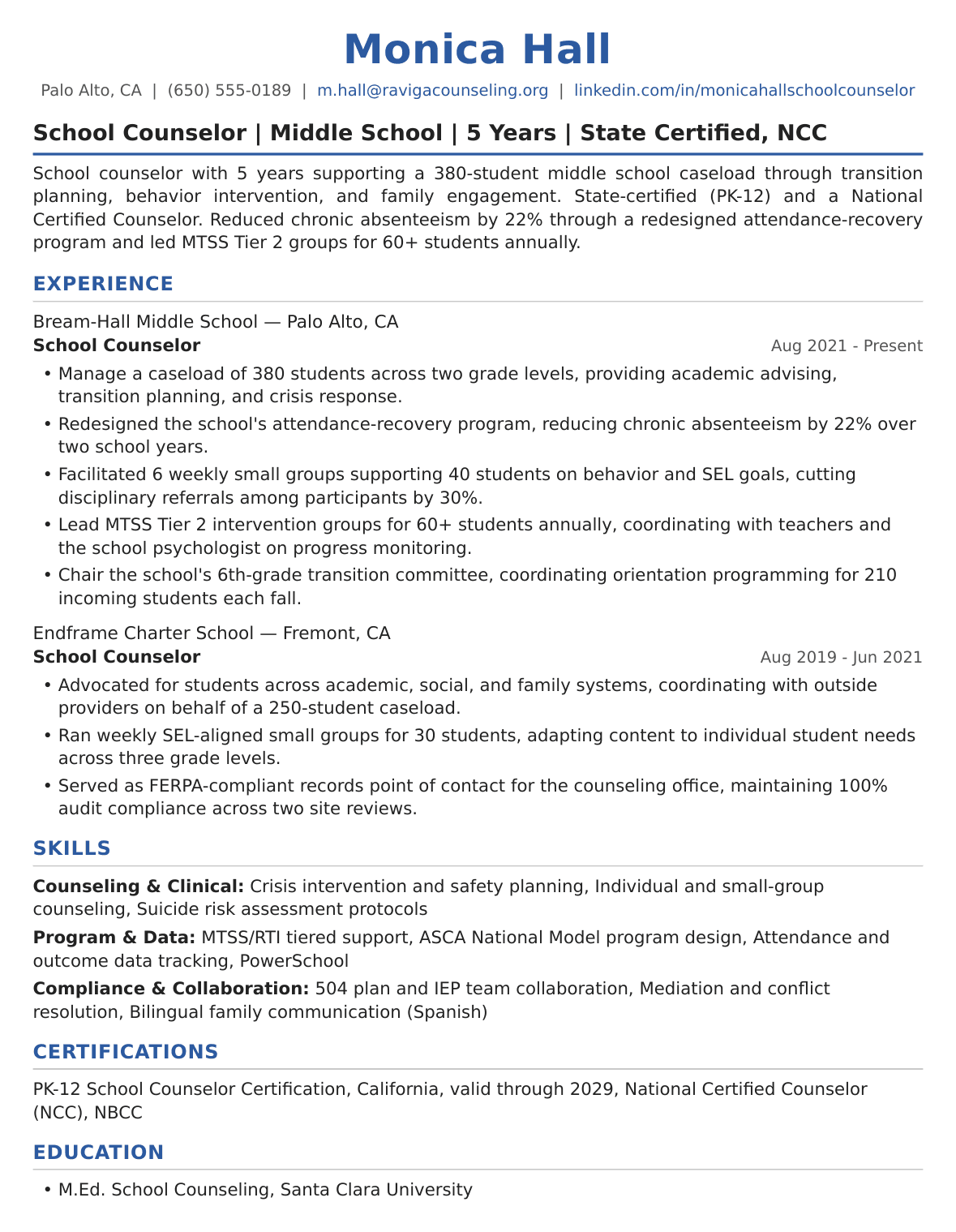
Mid-Level School Counselor Resume Example
Once you have 3-7 years in the role, the resume needs to work differently. Mid-level counselors should center their experience section on outcomes tied to a specific caseload or program: attendance improvements, reduced disciplinary referrals, FAFSA completion rates, or a redesigned advisory curriculum. Say directly whether your background is elementary or high school. Don't leave it implied by job titles alone.
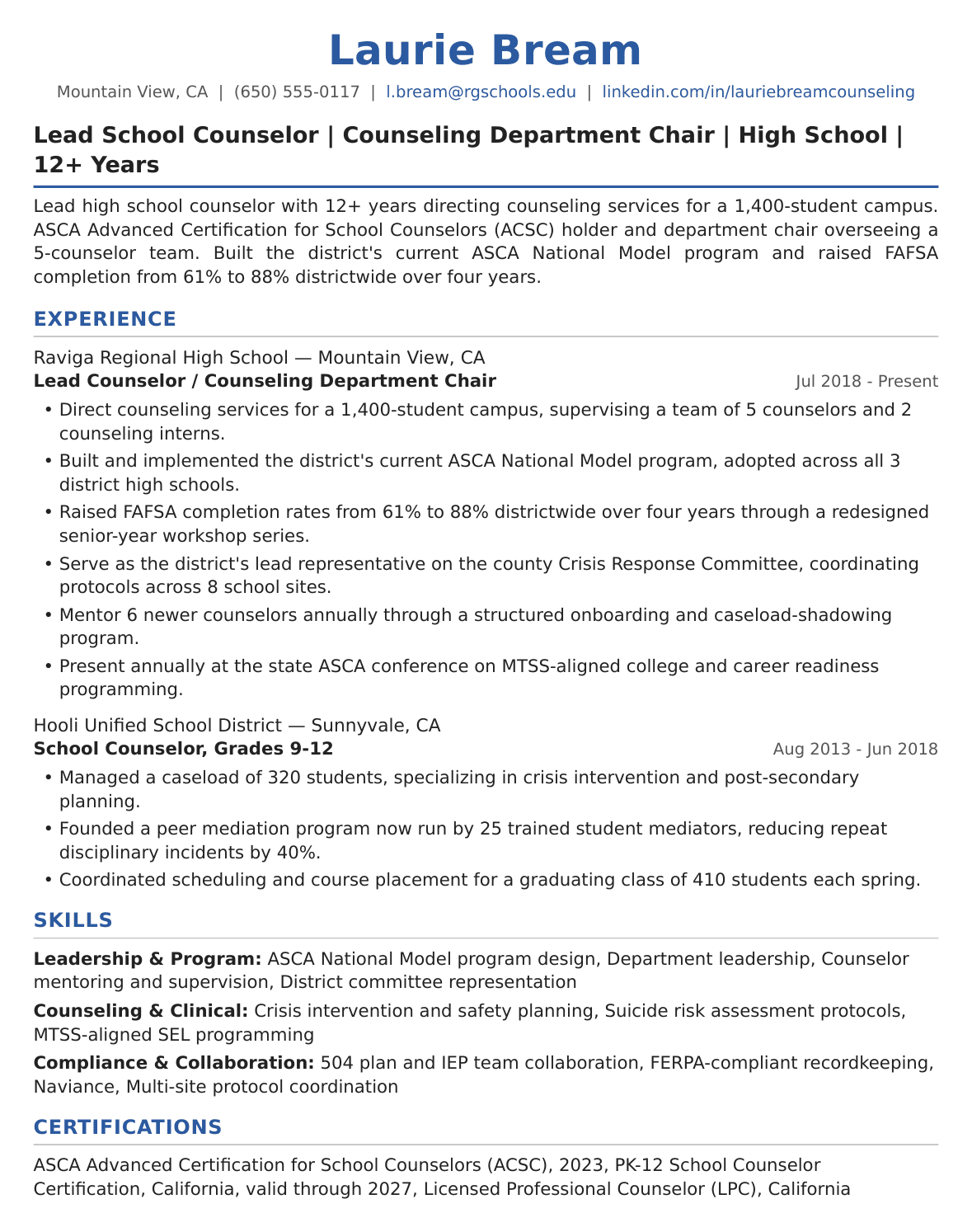
Experienced School Counselor Resume Example
At the experienced or lead counselor stage, the resume should emphasize scope beyond a single caseload: department leadership, program design, mentoring newer counselors, or serving on a district-level committee. Titles like "lead counselor" or "counseling department chair" belong near the top, alongside any ASCA National Model program you built or revised.
Regardless of career stage, tone should shift with the level you serve. An elementary school resume leans on SEL and developmental guidance language, a middle school resume puts weight on transition support and behavior intervention, and a high school resume foregrounds college and career readiness, scheduling, and crisis intervention.
School Counselor Resume Keywords
District HR systems scan for licensure, framework, and intervention language. Match the terms below to the tier of support each posting emphasizes, academic, social-emotional, or crisis.
| Category | Keywords |
|---|---|
| Credentials & frameworks | School counselor certification/licensure, ASCA National Model, Comprehensive school counseling program, Trauma-informed practices |
| Counseling & intervention | Individual counseling, Group counseling, Crisis intervention, Suicide risk assessment, Social-emotional learning (SEL), Behavior intervention, MTSS/RTI, Restorative practices |
| Academic & career | Academic advising, College and career readiness, FAFSA guidance, 504 plan coordination, IEP collaboration, Transition planning |
| Data & communication | Data-driven program evaluation, Naviance, SCOIR, PowerSchool, Parent and guardian communication, Community referrals, FERPA compliance |
When Half Your Job Wasn't Counseling: Presenting the Duties ASCA Says You Shouldn't Have
ASCA's model says counselors should spend 80% of their time on direct and indirect student services, and it explicitly names test coordination, master scheduling, and discipline as inappropriate duties. Reality: at a national average ratio of 372 students per counselor, many counselors spend enormous time on exactly those tasks. The resume problem is real: describe the coordination work and you look like an administrator; omit it and years of your actual job disappear.
Lead with the counseling you protected, quantified: "delivered 400+ direct-service hours and ran 6 small groups annually while carrying a 450-student caseload." The "while" clause does the work; it names the load without letting it headline.
Then convert the non-counseling duties into systems evidence, one bullet, not five: "coordinated state testing for 1,100 students (scheduling, accommodations logistics, data reporting) — experience now applied to counseling program data evaluation." Framing it as data-and-systems skill aligned to the ASCA National Model tells a savvy director two things at once: you can run logistics, and you know it isn't the job.
Common School Counselor Resume Mistakes to Avoid
Listing Duties Instead of Results
Many resumes read like a job description. "Facilitated small group counseling sessions" tells a reviewer nothing about effect. Compare that to "Ran 6 weekly small groups supporting 40 students, cutting disciplinary referrals among participants by 30%." The second version shows what changed because the counselor was there. Vague phrases like "helped improve attendance" or "supported student wellbeing" fail for the same reason: without a caseload size, a percentage, or a count of students served, the claim gives a hiring committee nothing to evaluate, and it's one of the most common reasons a strong candidate gets passed over.
Sending the Same Resume to Every District
Submitting one static resume to every posting is a common mistake, since districts look for language matched to their specific student population and program priorities.
Hiding Certification Near the Bottom
Licensure belongs near the top, not buried at the end where a screener may never see it before filtering the application out.
Sounding Like a Therapist Instead of an Educator
School counseling sits inside a K-12 education system, not a clinical practice. Resumes that lean heavily on therapeutic or social work terminology, without referencing IEPs, 504 plans, scheduling, or academic advising, can read as a mismatch for a school-based role.
Formatting That Confuses the ATS
Frontline and AppliTrack often fail to parse ATS-unfriendly formatting, including tables, multi-column layouts, and header or footer text, so a strong resume can get rejected as blank or scrambled before a human ever sees it.
Skipping the Grade Level the Posting Wants
A posting for a middle school counselor wants middle school experience and language front and center. Staying generic about grade band, or emphasizing the wrong level, makes it harder for reviewers to picture the candidate in that specific role.
How AI Resume Builders Can Simplify Your School Counselor Resume
Tailoring a school counselor resume to each district's Frontline or AppliTrack posting takes real time, and a generic version tends to get filtered before a human ever reviews it. An AI resume builder can close that gap without adding hours to your search.
- Real-time ATS scoring: your score updates live as you edit, so you can see the effect of each change instantly instead of downloading and re-uploading your resume to check.
- Transparent suggestions: every edit comes with a plain-language explanation of why it was made. You accept or reject each one individually, and nothing is invented or silently rewritten.
- Automatic formatting: your resume is built on ATS-friendly templates, with unlimited downloads in PDF, DOCX, or TXT once you're ready to submit through a district's application system.
- Structure guidance: content is reordered for relevance, action verbs are strengthened, achievements are quantified, and potential bias triggers are flagged, all based on recruiter best practices.
- Preference memory: your formatting and reordering choices carry over across sessions, and you can bookmark up to 5 master resumes for different job types, useful if you're targeting both elementary and high school openings.
Pricing is honest and built for the length of your search, not a monthly subscription. The free plan includes 200 ATS scans a month and 3 tailored resumes with matching cover letters, as a one-time allotment, with no credit card required. Beyond that, additional resumes cost $0.50 to $1.00 each depending on pack size.
Ready to tailor your school counselor resume for your next district application?
Build your tailored school counselor resume in minutes.
Whether you're finishing your practicum this spring or updating a resume you've carried across three districts already, the fundamentals below hold.