A special education credential gets you eligible for a role. It rarely gets you the interview. Hiring managers reading a stack of SPED resumes are screening for setting fit and caseload type, self-contained versus resource room versus inclusion, and for compliance rigor: IEP writing, FBA/BIP process, progress monitoring. A resume that reads as generic "great teacher" material gets passed over even when the candidate is qualified.
This guide gives you a targeted summary formula, placement rules for your license and endorsement, setting-specific bullet examples, and sample templates you can adapt today.
You'll find guidance on placing your license and endorsement where it gets seen, a skills section organized the way hiring managers actually scan it, achievement-focused bullet examples broken out by setting (self-contained, resource room, inclusion, autism-specific), sample resume templates for entry-level and experienced candidates, and the most common mistakes that cost SPED teachers interviews.
How to Write a Special Education Teacher Resume (Quick Answer)
A strong special education teacher resume does four things: it names your certification and setting experience in the first few lines, uses precise classroom vocabulary instead of generic teacher language, backs up your bullet points with IEP and behavior data, and gets tailored to the specific setting you're applying for.
Start by placing your state license and special-education endorsement (mild/moderate, moderate/severe, autism, LBS-1, or similar) near the top of the resume, not buried at the bottom. If you're applying across state lines or through a staffing agency, note your certification status clearly since reciprocity is often the first thing a hiring manager checks.
Next, replace "self-contained classroom teacher" or "patient and compassionate educator" with specifics: the setting (self-contained, resource room, inclusion/co-teach, itinerant), the disability categories you've served, and your caseload size. Then quantify results wherever you can: percentage of IEP goals met, FBA/BIP outcomes, or caseload growth you managed.
Finally, adjust your summary and bullets for the role you want. A resume built for a self-contained classroom reads differently than one aimed at a resource-room or inclusion position, and hiring managers notice when it isn't adjusted.
The rest of this guide walks through each of these steps in detail, with example bullets, a skills list, and full sample resumes for different settings and experience levels.
What Makes a Special Education Teacher Resume Effective?
Hiring managers reading a SPED teacher resume aren't just checking years of experience. They're matching your background against a specific opening: this classroom, this caseload, this disability category. A resume that reads as generic "great teacher" material gets passed over even when the candidate is qualified, because it doesn't answer the question the hiring manager actually has.
The first filter is setting fit. A self-contained classroom, a resource room, an inclusion/co-teach role, and an itinerant position all require different daily skills. If you've spent three years in a self-contained elementary classroom and you're applying for a resource-room opening, your resume needs to show you can operate in a less restrictive environment, not just that you've taught students with disabilities.
The second filter is compliance rigor. Writing legally sound IEPs, running the FBA/BIP process from data collection to plan implementation, and tracking progress monitoring against annual goals are skills a principal or special education director will screen for directly, often before they look at classroom management style. These are process skills with audit trails, and hiring managers know a teacher who's weak here creates legal exposure for the district.
That's why two resumes with identical years of experience can get very different responses. The one that names the setting, the disability categories served, and the caseload size, then backs it up with IEP or behavior outcomes, signals readiness in a way "three years of special education experience" never does.
How to Write a Special Education Teacher Resume That Gets Interviews
Write a Targeted Summary That Signals Setting and Specialty
Your summary has three sentences to prove you're not a generalist. Name your setting, your caseload's disability categories, and one measurable outcome. Skip the adjectives and lead with facts a hiring manager can verify.
Generic language reads as interchangeable. A hiring manager scanning 40 resumes for a resource-room opening needs to see setting fit in the first line, not in paragraph three.
A weak summary looks like this:
"Patient and compassionate special education teacher dedicated to helping all students succeed. Skilled at creating a positive classroom environment and working with diverse learners."
A stronger one looks like this:
"Special education teacher with 3 years managing a self-contained elementary caseload of 8-12 students with mild-to-moderate learning disabilities. Experienced in IEP development, progress monitoring, and co-teaching transitions, with 90% of students meeting annual IEP goals in the 2025-26 school year. Seeking a resource-room role supporting inclusive placements."
Notice what changed: setting (self-contained elementary, moving toward resource room), disability category (mild-to-moderate LD), caseload size, and a real outcome. If you're targeting a less restrictive environment, say so directly. It tells the reader you understand the full placement continuum across self-contained, resource room, and inclusion settings.
Showcase Your Certifications and Licensure Near the Top
Special education is a credential-gated field, so your certifications and licensure belong near the top of the resume, not buried after your work history. List your state teaching license, your special education endorsement or category (mild/moderate, moderate/severe, autism, or an LBS-1-style credential depending on your state), the issuing state, and current status.
A clean format: "State Teaching License: Special Education, Mild/Moderate (K-8), [State], Active through [year]." If you hold multiple endorsements, list each on its own line so nothing gets missed in an ATS scan.
If you're applying across state lines, relocating, or working with a staffing agency, add a short reciprocity note: "Eligible for licensure reciprocity in [State] via NASDTEC interstate agreement" or "In process: [State] SPED endorsement application submitted [month/year]." This single line answers the hiring manager's first question before they have to ask it, and it matters more in this field than almost any other teaching specialty.
Build a Skills Section Special Education Hiring Managers Actually Scan For
Skip the single-column list of adjectives. Group your skills by function so a hiring manager can scan for exactly what the posting asks for.
IEP and Compliance
- IEP development and annual review facilitation
- Progress monitoring and data-based goal tracking
- FBA and BIP development
- IDEA and Section 504 compliance documentation
Instructional and Behavioral
- Differentiated instruction for mild-to-moderate LD
- Positive behavior support (PBIS) implementation
- Small-group and 1 pull-out instruction
- De-escalation and crisis prevention (CPI-trained)
Collaboration
- Co-teaching and inclusion planning with general education staff
- Parent and guardian communication for IEP meetings
- Related-services coordination (OT, speech, counseling)
Tools and Software
- IEP Direct
- SEIS (Special Education Information System)
- Google Classroom and Google Workspace
- Data tracking in Excel or Google Sheets
Only list what you can actually do without support. If the job posting names a specific IEP platform or behavior framework, mirror that exact wording since many districts scan for it directly. Vague entries like "computer skills" or "special education software" tell a hiring manager nothing and waste space that could carry a specific tool name instead.
Write Achievement-Focused Experience Bullets With IEP and Behavior Data
Every experience bullet should follow one formula: action verb, plus the specific method or task, plus a quantifiable result or scope. Test scores rarely apply here. Your real numbers live in caseload size, IEP goal completion rates, and behavior plan outcomes.
A weak bullet looks like this:
"Responsible for writing IEPs and helping students with behavior problems."
A stronger one looks like this:
"Wrote and monitored 10 IEPs annually for students with mild-to-moderate LD, achieving 90% goal attainment through weekly progress data reviews."
Use this sub-role library to match your bullets to the setting you actually worked in.
Self-contained classroom
- Managed a self-contained caseload of 10 students with mild-to-moderate LD, maintaining 100% IEP compliance across annual reviews and re-evaluations.
- Reduced classroom behavior incidents by 40% over one semester through a consistent token economy system tied to individual behavior plans.
Resource room / pull-out
- Delivered small-group pull-out instruction to 18 students across 3 grade levels, with 85% meeting reading IEP goals by year-end.
- Coordinated pull-out schedules with 6 general education teachers to minimize instructional loss during core content blocks.
Inclusion / co-teach
- Co-taught in 2 inclusion classrooms alongside general education staff, adapting curriculum for 12 students with IEPs across math and ELA.
- Trained 2 paraeducators on IEP accommodations, improving accommodation fidelity during co-taught lessons.
Autism-specific classroom
- Implemented individualized ABA-informed behavior plans for 8 students, cutting elopement incidents by 50% within one semester.
- Developed visual schedules and communication supports for 6 nonverbal students, increasing independent task completion by 30%.
If clean metrics aren't available, quantify scope instead: caseload size, number of IEP meetings led, or paraeducators supervised. Check IEP progress reports, behavior logs, and quarterly data reviews. These documents usually already hold numbers you forgot you tracked.
Organize Your Work History Across Settings and Placements
List your work history in reverse-chronological order, but frame each role around the setting and grade band, not just the job title. If your title was generic ("Special Education Teacher"), add a clarifier in parentheses: "Special Education Teacher (Self-Contained, Grades 2-4)."
This matters because hiring managers are matching setting experience, not just years worked. A title alone doesn't tell them whether you taught resource room, inclusion, or a self-contained caseload.
If you've held multiple short-term placements through a staffing agency, group them under one header instead of listing each as a separate line: "Special Education Teacher, Staffing Placements via [Agency Name], 2023-2025," followed by the individual schools and grade bands underneath. This keeps the format clean and reads as intentional flexible placement work rather than job-hopping.
Special Education Teacher Resume Examples
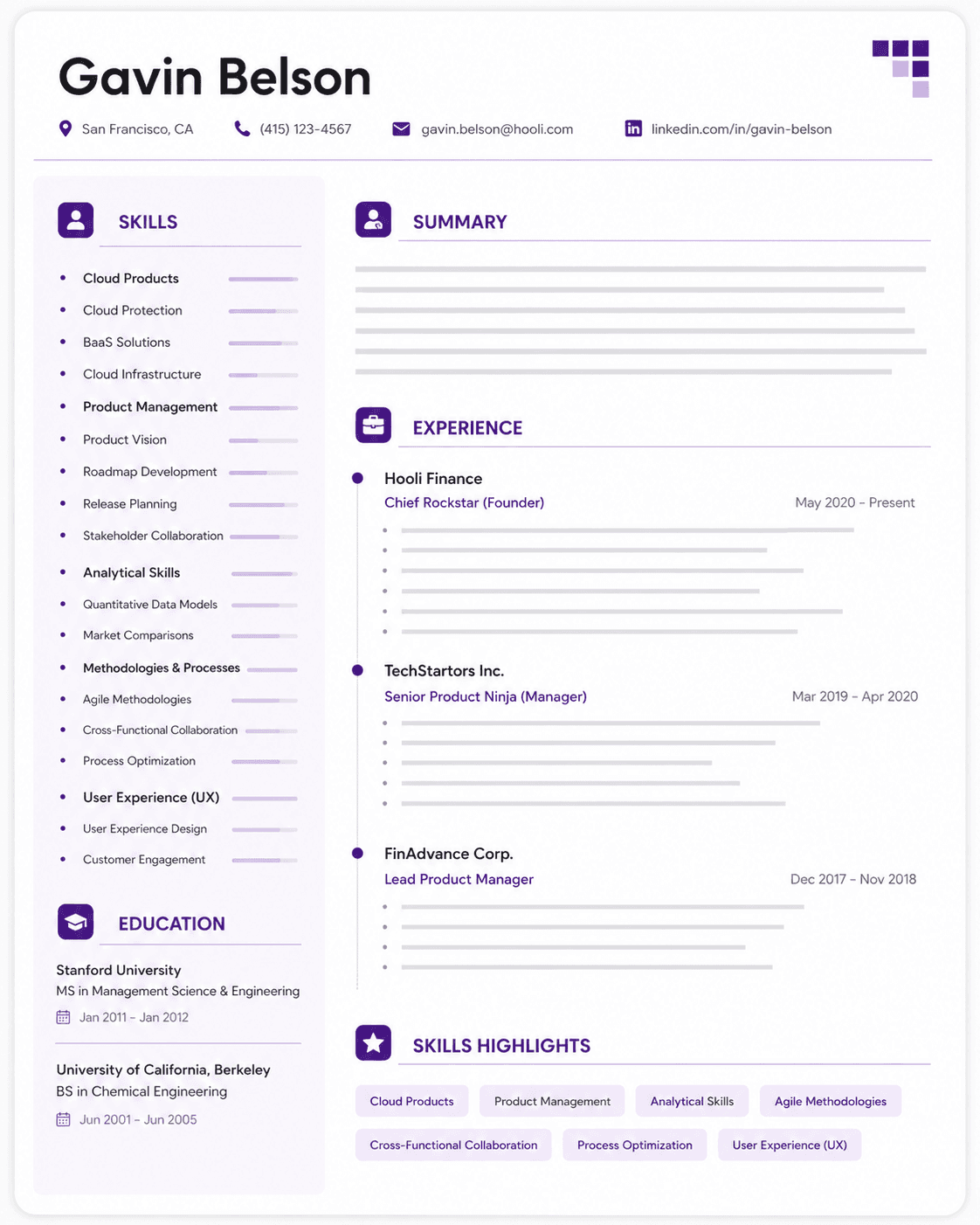
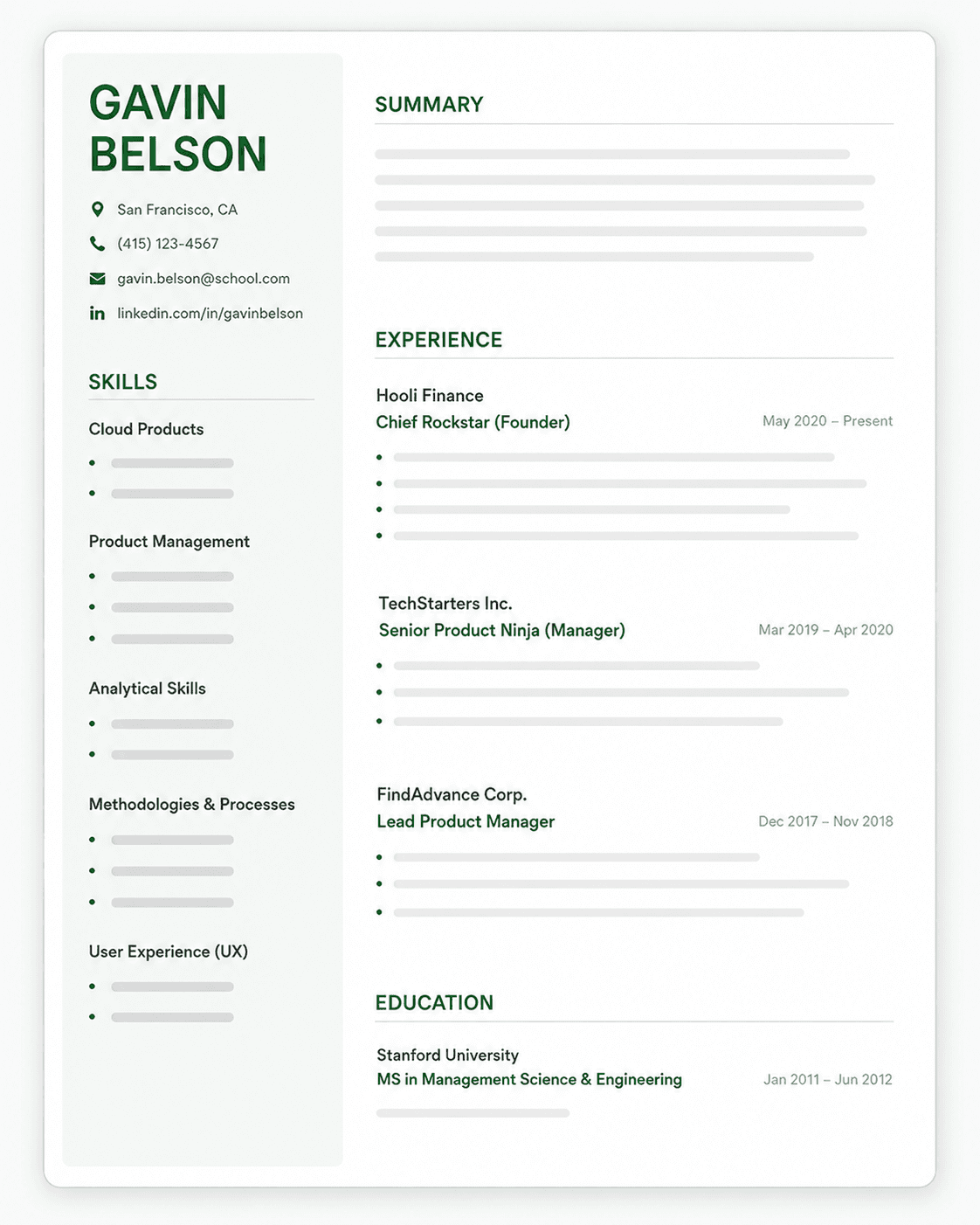
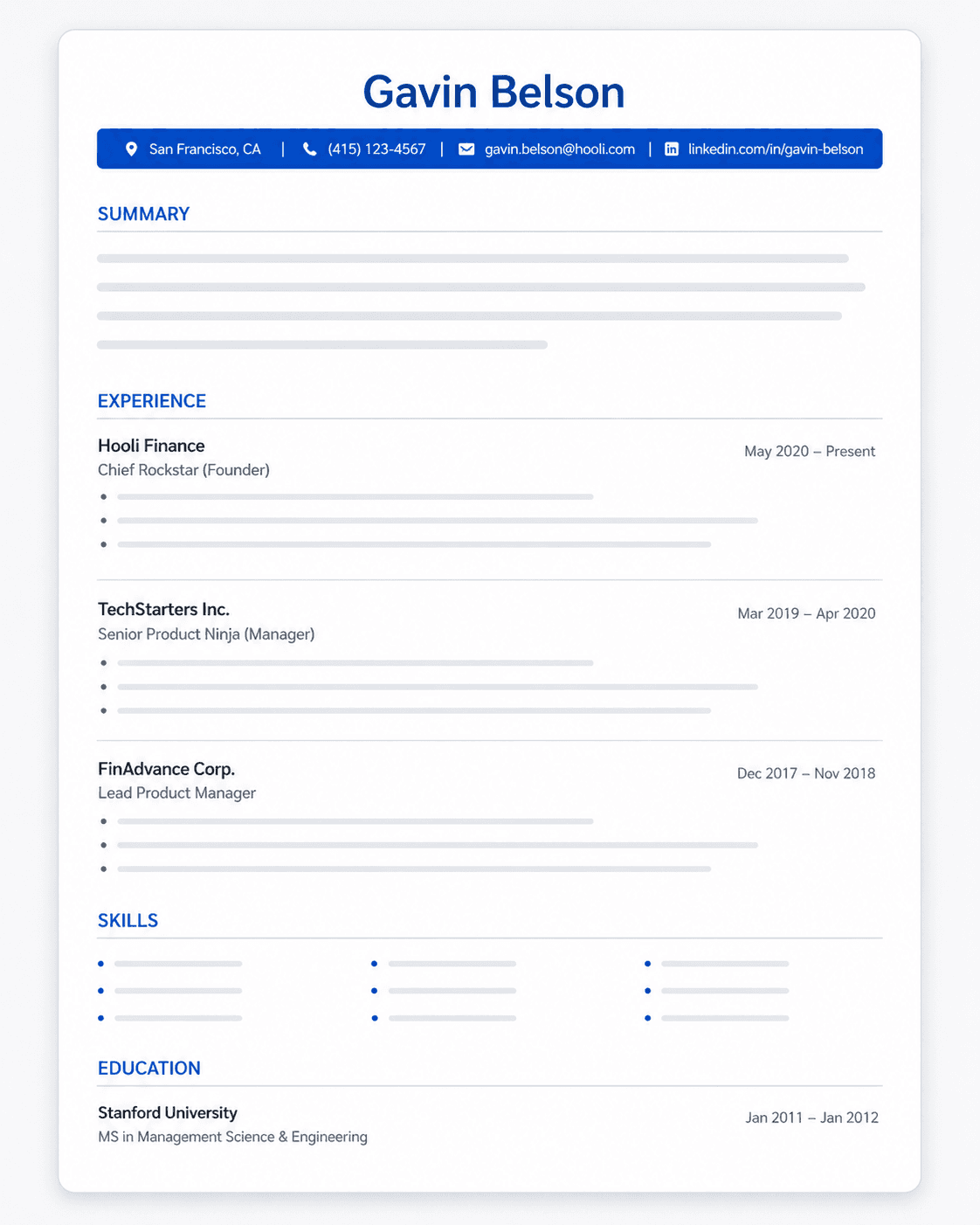
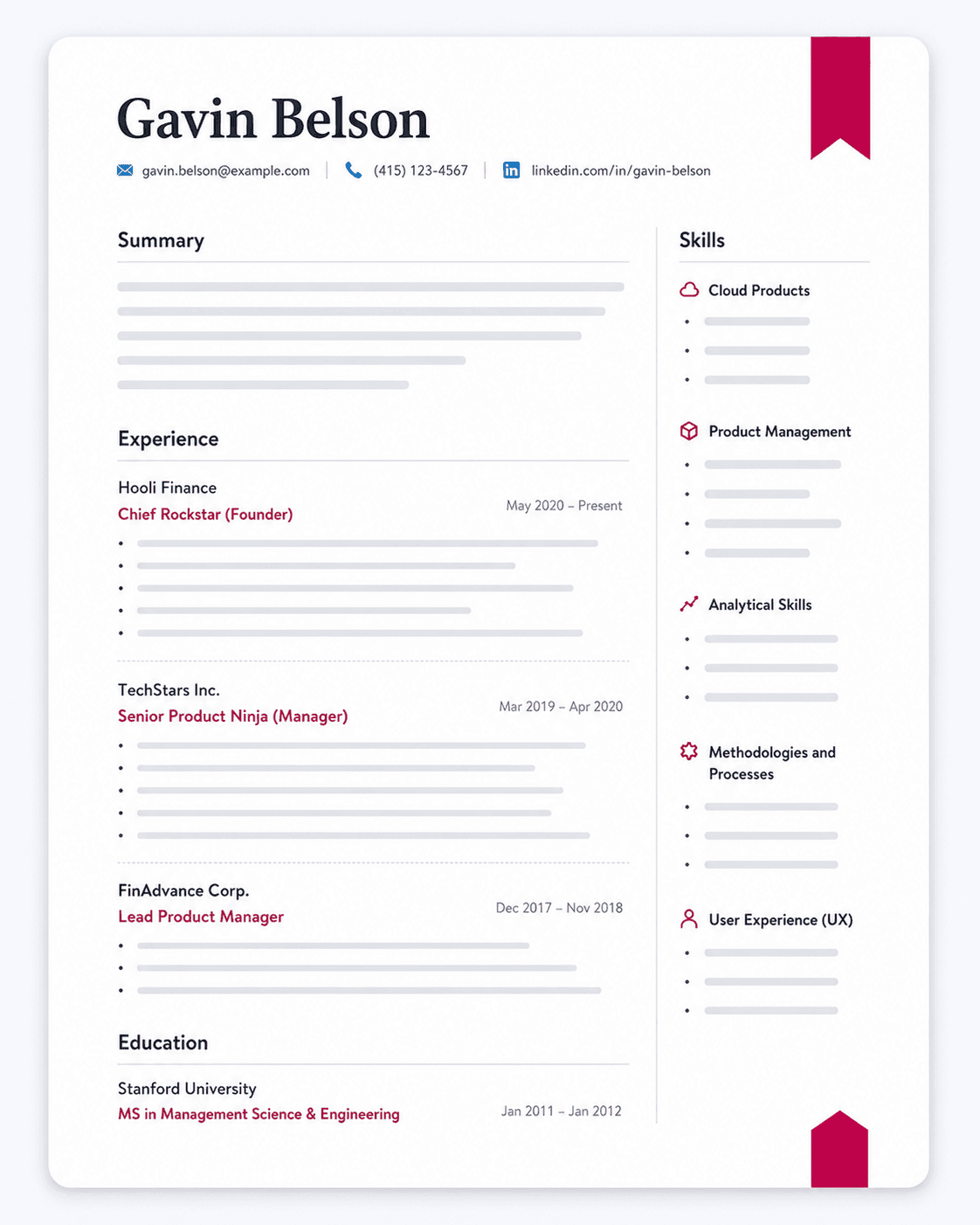
SPED hiring managers care less about years of experience and more about the setting and caseload type you have managed. The two examples below reflect that reality: an entry-level self-contained classroom resume and an experienced multi-setting specialist resume.
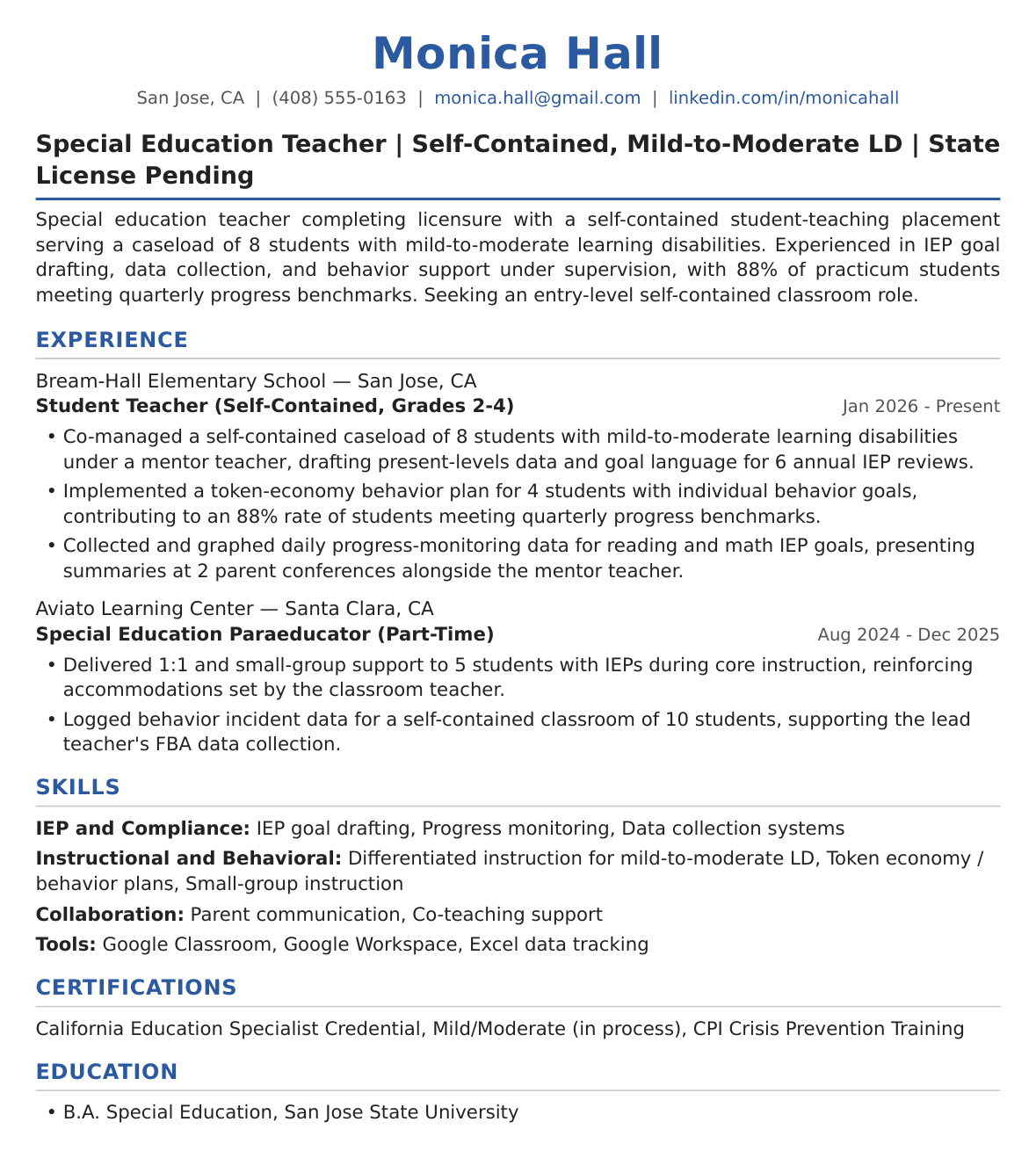
Entry-Level Self-Contained Classroom Resume
This template is built for a first or early-career self-contained placement. It leads with certification status (even if newly earned or pending), highlights student-teaching or practicum caseload experience, and translates coursework into concrete skills like IEP writing, data collection, and behavior support. Bullets focus on what the candidate has practiced under supervision, not years of independent ownership.
Experienced / Multi-Setting Specialist Resume
This template suits a teacher who has worked across settings, such as self-contained, resource room, and inclusion, or who has developed a specialty like autism support or secondary transition services. It emphasizes versatility across caseload types, certification endorsements tied to that specialty, and quantified outcomes: IEP goals met, behavior plan success rates, and collaboration scope across grade levels or co-teaching partners. This is the format for a candidate moving between districts or states who needs to show range, not just tenure.
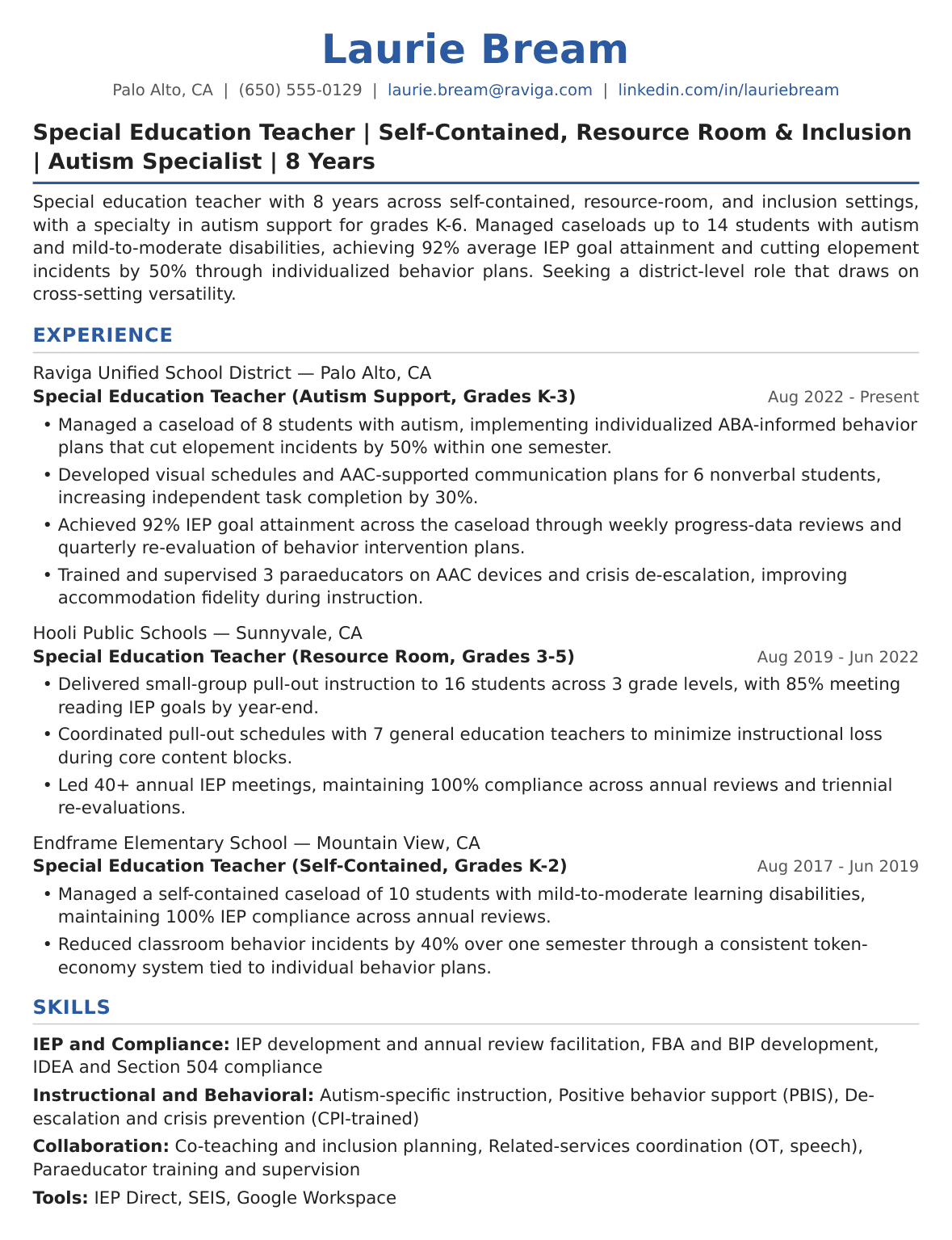
Whichever tier fits your background, use it as a starting point, not a script. Swap in your actual setting, disability categories served, and caseload data before you submit.
Special Education Teacher Resume Keywords
District ATS filters look for IEP language, legal compliance terms, and named instructional approaches. Use the acronyms and their spelled-out forms at least once each, since systems search both.
| Category | Keywords |
|---|---|
| Credentials & law | Special education certification, IDEA compliance, Section 504, Least Restrictive Environment (LRE), FERPA |
| IEP & assessment | IEP development and implementation, IEP goal writing, Progress monitoring, Functional Behavior Assessment (FBA), Behavior Intervention Plan (BIP), Data collection, Accommodations and modifications |
| Instruction | Differentiated instruction, Co-teaching and inclusion, Small-group instruction, Multi-sensory instruction (Orton-Gillingham), Assistive technology, ABA principles, Autism spectrum support |
| Collaboration | IEP meetings, Parent collaboration, Paraprofessional supervision, Transition planning, CPI/de-escalation certification |
Teaching on an Emergency Certificate: How to Present In-Progress Certification
Nearly a third of special education teachers now hold emergency or provisional credentials, and federal law makes the arrangement deliberately temporary: IDEA doesn't recognize emergency-certified teachers as fully qualified, and alternate-route teachers generally must reach full certification within three years. Districts hire on these credentials constantly, but they're reading your resume for one thing: where you are on that clock.
So put the clock on the page. In your certifications section, one precise line: "Emergency Teaching Certificate, [State] — enrolled in [alternate-route program], full SpEd certification expected May 2027; Praxis 5354 passed." Vague "certification in progress" phrasing reads as stalled; a named program with a date reads as on track.
Present your classroom time as full teaching experience, because it is: you were teacher of record, wrote IEPs, ran the caseload. Then add the support context districts want to see with alternate-route hires: "taught under assigned mentor with weekly coaching." That detail isn't a weakness admission; it signals your experience was supervised and structured, which is exactly what compliance-minded administrators need to defend the hire.
Common Special Education Teacher Resume Mistakes to Avoid
Special education hiring committees read closely for compliance rigor, so small resume mistakes carry more weight here than in general education applications. These are the errors that most often cost interviews.
Describing Duties Instead of Outcomes
"Implemented IEPs for students with learning disabilities" tells a hiring manager nothing about your effectiveness. Replace duty statements with results: goal mastery rates, behavior reduction percentages, reading level gains. Committees screen for evidence you move students forward.
Using One Generic Resume for Every Setting
A self-contained classroom resume and a resource-room resume should not read identically. If you're moving from self-contained to a less-restrictive resource role, reframe your bullets around collaboration, co-teaching, and mainstreaming support so the resume matches the setting you're targeting.
Vague Disability-Category Language
"Special needs students" is too broad to be useful. Name the categories and severity level you've actually served: mild-to-moderate learning disabilities, autism, emotional-behavioral disorders. Specificity signals real caseload experience and helps hiring managers match you to their student population.
Burying Your License or Certification
Your state teaching license and special education endorsement belong near the top of the resume, not buried in an education section at the bottom. Districts often screen for licensure status before reading anything else, so list the state, endorsement category, and status (active, pending, reciprocity in progress) up front.
Listing IEP Software Without Proficiency Context
Naming platforms like SEIS, Frontline, or IEP Direct means little on its own. Add what you did with them: managed a caseload of 8-12 IEPs, tracked progress-monitoring data, generated compliance-ready documentation. Context turns a keyword into evidence of real proficiency.
Sharing Identifying Student Details
Never include real student names, initials, photos, or specific identifying details in bullets, work samples, or attached documents, even to illustrate a strong outcome. This violates student privacy expectations under FERPA and is treated by any hiring committee as a serious professional judgment lapse.
Ignoring ATS Formatting
ATS-unfriendly formatting, including tables, text boxes, and graphics used to show caseload data, often gets scrambled by applicant tracking systems. Use standard headings, simple bullet points, and plain formatting so your certification, endorsement, and outcome data actually reach the reviewer instead of getting lost in a parsing error.
How AI Resume Builders Can Simplify Your Special Education Teacher Resume
Rewriting a resume for every SPED opening, whether the role calls out IEP compliance, a specific disability category, or a caseload size, takes time most job-hunting teachers do not have, and a generic resume rarely survives an ATS scan built to catch that exact specificity.
An AI resume builder built for this kind of precision work handles the load differently:
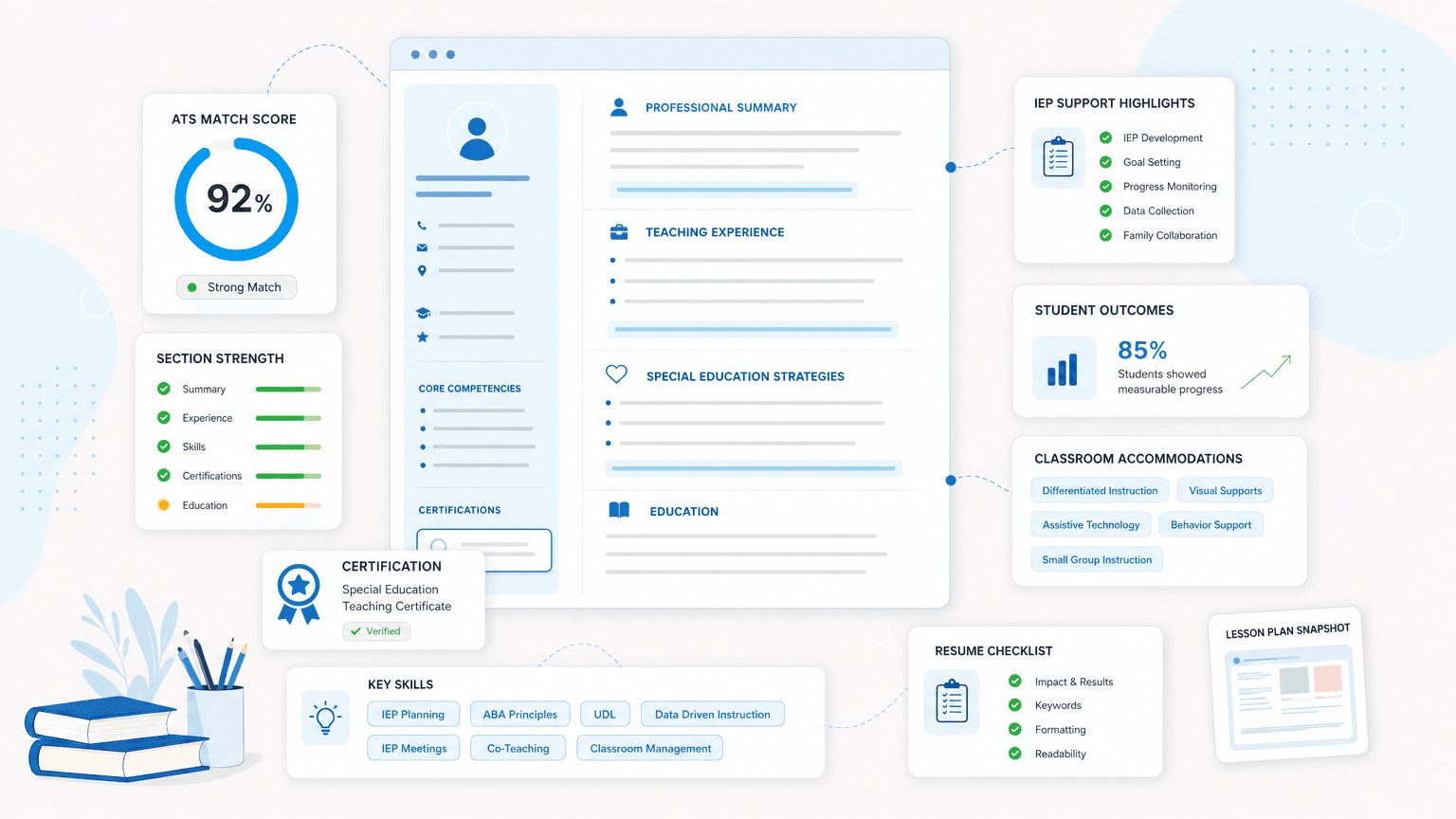
- Real-time ATS scoring: See your score update as you edit, so you can confirm your IEP and case-management language is registering before you submit.
- Transparent suggestions: Every edit comes with a plain-language "Why this change?" explanation. You accept or reject each one, and the AI never invents certifications, endorsements, or experience you don't have.
- Automatic formatting: Resumes with tables or graphics used to organize caseload data or accommodations can get scrambled by ATS parsers. Formatting is handled automatically so the content stays intact and readable by the system.
- Structure guidance: Suggestions follow recruiter best practices, reordering content for relevance, strengthening action verbs, and flagging language that could read as biased, so your experience with specific student populations is described clearly and fairly.
- Preference memory: Formatting, metric, and reordering choices persist across sessions, so tailoring your next application, for a different grade band or disability category, starts from where you left off.
On pricing, the free plan includes 200 ATS scans per month and 3 tailored resumes with unlimited downloads, no credit card required. Beyond that, additional resumes cost $0.50 to $1.00 each, with no subscription.
Tailor Your Special Education Teacher Resume Today
Get an ATS-optimized special education teacher resume, with every change explained, in minutes.