Most TAs don't think of the assistantship as a job. It feels like a stipend attached to grad school, not a line worth defending on a resume next to internships and full-time roles. That hesitation shows up in the writing: vague duty lists, no numbers, no clear sense of who's supposed to read it.
That's the real problem to solve before wording anything. A teaching assistantship is a legitimate role with real scope, real deliverables, and skills that transfer directly to instructional design, project coordination, and people management. This guide shows how to list it as that kind of experience, for an academic search committee expecting a CV or a recruiter scanning a one-page resume for keywords.
Ahead: how to pick the right format for your reader, where to place the assistantship and how to title it, how to build a skills section that survives ATS parsing, a bullet library organized by TA sub-role with real numbers to model, what to do if this is your first TA stint with nothing else on the page, and the mistakes that make otherwise strong teaching experience look thin.
Are You Writing This for an Academic Role or an Industry Resume?
Before you write a single bullet, figure out who's reading this. A teaching assistantship can lead two very different directions, and the right resume format depends on which one you're chasing.
If you're applying to another academic or instructional role (a TA-ship at a new institution, a lecturer position, a program abroad), you may be expected to submit a CV, not a resume. Academic and international hiring committees typically want the fuller CV format: publications, conference presentations, full teaching history, no length cap. That's a different document with different rules than what's covered here.
If you're applying to an internship, an industry job, or any role outside academia, you need a resume, and the assistantship has to be translated. "Led discussion sections" means little to a hiring manager until you reframe it as project coordination, communication, or people management they'll recognize.
Most readers land in the second bucket. That's why the rest of this guide is built around resume format and industry-facing language. If you're firmly on the academic or CV path, use the placement and quantification advice below, but expect a longer, publication-focused document instead.
How to Write a Teaching Assistantship Resume That Gets Interviews
Write a Targeted Summary or Objective
Your summary has three jobs: name your subject area, show the scope of what you actually taught or graded, and signal where you're headed (academic role or industry). Skip the personality adjectives. A hiring manager or search committee wants facts they can verify in the next sentence.
A weak summary looks like this:
"Organized and dedicated teaching assistant with strong communication skills and a passion for education."
A stronger one looks like this:
"Graduate Teaching Assistant in Biology with 3 semesters leading lab sections for 60+ undergraduates. Redesigned weekly quiz format, cutting grading turnaround from 5 days to 48 hours while raising average section grades by 6%."
If this is your first semester and you don't have results to quantify yet, an objective statement works better than a summary. It should still name your field and your target direction.
Entry-level objective example (first-time TA, no prior teaching experience):
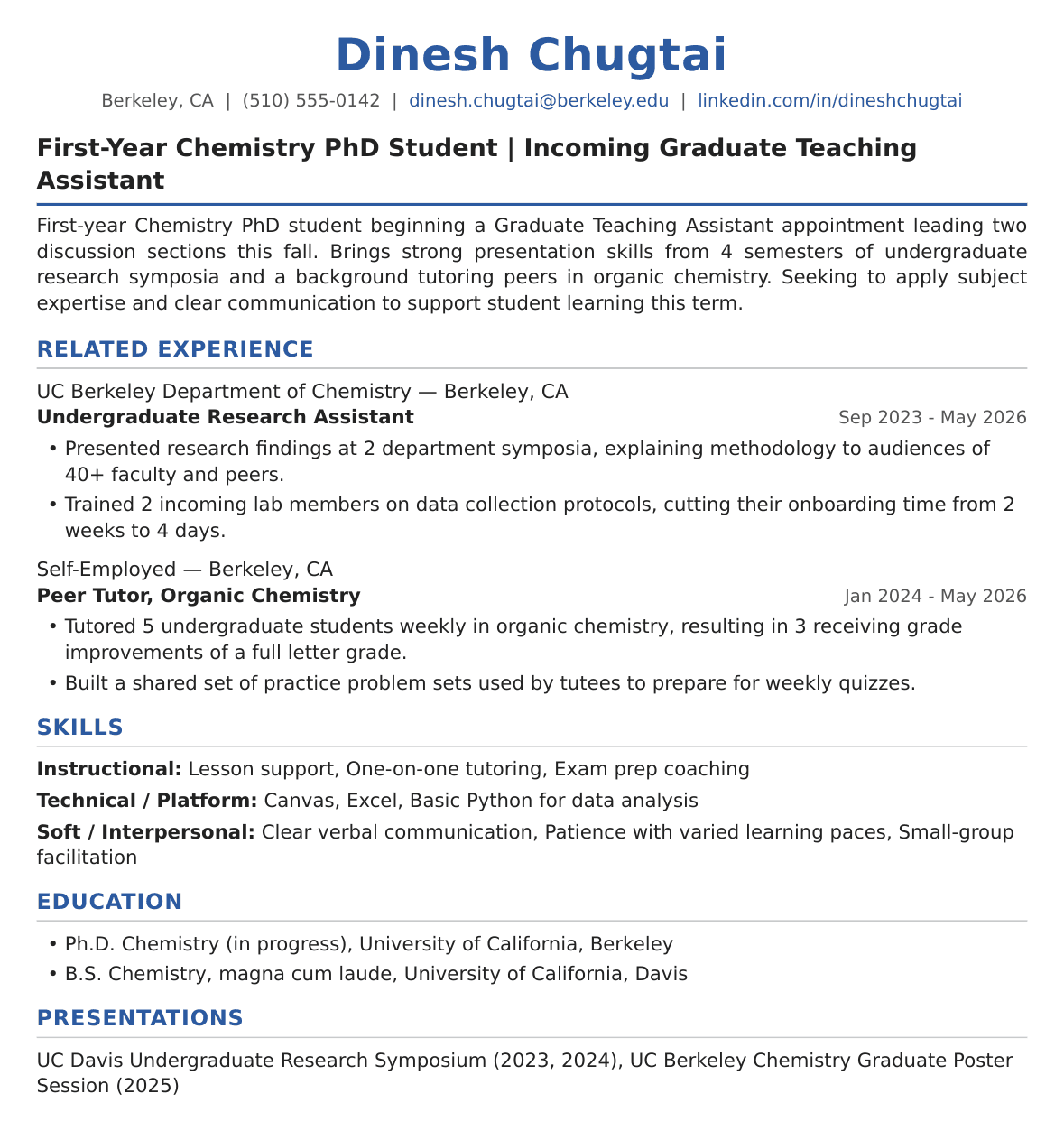
"First-year Chemistry PhD student beginning a Graduate Teaching Assistant appointment leading two discussion sections. Bring strong presentation skills from 4 semesters of undergraduate research symposia and a background tutoring peers in organic chemistry. Seeking to apply subject expertise and clear communication to support student learning this term."
Decide Where, and How, to List the Assistantship
Two questions come up constantly for grad students building this resume for the first time.
Experience section or Education section?
Use the rule of scope. If you held real instructional responsibility, running sections, grading independently, holding office hours, meeting with students, give the assistantship full Experience-section treatment with bullets like any other job. If your role was minor or unpaid (you shadowed a course, helped grade one assignment, or assisted informally), a brief line under your Education entry is enough. Most funded TA appointments belong in Experience. Don't undersell a paid, recurring teaching role by tucking it under your degree. Within either section, list multiple appointments in reverse-chronological order.
What job title do I use?
This trips people up because "Graduate Teaching Assistant" can mean very different things depending on the department. The answer: use your official title, exactly as your university lists it (Graduate Teaching Assistant, Teaching Fellow, Graduate Instructor), as the resume title line. Then use the bullets underneath to clarify what you actually did. Don't invent a title like "Course Coordinator" to sound more senior, and don't downgrade to "Tutor" to sound more humble. The formal title plus specific bullets gives the reader an accurate picture without guesswork.
Build a Skills Section That Speaks to Hiring Managers
Group your skills instead of listing them flat. A categorized block is easier to scan and reads as more deliberate, whether the reader is an academic search committee or a recruiter who has never sat in a lecture hall.
Instructional Lesson support and lecture prep, grading and rubric design, discussion facilitation, exam proctoring, one-on-one student conferencing
Technical / Platform Canvas, Blackboard, Zoom, Gradescope, plus subject-specific tools where relevant (R, Python, SPSS, MATLAB, Jupyter notebooks for STEM sections)
Soft / Interpersonal Clear verbal and written communication, patience with varied learning paces, conflict de-escalation during grade disputes, mentoring first-generation or non-native English speakers
Administrative Office hours scheduling, attendance and gradebook recordkeeping, FERPA-aware handling of student records, coordinating with faculty on syllabus logistics
Only list tools you've actually used unaided, and mirror the language from the job posting where it's accurate. A CS TA who never touched R shouldn't list it just because it's common in the category.
Write Achievement-Focused Experience Bullets
Every experience bullet should follow the same formula: action verb, specific task or method, quantifiable result or scope. "Graded assignments" describes a task. "Graded 200+ weekly problem sets using a standardized rubric, cutting turnaround time to 48 hours" describes an achievement.
A weak bullet looks like this:
"Responsible for helping students and grading homework."
A stronger one looks like this:
"Held weekly office hours for 45 students across 3 discussion sections, resolving conceptual gaps that raised the section's average exam score by 8 points."
Here's how that formula plays out across different TA roles.
STEM TA (labs, problem sets, code review)
- Led 2 weekly lab sections of 24 students each in Organic Chemistry, grading lab reports against a 6-point rubric with 72-hour turnaround
- Reviewed and debugged 30+ student Python submissions per week for an Intro to CS course, holding 4 office hours weekly to walk through common errors
Humanities / Social Science TA (discussion sections, essay grading)
- Facilitated 3 weekly discussion sections for a 90-student Political Theory lecture, designing prompts that raised participation grades by 15%
- Graded 60 argumentative essays per assignment cycle using a shared departmental rubric, providing written feedback within one week
Online / Hybrid TA
- Moderated a Canvas discussion board for a 150-student asynchronous course, responding to student questions within 24 hours on average
- Ran weekly Zoom review sessions for 40 remote students, recording and posting sessions to raise unit quiz scores by 10%
Research Assistant with a teaching component
- Co-taught a methods workshop for 12 incoming graduate researchers while managing a 3-person data collection team
- Trained 4 undergraduate research assistants on lab protocols, reducing onboarding time from 2 weeks to 4 days
Undergraduate-level TA
- Assisted a professor in a 200-student Intro to Psychology lecture, staffing weekly office hours for 20-25 students per session
- Graded weekly reading responses for 50 students, flagging common misconceptions that shaped the following week's lecture
If you're short on numbers, look in places you might not think to check: section or class size, how many sections you taught per semester, hours of office hours per week, your grading turnaround time, any measurable grade or attendance improvement in your sections, and student or professor evaluation scores if your department shares them.
Turn Coursework, Research, and Prior TA Stints Into Experience
If you're early in your program, you likely have more relevant material than you think. Graduate coursework, conference presentations, prior research assistantships, informal tutoring, and group projects you led can all become proof points, even if they weren't formal jobs.
A few ways to translate them:
- Coursework: A graduate seminar where you led a session or presented a paper becomes "Led a 90-minute seminar discussion on [topic] for 15 graduate peers."
- Research assistantships: Training a labmate or presenting findings counts. "Presented research findings at 2 department symposia" and "trained 2 incoming lab members on data protocols" are both legitimate bullets.
- Tutoring or mentoring: Even unpaid or informal tutoring shows the same skills a TA role requires. "Tutored 5 undergraduate students weekly in statistics, resulting in 3 receiving grade improvements of a full letter grade."
Frame these under a "Related Experience" or "Research & Teaching" heading rather than mixing them into your main assistantship entry, so the reader can still see your TA role as the clear anchor.
What to Include With No Teaching Experience
If this is your first semester as a TA and you have nothing to put above it, that's not a gap you need to explain away. Graduate teaching assistantships are routinely someone's first professional role, departments hand them to first-years specifically because they come with funding attached, not because applicants are expected to already have classroom experience.
What to lean on instead:
- An objective, not a summary. State your subject area, your appointment (sections, office hours, grading load), and what you're aiming for.
- Subject mastery. Coursework, GPA in your area of specialty, or relevant undergraduate research signals you know the material even before you've taught it.
- Transferable skills from adjacent work. Customer-facing jobs, camp counseling, resident advising, or peer mentoring all involve the same core skills: communication, organization, and managing a room of people who need something from you. Name the skill explicitly and connect it: "Managed a team of 6 as a resident advisor, developing the conflict-resolution skills now applied to office hours and grade disputes."
Teaching Assistantship Resume Examples
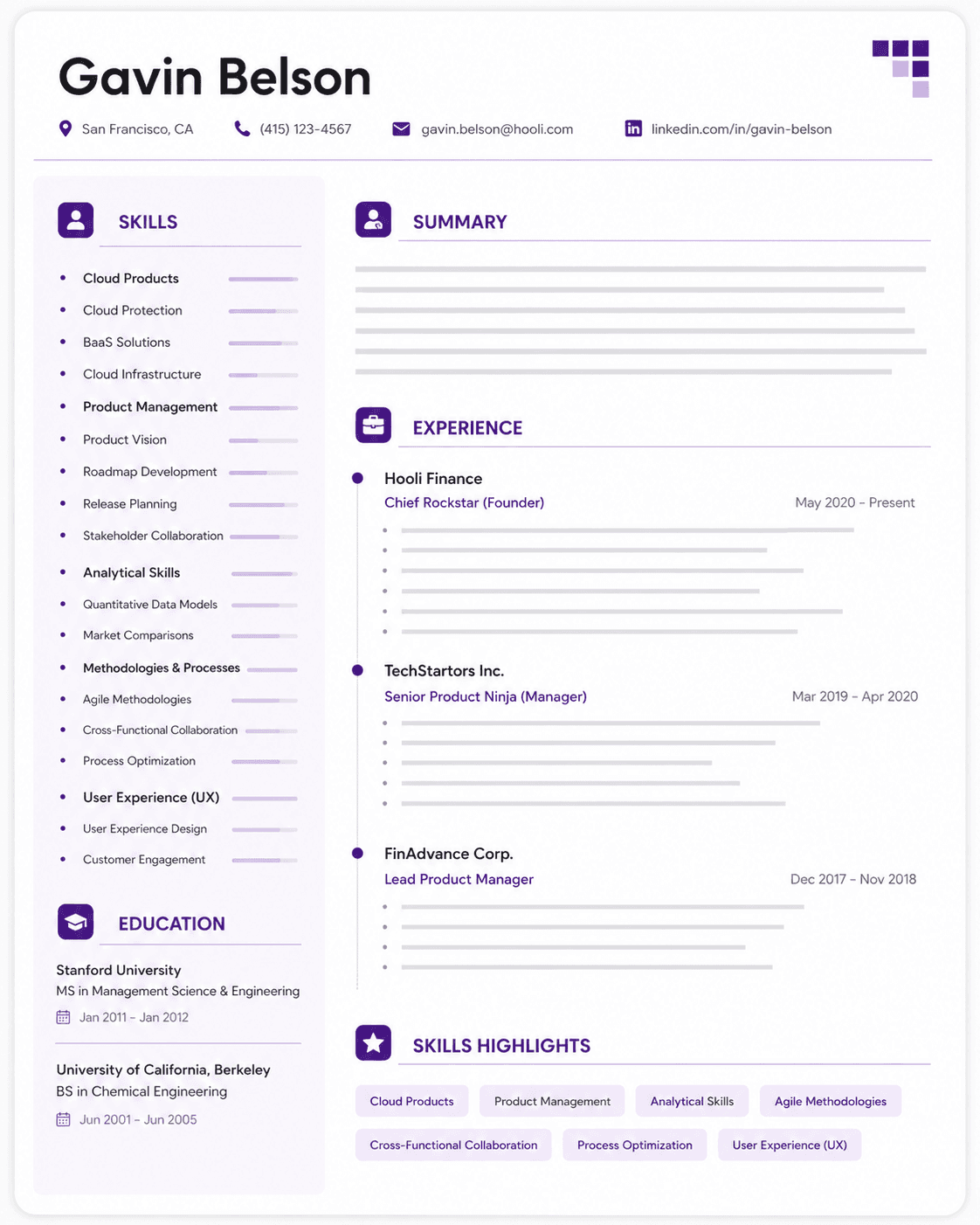
Entry-Level Teaching Assistantship Resume
For a first-time TA with no grading or classroom experience to point to. It leads with an objective or summary line, then pulls weight from relevant coursework, tutoring, group projects, and any presenting or mentoring experience. Skills sections carry more of the load here since the work history is thin.
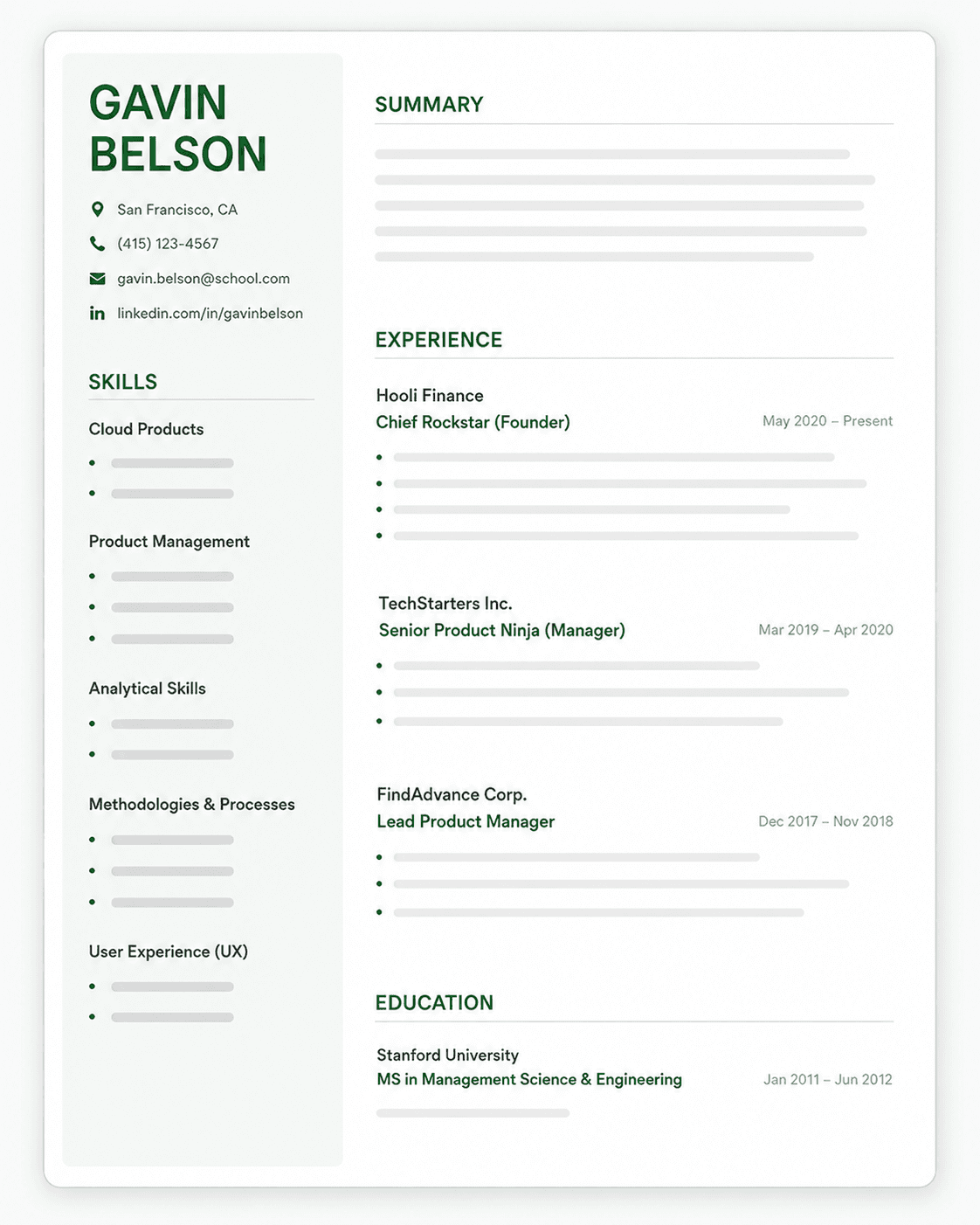
Mid-Level Teaching Assistantship Resume
For a TA in their second or third year who has run sections, held office hours, and graded across multiple semesters. This version replaces the objective with a professional summary and adds a dedicated experience section with bullet points quantifying section sizes, grading volume, and any curriculum or lab material contributions.
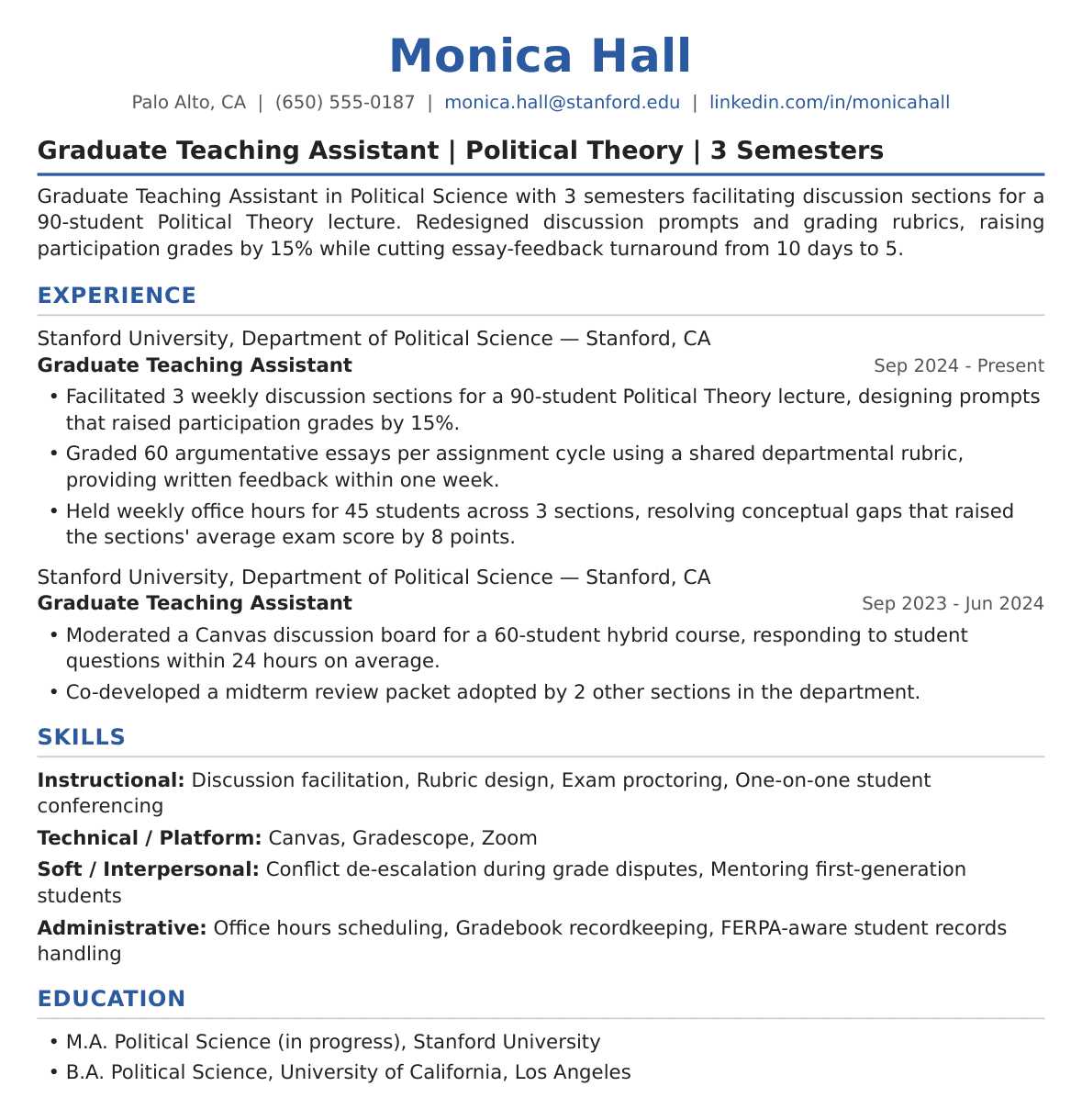
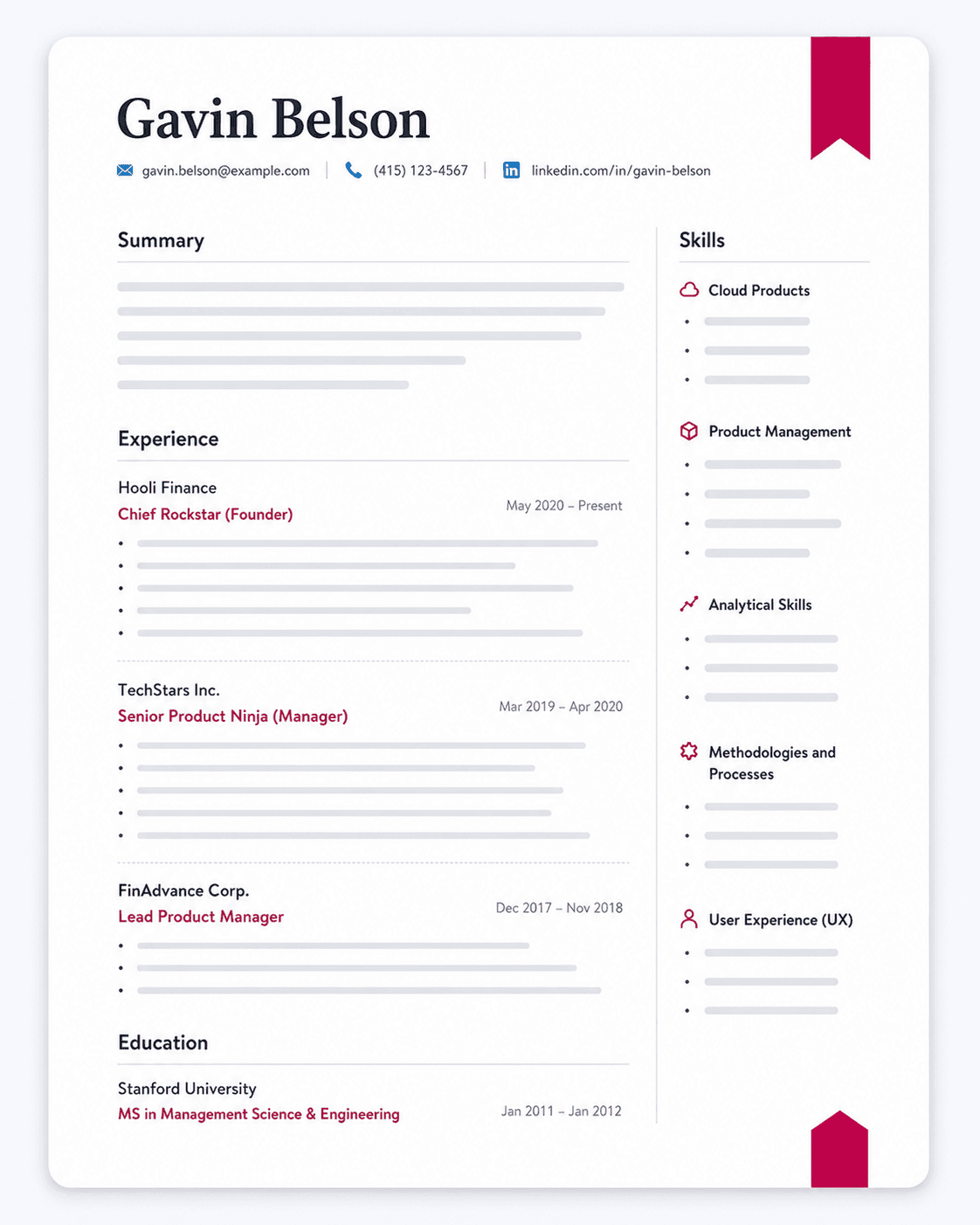
Senior-Level Teaching Assistantship Resume
For a head TA, a TA who supervises or trains other TAs, or someone transitioning toward instructor or adjunct roles. This version foregrounds leadership: training new TAs, designing assessments, coordinating with faculty on syllabus decisions, and any independent lecturing. It reads closer to an academic CV in structure while keeping resume-length brevity.
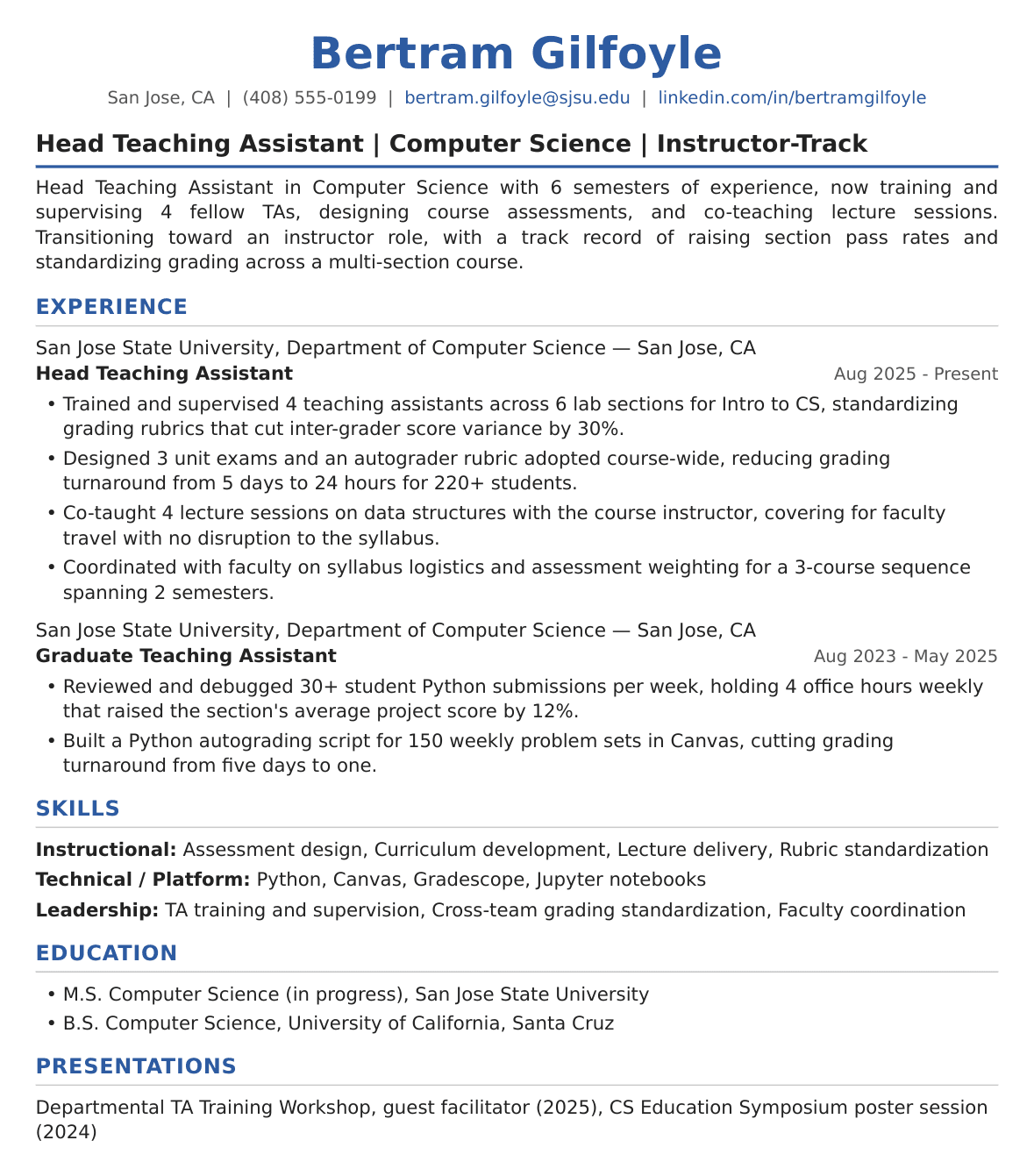
Teaching Assistantship Resume Keywords
Whether you are targeting academic or industry roles, these terms translate TA work into screening language. Pick the rows that match the job family you are applying to.
| Category | Keywords |
|---|---|
| Instruction | Undergraduate instruction, Discussion section leadership, Lab instruction and supervision, Guest lectures, Lesson planning, Student engagement, Classroom management |
| Assessment & support | Grading and assessment, Rubric development, Exam proctoring, Feedback delivery, Office hours, Student mentoring, Academic integrity |
| Tools & development | Learning management systems (Canvas, Blackboard, Moodle), Course material development, Syllabus support, Pedagogy training, Research support |
International TAs: Making Your Assistantship Count as US Work Experience
If you TA'd on an F-1 visa, you're job hunting with two extra screens no domestic candidate faces: employers unsure whether your assistantship was "real" US work experience (it was), and the unasked sponsorship question shaping whether you get a callback at all.
Answer the authorization question before it's asked, in your header or summary: "F-1 OPT: authorized to work in the US through [month/year]" and, if applicable, "STEM OPT extension eligible (36 months total)." Recruiters at sponsorship-cautious companies screen for this line, and its absence, not your qualifications, is often why international resumes go quiet.
Present the TA-ship itself as employment, not studies: US institution, title, dates, then achievement bullets, "taught 3 weekly sections of 30 students; graded for a 200-student course to deadline every week for 4 semesters." Note that OPT requires work related to your major, so bullets that tie teaching duties to your field ("led programming labs" rather than "assisted professor") do compliance and persuasion in the same sentence. Finally, strip the conventions US screeners flag: no photo, no nationality or marital status, no date of birth, even though resumes back home may expect all four.
Common Teaching Assistantship Resume Mistakes to Avoid
Describing Tasks Instead of Impact
Listing duties without outcomes reads flat: "Led discussion sections" or "Graded assignments." A stronger version shows what changed because of the work. Instead of "Held office hours," write "Ran weekly office hours that lifted average quiz scores by 12% over the semester."
Using One Generic Resume for Academic and Industry Applications
A CV aimed at a faculty search committee and a resume aimed at a corporate recruiter need different framing, even if the underlying experience is identical. Academic CVs can include full course lists, pedagogical philosophy, and multi-page detail. Industry resumes need one page, action verbs, and transferable skills like curriculum design, stakeholder communication, or data analysis. Submitting the same file to both audiences signals you have not thought about who is reading it.
Listing Tools and Skills Without Specificity
"Familiar with Excel, Python, LMS platforms" tells a reader nothing. Specify what you actually did: "Built a Python script to auto-grade 150 weekly problem sets in Canvas, cutting turnaround from five days to one."
Ignoring ATS Formatting
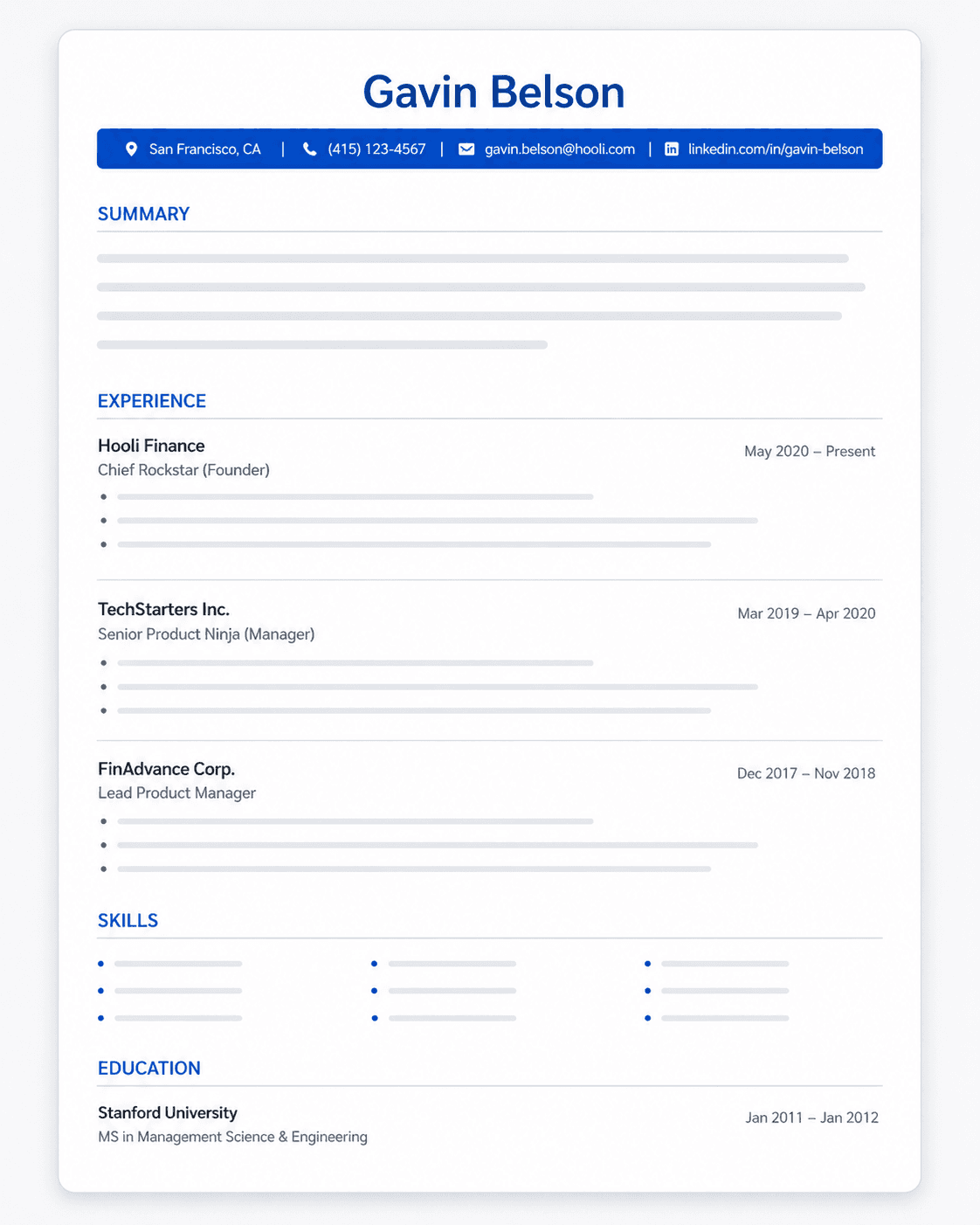
ATS-unfriendly formatting, including tables, text boxes, and multi-column layouts, often gets mangled or dropped entirely when parsed by applicant tracking systems. A TA who packs course names and semester dates into a graphic sidebar may show up in the system as a resume with no experience section at all. Stick to a single column, standard headers like Experience and Education, and plain bullet points.
Omitting Scale: Course, Department, Section Size, or Semester Count
"Assisted with an undergraduate course" could mean 15 students or 300, one semester or three. Without the course name, department, enrollment figure, and duration, the role sounds smaller and harder to verify than it was. Write "TA for Intro to Statistics (Department of Mathematics), supporting 120 students across three lab sections over four semesters" instead.
Collapsing Grading and Instructional Design Into One Line
Grading exams and building the rubric or lesson plan those exams were based on are different levels of responsibility, but many resumes flatten them into "graded and taught course material." If you wrote quiz questions, designed a grading rubric, or restructured a lab exercise, say so separately from routine grading. That distinction is what separates a support role from one with real instructional ownership.
Omitting Research or Mentoring Work That Rounds Out the Resume
TAs who also mentored undergraduates in a lab, co-authored a paper, or supervised independent study projects often leave that out, since it feels separate from "teaching." Add a line for it, even briefly: "Mentored 4 undergraduate researchers on data cleaning methods used in a published study."
How AI Resume Builders Can Simplify Your Teaching Assistantship Resume
If you're applying to several TA postings across departments, or using a TA role as a launchpad into industry or internships, rewriting your resume for every listing eats hours you don't have, and a generic version risks getting filtered before a hiring committee ever reads it. AI resume builders like Upplai speed up that tailoring without asking you to hand over control of your own document.
- Real-time ATS scoring: See your ATS and recruiter match score update as you edit, so you know immediately whether a change to your teaching, research, or grading experience actually helped, with no download-and-reupload cycle.
- Transparent suggestions: Every edit comes with a plain-language "why this change" explanation. You accept or reject each one individually, so nothing gets rewritten or invented behind your back.
- Automatic formatting: Your resume is checked and adjusted for ATS-friendly formatting, catching tables, headers, or layout choices that can confuse parsing systems before a recruiter sees the document.
- Structure guidance: Suggestions follow recruiter best practices, reordering content for relevance, strengthening action verbs, and quantifying outcomes like sections taught or students supported, while flagging language that could trigger bias.
- Preference memory: Your formatting, metric, and reordering choices carry over across sessions, so tailoring your next application starts from where you left off instead of from scratch.
On pricing, the free plan includes 200 ATS scans a month, 3 tailored resumes, and unlimited downloads, with no credit card required to start. If you need more tailored resumes beyond that, additional ones cost $0.50 to $1.00 each, with no subscription required.
Tailor your teaching assistantship resume in minutes
See where your teaching assistantship resume really stands with a free, instant resume check.
A teaching assistantship is a real job with real deliverables: sections taught, students graded, office hours held, materials built. Write it that way and it reads like professional experience, whether the person on the other end is a hiring committee or a recruiter scanning for keywords. Match the framing to the reader, back every bullet with a number, and the resume stops looking like an afterthought.