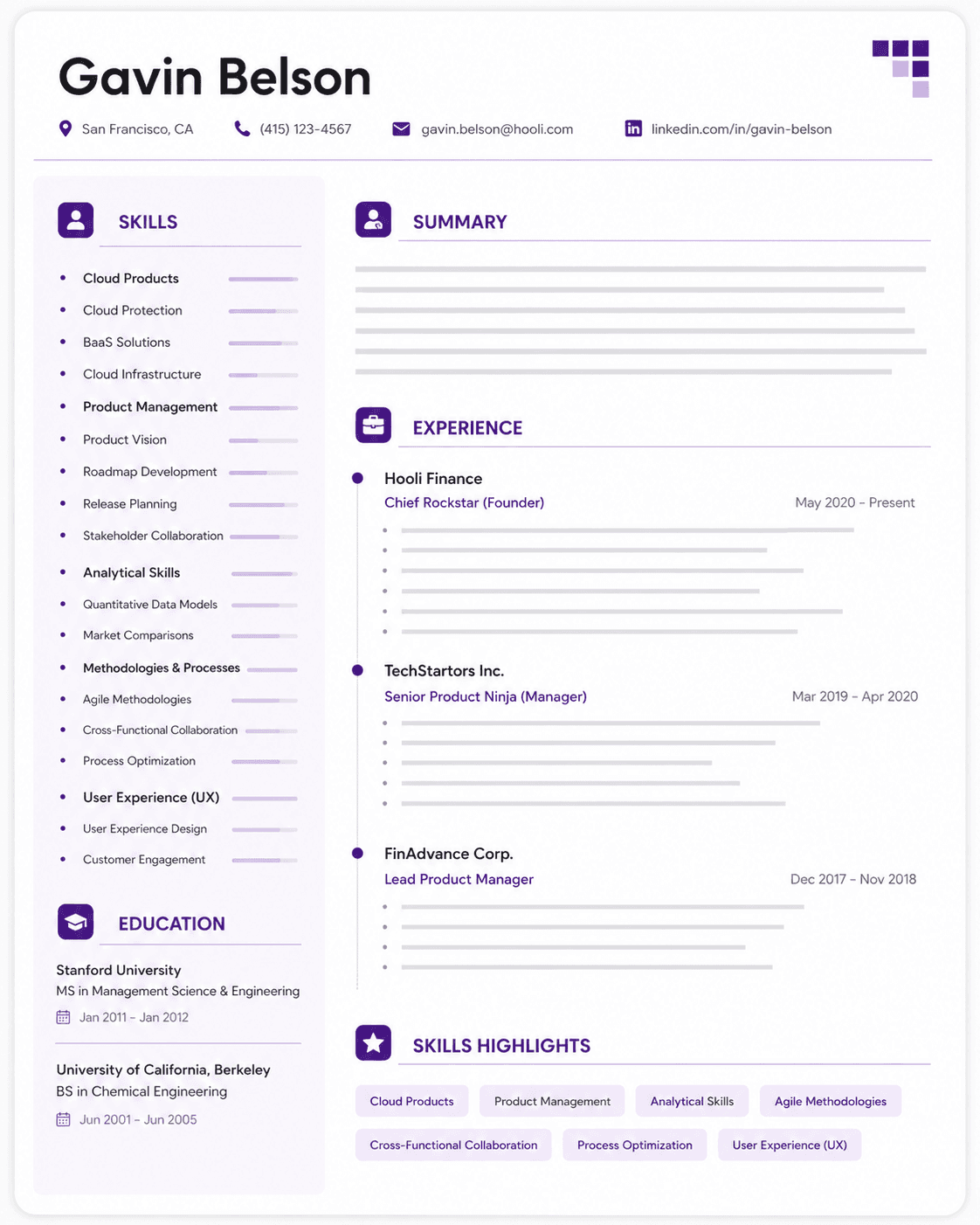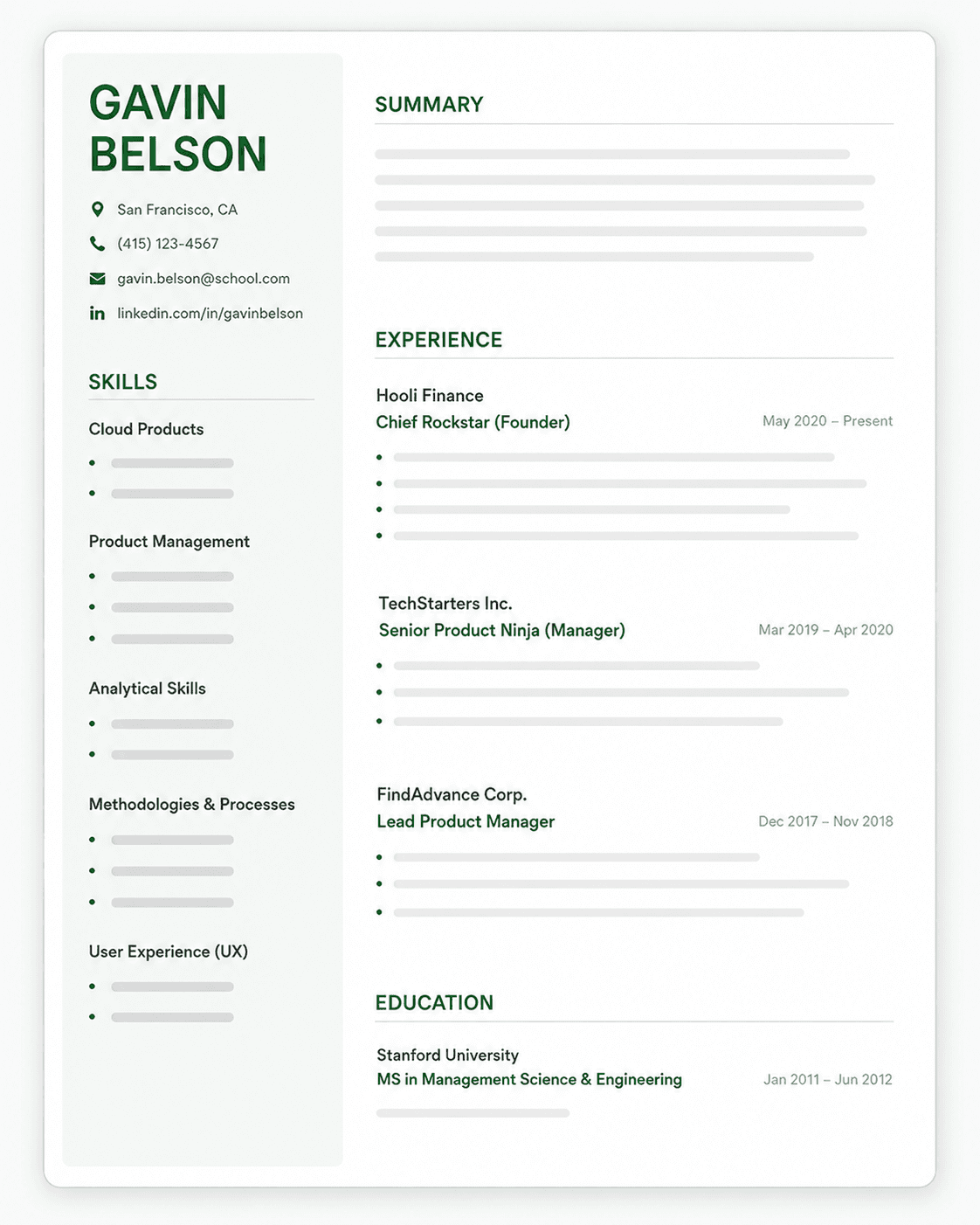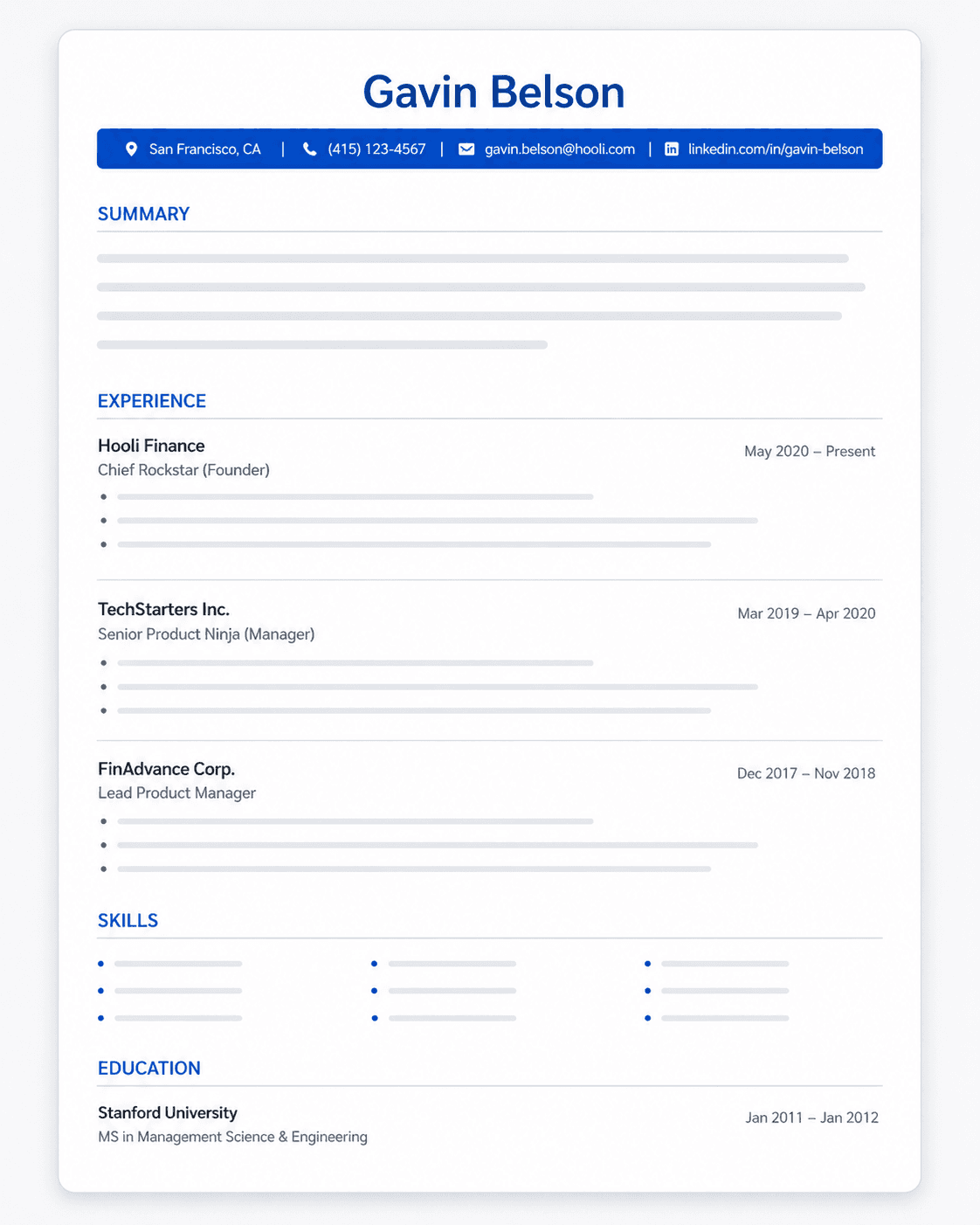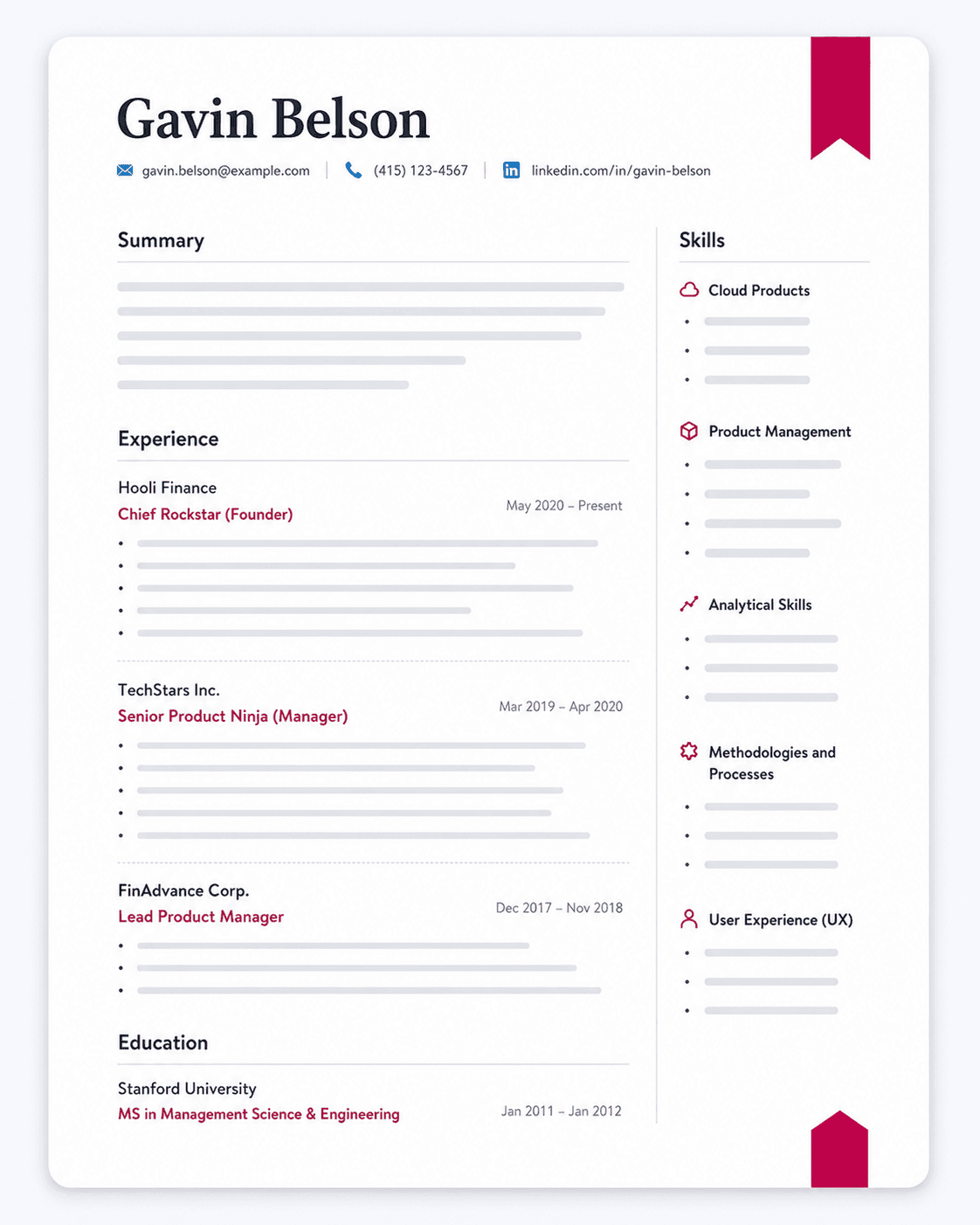
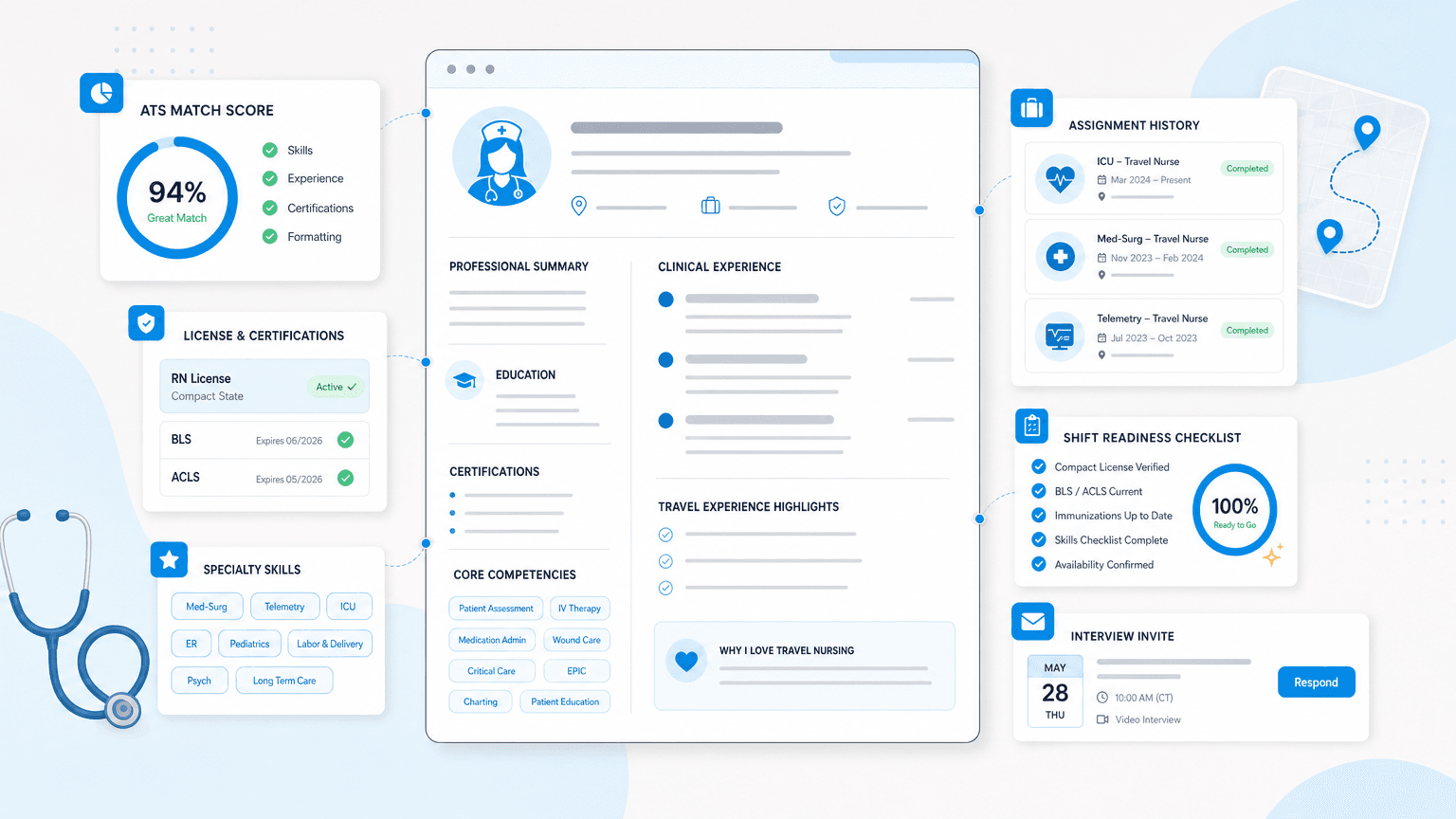
Five hospitals in three years reads as instability on most resumes. On a travel nurse resume, it's supposed to read as proof you're requested, extended, and rehired, but only if the formatting does the work. Without the right structure, a strong contract history gets mistaken for a candidate who can't hold a job.
This article gives you the exact format recruiters and hiring managers expect from a travel nurse resume: how to list your agency and assignments, where your license and compact status belong, how to write bullets that show impact instead of duties, and how to handle gaps or sensitive assignment types without over-explaining them.
It walks through the resume structure first, then covers what makes a travel nurse resume different from a staff nurse resume, examples by experience level, common mistakes, and how to adjust the resume by specialty and career stage.
How to Write a Travel Nurse Resume That Lands Assignments
Recruiters scan travel nurse resumes fast, often between shifts of their own. Your job is to make your assignment history, licenses, and skills readable in under a minute, and to frame your short contracts as proof of range instead of a red flag.
Write a Summary That Sells Adaptability, Not Just Tenure
A travel nurse summary needs to do two things: name your specialty and years of experience, then reframe your assignment count as versatility. Recruiters read "5 hospitals in 3 years" as either instability or serious adaptability, depending entirely on how you word it.
A weak summary looks like this:
"Registered nurse with 3 years of experience working at multiple hospitals in different states. Looking for a new travel assignment."
A stronger one looks like this:
"ICU travel RN with 3 years and 6 completed contracts across Level I and Level II trauma centers in 4 states. Onboards in under 48 hours, adapts quickly to new EHR systems and unit protocols, and has been offered extension on 4 of 6 assignments."
Entry-level / first-assignment variant
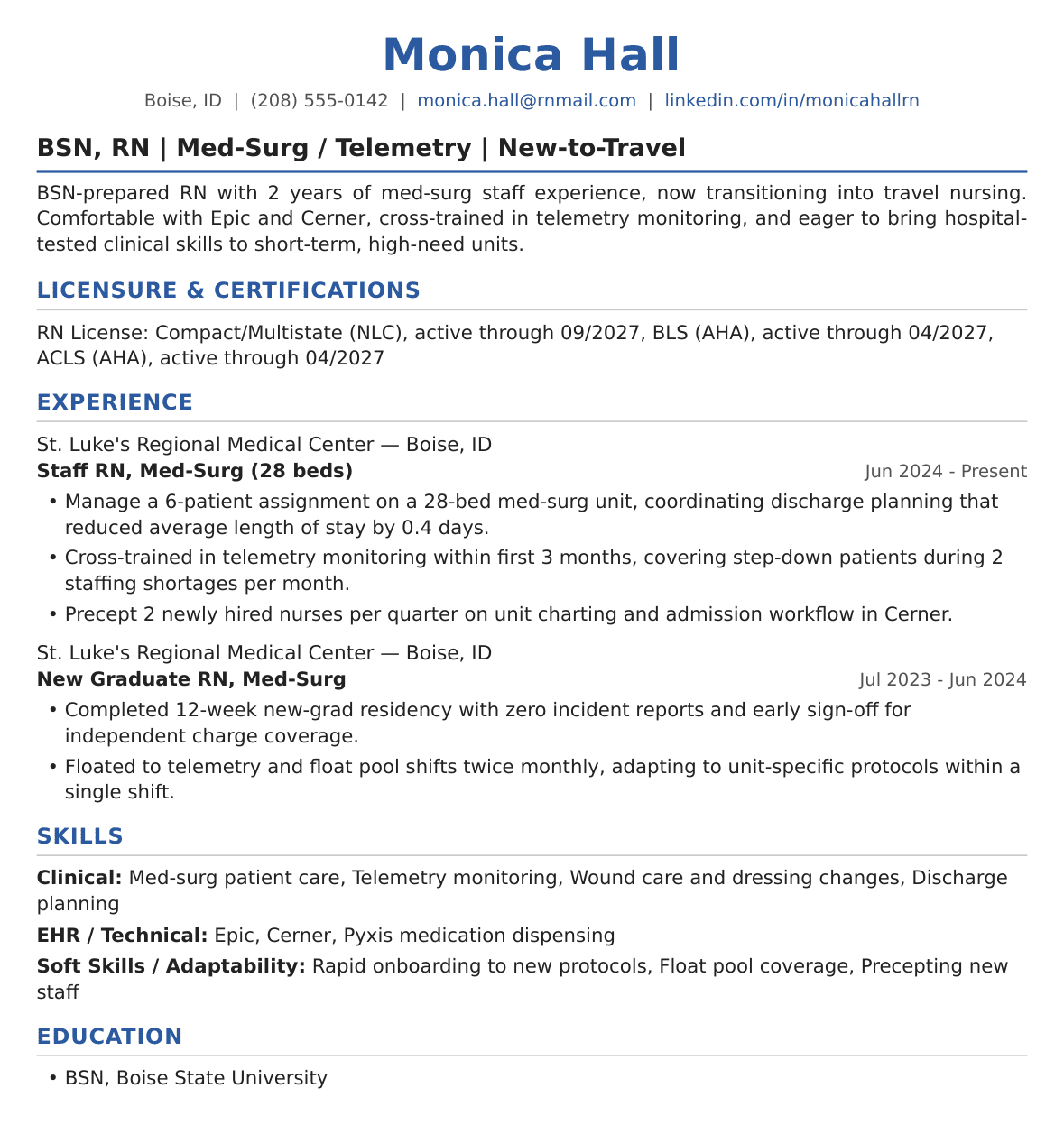
"BSN-prepared RN with 2 years of med-surg staff experience, now transitioning into travel nursing. Comfortable with Epic and Cerner, cross-trained in telemetry monitoring, and eager to bring hospital-tested clinical skills to short-term, high-need units."
List Your Agency and Assignments the Right Way
Travel nurse work history reads differently than a staff nurse resume. List your staffing agency as the employer of record, then nest each hospital assignment underneath it with facility name, unit, dates, bed count, and EHR system. Keep agencies and their assignments in reverse-chronological order. This ATS-friendly structure lets the parser and a human recruiter both find what they need without digging.
Label each entry "Travel RN" if it was agency-placed, and "Staff RN" if it was a direct hospital hire. Mixing the two without labels is what makes a resume look like job-hopping instead of contract work.
Aya Healthcare, Travel RN
Jan 2023 - Present

Cedar Grove Medical Center, Med-Surg Unit (32 beds), Denver, CO | Epic | Aug 2024 - Present
St. Luke's Regional, ICU (18 beds), Boise, ID | Cerner | Feb 2024 - Jul 2024
Riverside General, ICU (24 beds), Sacramento, CA | Meditech | Jan 2023 - Jan 2024
Lead With Licenses and Certifications
Put your license status and certifications near the top of the resume, right under your summary or in a dedicated header line. If you hold a Nurse Licensure Compact (NLC) multistate license, say so explicitly. It's the fastest thing a recruiter checks before reading further, since it determines how quickly you can start.
List every license and certification with its issuing body and expiration status so nothing needs a follow-up email.
RN License: Compact/Multistate (NLC), active through 06/2027
BLS: AHA, active through 03/2026
ACLS: AHA, active through 03/2026
CCRN: AACN, active through 11/2025
Build a Skills Section That Speaks to Recruiters and Hiring Managers
Group your skills instead of listing them in one long row. Recruiters and ATS filters both scan categorized skills faster, and hiring managers use this section to match you against a specific unit's needs.
Clinical
- Ventilator management, titratable drips, hemodynamic monitoring
- Rapid response and code team participation
- Wound care and central line dressing changes
EHR / Technical
- Epic, Cerner, Meditech
- Pyxis medication dispensing
- Telemetry and remote patient monitoring systems
Soft Skills / Adaptability
- Rapid onboarding to new units and protocols
- Cross-department float coverage
- Precepting new staff and travelers
Only list skills you can perform unaided on day one of a new contract. When a job posting names a specific EHR or protocol, use its exact wording. This is what pushes your resume past both the applicant tracking system and the first human read.
Write Achievement-Focused Experience Bullets
Use this formula for every experience bullet: action verb, plus the specific task or method, plus a quantifiable result or scope. Vague duty lists are what make travel nurse resumes blend together.
Weak: "Responsible for patient care in the ICU and worked with the care team."
Strong: "Managed a 2:1 patient ratio in an 18-bed ICU, coordinating with intensivists on ventilator weaning protocols that reduced average extubation time by 1 day."
ICU / Critical Care traveler
- Maintained 1:2 patient ratio across 24-bed ICU during a 13-week contract, earning a 96% patient satisfaction score
- Trained 3 new travel nurses on unit-specific charting in Cerner, cutting onboarding time by 2 days
ER / Trauma traveler
- Triaged an average of 18 patients per 12-hour shift in a Level I trauma center, maintaining sub-10-minute door-to-provider times
- Extended original 8-week contract to 16 weeks after consistently meeting rapid-assessment benchmarks
Med-Surg traveler
- Managed a 6-patient assignment on a 32-bed unit, coordinating discharge planning that reduced average length of stay by 0.5 days
- Cross-trained in telemetry monitoring within first week, covering both med-surg and step-down patients during staffing shortages
First-time traveler
- Completed first 13-week ICU contract with zero incident reports and a formal extension offer
- Adapted to a new EHR system (Meditech) within 3 shifts, verified by charge nurse sign-off
If a contract did not leave you with clean metrics, look for numbers in your last performance review, unit huddle stats, or notes your charge nurse kept on staffing ratios and outcomes. Even a bed count or shift frequency turns a duty list into a scope statement.
What Makes a Travel Nurse Resume Different From a Standard Nursing Resume?
A staff nurse resume answers to one employer. A travel nurse resume answers to two audiences at once: the agency recruiter deciding whether to submit you to a facility, and the hospital manager deciding whether to accept that submission. Each reads for different signals, and the resume has to satisfy both without contradicting either.
Recruiters scan for placement speed: licenses, certifications, availability, and proof you can walk into a new unit and perform immediately. Hiring managers scan for fit and reliability, since they are absorbing a stranger into their team for 13 weeks.
This changes how tenure gets read. On a staff resume, five jobs in three years looks unstable. On a travel resume, five assignments in three years is the expected pattern, and it should read as evidence you are requested, extended, or rehired, not evidence you cannot hold a job.
The resume also has to demonstrate range instead of depth. Rather than showing growth at a single hospital, it needs to show you can adapt across facility types, EHR systems, and patient populations, since that breadth is what makes a traveler valuable.
Travel Nurse Resume Examples by Experience Level
The right format depends on where you are in your travel nursing career. A first-time traveler needs to prove readiness. A veteran needs to prove reliability. Someone transitioning to a permanent role needs the same assignment history to read as broad, hands-on training instead of a resume gap.
New-to-Travel Nurse Example
Built for a staff nurse applying for a first travel assignment, this example leans on unit experience, float pool or per diem shifts, and exposure to multiple patient populations to show adaptability. Certifications, EHR familiarity, and availability dates sit high on the page so recruiters can match the candidate to open assignments fast.
See the full new-to-travel resume template
Get the complete entry-level layout, formatted and ready to adapt for your first assignment.
Experienced Traveler Example
A nurse with several completed contracts uses this format to highlight extension and rehire rates, the numbers that tell agencies and facilities the candidate performs well under pressure and integrates quickly into new teams. Assignments group by facility type and EHR system, showing breadth across trauma levels and patient acuity rather than listing every contract in equal detail.
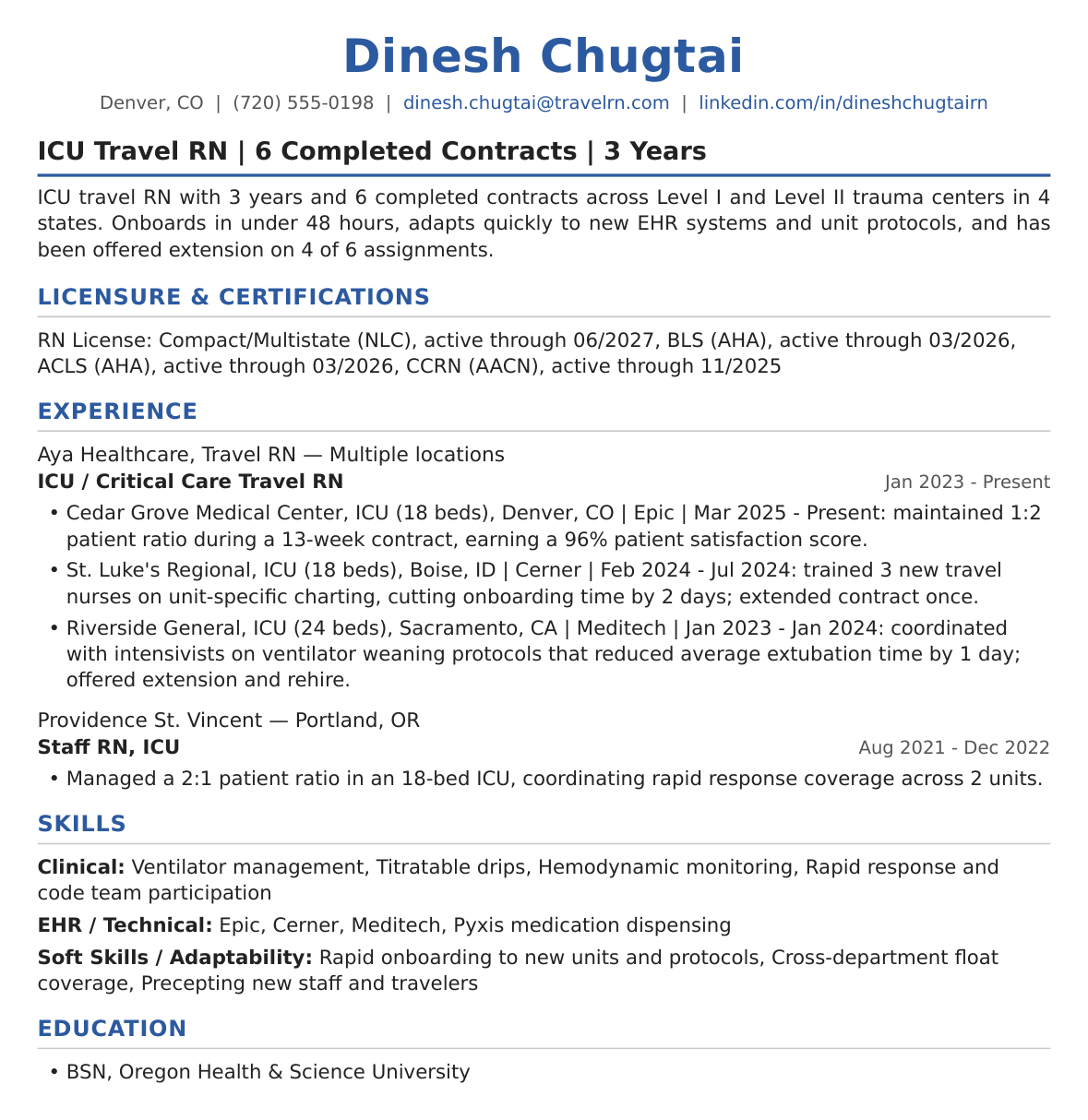
See the full experienced traveler resume template
Get the complete mid-career layout, built to highlight rehire rates and multi-system experience.
Travel-to-Permanent Transition Example
A traveler applying to a permanent staff position after one or more contracts uses this format to turn assignment variety into proof of exposure: different workflows, teams, and patient populations handled without ramp-up time. The summary and skills sections lead with consistency and rehire history, since permanent employers are screening for stability more than range.
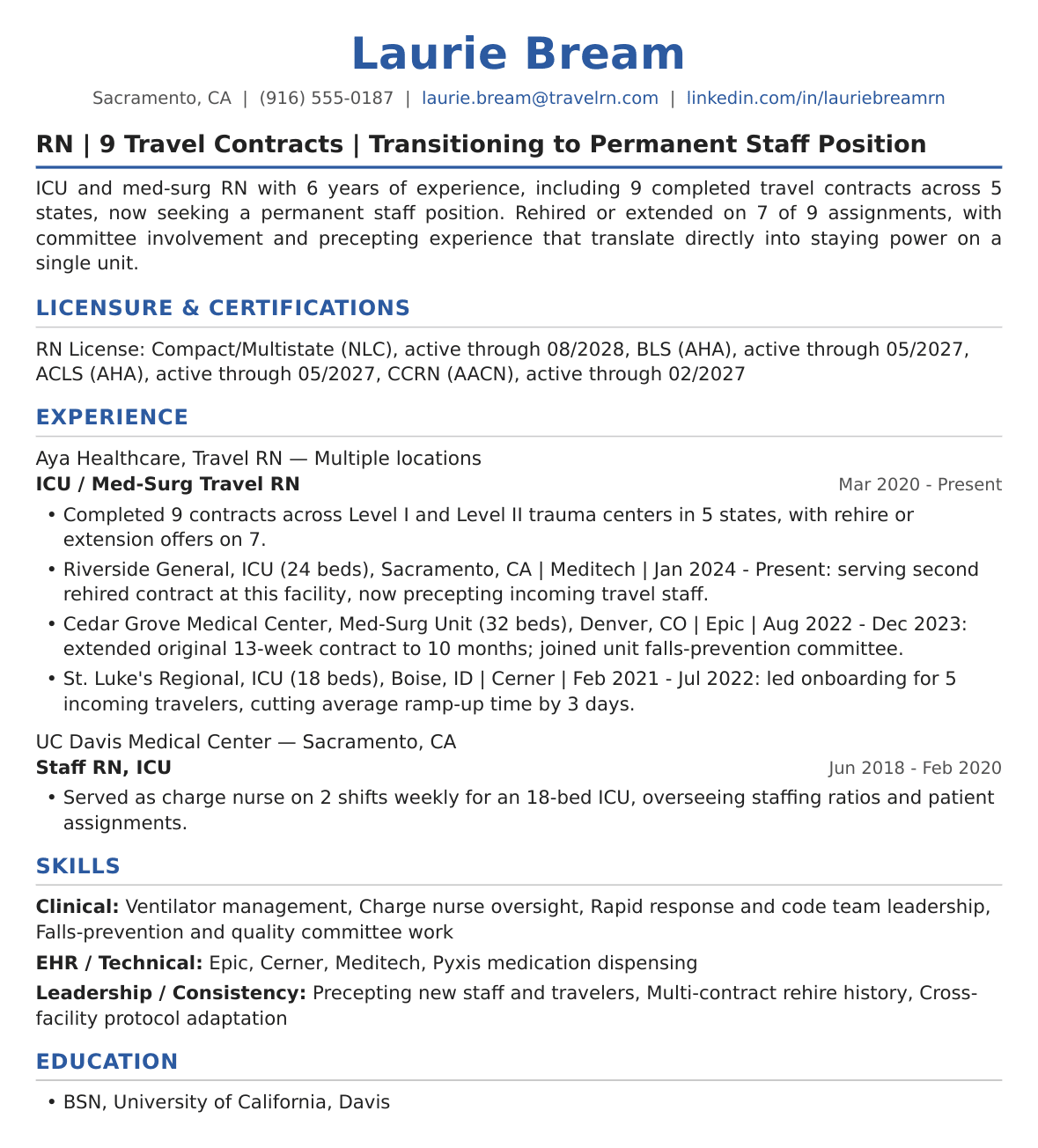
See the full travel-to-permanent resume template
Get the complete transition layout, designed to turn travel experience into a permanent job offer.
Travel Nurse Resume Keywords
Agency recruiters and facility ATS filters screen for compact licensure, specialty certifications, and first-day readiness signals. Name every EMR you have charted in, since float and travel roles filter on it.
| Category | Keywords |
|---|---|
| Licensure & certifications | Compact RN license (NLC), State licenses, BLS, ACLS, PALS, CCRN, CEN, PCCN, NIH Stroke Scale |
| Clinical & specialty | ICU, ER, Med-Surg, Telemetry, Critical care, Patient assessment, Medication administration, Charge nurse experience, Patient ratio management |
| Travel-specific | 13-week contracts, Rapid onboarding, First-day readiness, Float pool experience, Contract extensions, Skills checklists, Agency compliance documentation |
| Systems & standards | Epic, Cerner, Meditech, EMR adaptability, Joint Commission standards, Unit protocol adherence |
The Reference Treadmill: Collect One Before Every Contract Ends
Facilities typically require one or two supervisory references, charge nurse or above, from roughly the last one to two years. Travel makes that simple requirement brutal: you work eight facilities in two years, charge nurses rotate, managers quit, and the person who watched you run a code in Tulsa is unreachable by the time a Phoenix hospital asks. References older than about two years are treated as expired, so your bench keeps emptying on its own.
Make reference collection an end-of-assignment ritual, as fixed as returning your badge. In your final week, ask the charge nurse or unit manager directly, get a personal phone number or email (a switchboard is not a reference), and where your agency uses a reference platform, have the form completed while you're still on the schedule.
Keep a private reference log: name, role, unit, facility, contract dates, contact info, date last used. Two current supervisory references ready at submission time is often the difference between being submitted for a contract today and watching it fill while you chase a manager who left nursing in March.
Common Travel Nurse Resume Mistakes to Avoid
Describing Tasks Instead of Impact
Many travel nurse resumes read like a job description copied from a staffing agency posting. Listing "administered medications" or "monitored vital signs" tells a recruiter what the unit required, not what you delivered. Replace duty lists with outcomes: patient ratios you managed, float coverage you provided, or how fast you became productive on a new unit.
Using One Resume for Every Agency or Job
Some agencies suggest a single generic resume works everywhere since assignments move fast. In practice, facilities still screen for specific certifications, EHR systems, and patient populations. A resume tailored to each job description gets read more carefully than one blasted to every recruiter.
Burying License and Compact Status
Your RN license type, compact status, and expiration dates belong near the top of the resume, not buried in a footer. Recruiters need to confirm eligibility within seconds. A missing expiration date or unclear compact status can stall a submission before anyone reads further.
Listing Software Without Naming Systems
"EHR experience" tells a hiring manager almost nothing. Name the actual systems you have used, such as Epic, Cerner, or Meditech.
Unclear Travel RN vs Staff RN Labeling
A string of short-term positions without labeling can look like job-hopping to anyone unfamiliar with travel nursing. Label each entry "Travel RN" or "Staff RN," and group contracts under the agency name.
Over- or Under-Explaining Gaps
Gaps between contracts are normal and rarely need justification. A short, honest line, such as noting time for licensure or relocation, is enough. Skip the lengthy apologies.
Oversharing on Sensitive Assignment Types
Some travel contracts involve crisis response or coverage during labor disputes. Naming an assignment as strike coverage on a resume can create friction with a facility that has union ties, even when the work itself was standard bedside nursing. Keep the entry neutral: agency, dates, and unit type, without labeling the assignment. Save specifics for a direct question in an interview.
Customizing Your Resume for Different Travel Nursing Specialties and Career Stages
A generic travel nurse resume undersells a specialist. Each unit type screens for different proof points, so lead with those.
An ICU resume should front-load ventilator management, drip titration, and patient ratios. An ER resume needs triage volume, trauma level, and EMR fluency. L&D resumes carry more weight with delivery volume and NRP certification. Med-Surg resumes should show patient load and floating experience, and OR resumes need case volume by specialty and instrument familiarity. Swapping in these details per application takes minutes and changes how a recruiter reads the whole document.
Career stage matters as much as specialty. A first-time traveler has no travel history to lean on, so the resume should translate staff experience into travel-relevant language: float pool work, charge experience, precepting.
A seasoned traveler should foreground extension rates, rehire offers, and the range of facility types and EMR systems covered, placed near the top rather than buried in a job list.
A traveler moving toward a permanent role should emphasize longer stints, committee involvement, and leadership steps, since the resume now needs to signal staying power alongside adaptability.
How AI Resume Builders Can Simplify Your Travel Nurse Resume
Rewriting a resume for every facility, specialty, and shift type takes time most travel nurses do not have between contracts, and a generic resume often gets filtered out by ATS software or skimmed past by a busy recruiter.
Upplai's AI resume optimizer is built to close that gap:
- Real-time ATS scoring: see your ATS and recruiter score update as you edit, with no download and re-upload cycle between tweaks.
- Transparent suggestions: every edit comes with a plain-language "Why this change?" explanation, and you accept or reject each one individually. The AI never fabricates experience or silently rewrites your history.
- Automatic formatting: choose from multiple ATS-friendly templates and color themes, then download unlimited copies in PDF, DOCX, or TXT.
- Structure guidance: content gets reordered for relevance, action verbs get strengthened, achievements get quantified, and potential bias triggers get flagged, all based on recruiter best practices.
- Preference memory: your formatting, metric, and reordering choices persist across sessions, and you can bookmark up to 5 master resumes, useful for a travel nurse juggling separate versions for ICU, ER, med-surg, or telemetry assignments.
Pricing is straightforward. The free plan includes 200 ATS scans per month and 3 tailored resumes with matching cover letters as a one-time allotment, unlimited downloads, and no credit card required. Additional resume packs start at $5, working out to $0.50-$1.00 per tailored resume, with no subscription involved.
A travel nurse resume that lists your agency clearly, leads with your license, and turns your assignment history into a record of range gives recruiters and hiring managers exactly what each of them is scanning for. The mistakes that undercut this format are avoidable: vague duty bullets, buried compact status, and unlabeled contracts that read as job-hopping instead of experience. Fix those, tailor the resume per job description, and your next contract or permanent application starts from a stronger position.
Tailor your travel nurse resume for your next contract
Upload your resume and a job description to get your ATS score and edit suggestions in minutes.