You've applied to a dozen wealth management roles with a resume that lists "managed client portfolios" and "assisted senior advisors," and the callbacks aren't coming. The problem is usually keywords: the ATS scanning your resume is looking for specific terms like AUM, Series 7, and book of business, and generic phrasing doesn't register as a match.
This guide gives you the exact keywords wealth management recruiters and ATS software look for, organized into six categories: industry jargon, hard skills, licenses and designations, software, soft skills, and action verbs. You'll see which terms are non-negotiable, which ones differentiate you, and how to place them so both the software and the human behind it take notice.
Along the way, you'll get real example bullets for associate, mid-level, and senior wealth management resumes, plus the formatting mistakes that quietly strip your keywords out before anyone reads them.
Wealth Management Resume Keywords: The Complete List
Recruiters and ATS software scan wealth management resumes for six keyword categories: industry jargon, hard skills, licenses/certifications, software, soft skills, and action verbs. Use this table to check your resume at a glance, then jump to the sections below for detail on each.
| Category | Keywords to include |
|---|---|
| Industry jargon | AUM, NNA (Net New Assets), HNW, UHNW, Book of Business, Portable Assets, Wallet Share, RIA, Broker-Dealer, Discretionary/Non-Discretionary Accounts |
| Hard skills | Financial Planning, Portfolio Management, Asset Allocation, Retirement Planning, Estate Planning, Trust Administration, Tax-Loss Harvesting, Risk Assessment, Financial Modeling, Due Diligence, Alternative Investments |
| Licenses (mandatory) | Series 7, Series 63, Series 65, Series 66, SIE |
| Designations (differentiators) | CFP, CFA, CIMA, CPWA, CTFA |
| Compliance terms | KYC, AML, Fiduciary Standard, Suitability, Reg BI |
| Software | Salesforce Financial Services Cloud, Redtail, Wealthbox, eMoney Advisor, MoneyGuidePro, RightCapital, Bloomberg Terminal, Morningstar Direct |
| Soft skills | Relationship Management, Client Retention, Client Acquisition, Trust Building, Consultative Selling, Negotiation |
| Action verbs | Advised, Grew, Cultivated, Prospected, Rebalanced, Onboarded, Retained, Expanded |
Not every keyword belongs on every resume. An associate two years from a book of business needs "supported" and "SIE, Series 7 in progress" more than a senior advisor needs "Assisted." A relationship manager leans harder on retention terms like Wallet Share Expansion and Periodic Portfolio Reviews. The sections ahead break down exactly which keywords fit your title, experience level, and target firm, plus how to place them so both the ATS and the recruiter reading behind it take notice.
Why Keywords Make or Break a Wealth Management Resume
How ATS and recruiters actually screen finance resumes
Every private bank, wirehouse, and RIA you apply to almost certainly runs your resume through an ATS before a human sees it. 99% of Fortune 500 companies and 75% of large employers use ATS to screen resumes, and up to 80% of resumes are eliminated automatically before a human ever sees them. If yours lists "managed client portfolios" instead of "managed $180M AUM across 120 HNW households," the system may miss the match entirely.
Clearing the ATS only gets you to the next filter. Recruiters spend 3-7 seconds on resumes that clear it. They're scanning for proof you can do this specific job.
The three things wealth management resumes must prove at once
Wealth management sits at the intersection of three skill families, and your resume has to signal all three in that same window: technical competence (portfolio construction, asset allocation, tax-efficient strategies), relationship and sales ability (client acquisition, retention, book growth), and compliance fluency (Series 7, Series 66, CFP, fiduciary standard).
A resume heavy on technical terms but missing production numbers reads like an analyst, not a relationship manager. One heavy on sales language but light on licenses reads unqualified for a regulated role. Recruiters and ATS alike are checking whether you can build the book, manage the money, and stay compliant.
Core Industry Keywords & Jargon (AUM, HNW/UHNW, Book of Business)
Client-tier and portfolio terms
Before recruiters check your skills, they check whether you speak the language. A few core terms carry most of the weight.
AUM (Assets Under Management): the total market value of client assets you or your firm manage. It shows up on nearly every wealth management resume, and it should be a real number, even a modest one, not a vague claim.
NNA (Net New Assets): new client money brought in minus withdrawals or account closures over a period. It signals growth, not just retention.
HNW (High-Net-Worth): clients with roughly $1M to $30M in investable assets. UHNW (Ultra-High-Net-Worth): clients above $30M. Naming which tier you serve tells a recruiter what kind of complexity and service model you already know.
Why your book of business is a keyword, not just a number
"Book of business" refers to the full set of client relationships and assets you manage or influence directly. Recruiters and ATS systems search this exact phrase because it signals something a raw AUM figure alone doesn't: relationship ownership.
That distinction matters most around portable or transferable assets, the share of your book that would realistically follow you to a new firm. Private banks and wirehouses hiring senior advisors are often evaluating one thing: how much revenue walks in the door with you.
Related terms worth including: wallet share (the percentage of a client's total investable assets held at your firm, versus spread across competitors), RIA (Registered Investment Advisor, a fee-based fiduciary firm) versus broker-dealer (a commission-eligible firm), and discretionary versus non-discretionary accounts (whether you can trade without client pre-approval). Each of these appears in job descriptions as a filter, not decoration.
Hard Skills & Technical Keywords for Wealth Management Resumes
Financial planning & investment management terms
Weave these into your experience bullets, not just a skills list:
- Financial planning, comprehensive financial planning, holistic financial planning
- Portfolio management, discretionary portfolio management, portfolio rebalancing
- Investment strategy, asset allocation, equities and fixed income, alternative investments
- Retirement planning, estate planning, trust administration
- Tax-loss harvesting, tax-efficient investing
- Risk assessment, financial modeling, Monte Carlo analysis
- Due diligence, insurance and protection planning, education funding planning
A bullet like "Conducted Monte Carlo analysis and tax-loss harvesting reviews for 40+ client households" proves you know the methodology, not just the buzzword.
Software, CRM, and platform keywords
"Proficient in Microsoft Office" tells an ATS and a recruiter nothing. Naming the actual platforms you've used does:
- CRM: Salesforce (Financial Services Cloud), Redtail, Wealthbox
- Planning software: eMoney Advisor, MoneyGuidePro, RightCapital
- Research and data: Bloomberg Terminal, Morningstar Direct, FactSet
- Custodians: Charles Schwab, Fidelity, Pershing
- Analysis: Advanced Excel (pivot tables, modeling, not just "Excel")
Job descriptions almost always name the exact stack. If a posting says "eMoney experience preferred" and your resume says "financial planning software," you've made the recruiter guess. Match the exact tool name whenever you've genuinely used it.
Certifications and Licenses: What's Mandatory vs. What's a Differentiator
Recruiters read this section of your resume differently from every other section. Everywhere else, they're scoring you. Here, they're checking a box. Confusing the two costs candidates interviews.
Licenses recruiters treat as pass/fail
FINRA licenses aren't a skill you list to look impressive. They're a legal requirement to do the job. Series 7, Series 63, Series 65, Series 66, and the SIE (Securities Industry Essentials, the entry-level exam) function as gates, not differentiators. If the role requires a Series 7 and you don't have one, no amount of CRM experience or client-relationship language compensates on an ATS scan.
List these under a dedicated "Licenses" heading, not buried inside "Skills." Use the full name plus the common short form: "FINRA Series 7 (General Securities Representative)."
If you're studying but haven't passed yet, say so honestly: "Series 65 (In Progress, exam scheduled [month/year])" or "SIE Exam (In Progress)." Never list a license without a qualifier unless you've actually passed it. Recruiters and compliance teams verify licenses through FINRA's BrokerCheck, and a false claim is disqualifying, not just embarrassing.
Designations that set you apart
Once the license box is checked, designations are where you differentiate. CFP, CFA, CIMA, CPWA, and CTFA signal depth in planning, analysis, or trust work. CPA or JD matter if your role touches tax or estate strategy. List designations separately from licenses, and note "in progress" or "candidate" status the same way (e.g., "CFP (Candidate, exam date [month/year])").
Compliance terms to include
Recruiters also scan for regulatory fluency: KYC, AML, Fiduciary Standard, Suitability, and Regulation Best Interest (Reg BI). Weave these into bullet points where they reflect real work, such as KYC documentation or Reg BI-compliant recommendations, rather than listing them as bare acronyms.
Soft Skills and Business Development Keywords: The Hunter vs. Farmer Framework
Wealth management rewards two different instincts, and recruiters know it. One group excels at bringing in new clients; the other excels at keeping them. Most job descriptions blend both, but the emphasis shifts by role and seniority, so your resume should signal which side you lean toward.
Acquisition/hunter keywords
Hunter keywords describe how you build a pipeline from nothing. Use them if your work involves prospecting, cold calling, seminar marketing, or cultivating centers of influence (COIs) like CPAs and attorneys who refer clients. Round this out with networking, pipeline management, closing, new business development, lead generation, and client onboarding. Junior associates and business-development-focused roles should weight this list heavily.
Retention/farmer keywords
Farmer keywords describe how you deepen and protect existing relationships. This includes periodic or portfolio reviews, wealth plan reviews, and goal-based planning conversations. Add client education, wallet share expansion, concierge service, account opening, transfer of assets (TOA), client satisfaction, and cross-selling. Senior relationship managers with an established book often lean here, since growing existing AUM matters more than net-new logos.
Underneath both lists sit general resume soft skills every candidate needs regardless of lean: relationship management, client retention, client acquisition, trust building, communication, presentation skills, analytical skills, negotiation, and consultative selling.
Few roles are purely one or the other. Read the job description, identify which side it emphasizes, and mirror that language in your bullets and skills section.
How to Place Keywords in Your Resume (and Where Most People Get It Wrong)
Summary, skills section, and certifications section placement
Keyword placement matters as much as keyword choice. Start with a 2-3 line professional summary at the top, including your target title and top two or three keywords: "Wealth Management Associate with Series 7 and CFP progress, specializing in HNW client retention and AUM growth."
Add a dedicated Skills or Core Competencies section, grouping related terms (client relationship management, portfolio analysis, estate planning) so it reads as scannable, not stuffed.
Certifications need their own section too. Don't bury Series 7, Series 66, or CFP status inside a skills list. ATS software and recruiters both look for a standalone "Licenses & Certifications" header.
Finally, work keywords into your experience bullets: "Grew AUM by managing 150+ HNW relationships" beats a keyword sitting alone in a list.
Formatting pitfalls that break ATS parsing
Finance resumes often lean on tables to show AUM figures or performance data, but that ATS-unfriendly formatting can make the content disappear during parsing. Use plain text lines instead.
Never put contact information or key content in headers or footers. Some parsers skip them entirely, which can strip your phone number or email from the file.
Avoid multi-column layouts and heavy graphics, which confuse parsing order, and keep your licenses section under a standard heading rather than a sidebar or footnote parsers won't recognize as its own category.
Example Resume Bullets Using Wealth Management Keywords
Entry-level / associate bullets
Weak: Helped clients with financial plans and answered questions about accounts. Strong: Supported 4 financial advisors managing $180M AUM by preparing client onboarding documents, completing KYC and suitability reviews, and coordinating portfolio review meetings for 60+ households.
Weak: Assisted senior advisors with client meetings and general office tasks. Strong: Shadowed lead advisor in 30+ annual review meetings, drafted meeting summaries and follow-up action items, and maintained CRM records for a book of 220 client relationships (Series 7 and 66 in progress, exam date set).
If you do not have your own AUM yet, quantify the team or book you supported, not assets you personally manage. Naming the number of accounts, meetings, or households you touched still signals impact and keeps the bullet honest.
Mid-level / relationship manager or financial advisor bullets
Weak: Managed client relationships and helped grow the book of business. Strong: Managed $65M AUM across 95 client relationships, achieved 97% client retention, and grew the book by $12M in new assets through referral generation and cross-selling trust and lending products.
Weak: Worked with clients to identify new business opportunities. Strong: Sourced $8M in net new assets annually through centers-of-influence prospecting (hunting), while deepening 40 existing relationships with quarterly portfolio reviews and estate planning referrals (farming).
Senior wealth advisor / private banker bullets
Weak: Responsible for high-net-worth client accounts and team oversight. Strong: Built and managed a $340M book of business serving 55 HNW and UHNW families, generated $2.9M in annual fee-based revenue, and mentored a team of 3 associates on onboarding and compliance workflows.
Weak: Brought in new clients and grew revenue for the firm. Strong: Delivered $45M in portable assets upon transition, expanded the practice to $410M AUM within 18 months, and increased average client relationship size by 22% through tailored wealth transfer and tax planning strategies.
Wealth Management Resume Keywords at a Glance
Use this table as a quick reference, then see the sections above for placement guidance and the hunter-vs-farmer framing for business development terms.
| Category | Keywords |
|---|---|
| Client & business metrics | AUM growth, Book of business, HNW/UHNW clients, Client acquisition, Client retention, Referral networks, Fee-based advisory |
| Planning & advisory | Financial planning, Portfolio management, Asset allocation, Estate planning, Tax planning strategies, Retirement planning, Alternative investments, Risk tolerance assessment, Trust services |
| Credentials & licenses | CFP, CFA, CPWA, CIMA, Series 7, Series 65/66, Fiduciary standard |
| Compliance | KYC/AML, Suitability documentation, FINRA/SEC regulatory compliance |
| Tools | eMoney, MoneyGuidePro, Morningstar, Bloomberg Terminal, Salesforce CRM |
Your Resume Has a Public Shadow: Matching Your U4 and BrokerCheck Record
Every registered advisor's employment history lives in a public database. Forms U4 and U5 feed the CRD system, BrokerCheck publishes it, and compliance teams at hiring firms cross-reference your resume against it as a matter of routine. A date range that disagrees with your CRD record, a firm listed under its marketing name instead of its registered name, a role inflated past what was filed: each reads as dishonesty, even when it's memory drift.
So write the resume from the record: pull your own BrokerCheck report first and match employment dates and firm names exactly. Where your registered dates differ from your practical ones (the 30-day U4 amendment window creates drift), follow the filing.
If you carry a U5 disclosure, a termination narrative, a customer dispute, know that the reviewing firm reads it before your first interview. The resume is not the place to argue with it; never contradict the public record on paper. Keep the resume factual and consistent, prepare a direct, unrehearsed-sounding account for the conversation, and if the disclosure language is materially unfair, a U5 amendment or expungement process, not resume wording, is the remedy. The three examples below are built to that same standard: every AUM figure, book size, and license status is phrased so it would hold up next to your own BrokerCheck file, not just next to a job posting.
Wealth Management Resume Examples by Experience Level
Each example below assembles the keywords, licenses, and hunter-vs-farmer language covered so far into a full resume for a distinct stage of the wealth management ladder. Match the one closest to your current seat, then use it as a structural template, not a script: keep the section order and the discipline of pairing every claim with a number that would survive a compliance review, but swap in your own firm, licenses, and figures.
Wealth Management Associate Resume
This is the entry-level template for a candidate roughly two years into a support role, targeting a continued associate seat or a promotion into a client-facing advisor track. Without personal AUM to lean on yet, the summary and bullets quantify the team and book supported instead: assets managed by the team, households touched, and accounts opened, exactly as this guide recommends for anyone without their own book. The license line is explicit about what's passed versus in progress, since an associate's credibility here rests on that honesty as much as on the numbers.
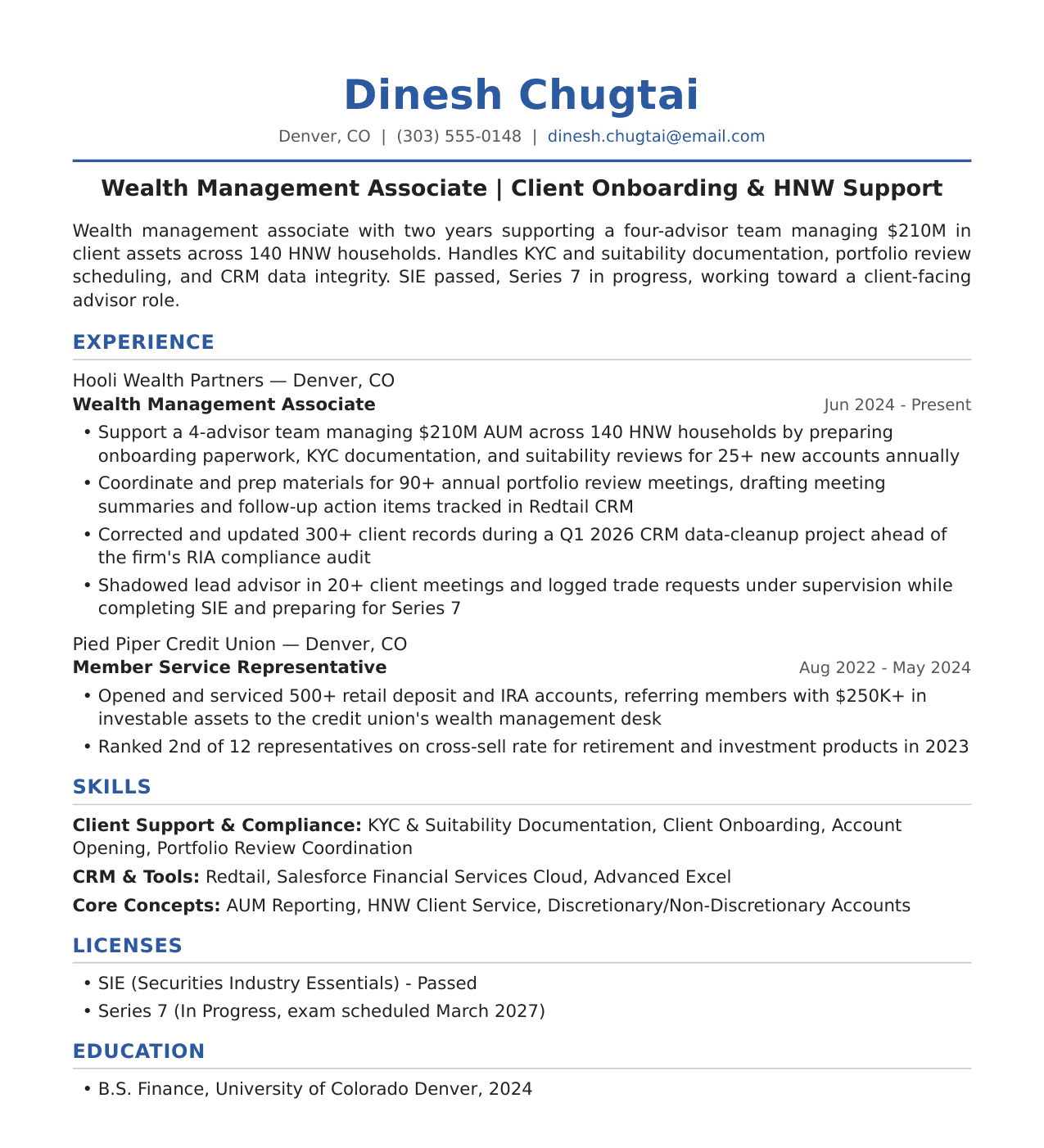
What's working here: the team AUM figure is framed as assets the associate supports, not assets they manage, KYC and suitability show up inside bullets tied to a volume of accounts rather than sitting alone as bare acronyms, and the credit union role is kept short and framed around a ranked cross-sell outcome instead of a list of duties.
Financial Advisor Resume
This is the four-to-six-year template for an advisor who already carries an individual book and needs the resume to show both sides of the hunter-vs-farmer split. The summary leads with AUM, relationship count, and a retention percentage in the same breath as a net-new-assets figure, so a reader sees prospecting and retention in one line instead of guessing which one this candidate leans toward. The bullets separate COI-sourced new assets from quarterly reviews on the existing book, mirroring the distinction this guide draws between the two skill sets.
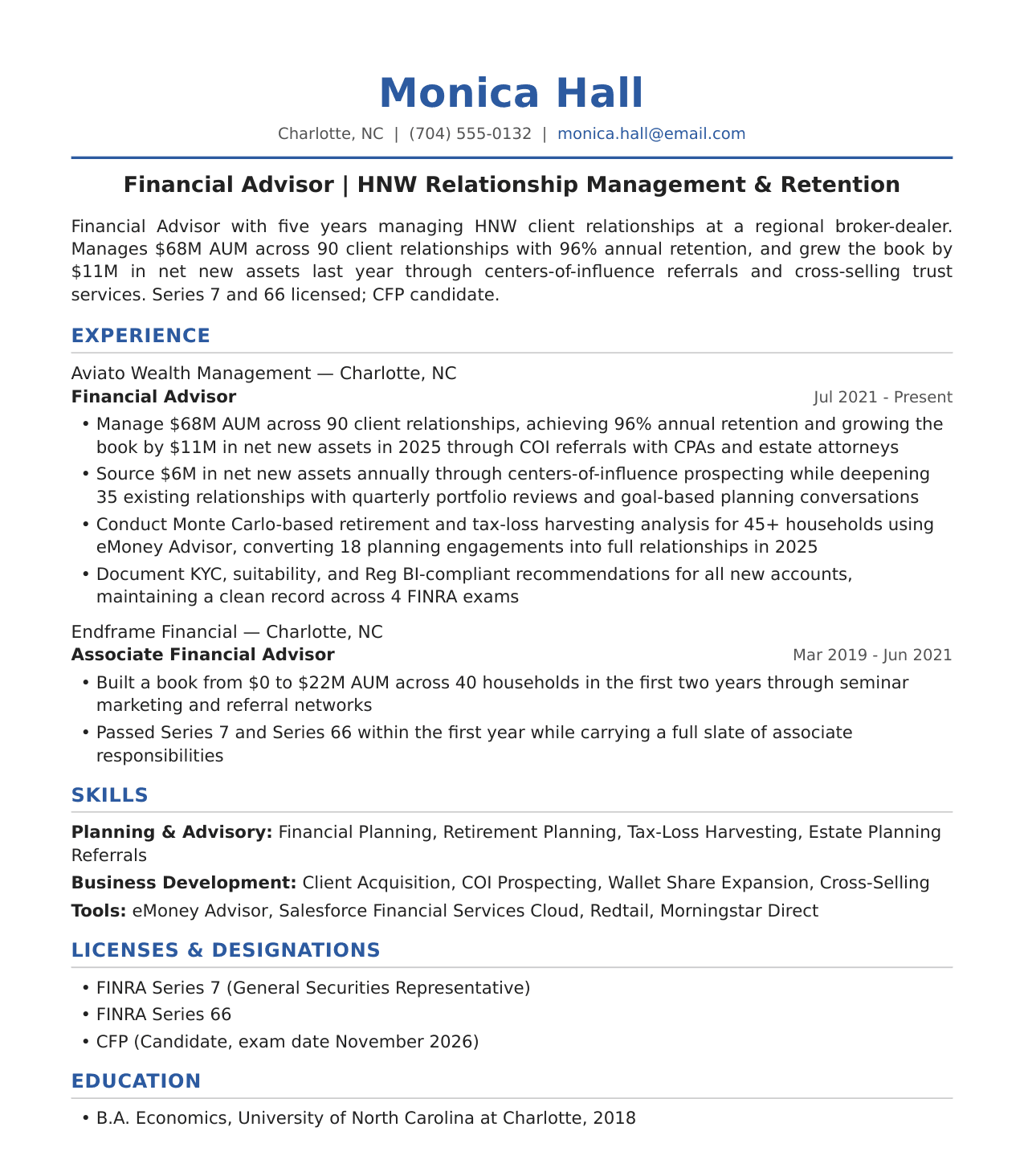
What's working here: the retention rate sits next to the AUM figure so a recruiter sees stability and growth together, the CFP candidacy line names an exam date rather than a vague "pursuing," and the Monte Carlo and tax-loss-harvesting bullet ties a named financial-planning method to a conversion number instead of dropping it as a bare keyword.
Private Wealth Advisor Resume
This is the senior-level template for an advisor owning a large book, a client segment, and informal team leadership. The summary leads with the book size and fee-based revenue it produces, then names the designations and licenses that back up work at this level, following the pass/fail-versus-differentiator distinction this guide draws between licenses and designations. Portable assets get their own bullet, since senior hiring at private banks and wirehouses is often a question of how much of this book would move with the advisor.
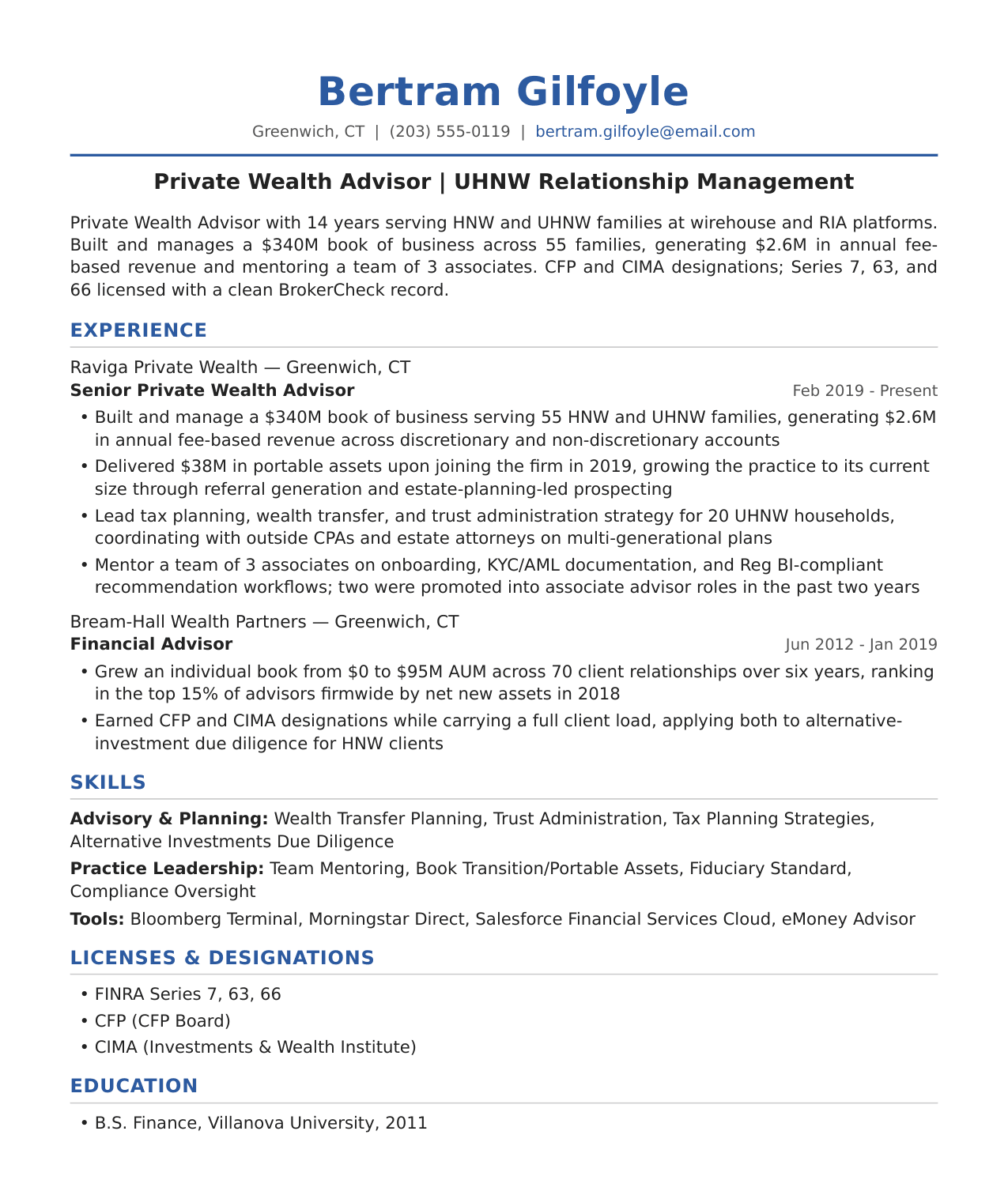
What's working here: the portable-assets figure is named separately from current book size so a hiring firm can see what actually transferred versus what was built since, the mentoring bullet quantifies associates promoted rather than just claiming "developed talent," and the fee-based revenue number gives a hiring manager a production figure an AUM total alone doesn't provide.
Across all three levels, the pattern holds: a license or designation named specifically with its status, an AUM or book figure scoped to what that person actually manages or supports, and hunter or farmer language chosen to match the role rather than borrowed from the other track. If your title sits between two of these, for example an associate advisor about to take over their own book, borrow the financial advisor structure and keep the numbers scaled to what you can currently document.
Common Mistakes and How to Check Your Resume's Keyword Match
Common mistakes
Even a resume packed with keywords can fail to land an interview. A few patterns show up again and again.
Keyword stuffing. Listing every term from the job description without context reads as a checklist, not a career. Recruiters notice, and some ATS scoring models penalize it too.
Conflating licenses with designations. Series 7 is a mandatory license. CFP is a professional designation you earn over time. Listing them side by side as if they're interchangeable signals you don't understand the field.
Vague AUM claims. "Managed high-net-worth client portfolios" says nothing. A number, even an approximate one, does the work: "$45M in client AUM across 60 households."
Missing financial-planning language. Bullets that describe only sales activity, without terms like retirement planning, estate planning, or tax-efficient investing, undersell candidates who actually do this work.
Generic software listings. "Microsoft Office" tells an ATS and a recruiter nothing. Name the actual tools: Salesforce Financial Services Cloud, eMoney Advisor, MoneyGuidePro, Redtail, Bloomberg Terminal.
How Upplai's ATS Resume Checker surfaces missing wealth management keywords
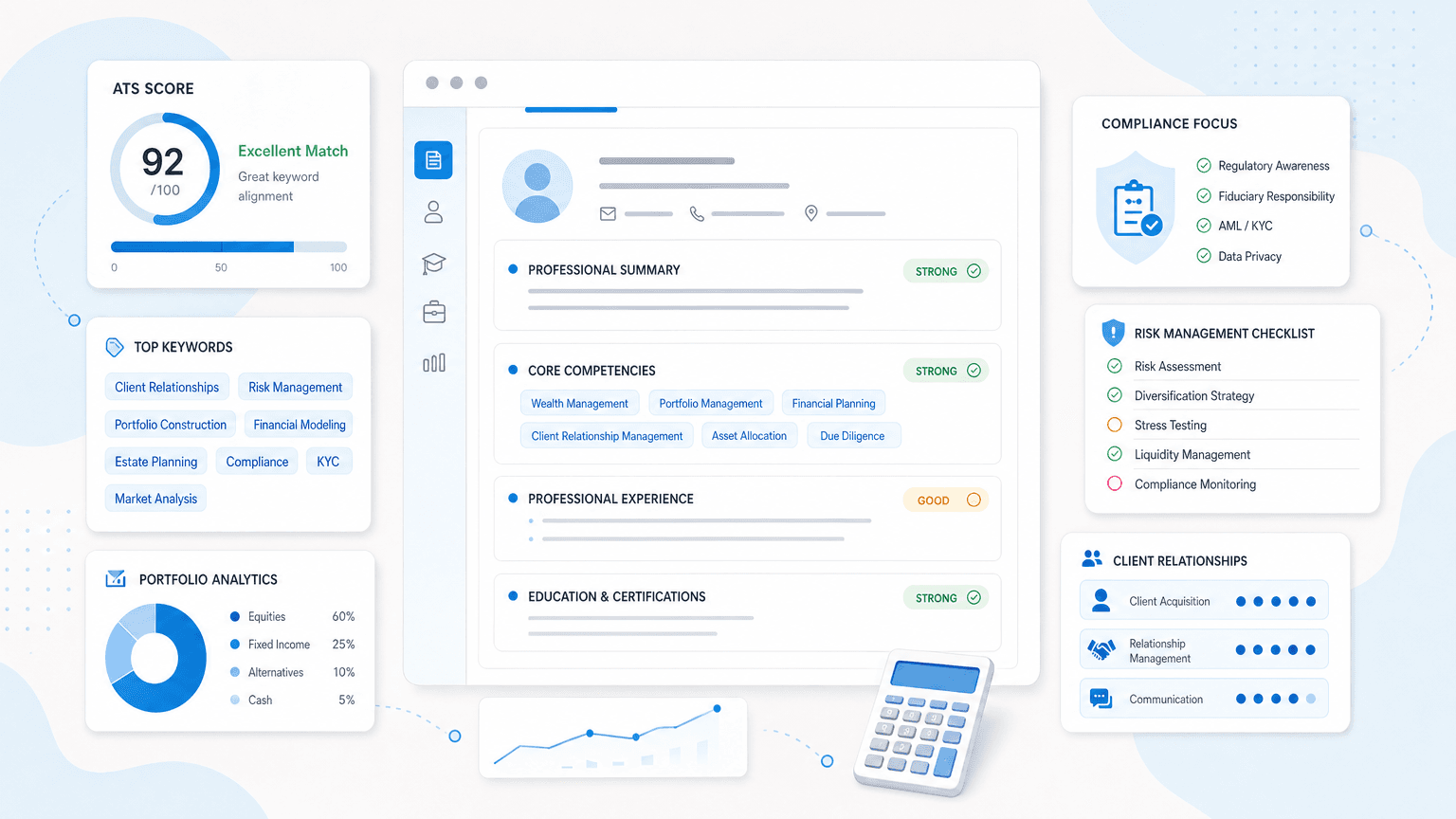
A generic AI tool can guess at your resume's quality, but it can't tell you whether the specific compliance and licensing terms a job description asks for are actually present. Upplai's ATS Resume Checker can. Paste your resume and the job posting, and it runs a gap analysis against that exact description.
It returns a dual ATS and recruiter score, plus a list of missing keywords shown with context, so you know why a term matters, not just that it's absent. Edit your resume and the score updates in real time. Tailored resumes produce 6X more interviews than generic ones, and this is how you find out if yours is one of them.
Check Your Wealth Management Resume's Keyword Match
Get an instant ATS and recruiter score, plus the exact wealth management keywords your resume is missing.
A wealth management resume gets judged twice: once by software counting keywords, once by a recruiter deciding if you can do the job. The categories in this guide, from AUM and book of business to licenses, software, and hunter-versus-farmer skills, are what both are looking for. Pick the terms that reflect your actual experience, place them in your summary, skills section, and bullets, and let the numbers do the talking. Get the keywords right and the formatting clean, and your resume stops getting filtered out before anyone reads it.