Job postings for accounting assistants look nearly identical on the surface: process invoices, reconcile accounts, support the senior accountant. But two resumes that both list those same duties can land very differently, because hiring managers aren't just checking whether you've done the tasks. They're checking whether they can trust you with the numbers that feed into their books.
That's the gap this guide closes. Every section below shows you exactly what to write, not just what to include, with weak-versus-strong examples, a categorized skills library, and copy-ready bullets for the sub-roles this title actually covers, from AP-focused to small-business generalist. If you're two years into the field, you'll find the language to show ownership. If you're reframing a bookkeeping course and a retail job into your first accounting-titled application, you'll find the specific wording that gets past the ATS and earns a second look from the person reading it.
What Makes an Accounting Assistant Resume Effective?
Hiring managers reading an accounting assistant resume are checking for three things, in roughly this order: can this person handle financial data without making costly errors, do they already know the tools the team uses, and can a senior accountant hand them work without walking through every step. Your resume needs to answer all three before it gets a second look.
Accuracy comes through in specifics, not adjectives. Saying you're "detail-oriented" proves nothing. Naming the volume of invoices you processed, the reconciliations you ran, or the error rate you helped reduce shows a hiring manager you can be trusted with numbers that feed into someone else's books.
Software fluency matters just as much. Most job postings name QuickBooks, SAP, or Excel with formulas and pivot tables, and hiring managers scan for those exact terms. If you're still building this experience, say so honestly and lean on what you do know rather than padding the list.
Independence is the third filter. An accounting assistant supports a senior accountant or controller, so your bullets should show you can manage recurring tasks like AP/AR or month-end prep without constant oversight.
Before you go further, confirm you're building the right resume. An accounting clerk role usually focuses on narrower data-entry and processing tasks with less cross-functional contact. A bookkeeper typically owns the full books for a small business, often solo, with more autonomy over the ledger. An accounting assistant sits in between: you support a senior accountant across a wider range of tasks, reconciliations and reporting included, but the final review and sign-off stay with someone above you.
If your target postings mention supporting an accountant or finance manager directly, "accounting assistant" is the right title to build toward. If they describe owning the books independently, look at bookkeeper postings instead.
How to Write an Accounting Assistant Resume That Gets Interviews
Every section of your resume has one job: prove you can be trusted with financial data on day one. That means the way you write your summary, skills, and bullet points matters as much as what you did in your last job. Here's how to build each section so it reads like an accounting assistant's resume, not a generic office worker's.
Write a Targeted Summary or Objective
Your summary sits at the top of the page, so it either earns a closer read or gets skipped. A good one for this role does three things in three to four sentences: names your accounting-specific experience or training, mentions at least one software tool, and includes a number that shows scope.
A weak summary looks like this:
"Organized and detail-oriented accounting assistant with strong communication skills and a good work ethic."
A stronger one looks like this:
"Accounting assistant with 2 years of experience processing accounts payable and receivable for a 40-person manufacturing firm. Proficient in QuickBooks and Excel, including pivot tables and VLOOKUP. Reduced invoice processing time by 20% by standardizing the monthly reconciliation workflow."
The weak version could describe an administrative assistant, a retail supervisor, or a receptionist. The strong version could only describe someone who has touched a general ledger.
If you're entry-level or switching careers, you won't have two years of AP/AR experience to cite. Use an objective instead of a summary, and lead with your training and transferable strengths rather than a job title you don't have yet.
Entry-level / career-changer objective example
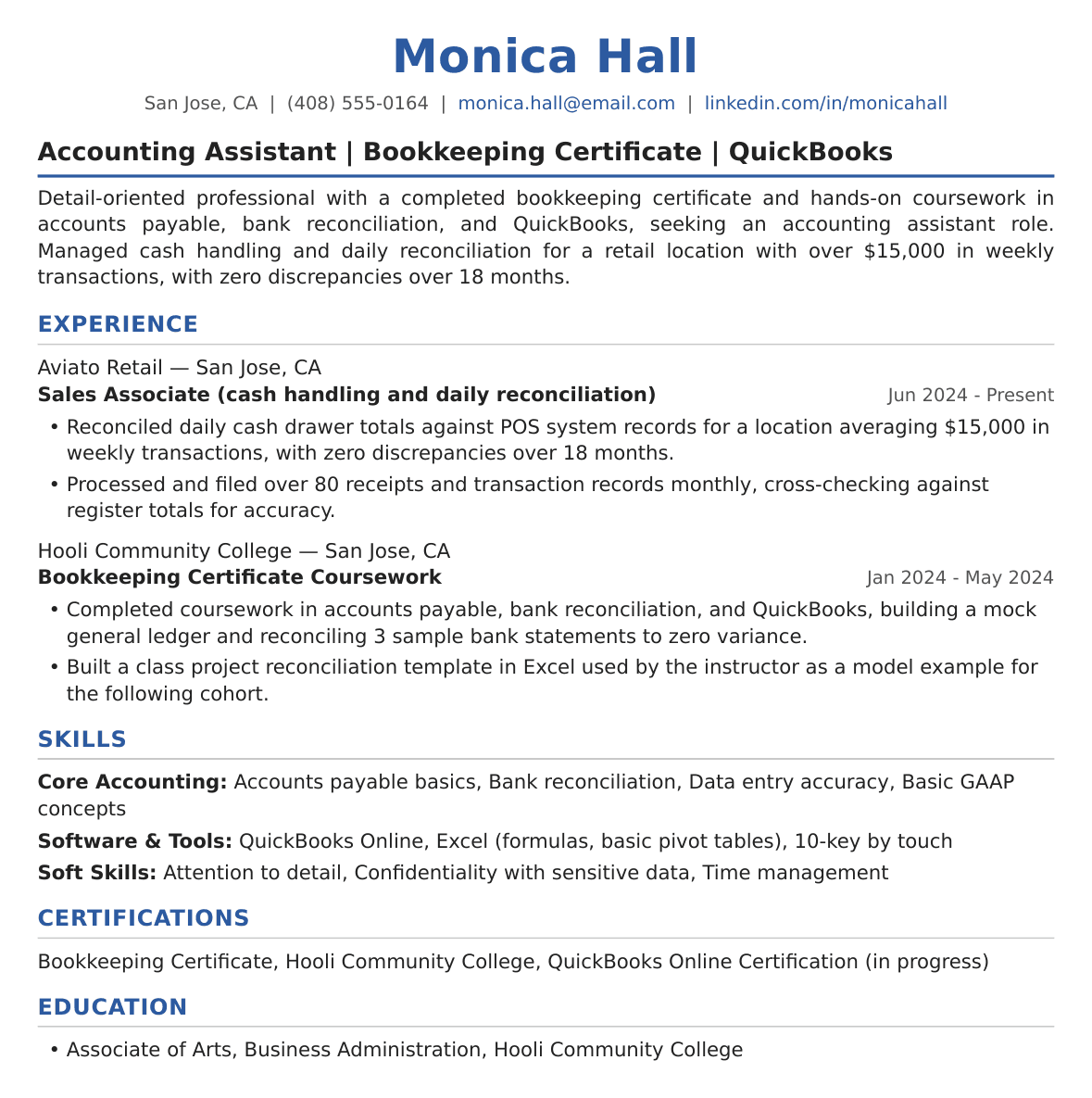
"Detail-oriented professional with a completed bookkeeping certificate and hands-on coursework in accounts payable, bank reconciliation, and QuickBooks, seeking an accounting assistant role. Managed cash handling and daily reconciliation for a retail location with over $15,000 in weekly transactions, with zero discrepancies over 18 months."
Notice the objective still contains a number and a named skill. "No experience" doesn't mean "no proof." It means you have to dig for proof in places other than a matching job title.
Build a Skills Section That Speaks to Hiring Managers
A skills section that just says "Microsoft Office, teamwork, detail-oriented" tells a hiring manager nothing they couldn't guess. Group your skills so a recruiter scanning for 10 seconds can see you cover the basics of the job.
Core Accounting Skills
- Accounts payable and receivable processing
- Bank and credit card reconciliation
- Journal entries and general ledger maintenance
- Month-end close support
- Basic GAAP application and account coding
Software & Tools
- QuickBooks Online and Desktop
- Excel (formulas, pivot tables, VLOOKUP)
- SAP or Oracle (if applicable)
- FreshBooks
Office & Systems
- Filing and document retention systems
- Expense report processing
- Vendor and client correspondence
- Data entry accuracy (10-key by touch, if relevant)
Soft Skills
- Attention to detail
- Time management under close-deadline pressure
- Confidentiality and discretion with sensitive financial data
That last soft skill is easy to skip and shouldn't be. Accounting assistants regularly see payroll figures, vendor contracts, and account balances that aren't public information. Naming discretion explicitly signals you understand that part of the job, not just the spreadsheet part.
Pull the exact wording from the job posting where you can. If a listing says "accounts payable" instead of "AP processing," match its language, since many employers still run resumes through keyword-matching software before a human sees them.
Address Software Proficiency Specifically
Software gets its own section because "proficient in accounting software" is one of the most common weak spots on this type of resume. Hiring managers want to know which programs, and how well.
Name the actual tools: QuickBooks, Excel (specifically formulas, pivot tables, and VLOOKUP, not just "Excel"), SAP, Oracle, FreshBooks. If a job posting names a specific platform, mirror that exact name rather than a general category.
Proficiency level matters more than the length of your list. "Excel (advanced: pivot tables, VLOOKUP, conditional formatting)" tells a hiring manager more than five tools listed with no context. If you've only used one program, don't pad the list with software you've briefly seen in a tutorial. Instead, go deep on what you know: describe the specific tasks you did in that program, like building a reconciliation template in Excel or generating AP reports in QuickBooks. Depth on one tool reads better than a shallow list of five.
Write Achievement-Focused Experience Bullets
Every bullet should follow the same formula:
[Action verb] + [specific task/method] + [quantifiable result or scope]
Tasks describe what you were assigned. Achievements describe what changed because you did it.
A weak bullet looks like this:
"Responsible for processing invoices and reconciling accounts."
A stronger one looks like this:
"Processed 150+ vendor invoices monthly and reconciled 3 bank accounts, reducing month-end close time from 5 days to 3 by standardizing the reconciliation checklist."
The examples below cover the sub-roles most accounting assistant postings fall into. Adapt the numbers to your own experience.
AP-focused assistant
- Processed an average of 200 vendor invoices per month, matching purchase orders and resolving discrepancies before payment approval.
- Reduced duplicate payment errors by 30% by implementing a vendor invoice tracking log in Excel.
AR-focused assistant
- Managed collections for 60+ client accounts, reducing average days sales outstanding from 45 to 32 days.
- Prepared and sent monthly invoices totaling $250,000+ in billed revenue with a 98% on-time delivery rate.
Small-business / generalist assistant
- Handled full-cycle bookkeeping for a 12-person business, including payroll support, bank reconciliation, and monthly financial statement prep.
- Cut month-end close time by 2 days by building a standardized reconciliation template in QuickBooks.
Firm / audit-support assistant
- Supported 4 senior accountants during quarterly audits by compiling and organizing supporting documentation for 20+ client files.
- Maintained working papers and reconciliations for 15 client accounts with zero audit findings related to documentation errors.
If you don't have clean metrics from a past job, look for numbers you already have access to: how many invoices or transactions you handled per week, how many vendor or client accounts you managed, how much you reduced errors or processing time, or how many accounts you reconciled per close cycle. Even a rough estimate ("approximately 100 invoices monthly") is more convincing than no number at all.
Turn Coursework, Internships, or Unrelated Jobs Into Experience
If you don't have a job with "accounting" in the title, you still likely have relevant material. Coursework, internships, and even unrelated jobs can become resume bullets if you frame them around the tasks that transfer, not the job title that doesn't.
For a bookkeeping or accounting course, describe the actual work you did, not just the class name. "Completed coursework in accounts payable, reconciliation, and QuickBooks" reads better than "Accounting 101." For an internship, treat it like any other job: what did you process, how much, and what was the result.
For unrelated jobs, look for the overlap. Retail and cash-handling roles involve daily reconciliation and discrepancy resolution. Administrative and customer service roles involve data entry, scheduling, and handling sensitive information. Pull those tasks out and describe them in accounting-adjacent language.
Examples:
- "Reconciled daily cash drawer totals against POS system records for a retail location averaging $8,000 in daily sales, identifying and resolving discrepancies same-day."
- "Processed and filed over 100 expense reimbursement requests monthly as an administrative assistant, cross-checking receipts against company policy for accuracy."
Both bullets describe non-accounting jobs, but both use the vocabulary and structure a hiring manager expects from someone applying to handle financial records.
Organize Your Work History the Right Way
Use reverse-chronological order, most recent job first, unless you have almost no work history at all. Most hiring managers expect this format and it's the easiest for applicant tracking systems to parse correctly.
If a past title doesn't match "accounting assistant" but the duties do, add a brief clarifier under the title, such as "Administrative Assistant (handled AP processing and vendor reconciliation)." This helps a recruiter connect the dots without reading the full bullet list.
For employment gaps, don't leave them unexplained or try to hide them with vague date ranges. A short line noting coursework, caregiving, or freelance bookkeeping during the gap is enough. Most hiring managers care more about what you can do now than about a clean, gap-free timeline.
Accounting Assistant Resume Examples
Different career stages call for different emphasis. Here is how your resume should shift as you gain experience.
Entry-Level Accounting Assistant Resume
If you are new to the field, lead with relevant coursework, internships, and transferable skills from retail, admin, or customer service roles. List the software you know, even at a basic level, such as QuickBooks, Excel, or spreadsheets used in school projects. Focus on accuracy, organization, and willingness to learn rather than years of experience you do not have yet.
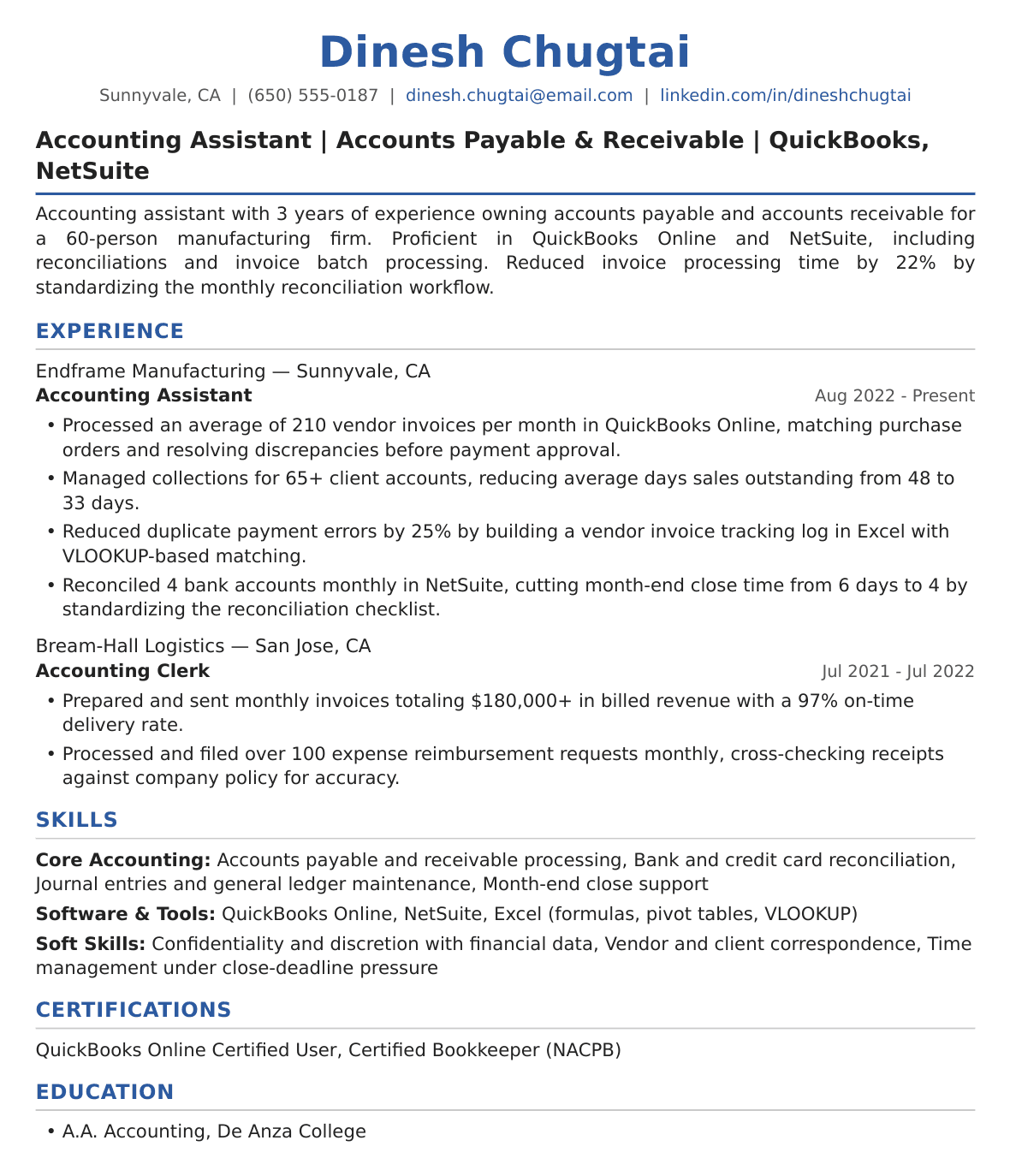
Mid-Level Accounting Assistant Resume
With two to five years under your belt, your resume should show ownership of accounts payable and accounts receivable processes, not just support tasks. Go deeper on specific software, naming the exact tools and modules you have used, such as reconciliations in NetSuite or invoice batches in QuickBooks Online. Quantify your impact with numbers like invoice volume, days sales outstanding improvements, or error reduction rates.
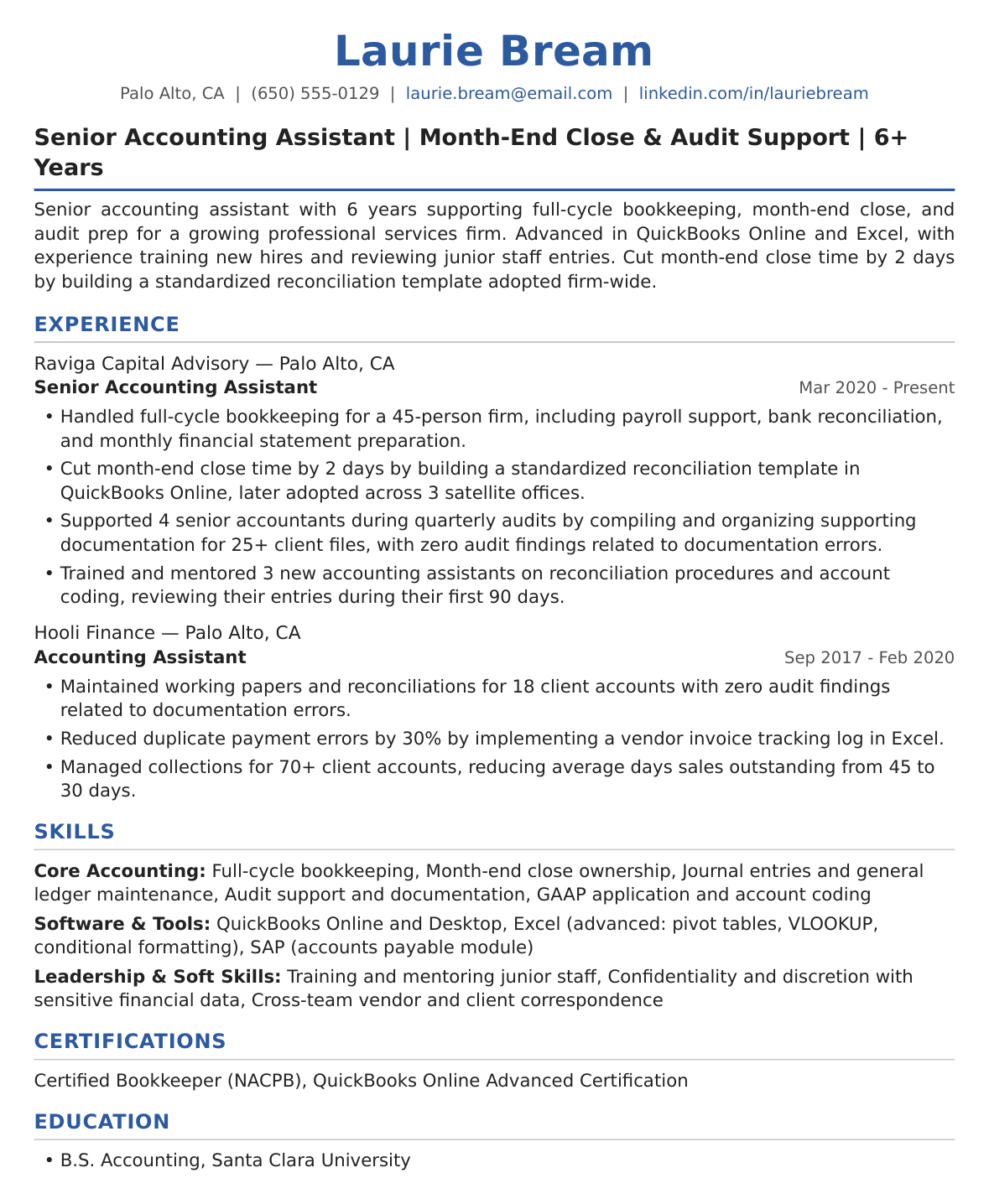
Experienced Accounting Assistant Resume
At five or more years, your resume should reflect a broader scope of responsibility. Highlight month-end close ownership, audit support, and process improvements you led. Mention any mentoring or light supervisory work, such as training new hires or reviewing junior staff entries, to show you are ready for the next step up.
Accounting Assistant Resume Keywords
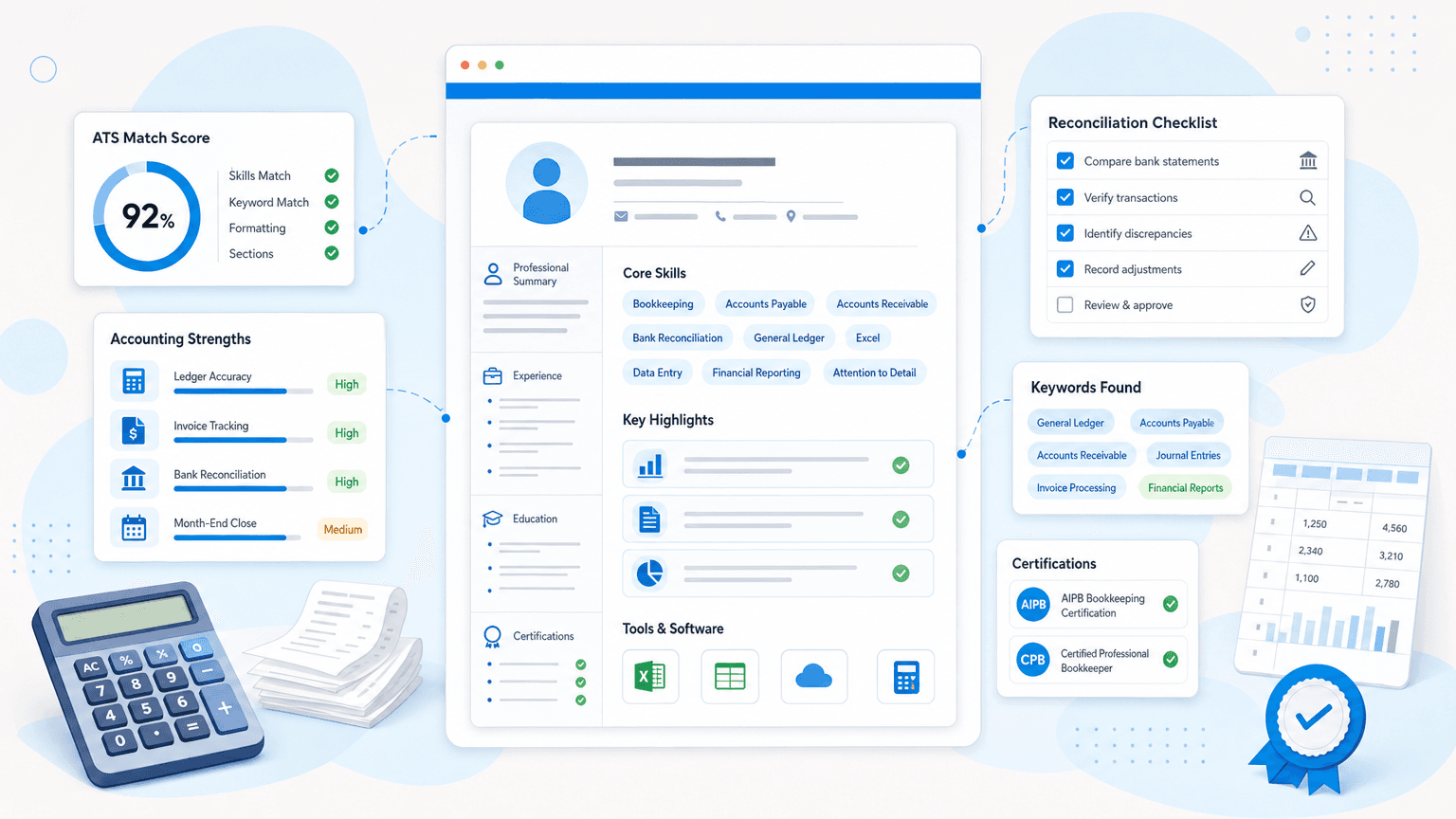
ATS filters scan for the same accounting terms hiring managers skim for. Work these into your skills section and bullets where they match your real experience, and mirror the exact phrasing in each job posting.
| Category | Keywords |
|---|---|
| Core accounting tasks | Accounts payable (AP), Accounts receivable (AR), Bank reconciliation, Journal entries, General ledger maintenance, Invoice processing, Month-end close support, Expense report processing, Payroll support |
| Software & tools | QuickBooks, SAP, Oracle NetSuite, Xero, Microsoft Excel (VLOOKUP, pivot tables), 10-key data entry |
| Reporting & compliance | GAAP knowledge, Financial reporting, Audit support, 1099 preparation, Vendor reconciliation |
| Soft skills | Attention to detail, Confidentiality, Deadline management, Vendor communication |
Your Excel Skills Will Be Tested Before You're Hired
Most accounting employers no longer take "proficient in Excel" on faith. Pre-employment Excel assessments are standard screening for accounting roles: a timed online test early in the process, sometimes a second, deeper test before the offer. Candidates who breeze through the interview and then fumble a pivot table quietly disappear from the shortlist.
Write your Excel line like it will be audited, because it will be. Name the specific functions you can perform live: "Excel (VLOOKUP/XLOOKUP, pivot tables, conditional formatting, bank reconciliation templates)." Skip anything you'd need to Google mid-test.
Before you apply, open a blank workbook and time yourself: build a pivot table from raw transaction data, write a VLOOKUP across two sheets, and clean a column of inconsistent dates. If any of those took more than a few minutes, practice before the assessment, not during it.
If your Excel is thin, say what's true instead: "Excel (data entry, sorting and filtering, basic formulas; currently completing pivot table training)." A modest claim you can demonstrate beats an inflated one that collapses in a 20-minute test.
Common Accounting Assistant Resume Mistakes to Avoid
Describing Tasks Instead of Impact
Many accounting assistant resumes read like a job description: "processed invoices," "reconciled accounts," "filed expense reports." Hiring managers already know the duties of the role. What they want to see is what changed because you did the job, like invoice processing time cut by 30% or a backlog of 200 unreconciled transactions cleared in two weeks.
Using One Generic Resume for Every Application
Sending the same resume to a small retail company and a mid-size accounting firm ignores that each posting emphasizes different priorities: AP/AR volume, payroll support, or audit prep. Match your bullet points and keywords to the specific listing each time you apply.
Listing Software Without Specificity
Writing "proficient in accounting software" tells a recruiter nothing they can verify or search for. Name the actual tools and your level with each one, such as "QuickBooks Online (3 years, monthly close)" or "advanced Excel including VLOOKUP and pivot tables."
Ignoring ATS Formatting
Tables, text boxes, columns, and image-based headers often get scrambled or dropped when an applicant tracking system parses your resume. Stick to a single-column layout with standard headings like "Experience" and "Education," and save the file as a simple, text-readable PDF or Word doc.
Using Jargon You Cannot Explain in an Interview
Dropping terms like "accrual accounting," "GAAP compliance," or "variance analysis" into your resume without hands-on experience with them creates a gap an interviewer will find quickly. Only include terminology tied to work you actually performed and can walk through in detail.
Burying or Omitting Software Names
Mentioning "Excel" once in a skills list undersells the daily reality of the job. If you built formulas, ran pivot tables, or maintained ledgers in QuickBooks, Sage, or SAP, name each tool where you actually used it in your experience bullets.
Overclaiming CPA or Certification Status
Listing "CPA" or "CPA Candidate" without clarifying where you stand in the exam or education process can look like misrepresentation to a hiring manager. If you have passed one section or are enrolled in required coursework, state that exact status plainly.
How AI Resume Builders Can Simplify Your Accounting Assistant Resume
Every accounting assistant job posting uses slightly different vocabulary and software names, from accounts payable terminology to specific platforms like QuickBooks, SAP, or Excel-based reporting. Matching each one by hand, and quantifying your bullets for every employer, takes real time. That's exactly why a generic resume gets filtered out before a recruiter ever opens it. Upplai's AI resume builder handles that matching work directly on your existing resume.
Here's what the tool does for an accounting assistant resume:
- Real-time ATS scoring: your score updates as you edit, so you can see the impact of adding a keyword like "accounts reconciliation" or "general ledger" immediately, with no download-and-re-upload cycle.
- Transparent suggestions: every AI edit comes with a plain-language explanation of why it was made. You accept or reject each one individually, and the AI never fabricates experience you didn't have.
- Automatic formatting: your resume is built on ATS-friendly templates, so tables, headers, or layouts that confuse parsing software aren't a risk.
- Structure guidance: the tool applies recruiter best practices to reorder and strengthen your bullets, and flags language that could introduce bias.
- Preference memory: formatting choices, how you prefer metrics framed, and reordering decisions carry over across sessions, so you're not resetting preferences every time you tailor a new application.
On pricing, the free plan gives you 200 ATS scans a month plus 3 tailored resumes with matching cover letters as a one-time allotment, no credit card required. Once you need more, additional resumes cost $0.50 to $1.00 each depending on pack size, with no subscription involved.
See how your accounting assistant resume scores
Click to run a free ATS scan and see your resume's score and missing keywords in seconds.
An accounting assistant resume earns interviews by proving you can be trusted with numbers before anyone meets you: name your software, quantify your tasks, and speak the field's vocabulary instead of generic office language. That formula holds whether you're coming in with two years of AP/AR experience or a bookkeeping course and a retail job to reframe. Specifics beat adjectives, and evidence beats titles, every time.