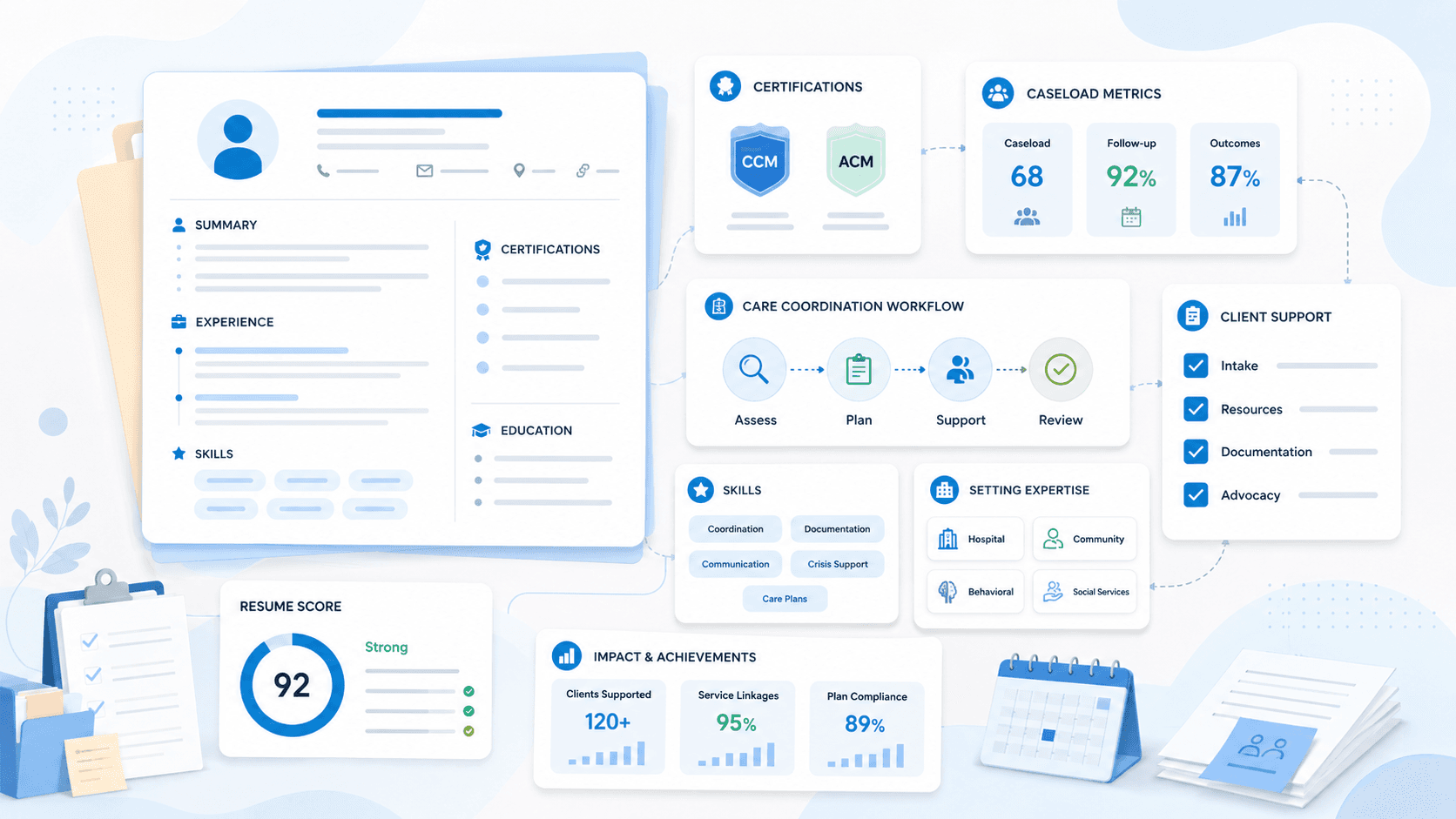
Case manager hiring happens across a wide range of settings. Hospitals, insurance and managed care plans, community mental health programs, workers' compensation, home health, and government social services all hire case managers regularly. The job titles and scope of practice vary significantly by setting and by discipline, and a nurse case manager and a social work case manager often do related but different work. Most general resume advice was written without any of this in mind.
This guide walks you through every section of a case manager resume with examples built around how case management hiring actually works.
How to Write a Case Manager Resume That Gets Interviews
Write a Targeted Summary or Objective
Your resume summary is the first thing a hiring manager reads. In case management hiring, it needs to establish four things immediately: your discipline and setting, the population you serve, your caseload size, and a result that shows you can move patients or clients through the system efficiently.
If you have previous experience as a case manager, write a professional summary. Keep it to three or four sentences. Lead with your years of experience and the setting you have worked in. Follow with your core functions, such as discharge planning, utilization review, or resource navigation, and the systems you use. Close with a concrete outcome, such as a caseload managed, a reduction in length of stay, or a readmission rate you moved.
A weak summary looks like this:
"Compassionate and dedicated case manager with strong organizational skills and a passion for helping patients navigate the healthcare system."
A stronger one looks like this:
"CCM-certified RN case manager with 7 years of experience in acute care at a 450-bed teaching hospital, managing a daily caseload of 20 to 24 medical-surgical patients across discharge planning and utilization review. Skilled in InterQual and Epic, reduced average length of stay by 1.4 days over 12 months, and kept observation-status denials below the system benchmark."
The second version names a certification, a discipline, a setting, a caseload, the criteria tools used, and two measurable outcomes. A hiring manager knows exactly what kind of case manager you are before reading a single bullet.
If you are a new graduate or transitioning from bedside nursing or direct social work, use an objective statement instead. Connect your existing clinical or client-facing experience to the case management role you are targeting.
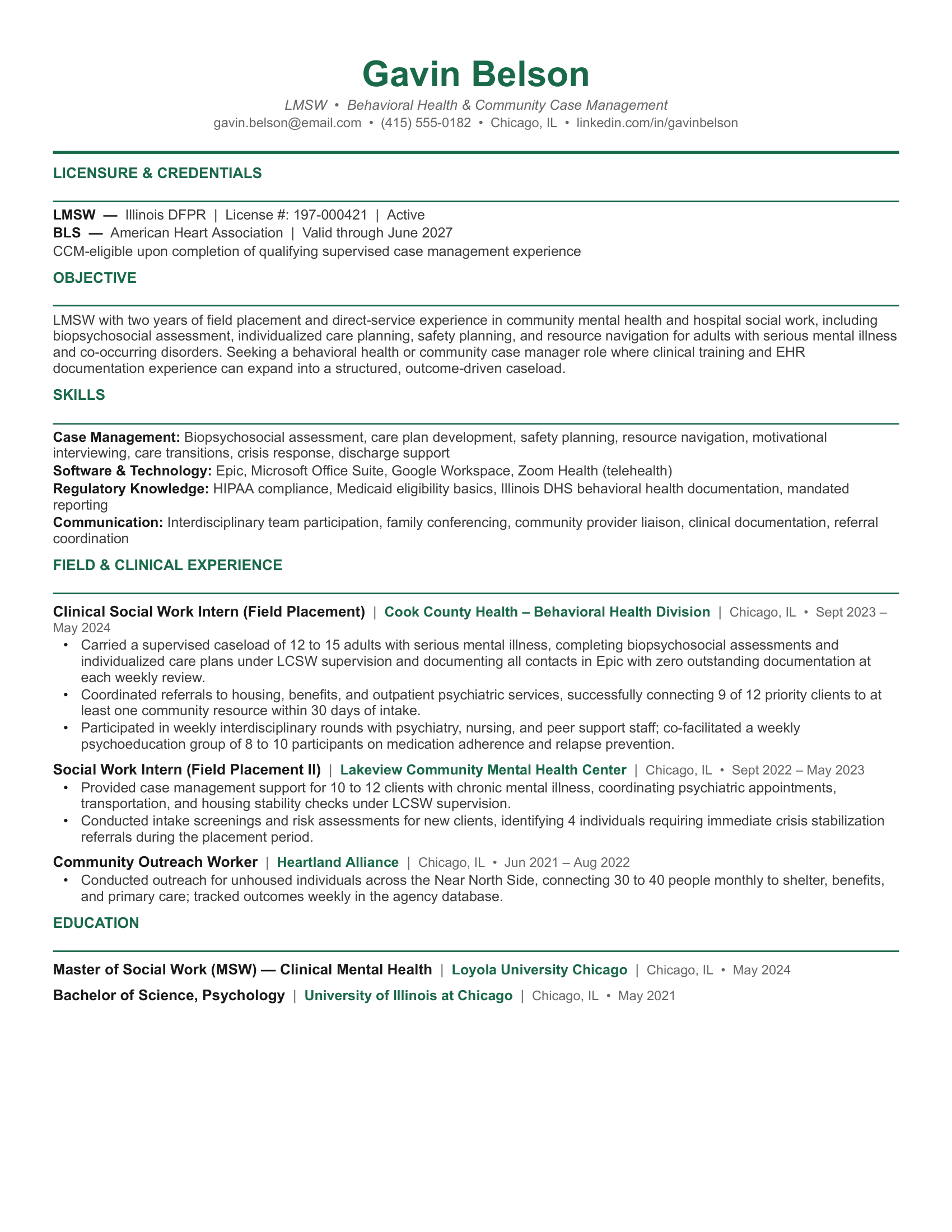
"LMSW with two years of field placement and direct-service experience in community mental health, including biopsychosocial assessment, safety planning, and resource navigation for adults with serious mental illness. Comfortable documenting in an EHR and coordinating with psychiatric, housing, and benefits providers. Seeking a behavioral health case manager role where I can build on this foundation in a community-based setting."
A few principles apply regardless of experience level:
- Name your discipline and setting specifically rather than describing yourself as "versatile" or "dedicated." A hospital case manager role and a payer-side utilization role are looking for different profiles
- Tailor your summary for each application. A workers' compensation role and a community social services role require completely different emphasis
- Avoid language like "passionate about patient advocacy" or "committed to quality care." These phrases carry no information and every applicant uses them
Build a Skills Section That Speaks to Hiring Managers
Case manager resumes draw from a wider range of competencies than most roles: clinical assessment, care coordination, utilization criteria, payer rules, psychosocial support, and documentation. All of these belong on the resume, but they need to be organized into clear categories.
Case Management Competencies: Care coordination, discharge planning, care transitions, utilization review and management, biopsychosocial assessment, individualized care plan development, risk stratification, chronic disease management, patient and family education, resource navigation, motivational interviewing, patient advocacy
Software and Clinical Technology: Epic, Cerner, Meditech, Allscripts, InterQual, MCG criteria, telehealth platforms, population health and care management platforms
Regulatory and Payer Knowledge: Medicare and Medicaid coverage rules, CMS Conditions of Participation for discharge planning, HIPAA, commercial and managed care authorization processes, NCQA and URAC standards, Two-Midnight Rule, observation versus inpatient status
Communication and Coordination: Interdisciplinary team rounds, family conferences, payer and provider communication, clinical documentation, care plan reporting, post-acute and community referral management
A few things to keep in mind when building this section:
- Only list competencies you can speak to in an interview. Case management screens often include scenario questions, and a hiring manager can tell within two minutes whether you have actually run a utilization review or only listed it
- Mirror the language in the job description. One employer calls it "utilization review," another calls it "utilization management." One posting lists "care transitions" and another lists "discharge planning." Use their terminology where it accurately reflects your experience
- Separate nursing scope from social work scope. A hiring manager screening for an RN case manager wants to see clinical assessment and utilization criteria, while a social work case manager role weighs psychosocial assessment and community resource navigation. Be clear about which you bring
Write Achievement-Focused Experience Bullets
Case manager experience bullets have a tendency to read as duty logs. "Coordinated discharges and completed assessments" and "communicated with insurance companies" tell a hiring manager what the job involved, not what you produced in the role.
Use this formula for each bullet: [Action verb] + [specific task or method] + [quantifiable result or scope]
Weak: "Responsible for managing a caseload of patients and coordinating their discharge."
Strong: "Managed a daily caseload of 18 to 24 acute medical-surgical patients, coordinated discharge plans across nursing, physical therapy, and social work, and reduced average length of stay by 1.2 days over 12 months."
The second version gives a hiring manager three things to evaluate: your caseload size, your coordination scope, and a measurable outcome that matters to any unit considering you.
Here are more examples across different case manager settings:
Hospital / Acute Care Case Manager (RN)
- Managed a daily caseload of 20 to 24 medical-surgical patients at a 450-bed hospital, led interdisciplinary rounds, and reduced average length of stay by 1.3 days over 12 months
- Completed utilization reviews using InterQual criteria for 25 to 30 cases daily and reduced observation-status denials by 22% through earlier physician documentation queries
Utilization Review / Managed Care Case Manager
- Reviewed 30 to 40 prior authorization and concurrent review cases daily against MCG criteria for a regional health plan and maintained a 98% turnaround compliance rate within contractual timeframes
- Enrolled 60+ high-risk members annually in complex care management and reduced 30-day readmissions in that cohort from 19% to 12% over 18 months
Behavioral Health Case Manager
- Carried a caseload of 40 to 50 adults with serious mental illness in an assertive community treatment program, coordinated psychiatric care, medication adherence support, and crisis response, and documented all contacts in the agency EHR
- Reduced psychiatric inpatient readmissions across the panel by 27% over two years through structured follow-up within 48 hours of discharge
Social Work / Community Case Manager
- Managed a caseload of 55 to 65 clients in a community health program, completed biopsychosocial assessments, and connected clients to housing, benefits, and outpatient treatment
- Increased the share of clients attending a first outpatient appointment after hospital discharge from 61% to 84% by building a warm-handoff protocol with three local providers
Workers' Compensation Case Manager
- Managed 45 to 55 active workers' compensation cases and coordinated treatment and return-to-work plans among injured workers, employers, and treating physicians
- Returned 78% of injured workers to modified or full duty within 60 days, ahead of the regional benchmark of 65%
When clean metrics are not available, quantify scope instead. How large was your caseload? How many reviews or assessments did you complete weekly? What was the size of the facility or the population you served? Scope metrics are weaker than outcome metrics but significantly stronger than purely descriptive bullets.
One practical step before writing your resume: pull up your productivity reports, EHR dashboards, and quality data from previous roles. Caseload counts, length-of-stay trends, readmission rates, and authorization turnaround times often sit in reporting tools you may have stopped checking. A short audit can surface numbers that strengthen several bullets at once.
Frame Transferable Experience if You Are New to Case Management
Most case managers do not start their careers in case management. They come from bedside nursing, direct social work, discharge planning support, or community outreach. New social work graduates often have field placements that involved real client work under supervision. All of this experience counts when you frame it around case management functions rather than the original job title.
If you are a nurse moving from the bedside, lead with the parts of your clinical work that map to case management: interdisciplinary rounds, discharge coordination, patient education, and any exposure to utilization criteria. If you are a social worker, lead with assessment, care planning, and resource navigation. If you are a new graduate, treat each significant field placement or internship as its own experience entry.
Include the site name, the setting, the supervisor's credential, the dates, and two to three outcome-focused bullets covering caseload, populations served, and what you coordinated.
Clinical Social Work Intern (Field Placement) | County Behavioral Health Services | Sept 2024 – May 2025
- Carried a caseload of 12 to 15 clients under LCSW supervision and completed biopsychosocial assessments and individualized care plans
- Connected clients to housing, food assistance, and outpatient psychiatric care and documented all contacts in the agency EHR
- Co-facilitated a weekly psychoeducation group of 8 to 10 participants on medication adherence and relapse prevention
A few principles apply when documenting transferable experience:
- Be specific about your actual scope and level of supervision. A hiring manager can tell the difference between observing a care conference and running one
- Lead with the experience most relevant to your target setting. A nurse applying for hospital case management should foreground discharge and rounds work, not unrelated floor duties
- Do not inflate responsibilities beyond what happened. References and a structured interview will clarify any discrepancy quickly
Showcase Your Certifications and Licensure
Certification and licensure carry more weight in case management hiring than in many other fields, and many postings list a specific credential as required or strongly preferred. A missing license number, an unlisted certification, or a lapsed credential can slow you down before a hiring manager makes a decision.
List the following in a dedicated section near the top of your resume, directly after your summary or contact information:
For RN case managers:
Certifications
- NCCPA Certification (CCM) | Commission for Case Manager Certification | Valid through 2027
- Registered Nurse (RN) | [State] Board of Nursing | License #: XXXXXXX | Active
- Accredited Case Manager (ACM-RN) | American Case Management Association | Valid through 2026
- Basic Life Support (BLS) | American Heart Association | Valid through 2026
For social work case managers:
Certifications
- Licensed Clinical Social Worker (LCSW) | [State] Board of Social Work | License #: XXXXXXX | Active
- Certified Case Manager (CCM) | Commission for Case Manager Certification | Valid through 2027
- Accredited Case Manager (ACM-SW) | American Case Management Association | Valid through 2026
Continuing education:
Continuing Education: 80 CE hours completed in current 5-year CCM renewal cycle, including 20 hours in care transitions and utilization management
A few things to get right here:
- Keep expiration dates current. A lapsed certification or license on a case manager resume creates a red flag before you walk in the door. Audit your credentials before each application and renew anything that has expired or is close to it
- If you are not yet certified, note your eligibility. Writing "CCM-eligible (24 months of qualifying experience completed)" tells a hiring manager you understand the credential and are on track for it
- Separate licenses and recognized certifications from short workshops. A weekend training and a board-recognized credential are not in the same category
Case Manager Resume Examples
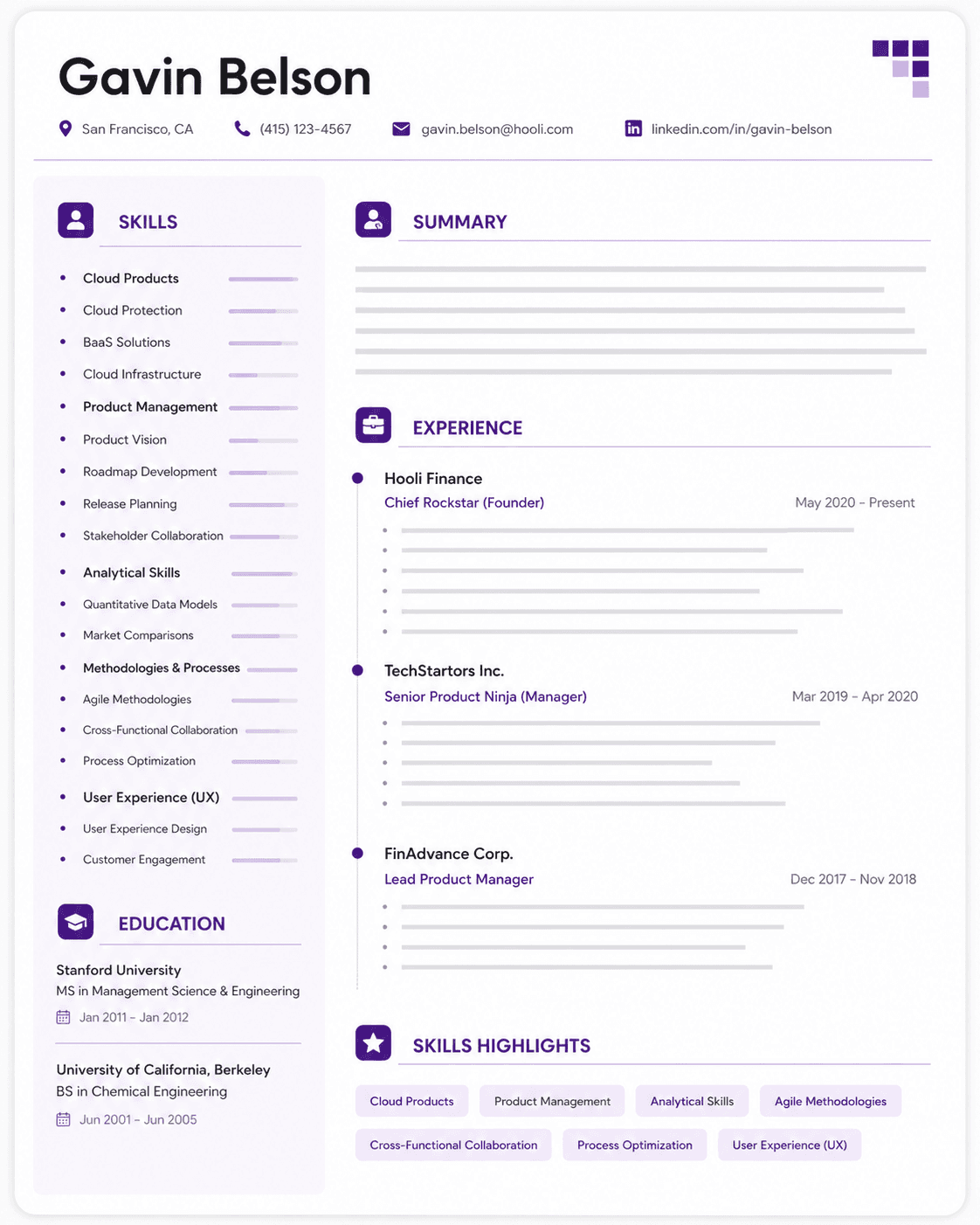
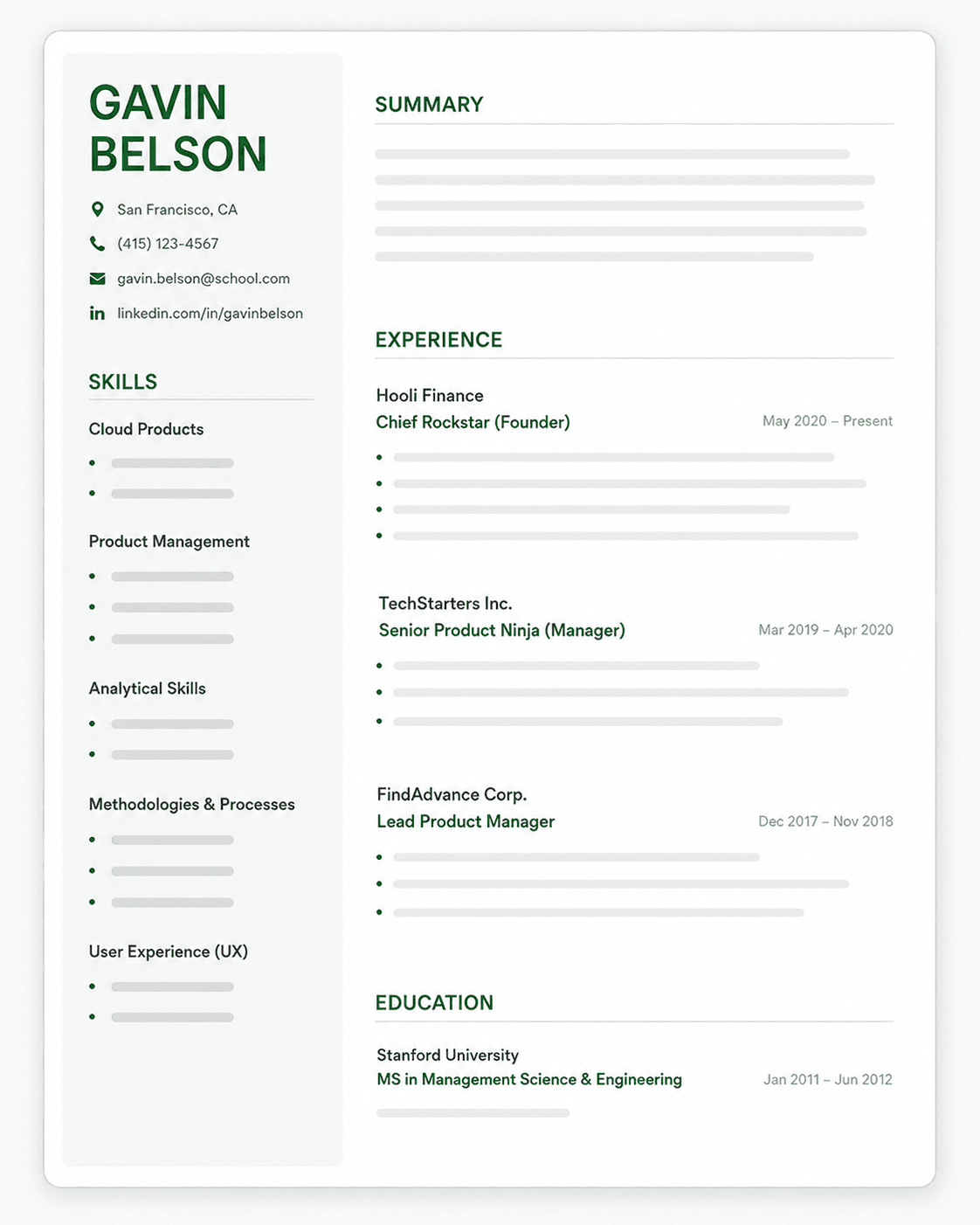
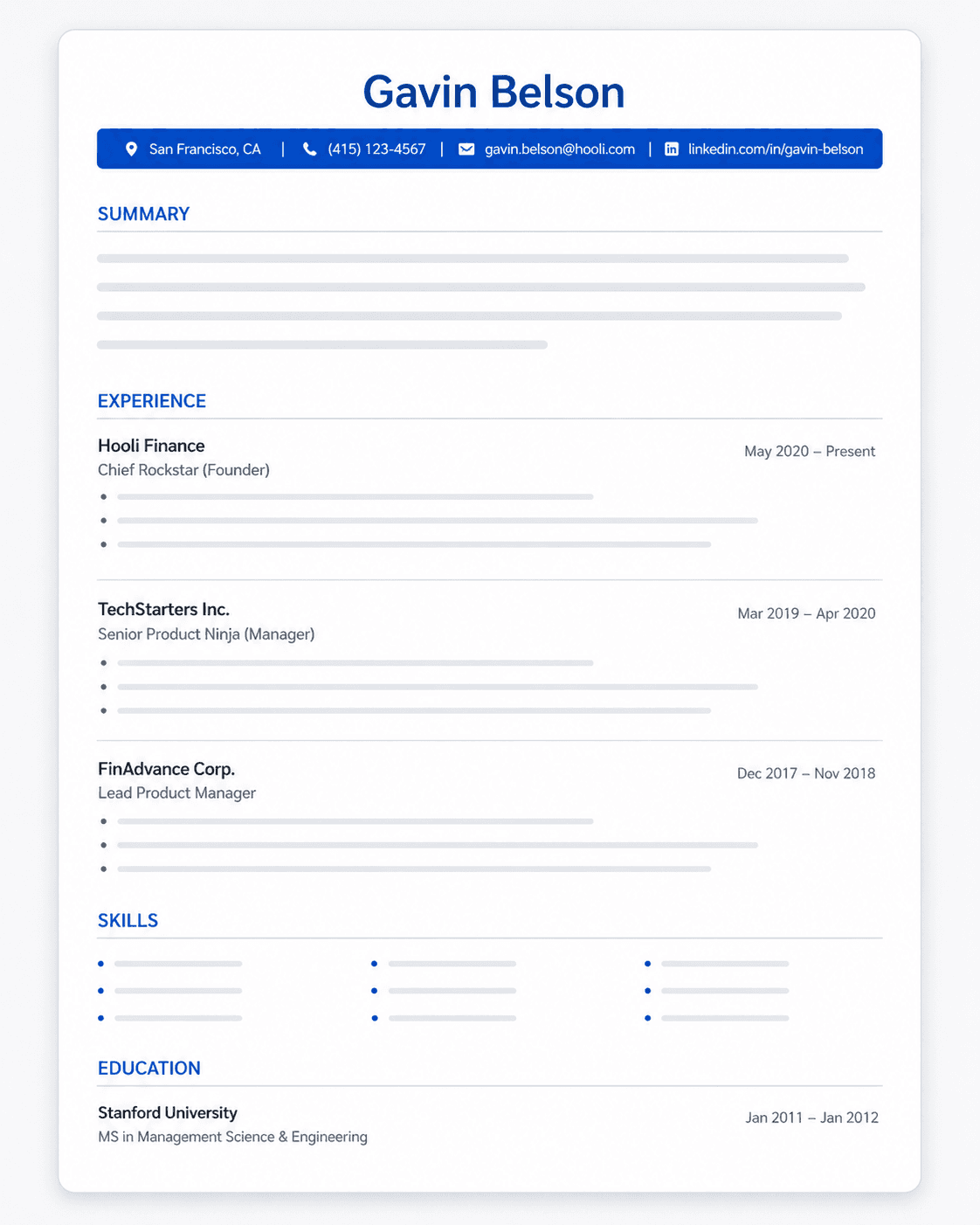
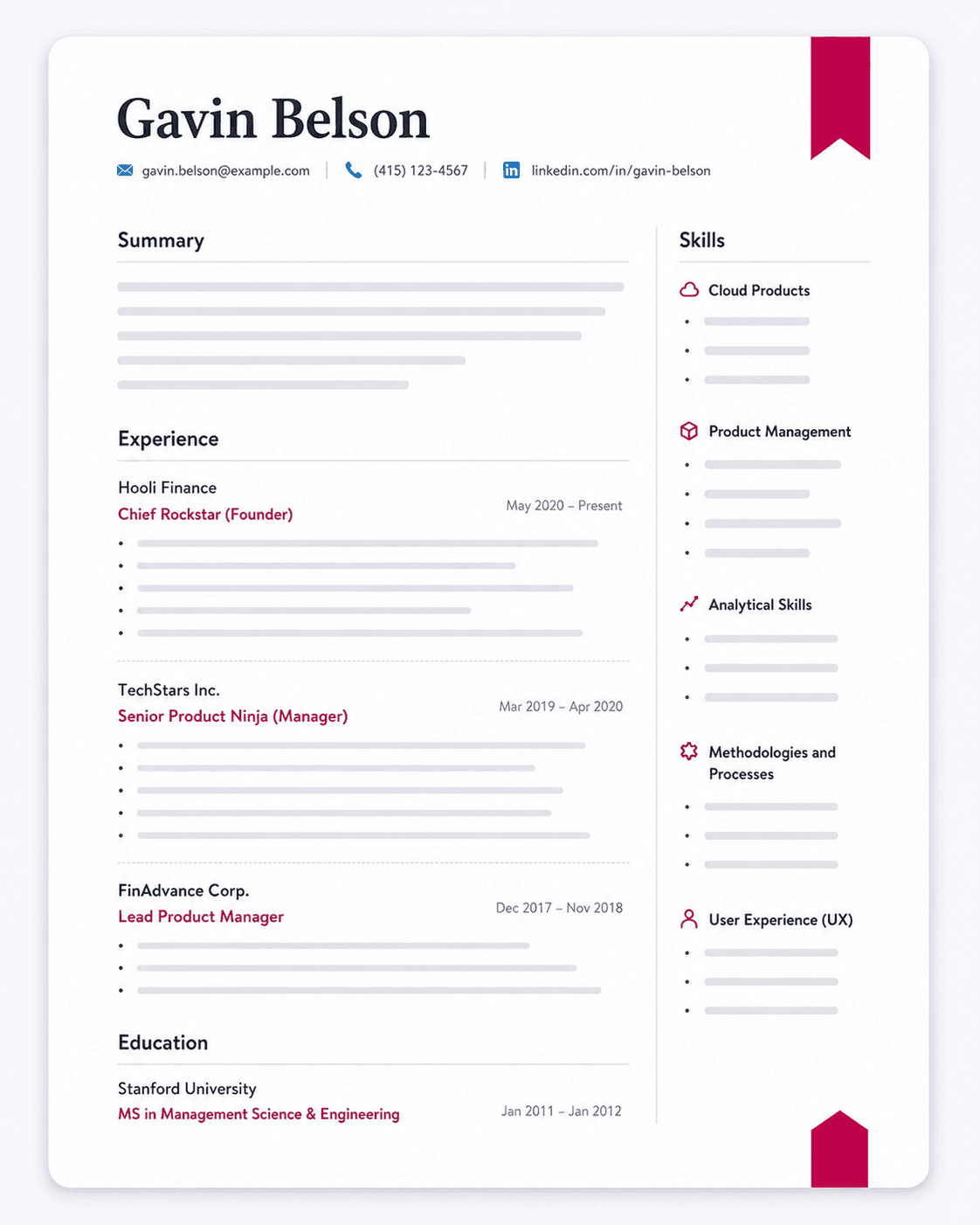
Entry-Level Case Manager Resume Template
Mid-Level Case Manager Resume Template
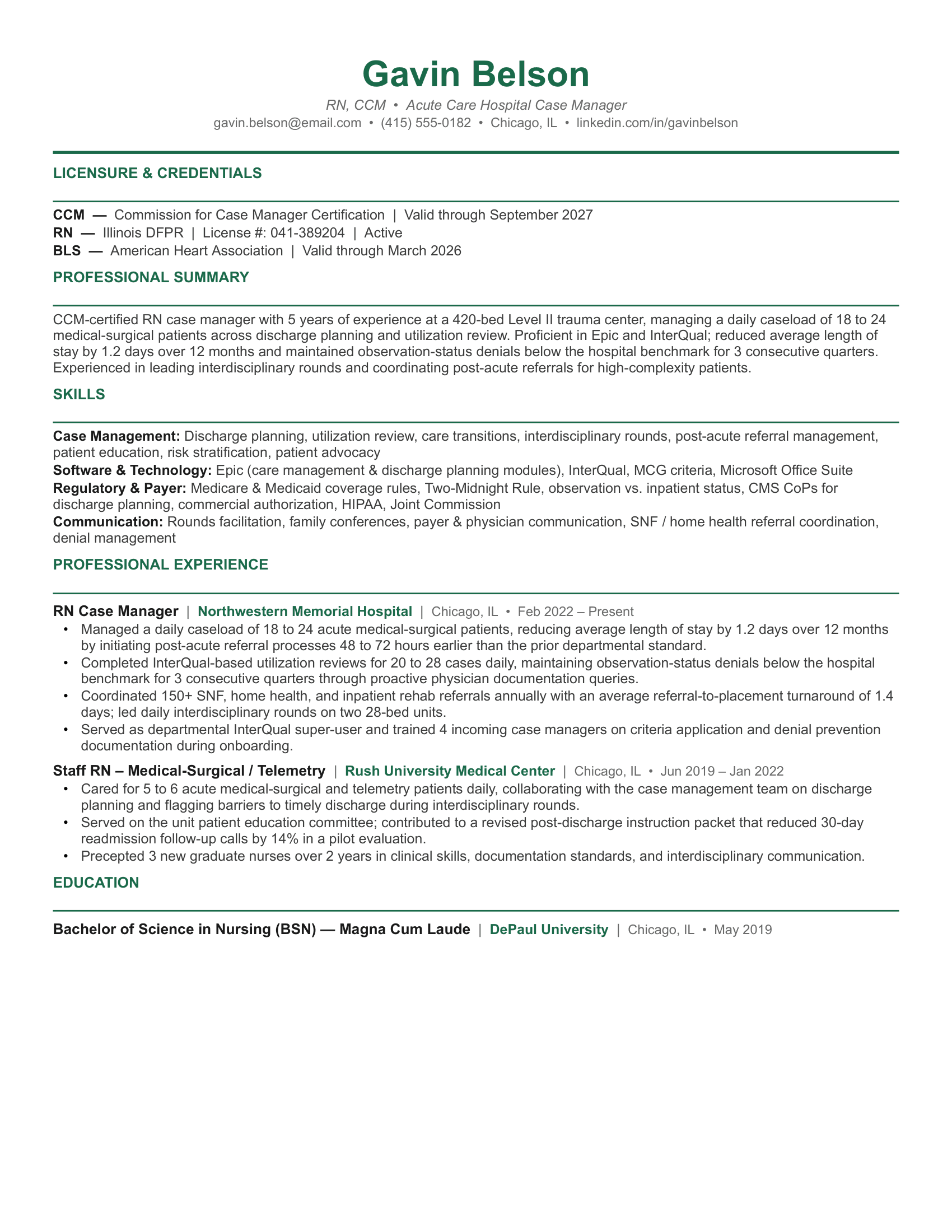
Senior-Level Case Manager Resume Template
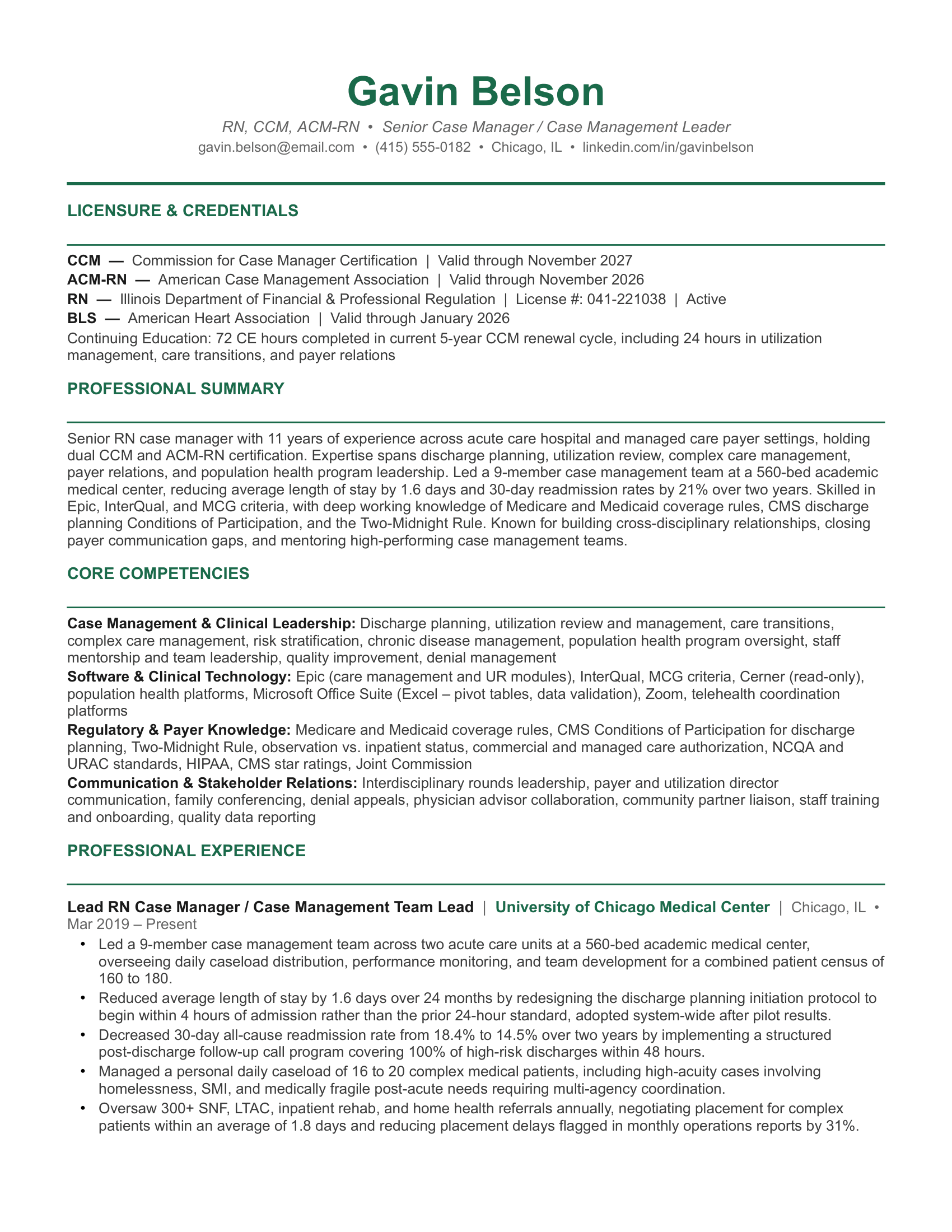
Common Case Manager Resume Mistakes to Avoid
Describing caseload duties instead of outcomes
Bullets like "coordinated discharges and completed assessments" describe the job function, not your performance within it. Hiring managers want to see caseload size, length-of-stay or readmission movement, authorization turnaround, and return-to-work rates. Pull those numbers from your productivity reports and EHR dashboards before writing.
Burying or omitting certifications and licensure
Leaving out license numbers, certifying bodies, or expiration dates creates friction in the hiring process. Many case manager postings screen for a specific credential, and a hiring coordinator should not have to hunt for it. A complete and current credentials section near the top removes that friction and signals organizational competence.
Using the same resume for every setting
A hospital case manager role, a payer-side utilization role, and a community social services role are looking for different experience profiles. Sending an unmodified resume to all three reduces your relevance signal in each. Adjust your summary, your skills list, and your most prominent bullets for the specific setting and population you are applying to.
Leaving caseload size and productivity metrics off
Caseload size is one of the first things a case management hiring manager looks for, because it signals how much complexity you can hold at once. A resume that never states a caseload number forces the reader to guess. Put your typical caseload, your weekly review or assessment volume, and the size of your facility or population on the page.
Blurring the line between nursing and social work scope
Nurse case managers and social work case managers do related work, but their scope differs, and credentialing and interviews surface the difference quickly. Be accurate about what you did. A social worker should not imply clinical utilization-criteria authority, and a nurse should foreground clinical assessment rather than positioning psychosocial counseling as the core of the role.
Ignoring ATS formatting requirements
Hospital system and large payer job postings often go through an applicant tracking system before a human reviews them. Creative templates with graphics, multiple columns, or icons may look clean but frequently fail ATS parsing. Use standard fonts, clear section headers, and simple bullet points. If the job description lists a specific certification, EHR, or criteria tool, use that exact language in your resume.
Leaving out payer, regulatory, and utilization knowledge
Case management runs on coverage rules, discharge regulations, and utilization criteria. If you know Medicare and Medicaid rules, the Two-Midnight Rule, CMS discharge planning requirements, or InterQual and MCG criteria, say so explicitly. Hiring managers on both the provider and payer side treat this knowledge as a core competency, not a nice-to-have.
Why It's Important to Tailor Your Resume for Different Case Manager Roles
Case manager roles vary significantly across settings and disciplines. A hospital case manager role weighs discharge planning, length of stay, and utilization criteria. A managed care role weighs authorization turnaround and readmission reduction. A community social work role weighs assessment and resource navigation, and a workers' compensation role weighs return-to-work outcomes. One resume cannot foreground all of these at once.
Tailoring your resume for each of these manually is slow, and generic resumes in case management hiring get filtered out quickly, especially when employers are screening for specific certifications, EHR systems, and criteria tools.
This is where an AI resume optimizer tool like Upplai can help. Here is how Upplai can simplify your search for a suitable case manager role:
- Real-time ATS scoring: Upplai updates your ATS score as you edit, so you can see the impact of every change instantly rather than re-uploading your resume each time.
- Transparent suggestions: Every recommendation comes with a clear reason behind it and controls. You can accept or reject it in one click without guessing about the logic.
- Automatic formatting: You get a clean, professionally designed resume without adjusting a single margin or font size after every edit.
- Structure guidance: Upplai guides you on resume writing best practices developed by recruiters and resume coaches, such as when to use a summary versus an objective, where to place your certifications and licensure, how to frame transferable experience, and how to order your experience based on your target setting. It also flags content that can lead to potential recruiter bias.
- Preference memory: Your caseload metrics, certifications, section ordering, and formatting choices carry over each time you apply somewhere new, saving you hours in your job search.
If you are worried about getting trapped in subscription fees, Upplai's pricing is straightforward. You get 200 ATS scores per month, three tailored resumes, and unlimited downloads with no credit card in the free plan. If you need additional resumes, you can pay $0.50 or $1.00 each with no subscription attached.