Your floor experience reads like a deficit the moment an ICU posting asks for CCRN you can't yet sit for. Two to five years on med-surg, telemetry or step-down is real acute care experience, but a resume that describes duties instead of acuity gives a unit manager no way to see it. You don't need to manufacture ICU experience. You need to translate what you already do, ratios, drips, rapid responses, deteriorating patients caught early, into language a critical care screener checks for.
This guide shows you how to write a summary that leads with acuity, build a certifications block that shows a CCRN clock already running, and write bullets that prove you think in reasoning, not tasks.
What Critical Care Hiring Managers Screen For
Critical care applications get read twice, by two different people looking for two different things.
HR checks the hard gates first: active RN license, BLS, ACLS, and a minimum number of years of acute care experience. Most ICU postings set that bar at 1 to 2 years, and several large health systems name med-surg, telemetry and step-down experience directly as qualifying background. If your floor experience is recent and acute-care-heavy, you likely already clear this gate. Don't self-reject before a manager ever sees the page.
Only after that pass does a unit nurse manager read the clinical detail. Experienced nurses describe this second read as the one that actually decides the interview. One allnurses thread on building an ICU resume makes the point plainly: a manager is checking patient population, acuity, ratios, and the specific therapies and devices you've actually run, not a stack of generic nursing verbs. "Detail-oriented team player with strong communication skills" tells a manager nothing about whether you can titrate a drip or read an arterial line.
That two-reader structure is why a resume built for one audience can still fail the other. Clinical detail with a missing certification date never clears the HR pass. Perfect credentials paired with "administered medications and monitored vital signs" won't hold a manager's attention.
So the top third of the page has to satisfy the license and certification check at a glance, and the bullets underneath have to earn the manager's attention with acuity, not adjectives.
How to Write a Critical Care Nurse Resume That Gets Interviews
Write a Summary That Leads With Acuity, Not Adjectives
A critical care resume summary has three jobs: name the patient population and acuity you've cared for, state the ratio and setting, and name one critical care skill or therapy you already perform. Skip personality traits. A screener assumes you're compassionate already; they're checking whether you understand acuity.
A weak summary looks like this:
"Compassionate, detail-oriented RN with excellent communication skills and a passion for patient care."
A stronger one looks like this:
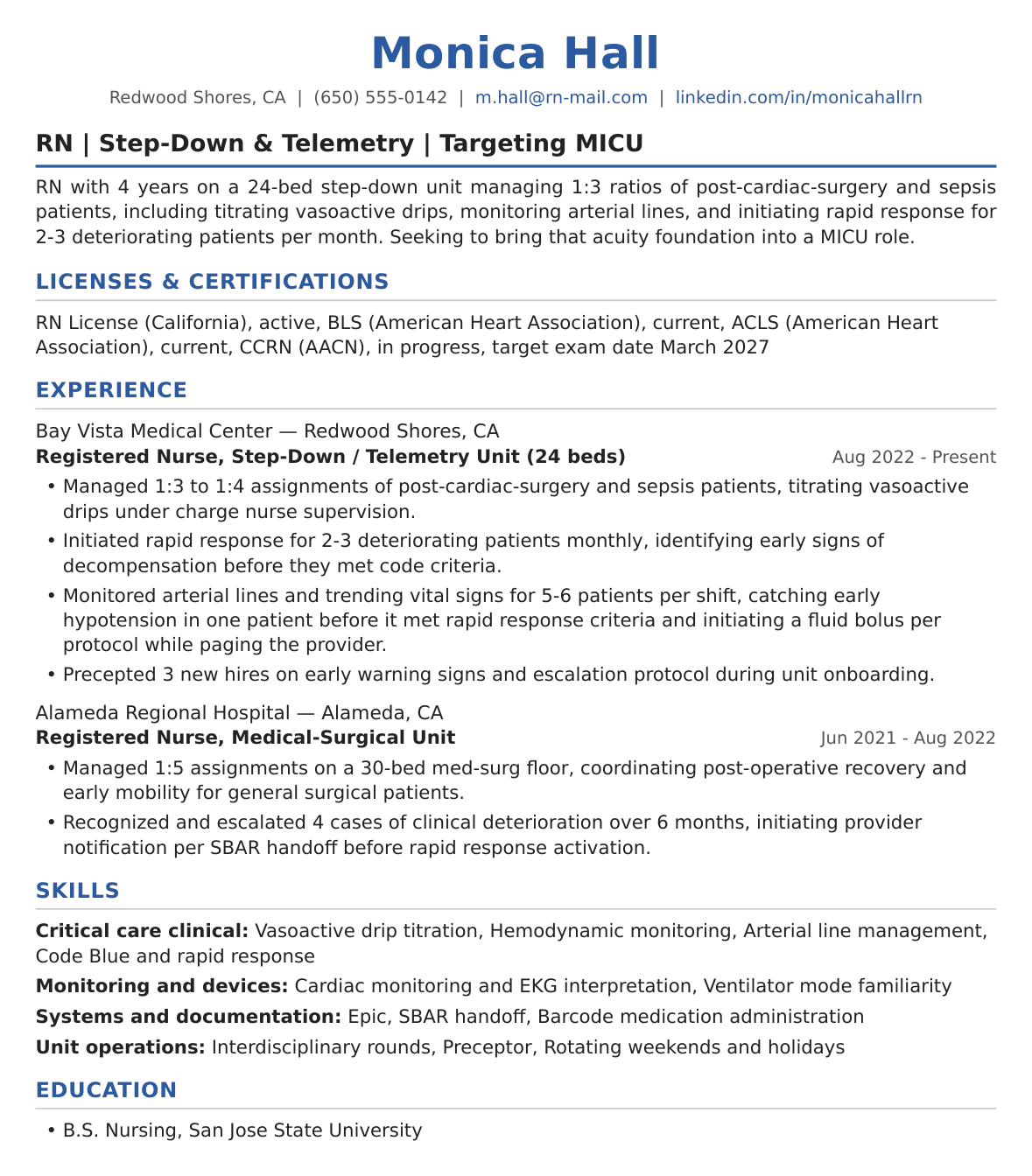
"RN with 4 years on a 24-bed step-down unit managing 1:3 ratios of post-cardiac-surgery and sepsis patients, including titrating vasoactive drips, monitoring arterial lines, and initiating rapid response for 2-3 deteriorating patients per month. Seeking to bring that acuity foundation into a MICU role."
Transitioning in from the floor? Keep the same structure but let it read as a foundation.
Transitioning-in summary variant: "Step-down RN with 3 years managing high-acuity telemetry patients (post-MI, CHF, early sepsis) at 1:4 ratios, including drip titration under charge nurse supervision and rapid response activation. Bringing that acuity background to a first critical care role."
Put Your Licenses and Certifications Where a Screener Will See Them
Certifications belong in their own block near the top, directly under your summary, not folded into a skills paragraph. Write each one the way postings write it: credential, issuing body, current status.
- RN License (state name or "compact"), active
- BLS (American Heart Association), current through [date]
- ACLS (American Heart Association), current through [date]
- CCRN (AACN), in progress or target exam date [date] (omit if not applicable)
- TNCC, PALS, NIHSS, Basic Arrhythmia Recognition, listed only if held
BLS and ACLS are close to universal on ICU postings. CCRN almost always shows up as preferred, not required. If you don't hold a certification yet, say when you expect to rather than leaving it off. Some systems build in a grace window: one allows ACLS within 60 days of hire or transfer, another gives 18 months for TNCC. Windows vary by employer, so treat them as evidence a scheduled cert isn't disqualifying rather than a rule you can count on.
If you're wondering whether your CCRN clock has already started based on floor hours, AACN's direct care eligibility pathway spells out exactly which hours count.
Build a Skills Section Around Procedures and Systems
Critical care clinical: Hemodynamic monitoring, arterial line management, central line care, vasoactive drip titration, ventilator management, Code Blue response, CRRT
Monitoring and devices: Cardiac monitoring and EKG interpretation, Swan-Ganz and FloTrac/Vigileo familiarity, IABP, ventilator mode adjustment
Systems and documentation: Epic, Cerner, Meditech, SBAR handoff, barcode medication administration
Unit operations: Charge nurse coverage, precepting new hires, interdisciplinary rounds, cross-training (CVICU, ECMO)
Group your skills into labeled categories like the block above, and only list what you can perform unaided, not what you've watched a preceptor do. Mirror the posting's exact wording ("vasoactive drips," not "pressors"), and skip the drip-by-drip laundry list.
Write Bullets That Show Anticipation, Not Tasks
Every experience bullet should follow the same formula: [Action verb] + [specific intervention or population] + [quantified scope or result].
A weak bullet looks like this:
"Cared for critically ill patients and administered medications as ordered."
A stronger one looks like this:
"Managed a 1:2 assignment of post-cardiac-surgery patients, titrating three concurrent vasoactive drips and identifying early signs of tamponade in one patient that led to an emergent return to the OR."
Use the sub-unit library below as a starting point and swap in your own numbers.
Med-surg or telemetry nurse targeting ICU
- Managed 1:4 to 1:5 assignments on a 30-bed telemetry unit, initiating rapid response for 2-3 deteriorating patients monthly
- Titrated low-dose vasoactive drips under charge nurse supervision for post-cardiac patients, and precepted 3 new hires on early warning signs
Medical ICU (MICU)
- Managed 1:2 ventilator-dependent patients, averaging 4.2 ventilator days per patient, titrating up to 3 vasoactive drips per shift
- Served as primary compression or medication nurse in 15+ Code Blue responses over 12 months; kept CLABSI rate below benchmark for 6 straight quarters
Cardiovascular or cardiothoracic ICU (CVICU/CTICU)
- Managed 1:1 to 1:2 fresh post-op open-heart patients, monitoring arterial lines, Swan-Ganz catheters, and IABP counterpulsation through the first 24 postoperative hours
- Titrated inotropic and vasopressor drips for 8-10 cardiac surgery patients monthly; identified 4 tamponade cases needing emergent intervention over one year
Neuro ICU or surgical ICU
- Managed 1:2 post-craniotomy and stroke patients, performing hourly neuro checks and managing external ventricular drains and ICP monitoring
- Coordinated targeted temperature management for 6+ post-arrest patients annually; precepted 2 new-hire nurses on neuro assessment technique
No clean outcome statistics like infection rates? Quantify scope instead: ratio, ventilator days, codes attended, drips managed, or nurses precepted. Those numbers usually sit in your staffing sheets and incident logs already.
Translate Floor and Step-Down Experience Into ICU Terms
The biggest shift a floor nurse has to make on paper is moving from task language to reasoning language. Critical care screeners check whether you knew what could go wrong next, not just whether you did something.
A task-oriented bullet looks like this:
"Monitored vital signs and administered medications for post-operative patients."
An anticipation-oriented rewrite looks like this:
"Monitored trending vital signs for 5-6 post-operative patients per shift, identifying early hypotension in one patient before it met rapid response criteria and initiating a fluid bolus per protocol while paging the provider."
The rewrite doesn't invent experience. It names the same shift and adds the reasoning already happening in your head.
The med-surg-to-ICU transition is common enough that hospitals build 12 to 16 week orientations around it. Managers still weigh floor experience differently, so write for the one who wants it, and let your bullets carry the acuity detail that proves it.
MICU, SICU, CVICU, Neuro: Why Your Unit Type Belongs on the Page
Most resume advice treats "ICU" as a single job. Postings don't. The same hospital can run separate requisitions for a medical ICU, a surgical ICU, a CVICU, a neuro/neurosurgical ICU and an eICU, each with its own manager and case mix. A listing titled "ICU RN" sometimes turns out to be a combined medical/surgical unit once you read the description.
So your title line should say more than "ICU Nurse." Write the actual unit name and bed count: "Registered Nurse, Cardiovascular ICU (18 beds)" tells a screener what you've handled before they open the resume. If your background is a combined medical/surgical or general ICU, say so directly and describe the case mix rather than borrowing a specialty label you can't back up at interview.
If you're transitioning in from a floor unit, name the unit you're targeting in your summary and match the language that unit's postings use. Say "CVICU" rather than "ICU" generically.
If CVICU is the goal and you haven't worked cardiac surgery patients yet, shadowing in the cath lab or interventional radiology is common advice among nurses who've made the move, and it belongs on a professional development line.
| Unit | Common abbreviation | Typical case mix |
|---|---|---|
| Medical ICU | MICU | Sepsis, respiratory failure, multi-organ dysfunction |
| Surgical ICU | SICU | Post-surgical, trauma, abdominal or vascular cases |
| Cardiovascular/cardiothoracic ICU | CVICU/CTICU | Fresh post-op open-heart, IABP, inotrope titration |
| Neuro ICU | Neuro ICU | Stroke, craniotomy, ICP monitoring, EVD management |
| Cardiac ICU/coronary care unit | CCU | Acute MI, arrhythmia, heart failure, non-surgical |
| Combined medical/surgical ICU | General ICU | Mixed acuity across medical and surgical diagnoses |
Critical Care Nurse Resume Examples
Transitioning Into Critical Care
At this stage, lead with the summary variant already covered, then put the certifications block directly beneath it, both above the fold, so a screener sees BLS, ACLS, and any in-progress CCRN before reaching your work history. Replace generic floor bullets with the acuity-framed version: ratios, drip titration under supervision, rapid response counts, deteriorating patients caught early. Name the target unit (MICU, CVICU, neuro ICU) rather than writing "critical care" generically. Keep this version to one page. What it has to prove is narrow: the acuity foundation is real, and a hiring manager won't be starting from zero.
Experienced ICU Nurse Changing Hospitals
Lead with specifics in the job title line: unit name, bed count, and case mix, not just "ICU RN." A line like "MICU RN, 18-bed unit, ventilator and sepsis-heavy census" tells the reader whether the background maps onto their unit. Certifications still sit near the top, but the experience section carries the weight, so name devices and therapies run independently (Swan-Ganz, IABP, CRRT, targeted temperature management) rather than folding them into a skills line. This resume has to prove the candidate can carry a full assignment on day one. If the work history spans multiple hospitals or travel contracts, group them under one staffing agency heading with contract dates underneath in reverse chronological order, rather than listing each facility as its own job, so a string of 13-week contracts doesn't read as job-hopping.
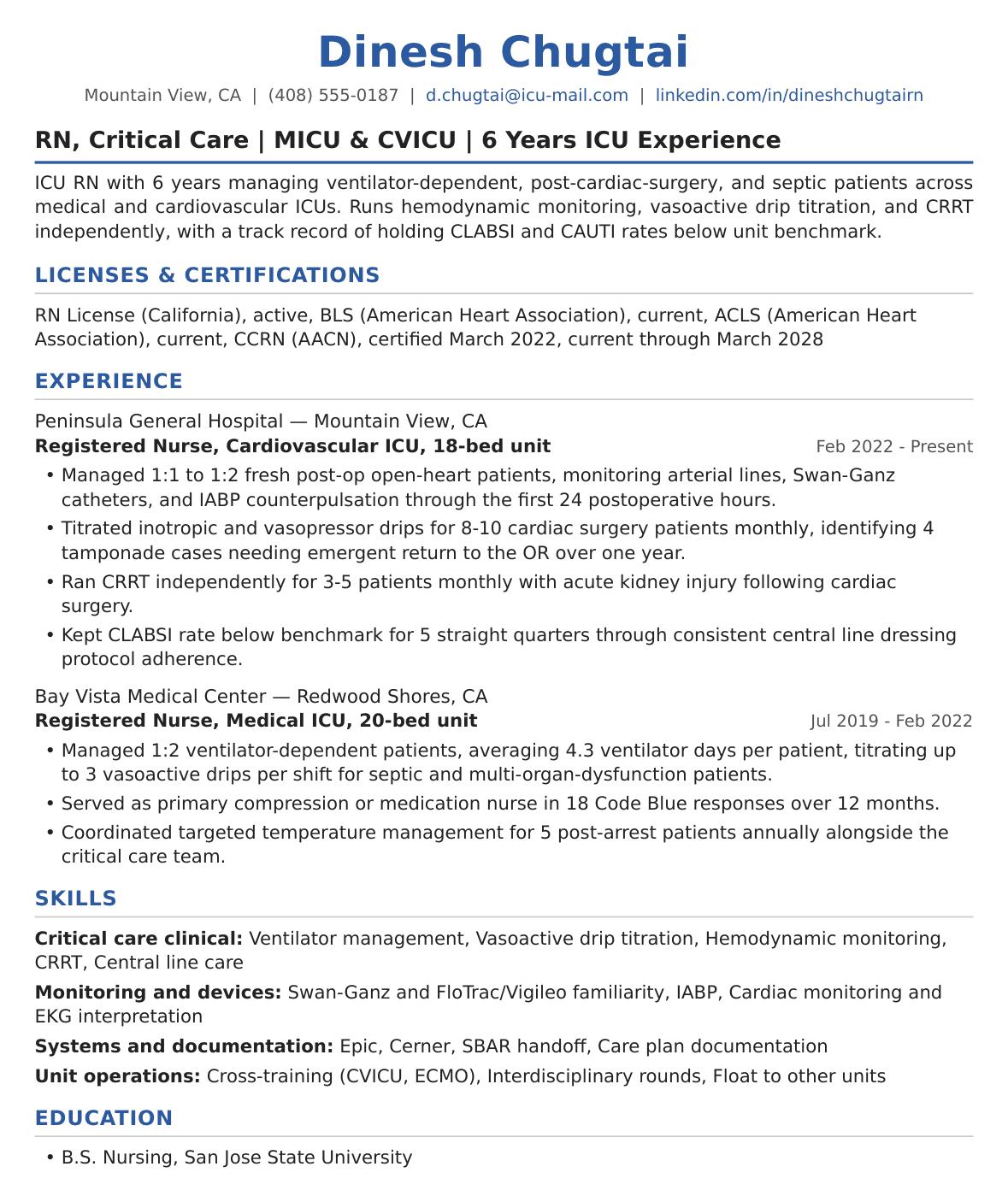
Senior or Charge Critical Care Nurse
Lead with scope, not task detail: charge shifts covered per month, nurses precepted, committee or protocol work (sepsis bundle compliance, skin integrity rounds), and unit metrics owned, like CLABSI or CAUTI rates for a shift. The certifications block can move further down, since a CCRN and a decade of ICU bullets already establish clinical depth. What a reader checks for here is judgment and influence beyond a single assignment. Two pages is acceptable at this level.
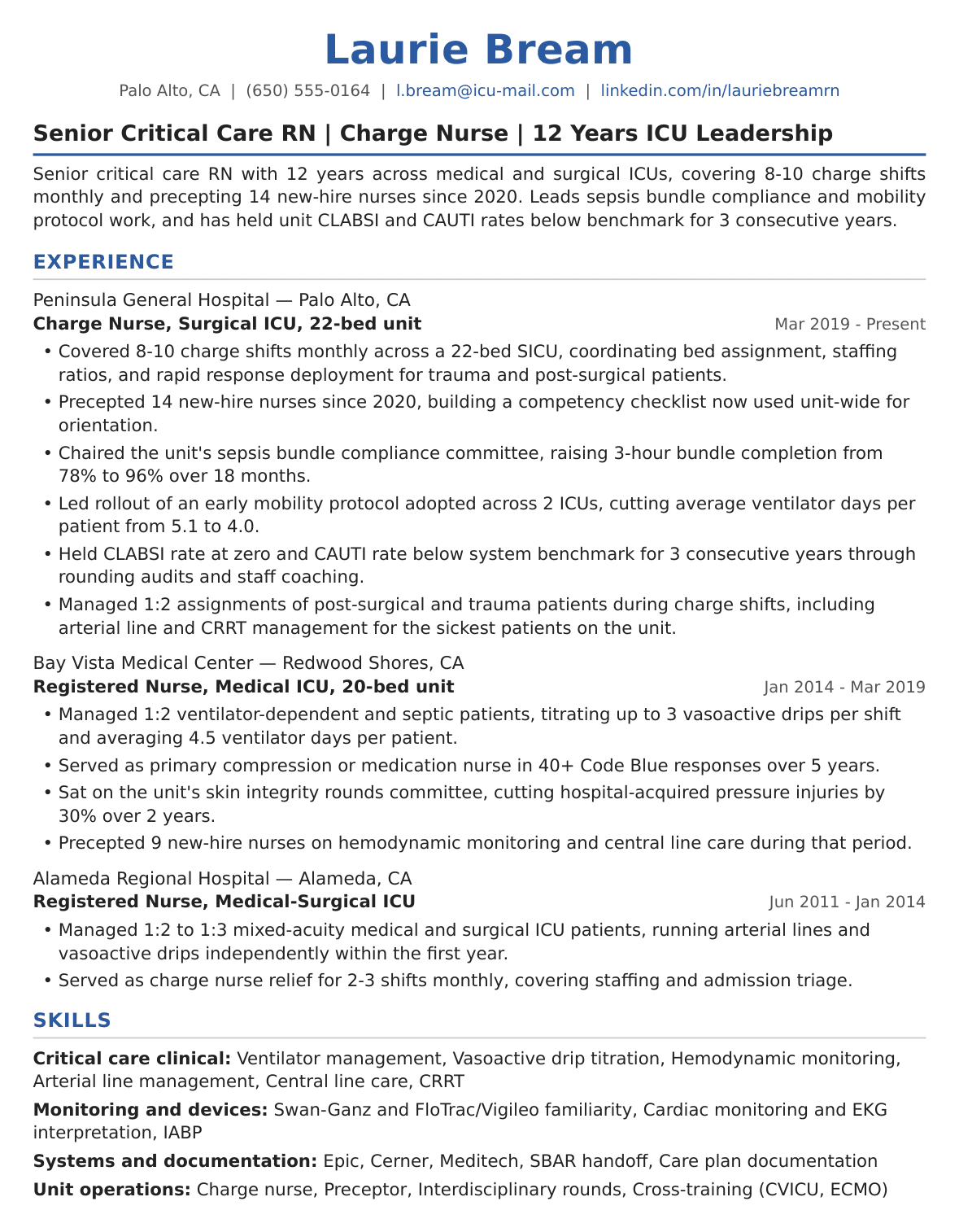
All three share the same backbone. What changes is where each piece sits and how much proof backs it up. If you sit between two levels, say three years of ICU experience with no charge shifts yet, borrow the experienced-nurse structure and keep any leadership language modest rather than claiming scope you don't hold.
Critical Care Nurse Resume Keywords
Critical care postings use precise clinical language, and an ATS or a nurse manager scanning quickly will look for that exact language, not a general nursing paraphrase. Read our ATS resume keywords guide for how applicant tracking systems match terms before a human ever opens your resume. The table below covers the vocabulary hiring systems and screeners scan for. Your summary and bullets still have to carry the ratios, drip counts and outcome numbers that prove you can use it.
| Category | Keywords |
|---|---|
| Licensure & certifications | RN license (state or compact), BLS, ACLS, CCRN, TNCC, PALS, NIHSS, BSN, Basic Arrhythmia Recognition |
| Critical care clinical skills | Ventilator management, Vasoactive drip titration, Hemodynamic monitoring, Arterial lines, Central line care, Code Blue and rapid response, Cardiac monitoring and EKG interpretation, CRRT, Targeted temperature management |
| Systems & documentation | Epic, Cerner, Meditech, Electronic health record (EHR) documentation, Medication administration per physician orders, SBAR handoff, Barcode medication administration, Care plan documentation |
| Unit operations & teamwork | Interdisciplinary rounds, Charge nurse, Preceptor, Float to other units, Rotating weekends and holidays, Cross-training (CVICU, ECMO), Patient and family education |
Match the posting's exact wording rather than a nearby synonym. If the job listing says "vasoactive drip titration," use that phrase, not "medication management." Put these terms where a screener can verify them, in your skills block and inside specific bullets, not stacked at the bottom of the page as a list. Only list a certification, device or system you can actually use unsupervised.
The CCRN Hour Rule Nobody Explains
Most ICU postings list CCRN as preferred, and most step-down or telemetry nurses read that as a closed door. If you assume the eligibility clock starts on your first ICU shift, you leave the credential off the resume entirely, even the target date. That erases a differentiator you may already be partway to earning. On an allnurses thread where an ED nurse asked about transitioning to ICU, other nurses told him he needed ICU experience first. He corrected the thread himself by quoting AACN.
AACN offers two paths. The Two-Year Option needs 1,750 hours in direct care of acutely or critically ill patients over the previous two years, with 875 of those hours in the most recent year. The Five-Year Option needs a minimum of 2,000 hours over five years, with 144 in the most recent year. AACN's own FAQ states that final eligibility is based on patient acuity, not unit type, because bed placement varies by facility. Eligible areas named by AACN include ICUs, CCUs, medical/surgical ICUs, neuro and neurosurgical ICUs, PICUs, NICUs, critical care transport and flight, trauma units, and emergency departments. Orientation hours count too, but only once you are assigned as the primary nurse for acutely or critically ill patients. Shadowing another nurse's assignment does not count.
If you have high-acuity step-down, telemetry, trauma or ED hours, do not omit CCRN. Write a dated line instead: "CCRN eligibility in progress: accruing direct-care hours toward AACN's Two-Year Option, target application [date]." If you just started an ICU orientation, begin counting from the shift you first carry the assignment, and write "Accruing critical care direct-care hours toward CCRN eligibility" until you have a number worth stating. If you already hold CCRN and are changing hospitals, write it as "CCRN (AACN), certified [month/year], current through [month/year]," since certification runs for a three-year period.
One more detail: AACN states CCRN is a registered service mark and brand name, not an abbreviation for "Critical Care Registered Nurse", though postings often spell it out anyway. Write it as CCRN. Never claim eligibility or certification you have not earned. Employers verify it.
Common Critical Care Nurse Resume Mistakes to Avoid
Writing Duties Instead of Acuity
"Administered medications as ordered" and "provided patient care to critically ill patients" could describe almost any nursing job. Name the ratio and the population instead, post-cardiac-surgery at 1:2, septic patients on pressors, ventilated patients at 1:2. Never submit a line a screener could not trace back to a specific unit.
Sending the Same Resume to Every ICU Posting
A MICU posting wants sepsis, ventilator days and CRRT. A CVICU posting wants fresh post-op hearts, IABP and inotropic titration, even at the same hospital. One generic resume covers neither well. Before you apply, rewrite your summary and top three bullets to match the case mix named in that specific posting.
Listing Certifications Without Status
"BLS certified" and "ACLS certified" tell a screener nothing about whether they are current. Write the credential, the issuing body and the expiration or status, the section above shows the exact format. The opposite mistake also costs you: leaving CCRN off entirely because you have not sat for it yet. A dated line showing progress reads stronger than no line at all.
Opening With a Stack of Soft-Skill Adjectives
"Compassionate, dedicated, detail-oriented team player" is common filler that experienced nurse reviewers call out immediately. A screener assumes compassion. What they are checking is whether you understand acuity, so replace the adjective stack with the population and ratio you have carried.
Listing Every Drip You Have Ever Titrated
Naming every gtt you are comfortable with, norepinephrine, vasopressin, dopamine, milrinone, one line at a time, reads as trying too hard rather than as thorough. Summarize it as titrating vasoactive drips and let the interview surface which ones. Use the space you free up for a ratio, a code count or a ventilator-days figure instead.
Formatting the Resume So a Parser Cannot Read It
Multi-column layouts, skills boxed into text boxes, certifications tucked into a header or footer, and a table of credentials are common in nursing resume templates, and they are exactly what an ATS parser drops or scrambles. Keep your license, BLS, ACLS and CCRN status in the body text, in a single column.
How AI Resume Builders Can Simplify Your Critical Care Nurse Resume
Every posting wants a different case mix emphasized, and rewriting your summary and top bullets by hand for each one takes too long. A generic resume gets filtered before a recruiter opens it.
An AI resume builder helps in five ways:
- Real-time ATS scoring: your match score updates as you edit, so you know if swapping in ventilator or titration language moved the needle, no re-uploading to check.
- Transparent suggestions: every edit comes with a plain-language "why this change" note, and you accept or reject each one. Nothing gets rewritten or invented behind your back.
- Automatic formatting: your resume gets cleaned into ATS-friendly templates, avoiding layouts that trip up hospital parsers.
- Structure guidance: suggestions reorder content for relevance, quantify patient ratios and outcomes, and flag language that could trigger bias.
- Preference memory: formatting and metric choices carry over between sessions, and you can bookmark separate master resumes for MICU, CVICU, and Neuro ICU postings.
Pricing stays honest for a search with an end date. The free plan includes 200 ATS scans a month plus a one-time allotment of 3 tailored resumes with matching cover letters, unlimited downloads included, no card required. Extra resumes run $0.50 to $1.00 each, no subscription.
Try it on your ICU resume
Run a free ATS check and see how your resume reads against a specific ICU posting.