Your dance training and stage credits got you noticed, but they won't be what gets you hired as a teacher. Studio directors, academy owners, and school arts coordinators screen resumes for curriculum planning, classroom management, and safety awareness. A resume built entirely around performance credits reads like an audition document.
This guide shows you how to build every section of a dance teacher resume so it proves you can run a classroom. You'll get copy-ready summary lines, a categorized skills framework, and a bullet library across private studio, school arts program, competitive team, and private instruction settings, so you can adapt the format regardless of where you're applying next.
Below is how to build each section. Start with the summary, since it sets the tone for the rest of your resume.
How to Write a Dance Teacher Resume That Gets Interviews
A dance teacher resume is not a performance resume with a job title added. Hiring managers at studios, academies, and school arts programs are screening for curriculum planning, safety awareness, and classroom results, not just the styles you can perform. If your only prior job came through a personal connection rather than a competitive hire, this is your first real chance to show that on paper.
Below is how to build each section, with copy-ready examples for a teacher moving from a single studio job into a larger academy or school program.
Write a Resume Summary That Sells Your Teaching Style
Your summary needs three things: years teaching plus the styles you teach, one signature teaching strength (curriculum design, retention, competition prep), and a quantified outcome. Skip the performance bio here; save that context for your cover letter or a brief "training" line lower down.
A weak summary looks like this:
"Passionate and dedicated dance teacher with a background in ballet and jazz. Skilled dancer with strong stage presence and a love for working with children."
A stronger one looks like this:
"Ballet and jazz instructor with 3 years of experience teaching students ages 5-12 and coaching a competitive pre-teen team. Built a leveled curriculum that moved 90% of intermediate students to the next skill tier within one year, and led a 12-dancer competition team to three regional finals."
If you're transitioning from performance into teaching and don't have a formal "teacher" title yet, lead with your training and any informal instruction you've given, not your stage credits alone.
Objective (performer transitioning into teaching)
"Classically trained dancer with 6 years of performance experience and 2 years assisting group ballet and jazz classes for children ages 6-10. Seeking a teaching role to apply strong technique, choreography skills, and hands-on classroom experience to a structured academy program."
Build a Skills Section That Speaks to Studio Owners
Avoid a flat list of dance styles. Studio owners and school arts directors want to see technique, instructional method, safety knowledge, and classroom skill as separate categories, not one undifferentiated block. Only list what you can teach on your own, and match the wording to the job post (if the listing says "contemporary," don't write "modern").
- Dance Styles & Technique: Ballet (RAD syllabus), Jazz, Lyrical, Beginner Tap
- Instructional & Curriculum Skills: Age-appropriate lesson planning, skill-progression tracking, recital choreography and staging, competition routine development
- Safety & Physical Knowledge: Injury prevention and stretching protocols, posture and alignment correction, CPR/First Aid certified
- Soft/Classroom Skills: Classroom management for ages 5-12, parent communication, collaboration with fellow instructors on recital scheduling
Naming a real method or certification (RAD syllabus, CPR/First Aid) reads as far more credible than writing "strong dance knowledge."
Write Achievement-Focused Experience Bullets
Use this formula: action verb, what you taught or produced, and a quantified scope or result. A duty description tells a hiring manager what your job was. A result tells them what you're capable of.
A weak bullet looks like this:
"Taught ballet and jazz classes to children and helped prepare them for the year-end recital."
A stronger one looks like this:
"Taught weekly ballet and jazz classes to 45 students across three age groups (5-7, 8-10, 11-12), and choreographed and staged 6 recital numbers performed to an audience of 300+."
Here's a bullet library across the teaching settings you might be applying to next, formatted so you can copy and adjust the numbers to your own experience.
Private Studio Instructor
- Led weekly ballet and jazz classes for 40+ students ages 5-12 and moved 85% of returning students up a skill level each season.
- Redesigned the beginner curriculum and cut student drop-off between fall and spring sessions from 20% to 8%.
K-12 / School Arts Program Dance Teacher
- Developed a semester-long dance curriculum for 3 grade levels and aligned lesson plans with the school's arts-standards requirements.
- Directed the spring dance showcase for 90 students across 5 classes and coordinated rehearsal schedules with 4 other arts faculty.
Competitive Team / Company Coach
- Coached a 12-member pre-teen competition team through 5 regional competitions and earned 3 top-five placements and 2 category wins.
- Ran auditions for a 15-spot competitive team, with 70% of selected dancers advancing to a higher-level team the following year.
Private / In-Home Instructor
- Delivered individualized ballet instruction to 8 private students, with 6 successfully passing their next RAD grade exam.
- Built customized technique plans for students preparing for studio auditions, and 5 of 6 coached students were accepted.
If you don't have clean metrics like these yet, quantify scope instead: class size, number of recitals you produced, styles you taught, or years at a level. Look for forgotten numbers in studio enrollment records, old recital programs, competition results, and even parent or student feedback you've received. A studio's front-desk enrollment count or a recital program listing your name as choreographer is enough to reconstruct a real number.
Showcase Dance Certifications and Credentials
Certifications belong near the top of your resume, right under your summary or in a dedicated section before work experience. Format each one as: certification name, issuing body, date earned, and expiration date if it has one.
Examples of real, recognized credentials worth listing if you hold them:
- Certificate in Ballet Teaching Studies (CBTS), Royal Academy of Dance, [date]
- Certificate in Dance Education, National Dance Education Organization (NDEO), [date]
- Pilates Mat Certification, Balanced Body, [date]
- Professional Dancers' Postgraduate Teaching Certificate, [issuing body], [date]
- CPR/First Aid, American Red Cross, [date earned], expires [date]
Match the certification to the job. A Royal Academy of Dance credential carries more weight when you're applying to a ballet-focused academy than a general studio, and a program that requires you to supervise students independently will weigh your CPR/First Aid certification heavily regardless of what styles you teach.
What Hiring Managers Look for in a Dance Teacher Resume
Studio directors and school arts coordinators are not screening for the best dancer. They're screening for the person they trust in a room alone with other people's kids. That means reliability and professionalism read first: consistent employment history, a real explanation for any gaps, and language that signals you show up prepared and on time.
Classroom management comes next. Teaching six-year-olds ballet basics and coaching a competitive pre-teen team require different skills, and your resume should show you understand the difference. Age-appropriate instruction, lesson planning, and the ability to hold a room of squirmy five-year-olds all matter more here than a long list of styles you can perform.
Safety and injury-prevention awareness is a specific hiring concern in dance, not a generic resume nicety. CPR/First Aid certification, knowledge of proper alignment and progressions, and any training in age-appropriate physical development belong near your credentials, not buried in a skills list.
Hiring managers also check whether your certifications match what they actually teach. A jazz-heavy program cares less about a ballroom credential than a Royal Academy of Dance or NDEO certification relevant to their curriculum.
Finally, they look for evidence you can retain students and produce results: enrollment growth, recital participation rates, competition placements, or students who advanced to higher levels or auditions. A resume built entirely around performance credits, with no mention of these outcomes, reads like a dancer's application rather than a classroom teacher's resume.
That's also why some studio directors recommend keeping two separate documents: a teaching resume, and a separate performance/choreography resume for extensive stage credits. A great performer doesn't automatically make a great teacher, and mixing the two dilutes the case you're trying to make.
Your State May Not Certify Dance Teachers at All
If you're aiming at a K-12 or school-arts posting, certification isn't a resume line you can polish your way around. It's a legal gate set by the state, and the rules aren't consistent from one state to the next, or even stable over time within a single state. A candidate who assumes "certified is certified" can spend months chasing a credential path that state no longer offers, or apply confident in a certification that credential body doesn't recognize as full status.
The variation is wider than most candidates expect. According to a state-by-state compilation from the Education Commission of the States (drawn from state education agency data as of its last update, so confirm current rules with your own state agency before applying), 36 states, including DC, certify dance teachers, but only 32 of those treat it as a full, standalone certification. Colorado and Utah offer dance only as an add-on endorsement to an existing teaching license, Kentucky issues a restricted base certificate rather than full certification, and Michigan phased its dance endorsement out entirely in January 2018. Of the 36, only 13 require a content-specific licensure exam: Arizona, Massachusetts, Minnesota, Ohio, Oklahoma and Washington run state-level dance tests, Alabama, Illinois, New Jersey and Tennessee require the edTPA Performing Arts assessment, Texas requires one or the other, and New York requires both. Arizona layers on a DPS IVP Fingerprint Clearance Card and a $60 application fee beyond the exam itself.
If you're licensed, name the credential type precisely on your resume: full certification, add-on endorsement, or restricted base certificate, not just "certified," since a school district reviewer will check which one you actually hold. If you're targeting a school program without a license yet, verify your target state still offers a dance-specific path before you invest time or money in coursework or an exam, since a posting can outlive the credential it references.
The same precision problem shows up outside the public-school system, too. If you list ABT National Training Curriculum training, say "attended ABT NTC" unless you passed every level, since ABT only grants "ABT Certified Teacher" status to candidates who cleared each exam, and permanently bars a candidate from a level after two failed attempts. Precision here reads as credibility, not caution.
Dance Teacher Resume Examples
Here is what the resume should emphasize at three career stages.
Entry-Level Dance Teacher Resume
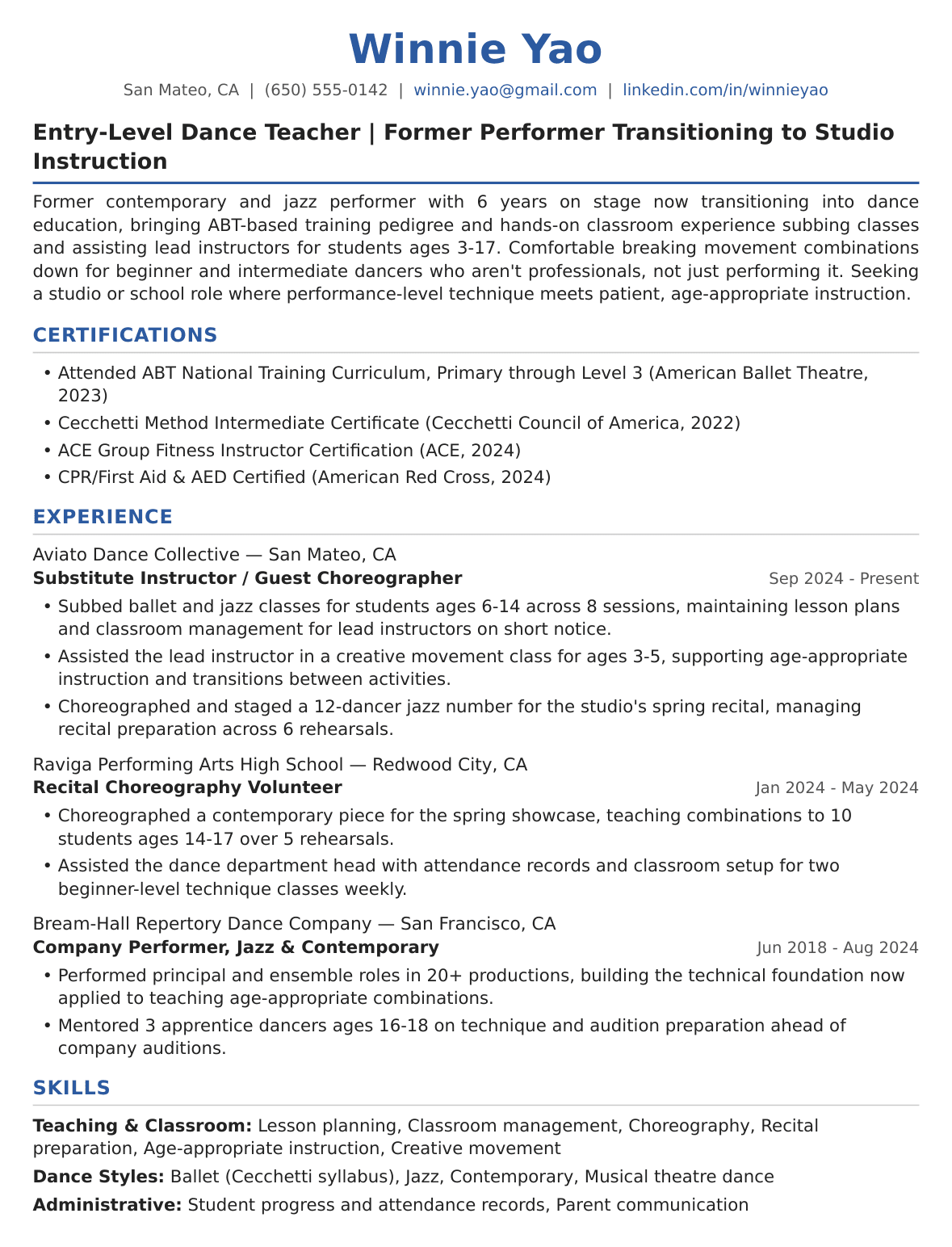
Lead with your training pedigree, since you don't have a teaching title to lean on yet. If you're a performer transitioning to the studio, name your certifications (ABT, Cecchetti, RAD, ACE group fitness) in a labeled block near the top, and list them by issuing body and date. Pull your teaching evidence from informal experience: subbing a class, assisting a lead instructor, choreographing a school recital number. Name the ages or levels you worked with, even briefly. Hiring managers expect thin formal experience here. What replaces it is proof you can already break movement down for students who aren't professionals, not just perform it yourself.
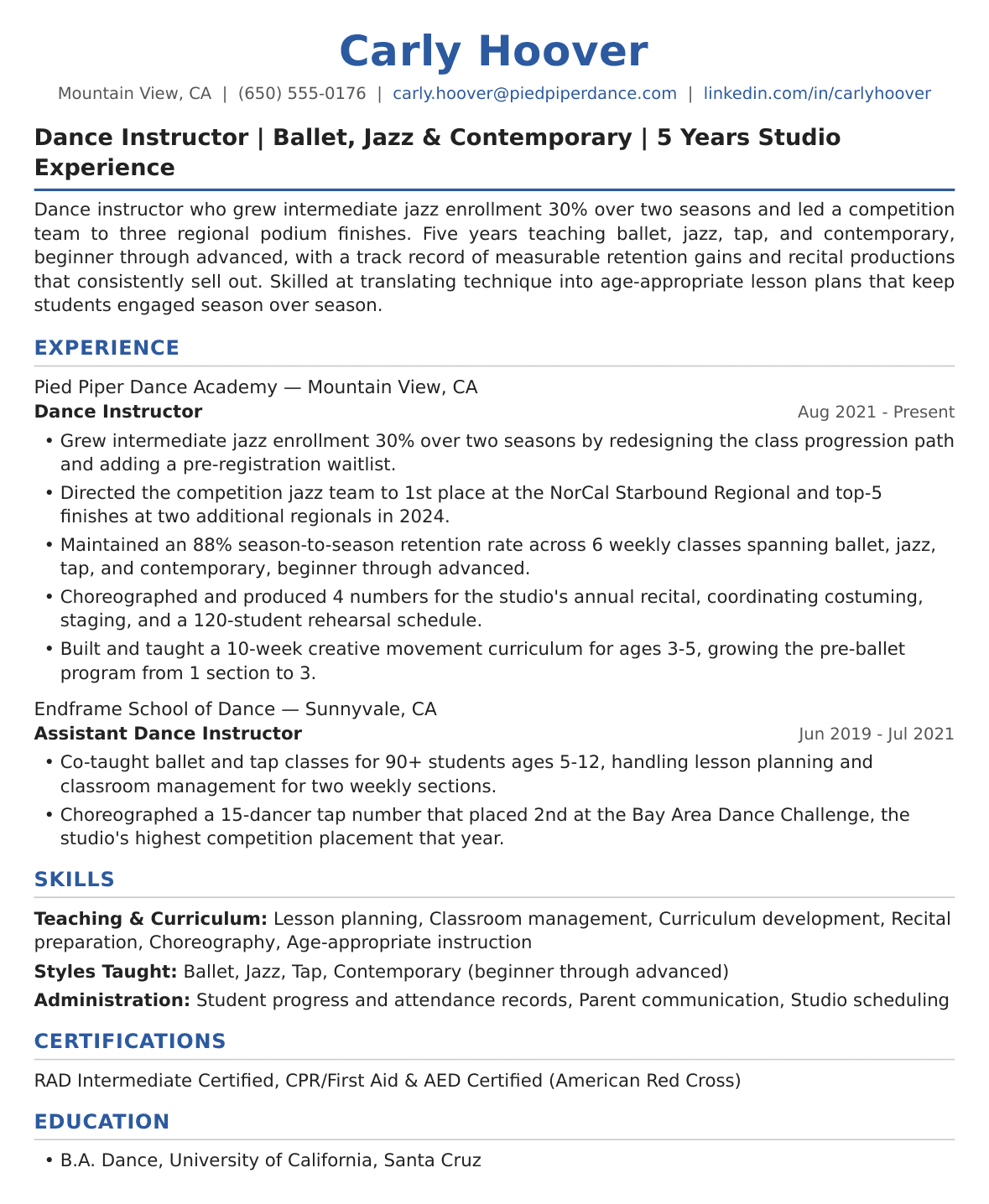
Mid-Level Dance Teacher Resume
Lead with a professional summary that opens with what you've produced, not what you're trained in. This candidate already holds a teaching title, so the resume has to prove classroom results: recital outcomes, competition placements, and class retention rates by name and number. Name the range of levels and styles you teach in one line (ballet and jazz, beginner through advanced, for example), then let bullets carry the specifics, such as "grew intermediate jazz enrollment 30% over two seasons" or a named competition placement. Certifications drop to a single line near education. The experience section should dominate the page, with results-first bullets replacing technique-class lists.
Senior-Level Dance Teacher Resume
Lead with scope beyond your own classroom. Name how many teachers you supervised, how large a program or student roster you managed, and which of curriculum design, budget, or recital production you owned. Those are what separate a program director from a lead instructor. This resume proves you can run a program, not just teach one, so bullets should carry organizational outcomes: enrollment growth across the program, a curriculum you built or revised, a budget you managed, a recital season you produced start to finish. Title progression (instructor to department head or director) should read clearly in the job title line, not only in the dates.
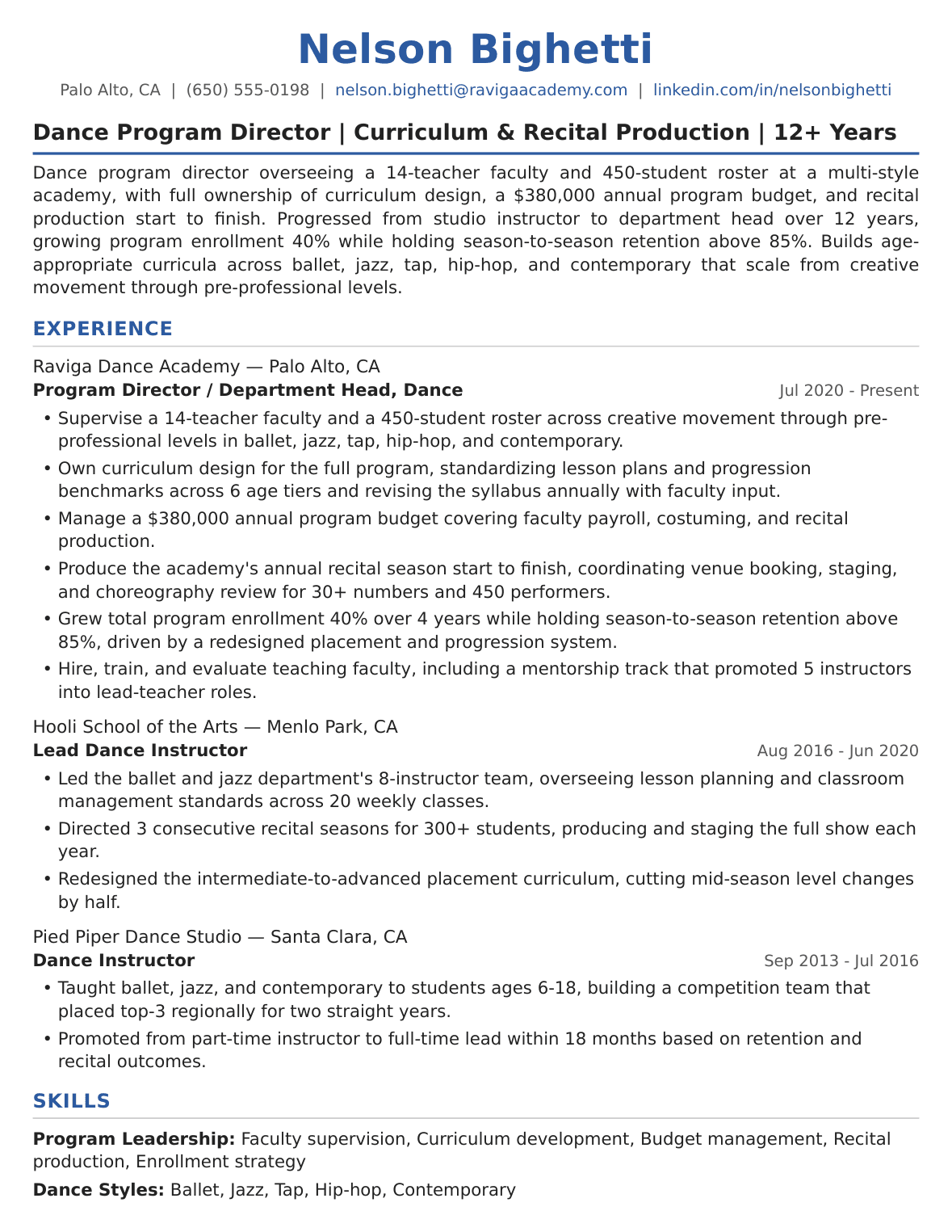
All three levels share the same backbone: training credentials and results placed to match what they signal at that stage. The emphasis shifts as you go up, first to what you learned, then to what you produced, then to what you managed. If you sit between two levels, for example three years of experience with some assistant-supervisory duties but no formal director title, borrow the mid-level summary structure and add a line naming the supervisory scope you already carry rather than inflating your title.
Dance Teacher Resume Keywords
Dance teacher postings mix studio vocabulary with school-district and compliance language, so a resume built only around the styles you teach can miss what an ATS is actually scanning for. Getting your ATS resume keywords right here means covering credentialing and clearance terms alongside technique, not just naming ballet and jazz. The table below covers the vocabulary. Your summary and bullets carry the class sizes, retention rates, and results.
| Category | Keywords |
|---|---|
| Certifications & clearances | CPR/First Aid, AED, Mandated reporter certification, Sexual harassment prevention certification, Fingerprint background check, State teaching certification (dance endorsement), NDEO Certificate in Dance Education, RAD syllabus |
| Classroom & curriculum skills | Lesson planning, Classroom management, Choreography, Recital preparation, Age-appropriate instruction, Student progress and attendance records, Curriculum development |
| Dance styles & technique | Ballet, Jazz, Tap, Hip-hop, Contemporary, Latin dance, Musical theatre dance, Creative movement |
| Hiring & employment terms | Criminal background check, Independent contractor (1099), W-2 employee, Professional references, Physical/health clearance form |
Some of these are situational, not a checklist to copy in full. Only list a style if you can teach it unaided, and only claim a certification you've actually earned; a fingerprint clearance or mandated-reporter certification you don't yet hold will surface the moment a studio verifies it.
Mirror the posting's exact string, since an ATS matches literals, not meaning. A posting that says "contemporary" won't credit you for "modern," and one that says "creative movement" won't credit you for "pre-ballet," even though studio staff would treat them as close enough. The same goes for the job title itself: if a listing says "dance instructor," use that phrase somewhere on your resume rather than assuming "dance teacher" reads the same to the parser. If you're applying to a school program, weight the certifications and clearances row heaviest, since that's the vocabulary a district's ATS is built to flag first.
Common Dance Teacher Resume Mistakes to Avoid
Describing Duties Instead of Teaching Impact
"Taught ballet and jazz classes to children ages 5-12" tells a hiring director nothing about how you teach or what your students achieved. Show a result instead: a recital placement, a retention rate, a student who advanced levels.
Using One Generic Resume for Every Studio or School
Sending the same resume to a competitive dance academy and a K-12 arts program signals you haven't read the job post closely. A school program cares about curriculum planning and classroom management, while a private academy cares about technique lineage and competition results, so adjust your summary and top bullets to match each posting.
Listing Dance Styles or Certifications With No Specificity
"Strong dance knowledge" or "trained in multiple styles" reads as filler. Name the styles you teach unaided (ballet, jazz, contemporary), the method or syllabus (Royal Academy of Dance, Cecchetti), and the certifying body for any credential. Vague language makes a hiring director assume you're padding your qualifications.
Ignoring ATS Formatting
Larger academies and school districts often run applications through tracking software before a human sees them. Tables, text boxes, graphics, and columns can scramble your certifications, so stick to a single-column layout with standard headings.
Treating the Resume Like a Performance CV
A stage credit list shows range as a performer, but says nothing about classroom skill. Keep performance credits brief and put teaching outcomes and classroom experience front and center.
Leaving Employment Gaps Unexplained
If you left a studio for a season or took time off between roles, don't just skip the dates and hope no one notices. A short line in your cover letter, such as caring for a family member or pursuing certification, closes the question before it becomes a red flag.
Listing Every One-Off Guest-Teaching Gig
A single master class here or a weekend workshop there can pile up into a cluttered work history. Curate your experience section around recent, relevant teaching roles and fold occasional guest spots into one summary line.
How AI Resume Builders Can Simplify Your Dance Teacher Resume
Tailoring a dance teacher resume for every studio's ATS, certifications, and age-group keywords eats time you don't have between classes and rehearsals, and Upplai reads the job posting and shows you exactly where your resume falls short, then explains every fix in plain language:
- Real-time ATS scoring: see your ATS and recruiter scores update as you edit, with no downloading and re-uploading to check your progress
- Transparent suggestions: accept or reject each change individually, with a plain-language explanation for every edit and no invented experience
- Automatic formatting: clean, ATS-friendly layout applied without manual reformatting
- Structure guidance: recommendations based on recruiter best practices, plus bias flagging to catch language that could work against you
- Preference memory: your formatting, metric, and reordering choices carry over the next time you tailor a resume
Upplai's free plan includes 3 tailored resumes with matching cover letters (a one-time allotment) and 200 ATS scans a month, with no credit card required. Beyond that, resume packs cost $0.50 to $1.00 per tailored resume depending on pack size, with no subscription.
Ready to put your teaching resume in front of the right studio?
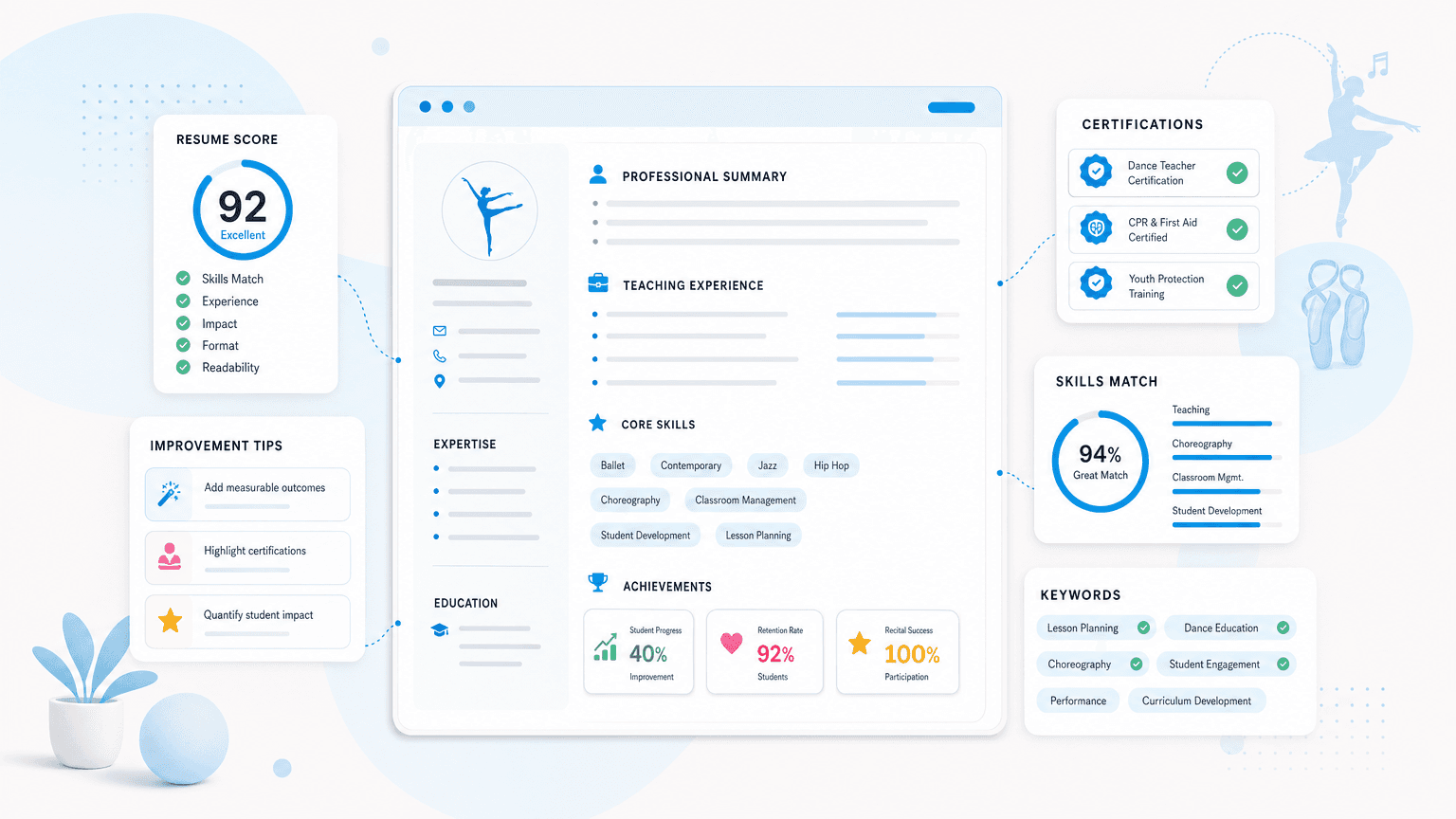
Upload your resume and a job posting to see your resume score and a tailored rewrite in minutes.
A dance teacher resume built around curriculum planning, safety awareness, and measurable results will read as a stronger application than one built around performance credits alone, even if your only prior teaching job came through a personal connection rather than a competitive hire. Use the copy-ready summary lines, skills categories, and bullet library above as a starting structure, then adjust the wording and metrics to match the specific studio, academy, or school program you're applying to. The details you already have (class sizes, recital numbers, competition placements) are usually enough to build a resume that proves you belong in the room.