How to Write a Forklift Operator Resume That Gets You Hired
If your resume currently says "operated forklift, moved pallets" and stops there, you're not alone. Most forklift operators write their resume like a job description instead of proof they can do the job well. That's why applications go quiet even when your certification is current and your experience is solid.
This guide is built for operators with a year or two on the equipment, usually counterbalance or reach truck, who are ready to leave shift work or agency placements behind for something steadier: better pay, better hours, or a shot at running equipment you haven't touched yet. You'll get a step by step process for writing each part of a forklift operator resume (summary, certification, skills, experience bullets, work history, and what to do if you're just starting out), plus examples and the mistakes that quietly get resumes rejected.
Forklift operator jobs span warehouses, manufacturing floors, construction sites, and 3PL/logistics operations, and hiring managers at each one move fast. Once your resume clears the initial screen, most recruiters give it only a few seconds of real attention, so it needs to prove its case immediately: is your certification active, do you have hours on the equipment they run (counterbalance, reach truck, order picker, or a mix), and can you back up "safety" and "productivity" with something concrete, like pallets per shift or an inventory accuracy rate.
Most operators miss the same thing. Certification gets you past the first filter, but it doesn't set you apart, since nearly every applicant in the stack has one too. What separates a callback from a pass is specificity: which equipment, what environment (cold storage, high-rack, narrow aisle), what throughput, what safety record. Naming those details turns a generic bullet into evidence a hiring manager can act on.
The rest of this guide shows you exactly how to turn "moved pallets" into that kind of proof, section by section.
How to Write a Forklift Operator Resume: Step by Step
Write a Targeted Summary or Objective
Your summary is the first thing a hiring manager reads and often the only part they read before deciding whether to keep scrolling. Keep it to 3-4 lines. It needs to establish what equipment you run, your certification status, the type of setting you've worked in, and one or two outcomes a reader can verify against your bullets below.
A weak summary looks like this:
"Hardworking forklift operator looking for a good opportunity to grow with a company and use my skills."
A stronger one looks like this:
"Certified forklift operator with 2 years running sit-down counterbalance and reach trucks in a 200,000 sq ft distribution center. OSHA-certified, RF scanner proficient, consistently meets pick-rate targets on 10-hour shifts."
If you're entry-level or switching careers, use an objective instead of a summary. It should point at the certification and the transferable skills you're bringing in, not padded enthusiasm.
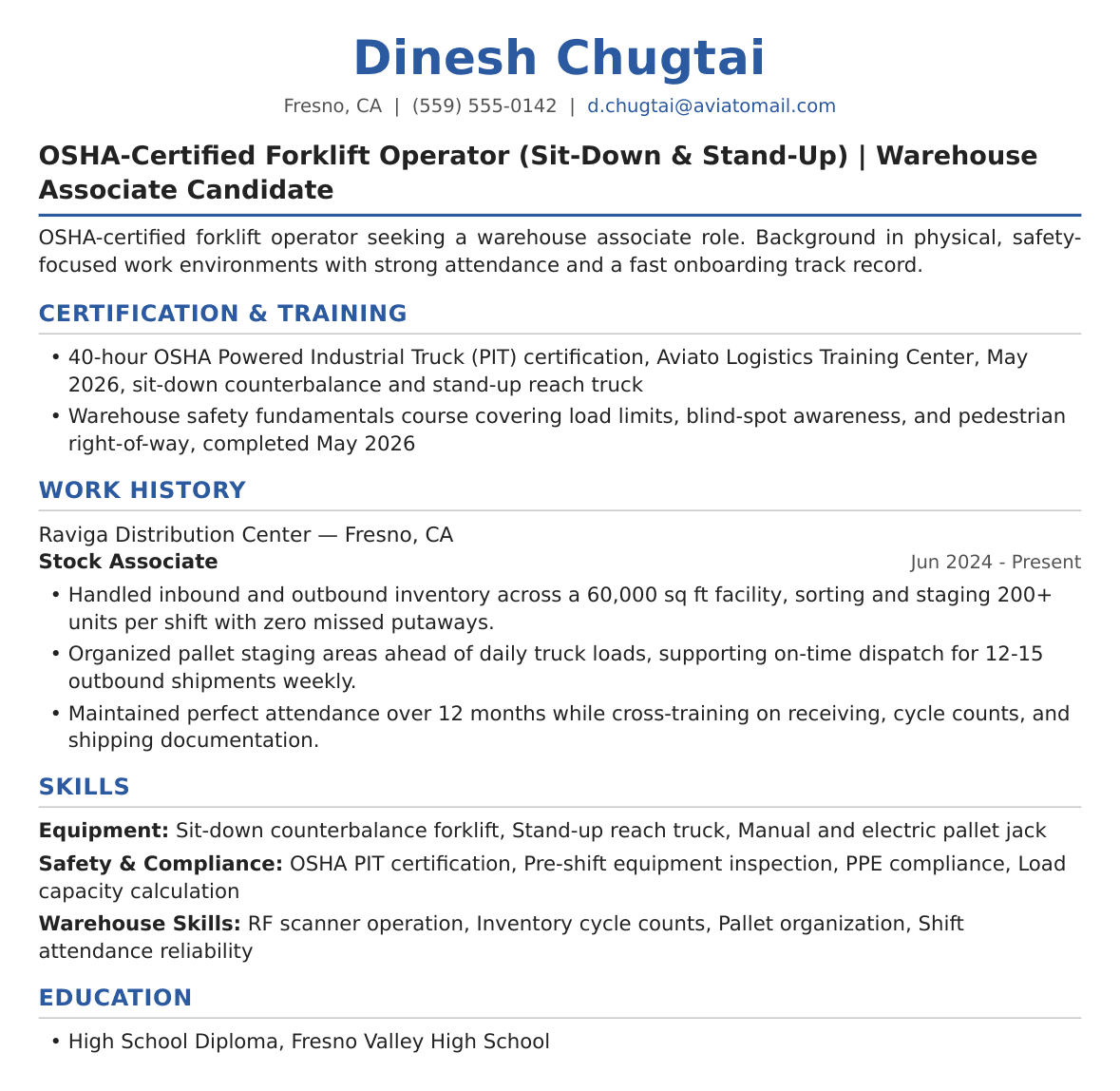
Objective (entry-level/career-changer): "OSHA-certified forklift operator (sit-down and stand-up) seeking a warehouse associate role. Background in physical, safety-focused work environments with strong attendance and a fast onboarding track record."
Showcase Your Forklift Certification the Right Way
Certification is the gate, so list it high, ideally right under your summary, not buried at the bottom of a skills list.
Include four things: certification name, issuer, month and year, and the equipment it authorizes you to run. For example: "Powered Industrial Truck (PIT) Certification (National Safety Council, March 2024, sit-down counterbalance and stand-up reach truck)." If it's close to expiring, note the renewal date too.
A quick accuracy note: OSHA sets the training and evaluation standard under 29 CFR 1910.178(l), but OSHA itself doesn't issue personal operator certifications. Your employer or training provider evaluates you against that standard and certifies you. "OSHA-certified" is common shorthand for this, and reviewers read it that way, but on your resume, name the actual issuer (your employer or training provider) rather than implying OSHA certified you directly.
Employer-issued certifications count just as much as ones from a formal training provider. List the employer name as the issuer the same way you would a training company. If you've been certified on multiple equipment types across different employers, list each certification separately with its own date and issuer so a reviewer can see the full scope at a glance.
Build a Skills Section That Names Your Equipment
Never list "forklift" alone as a skill. It tells the reviewer nothing about what you can actually run or how you work. Break the skills section into labeled groups instead.
Equipment types: Sit-down counterbalance, stand-up reach truck, order picker, pallet jack (manual and electric), cherry picker
Systems & tools: RF scanner operation, WMS order entry (SAP, Manhattan), inventory cycle counts, barcode scanning
Safety & compliance: OSHA PIT certification, pre-shift equipment inspection, load capacity calculation, PPE compliance
Workflow & teamwork: Cross-training on multiple stations, shift handoff reporting, team lifting protocols, dock scheduling coordination
This structure lets a reviewer scan for the exact equipment and systems named in the job posting in under five seconds.
Write Achievement-Focused Experience Bullets
Use this formula for every experience bullet: action verb, equipment, the task or workflow, a volume or pace figure, and the outcome or system involved.
Weak: "Responsible for operating forklift and moving pallets around warehouse."
Strong: "Operated stand-up reach truck to stage and load 120+ pallets per shift across a 3-dock outbound line, maintaining a 98% on-time load rate."
Adapt bullets to your specific equipment and role. Here are starting points by operator type:
Warehouse/Counterbalance Operator: "Ran sit-down counterbalance forklift to unload 15-20 inbound trailers weekly, sorting SKUs into staging zones with zero missed putaways." / "Loaded and unloaded an average of 40 pallets per 8-hour shift using RF scanner for real-time inventory updates."
Reach Truck/Narrow-Aisle Operator: "Operated reach truck in narrow-aisle racking up to 30 feet, completing 90+ putaways per shift with consistent slot accuracy." / "Maintained pick accuracy above 99% while navigating tight aisle configurations during peak season volume."
Order Picker: "Used stand-up order picker to fulfill 150+ line items per shift across a multi-level pick module." / "Cut average pick time per order by working closely with WMS-assigned pick paths and batch picking methods."
Entry-Level/Certified-No-Experience: "Completed 40-hour OSHA PIT certification covering sit-down and stand-up equipment, including load handling and pre-shift inspection protocols." / "Trained on warehouse safety procedures and pallet jack operation during 2-week certification program, passing all practical evaluations."
Lead/Trainer Operator: "Trained 6 new hires on reach truck operation and OSHA safety checklists, reducing onboarding time by half." / "Coordinated forklift traffic flow across 2 dock zones during peak shifts, flagging equipment issues before they caused downtime."
Quantify scope honestly. A pallet count, pick rate, or dock volume carries weight because it's checkable. Avoid absolute safety claims like "zero accidents ever," since no one can verify that and interviewers tend to probe it. If you're short on numbers, check old shift logs, WMS dashboard exports, or ask a former supervisor what volume your area typically ran.
Organize Your Work History and Handle Limited Experience
Reverse-chronological order is the default and what most warehouse hiring managers expect: most recent role first, with dates, employer, and location.
If you're new to forklift operation, certified but not yet employed as an operator, or coming from an adjacent field, use a combination format instead. Lead with a certification and training block (including hours completed and any practical evaluations passed), then follow with a shorter work history beneath it. This keeps your strongest credential visible without hiding your actual work record, and addresses the experience gap directly.
Relevant training/coursework:
"40-hour OSHA Powered Industrial Truck certification, including hands-on evaluation on sit-down and stand-up equipment" / "Warehouse safety fundamentals course covering load limits, blind-spot awareness, and pedestrian right-of-way"
When your background is in an adjacent role, reframe it around transferable duties. A stock associate position becomes inventory handling and pallet organization. A material handler role becomes load staging and warehouse safety compliance. A delivery driver role becomes loading, route-based time management, and equipment handling. Use the same action-verb-plus-outcome structure from your bullets above, applied to the work you actually did. Stacking, sorting, loading, or general labor roles all show you can handle the physical demands of the job, even without forklift hours yet.
Forklift Operator Resume Examples
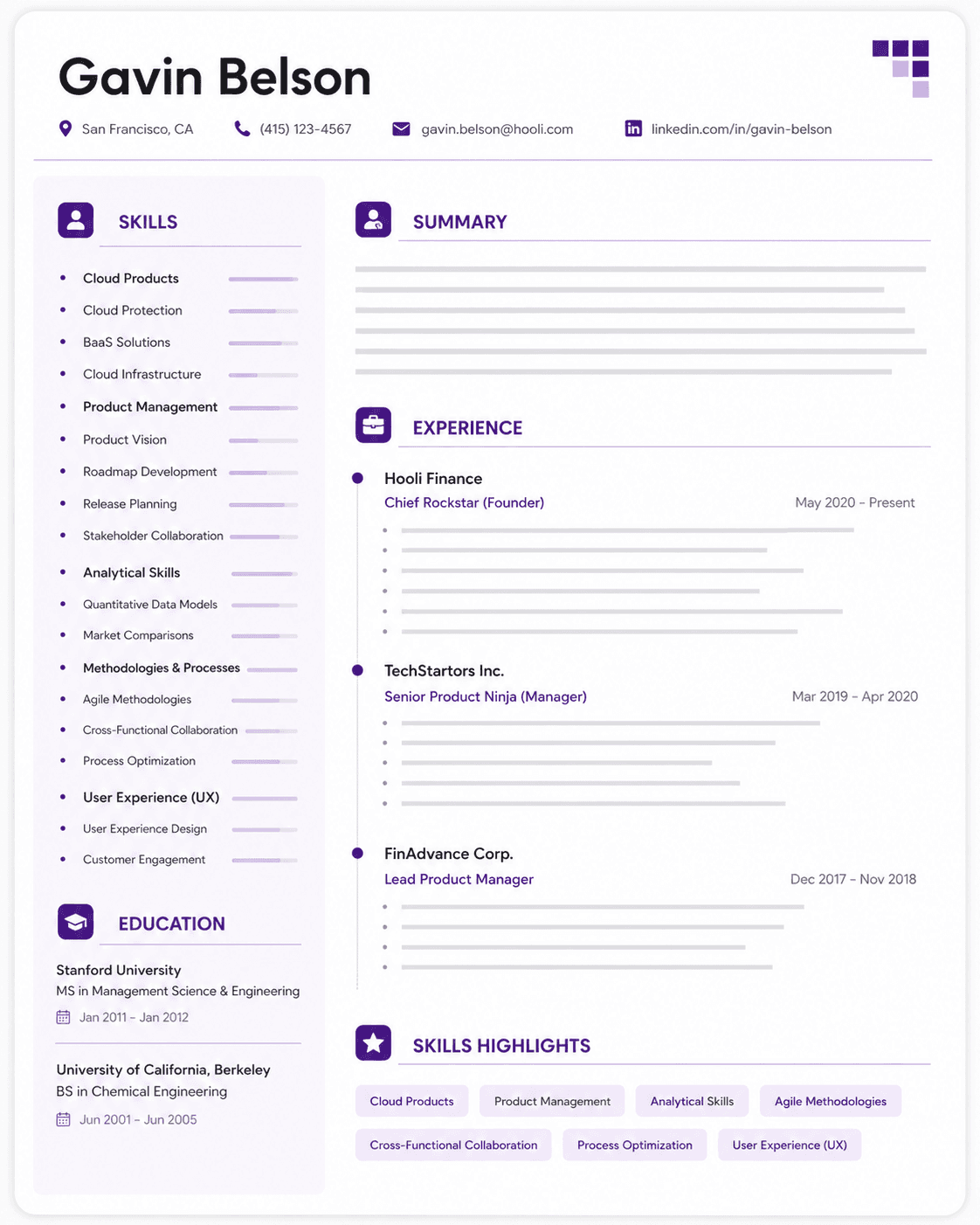
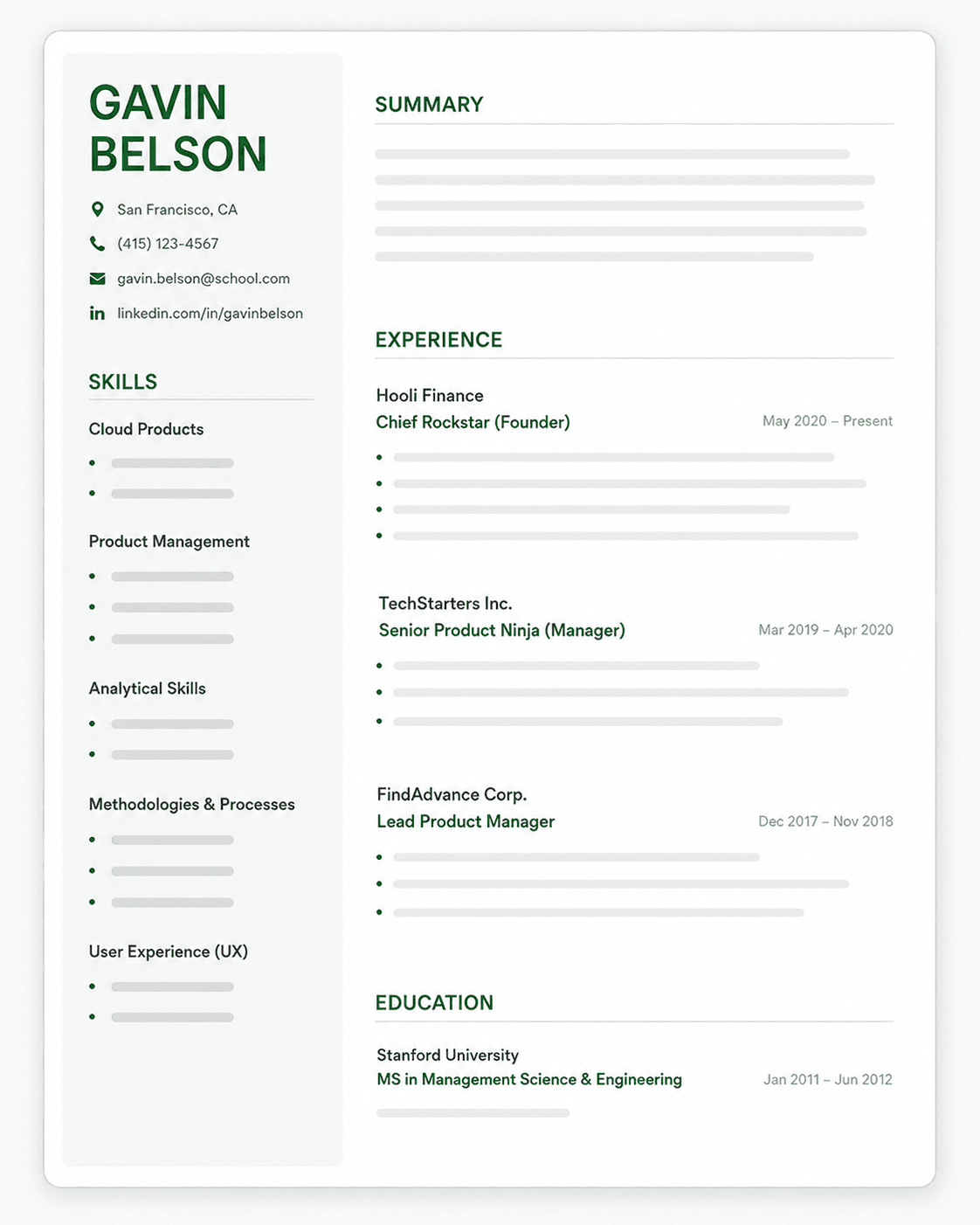
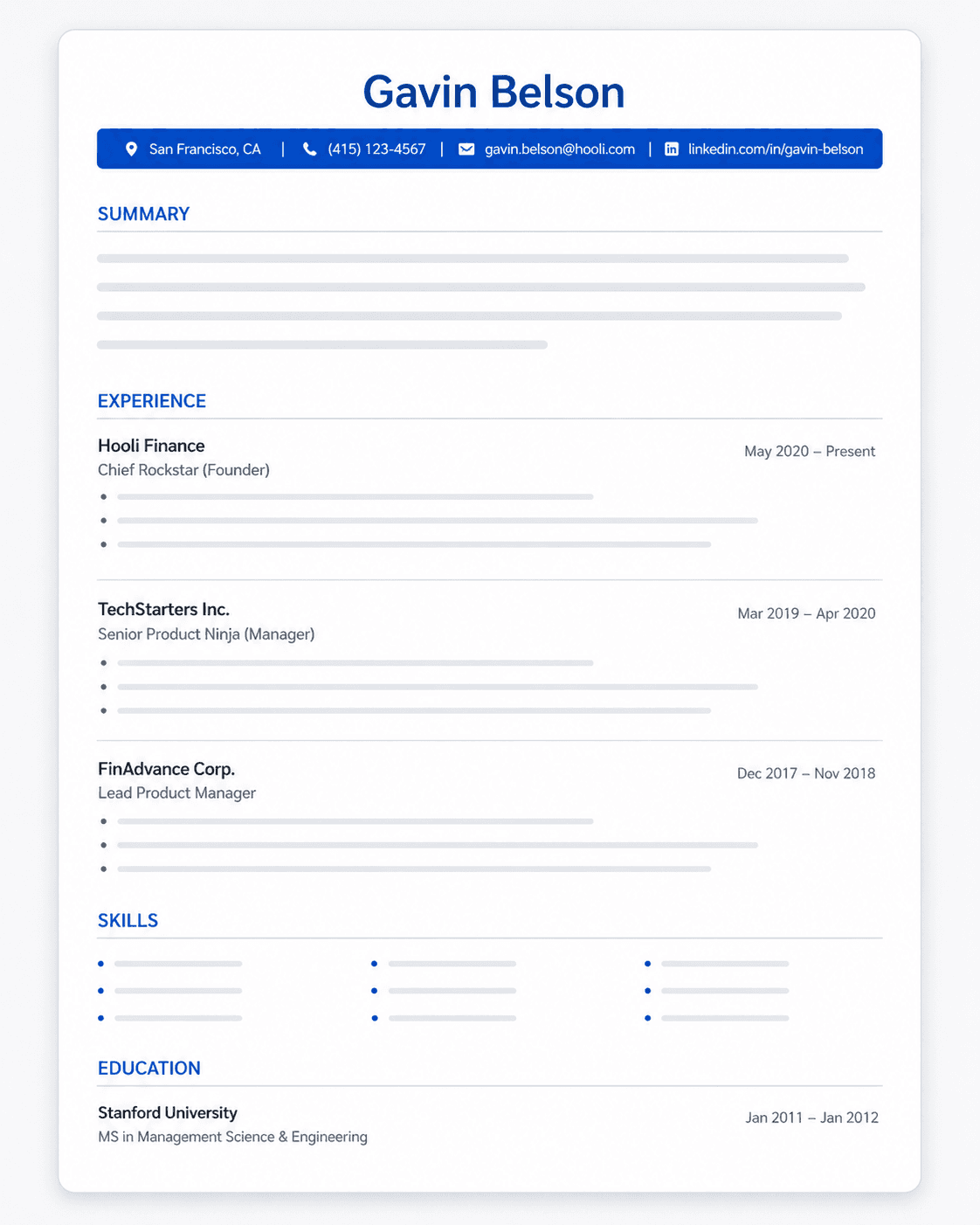
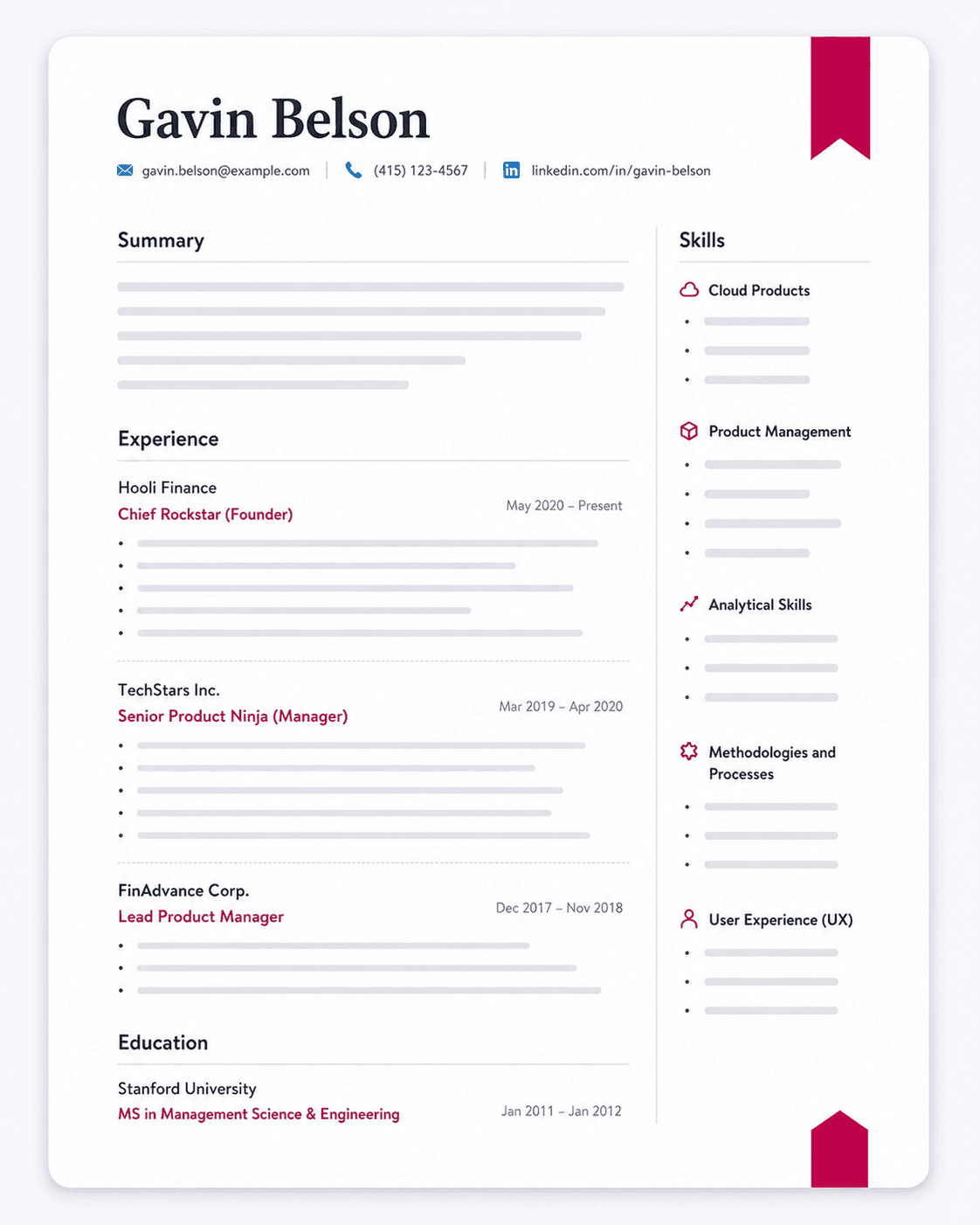
Below are three downloadable resume templates, one for each career stage. Pick the version closest to your experience and adjust the details to fit your certifications and work history.
Entry-Level (Certified, No Experience)
Built for new operators who hold a forklift certification but have not yet worked the equipment on the job. Emphasizes training, safety scores, and transferable warehouse skills.
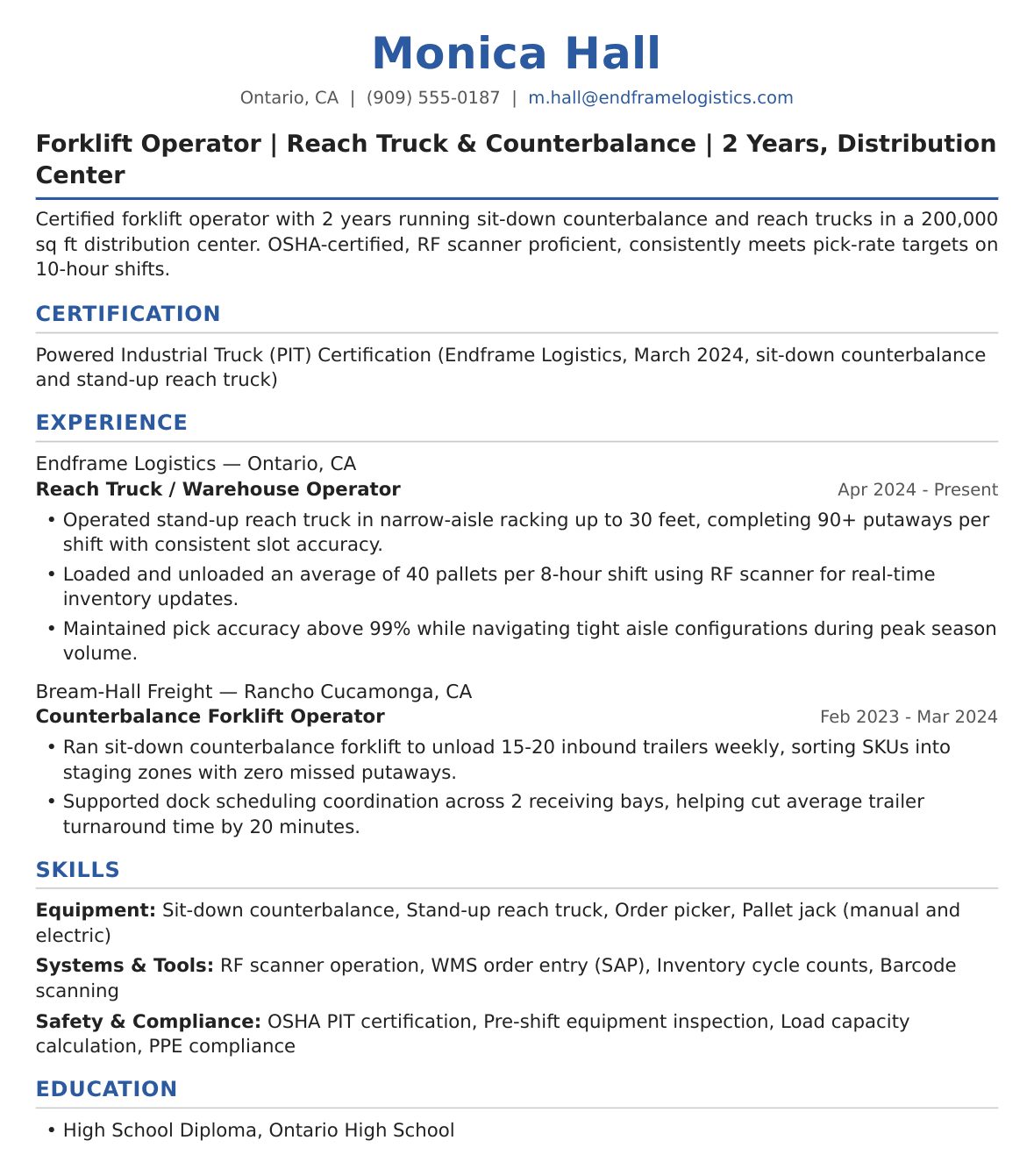
Mid-Level (Warehouse / Reach Truck Operator)
Designed for operators with 1-3 years of experience running reach trucks or standard forklifts in warehouse settings. Highlights throughput numbers, equipment variety, and inventory accuracy.
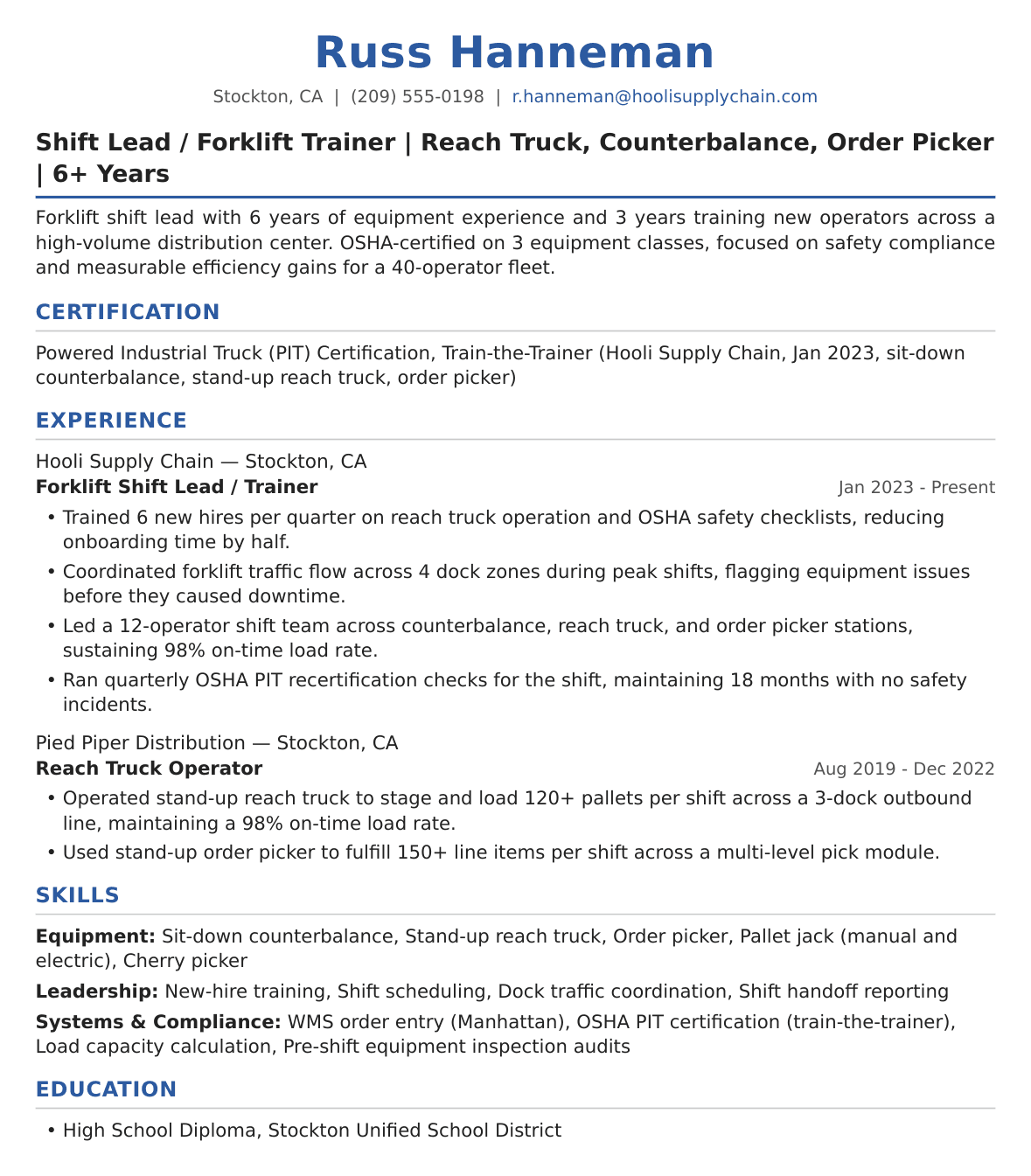
Senior/Lead (Trainer or Shift Lead)
Suited for operators who train new hires, lead a shift, or manage equipment fleets. Focuses on leadership, safety compliance, and measurable efficiency gains.
Forklift Operator Resume Keywords
Warehouse recruiters filter first by certification and equipment type. Name every truck class you are certified on, then back the rest with safety and volume numbers.
| Category | Keywords |
|---|---|
| Equipment | Sit-down forklift, Stand-up reach truck, Order picker, Electric pallet jack, Counterbalance forklift |
| Operations | Shipping and receiving, Trailer loading and unloading, Pallet staging, RF scanning, Cycle counting, Warehouse management systems (WMS) |
| Safety & compliance | OSHA forklift certification, Pre-shift equipment inspections, Load capacity and stability, Safe stacking, Pedestrian awareness |
How to List Seasonal Peak Jobs Without Looking Like a Job Hopper
Warehousing staffs up every fourth quarter and releases after peak. If you've run seasonal cycles, your history is a stack of 3-month stints, and a recruiter who doesn't look closely reads it as quitting. The industry designed the churn, but your resume takes the blame unless you label it.
Put "(Seasonal)" directly in the job title: "Forklift Operator (Seasonal Peak), [Company]." That one word converts job hopping into completed contracts. If you've returned to the same site across multiple peaks, collapse them into one entry, "Peak seasons 2023–2025," because being rehired is itself a credential; say so: "invited back for three consecutive peaks."
Then let peak numbers work for you. Seasonal volume is the hardest proving ground in the building, so quantify against it: "maintained 99%+ pallet accuracy at peak volume (double standard throughput)." A hiring manager who sees consistent seasonal callbacks and peak-rate numbers stops counting the months and starts counting the proof.
Common Forklift Operator Resume Mistakes to Avoid
Describing Tasks Instead of Outcomes
Writing "operated forklift in warehouse" tells a hiring manager nothing they can compare. Instead try "moved 150+ pallets per shift with zero product damage" or "cut loading dock wait times by reorganizing staging area." Numbers and results separate candidates who did the job from candidates who improved it.
Using One Generic Resume for Every Application
Sending the same resume to a grocery distribution center and a cold storage facility ignores that each employer scans for different keywords. A job posting mentioning "reach truck" and "narrow aisle" should see those terms echoed back. Five minutes of tailoring per application beats a single resume blasted everywhere.
Listing "Forklift" With No Equipment Specificity
"Forklift experience" is vague enough to mean anything. Specify sit-down counterbalance, stand-up reach truck, order picker, or pallet jack, since warehouses often run only one or two types. A hiring manager needs to know you can run their specific equipment, not just forklifts in general.
Ignoring ATS-Breaking Formatting
Tables, text boxes, columns, and headers or footers often get scrambled or dropped when an applicant tracking system scans a resume. A certification hidden in a header might never reach a recruiter's screen. Stick to a single column with standard section headings so the system reads every line correctly.
Burying or Omitting Certification Details
A forklift certification is one of the strongest credentials on this resume, yet many candidates bury it in a skills list or leave out the issuing body and date. List it clearly: certifying organization, certification type, and expiration if applicable. Recruiters often search for this exact term first.
Overclaiming Safety or Performance Stats
"Zero accidents ever" or "100% perfect record" sounds impressive but reads as unverifiable and can raise doubts in an interview. Grounded claims like "18 months, no safety incidents" hold up better under questioning. Specific, checkable numbers build more trust than sweeping claims.
Missing or Inconsistent Dates
Gaps or mismatched formats, like listing "2023-2024" for one job and "March 2022 to Present" for another, create confusion and signal carelessness. Use a consistent month and year format throughout, and account for any employment gaps honestly. Clean dates make a resume easy to scan and verify.
Why You Should Tailor Your Resume for Every Forklift Role
Not every forklift job runs the same way. A cold storage DC cares about speed in freezing conditions and product handling. A high-rack narrow-aisle warehouse cares about precision at height. A high-volume distribution center wants raw throughput. A construction site wants safety compliance and rough-terrain handling. A manufacturing floor wants tight coordination with production lines. Same equipment, different priorities.
A generic resume that just lists "forklift experience" gets filtered twice. First by the ATS, which scans for keywords matching the specific posting, not forklift experience in general. Then by a recruiter giving it a few seconds of real attention, looking for signals that you fit this job, not just any job.
Here's what that looks like in practice. Applying to a cold storage DC, you'd lead with reefer/freezer certification, pallet accuracy rates, and comfort working sub-zero shifts. Applying to a construction site, you'd lead with rough-terrain forklift certification, OSHA training, and experience on active job sites with heavy equipment traffic. Same operator, same core skills, tailored resume for each.
Tailoring means pulling forward the parts of your experience that match what this employer actually needs, so both the ATS and the human reader see a fit fast.
How AI Resume Builders Can Simplify Your Forklift Operator Resume
Rewriting your resume for every warehouse job posting eats up time you don't have after a shift, and a generic resume that doesn't match the job description often gets filtered out before a recruiter ever sees it.
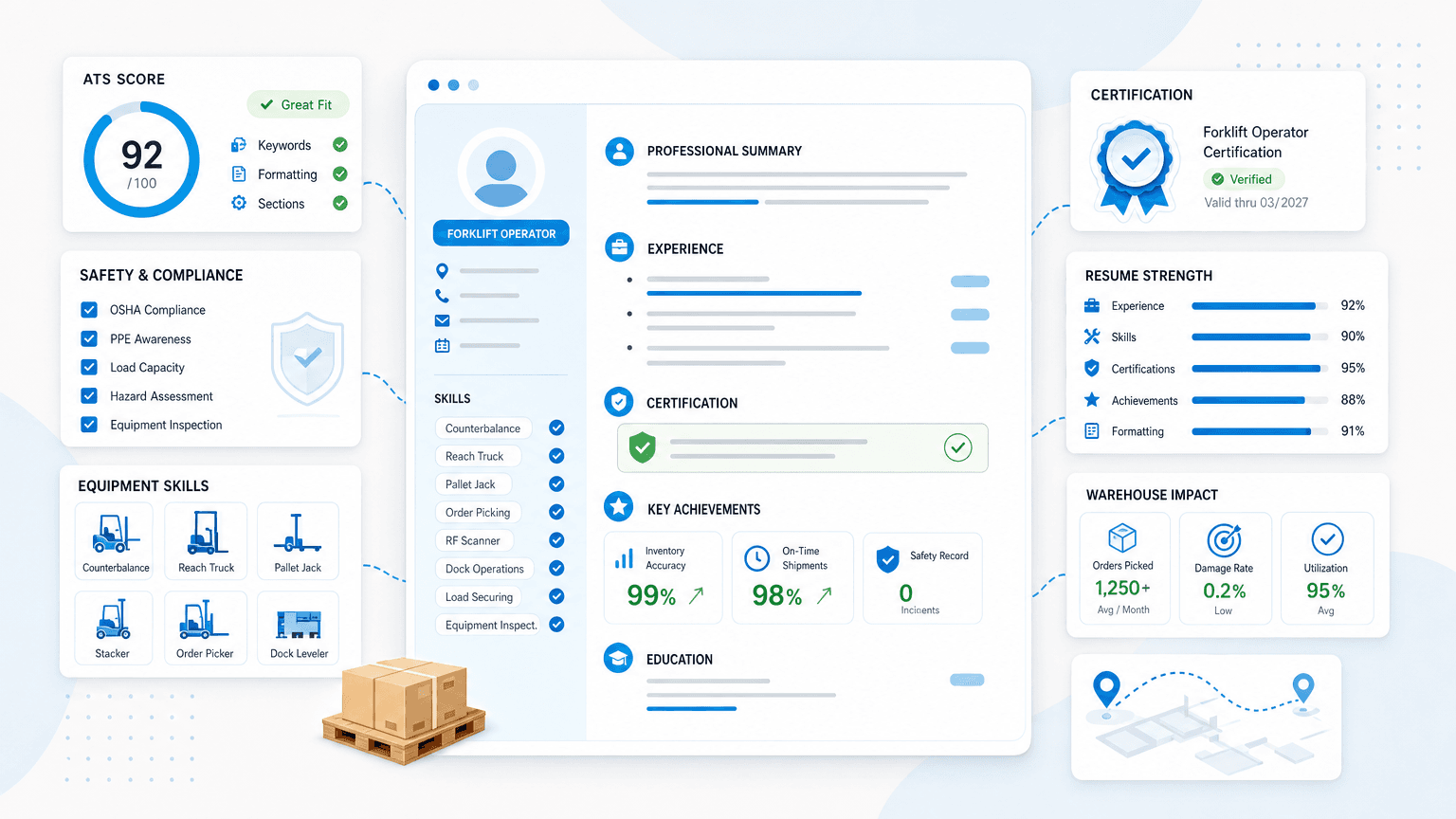
- Real-time ATS scoring: Your ATS and recruiter scores update as you edit, so you can see how a change affects your match rate without downloading and re-uploading your resume over and over.
- Transparent suggestions: Every edit comes with a plain-language "why this change" explanation, and you accept or reject each one. Nothing gets rewritten behind your back.
- Automatic formatting: Pick from multiple ATS-friendly templates and color themes, and download the finished resume as PDF, DOCX, or TXT.
- Structure guidance: The tool reorders content for relevance, strengthens weak action verbs, quantifies your achievements (loads moved, accuracy rate, safety record), manages resume length, and flags language that could trigger bias.
- Preference memory: Your formatting choices, preferred metrics, and reordering habits carry over the next time you tailor a resume, so you're not resetting preferences for every application.
Pricing is straightforward, no subscriptions or auto-renewals. The free plan gets you 200 ATS scans a month plus a one-time allotment of 3 tailored resumes with matching cover letters, no credit card required to start. Need more than 3 resumes? Additional resume packs start at $5 one-time, working out to $0.50 to $1.00 per tailored resume depending on pack size.
Get your forklift resume job-ready
Run a free ATS check and see where your resume stands before you apply.