Why a Generic Resume Doesn't Work for HVAC Jobs
Every HVAC hiring manager, from a two-truck residential outfit to a regional commercial contractor to a union hall, is scanning your resume for the same two things first: are you certified, and are you actually good at this. You already know the trade splits hard along those lines. A residential service call has a different rhythm than a commercial rooftop unit, and a union apprenticeship path judges you by entirely different rules than an independent shop does.
Here's the part that trips up a lot of techs moving from a small contractor to a bigger one: your EPA 608 Universal card and NATE certification get your resume into the pile. They don't get you the callback. Once you clear that first filter, the hiring manager is skimming for real numbers (calls closed, callback rate, units serviced) not phrases like "hardworking" or "team player."
This section is about closing that gap. We'll show you what hiring managers actually look for, how to build an HVAC resume summary and skills section that prove competence fast, how to write bullets with real numbers pulled from your service tickets, and example bullets by role so you're not starting from a blank page.
What Hiring Managers Look for in an HVAC Resume
Certifications are the first filter, and they're non-negotiable. EPA 608 is a legal requirement for anyone handling refrigerant, and hiring managers check for it before they read anything else. If your card stops at Type II, it already covers most residential and light-commercial work, but a regional contractor running chillers or low-pressure equipment will want Universal, which adds Type III coverage. NATE certification isn't legally required, but it signals a level of technical skill that a lot of contractors trust more than years of experience alone. List both clearly near the top of your resume, not buried in a skills paragraph.
Once you clear the certification filter, the resume gets a fast scan, roughly seven seconds before they move to the next one, and a duty list won't hold their attention. "Performed maintenance and repairs on residential HVAC systems" tells them nothing they didn't already assume from your job title. What gets a second look is a number: calls closed per day, first-time fix rate, callback percentage, systems installed per month. Numbers read as proof you can do the job, not just describe it.
The other thing hiring managers read for is fit. HVAC techs specialize, and a hiring manager posting a commercial role is scanning for signals of that background, not the phrase "HVAC experience." If your resume only shows residential service calls and you're applying to a regional contractor with rooftop units and commercial refrigeration accounts, spell out any exposure you've had to that equipment, even limited exposure, so the connection is obvious instead of assumed.
How to Write an HVAC Resume That Gets Interviews
Once you know what hiring managers scan for, the next step is putting it on the page in the right order and format. Here's how to build each section.
Write a Targeted Summary or Objective
Your summary is three sentences, not a biography. It needs to cover your years of experience and the systems you've worked on (residential, commercial, heat pumps, refrigeration), your top certification, and one number that proves you're good at the job.
A weak summary looks like this:
"Hardworking HVAC technician looking for a new opportunity to grow my skills and join a great team."
A stronger one looks like this:
"Residential HVAC technician with 4 years of experience installing and repairing split systems, heat pumps, and mini-splits. EPA 608 Universal certified, NATE certified in Air Conditioning. Maintain a 92% first-time fix rate across 15+ service calls per week."
If you're fresh out of trade school or early in an apprenticeship, use an objective statement instead. Skip the accomplishment and lead with training and drive instead.
"HVAC apprentice with EPA 608 Universal certification and hands-on training in residential system diagnostics, refrigerant handling, and ductwork installation. Completed 500+ hours of supervised fieldwork. Looking to apply that training on a full-time service team."
Showcase Your Certifications and Licenses
Certifications belong near the top of the resume, either directly under your summary or in a dedicated line in your header. Don't bury them in a skills list at the bottom where a scanning manager might miss them.
List each one as issuing body plus status and date, not just a name:
- EPA 608 Universal, Certified 2022
- NATE Certified, Air Conditioning, 2023
- Registered ACR Technician, TDLR (Texas), 2023
- OSHA 10 Card, 2021
If your EPA 608 is a Type I, II, or III rather than Universal, just note which one here (the summary before this section already covered what each type covers).
Two certifications get overlooked by techs who'd actually benefit most from listing them. A BPI (Building Performance Institute) certification signals energy-efficiency and building-science knowledge that stands out for weatherization-adjacent or residential efficiency roles. And if you have any exposure to building automation systems or controls protocols (BACnet, Modbus, Alerton), list it explicitly. Most residential techs don't have this, which is exactly why it catches a commercial or controls-focused hiring manager's eye if you're trying to move in that direction.
Build a Skills Section That Speaks to Hiring Managers
Group your skills so a manager can scan them in seconds. Stick to 6 to 10 total items. A long undifferentiated list reads like filler.
SKILLS
- Technical/Diagnostic: Refrigerant charging and recovery, electrical troubleshooting, heat pump diagnostics
- Tools & Systems: Split systems and mini-splits, ServiceTitan
- Compliance & Safety: EPA 608 Universal, OSHA 10
- Customer Service: Client communication, upselling maintenance plans
Cut anything generic like "hard worker" or "team player." Every item here should be something a manager could ask you to demonstrate in an interview.
Write Achievement-Focused Experience Bullets
Use this formula for every work experience bullet:
[Action verb] + [scope of the program] + [quantified outcome]
A weak bullet looks like this:
"Responsible for repairing and maintaining HVAC systems for customers."
A stronger one looks like this:
"Diagnosed and repaired residential heat pump and split systems on 15+ service calls per week, maintaining a 95% customer satisfaction score and a callback rate under 3%."
If you don't have a clean metric memorized, you likely still have the raw material. Try units serviced per month, callback or first-time fix rate, customer satisfaction scores, or energy-efficiency gains from a system you upgraded. Check your service tickets, your dispatch software (ServiceTitan and similar tools log this automatically), or ask a supervisor for your last performance review. If you got your job through a referral, you've probably never had to pull these numbers together for a resume, even though they're already sitting in your dispatch system or performance reviews.
Organize Your Work History the Right Way
Reverse-chronological order, most recent job first, is the standard and the safest choice for most techs. It's what hiring managers expect and what applicant tracking systems parse best.
If you've worked as a 1099 contractor or bounced between short-term gigs with varied scope, a hybrid format works better: lead with a skills or achievements block, then list a condensed work history underneath. This keeps the focus on what you can do rather than on gaps between contracts.
If you've moved from apprentice to journeyman, frame it as a promotion, not a job change. Under one employer, list it as two entries or one entry with two title lines and dates:
- Journeyman Technician, ABC Heating & Cooling (2024 to present)
- HVAC Apprentice, ABC Heating & Cooling (2022 to 2024)
That structure reads as growth on the page, which is exactly the story you want it to tell if you're aiming for a lead-tech track next.
The "Licensed HVAC Tech" Line Means Something Different in Every State
Most resume advice tells you to list your state license and move on, as if every state licenses HVAC techs the same way. They don't. Some states license the individual technician, some license only the contractor a tech works under, and some states don't license HVAC work at all. Put the wrong version of "licensed" on your resume and a hiring manager checking behind you will catch the mismatch fast, especially if you're applying across state lines.
California is a contractor-level state, not a technician-level one. There's no individual HVAC tech license to hold. Techs work under their employer's C-20 Warm-Air Heating, Ventilating and Air-Conditioning contractor license, issued by the Contractors State License Board. That license belongs to the contractor, not to you, so there is no personal license number for a California tech to put on a resume in the first place. Your EPA 608 card still does work here though: CSLB accepts a copy of your Type II or Universal certification as supporting documentation for claimed C-20 or C-38 journey-level experience when you eventually go for your own contractor license. Pennsylvania goes the other direction: it has no statewide HVAC license at all, and licensing gets set locally instead, city by city. That is exactly why Delaware's Master HVACR licensure board tells reciprocity applicants a Pennsylvania municipal license doesn't count as a state license and routes them to the exam path instead. Delaware itself requires a Master HVACR (or Master HVACR Restricted) license, reached through a journeyman's certificate plus two years working under a master contractor, or seven years of supervised experience without one.
If you're staying in-state, write your license the way your state actually structures it. In a contractor-level state like California, don't invent a personal license number. Name the license class you work under instead. If you're applying across state lines, check the target state's board before you apply, because reciprocity is limited and inconsistent. And if you're in a state with no license requirement at all, put your EPA 608 status and any A2L refrigerant safety training in that line so the space isn't blank. Your Section 608 certification is federal and doesn't expire, which makes it the one credential on your resume that reads the same in all fifty states.
HVAC Resume Examples by Experience Level
Your resume should look different depending on where you are in your career. What moves is the order: early on, training sits above work history; later, numbers sit above credentials. Here is what changes at each stage.
Entry-Level HVAC Resume
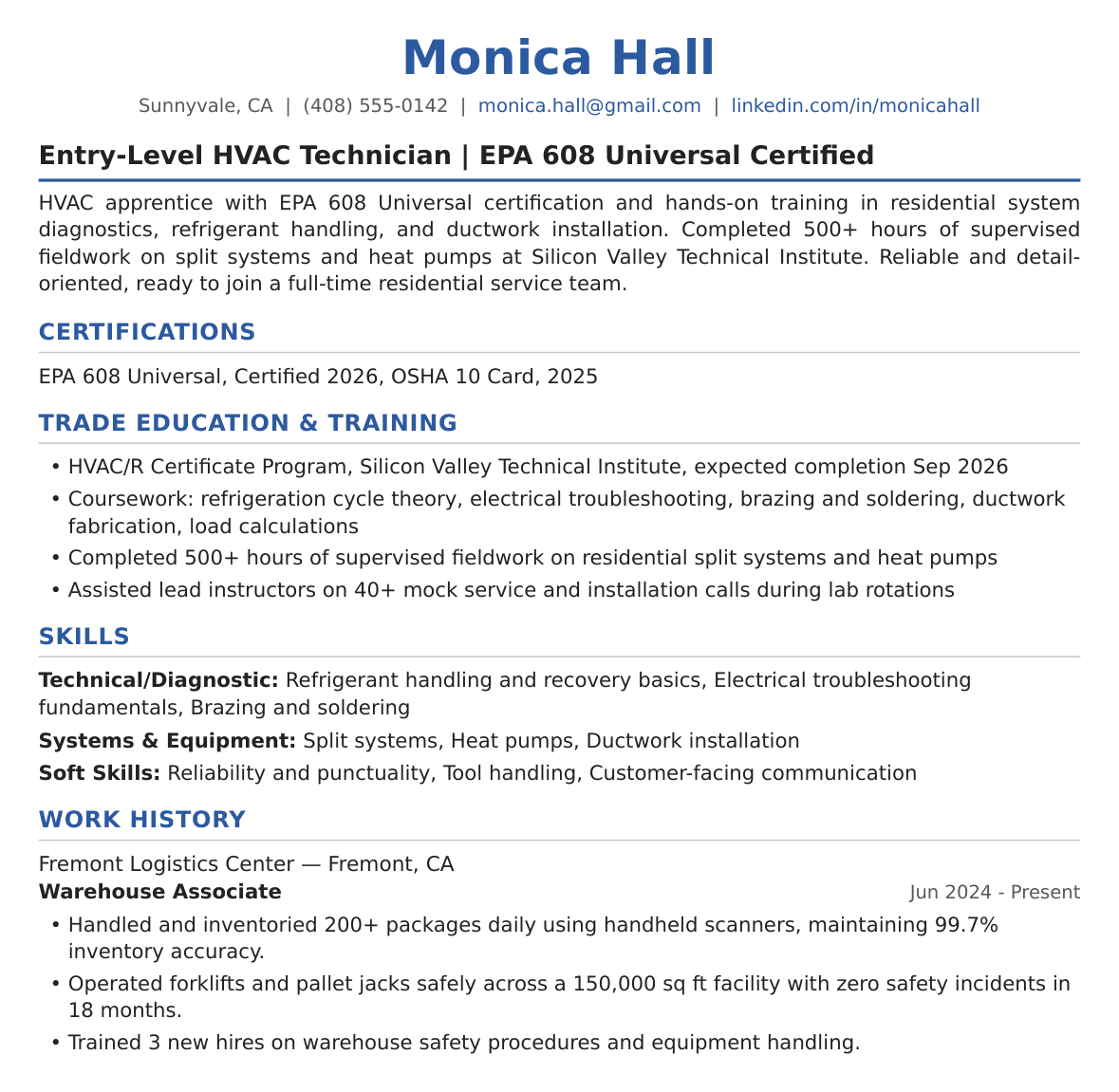
With little or no field history, this version leads with credentials and training instead of employment. Put your EPA 608 status (including the type, or "in progress" with a test date) directly under the summary, then a trade school or apprenticeship block naming the specific coursework you completed: refrigeration cycle theory, electrical troubleshooting, brazing, ductwork fabrication, load calculations. Quantify training the way you would quantify a job, with supervised fieldwork hours, ride-along or internship weeks, and the number of installs or service calls you assisted on. Work history goes last and can include non-HVAC jobs, as long as each bullet points at something the trade values: reliability, tool handling, customer contact, or physical job sites. What you are proving here is that you can be dispatched with a lead tech tomorrow and not slow the truck down.
Mid-Level HVAC Resume
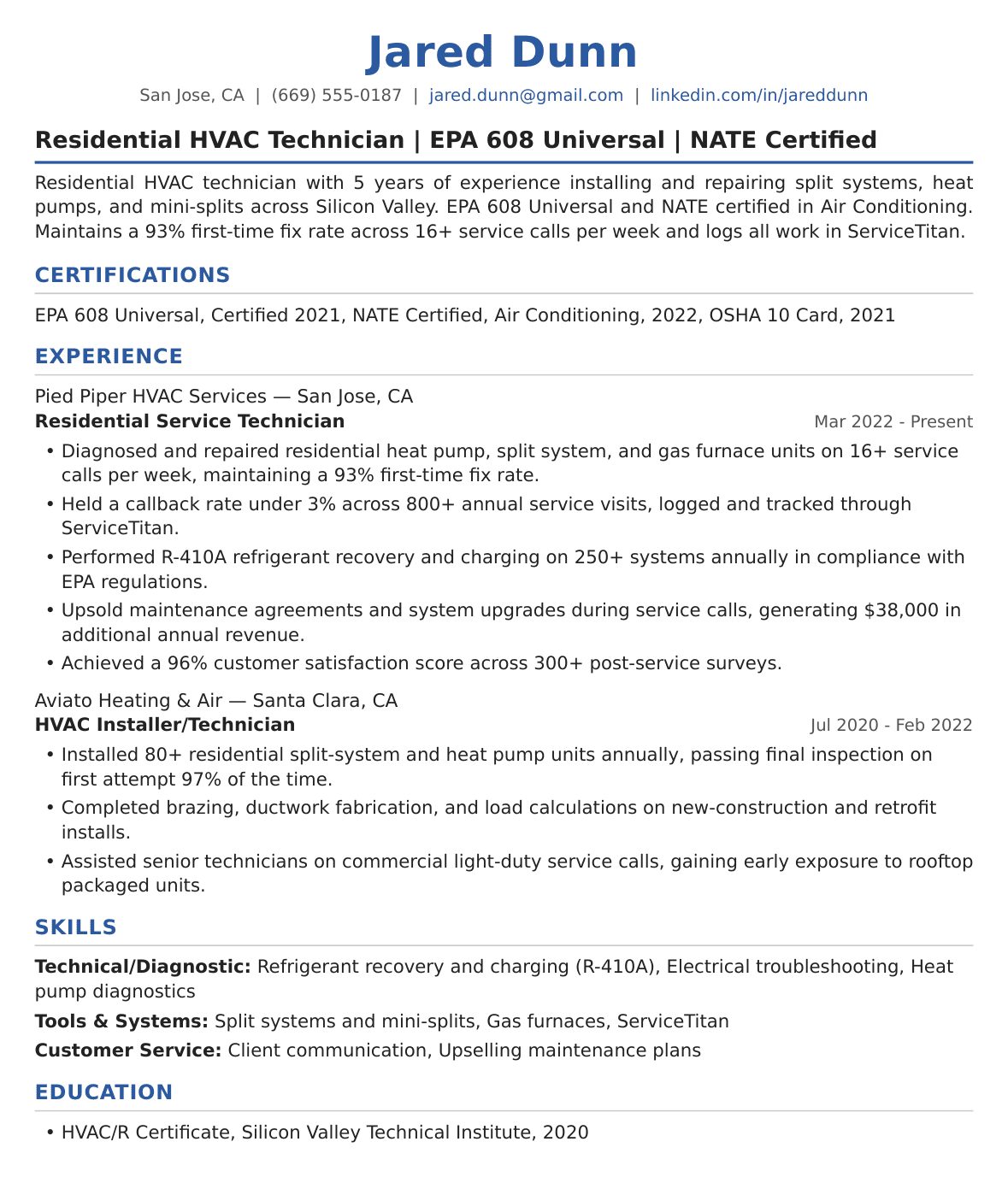
This is where most residential techs land, including anyone with roughly 3 to 6 years in the field and a Universal 608. The training block shrinks to a single education line and a metrics-heavy work history takes the top of the page. Every bullet in your most recent role should carry a number: service calls per week, first-time fix rate, callback percentage, maintenance agreements sold, units installed per month. Name the equipment you actually touch (split systems, heat pumps, mini-splits, gas furnaces, R-410A recovery) rather than writing "HVAC systems," and name your dispatch software, since that tells a hiring manager how your work gets documented. Certifications keep their own section but they now support the numbers instead of standing in for them. What you are proving at this stage is that you close calls unsupervised and customers do not call back.
Senior-Level HVAC Resume
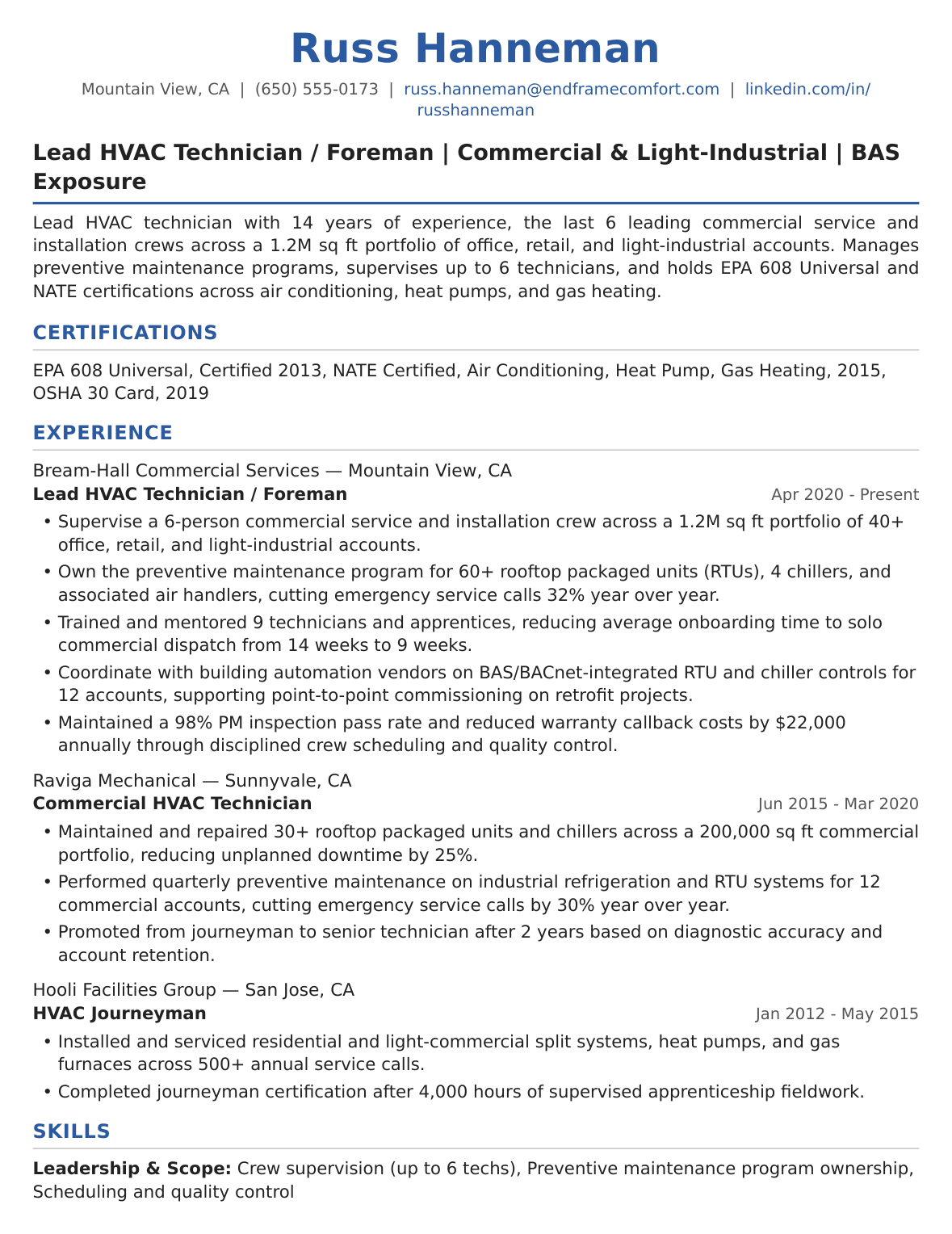
At the lead tech, foreman, or commercial level, the resume shifts from throughput to scope. Lead with crew size supervised, technicians trained or mentored, square footage or number of buildings covered, contract or account value, and preventive maintenance programs you own. Individual repair bullets get compressed or dropped entirely to make room for the equipment class that separates commercial work from residential: rooftop packaged units, chillers, cooling towers, VAV boxes, boilers, and building automation or controls exposure. Add anything that reads as accountability rather than task completion, such as scheduling, inspection pass rates, warranty or callback cost reduction, and safety record across a crew. What you are proving here is that a contractor can hand you a job site and a schedule and stop watching it.
All three versions share the same spine: certifications high on the page, quantified bullets underneath, equipment named specifically instead of generically. If you sit between two levels, build the higher one and let the evidence decide. A journeyman with two techs reporting to them on install days should use the senior structure and fill the scope bullets honestly rather than padding the mid-level version. If you are moving from a small residential shop toward a bigger commercial contractor, start from the mid-level or senior layout and build your scope section around the crews and accounts you want to manage next.
Resume Bullet Examples by HVAC Role
Your bullets should match the role you actually did, not a generic template. Here are copy-ready examples for five common HVAC positions.
Residential Service Technician
Focused on diagnostics, repair, and customer-facing service calls in homes.
- Completed 400+ residential HVAC repair and maintenance visits annually, achieving a 92% first-call resolution rate on furnace and AC systems.
- Upsold maintenance plans and system upgrades during service calls, generating $45,000 in additional annual revenue for the branch.
Commercial/Industrial Technician
Works on larger rooftop units, chillers, and building-wide systems with tighter uptime demands.
- Maintained and repaired 30+ rooftop packaged units and chillers across a 200,000 sq ft commercial portfolio, reducing unplanned downtime by 25%.
- Performed quarterly preventive maintenance on industrial refrigeration and RTU systems for 12 commercial accounts, cutting emergency service calls by 30% year over year.
Installer
Handles new system installs, replacements, and startup for residential or light commercial jobs.
- Installed 100+ residential split-system and heat pump units per year, passing final inspection on first attempt 98% of the time.
- Led ductwork and equipment installation on new construction projects, completing 20 single-family home systems on schedule with zero rework callbacks.
HVAC Apprentice
Building core skills under supervision while logging hours toward journeyman certification.
- Assisted lead technicians on 10+ service and installation calls per week, logging 1,800 hours toward EPA 608 Universal and state apprenticeship requirements.
- Learned refrigerant recovery and brazing procedures under direct supervision, completing 50+ supervised installs with no safety incidents.
Lead Technician/Foreman
Oversees crews, schedules, and quality control on installation or service teams.
- Supervised a 5-person installation crew across 8 to 10 weekly job sites, keeping projects within budget on 95% of completed installs.
- Trained and mentored 6 junior technicians and apprentices, reducing average onboarding time to full solo dispatch from 12 weeks to 8 weeks.
Adjust the numbers to reflect your actual scope, but keep the structure: action verb, specific system or task, and a measurable result. That structure is what reads as proof of performance instead of a duty list.
HVAC Resume Keywords
Certification strings are literal to an ATS, not descriptive. "EPA 608 Universal" and "EPA certified" don't match each other in a scan, and equipment class (residential split system versus commercial RTU) is one of the fastest signals a filter uses to route your resume. See ATS resume keywords for how the matching actually works. The table below covers vocabulary; your bullets still carry the numbers.
| Category | Keywords |
|---|---|
| Certifications & Safety | EPA 608 Universal/Type II, NATE certification, OSHA 10-Hour, OSHA 30, Valid HVAC technician license, Clean driving record |
| Refrigerant & Diagnostics | Refrigerant recovery and charging, Brazing and soldering, Electrical troubleshooting, Split systems and heat pumps, Rooftop packaged units (RTUs), Chillers and air handlers, Boiler systems |
| Building Automation & Controls | Building Automation Systems (BAS), BACnet, Modbus, Tridium Niagara, Siemens, Alerton, Point-to-point commissioning |
| Field Software & Customer Skills | ServiceTitan, Dispatch and scheduling software, Customer communication, Warranty documentation, Upselling maintenance agreements, Title 24 code compliance |
The Building Automation & Controls row showed up in only one of the twelve postings pulled for this piece, so add it only if you're actually targeting commercial or controls work. Listing BACnet or Alerton on a residential-service resume raises a question you can't answer in the interview.
Mirror the posting's exact string. A posting asking for "EPA 608 Universal" won't credit "EPA certified," and one naming "rooftop packaged units (RTUs)" won't match a resume that just says "rooftop units." Pull the wording straight from the listing instead of paraphrasing it.
Common HVAC Resume Mistakes to Avoid
Run through this list before you hit submit.
Listing duties instead of results. "Performed routine maintenance on residential HVAC units" tells a hiring manager nothing about how well you did it. Replace duty language with a number: units serviced per day, callback rate, first-time fix rate.
Sending the same resume to every job. A residential service resume and a commercial contractor resume don't read the same way. Commercial and union roles want to see rooftop units, chillers, BAS systems, or apprenticeship hours front and center, not buried under residential service call language.
Certifications with no detail. "EPA 608 Certified" alone raises questions. Add the type (Universal), the issuing body, and the date earned or expiration. A recruiter scanning fifty resumes will skip past anything that looks unverified.
Formatting that breaks ATS parsing. Tables, text boxes, columns, and logos look clean to a human eye and confuse the software scanning your resume first. Stick to a single column, standard headers, and plain text so the ATS reads your certifications and skills correctly.
Vague skills with zero context. A line that just says "HVAC skills" or "mechanical skills" answers nothing. Name the systems, refrigerants, and tools: split systems, mini-splits, R-410A recovery, digital multimeters.
Skipping the safety and compliance language. Recruiters in commercial and union hiring scan for OSHA 10 or OSHA 30, refrigerant handling and recovery compliance, and confined space or lockout/tagout awareness. Leaving this out makes a residential tech look less ready for a commercial site.
Burying certifications at the bottom. If your EPA 608 and any specialty training sit below three jobs of work history, they might not get read at all. Move certifications into the top third of the page, near your summary, especially when you're targeting a step up to a bigger contractor.
Read through your draft once with this checklist open. Each fix takes minutes and removes a reason to pass on your resume.
How AI Resume Builders Can Simplify Your HVAC Resume
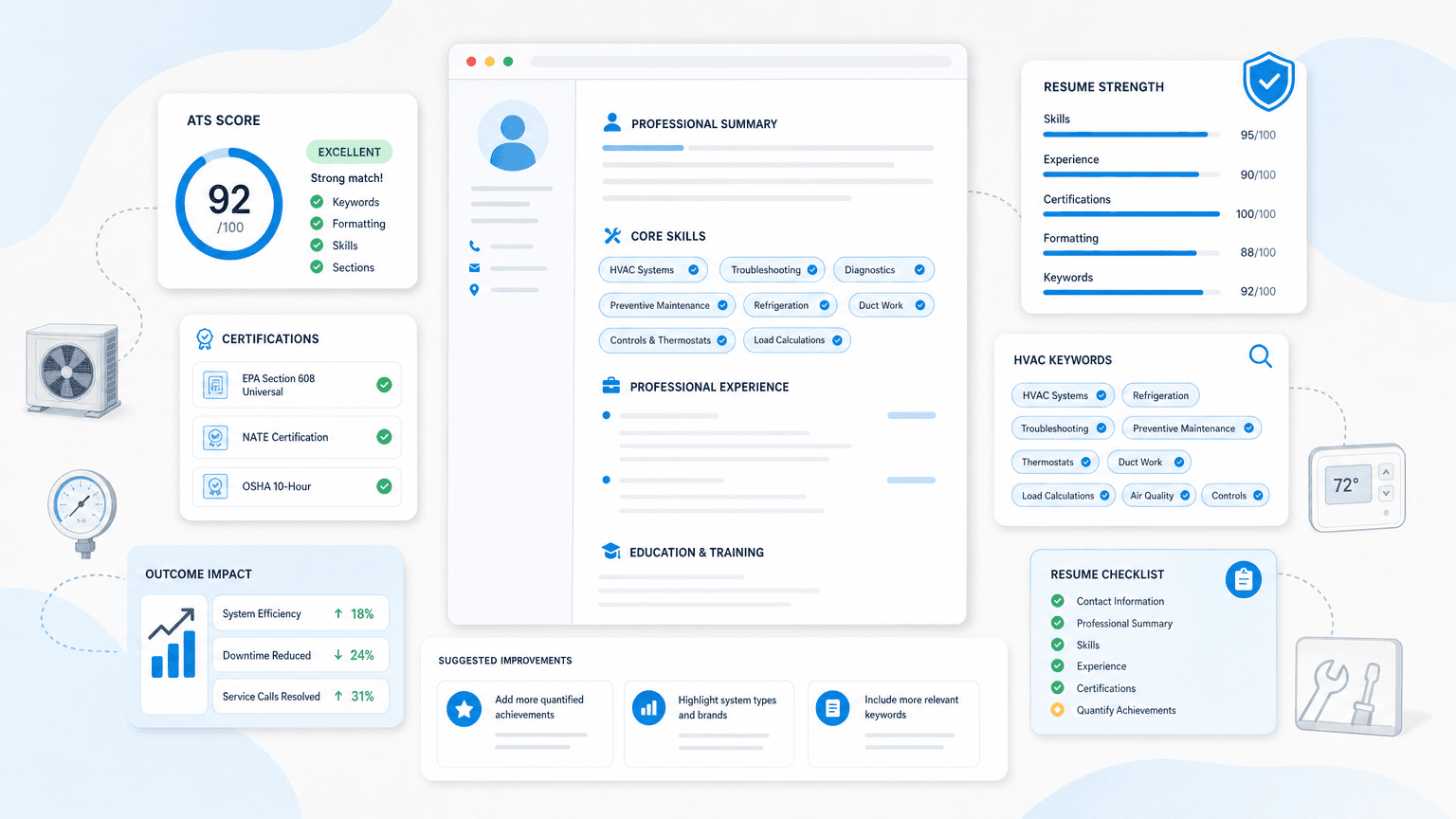
Rewriting your resume for every residential, commercial, and union posting takes hours you don't have after a full day of service calls, and the one-size-fits-all version you keep reusing is exactly what gets filtered out by ATS software before a person ever sees it. Upplai handles the tailoring without inventing experience you never had, which matters if you have been burned by generic AI tools that pad resumes with fake claims.
- Real-time ATS scoring: your score and recruiter score update as you edit, so you see the impact immediately instead of downloading and re-uploading to check.
- Transparent suggestions: every edit comes with a plain-language "Why this change?" explanation, and you accept or reject each one individually. Nothing gets added to your resume without your say-so.
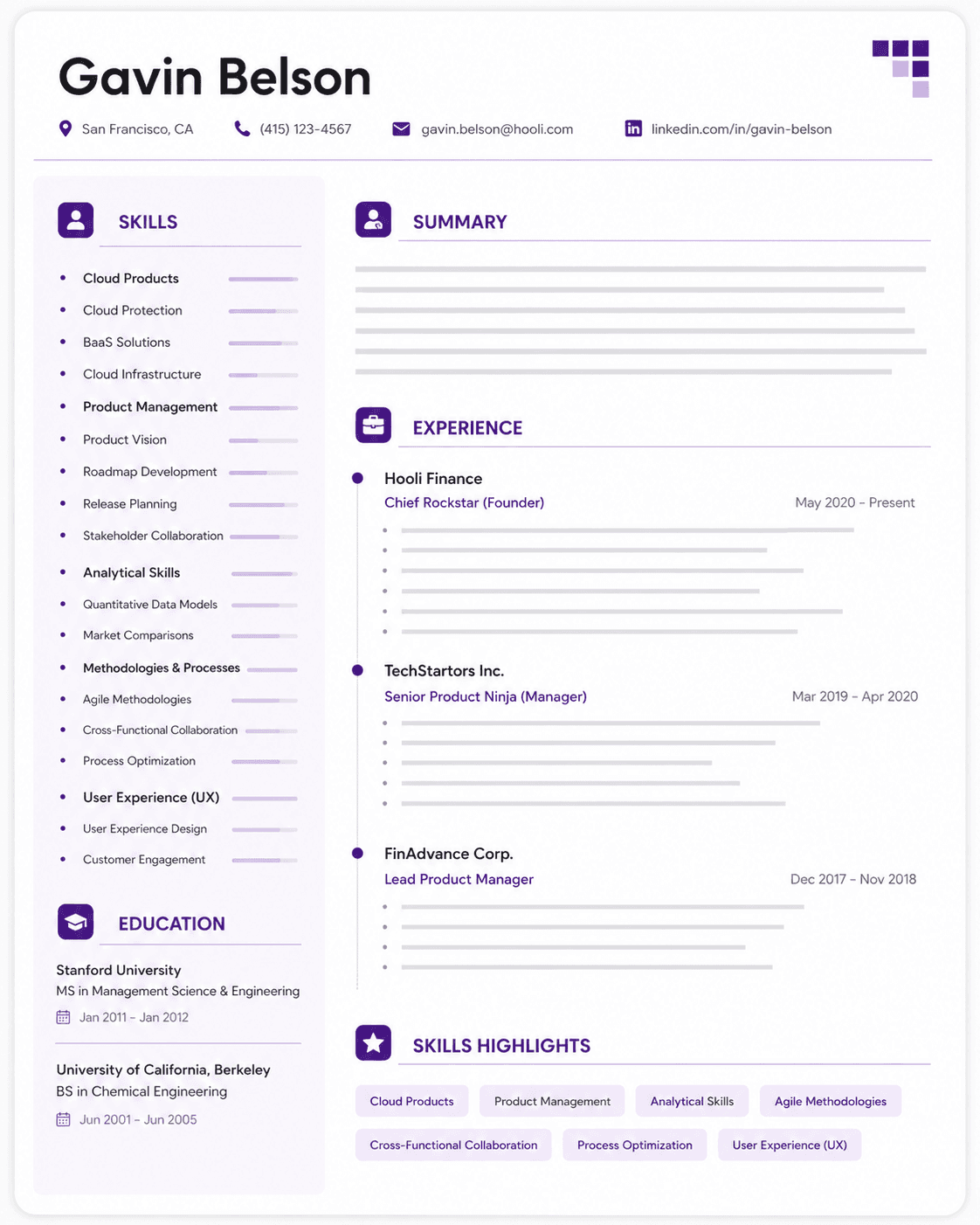
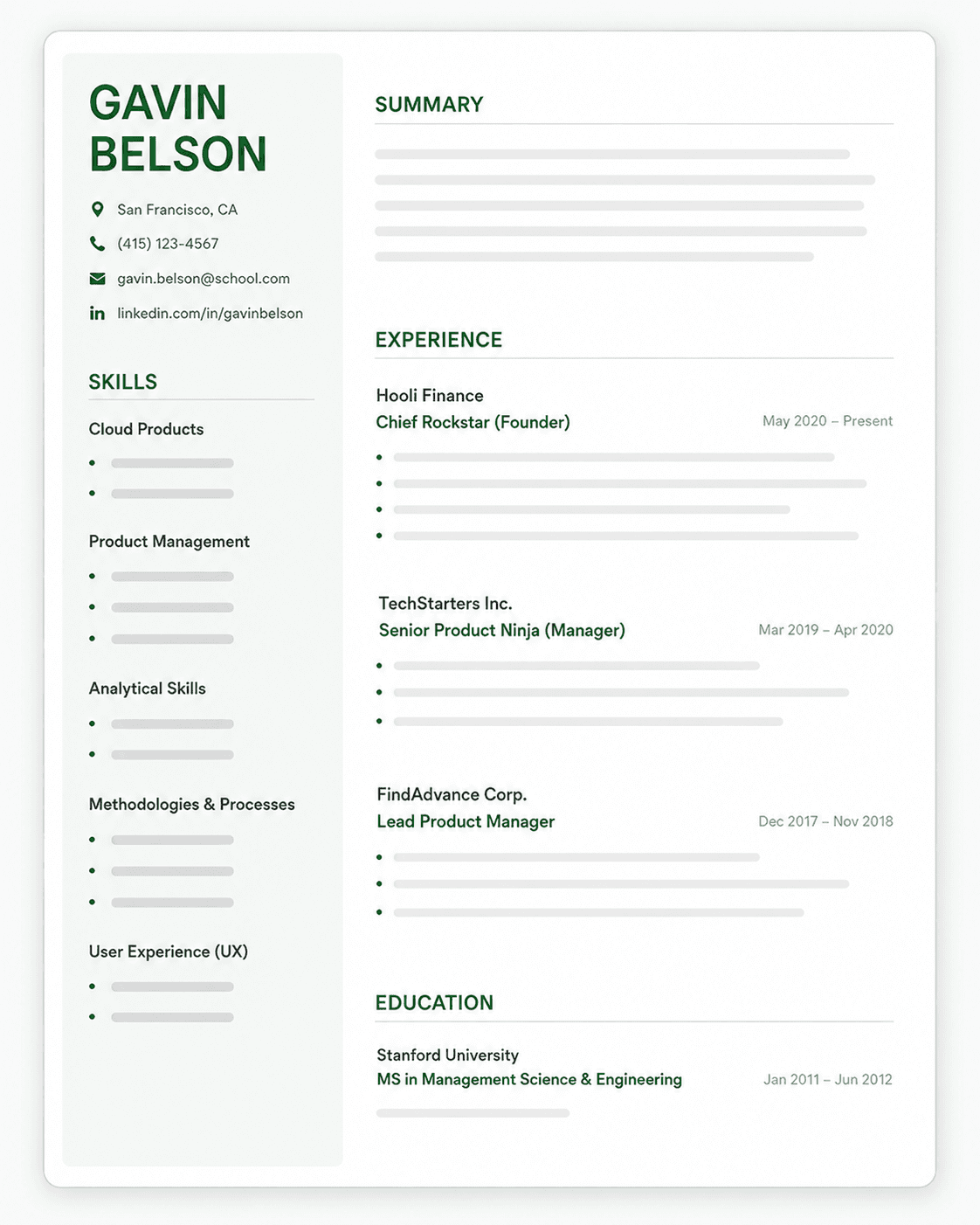
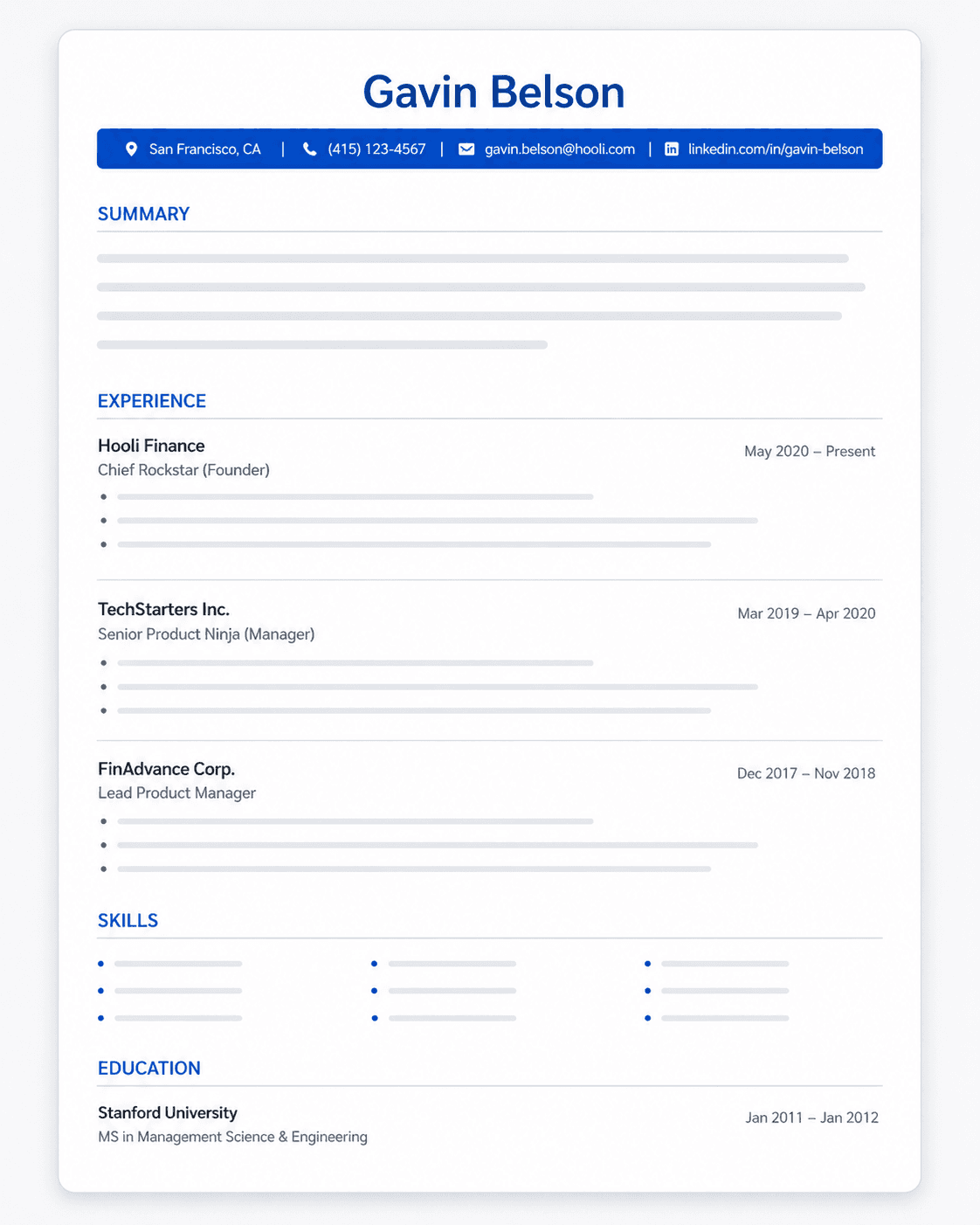
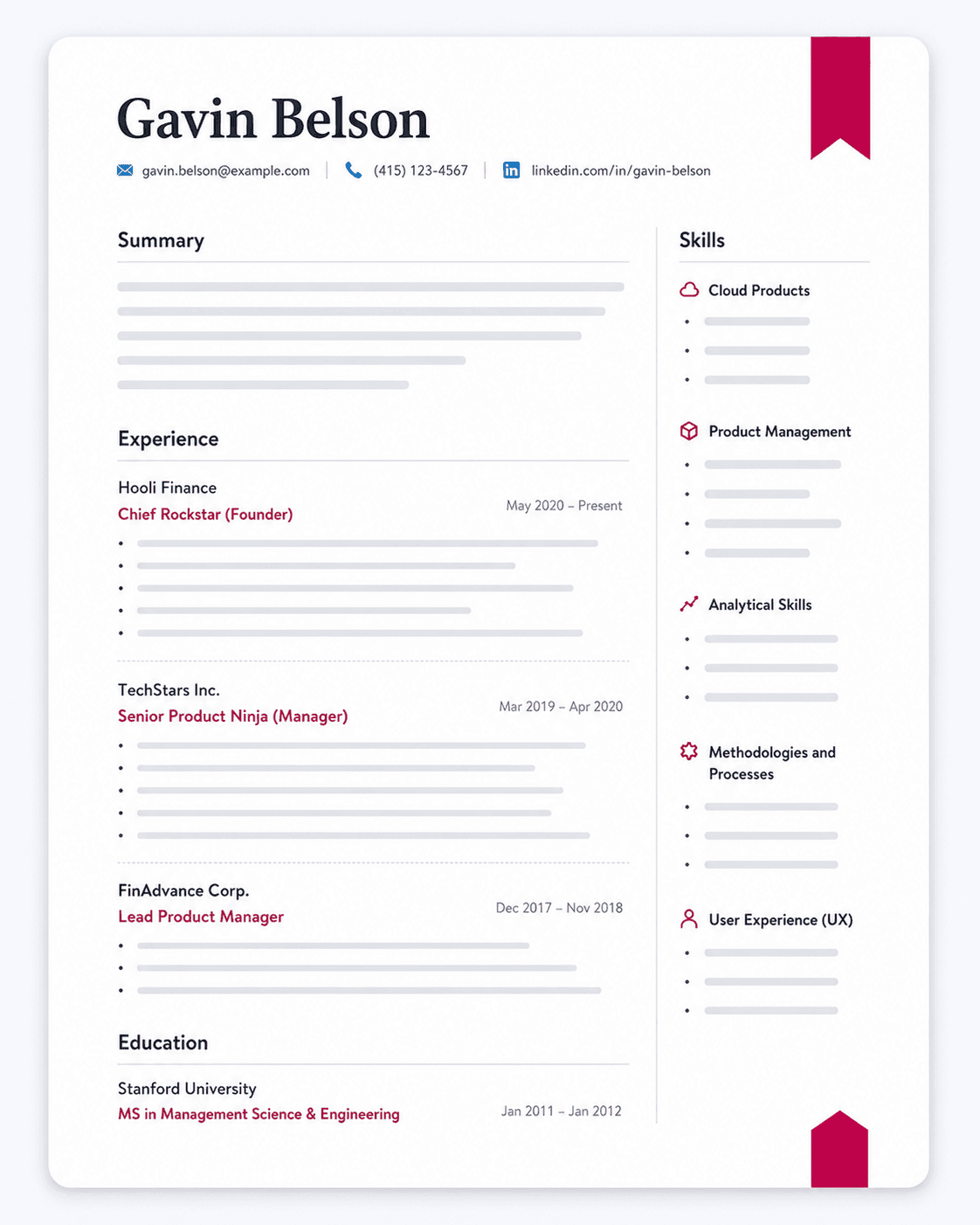
- Automatic formatting: choose from ATS-friendly templates with full design control, so a technician resume looks clean without you fighting Word margins.
- Structure guidance: reorders your bullets for relevance, strengthens weak action verbs, helps you quantify calls completed or callback rates, manages length, and flags language that could read as biased.
- Preference memory: your formatting choices, preferred metrics, and reordering decisions carry over the next time you tailor a resume, so you're not resetting preferences for every job.
A matching cover letter comes with every resume at no extra cost, and tailored resumes generate 6X more interviews than generic ones. The free plan includes 200 ATS scans and resume match scores per month and 3 tailored resumes with matching cover letters as a one-time allotment, plus unlimited PDF, DOCX, and TXT downloads. No credit card required. No annoying subscriptions.
Land your next HVAC job with a tailored resume
Upload your resume and see exactly where it stands before you apply for your next job.