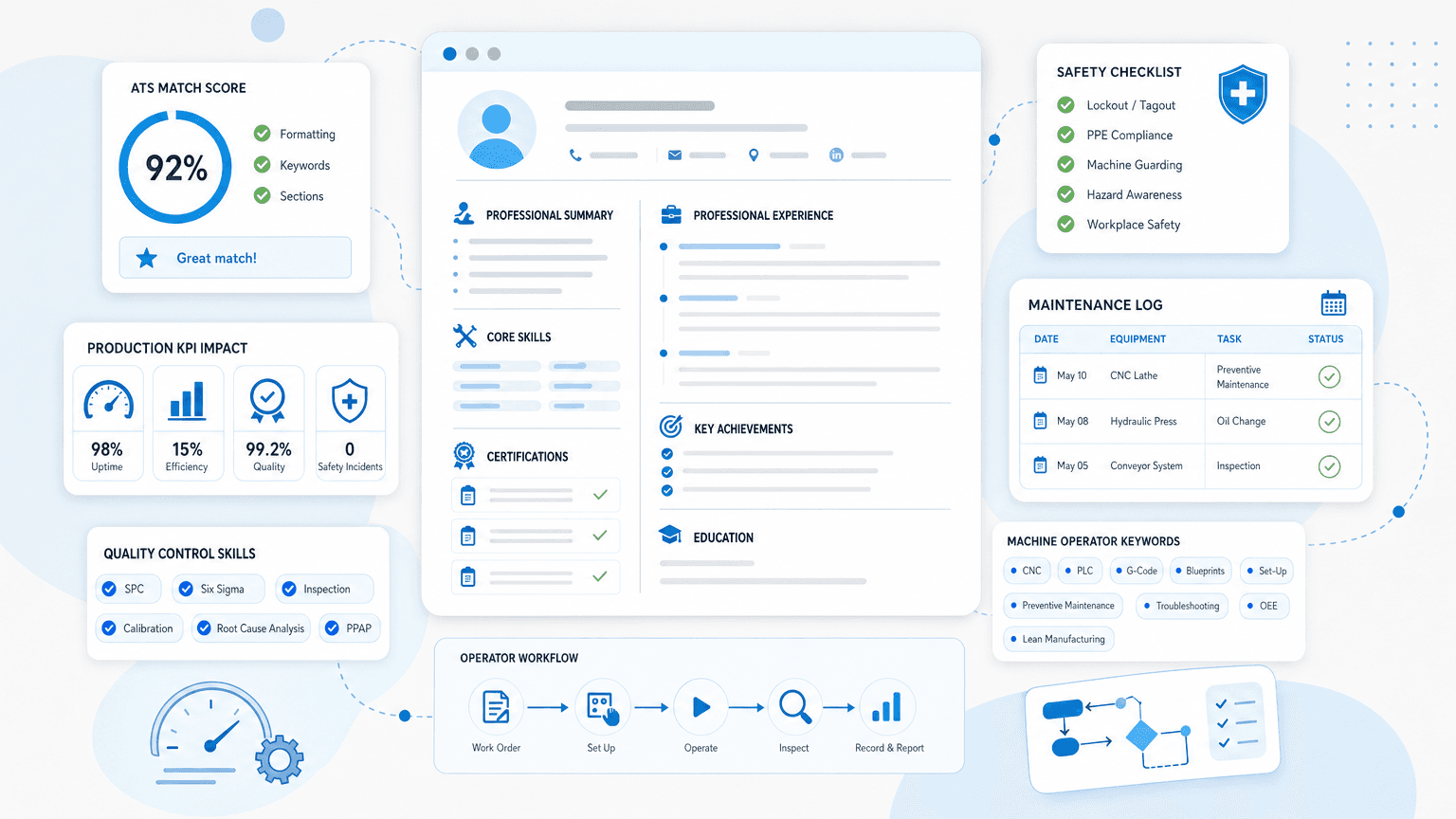
You've run the machine, hit your numbers, and passed your safety checks, and your resume still isn't landing interviews. That's a common gap for machine operators, because "machine operator" covers CNC work, injection molding, and assembly line production, and each hiring manager scans for different proof depending on which machines their floor actually runs.
This guide walks through every section of a machine operator resume, from summary to work history, with real examples for CNC, production/assembly line, injection molding, lead/trainer, and entry-level operators. Certification gets your resume past the first filter. Specificity, naming the actual machine, the tolerance you held, the scrap rate you hit, is what gets you the callback.
How to Write a Machine Operator Resume That Gets Interviews
Write a Targeted Summary or Objective
Your summary needs to do three things in three or four lines: name the machine or process type you run, state your years of relevant experience, and back it with one quality or output number a reader can check against your bullets below.
A weak summary looks like this:
"Hardworking machine operator with strong work ethic looking for a new opportunity in manufacturing."
A stronger one looks like this:
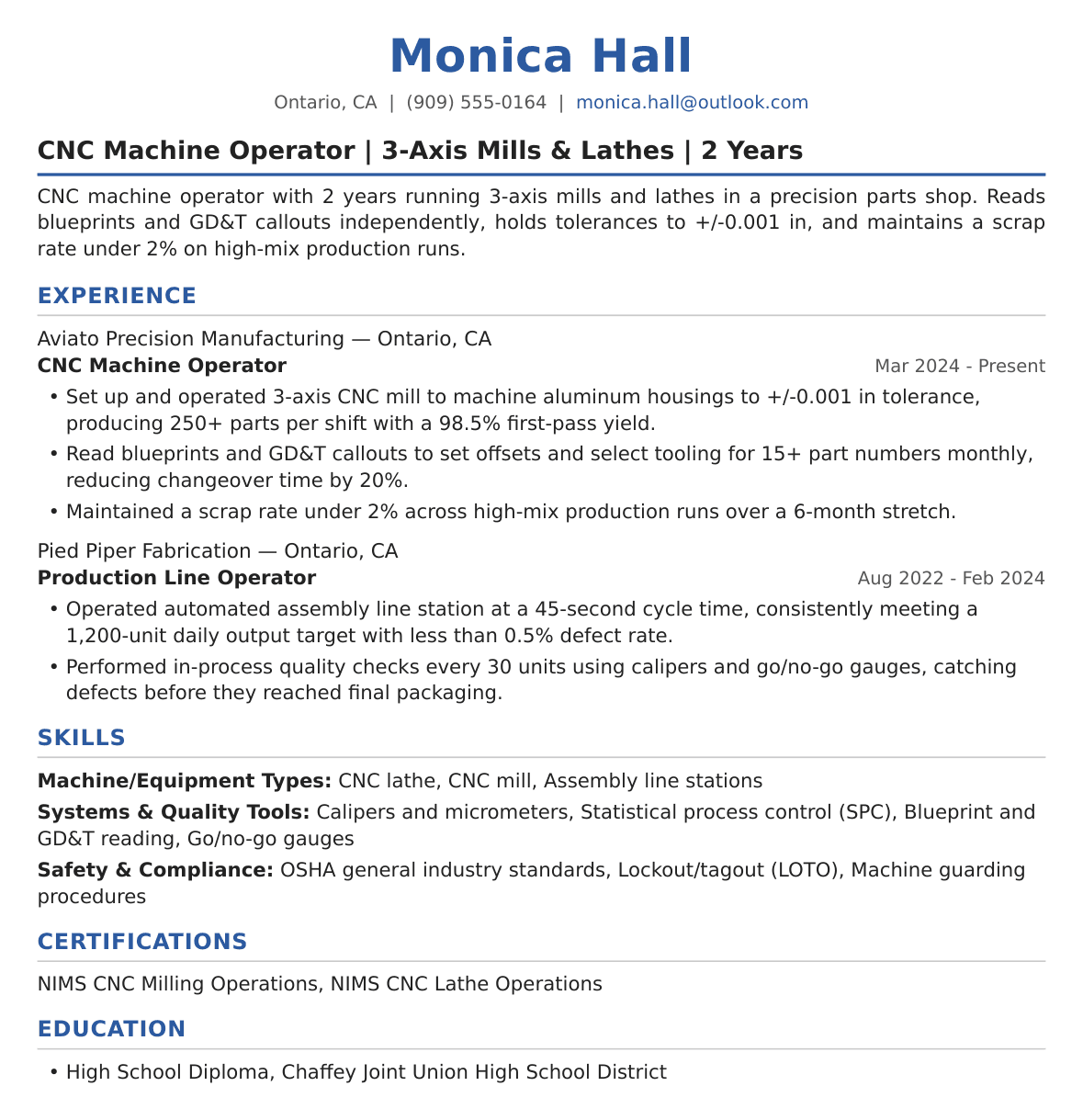
"CNC machine operator with 2 years running 3-axis mills and lathes in a precision parts shop. Reads blueprints and GD&T callouts independently, holds tolerances to +/-0.001 in, and maintains a scrap rate under 2% on high-mix production runs."
If you're entry-level or moving into manufacturing from another field, use an objective instead. It should point to your training and transferable skills, not general enthusiasm.
Objective (entry-level/career-changer): "Recently certified machine operator with completed hands-on training in machine setup, blueprint reading, and lockout/tagout safety procedures. Background in warehouse and general production work, with a consistent attendance record and fast onboarding on new equipment."
Build a Skills Section That Names Your Equipment and Systems
Never list "machine operator" or "operated machinery" alone as a skill. It tells a reviewer nothing about what you can actually run. Name the equipment, the tools, and the systems instead, grouped so a reader can scan for what matches the job posting in a few seconds.
Machine/Equipment Types: CNC lathe, CNC mill, injection molding press, punch press, assembly line stations, conveyor systems, stamping press
Systems & Quality Tools: Calipers and micrometers, statistical process control (SPC), blueprint and GD&T reading, CAD/CAM familiarity, go/no-go gauges
Safety & Compliance: OSHA general industry standards, PPE compliance, lockout/tagout (LOTO), machine guarding procedures
Process & Efficiency: Lean manufacturing familiarity, Six Sigma/Kaizen exposure, changeover and setup reduction, preventive maintenance checks
Match the wording in the job posting where it's accurate. If a posting says "injection molding press" and that's what you ran, use that exact phrase rather than a generic substitute, since both ATS software and human reviewers scan for the specific term.
Keep the categories short and specific rather than turning this into a long, unsorted list. A reviewer scanning fifty resumes for one opening spends a few seconds per skills section, so four tight categories with real equipment names beat a wall of twelve bullet points with no structure.
Showcase Certifications the Right Way
If you're a CNC operator, a NIMS (National Institute for Metalworking Skills) certification is worth listing prominently. The CNC Milling Operations and CNC Lathe Operations credentials, part of NIMS's Machining Level 1 series, are the most directly relevant for this role. They're earned through a training program, secondary or post-secondary coursework, or an apprenticeship that combines a hands-on performance assessment with a written theory exam, not something NIMS staff hand out directly without testing. They also don't expire once earned, so there's no renewal cycle to track or list a date against.
List it the same way you'd list any credential: credential name, issuing or administering program, and the month and year you completed it. If you hold more than one (say, both milling and lathe credentials), list each separately so a reviewer can see the full scope of what you're qualified to run.
General safety training is worth a line too. OSHA sets the safety standards that apply to machine shops and production floors (things like machine guarding and lockout/tagout), but OSHA itself doesn't personally certify individual workers. Your employer or a training provider evaluates you against those standards and issues the actual certificate, so list the training provider or employer as the issuer rather than writing "OSHA-certified" as if OSHA trained you directly.
If you also hold a forklift certification, it's worth one line as a bonus skill, especially for roles that mix machine operation with material handling. It doesn't need more space than that here.
Write Achievement-Focused Experience Bullets
Every work experience bullet should follow the same formula: action verb, plus the machine or process, plus a volume or quality metric, plus the outcome. This is the single biggest gap in most machine operator resumes, most read like a job description instead of proof of results.
A job description says what the role involves. A bullet built on this formula says what you did with it, in numbers a hiring manager can picture: how many parts, how tight a tolerance, how much scrap avoided.
Weak: "Responsible for operating machines and ensuring quality standards were met."
Strong: "Operated CNC lathe to produce 300+ precision parts per shift within +/-0.002 in tolerance, maintaining a scrap rate under 1.5% across a 6-month stretch."
Adapt the formula to your specific sub-role. Here's a starting library by machine operator type:
CNC Machine Operator: "Set up and operated 3-axis CNC mill to machine aluminum housings to +/-0.001 in tolerance, producing 250+ parts per shift with a 98.5% first-pass yield." / "Read blueprints and GD&T callouts to set offsets and select tooling for 15+ part numbers monthly, reducing changeover time by 20%."
Production/Assembly Line Operator: "Operated automated assembly line station at a 45-second cycle time, consistently meeting a 1,200-unit daily output target with less than 0.5% defect rate." / "Performed in-process quality checks every 30 units using calipers and go/no-go gauges, catching defects before they reached final packaging."
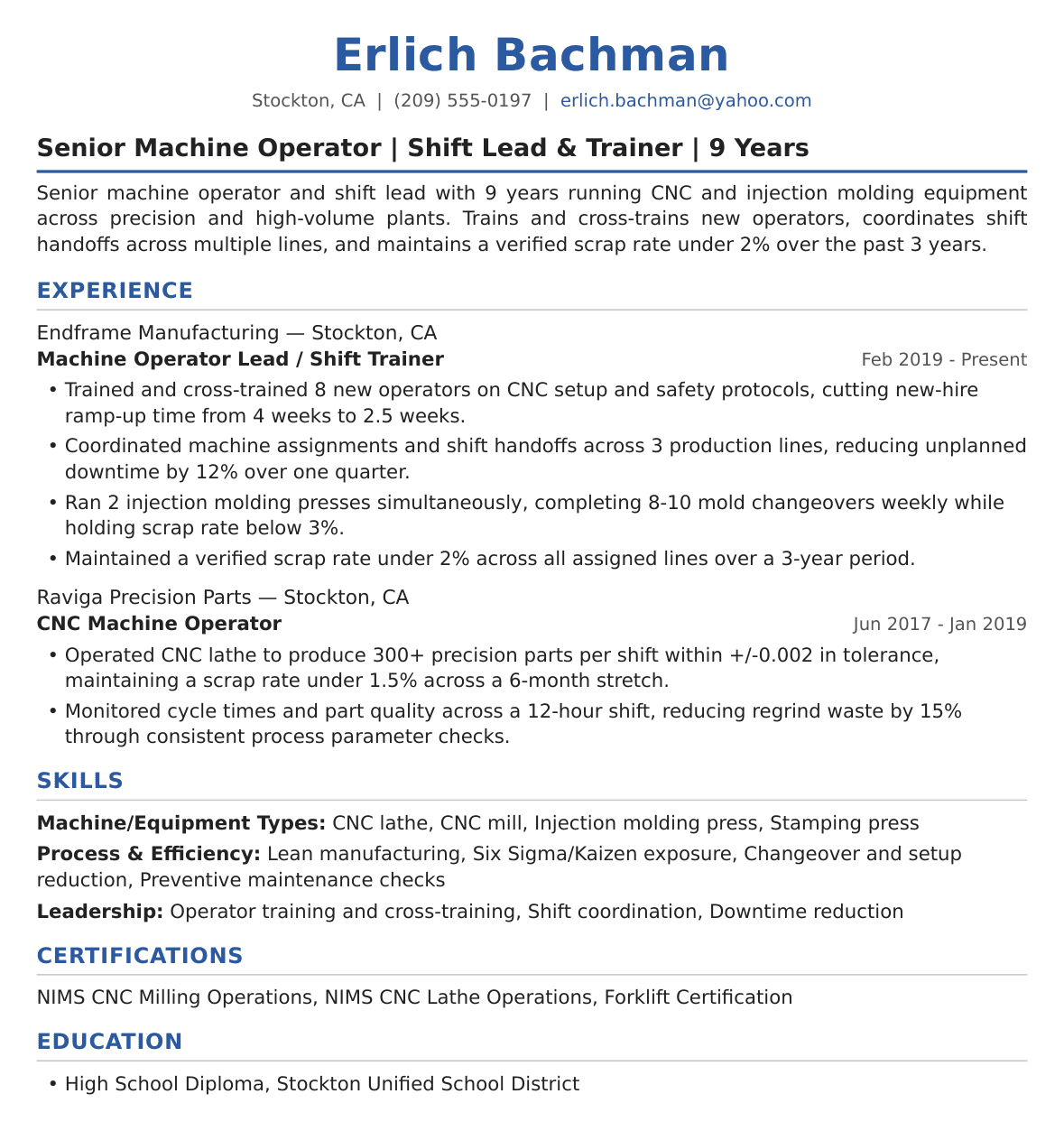
Injection Molding Machine Operator: "Ran 2 injection molding presses simultaneously, completing 8-10 mold changeovers weekly while holding scrap rate below 3%." / "Monitored cycle times and part quality across a 12-hour shift, reducing regrind waste by 15% through consistent process parameter checks."
Machine Operator Lead/Trainer: "Trained and cross-trained 8 new operators on CNC setup and safety protocols, cutting new-hire ramp-up time from 4 weeks to 2.5 weeks." / "Coordinated machine assignments and shift handoffs across 3 production lines, reducing unplanned downtime by 12% over one quarter."
Entry-Level/Certified-No-Experience: "Completed 80-hour machine operator training program covering CNC basics, blueprint reading, and lockout/tagout procedures, passing all practical evaluations." / "Applied warehouse material-handling experience to a 6-week manufacturing apprenticeship, learning press operation and quality inspection using calipers and micrometers."
Quantify honestly. A tolerance, scrap rate, or units-per-shift number carries weight specifically because a hiring manager can ask you about it in an interview and expect a straight answer. If you don't have exact figures memorized, check old shift logs, quality reports, or ask a former supervisor what your line or station typically produced. Round conservatively rather than guessing high.
If you've worked more than one sub-role, say a stint on an assembly line before moving to CNC, keep both sets of bullets on your resume rather than dropping the earlier ones. A production-line background shows you already understand cycle time and quality checks, which makes the jump to CNC or injection molding read as a progression instead of a fresh start.
Organize Your Work History and Handle Limited Experience
Reverse-chronological order (most recent role first, with employer, dates, and location) is the default and what most manufacturing hiring managers expect to see.
If you're new to machine operation, recently certified but not yet placed, or coming from an adjacent field, use a combination format instead. Lead with a training and certification block, then follow with a shorter work history beneath it. This puts your strongest credential up front without hiding your actual work record.
When your background is in an adjacent role, reframe it using the same language a machine operator resume needs. Warehouse work becomes material handling and inventory accuracy. General labor becomes physical stamina and safety-procedure compliance. Assembly-adjacent work (packaging, kitting, quality sorting) becomes quality inspection and process familiarity. Use the action-verb-plus-outcome structure from the bullets above, applied honestly to what you actually did, and the transition into "machine operator" reads as a natural next step rather than a stretch.
For example, "stocked shelves and packed orders" becomes "handled 200+ units daily while maintaining inventory accuracy, with direct experience following safety and quality checkpoints." Same work, described in terms a manufacturing hiring manager can map onto the job they're filling.
Machine Operator Resume Examples
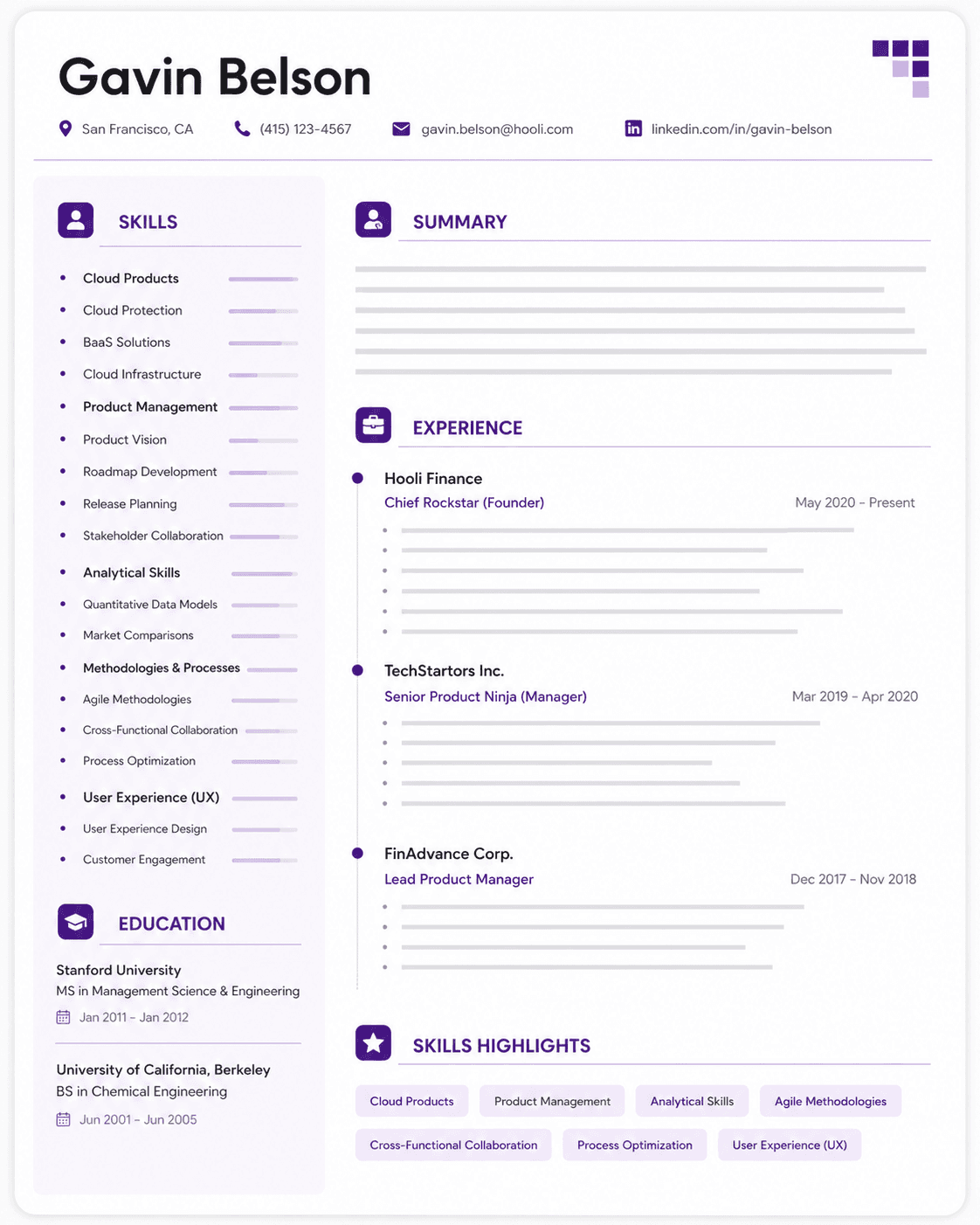
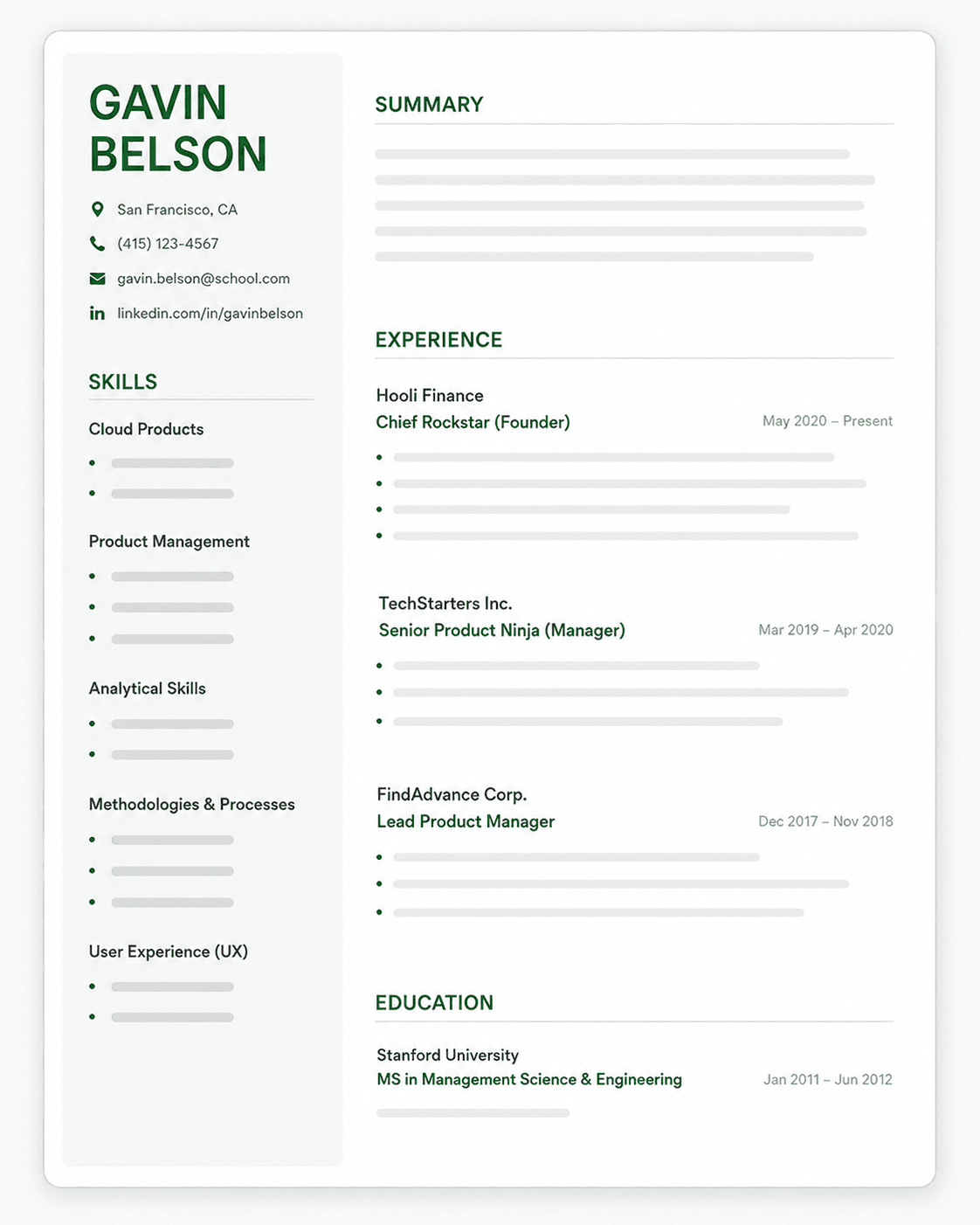
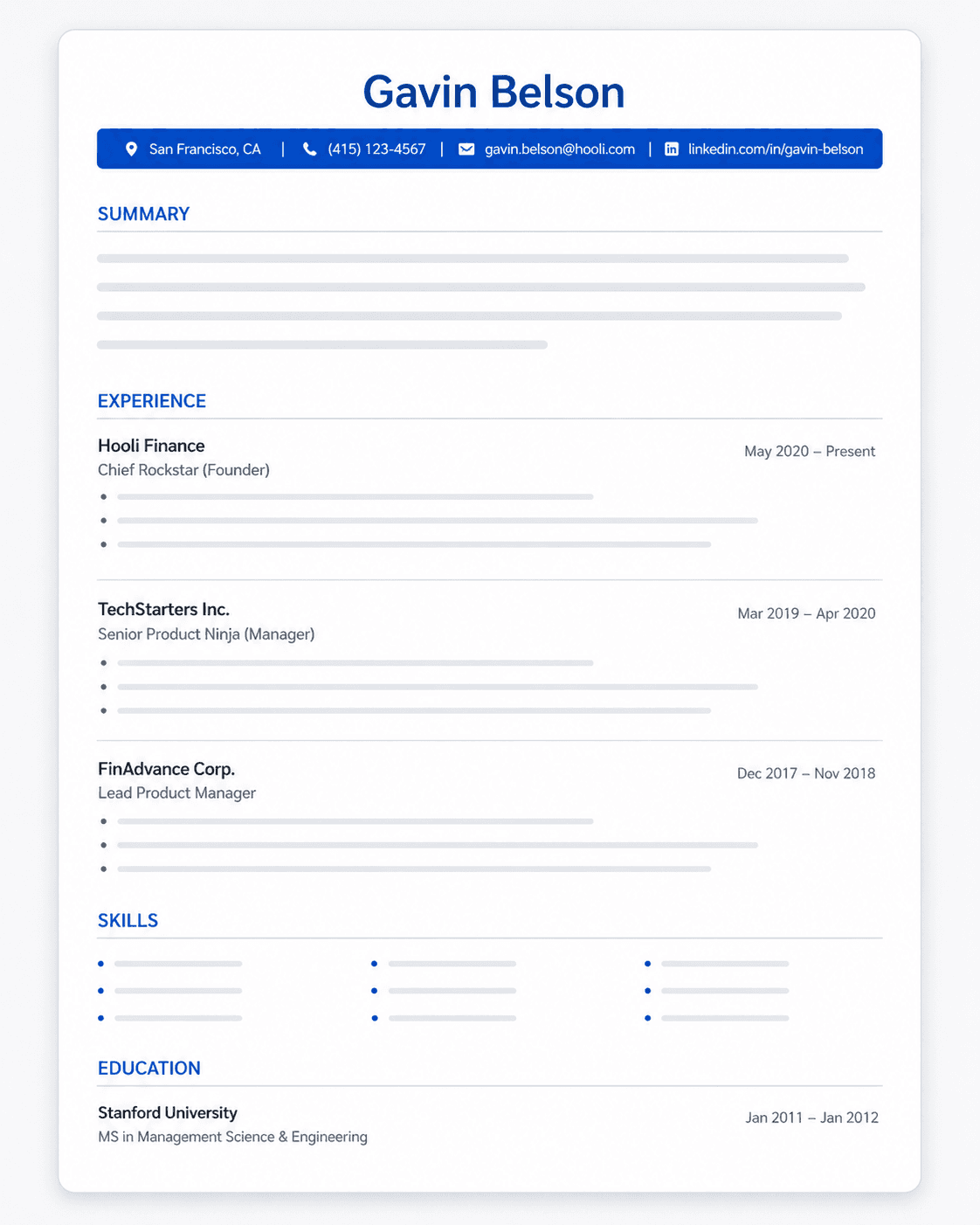
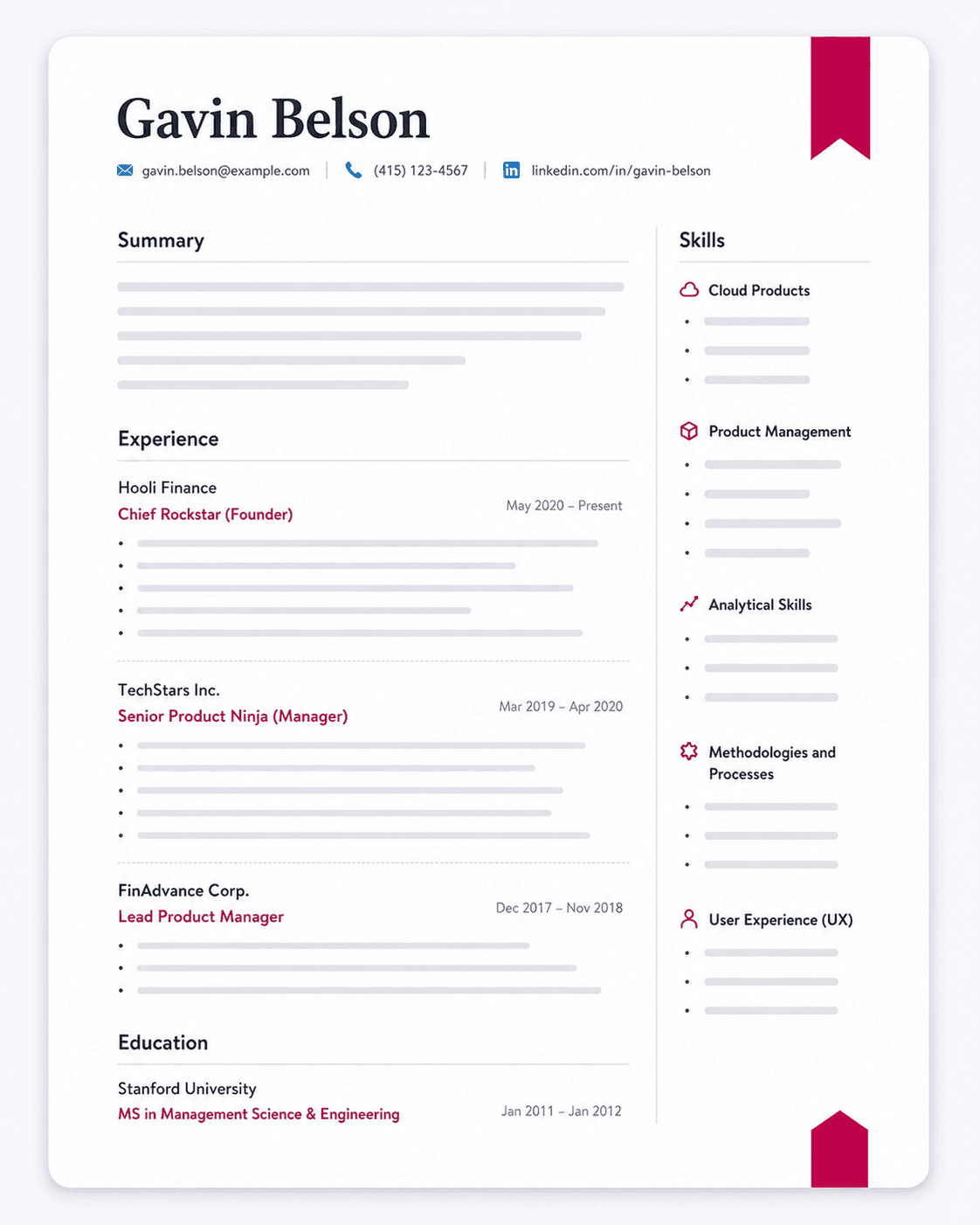
Seeing a full resume laid out is often faster than building one from a blank page. Below are three downloadable templates, one for each career stage, each following the summary-skills-certifications-experience structure from this guide. Pick the version closest to your background and swap in your own machines, numbers, and certifications.
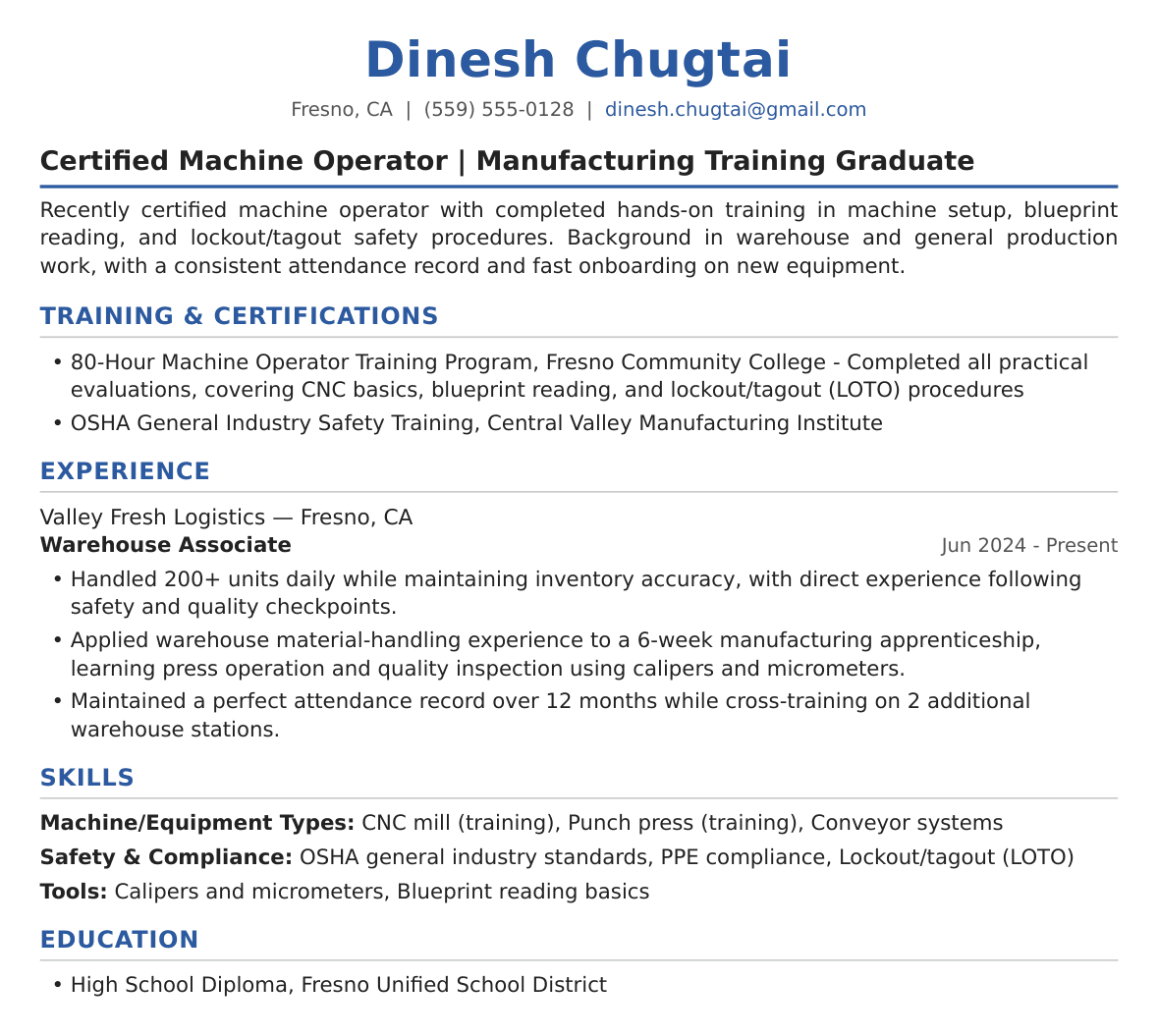
Entry-Level (Certified, No Experience) Built for operators who've completed a training program or apprenticeship but haven't yet worked the floor. Leads with certification, training hours, and transferable general-labor experience.
Entry-Level Machine Operator Resume Example
Mid-Level (CNC or Production Operator) Designed for operators with 1-3 years running CNC equipment or a production/assembly line. Highlights tolerances, output volume, and quality metrics.
Mid-Level Machine Operator Resume Example
Senior/Lead (Trainer or Shift Lead) Suited for operators who train new hires, coordinate shifts, or oversee multiple machines or lines. Focuses on efficiency gains, cross-training, and downtime reduction.
Senior-Level Machine Operator Resume Example
Machine Operator Resume Keywords
Manufacturers screen for machine types, quality language, and safety compliance. Name the equipment and measurement tools you have run, and attach numbers like scrap rates or output where you can.
| Category | Keywords |
|---|---|
| Operation & setup | CNC machine operation, Machine setup and changeovers, Production line operation, Equipment troubleshooting, Preventive maintenance |
| Quality | Quality inspection, Micrometers and calipers, Blueprint reading, Tolerance verification, Statistical process control (SPC), ISO 9001 |
| Process improvement | Lean manufacturing, 5S, OEE improvement, Scrap and downtime reduction |
| Safety | Lockout/tagout (LOTO), OSHA compliance, PPE adherence, Forklift certification |
Worked Through a Temp Agency? Here's How to List It
A huge share of manufacturing runs on temp-to-hire: you're on Adecco's or Staffmark's payroll while running machines at someone else's plant, sometimes for years across several sites. Listing only the plant breaks your background check, because the plant never employed you. Listing only the agency hides what you actually ran.
List both, agency first: "CNC Operator, Adecco Staffing (assigned to Precision Metals Inc.), 2023–2025." The agency is your employer of record, so verification and W2s match, and the parenthetical tells the hiring manager where the real work happened.
If you've had three or more placements through one agency, group them under a single agency heading with the plants as sub-lines. That turns what looks like five short jobs into one continuous employment relationship, which is what it was. And if a placement converted to a direct hire, make that its own line: "converted to permanent hire after 90 days" is one of the strongest endorsements a temp resume can carry, because the plant saw your work and paid to keep it.
Common Machine Operator Resume Mistakes to Avoid
Describing Tasks Instead of Outcomes
"Operated CNC machine and monitored production" tells a hiring manager what your job title was, not what you accomplished. Replace it with "produced 250+ parts per shift at 98% first-pass yield" or "reduced changeover time by 20% through improved tooling setup." Outcomes are what separate a candidate who showed up from one who improved the line.
Treating "Machine Operator" as One Job
CNC, injection molding, and assembly line work require different skills, tools, and vocabulary, and a resume that stays vague enough to cover all three usually convinces a reviewer of none of them. Name the actual machines you've run (CNC lathe, injection molding press, punch press) instead of leaning on the umbrella term. Zero specific equipment named is the fastest way to get passed over.
Sending One Generic Resume to Every Employer
A precision machine shop and a high-volume assembly plant scan for different keywords. One wants tolerances and GD&T; the other wants cycle time and output volume. Read the posting and echo back the specific machines, systems, and metrics it mentions. A few minutes of tailoring per application beats one resume blasted everywhere.
Burying or Omitting Certifications
A NIMS credential or completed safety training is one of the stronger signals on an entry-level or CNC resume, yet it often gets buried at the bottom or left off the skills list entirely. List certifications near the top, with the issuing program and date, so a reviewer scanning quickly doesn't miss it.
Overclaiming Safety or Quality Stats
"Zero defects ever" or "perfect safety record" sounds strong but reads as unverifiable, and an interviewer who asks a follow-up question can turn it into a red flag. A grounded claim like "maintained scrap rate under 2% over 6 months" holds up better because it's specific and checkable.
Ignoring ATS-Breaking Formatting
ATS-breaking formatting can cause tables, columns, text boxes, and headers or footers to get scrambled or dropped when an applicant tracking system parses a resume. A certification or metric buried in a table might never reach a human reviewer. Stick to a single column with standard section headings.
Missing or Inconsistent Dates
Gaps in employment or mismatched date formats (listing "2023-2024" for one job and "March 2022 to Present" for another) read as careless and raise questions a reviewer would rather skip past. Use a consistent month and year format across every entry, and account for gaps honestly rather than leaving them unexplained.
Padding With Generic Soft Skills
"Team player" and "strong communicator" tacked onto the bottom of a skills section don't tell a hiring manager anything specific about your ability to run a machine or hold a tolerance. If you want to mention teamwork, tie it to something concrete, like training new operators or coordinating a shift handoff, rather than listing the trait on its own.
How AI Resume Builders Can Simplify Your Machine Operator Resume
Rewriting your resume for every machine shop or production plant posting takes time you don't have after a shift, and a generic resume that doesn't echo the specific machines and metrics in a job description often gets filtered out before a person ever reads it.
- Real-time ATS scoring: Your ATS and recruiter scores update as you edit, so you can see how naming a specific machine or metric changes your match rate without downloading and re-uploading your resume.
- Transparent suggestions: Every edit comes with a plain-language "why this change" explanation, and you accept or reject each one individually. Nothing gets rewritten without your say-so.
- Automatic formatting: Choose from multiple ATS-friendly templates and color themes, then download the finished resume as PDF, DOCX, or TXT.
- Structure guidance: The tool reorders content for relevance, strengthens weak action verbs, helps quantify achievements (parts per shift, scrap rate, uptime), manages resume length, and flags language that could trigger bias.
- Preference memory: Your formatting choices, preferred metrics, and reordering habits carry over the next time you tailor a resume, so you're not resetting preferences for every application.
Pricing is straightforward: no subscriptions, no auto-renewals. The free plan includes 200 ATS scans a month plus a one-time allotment of 3 tailored resumes with matching cover letters, no credit card required to start. Need more than 3 resumes? Additional resume packs start at $5 one-time, working out to $0.50 to $1.00 per tailored resume depending on pack size.
Get your machine operator resume job-ready
Run a free ATS check and see where your resume stands before you apply.