You carry a quota, and you know your numbers cold. 118 percent to plan last quarter, average deal size up 22%, a pipeline you built mostly through cold outreach that actually converted. None of it seems to matter once your resume hits an ATS or a recruiter's three-to-seven-second scan. The numbers are real. The interviews aren't coming at the rate those numbers deserve.
This article closes that gap: the specific keywords, phrases, and terminology that ATS software and sales recruiters actually scan for, organized so you can find what applies to your situation instead of wading through a generic list built for someone else's title.
You'll get the full keyword list by category, guidance on which keywords matter most for your role and seniority, weak-versus-strong resume bullets across SDR, AE, and senior levels, the mistakes that quietly tank keyword matching, and a way to check your match rate before you hit submit.
Sales Resume Keywords: The Complete List
Recruiters and ATS software scan sales resumes for specific language, not vague claims. Below is the full keyword set, grouped by category. Skim it now, then use the deeper sections below to see each category applied to real bullets.
| Category | Examples |
|---|---|
| Hard skills | Business development, account management, territory management, sales process optimization, GTM strategy, contract negotiation, objection handling, upselling, cross-selling, full-cycle sales |
| Quota & metrics | Quota attainment, % to plan, quota-carrying, ARR, average deal size, win rate, close rate, forecast accuracy, pipeline value, sales cycle length, President's Club |
| Methodologies | MEDDIC/MEDDPICC, Challenger Sale, SPIN Selling, Solution Selling, Consultative Selling, Sandler, Value Selling, BANT, Account-Based Selling |
| CRM & sales tech | Salesforce, HubSpot, Pipedrive, Zoho CRM, Outreach, Salesloft, Gong, Chorus, ZoomInfo, LinkedIn Sales Navigator, Clari |
| Pipeline & sales cycle | Prospecting, cold outreach, lead qualification, discovery call, needs assessment, proposal development, deal closing, renewal management, account expansion, churn reduction |
| Soft skills | Relationship building, active listening, stakeholder communication, C-level engagement, negotiation, cross-functional collaboration, coaching/mentoring |
| Action verbs | Achieved, exceeded, generated, closed, negotiated, secured, drove, expanded, prospected, forecasted, upsold |
A few rules for using this list well:
- Pair a keyword with a number. "Quota attainment" alone is generic. "Exceeded quota attainment at 128% for four consecutive quarters" is a keyword and proof in one line.
- Name your actual tools. "CRM experience" is not a keyword an ATS credits the way "Salesforce" or "Outreach" is.
- Only claim a methodology if you've used it, even informally. Naming MEDDIC without being able to speak to it in an interview backfires fast.
- Don't list keywords for roles you don't want. If you're targeting Account Manager roles, lead with retention language, not cold-calling.
The sections below apply each category with real before/after bullets by seniority.
Why Sales Resumes Live or Die by Keywords
Sales resumes get screened harder than most, because sales is one of the few functions where success is a number, not a description. A hiring manager doesn't just want to know what you did. They want to know what you produced, compared to what was assigned, compared to what your peers produced.
How ATS and recruiters screen sales resumes differently than other roles
99% of Fortune 500 companies and 75% of large employers use an ATS to screen resumes before a person ever opens them, and up to 80% of resumes get eliminated at that stage. For sales roles, the software isn't just checking whether "prospecting" or "Salesforce" appear on the page. It's checking whether those terms sit next to numbers, because quota, attainment percentage, and deal size are searchable fields recruiters filter by directly.
Once a resume clears that filter, a recruiter spends 3-7 seconds on it. For an AE or SDR, that window has to answer one question: did this person sell. If your quota attainment isn't visible in your resume summary, the keyword match got you through the door for nothing.
The two things every sales resume must prove at once
Every sales resume is making two separate arguments, and both have to land. First: can you hit a number. That's your attainment percentage, your deal size, your revenue generated. Second: can you do it again. That's pipeline generated, win rate, sales cycle length, retention. A single blowout quarter reads as luck. The same result repeated across quarters or years reads as a skill.
Keywords are how you signal both at once. "Exceeded quota" is a claim. "127% of $1.2M quota, 4 consecutive quarters" is proof of both the number and the repeatability, in language an ATS can match and a recruiter can verify in seconds.
Quota, Metrics, and Performance Keywords
Every category in the table above is a keyword family. This one is different. It's the category that ATS filters and recruiters trust most, because it's the hardest to fake.
Quota and attainment language
"Quota attainment," "% to plan," and "quota-carrying" are specific phrases that show up in job postings and get matched literally. A posting that says "quota-carrying role" or "consistent quota attainment" is telling the ATS what to look for. If your resume says "responsible for sales targets" instead, the match fails even though you mean the same thing.
Use the terms postings actually use: quota attainment, % to plan (or percent to quota), quota-carrying, sales target achievement. If you've made President's Club, name it. "President's Club, 2024" or "Top Performer, Q3 2025" signals top-decile performance in three words, and recruiters recognize the language immediately.
Revenue and pipeline metrics
Beyond quota, a second layer of terms describes how you sell, not just how much: annual recurring revenue (ARR), average deal size, win rate, close rate, forecast accuracy, pipeline value, sales cycle length, year-over-year (YoY) growth, net new revenue. These aren't interchangeable. "Grew ARR 40% YoY" and "improved win rate from 18% to 27%" prove different things to a hiring manager, and a resume that only ever says "increased revenue" is missing all of that texture.
Why a number next to a keyword beats the keyword alone
"Quota attainment" alone is a claim. "142% quota attainment, 4 consecutive quarters" is evidence. The keyword gets you matched by the ATS; the number is what convinces the recruiter once they open it. Skip the term and lead with a bare number, and you lose the keyword match even if the number is strong. You need both: the term and the figure attached to it.
Sales Methodologies and Frameworks Worth Naming
Most sales resume guides mention MEDDIC or SPIN in passing and move on. That's a missed opportunity. Methodology fluency is one of the strongest signals recruiters and hiring managers scan for, especially above the SDR level, and almost nobody explains what to actually name and when.
Enterprise/complex-sale frameworks (MEDDIC/MEDDPICC, Challenger Sale, Solution Selling)
MEDDIC/MEDDPICC (Metrics, Economic Buyer, Decision Criteria, Decision Process, Identify Pain, Champion) is a qualification framework for multi-stakeholder deals. Naming it signals you can navigate committee-based buying, not just book a demo.
Challenger Sale is about teaching prospects something new about their own problem, then tailoring the pitch to their business. It reads well for anyone selling into skeptical, well-informed buyers.
Solution Selling predates both and focuses on diagnosing pain before proposing a fix. It's a safer, more generic term for less formal training.
Consultative and relationship frameworks (SPIN Selling, Sandler, Value Selling, Consultative Selling)
SPIN Selling (Situation, Problem, Implication, Need-payoff) is a questioning framework for uncovering need before pitching. Sandler emphasizes qualifying pain and budget early to avoid wasted cycles. Value Selling ties every conversation to quantified business outcomes. Consultative Selling is the umbrella term for all of these if you don't want to commit to one named system. BANT (Budget, Authority, Need, Timeline) and Account-Based Selling are worth a mention too, especially for SDRs doing structured qualification or targeted enterprise outbound.
When to name-drop a methodology and when it's overkill
Match the framework to the deal complexity. MEDDIC on a resume for a transactional SMB SDR role reads as misaligned, like you're overselling a simple job. The same term on an enterprise AE resume, where deals involve five stakeholders and a six-month cycle, reads as fluency.
If you were trained on a methodology but never used it in the field, name the skill it built (discovery questioning, multi-threading) instead of the brand name.
CRM, Sales Tech, and Tools to Name Specifically
"Proficient in CRM software" tells an ATS nothing. Most sales postings scan for a named platform, and if that string isn't on your resume, you don't score the match even if you've used the tool for years.
CRM platforms
Name the system you've actually run deals in: Salesforce, HubSpot, Pipedrive, Zoho CRM, Microsoft Dynamics 365, Oracle NetSuite, Freshsales. Salesforce and HubSpot dominate job postings, so if you've used either, lead with it in your skills section and repeat it once in a relevant bullet ("Managed 60+ account pipeline in Salesforce, maintaining 95% data hygiene for accurate forecasting").
Prospecting, engagement, and intelligence tools
Beyond the CRM, name the tools around it: Outreach or Salesloft for sequencing, Apollo for prospecting, Gong or Chorus for call intelligence, ZoomInfo or Lusha for contact data, LinkedIn Sales Navigator for social selling, Clari for forecasting, Tableau for reporting. Each is a distinct keyword an ATS parses separately, so naming two tools beats one vague "sales tools" mention.
Why "CRM experience" alone isn't a keyword
ATS matching works on strings, not concepts. "CRM experience" doesn't match a requisition asking for "Salesforce," and the generic phrase signals padding, since anyone who has sold anything has touched some CRM.
Two rules for which tools to list. Mirror the job posting: if it names Salesforce and Outreach, use those exact terms, not synonyms. And only list what you've genuinely used. A recruiter will ask you to speak to any tool on the page, and a thin answer costs more than a shorter list would have.
Sales Cycle, Pipeline, and Soft Skill Keywords
ATS filters also scan for how you move a deal from first touch to signature. If your resume only says "sold software," it misses every stage a recruiter searches for individually.
Full-cycle sales language
"Full-cycle sales" itself is a keyword worth including if it's accurate. Underneath it, use stage-specific terms: prospecting, cold calling, cold outreach, lead generation, and lead qualification for the top of funnel. Discovery call and needs assessment cover early conversations. Product demonstration and proposal development show mid-cycle work. Objection handling, negotiation, and closing (or deal closing) cover the finish.
Pipeline management, pipeline generation, and sales forecasting matter too. If you owned a number and forecasted against it, name that explicitly.
Account management and retention language
Closing isn't the end of the resume story for most B2B sellers. Onboarding, account expansion, renewal management, client retention, and churn reduction are keywords recruiters search for when a role includes post-sale ownership. If you managed a book of business after the initial close, list the retention rate or expansion revenue next to the keyword, not just the term alone.
Soft skills that still need to show up as keywords
Communication, relationship building, active listening, negotiation, persuasion, presentation skills, public speaking, stakeholder communication, C-level engagement, team leadership, coaching, time management, adaptability, resilience, problem-solving, empathy, and cross-functional collaboration all get searched by ATS, even though they feel implied by "sales" as a job title.
The mistake is listing them bare. Follow the same evidence-first approach used for other resume soft skills: pair the keyword with where it happened. "Led stakeholder communication across a 6-person buying committee" or "coached two new SDRs to quota in their first 90 days" gives the keyword context that proves it's true.
Matching Keywords to Your Sales Role and Seniority
The same keyword list will not land the same way twice. A resume that reads well for an SDR role can undersell an AE, and a resume built for closing can work against you if you're applying for retention-focused work. ATS and recruiters both read for role fit, not just keyword presence, so which terms you lead with matters as much as whether you have them.
SDR/BDR vs. AE vs. Account Manager
Each role calls for a different keyword family up top, even if your resume touches all three. SDRs and BDRs should lead with prospecting and outreach language paired with volume metrics, since hunting activity is what recruiters are scanning for first. AEs should lead with full-cycle and outcome language: the keyword shift from SDR to AE is largely a shift from activity metrics to closed-deal metrics, so booking meetings matters less than quota attainment and win rate. Account Managers should lead with retention and growth language rather than outreach terms, since a farmer resume that opens with cold-calling keywords signals the wrong specialty before a recruiter reads past the first line.
Sales Manager, Regional Director, and leadership-level keywords
Leadership resumes need a different vocabulary: forecasting, pipeline coaching, team quota attainment, hiring and ramping reps, territory design, and P&L awareness. A director-level resume that still leans on individual contributor language like "cold called" reads as underqualified for the scope.
The mistake of listing keywords for a role you don't want
It's tempting to include every keyword you've ever touched, but that backfires. An SDR targeting a promotion into account management who fills the resume with churn reduction and upsell language, terms they haven't actually earned yet, signals inflated experience rather than readiness. The same applies in reverse: an AE moving into leadership shouldn't over-index on individual closing stats at the expense of coaching and forecasting terms. Match your keywords to the job you're applying for next, not the one you already have.
Example Resume Bullets Using Sales Keywords
The strongest experience bullets combine the sales keyword with a number and an outcome. Use the examples below as patterns, not lines to copy without evidence.
Entry-level / SDR-BDR bullets
-
Weak: "Responsible for cold calling and setting up meetings for the sales team."
-
Strong: "Generated 60+ outbound cold calls and emails daily using Salesloft and LinkedIn Sales Navigator, booking 25 qualified discovery calls per month and contributing to $1.2M in pipeline."
-
Weak: "Worked with prospects to qualify leads before passing to account executives."
-
Strong: "Prospected and qualified inbound and outbound leads against BANT criteria, achieving 118% of quarterly quota for meetings set and maintaining a 40% lead-to-opportunity conversion rate in Salesforce."
Mid-level Account Executive bullets
-
Weak: "Managed the full sales cycle and closed deals with new customers."
-
Strong: "Owned full-cycle sales from discovery call through close for mid-market accounts, closing $850K in new ARR at 112% of quota with an average deal size of $42K and a 28% win rate."
-
Weak: "Handled objections and negotiated contracts to retain customers."
-
Strong: "Applied MEDDIC to qualify a $3M pipeline, improving forecast accuracy to within 5% and increasing win rate from 24% to 33% through structured stakeholder mapping and objection handling."
Senior / sales leadership bullets
-
Weak: "Led a sales team and helped them hit their targets."
-
Strong: "Coached and managed a 10-person AE team to 121% of plan, using Clari for pipeline forecasting and Gong call reviews to raise team win rate from 22% to 31% year over year."
-
Weak: "Responsible for sales strategy and revenue growth across the region."
-
Strong: "Owned a $12M regional revenue target and P&L, implementing Challenger-based sales methodology across the team and expanding net revenue retention from 92% to 108% within four quarters."
Sales Resume Keywords at a Glance
Use this table as a quick reference, then see the sections above for how to work each term into bullets that prove quota performance.
| Category | Keywords |
|---|---|
| Performance | Quota attainment, President's Club, Win rate, Forecast accuracy, ACV/ARR growth, Pipeline coverage |
| Prospecting | Outbound prospecting, Cold calling, Lead qualification, Discovery calls, Territory management, Account-based selling |
| Methodologies | MEDDIC/MEDDPICC, SPIN Selling, Challenger Sale, Sandler, Solution selling, Consultative selling |
| Tools | Salesforce, HubSpot, Outreach, Salesloft, Gong, ZoomInfo, LinkedIn Sales Navigator |
| Deal execution | Negotiation, Objection handling, Closing, Upselling and cross-selling, Account management, Renewal and expansion |
Your Quota Claims Will Be Verified — Write Them Audit-Proof
Everything above tells you to quantify: attainment, rank, deal sizes. Know that the market now audits those numbers. Recruiters ask candidates for three years of quota, attainment, and rank, then check them with former managers; some firms request W2s or comp statements at offer stage; entire recruiting services now market "W2-verified" candidate pools. The inflated number that wins the first interview detonates at the reference check.
The defense is claims that match documents. Before you leave any sales job, save what proves your performance: comp statements, President's Club confirmations, leaderboard screenshots, plan documents. You can't retrieve them after your badge stops working.
Then write attainment the way an auditor would read it: "112% of a $1.4M individual quota (FY25, W2-verifiable)" if you're comfortable signaling it, and never dress a team number as an individual one, because that's the first thing a manager reference unravels. If your true story is "94% in a year the whole team missed," write that with context; verified honesty consistently outperforms unverifiable heroics in an industry that assumes exaggeration. The four examples below apply that same discipline at each stage of the sales ladder, from a first SDR seat through a P&L-owning sales manager role.
Sales Resume Examples by Experience Level
Each example below assembles the keywords, quota language, and audit-proof phrasing covered so far into a full resume for a distinct stage of the sales ladder. Match the one closest to your current seat, then use it as a structural template, not a script: keep the section order and the discipline of pairing every keyword with a verifiable number, but swap in your own employer, tools, and figures.
SDR/BDR Resume
This is the entry-level template for a candidate roughly a year into outbound prospecting, targeting a continued SDR/BDR seat or a promotion into a closing role. Without a quota history to lean on yet, the summary and bullets lean on activity and conversion metrics instead: calls and touches per day, meetings booked per month, and lead-to-opportunity conversion rate. The team quota result is labeled explicitly as a team number, not folded into personal language, which matters even at this level since it's the habit that keeps every claim above it honest.
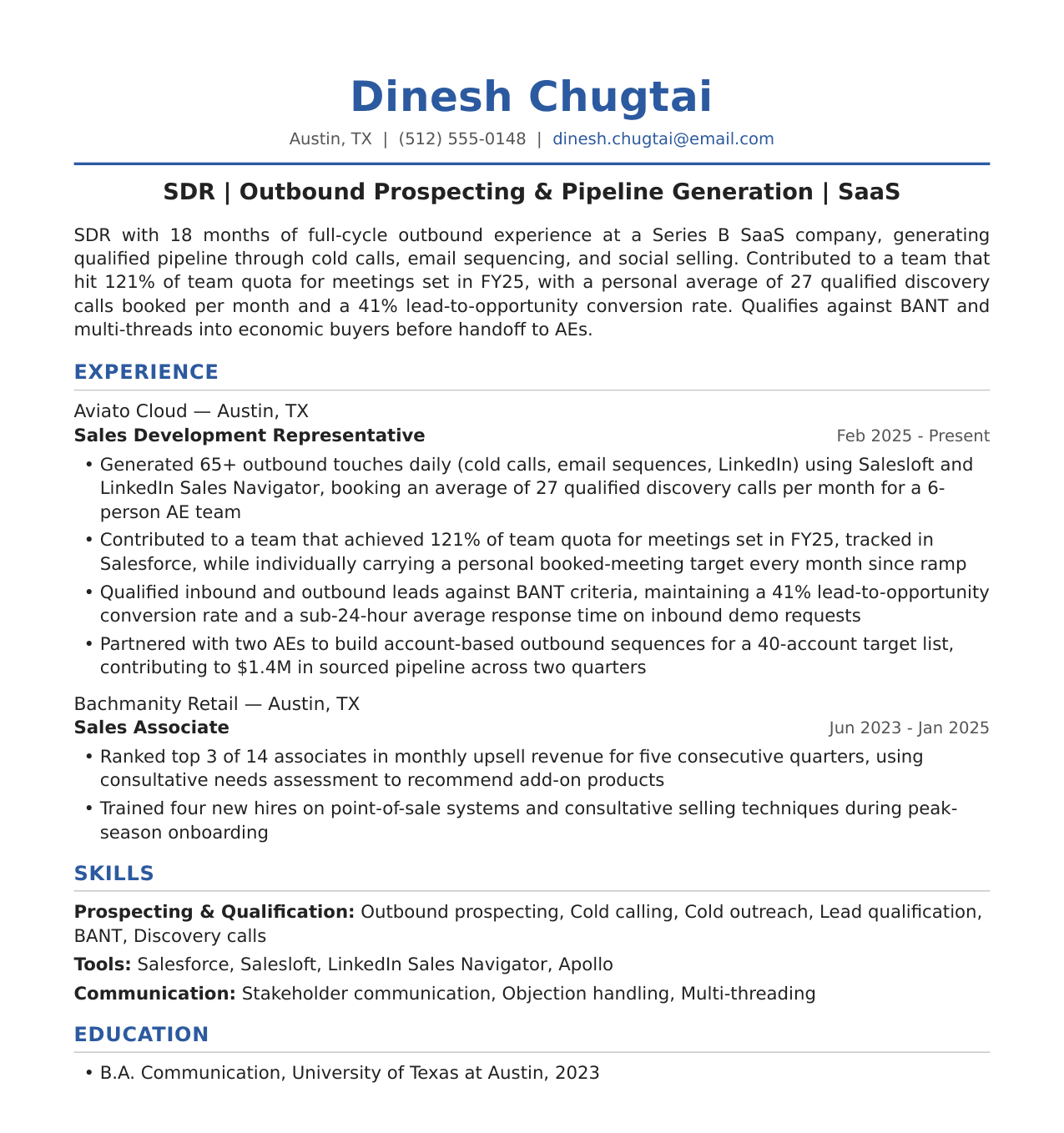
What's working here: BANT and multi-threading show up inside bullets tied to a conversion number instead of sitting alone in a skills list, the prior retail role is kept short and framed around a ranked outcome rather than padded with duties, and the team-quota bullet names the team size so a reader can't mistake it for an individual result.
Account Executive Resume
This is the two-to-four-year template for a full-cycle closer who already carries an individual number. The summary leads with the quota figure in the exact audit-proof format this guide recommends: percentage, dollar quota, fiscal year, and a W2-verifiable flag, so the strongest claim on the page is also the safest one. MEDDIC gets named because the bullets show it being used against a specific pipeline value, not dropped as a bare keyword.
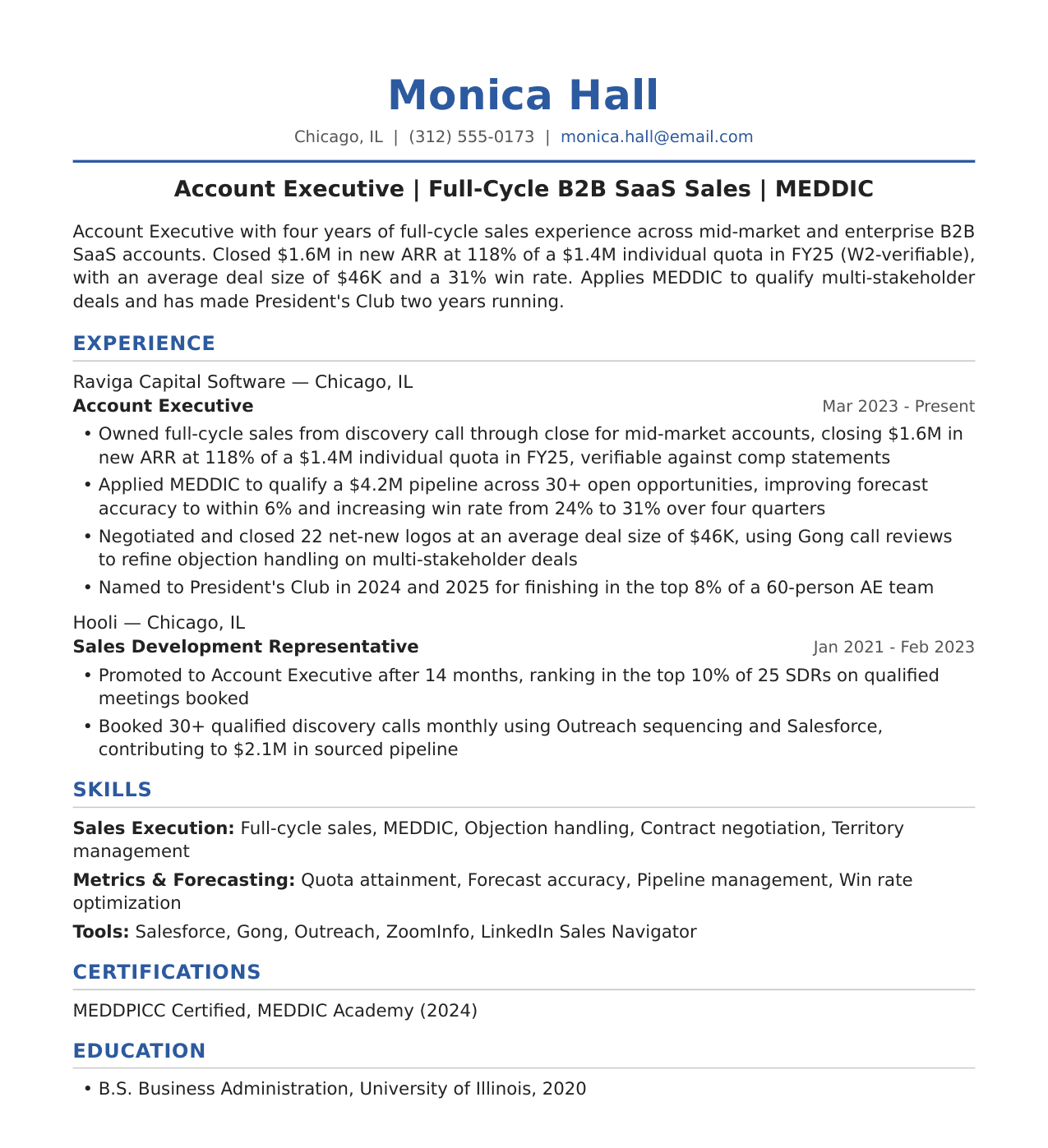
What's working here: the President's Club line names the year and the percentile instead of just the award, the average deal size and win rate sit next to each other so a recruiter sees both the size and the repeatability of the results, and the MEDDPICC certification gets its own line since it backs up a methodology claim made twice in the bullets above it.
Sales Manager Resume
This is the leadership-track template for someone managing a quota-carrying team rather than carrying an individual number personally. Every team result is explicitly labeled as a team result, the summary leads with P&L ownership and forecasting accuracy rather than a personal close rate, and the bullets add the vocabulary this guide flags as leadership-specific: hiring and ramping reps, territory design, and pipeline coaching. A short earlier-career block establishes the individual-contributor track record that earned the promotion, without letting it crowd out the management evidence.
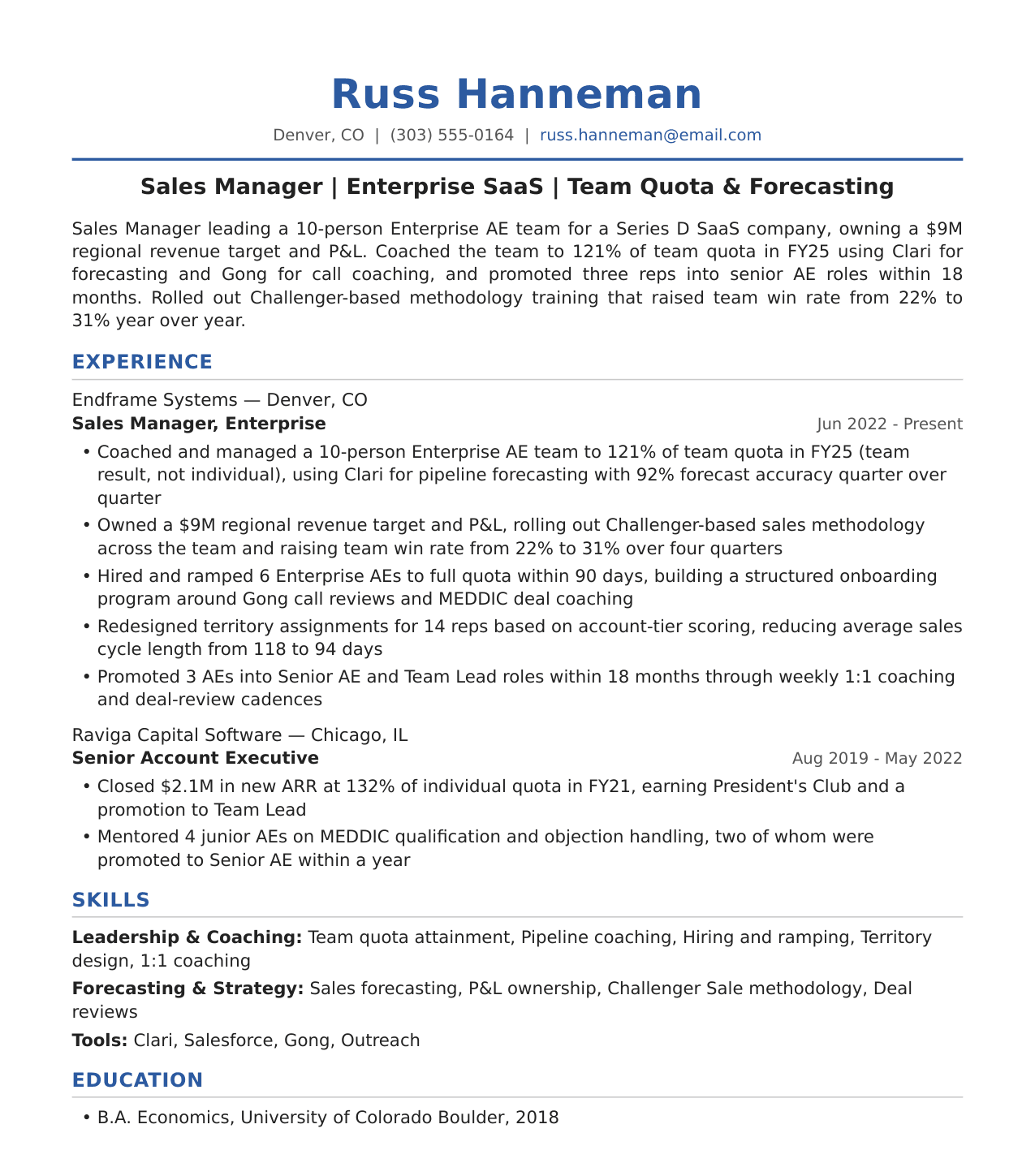
What's working here: "(team result, not individual)" appears directly in the bullet instead of being left for a reader to assume, the coaching and promotion bullet quantifies outcomes for the reps who were developed rather than just claiming "strong coach," and Challenger Sale is named next to the win-rate lift it produced, not as a bare methodology mention.
Account Manager Resume
Account Manager is a lateral track, not a rung above or below Account Executive, and the resume has to read that way. This template drops hunting language entirely in favor of the retention and growth vocabulary this guide calls out separately: renewal management, account expansion, churn reduction, and net revenue retention. The book of business size opens the summary in place of a quota figure, because for this role that number, not a close rate, is what a hiring manager checks first.
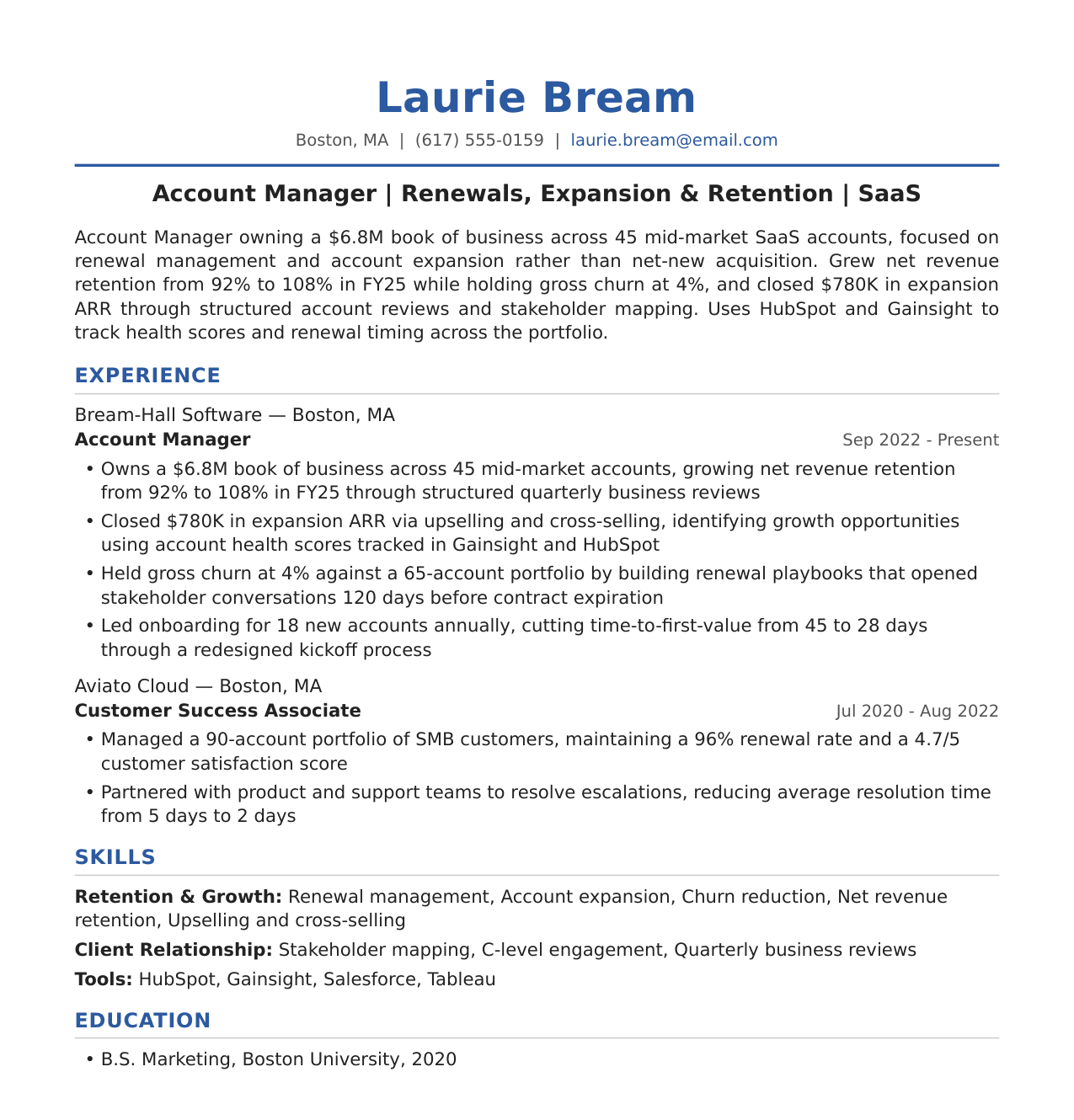
What's working here: net revenue retention and gross churn are reported as separate figures instead of one vague "retention" number, the expansion-ARR bullet is kept distinct from the renewal bullet so a reader can see new revenue and retained revenue as two different skills, and the prior customer success role is included specifically because it shows the same retention muscle one step earlier.
Across all four, the pattern holds: a keyword or methodology named specifically, a number attached to it that could survive a reference check, and team results labeled as team results. If your title sits between two of these, for example an AE who already manages a junior rep informally, borrow the closer structure and add one bullet in the leadership vocabulary rather than switching templates entirely.
Common Mistakes, and How to Check Your Resume's Keyword Match
Common mistakes
Even with the right keyword list, most sales resumes lose points on execution. Watch for these:
Keyword stuffing. Pasting every term into a skills block, or repeating "Salesforce" five times, does not help. Recruiters read the resume too, and disconnected keywords read as padding.
Generic filler with no context. "Team player," "results-driven," "hardworking." These are not keywords, just noise that neither ATS nor recruiters weight.
No CRM or tool named specifically. "Proficient in CRM software" tells a screener nothing. Say Salesforce, HubSpot, or Outreach. The job posting almost always names its stack, and matching it by name is one of the highest-value, lowest-effort fixes here.
Vague "increased sales" claims with no numbers. "Increased sales" could mean 3% or 300%. Sales resumes live on numbers: quota attainment, deal size, win rate, revenue growth. Without one, the claim is unverifiable.
Methodology name-dropping you cannot back up. Listing MEDDIC or Challenger Sale because it showed up in a keyword search, without being able to explain how you used it, is a fast way to lose credibility in the first interview question about it.
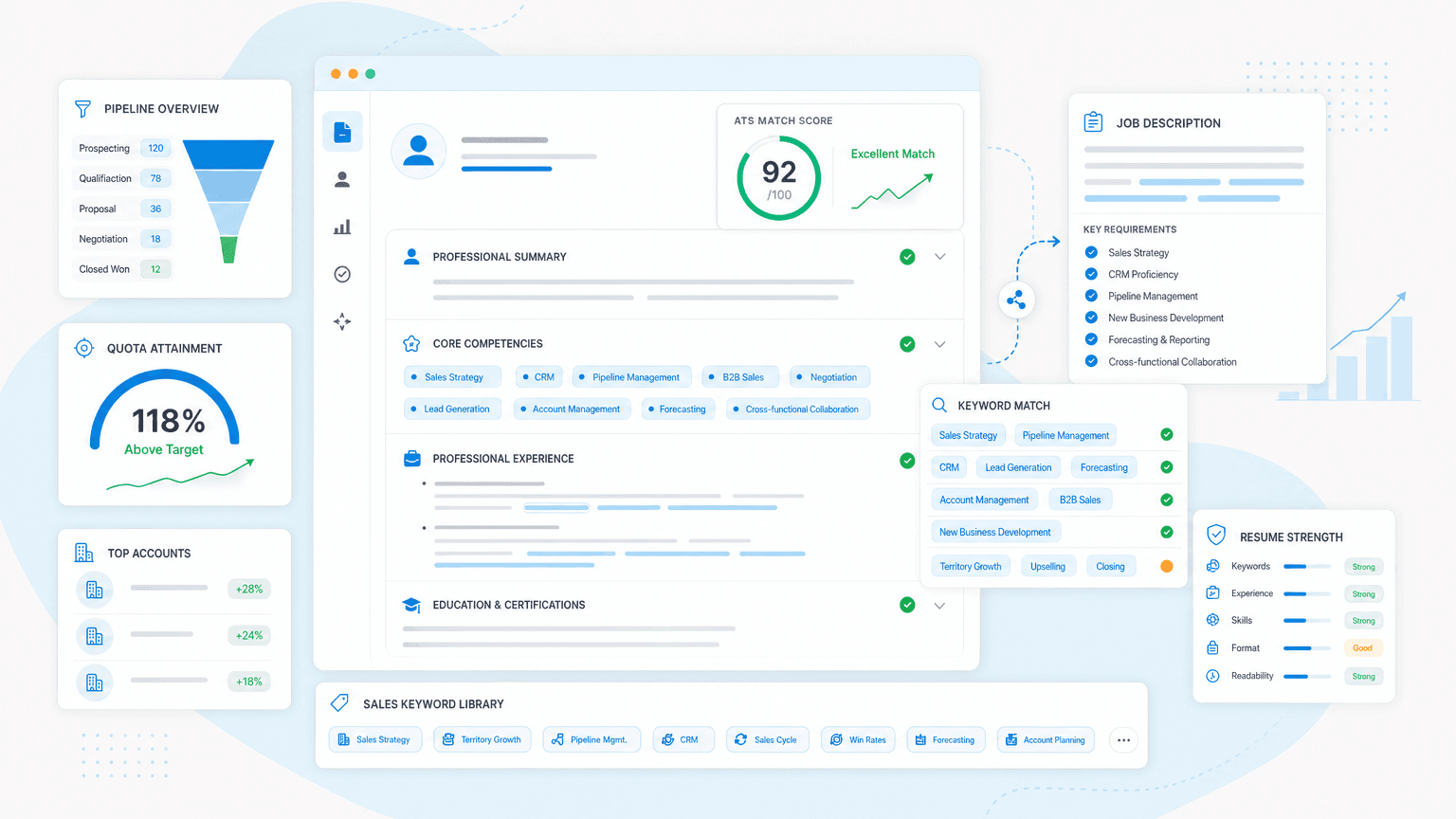
How Upplai's ATS Resume Checker surfaces missing sales keywords in seconds
Catching these mistakes on your own is hard, since it's difficult to see your resume the way an ATS or a recruiter does. Upplai's ATS Resume Checker scores a resume against a specific job description in about 10 seconds and shows missing keywords with context, not just a yes or no list, so you can see where a term like "quota attainment" or "MEDDIC" actually belongs.
It also runs a dual score: an ATS score and a separate recruiter or match score, so a resume packed with quota language still gets checked for genuine fit, not just density. Scores update in real time as you edit, no re-upload needed. The Checker shows what is missing; closing those gaps is what pays off, since tailored resumes produce 6X more interviews than generic ones.
The right sales keywords, placed with real numbers and matched to how ATS software actually parses a resume, are what separate an application that reaches a recruiter from one that stalls in a queue. Keeping your resume current matters, but so does knowing where it stands today. Run it through a quick check, see which of those keywords are missing or buried, fix what's flagged, and get back to applying with a stronger shot at clearing the ATS.
See how your sales resume scores
Get a free ATS scan and see which keywords you're missing.