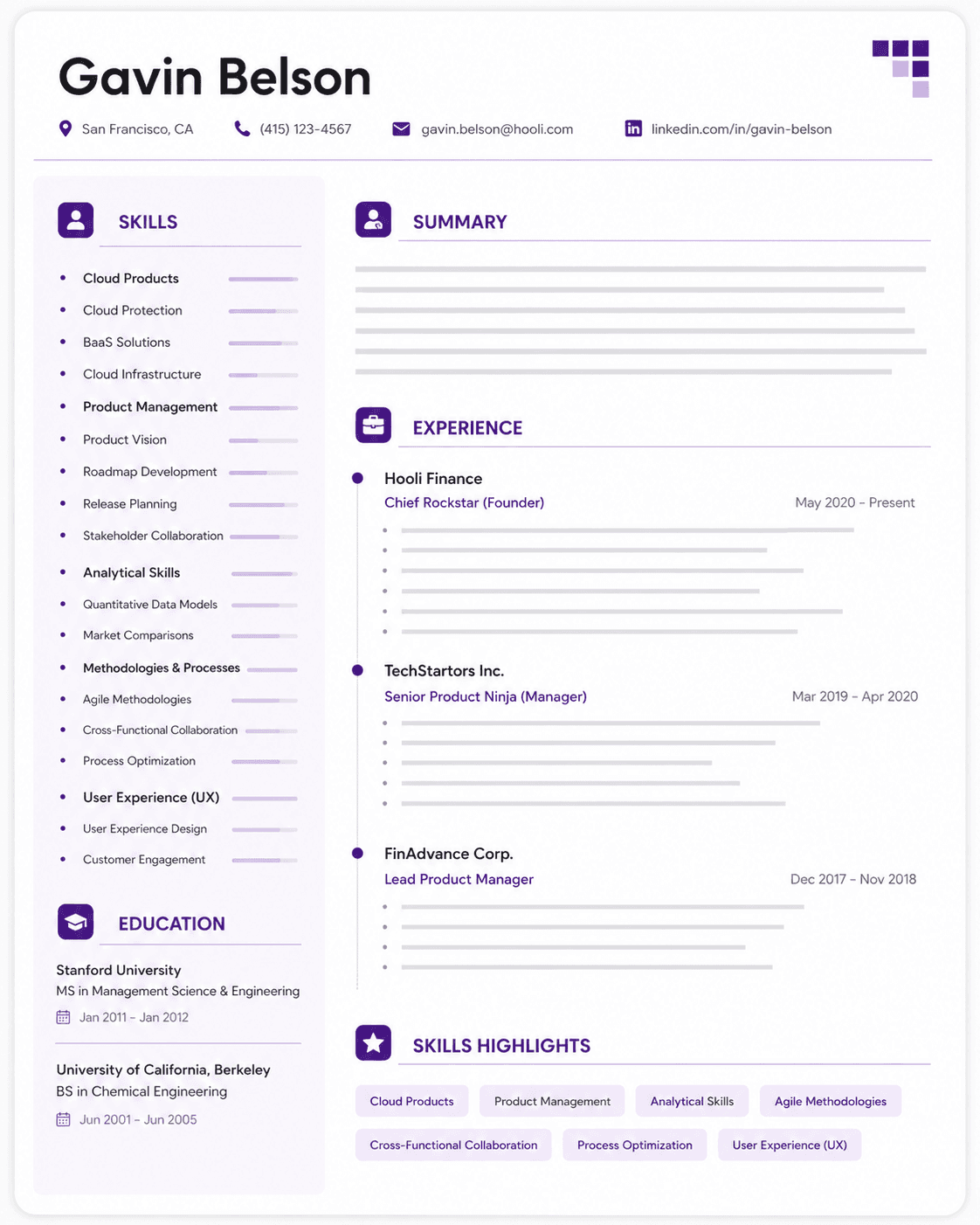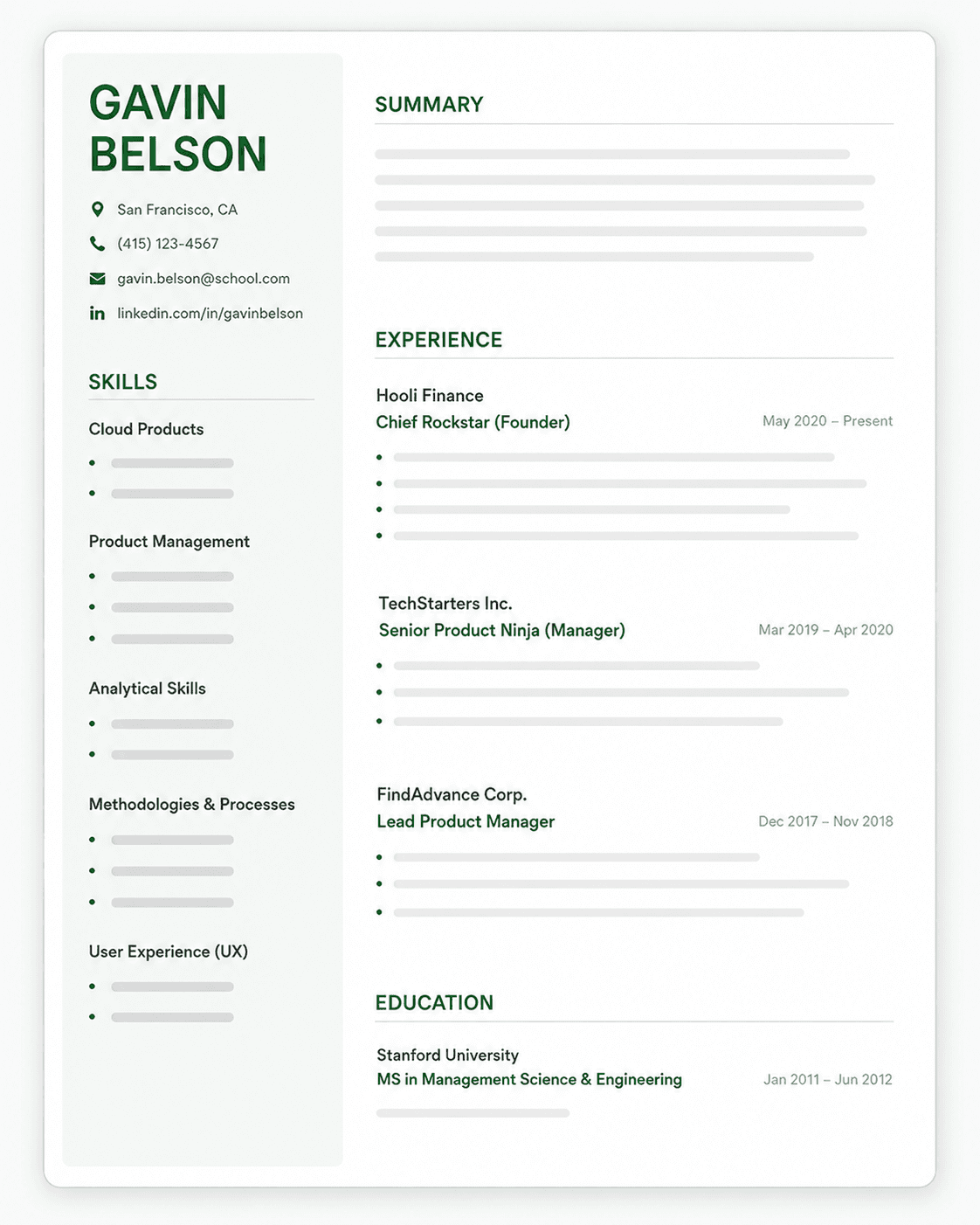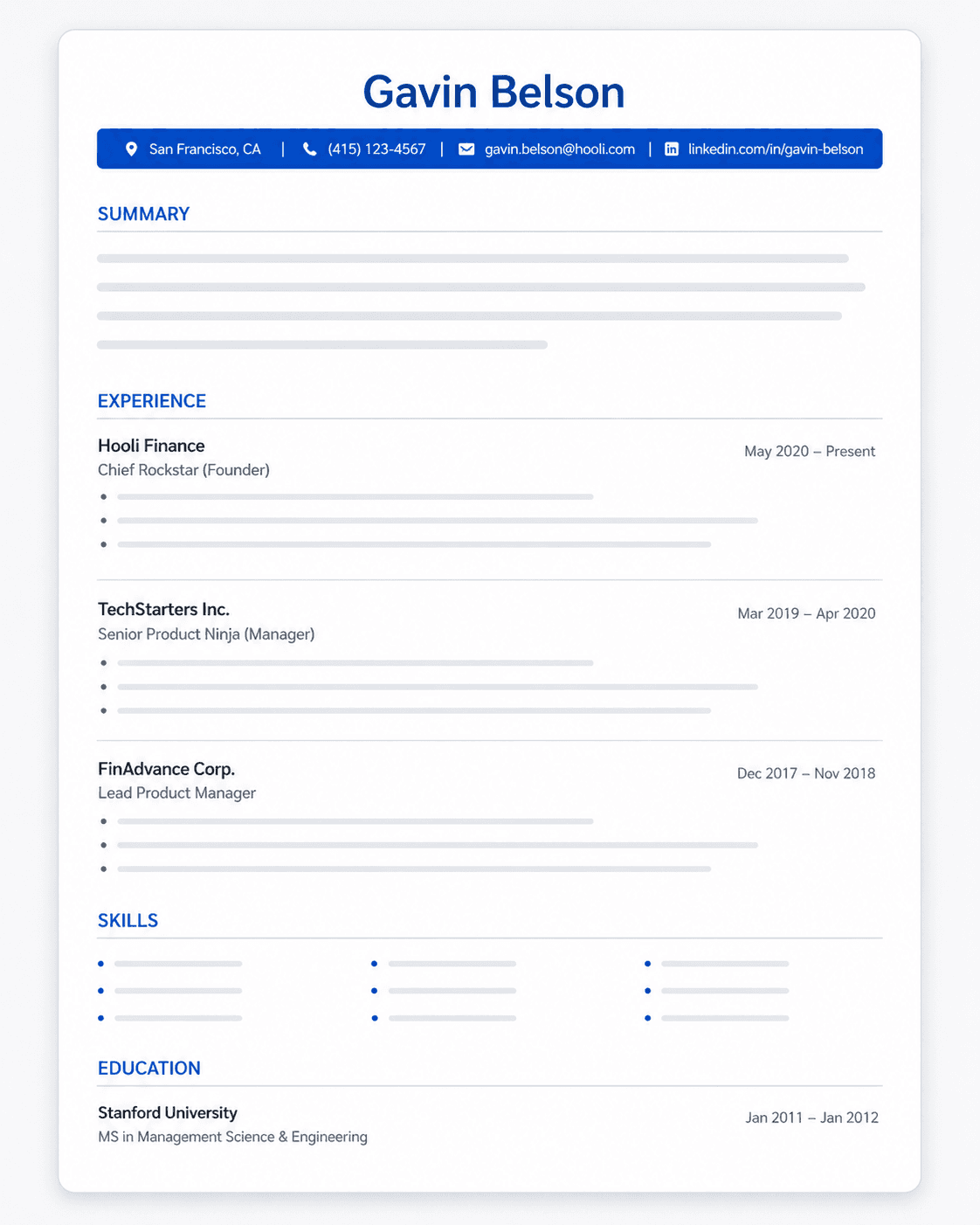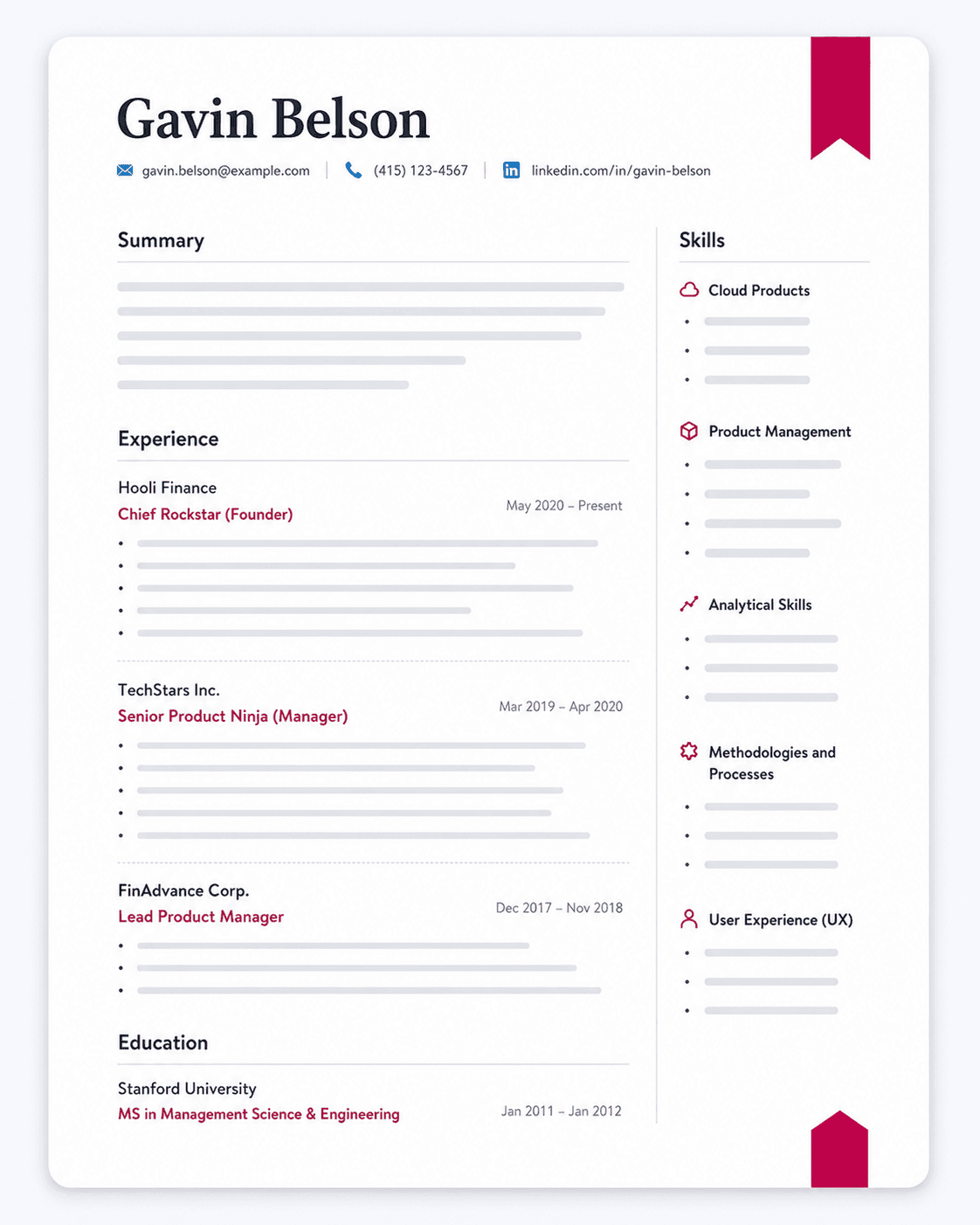
You know how to find bugs. The problem is that the posting says "Software Tester" and then lists Selenium, Jenkins, and a CI pipeline under required qualifications, and your resume has four years of careful manual work that no longer reads as current. Generic resume advice does not touch this, because it does not know what a regression cycle is.
This guide walks every section with examples you can adapt: picking the right title, a summary that names your testing domain, a skills block that keeps manual and automation work visible separately, and bullets carrying QA-specific numbers. You will also find resume examples by level, an ATS keyword table pulled from live postings, an honest answer on whether ISTQB is worth paying for, and what to do when a posting's automation bar sits above your experience.
Software Tester, QA Tester, or QA Engineer? Match Your Title to the Posting
These titles are not unrelated jobs, and they are not interchangeable either. Getting yours right is the fastest fix available before you touch a single bullet.
Software Tester and QA Tester are largely the same role in most postings: manual and functional testing, test case writing, defect logging, regression passes. Use either label for entry to mid-level work verifying that features work, rather than building the tools that verify them.
Manual Tester is narrower. It tells a hiring manager you own test execution and case design but not automation, an honest position that narrows your applicant pool on purpose in a market where postings increasingly name Selenium, Playwright, or Postman. Use it only when the posting does.
QA Engineer and SDET signal scripting ability, automation suite ownership, and CI/CD involvement. Claiming either without automation work behind it fails the first screening call, since the interviewer asks what you built.
| Title on the posting | What it signals | What to put on your resume |
|---|---|---|
| Software Tester / QA Tester | Manual, functional testing | Mirror this title in your headline |
| Manual Tester | No automation ownership | Use only if the posting uses it |
| QA Engineer / SDET | Automation, scripting, CI/CD | Use only with real automation work to show |
The practical rule: mirror the posting's exact title in your headline and summary, and keep work-history titles truthful. If your internal title was unusual, add a parenthetical clarifier, such as "Quality Analyst II (Software Tester)." Applicant tracking systems weight titles heavily, and the title is the one keyword you can always get exactly right.
How to Write a Software Tester Resume That Gets Interviews
Hiring managers check three things fast: what kind of testing you do, whether you name real tools at a real proficiency level, and whether your bullets prove impact.
Write a Summary That Names Your Testing Domain
Your summary has three jobs: name your testing domain (manual/functional, automation, API, mobile), give the scale or product context (SaaS platform, mobile app, regulated system), and include one proof point, a metric that shows you can do the work rather than describe it.
A weak summary looks like this:
"Detail-oriented software tester with strong communication skills and a passion for quality."
A stronger one looks like this:
"Software tester with 3 years testing a B2B SaaS platform, writing and executing 200+ manual test cases per release and triaging defects in Jira. Reduced escaped defects to production by 22% after introducing a structured regression checklist, with growing exposure to Selenium for smoke-test automation."
If you're entering QA without a testing title yet, use an objective instead. It should point at the testing role you want and name the transferable skill that gets you there.
Entry-level or career-changer objective example:
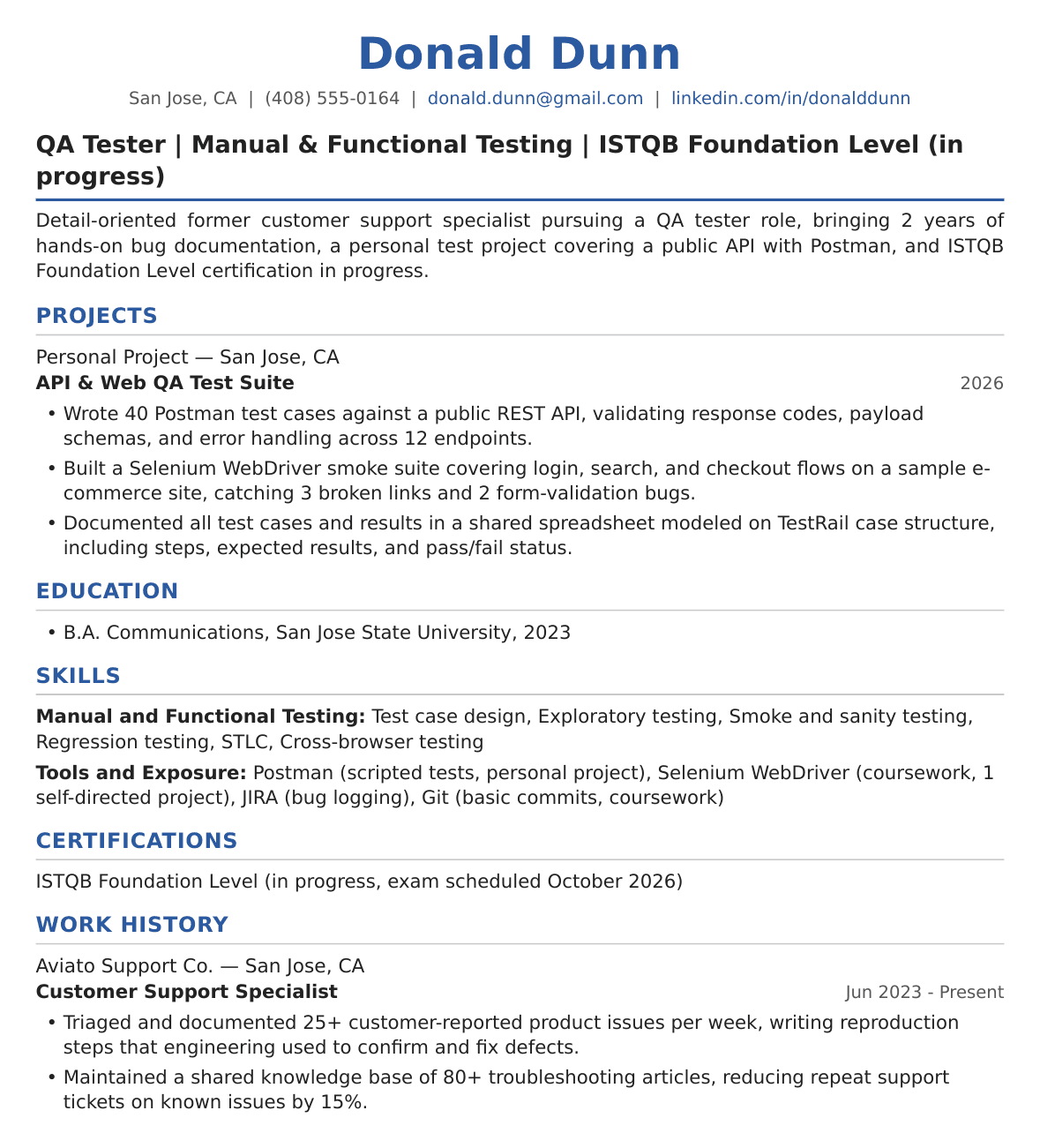
"Detail-oriented former customer support specialist pursuing a QA tester role, bringing 2 years of hands-on bug documentation, a personal test project covering a public API with Postman, and ISTQB Foundation Level certification in progress."
Build a Skills Section That Separates Manual, Automation and Tools
Group your skills so a recruiter scanning quickly can see exactly what you can do and where, instead of one undifferentiated list of testing words.
- Manual and Functional Testing: Regression testing, functional testing, exploratory testing, smoke and sanity testing, cross-browser testing, test case design, STLC
- Automation and Scripting: Selenium WebDriver, basic Java/Groovy scripting, Postman scripted tests, exposure to Playwright (coursework)
- Tools and Platforms: JIRA, TestRail, Zephyr, Bugzilla, Git, Chrome DevTools
- Process and Collaboration: Agile/Scrum, sprint ceremonies, defect triage, cross-functional collaboration with developers and product managers
Only list tools you can use unaided, not ones you watched a teammate run. Mirror the posting's exact wording ("API testing," not "backend validation").
Name Your Testing Tools at the Right Proficiency Level
"Proficient in testing tools" tells a hiring manager nothing. Name the application and the level of real use behind it, since automation-heavy postings screen for the gap between hands-on ownership and passing familiarity. Compare these ways of listing the same tools:
- Honest and specific: "Selenium WebDriver (built and maintained a 120+ test suite integrated into a nightly CI run)"
- Honest and specific: "Playwright (coursework, 2 self-directed projects, not yet used in production)"
- Vague and unhelpful: "Selenium, Playwright, Cypress, Postman (familiar)"
The first two tell a screener what you can be trusted with on day one. The third invites a question you can't answer well. If a posting lists a tool you've only studied, name it with the honest scope attached.
Write Achievement-Focused Experience Bullets
Every experience bullet should follow the same formula: [action verb] + [specific test activity or method] + [quantifiable result or scope]. The activity proves the discipline. The result proves you did it well.
A weak bullet looks like this:
"Responsible for testing software features and reporting bugs to the development team."
A stronger one looks like this:
"Designed and executed 150+ manual regression test cases per release cycle for a payments platform, identifying an average of 18 defects pre-release and cutting escaped defects to production by 30% over two quarters."
Use the sub-role bullets below as templates and swap in your own numbers.
Manual / Functional QA
- Wrote and executed 200+ manual test cases per two-week sprint across web and mobile checkout flows, maintaining 95% test case pass documentation accuracy in TestRail
- Triaged and prioritized 40+ defects per release in Jira with developers and product managers, reducing average defect resolution time from 5 days to 2
Automation / SDET
- Built and maintained a 120-test Selenium WebDriver suite integrated into Jenkins CI, cutting manual regression time from 3 days to 6 hours
- Converted 60 manual regression cases into automated Playwright scripts over one quarter, raising automated coverage of the core checkout flow from 20% to 65%
API Testing
- Authored 80+ automated Postman test collections covering REST endpoints for a customer-data service, catching 12 contract-breaking changes before release
- Validated API responses against SQL backend data across 3 microservices, reducing data-mismatch defects reaching QA sign-off by 25%
Mobile QA
- Executed manual and exploratory testing across iOS and Android builds for a consumer app with 500K+ monthly active users, logging an average of 25 defects per release cycle
- Ran cross-device regression testing on 15+ device/OS combinations using BrowserStack, reducing device-specific escaped defects by 40% over two release cycles
If you don't track clean metrics yet, dig for them: defect counts from Jira exports, regression cycle time before and after a change, escaped-defect rate from retrospectives, test coverage percentage from your automation dashboard, and suite runtime logs from your CI tool.
Software Tester Resume Examples
Reading a resume is faster than reading advice. Here is what a strong software tester resume looks like at three career stages.
Entry-Level or Career-Changer QA Tester
Lead with an objective rather than a summary, since you don't have testing metrics yet. Name the credential you're pursuing (ISTQB Foundation Level), the target domain (manual/functional QA), and one transferable strength such as support-ticket triage or business-analysis rigor. Put a Projects section above your work history: a personal or bootcamp test project with a named tool, for example "Wrote 40 Postman test cases against a public API." Follow with Education, then Skills split into manual testing terms (test case design, exploratory testing, STLC) and any tool exposure you can honestly claim. Work history goes last, reframed around triage, documentation, and process rather than the job title. One page.
Mid-Level Tester Moving From Manual to Automated Testing
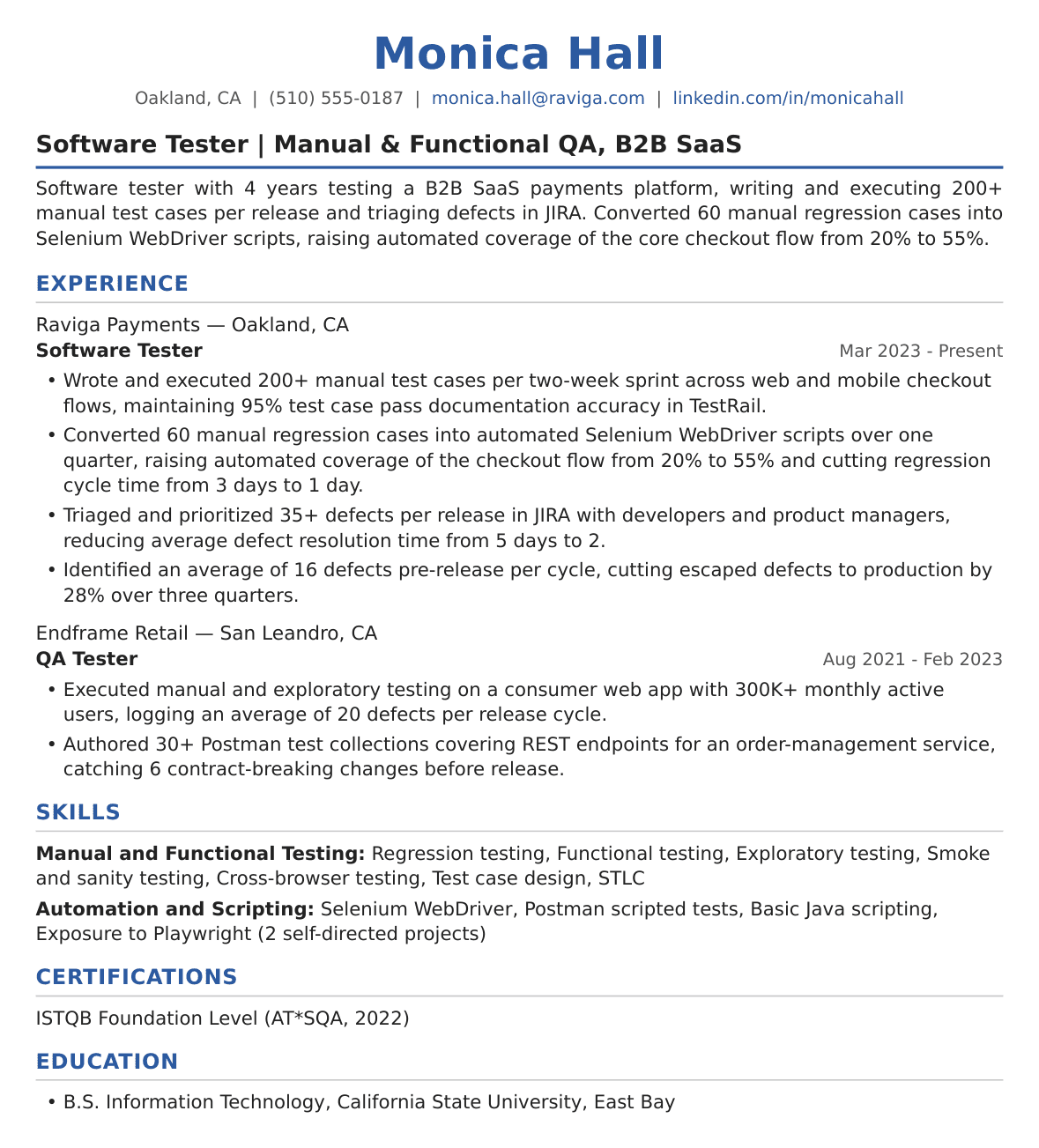
Lead with a summary naming years of manual/functional depth, the product tested (SaaS platform, payments flow, mobile app), and one piece of concrete partial automation, such as "converted 60 manual regression cases into Selenium scripts." Split skills into two labeled groups, manual and automation, so a screener sees both without assuming more automation experience than you have. Every work-history bullet should carry a QA-specific number: defects found pre-release, regression cycle time before and after a change, escaped-defect reduction, or automated coverage percentage. Certifications sit below skills. One page is standard, and a second is justified only if manual and automation experience each need room.
Senior QA Engineer or SDET
Lead with a summary that states scope: team size mentored, the automation framework you own end to end, and where you sit in the CI/CD pipeline (test stage ownership, release-gate authority). Name the framework (Selenium WebDriver, Playwright, Cypress) and the pipeline tool (Jenkins, GitHub Actions) rather than listing tools generically. Work-history bullets should read like ownership: framework migrations completed, cross-team quality metrics improved (defect escape rate, suite runtime, coverage), and test strategy decisions that changed how other engineers work. Certifications drop near the bottom. Two pages are acceptable if the scope needs them.
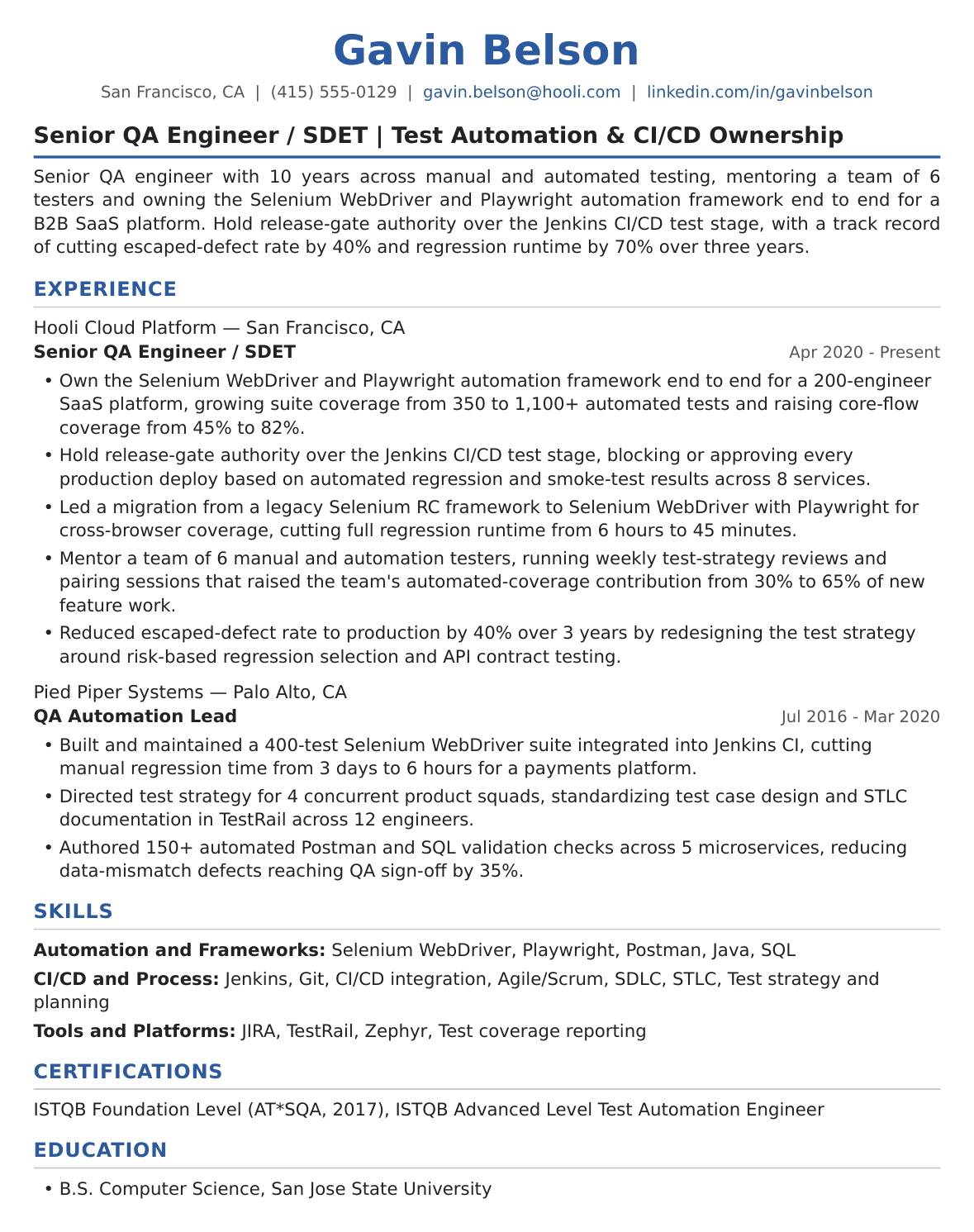
All three share the same backbone: name the testing domain, name the tools at an honest proficiency level, quantify with QA-specific numbers. If you sit between two levels, borrow the mid-level structure and keep the automation claims modest but specific rather than inflating your scope.
Software Tester Resume Keywords
Software testing carries more vocabulary per resume than almost any other role: testing types, methodologies, and a tool list that turns over every few years. Postings repeat the same terms across employers partly because much of the vocabulary is standardized rather than company-specific, codified in the ISO/IEC/IEEE 29119 software testing standard series. Treat the table below as vocabulary and let your bullets carry the numbers, and see our guide to ATS resume keywords for how parsers weight these terms.
| Category | Keywords |
|---|---|
| Testing types and methods | Manual testing, Regression testing, Functional testing, Exploratory testing, End-to-end testing, Smoke and sanity testing, Cross-browser testing, API testing (REST/SOAP) |
| Tools and platforms | JIRA, Bugzilla, Zephyr, TestRail, Selenium (WebDriver), Postman, Katalon Studio, Playwright, Jenkins, Git |
| Process and methodology | Agile/Scrum, Kanban, Sprint ceremonies, Software Development Life Cycle (SDLC), Software Testing Life Cycle (STLC), Test case design, Defect and bug tracking |
| Technical and reporting | SQL (test data validation), Test plan and test case documentation, Root-cause analysis, CI/CD integration, Test coverage, Cross-functional collaboration |
Two rules on spelling. Use the exact form the posting uses (JIRA or Jira, Selenium WebDriver or Selenium), since parsers match strings rather than concepts. And never list a term you could not discuss for two minutes in an interview, because every keyword on the page is a question a hiring manager is allowed to ask.
Is ISTQB Certification Worth $229 on Your Resume?
Almost every software tester hits the same question: does the ISTQB Foundation Level certificate change anything, or is it a line item you pay for and nobody reads? Resume advice sites answer by listing the acronym next to CSTE and CSQA without saying what any of them cost or signal.
The Foundation Level exam (CTFL) costs $229 through AT*SQA, the official United States exam provider. The American Software Testing Qualifications Board states that Foundation Level is required before any other ISTQB certification, so it is the entry point rather than one option among several. ASTQB's survey data reports that 92% of ISTQB-certified testers said certification helped demonstrate their professional competency and 98% of managers said it helps career development. Read those numbers as what they are, a certifying body surveying its own members.
The part that matters for your resume: in the postings sampled for this guide, ISTQB appeared as a stated plus and never as a hard requirement. ASTQB maintains a page of United States employers that name ISTQB in job postings, and the list skews enterprise and regulated, including Amazon, IBM, Lockheed Martin, Verizon Wireless, Discover Financial Services, GE Healthcare, General Motors, Walmart, and Northrop Grumman.
So the rule splits by target. For enterprise, defense, healthcare, or financial-services QA teams, the certificate is a searchable keyword those employers screen on. For product startups and mid-size SaaS companies, spend the money and study hours on a demonstrable automation project instead, since those teams ask what you built. If you hold it, list it in your certifications section with the issuing body and year. If you are studying for it, write "ISTQB Foundation Level (in progress, exam scheduled [month])" rather than leaving it off.
The Manual-to-Automation Gap: What to Do When Postings Outrun Your Experience
You have four years of manual and functional testing, a strong defect record, and a posting titled "Software Tester" that lists Selenium, Jenkins, and a CI pipeline under required qualifications. The title matches. The requirements do not. This is the most common reason a competent tester's resume stops getting responses, and it reflects a market shift rather than your work.
Look at how automation-tier postings phrase the bar. One remote QA automation role reviewed for this guide required five or more years in software quality assurance with a strong emphasis on automation testing, plus hands-on Selenium WebDriver and Katalon Studio with Groovy. Another required three or more years of test automation nested inside five or more years of software testing, meaning roughly 60% of total tenure has to be automation-specific. Those are structural bars, and no wording clears them.
What the wording can do is stop you from being filtered out of the roles you do qualify for. The Bureau of Labor Statistics projects the combined category of software developers, quality assurance analysts, and testers to grow 15% from 2024 to 2034, so the roles exist. Reaching them takes two moves.
First, lead with the manual depth as leverage instead of apologizing for it. "Five years of test strategy and defect analysis, now building on that foundation with Playwright automation and API testing" reads as a trajectory. "Manual tester seeking automation opportunity" reads as a gap. Test design and defect triage judgment are the parts automation cannot replace, and any hiring manager who has watched a clean automated suite pass while a bug shipped knows it.
Second, make the automation claim concrete and small. One finished project with a real number beats a tool list. "Converted 60 manual regression cases into Selenium scripts, cutting the regression pass from 3 days to 6 hours" survives an interview. "Familiar with Selenium" invites a question you will lose.
Common Software Tester Resume Mistakes to Avoid
Describing Test Activity Instead of Impact
"Executed test cases and reported defects to developers" describes the job description, not your performance in it. Every tester applying to the same posting did that. Rewrite each duty as an outcome with a number: cases written per sprint, defects caught pre-release, regression cycle time cut, escaped defects reduced.
Sending the Same Resume to Every Title Variant
A manual QA posting at a healthcare vendor and an SDET posting at a payments startup want different things from the same work history. Sending one file to both guarantees at least one reads as a mismatch. Adjust the headline title, the summary's first clause, and the top three bullets each time.
Listing Tools Without a Proficiency Level
A skills line reading "Selenium, Cypress, Playwright, Postman, JMeter, Appium" invites the interviewer to pick the one you know least. Attach scope to each tool that matters, and separate production use from coursework. Fewer tools with honest levels behind them beat a long list that collapses under one question.
Claiming Automation You Cannot Demonstrate
Automation-adjacent screening calls are usually a conversation about code you say you wrote. Naming a framework you have only watched a teammate run ends a promising interview at minute six. Claim what you built, name what you are learning, and keep the two visually separate.
Copying Contractor-Length Advice Into a Product-Company Application
Resume length is contested inside this trade in a way it is not in most fields. Testers on concurrent client engagements keep long, project-by-project CVs, and working testers defend that format publicly. Hiring managers screening for one in-house product team say the opposite, that long resumes never reach the interview stage. Match the format to the employer: one to two pages for a product company, a longer engagement record only where a client-services employer expects it.
Ignoring ATS Formatting
Multi-column layouts, skills embedded in graphics, and tool names living only inside a header get scrambled or dropped by resume parsers. Since this role's keyword set is almost entirely tool names and testing terms, a parsing failure removes exactly the words the system scans for. Use a single-column layout, keep tool names in body text, and save as a .docx or text-based PDF. Our guide to ATS-friendly formatting has the details.
How AI Resume Builders Can Simplify Your Software Tester Resume
Every QA posting weights the same vocabulary differently: one lists Selenium and Jenkins first, another leads with test case design and JIRA, a third cares mostly about SQL. Tailoring by hand costs 40 to 60 minutes per application, and the generic version you send instead gets filtered before a recruiter sees it.
An AI resume builder designed for that kind of tailoring helps in five ways:
- Real-time ATS scoring: your ATS and recruiter match scores update as you edit, so moving Playwright above Selenium or adding a coverage metric shows its effect immediately, with no download and re-upload cycle.
- Transparent suggestions: every edit arrives with a plain-language explanation, and you accept or reject each one individually. Nothing gets rewritten or invented behind your back, which matters when your resume names tools you will be questioned on.
- Automatic formatting: your resume is restructured into an ATS-friendly layout, so the columns or text boxes that scramble a tool list during parsing do not cost you the callback.
- Structure guidance: suggestions reorder content for relevance, strengthen action verbs, quantify defect and coverage numbers, and flag language that could trigger bias.
- Preference memory: your formatting and reordering choices carry across sessions, so the fifth application does not start from a blank page.
Pricing matches a job search that has an end date. The free plan includes 200 ATS scans every month plus a one-time allotment of 3 tailored resumes with matching cover letters and unlimited downloads, no credit card required. Extra resumes run $0.50 to $1.00 each, no subscription.
Try it on your own resume
Run a free ATS check in under three minutes and see what is holding your resume back.
A software tester resume earns an interview when it reads like a test report: what you tested, at what scale, with which tools, and what the defect numbers did as a result. Pick the title, tool phrasing, and sub-role bullets from this guide that match the posting in front of you, and leave the rest out.