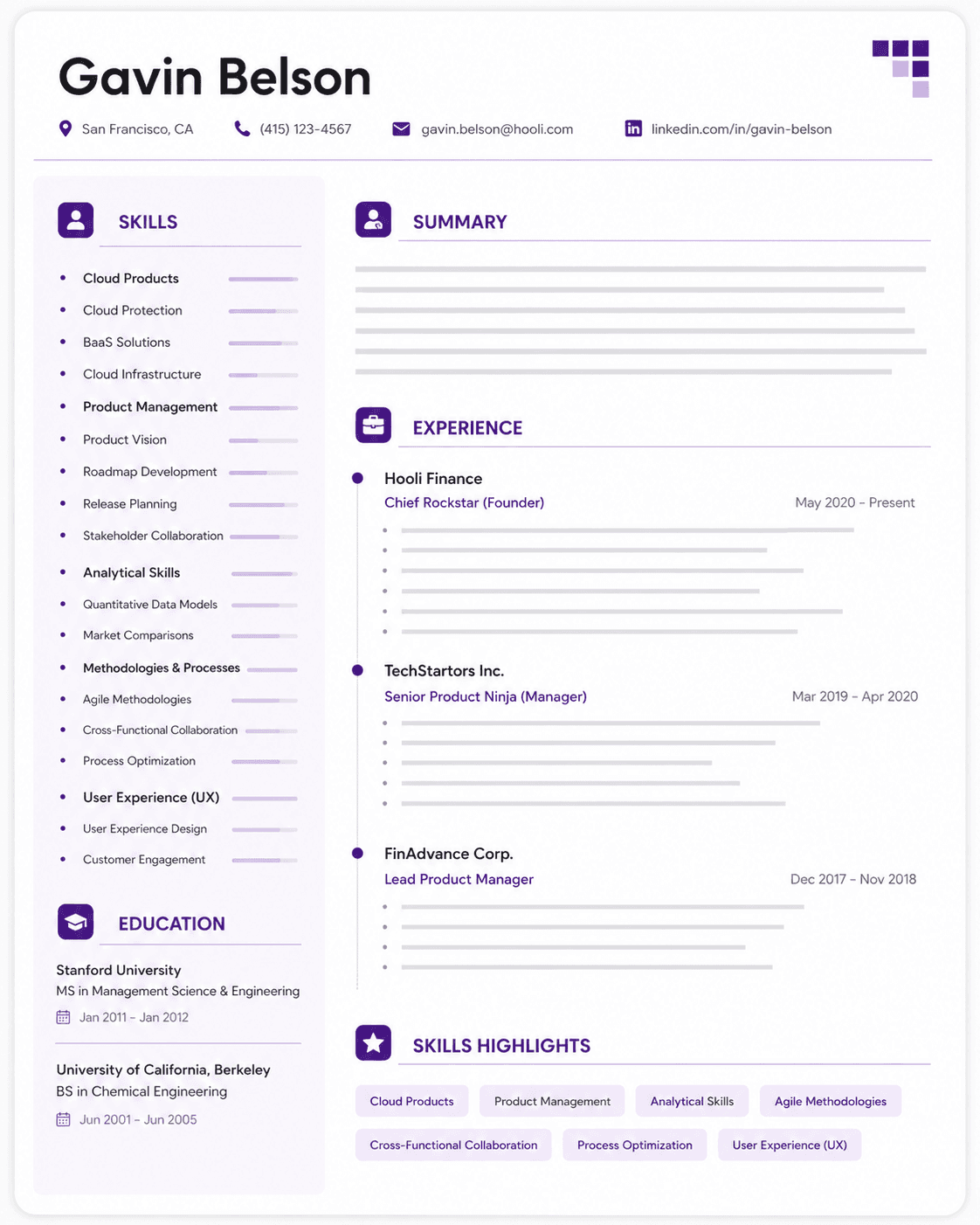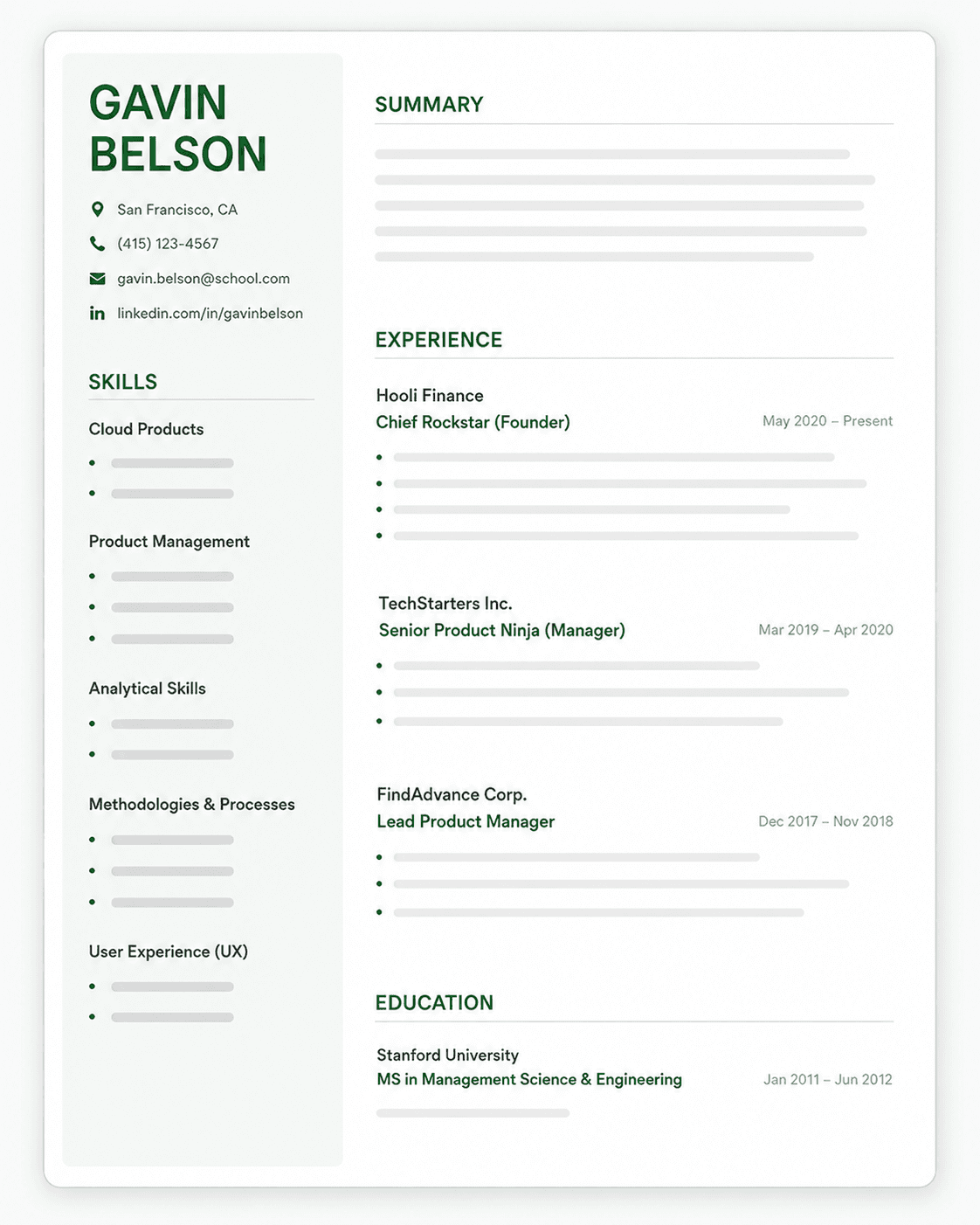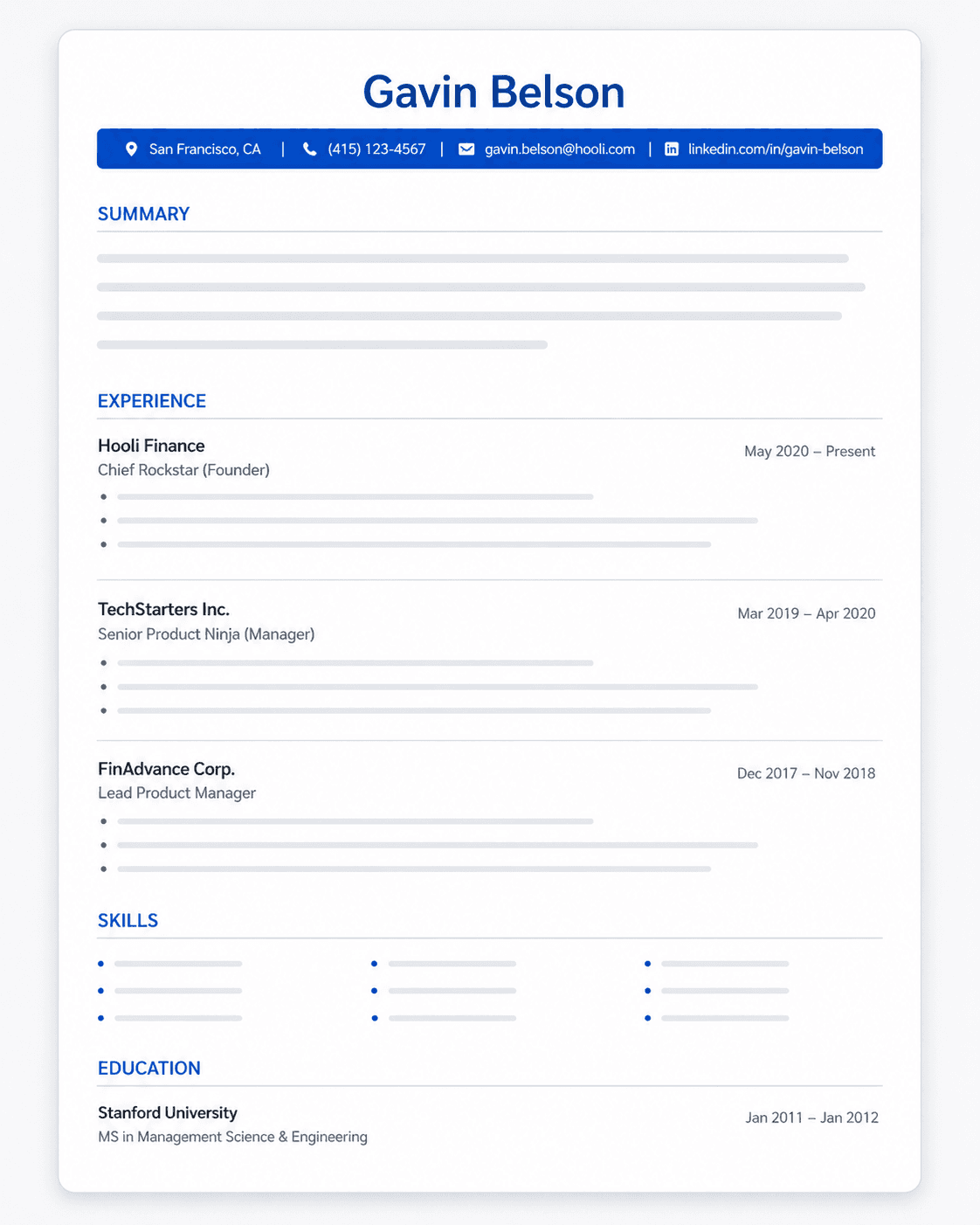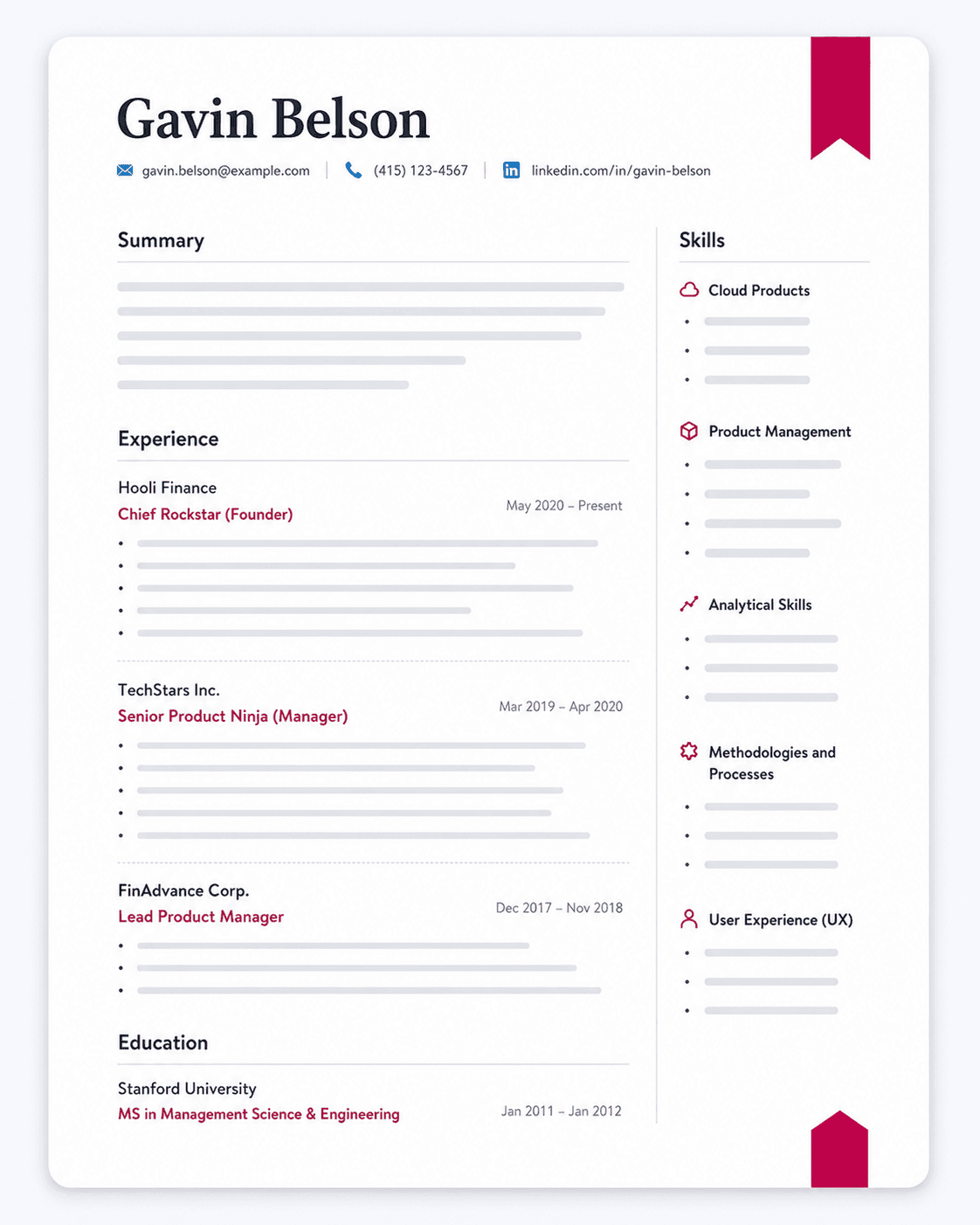
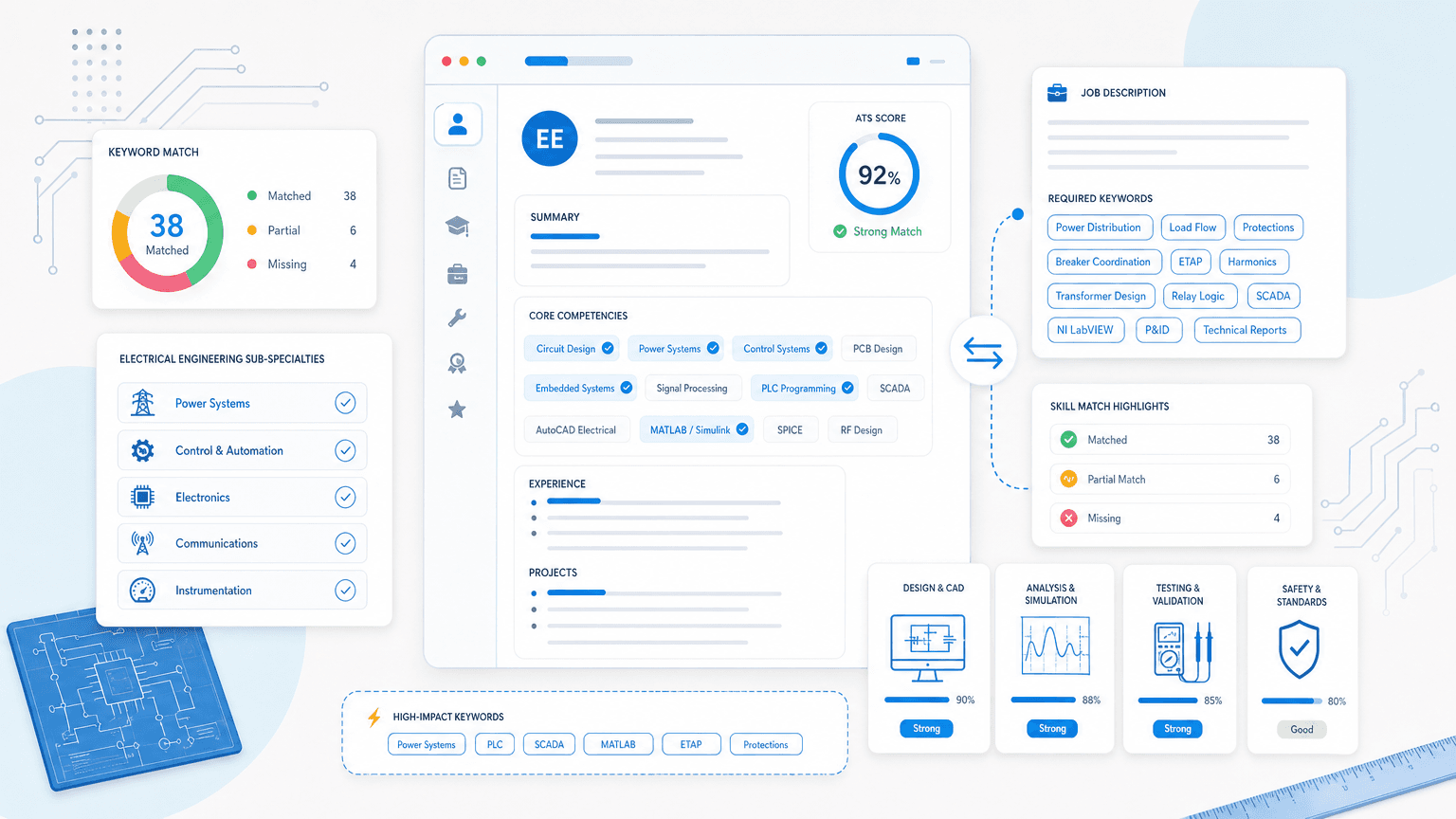
You've applied to a stack of electrical engineering roles with a resume that lists "circuit design" and "PLC experience," and the callbacks aren't coming. The problem is usually keywords: the ATS scanning your resume is looking for the exact tool, standard, or certification name tied to the job, and generic phrasing doesn't register as a match.
This guide gives you the electrical engineering resume keywords recruiters and ATS software actually look for, organized by sub-specialty, certification, software, and soft skill, plus which terms are non-negotiable and which ones differentiate you.
Along the way, you'll get real example bullets for new-grad, mid-level, and PE-licensed resumes, plus the formatting mistakes that quietly strip keywords out before anyone reads them.
Electrical Engineering Resume Keywords: The Complete List
Recruiters and ATS software scan electrical engineering resumes for seven keyword categories: core fundamentals, sub-specialty technical terms, certifications and licenses, software and tools, standards and codes, soft skills, and action verbs. Use this table to check your resume at a glance, then jump to the sections below for detail on each.
| Category | Keywords to include |
|---|---|
| Core fundamentals | Circuit design, signal processing, power distribution, load flow analysis, schematic capture, wiring diagrams, root-cause analysis, troubleshooting |
| Sub-specialty terms | ETAP, SKM Power Tools (Power Systems); Allen-Bradley ControlLogix, Siemens TIA Portal, SCADA, PID control (Controls & Automation); Altium Designer, Cadence OrCAD, PCB layout (Electronics/PCB); ARM Cortex-M, VHDL, FPGA, RTOS (Embedded/Firmware) |
| Certifications/licenses | PE License, EIT/FE, NABCEP, Six Sigma Green/Black Belt, PMP |
| Software/tools | MATLAB/Simulink, AutoCAD Electrical, SolidWorks Electrical, LabVIEW, Python, LTspice |
| Standards/codes | IEEE 1584, NFPA 70E, NEC/NFPA 70, IEC 61850, IPC-2221, NERC CIP |
| Soft skills | Cross-functional collaboration, technical presentation, vendor management, safety compliance mindset, project ownership |
| Action verbs | Designed, Commissioned, Debugged, Optimized, Validated, Integrated |
Not every keyword belongs on every resume. A Power Systems candidate listing ETAP, arc flash calculation, and IEEE 1584 will look qualified for a utility role and irrelevant for a PCB design role, and the reverse is just as true for someone leading with Altium Designer and signal integrity. A controls engineer and an embedded firmware engineer share fundamentals but almost none of their tool names. The sections ahead break down which keywords match your actual sub-specialty, experience level, and target employer, plus exactly how to place them so both the ATS and the recruiter behind it take notice.
Why Keywords Make or Break an Electrical Engineering Resume
How ATS and recruiters screen technical resumes
Every mid-size or large employer almost certainly runs your resume through an ATS first. 99% of Fortune 500 companies and 75% of large employers use ATS to screen resumes, and up to 80% of resumes are eliminated automatically before a human ever sees them. If your bullet says "used PLCs for automation" instead of naming the platform you actually programmed, the system may never register a match.
Clear that filter, and a recruiter still spends only 3-7 seconds scanning what's left, looking for the exact tools, standards, and project scope tied to the role.
The ATS synonym trap
ATS software matches text, not meaning. It compares the words on your resume against the words in the job posting and counts overlaps. It has no concept that "PLC programming" and "Allen-Bradley ControlLogix" describe related work.
That gap punishes generic phrasing. A posting asking for "Allen-Bradley ControlLogix" will skip a resume that only says "PLC programming," even though a hiring manager would read them as connected.
The fix is specificity. If you programmed on a Siemens S7 platform, write "Siemens S7," not "PLC experience." Name the exact tool you used, every time it's true.
Electrical Engineering Keywords by Sub-Specialty
Below are some must-have ATS keywords that electrical engineers must include in their resume:
Power Systems
Power systems work centers on keeping electricity flowing safely from generation to end use: load flow analysis, short circuit analysis, arc flash calculation, and protective relay coordination across substations, switchgear, and transformers. Name the tools that do this work, ETAP, PSS/E, SKM Power Tools, PSCAD, along with the relay brands (SEL, GE Multilin) engineers actually configure. Pair those with standards like IEEE 1584, NESC, NERC CIP, and NFPA 70E, plus growing BESS and solar/wind integration experience.
Controls & Automation
Controls and automation engineers program the logic that runs manufacturing lines and process equipment, mainly through Allen-Bradley ControlLogix and CompactLogix, Siemens TIA Portal and S7, and Rockwell Studio 5000. Resumes should name the languages (Ladder Logic, Structured Text, IEC 61131-3), the interfaces (SCADA, HMI), and the hardware they tune (PID control loops, VFDs, servo drives). Communication protocols like Modbus, EtherNet/IP, and PROFINET round out what recruiters search for in this track.
Electronics & PCB / Hardware Design
Hardware design engineers take circuits from schematic to manufactured board, using Altium Designer, Cadence OrCAD/Allegro, KiCad, Eagle, and LTspice or PSpice for simulation. Keywords should reflect the actual deliverables: PCB layout, signal integrity, and DFM/DFT (design for manufacturing/testability) reviews. Compliance keywords matter here too: IPC-2221 and IPC-A-610 for board standards, FCC Part 15 for emissions, and RoHS for materials.
Embedded Systems & Firmware
Embedded and firmware engineers write the code that runs directly on hardware, most often in C/C++, VHDL, or Verilog targeting ARM Cortex-M/STM32 microcontrollers or FPGAs (Xilinx, Altera). List the real-time environment (RTOS) and communication protocols engineers debug daily: I2C, SPI, UART, and CAN bus. MATLAB/Simulink for modeling and MISRA C for safety-critical code compliance signal depth an ATS and a recruiter both recognize immediately.
Renewable Energy & Electrical Design/Construction
This track blends electrical design with construction documentation: single-line diagrams, load calculations, panel schedules, and grounding and bonding work governed by NEC/NFPA 70. Solar-specific resumes should include solar PV integration, inverters, and the NABCEP certification that signals real renewables credibility. Tools worth naming explicitly include Revit MEP and Eplan Electric P8, both far stronger ATS matches than a generic "CAD software" line.
Certifications and Licenses: PE, EIT, and What Actually Gates a Role
The PE license
The Professional Engineer (PE) license is state-issued, and each state licenses separately, so note the specific state on your resume. Some roles treat it as a hard gate: any position requiring a stamped and sealed design (public infrastructure, utility work, many senior engineering roles) legally requires a PE. For entry-level and mid-level roles, it's more often a plus than a requirement. List it under a dedicated "Licenses & Certifications" heading, not folded into skills: "PE License (Electrical), State of Texas."
EIT/FE exam
The Fundamentals of Engineering (FE) exam, and the Engineer in Training (EIT) status it grants, is the required first step toward a PE. Most new grads take the FE before or shortly after graduation. If you've passed it, list "EIT" or "FE Certified" plainly. If you're studying for it, say so honestly: "FE Exam (In Progress, scheduled [month/year])." Never imply EIT status you haven't earned.
Voluntary certifications that differentiate
Once licensing is accounted for, voluntary certifications separate you from other candidates with similar experience. NABCEP matters for solar and renewables roles, Six Sigma Green or Black Belt signals process rigor valuable in manufacturing-adjacent roles, and PMP helps candidates moving toward project leadership. List these separately from your Licenses section under "Certifications," and use "Candidate" or "In Progress" for anything not yet completed, the same honesty standard as your PE and EIT status.
Naming standards as evidence of depth
A junior engineer's resume often cites broad codes like "NEC" or "NFPA 70" without elaboration. A senior engineer names the specific standard and clause that governed their actual work, such as IEEE 1584 for arc flash calculations, NERC CIP for grid cybersecurity compliance, or IEC 61850 for substation communication protocols. That specificity does double duty: it matches ATS searches built around real job requirements, and it tells a reviewer you've worked inside the standard, not just around it.
Software, Tools, and Standards Recruiters Actually Search For
Some tools show up on almost every EE resume regardless of specialty. Recruiters and ATS filters still expect the exact product name, not a category label.
| Tool | Common use case |
|---|---|
| MATLAB/Simulink | Modeling, simulation, control system design |
| Python | Data analysis, test automation, scripting |
| AutoCAD | General 2D drafting |
| AutoCAD Electrical | Schematic and panel layout, wire numbering |
| SolidWorks Electrical | Electrical design integrated with mechanical CAD |
| LabVIEW | Test bench automation, data acquisition |
| Microsoft Project / Visio | Schedule tracking, process and system diagrams |
AutoCAD and AutoCAD Electrical are not interchangeable to an ATS. Listing "AutoCAD" when a posting asks for "AutoCAD Electrical" means the parser sees a miss, even though a human would call them close enough.
Placement matters as much as the keyword itself. In the skills section, a tool is just a line item: "MATLAB, Simulink, Python." In an experience bullet, the same tool needs context and a result: "Built a Simulink model to validate motor controller response time, cutting bench test cycles by 20%." Recruiters skim the skills list to confirm competence, then read bullets to confirm the tool was actually used on real work.
Soft Skills That Belong on an Electrical Engineering Resume
Soft skills only prove anything when they're attached to a real situation. "Strong communicator" tells a recruiter nothing. "Presented arc flash study results to plant operations staff and revised the report format based on their feedback" shows the same skill in action.
The EE soft skills worth showing this way:
- Cross-functional collaboration: coordinating an interface spec with a firmware team, or resolving a connector conflict with mechanical during layout review.
- Technical communication: translating test data or a failure report for a non-technical stakeholder, customer, or project manager.
- Vendor/supplier management: qualifying a component vendor, resolving a lead-time issue, or reviewing a supplier's test data.
- Project ownership: tracking a task against budget, schedule, or scope on a specific project.
- Root-cause troubleshooting: isolating an intermittent fault or diagnosing a test failure back to its source.
- Safety compliance mindset: following NFPA 70E procedures during energized testing, or flagging a hazard before it became an incident.
Weak: "Team player with excellent communication skills." Strong: "Coordinated with firmware team to finalize UART interface spec, reducing integration rework by two design cycles."
How to Place Keywords (and Formatting Pitfalls That Break ATS Parsing)
ATS parsers weight sections differently, so keyword placement matters as much as keyword choice.
Where each keyword type belongs
The summary should carry the target title plus 2-3 top keywords: "Controls Engineer | Allen-Bradley ControlLogix, SCADA, IEC 61131-3." This is the first block both parser and recruiter read.
The skills section groups keywords by category (Software, Standards, Protocols) for fast scanning. Certifications get their own heading, separate from Education, so a parser searching exact section labels can find PE, EIT, or NABCEP.
Experience bullets should embed keywords with a result, not list them bare. As an example: "Programmed Allen-Bradley ControlLogix PLCs, reducing changeover time by 20%" beats a plain skills-list bullet with no outcome attached.
Formatting mistakes specific to technical resumes
Tables for spec or parameter data often parse as garbled text or drop entirely; convert them to plain bullet lines. Schematics and diagrams embedded as images are invisible to parsers, since ATS reads text, not pixels.
Multi-column layouts can scramble reading order, merging unrelated lines together. Contact info in a header or footer sometimes gets skipped, so keep name, phone, and email in the main body. Outdated software versions, like listing Allegro 16.6 instead of a current release, can also read as stale experience.
Example Resume Bullets by Experience Level
Entry-level / new-grad
Weak: Worked on a senior design project involving power systems and helped with an internship in electrical engineering.
Strong: Designed and simulated a 3-bus distribution network in ETAP for senior capstone project, performed short circuit and arc flash analysis per IEEE 1584, and reduced predicted incident energy by 18% through protective relay coordination changes.
No job title yet does not mean no numbers. Quantify project scope the same way you would a job.
Mid-level (2-7 years)
Weak: Responsible for PCB design and worked with cross-functional teams on hardware projects.
Strong: Owned PCB layout and signal integrity analysis in Altium Designer for a 4-layer sensor board, resolved EMI failures found in FCC Part 15 pre-compliance testing, and cut board respin cycles from three to one across two product releases.
Weak: Worked on control systems and helped improve plant automation processes.
Strong: Redesigned PID control loops and HMI screens on a Rockwell Studio 5000 platform for a bottling line, reducing downtime events by 22% and cutting changeover time by 15 minutes per shift.
Senior / PE-licensed
Weak: Led a team of engineers and managed electrical projects for utility clients.
Strong: Led a 5-engineer team delivering substation protection upgrades for a regional utility, managed a $2.4M project budget, and served as PE of record certifying protective relay coordination studies to NERC PRC and IEEE 1584 standards. The three examples below turn these same building blocks into complete resumes at each career stage and sub-specialty of the EE ladder.
Electrical Engineering Resume Examples by Experience Level
Each example below is a complete, one-page resume for a specific electrical engineering sub-specialty and career stage, not a generic all-purpose template. Match the sub-specialty closest to your target role first, then the level closest to your experience, since a Power Systems PE resume and an entry-level embedded resume share almost none of the same keywords despite both belonging to "electrical engineering." Use the structure and the discipline of pairing every specific tool or standard name with a quantified outcome, then swap in your own projects, employers, and numbers.
Embedded Systems Engineer Resume
This is the new-grad template for someone with no professional engineering title yet, targeting an Embedded Systems Engineer or Firmware Engineer I role. Since embedded work rarely leaves a link a recruiter can click, the resume treats the senior capstone project like a job, naming the microcontroller, the measured efficiency, and the compliance standard it was tested against, and points to a personal portfolio site for the schematics and writeup the resume itself can't carry. EIT status sits in a dedicated Licenses & Certifications line rather than folded into the summary.
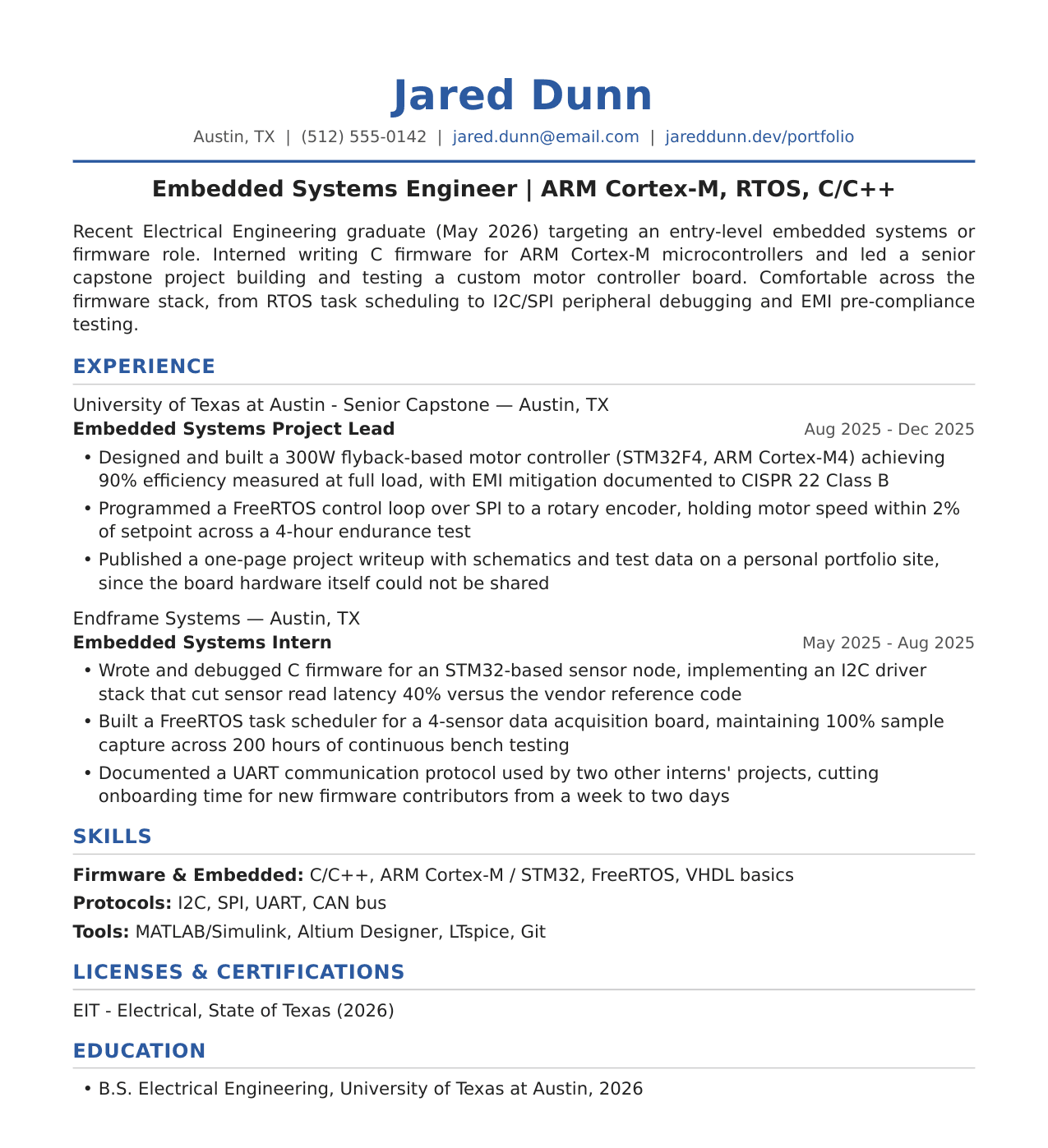
What's working here: the capstone bullet reads like a project a working engineer would defend in an interview, naming the topology, the chip, and one measured number, exactly the format this guide's hardware-portfolio section recommends. The internship bullets lean on effort and scope metrics like latency reduction and test-hour counts rather than business outcomes, appropriate for a first internship. EIT status is dated and state-specific instead of a vague "in progress" claim.
Controls & Automation Engineer Resume
This is the two-to-seven-year template for a Controls & Automation candidate who already owns PLC platforms end to end and needs the resume to prove commissioning ownership, not just programming tasks. The summary opens with years of experience and names the platforms specifically, Allen-Bradley ControlLogix and Siemens TIA Portal, then states EIT status and a PE track, since controls roles rarely require a PE but recruiters read progress toward one as a trajectory signal. Two roles carry the page, and every bullet names a protocol or platform next to the outcome it produced.
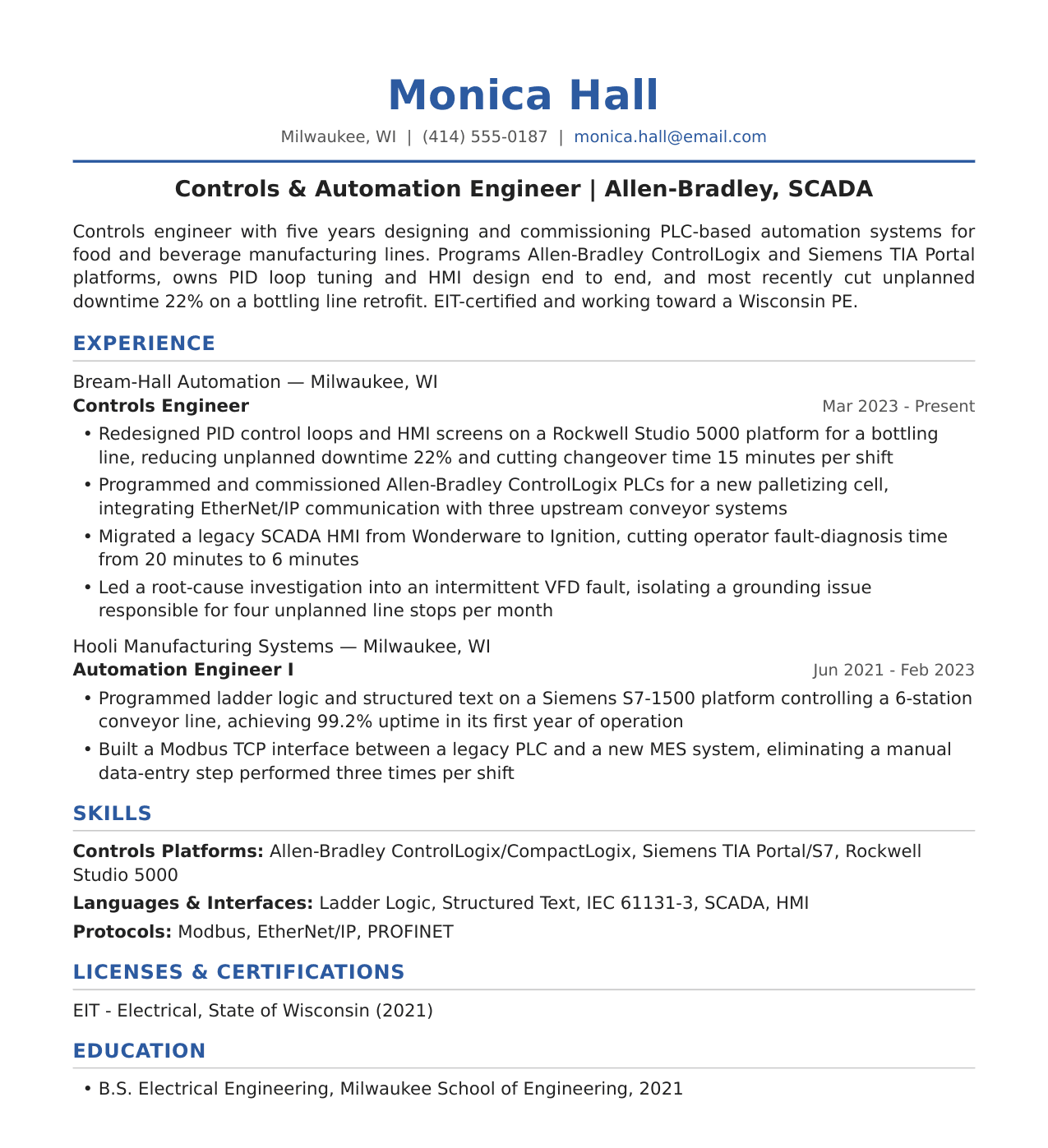
What's working here: the SCADA migration bullet names both the old and new platform, Wonderware to Ignition, instead of just "upgraded SCADA system," the root-cause bullet quantifies the fault frequency it eliminated rather than describing troubleshooting in the abstract, and the skills section separates platforms, languages, and protocols into the same categories a controls-specific ATS search would use.
Senior Power Systems Engineer (PE) Resume
This is the PE-licensed template for an engineer who stamps designs and leads a delivery team, the point on the Power Systems ladder where the license stops being optional. The summary leads with the PE credential and team size in the same sentence, and every bullet in the experience section carries a dollar figure, a relay count, or a percentage tied to a named standard, IEEE 1584 or NERC PRC, because at this level the resume has to prove engineering depth and delivery accountability at once. This example still fits one page; if your own PE-level scope needs more room, a second page is defensible here in a way it is not earlier in the ladder.
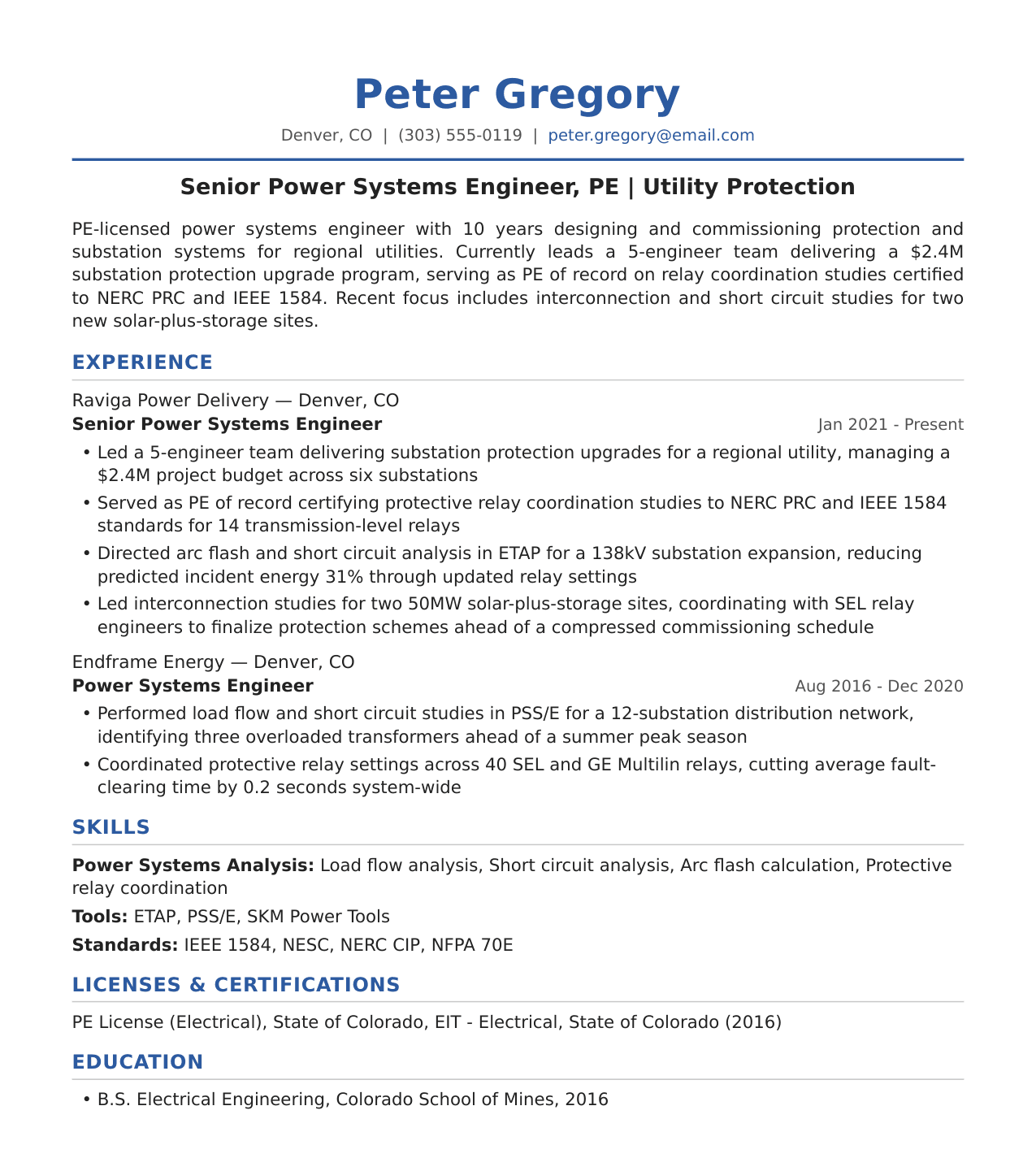
What's working here: "PE of record" appears inside a bullet tied to a specific standard and relay count, not just listed as a credential, the interconnection bullet signals the engineer is current on solar-plus-storage work rather than only legacy substation upgrades, and the Licenses line separates the PE from the earlier EIT so a reviewer can see the progression rather than just the end state.
Across all three, the pattern holds regardless of sub-specialty: a named tool or standard sits next to a number, and certifications are dated and state-specific rather than vague. If your target role sits between two of these, for example a controls engineer two years from PE eligibility, borrow the mid-level structure and let your EIT date carry the trajectory signal instead of overstating your license status.
Electrical Engineering Resume Keywords at a Glance
Use this table as a quick reference, then jump to the sub-specialty sections above for context on when each term belongs on your resume.
| Category | Keywords |
|---|---|
| Core design | Circuit design, PCB design, Schematic capture, Analog and digital design, Power systems, Embedded systems, Control systems, Signal processing, RF design |
| Programming & simulation | MATLAB/Simulink, SPICE/LTspice, Verilog, VHDL, PLC programming, Firmware development |
| Tools & platforms | Altium Designer, Cadence, AutoCAD Electrical, ETAP, SCADA, Oscilloscopes and lab instrumentation |
| Standards & credentials | PE license, EIT/FE, NEC, IEEE standards, UL compliance |
| Delivery | Design verification and testing, DFM, Root cause analysis, Technical documentation |
How to Show Hardware Projects a Recruiter Can't Click
Software candidates link a GitHub. You built a power supply. Hiring teams increasingly expect a portfolio from EE candidates, especially new grads and embedded applicants, but circuits are physical, proprietary, or locked in a lab, so the resume has to do the demonstrating.
Write project lines with the specs a fellow engineer would ask about: topology, key components, standards, and measured results. "Designed and built a 300W flyback converter (UC3843, 90% efficiency measured at full load); documented EMI mitigation to CISPR 22 Class B" proves more than any link. One measured number per project line is the rule.
For work you can show, build a lightweight portfolio anyway: photos of builds, schematics you're allowed to share, a one-page writeup per project covering the design decision you'd defend in an interview. Host it as a simple PDF or site and put the link in your header. For proprietary work, describe the problem class and your measured contribution without the employer's specifics, the same way you'd discuss it in an interview.
Common Mistakes and How Upplai's ATS Resume Checker Finds Missing Keywords
Common mistakes recap
- Generic category words: "Circuit Design" with no tool or brand attached reads as filler.
- Buried certifications: PE, EIT, and NABCEP need their own heading, not a mention inside a paragraph.
- PE and EIT treated as interchangeable: One's a license, one's a stepping stone.
- Wrong sub-specialty vocabulary: PCB terms on a Power Systems resume, or firmware terms on a Controls resume.
- Tables and embedded schematics: Spec sheets in tables and diagrams saved as images often get skipped by ATS parsers, keywords included.
Upplai tie-in
Upplai's ATS Resume Checker runs a gap analysis against the actual job description you paste in, not a generic EE keyword list. It returns a dual ATS and recruiter score, then shows missing keywords in context, so you see why "ETAP" or "IEC 61131-3" matters for that role. Edit your resume and the score updates in real time, no re-uploading required.
Tailored resumes produce 6X more interviews than generic ones. Running a gap analysis instead of guessing at which tool names or standards to add is how you find out if yours is one of them.
Check Your Electrical Engineering Resume's Keyword Match
Get an instant ATS and recruiter score, plus the exact EE keywords your resume is missing for the job you want.
An electrical engineering resume gets judged twice: once by software counting keywords, once by a recruiter deciding if you can do the job. The categories in this guide, from sub-specialty tools and standards to PE status and formatting, are what both are looking for. Pick the terms that reflect your actual projects and coursework, place them in your summary, skills section, and bullets, and let the results do the talking. Get the keywords right and the formatting clean, and your resume stops getting filtered out before anyone reads it.