Every other applicant for this posting holds Series 7 and Series 66 too. The licenses line proves you cleared the entry bar. It gives a hiring manager no reason to call you over the next candidate with the same exams.
This guide covers what separates financial advisor resumes that get interviews: a summary and skills section built around channel and production, achievement bullets with defensible AUM, exact license wording, and examples matched to wirehouse, RIA, and bank channel roles. You'll also get the recruiter keyword list, why your registration record is public, and the mistakes that get advisors screened out.
What Makes a Financial Advisor Resume Effective?
A hiring manager screening financial advisor resumes reads for three things that generic resume advice never mentions.
The first is channel fit. "Financial advisor" means different jobs at a wirehouse, an independent RIA, and a bank or insurance channel, and each wants different proof. A wirehouse reads for production and net new assets, an RIA for planning-process depth and fee-based retention, a bank or insurance channel for referral volume and cross-sell results. A resume built for one channel and sent to another reads as a mismatch before the interview starts.
The second is registration status. It matters less which exams appear on the page than whether they're current, and whether the title you've given yourself matches the title on file with FINRA. A hiring manager, and often a compliance reviewer, can pull your record and check.
The third is defensibility. AUM, household count, net new assets, retention rate: any of these can appear on a resume, but only some can survive a follow-up question in the interview. A number the candidate can't explain, defend, or attribute correctly (individual book versus team book) does more damage than leaving it off.
Underneath all three sits the real tension of this job search. Series 7, Series 66 and a CFP designation in progress get you considered, because they are the entry price for the role. They do not get you hired, because every other serious applicant for the same posting holds the same licenses. The resume has to work past the license and prove production, process or relationships.
How to Write a Financial Advisor Resume That Gets Interviews
Write a Summary That Signals Channel, License Status and Production
A financial advisor summary has three jobs in three lines: name the setting you work in, state what you're licensed to do, and show evidence you can produce. Name it explicitly (wirehouse, independent broker-dealer, bank channel, insurance-to-advisory), list licenses by exact name (not "fully licensed"), and close with a figure you can defend: AUM, revenue, net new assets, or retention.
A weak summary looks like this:
"Results-driven financial professional with excellent client relationship skills, seeking to grow my career at a top firm."
A stronger one looks like this:
"Financial advisor with 4 years at a regional broker-dealer, Series 7 and Series 66 licensed. Supported a team book of $85M AUM, sourced $6.2M in net new assets in 2025, and maintained a 94% retention rate across 140 households."
With no AUM yet, an objective works better than a summary: state license status, transferable background, and the specific track you're targeting.
Entry-level or career-changer objective example:
"SIE and Series 65 candidate (exam scheduled October 2026), transitioning from 6 years in retail banking managing 300+ client relationships and exceeding referral targets. Seeking an associate financial advisor role to build a fee-based planning practice."
Build a Skills Section That Separates Planning, Sales and Compliance
A skills list of "communication, teamwork, financial analysis" tells a hiring manager nothing your license already proves. Group skills by what you plan, sell, run software on, and are licensed to do.
Planning and analysis: Retirement planning, estate planning, tax planning, risk tolerance assessment, cash flow analysis
Products and markets: Equities, bonds, ETFs, mutual funds, annuities, managed accounts
Platforms and CRM: eMoney Advisor, Wealthbox, Redtail, Black Diamond, Salesforce, Orion
Compliance and licensing: Series 7, Series 66, SIE (Securities Industry Essentials), fiduciary standard, state regulator registration
List only software you've actually operated, not a system your firm licensed. Mirror a posting's exact license wording ("Series 7 & 66 or 7, 63 & 65") and name the actual platform, eMoney or Black Diamond, instead of "financial planning software."
Turn Book Growth and Client Work Into Achievement Bullets
Every bullet follows the same formula: [Action verb] + [specific task or method] + [quantifiable result or scope]. A task tells the reader what your job was; a result tells how well you did it.
A weak bullet looks like this:
"Responsible for managing client relationships and providing financial advice."
A stronger one looks like this:
"Built a fee-based financial planning practice from 40 to 165 households over 3 years, growing AUM from $22M to $61M while maintaining a 96% client retention rate through quarterly review meetings."
Pull from the library below by channel, then swap in numbers you can defend.
Wirehouse or broker-dealer advisor
- Grew individual production from $310K to $540K gross dealer concession over 4 years, expanding a high-net-worth client segment
- Sourced $18M in net new assets in 2025 against a $12M target, top 15% of the region
Independent RIA or fee-based advisor
- Managed a fee-based book of 95 households and $48M AUM, delivering full financial plans for 100% of top-tier clients annually
- Improved client retention from 88% to 97% over 2 years by moving the practice to a quarterly review cadence in eMoney Advisor
Bank or credit-union channel advisor
- Converted 210 banker referrals into 68 new advisory relationships in 2025, generating $4.1M in new AUM
- Cross-sold insurance and investment products to 30% of a 1,200-account deposit base, beating the branch's production goal by 22%
Insurance-licensed advisor moving to fee-based
- Transitioned 45 insurance clients into fee-based relationships over 18 months, adding $9M in AUM while maintaining licensed production
- Completed 120 financial needs analyses annually, building a referral pipeline that generated $2.3M in fee-based assets
If you work on a team, attribute the book honestly: write "supported a team book of $85M AUM," not "managed $85M," when the practice belongs to a senior advisor or a shared team.
Be equally careful about what you imply you can bring with you. Describe the relationships you served, never a client list you could carry to a new firm. Most advisors are bound by non-solicit agreements, and even Protocol for Broker Recruiting firms allow only a narrow, defined set of client data to move with a departing advisor. That's a legal exposure, not a wording choice.
List Your Licenses and Designations Exactly as You Hold Them
Everyone lists license acronyms; almost nobody explains what they mean.
The SIE is a co-requisite exam covering general securities knowledge; it doesn't authorize selling anything alone. Series 7 qualifies you to sell most securities, the core registration most wirehouse and broker-dealer roles require. Series 66 is the NASAA Uniform Combined State Law exam; paired with Series 7, it adds investment adviser rep capacity. Series 65 qualifies you as an investment adviser rep alone, without Series 7, which is why career changers heading toward RIA work often sit for 65 alone. Series 63 covers state securities law and pairs with Series 6 or 7.
Write status plainly: "Series 7, held" if actively registered; "Series 66, in progress, exam scheduled [date]" if studying; "Series 65 required by target role, not yet held" if being transparent about a gap. "Fully licensed" invites the follow-up you're trying to avoid.
Apply the same precision to CFP and CFA. Never write "CFP" unqualified unless certified: use "CFP candidate" or name which of the CFP Board's four certification requirements (education, exam, experience, ethics) you've completed. Same for CFA: "Level II candidate" is accurate mid-program; "charterholder" is reserved for those who've finished all three levels and the experience requirement. Listing either as finished early is a claim a reviewer will check.
Match the Resume to Your Channel: Wirehouse, RIA, or Bank and Insurance
The same resume rarely works across all three channels; each screens for a different signal.
A wirehouse or broker-dealer wants production first: lead with gross dealer concession, book size, and net-new-asset numbers.
An independent RIA wants planning depth: move methodology, named platform, fee-based retention, and CFP progress above raw production numbers.
A bank or credit-union channel wants referral volume, cross-sell results, and licensing breadth: lead with conversion percentages and list every license you hold, including Life and Health.
Financial Advisor Resume Examples
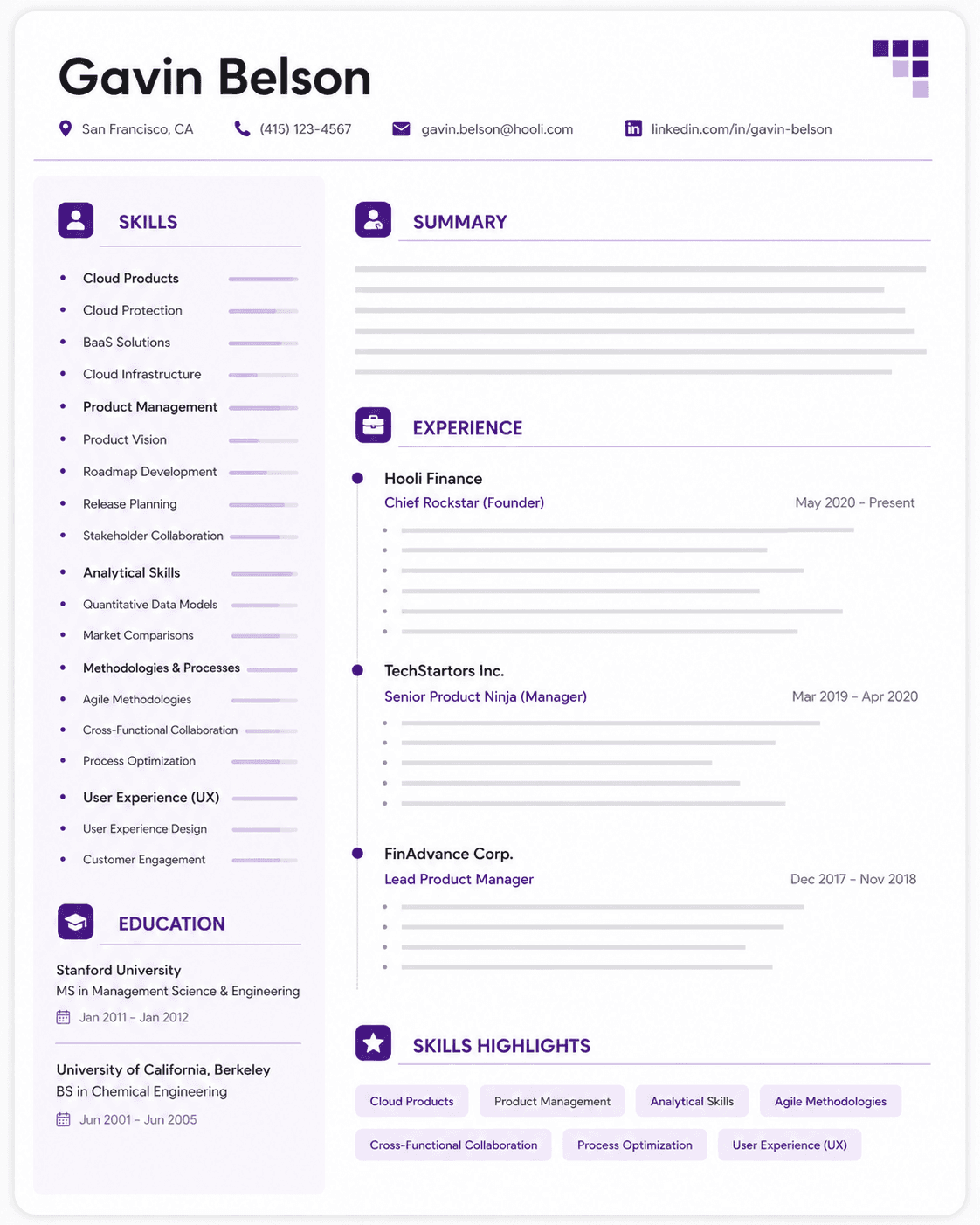
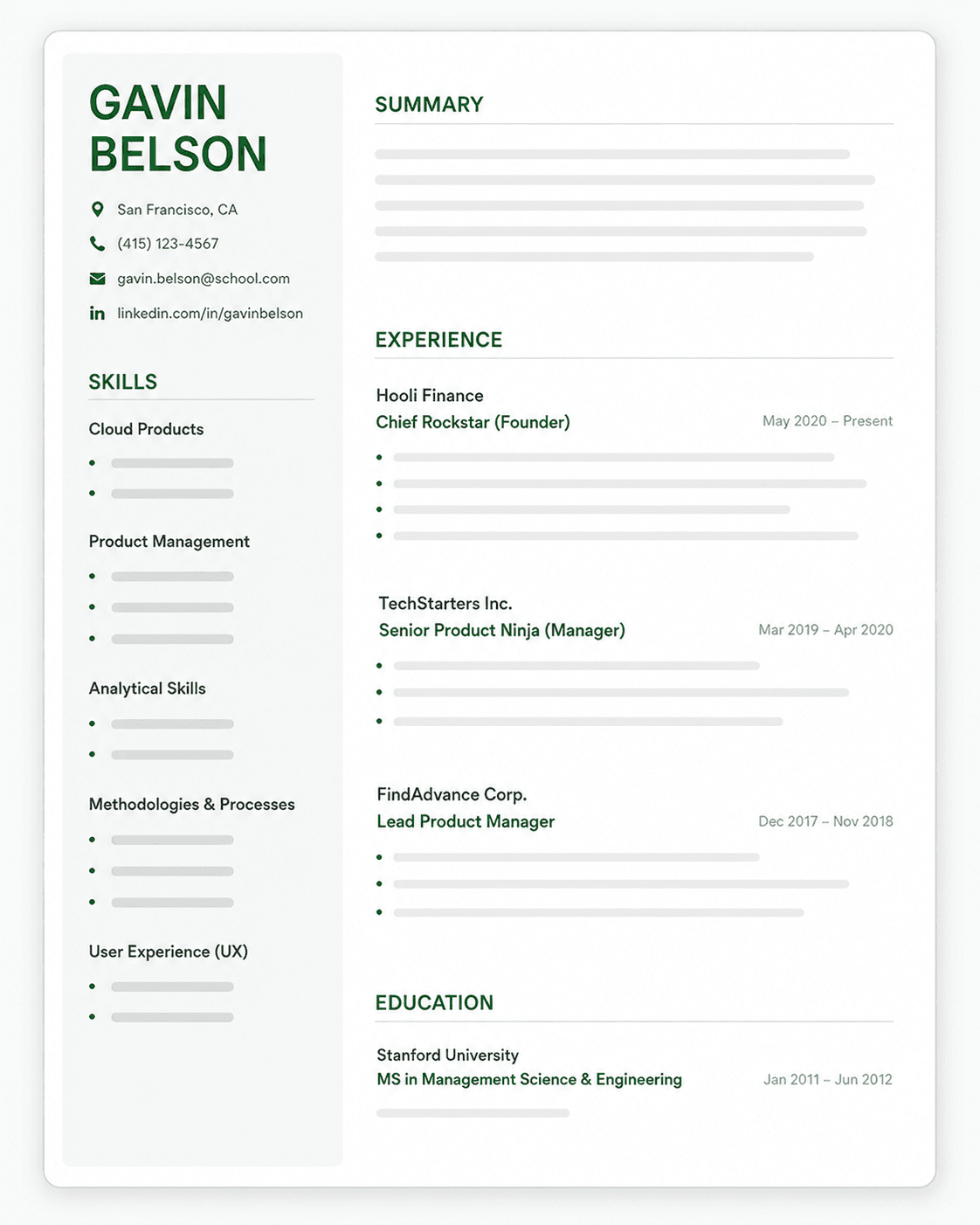
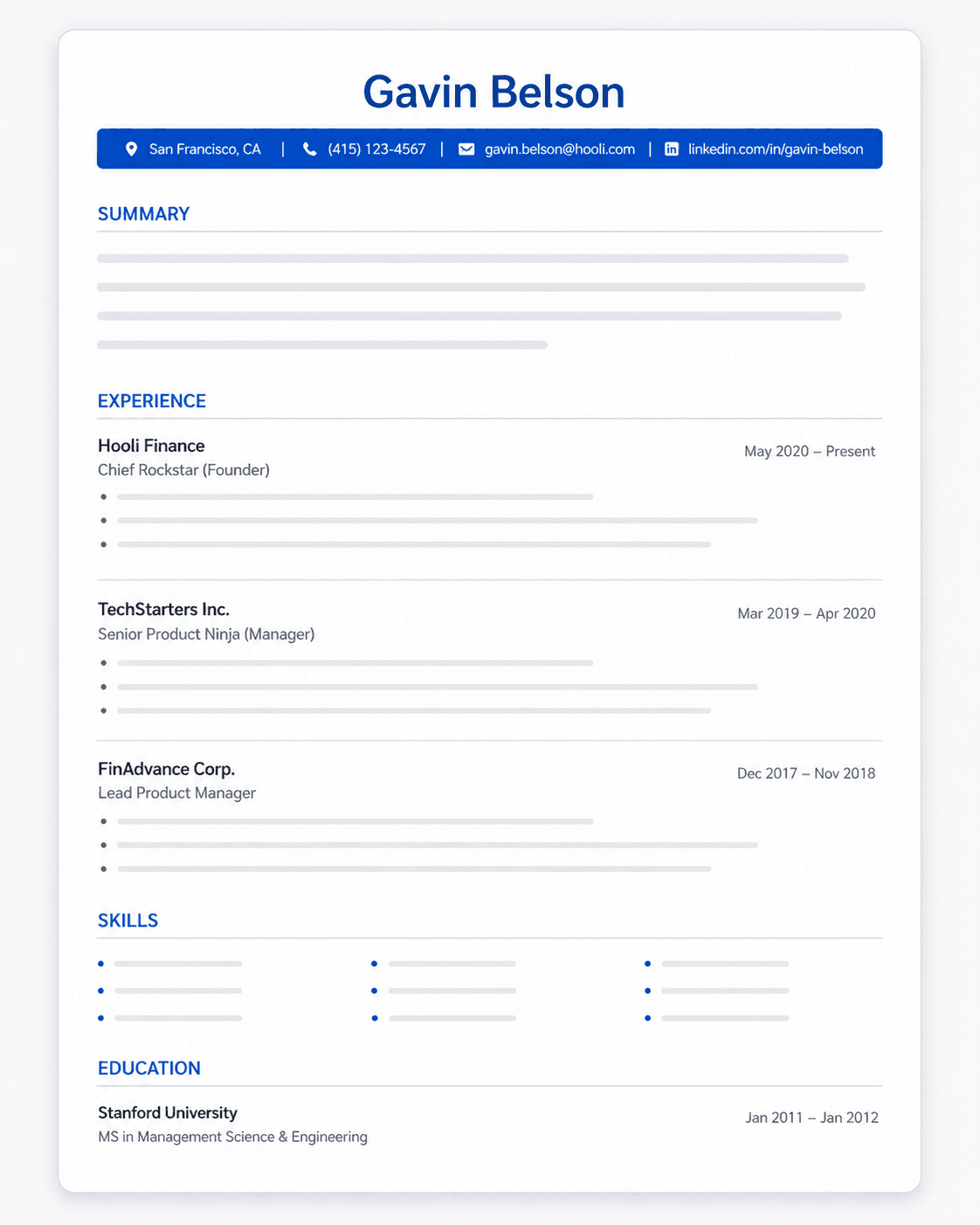
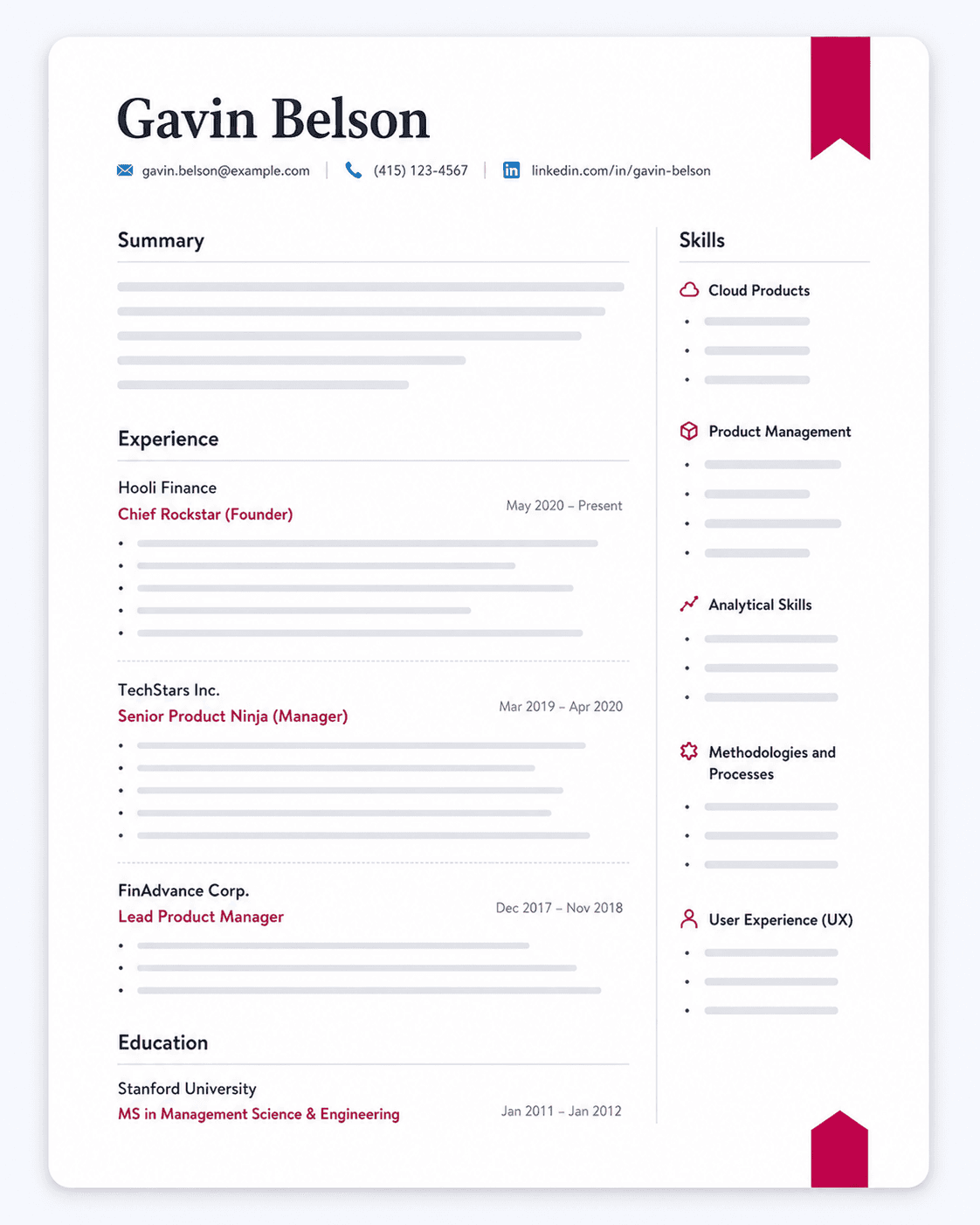
Reading a resume is faster than reading advice. Here is what a strong financial advisor resume looks like across the three settings where advisors get hired, since the channel changes what a screener is actually checking for.
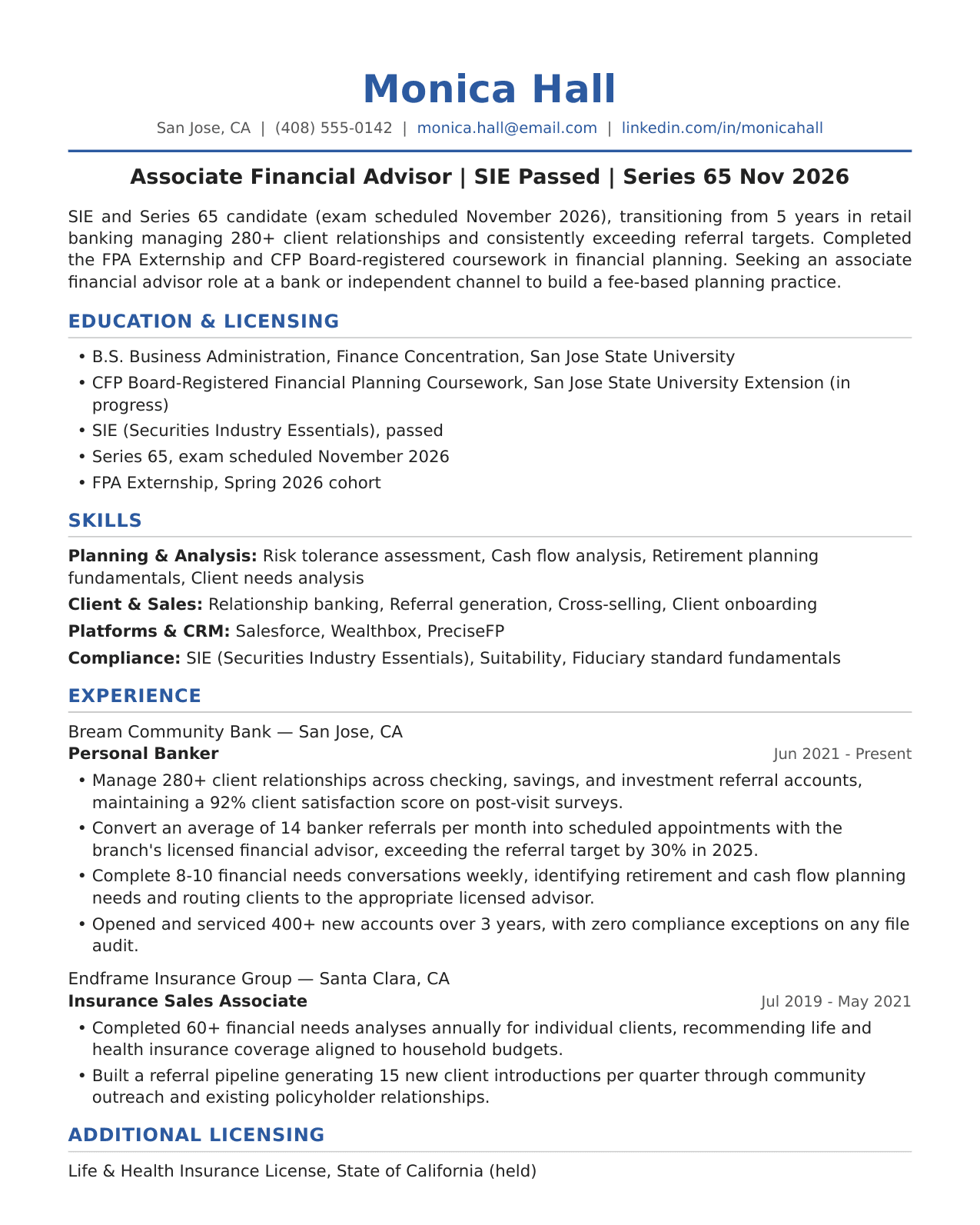
Entry-Level or Career-Changer Financial Advisor Resume
Lead with an objective, not a summary, and put education and licensing above experience since you have no AUM yet. State license status precisely: SIE passed, Series 65 scheduled, or Series 7 in progress. Replace production numbers with transferable client-facing metrics from banking, insurance, or retail: accounts opened per month, referral volume, client satisfaction scores, or portfolio size managed on someone else's behalf. Name any internship, FPA Externship placement, or CFP Board-registered coursework completed, since those signal real commitment over a generic career-change story. Keep the layout simple: objective, education and licensing, skills, then work history reframed around client relationships and sales discipline.
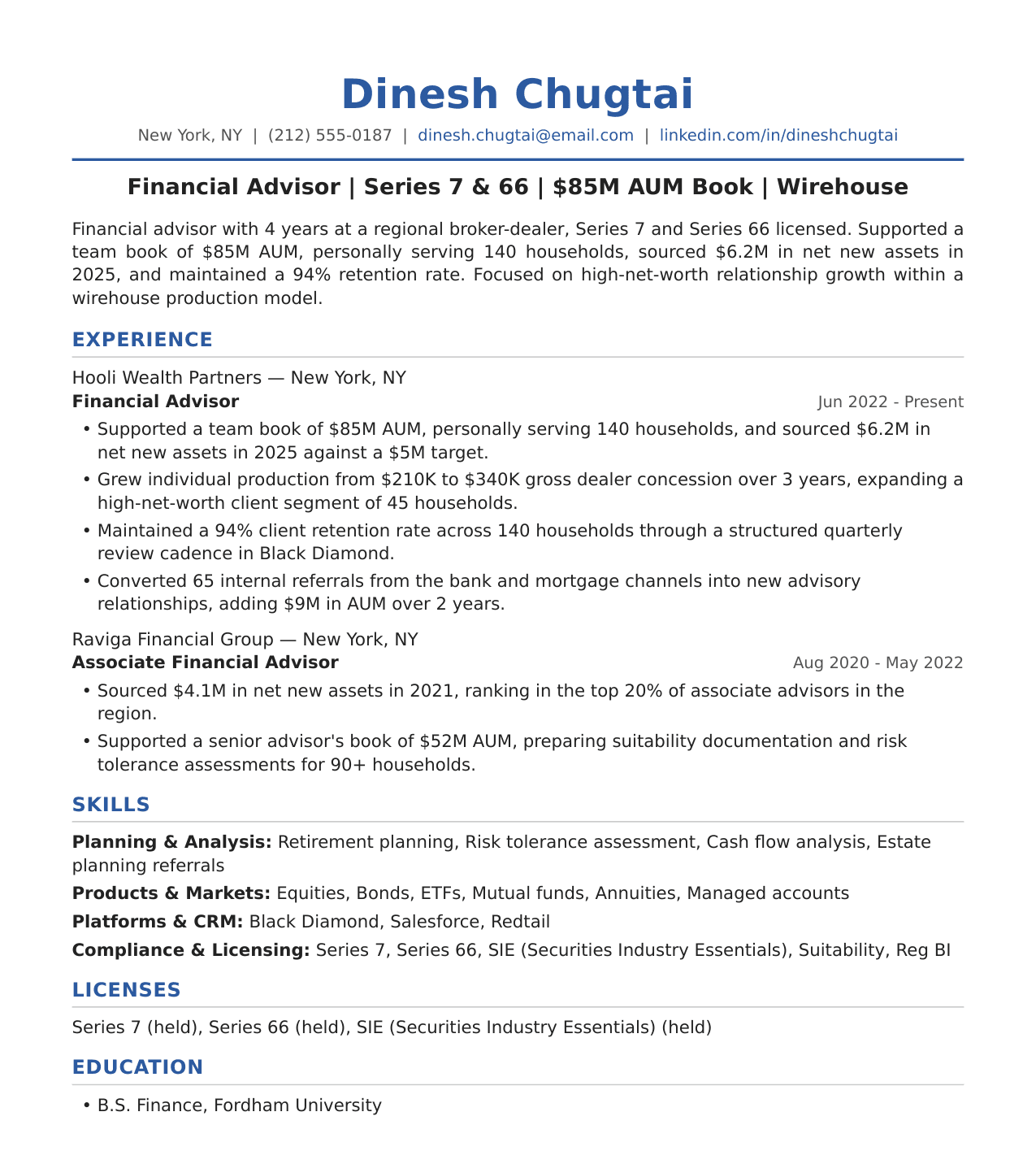
Wirehouse or Broker-Dealer Financial Advisor Resume
Lead with a production summary and put experience first, since this channel screens on numbers before anything else. Every role should carry net new assets, AUM managed, household count, and a retention percentage, the figures a sales manager would ask for in an interview. State Series 7 and Series 66 by name, not "fully licensed," since a wirehouse recruiter reads license wording as a proxy for regulatory attention to detail. If the book belongs to a team or a senior advisor, attribute it honestly, writing "supported a team book of" rather than claiming the full figure as an individual result.
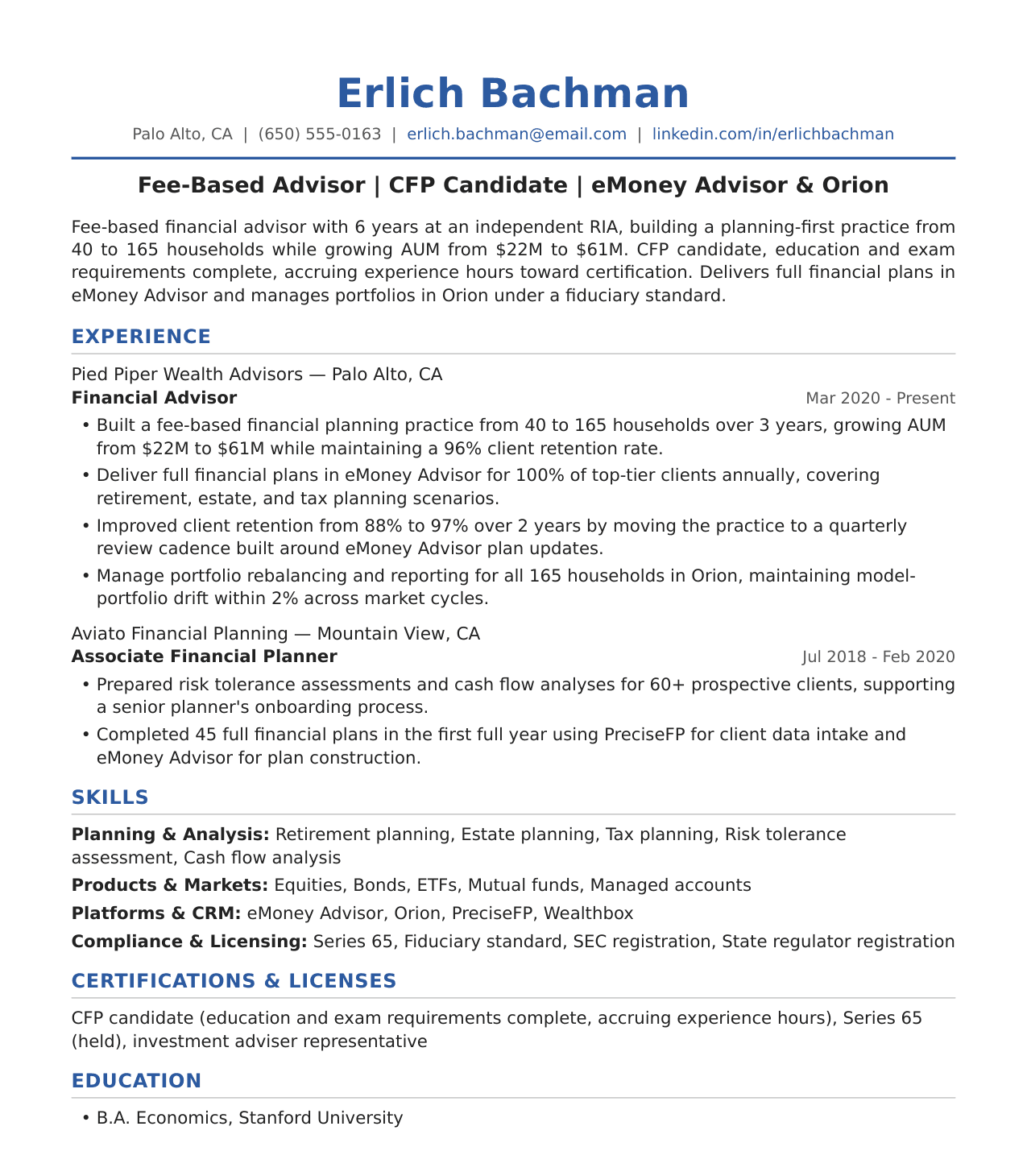
Independent RIA or Fee-Based Financial Advisor Resume
Lead with planning-process depth rather than gross production. Name the actual planning platform you use, eMoney Advisor, MoneyGuidePro, or RightCapital, and the portfolio system, Orion or Black Diamond, instead of a generic "financial planning software" line. Show CFP progress by exam and experience-hour status, or list the full certification if earned. Replace production totals with fee-based retention rate and the number of full financial plans delivered per year, the metrics an RIA principal actually screens for. List Series 65, or Series 66 paired with Series 7, as the investment adviser representative credential that qualifies you to give advice for a fee.
All three stay reverse-chronological and fit one page unless you are past 15 years in production. Every license appears by its exact name, never "fully licensed," and every number is one you could defend if a hiring manager asked how you calculated it. If you sit between two channels, such as a bank-channel advisor moving to an RIA, borrow the wirehouse example's production discipline for your current role and the RIA example's planning-platform detail for where you're headed.
Financial Advisor Resume Keywords
Advisor postings screen on exact license and exam names before anything else, so getting that vocabulary right matters more here than in most fields. Read our ATS resume keywords guide for how parsers match terms, then use the table below as your vocabulary reference; your bullets still have to carry the AUM, retention and production numbers. One honest pattern from live postings: employers rarely name Reg BI or KYC outright, leaning instead on softer phrasing like "fiduciary standard" and "maintaining compliance with all rules and regulations." That makes the license row below the one spot where an exact match still counts.
| Category | Keywords |
|---|---|
| Licenses, exams & designations | Series 7, Series 66, Series 63, Series 65, SIE (Securities Industry Essentials), CFP, ChFC, Life & Health Insurance License |
| Planning & client work | Retirement planning, Estate planning, Tax planning, Risk tolerance assessment, Cash flow analysis, Client acquisition plan, Assets under management (AUM) |
| Platforms & CRM | eMoney Advisor, Wealthbox, Redtail, Black Diamond, Salesforce, Orion, PreciseFP |
| Compliance & regulatory | Fiduciary standard, SEC registration, State regulator registration, FINRA, Suitability, Reg BI |
Put licenses in your summary and again on a dedicated licenses line near the top, since that is the first thing a recruiter and an ATS both scan for. Move platform names into your skills block, and let planning verbs like "built," "assessed," and "converted" do their work inside experience bullets instead. Never list a license you have not passed or a platform you have not actually used: exam and registration claims are checkable against FINRA's records, and a mismatch there costs more trust than a thin resume ever would.
Your Licenses Run on a Two-Year Clock, and BrokerCheck Shows the Rest
An advisor's registration history is not private. Every firm you've worked for, every date you started and left, and every title you were registered under is a matter of public regulatory record, searchable on BrokerCheck. A hiring manager who likes your resume can and often will pull that record before the first interview. If your dates, titles, or license claims don't match it, you're not explaining a formatting choice. You're explaining a discrepancy in a compliance file.
The mechanics behind that record move faster than most advisors expect. When you leave a firm, that firm has 30 days from your termination date to file Form U5 and hand you a copy, so your departure date is locked into the record almost immediately. From there, the clock keeps running. Under FINRA's Maintaining Qualifications Program, your qualification registrations terminate two years after you leave a member firm unless you elect into the MQP within that window, and even MQP enrollment only buys five years total before you'd need to retake your exams. Separately, a registration that goes CE-inactive and stays that way for two years is administratively terminated, and you'll need to requalify by exam to get it back.
What you write should match where you actually sit on that clock. Moving firms while still registered: use the exact dates and the exact registered title on your CRD record, not an upgraded one, and save any explanation of an abrupt departure for the cover letter. Out of the industry under two years: write "Series 7 and Series 66, registrations held through [month year]" and state whether you're MQP enrolled. Out more than two years without MQP coverage: say plainly that you'll requalify by exam and give the scheduled date, so the hiring firm can plan for it instead of finding out during onboarding. One more thing to watch: many firms won't let you use the title "Advisor" until you've cleared the SIE, Series 6 or 7, and state insurance licensing, so upgrading "Financial Representative" to "Financial Advisor" on paper contradicts what the record actually shows.
Common Financial Advisor Resume Mistakes to Avoid
Describing Duties Instead of Production
"Responsible for managing client relationships and providing financial advice" tells a hiring manager nothing a license doesn't already imply. Every bullet needs an action, a method, and a number a reader can check: households served, AUM, retention, net new assets. Duty language reads as filler on a first pass.
Sending the Same Resume to a Wirehouse and an RIA
One resume built for every channel undersells the candidate in all three. A wirehouse wants gross dealer concession and book size first; an RIA wants planning methodology, named software, and CFP progress; a bank channel wants referral conversion and licensing breadth. A generic resume buries the exact number each channel screens for.
Claiming a Team's Book as Your Own
Writing "managed $240M AUM" when the candidate was one of four advisors on a shared team collapses under the first interview follow-up question. Write "supported a team book of $240M, personally serving 95 households" instead.
Writing "Fully Licensed" Instead of Naming the Exams
A recruiter screening for Series 66 cannot match "fully licensed" against a requirement, and neither can an ATS keyword scan. State each exam by name and status: held, in progress, or required but not yet obtained. The same problem applies to "financial planning software" instead of eMoney Advisor or Black Diamond.
Implying a Credential You Have Not Earned
Writing "CFP" or "CFA" without a qualifier when still a candidate misrepresents a regulated credential, not just word choice. Use "CFP candidate" or name the specific requirement completed, and use "Level II candidate" rather than "charterholder" before the program and experience hours are finished. This is an ethics problem in a licensed profession, and a reviewer who checks the CFP Board or CFA Institute directory will treat it as one.
Hinting That Your Clients Will Follow You
A line suggesting a candidate can bring a book of business invites a non-solicit and Protocol for Broker Recruiting problem before the offer stage, and a hiring firm's compliance team reads it as legal exposure rather than as sales confidence. Describe the relationships served instead: household count, planning cadence, retention rate, not a client list implied to be portable.
Formatting That Breaks an ATS Parse
License names buried in a graphic header or a two-column sidebar, and AUM figures sitting inside a text box, often never reach the applicant tracking system large firms in this space run. A PDF exported from a design tool can strip that text entirely. Keep the licenses line in plain, machine-readable text.
How AI Resume Builders Can Simplify Your Financial Advisor Resume
An advisor applying to a wirehouse, an independent RIA and a bank channel in the same week is rewriting the summary three times, reordering the licenses line for each posting, and swapping production numbers for planning metrics depending on who's reading. The posting language differs enough between those channels that one resume genuinely cannot serve all three, and a version that reads generic gets filtered before a recruiter ever opens it.
Upplai, the transparent resume AI, tailors your existing resume to each specific posting and explains every change in plain language so you stay in control.
- Real-time ATS scoring: see your ATS and recruiter match score update as you edit, so you know whether reordering your licenses line actually helped, with no download-and-reupload cycle.
- Transparent suggestions: accept or reject every change individually, each with a plain-language explanation of why it was suggested.
- Automatic formatting: clean, ATS-friendly formatting applied across multiple templates.
- Structure guidance: recommendations based on recruiter best practices, including bias flagging.
- Preference memory: your formatting, metric, and reordering choices persist across sessions, so tailoring for the next channel goes faster than the last.
The free plan includes 200 ATS scans and resume match scores per month plus a one-time allotment of 3 tailored resumes with matching cover letters, unlimited downloads in PDF, DOCX and TXT, and no credit card required. Need versions for more channels? Additional resume packs start at $5 one-time, working out to $0.50 to $1.00 per tailored resume, with no subscription attached.
A resume that states your license status accurately and leads with the signal each channel actually screens for is what moves you from the maybe pile to the interview pile.
Ready to tailor your financial advisor resume?
Upload your resume and a job posting to see your ATS score, recruiter score, and tailored suggestions in minutes.