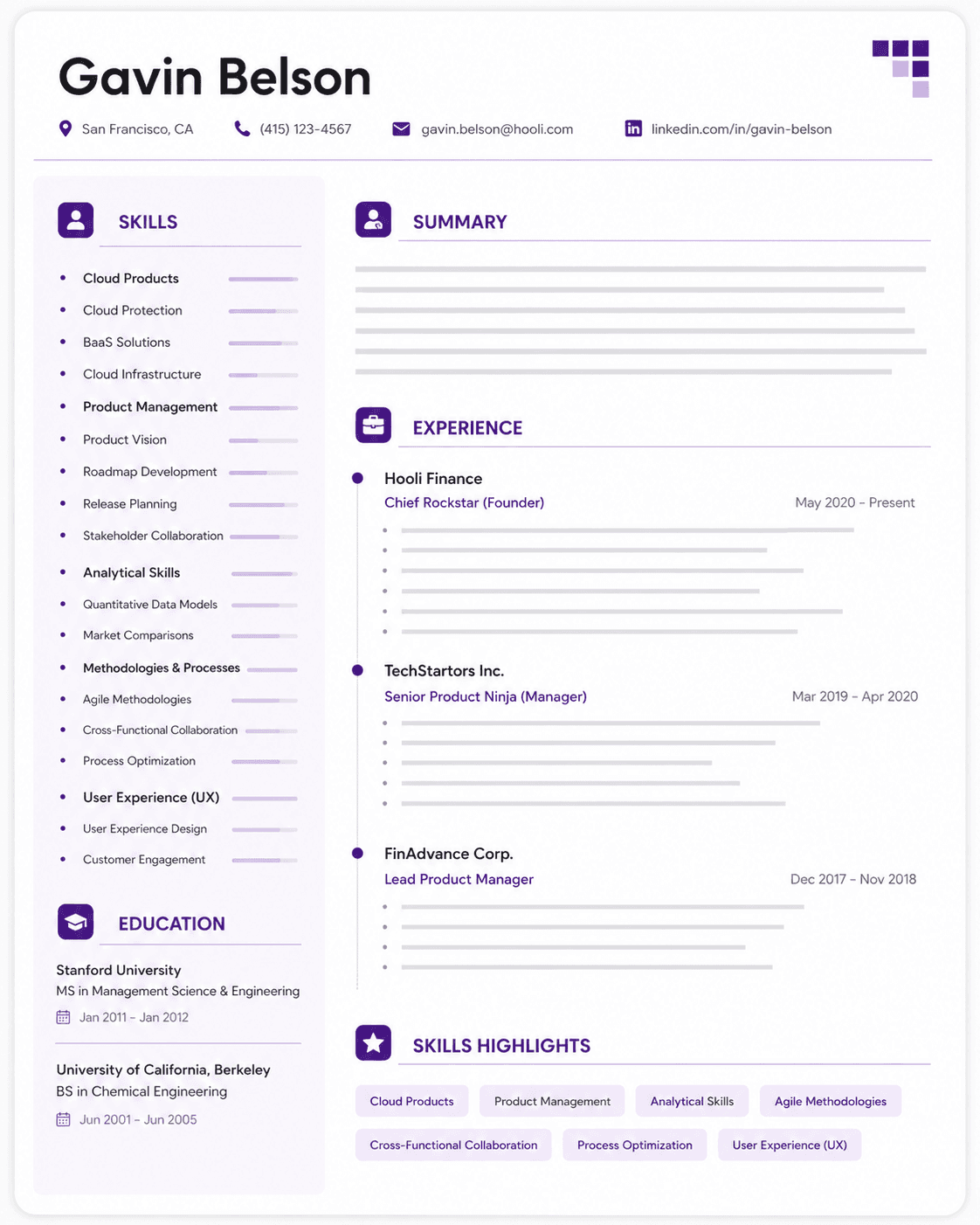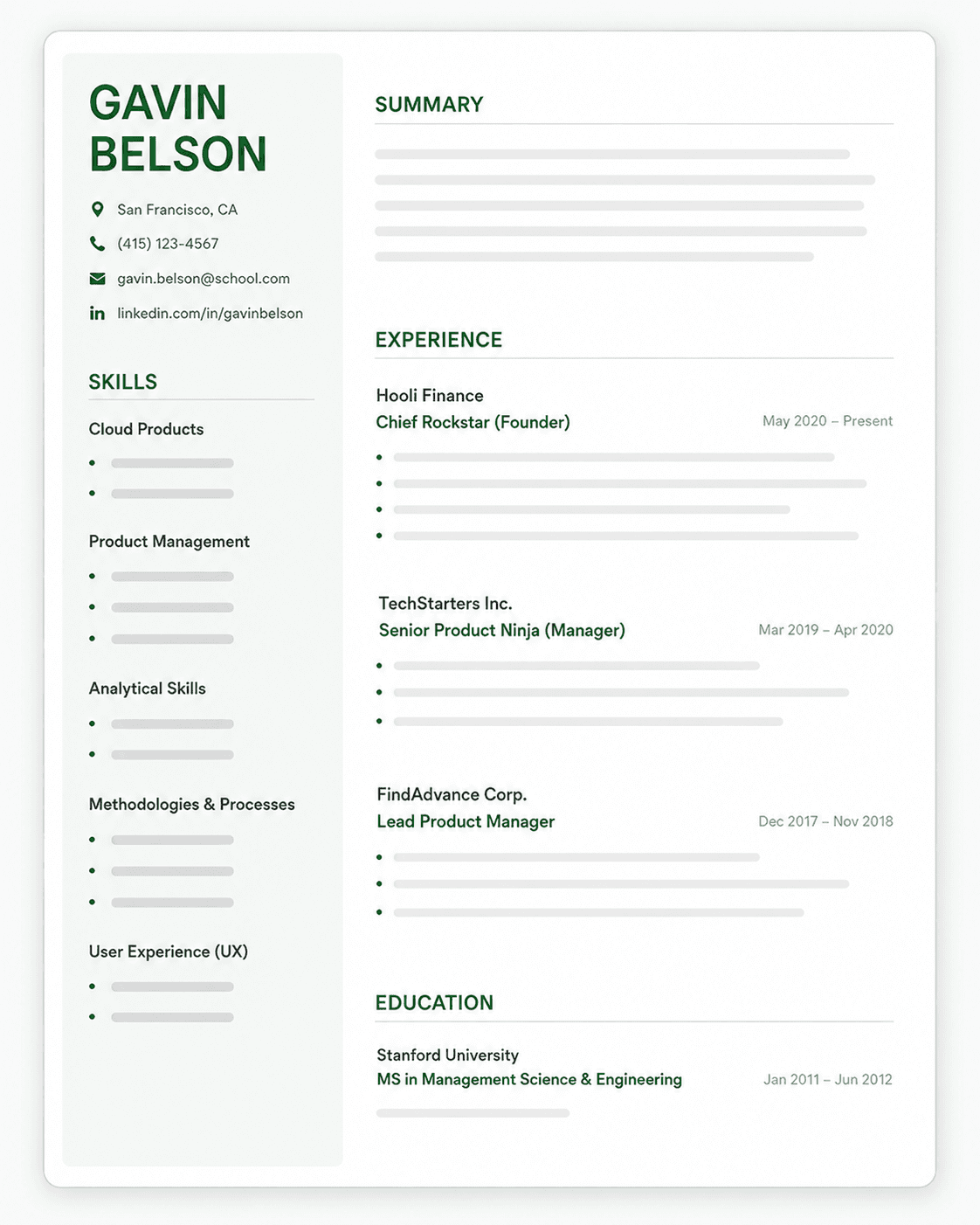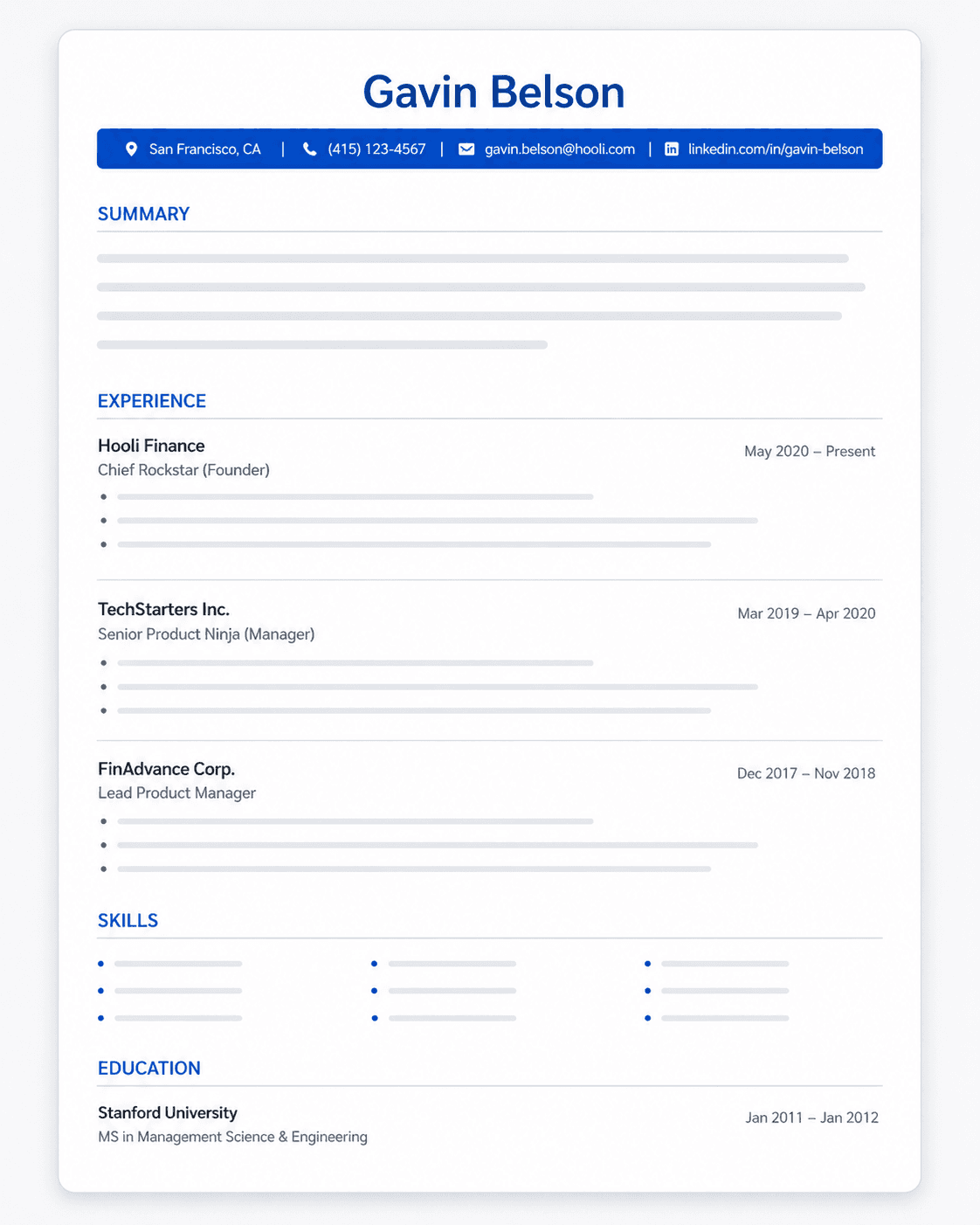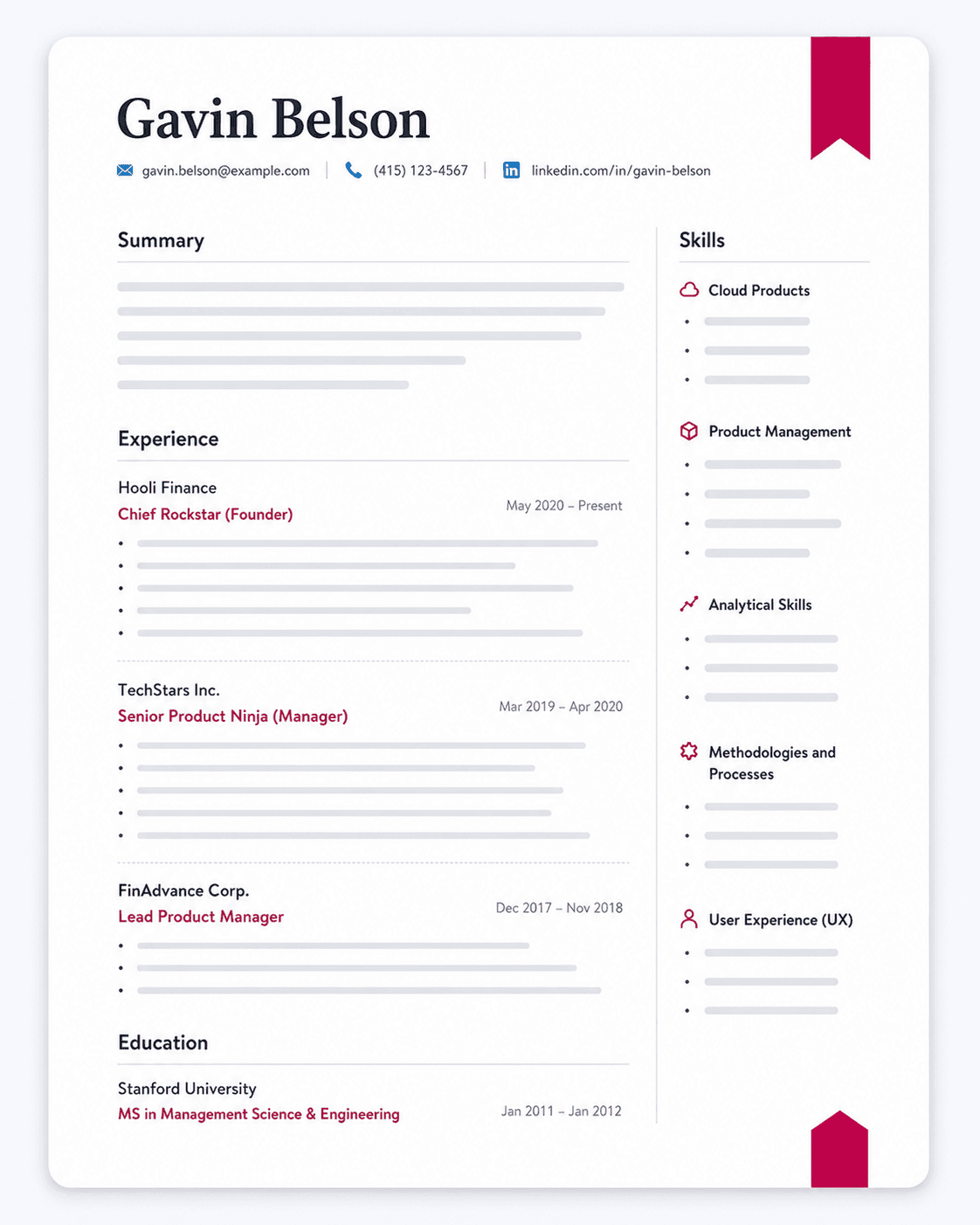
Nobody has ever asked you for a resume before. Clients hire you off three writing samples and a quick email exchange, so when an agency or a bigger retainer client suddenly wants a formal resume, it is fair to wonder what a document like that is even supposed to say about work that never looked like a normal job.
This guide shows you how to translate gigs, clients, and projects into a resume format that actually holds up. You have three real options: list your freelance practice as one continuous job, give your biggest clients their own entries, or group everything by project type instead of a timeline.
You will get a clear way to decide which structure fits your client history, a formula for turning deliverables into results-driven bullets, examples by specialty from SEO writing to ghostwriting, and guidance on where your portfolio link needs to sit so it actually gets clicked.
What Makes a Freelance Writer Resume Different From a Regular Resume
Why Clients and Hiring Managers Still Ask for One (even when you have a portfolio)
If clients have always hired you off a few writing samples, a resume request can feel redundant. It isn't. A portfolio proves you can write. A resume proves you can be trusted with a deadline, a scope, and a working relationship, a different question entirely for an agency vetting a new contractor or a company considering you for a staff or retainer role.
A resume also does something a portfolio link can't: it gets scanned in seconds, checking volume of experience, range of clients, and scope, before anyone clicks through to your writing. Your portfolio closes the deal. The resume decides whether you get that far.
The One Structural Problem Every Freelance Resume Has to Solve (gigs and clients, not job titles)
Traditional resumes assume a career ladder: one employer at a time, a title, a promotion, a clean timeline. Freelance writing rarely works that way. You might have written for six clients in the past year, some for a single project, some on ongoing retainer, with overlapping start and end dates and no single job title to anchor any of it.
Force that reality into a standard reverse-chronological template and it reads as messy or thin. The real question is what unit of work you're organizing the whole resume around: your freelance practice as one continuous job, each long-term client as its own entry, or your writing grouped by project type and skill instead of employer at all. Getting that structural call right, before you touch a single bullet, is what the next section walks through.
How to Write a Freelance Writer Resume That Gets Responses
Choose the Right Format for Your Client History
Before you touch a summary or a bullet point, decide how you're going to organize your client history. Get this one call right and the rest of the resume holds together. Get it wrong and it reads as scattered no matter how good the individual bullets are. The right answer depends entirely on the shape of your client list.
If you've worked with a small number of clients over long stretches, treat your freelance practice like a job. Use a header such as "Freelance Writer | Self-Employed | 2022-Present" and list your work underneath it the same way you'd list responsibilities at a company. If a couple of those clients were especially long-term or significant (a year or more, recurring monthly retainers), give each one its own entry with its own dates, the same way you'd list two different employers.
If you've worked with many short-term or rotating clients, drop the timeline format entirely. Use a functional or project-grouped structure instead, organized by the type of work: "Blog Writing," "Copywriting," "Ghostwriting," or whatever categories match what you actually did. Under each category, name a few representative clients and attach metrics (word counts, publishing frequency, results). This format lets a hiring manager scan your range without wading through a dozen short-lived gigs that each lasted six weeks.
Most freelancers land somewhere in between. In that case, default to whichever format hides less information.
Write a Targeted Summary That Signals Your Niche and Value
Your summary has to do three things in two or three sentences: name your niche, establish the scope of your client work, and give the reader one reason you're different from every other writer applying.
Niche means specificity. "Freelance writer" tells a hiring manager nothing. "SEO content writer for B2B SaaS companies" tells them exactly what to expect from your samples before they even open your portfolio. Scope means naming how long you've done this and how much of it you've done: years active, number of clients or industries, typical project size. The differentiator is whatever makes clients come back to you specifically: a specialty, a process, a track record of retention.
A weak summary looks like this:
"Freelance writer with experience creating content for a variety of clients across different industries."
A stronger one looks like this:
"SEO content writer with 3 years of experience producing blog and website content for B2B SaaS and fintech clients. Delivered over 200 published articles and maintained repeat contracts with 6 clients for a year or longer."
Build a Skills Section That Covers Craft, Tools, and Reliability
A freelance writer's skills section needs to cover more ground than a staff writer's, because clients are also evaluating whether you can run your side of the relationship without hand-holding. Group your skills so a reader can see craft, tools, and reliability at a glance, rather than scanning one long unsorted list.
Writing & Editing SEO writing, long-form content, ghostwriting, copywriting, AP style, editing and proofreading
Tools & Platforms WordPress, Google Docs, Grammarly, Surfer SEO, Clearscope, Trello, Asana
Client-Facing Skills Deadline management, revision handling, scope negotiation, client communication, invoicing
Only include tools you've actually used on paid work, and be specific: "SEO tools (Surfer SEO)" reads as real experience, while "SEO" alone reads as a guess.
Turn Clients and Projects Into Achievement-Focused Bullets
The formula for a strong bullet stays the same no matter where it sits, under a client header or a project category: action verb, specific task or method, quantifiable result or scope.
A weak bullet looks like this:
"Wrote blog posts for several clients on a regular basis."
A stronger one looks like this:
"Wrote 8 SEO-optimized blog posts per month for 3 wellness brand clients, growing organic traffic to one client's blog by 60% over 6 months."
Freelancers often lack the clean KPIs a staff job hands you, like a performance review score or a sales number tied directly to your work. When you don't have that kind of metric, quantify scope instead: word counts, number of pieces published, publishing cadence, how many rounds of revision your average project takes, or how long a client kept renewing your contract. A bullet that says "maintained a 14-month retainer with a single client, delivering weekly content" is still a real result even without a percentage attached to it.
The next section gives you a full library of these bullets broken out by specialty (SEO writer, copywriter, ghostwriter, journalist, technical writer), so you can pull examples close to your own niche.
Link to Your Portfolio the Right Way
Your portfolio link belongs in your header, next to your email and phone number, not tucked into a skills list or a closing line. Clients often decide whether to keep reading your resume based on whether the link is easy to find and click.
Point it to a page with 3 to 5 of your strongest, most relevant clips, not a full archive of everything you've ever published. Lead with samples that match the work you're applying for, SEO clips for an SEO pitch, not your favorite personal essay.
If you don't have a portfolio built yet, that's a separate problem with its own fix, covered later in this guide.
Freelance Writer Resume Examples by Specialty
Bullet formulas work the same across specialties, but the details you emphasize should match what each type of client actually pays for. Use the examples below as a starting point and swap in your own clients, niches, and numbers.
SEO / Content Writer
Lead with organic performance and volume, since content clients care about traffic and consistency more than prose style.
- Wrote 60+ SEO-optimized blog posts (1,200-2,000 words each) for a B2B SaaS client, growing organic traffic to the blog by 45% over 10 months
- Researched and drafted keyword-targeted articles for 3 concurrent clients using Surfer SEO and Ahrefs, maintaining a 95% first-draft approval rate
Copywriter
Emphasize conversion and business impact, pairing each bullet with a specific asset type such as a landing page, email, or ad.
- Wrote email campaigns for a direct-to-consumer skincare brand, lifting average open rates from 18% to 27% across 40 sends
- Rewrote landing page copy for a fintech client's signup flow, increasing conversion rate by 22% over a 3-month A/B test
Freelance Journalist
Focus on placements and editorial credibility. Name the publication tier and any reporting skills like interviewing or fact-checking.
- Published 25+ bylined features on housing policy in regional and national outlets over 18 months, including two front-page stories
- Interviewed 50+ sources for investigative pieces on local government spending, with two stories cited in follow-up coverage
Ghostwriter
Ghostwriting bullets can't name the byline, so lean on scope, format, and client retention instead.
- Ghostwrote a 65,000-word business memoir for a startup founder client, delivered in 6 months across 12 chapter drafts
- Wrote weekly LinkedIn posts for 4 executive clients over 2 years, with one client's average post engagement tripling within the first quarter
Technical Writer
Highlight subject-matter range and documentation types, since technical clients screen for accuracy and structure over voice.
- Wrote and maintained API documentation for a developer tools client, reducing support tickets related to onboarding by 30%
- Produced 15 user guides and knowledge base articles for a health tech client's SaaS product, cutting average customer onboarding time by 2 days
What to Put on Your Resume With No Paid Writing Experience Yet
Build Proof Before You Build a Resume
If you have no paid clips, the resume is not your first move. Every client-facing document works by pointing to proof, and right now you have none to point to. Fix that first.
Write 3 to 4 pieces, not an open-ended pile of free work. A pitch-style article for a niche site, a guest post for a blog in your target industry, or two strong posts on your own Medium or WordPress site are enough to show range and finish quality. A local newspaper or community magazine byline counts too, even unpaid, because it proves an editor accepted your work.
Treat each piece like a client project on your resume: give it a title, describe the audience and goal, and note any measurable outcome. That turns spec work into resume-ready proof instead of a permanent unpaid sideline.
Reframe Coursework, Internships, and Unrelated Jobs as Transferable Experience
You likely have more relevant material than you think. A journalism, English, or marketing class where you produced graded writing samples belongs on your resume as coursework, listed with the skill it demonstrates.
A college paper role, even as a contributor rather than an editor, is real experience: list it with a title, the publication name, and what you covered. If you conducted interviews or did source research for a class project, that is a transferable skill worth its own bullet.
Unrelated jobs still transfer. A barista job that demanded accuracy under time pressure still demonstrates deadline discipline. Frame it as a skills-first bullet: "Managed customer requests under time pressure, a skill now applied to meeting tight client deadlines."
No HR Department Will Vouch for You: Making Freelance Work Verifiable
When an agency or an in-house employer moves you to a final round, someone runs a verification check. For a staff hire that means a call to an HR department that confirms your title and your dates. A freelance practice has no HR department and no employer of record, so the same check stalls or comes back inconclusive, and it happens after the interviews went well. Most writers never find out this was the problem.
The paper trail you need usually exists already, because two bodies of law put it there. New York's Freelance Isn't Free Act added Article 44-A to the state's General Business Law on August 28, 2024, requiring a written contract for any freelance engagement worth $800 or more, counted alone or across everything you do for the same client in a 120-day window, and the hiring party has to keep its copy for six years. California's AB 2257 reaches the same place from the other direction: a freelance writer stays properly classified as an independent contractor only under a written contract naming the rate, the payment date, and the scope. If you have written for a New York or California client since 2020, a signed document with your name and dates on it sits in their files.
Copyright law is what makes your clips unreliable as proof on their own. Under 17 U.S.C. § 101, a commissioned piece counts as a "work made for hire" only when both parties sign a written instrument saying so, and the client is then treated as the author and owns every right in it. Ghostwritten and NDA-bound work is not yours to display, no matter how much of it you produced.
Build a verification file before you need one. For each client you plan to list, keep the signed contract, the final invoice, and one dated email confirming scope, and name a person on the client side who has agreed to take the call. Ask while the relationship is warm, not three years later through a general inbox.
For work you cannot show, change the ask. Request a one-line confirmation of your dates and scope rather than permission to publish the piece, because that is a far smaller thing to approve. If a client has gone quiet or no longer exists, your invoices and payment records are the fallback, and one sentence in your cover letter naming the constraint lands better than a verification that comes back empty.
Freelance Writer Resume Examples
Below are entry, mid, and senior-level freelance writer resumes you can adapt to your own client history and specialty. Each level solves a different problem, so work from the one that matches where you are now rather than where you are headed.
Entry-Level Freelance Writer Resume
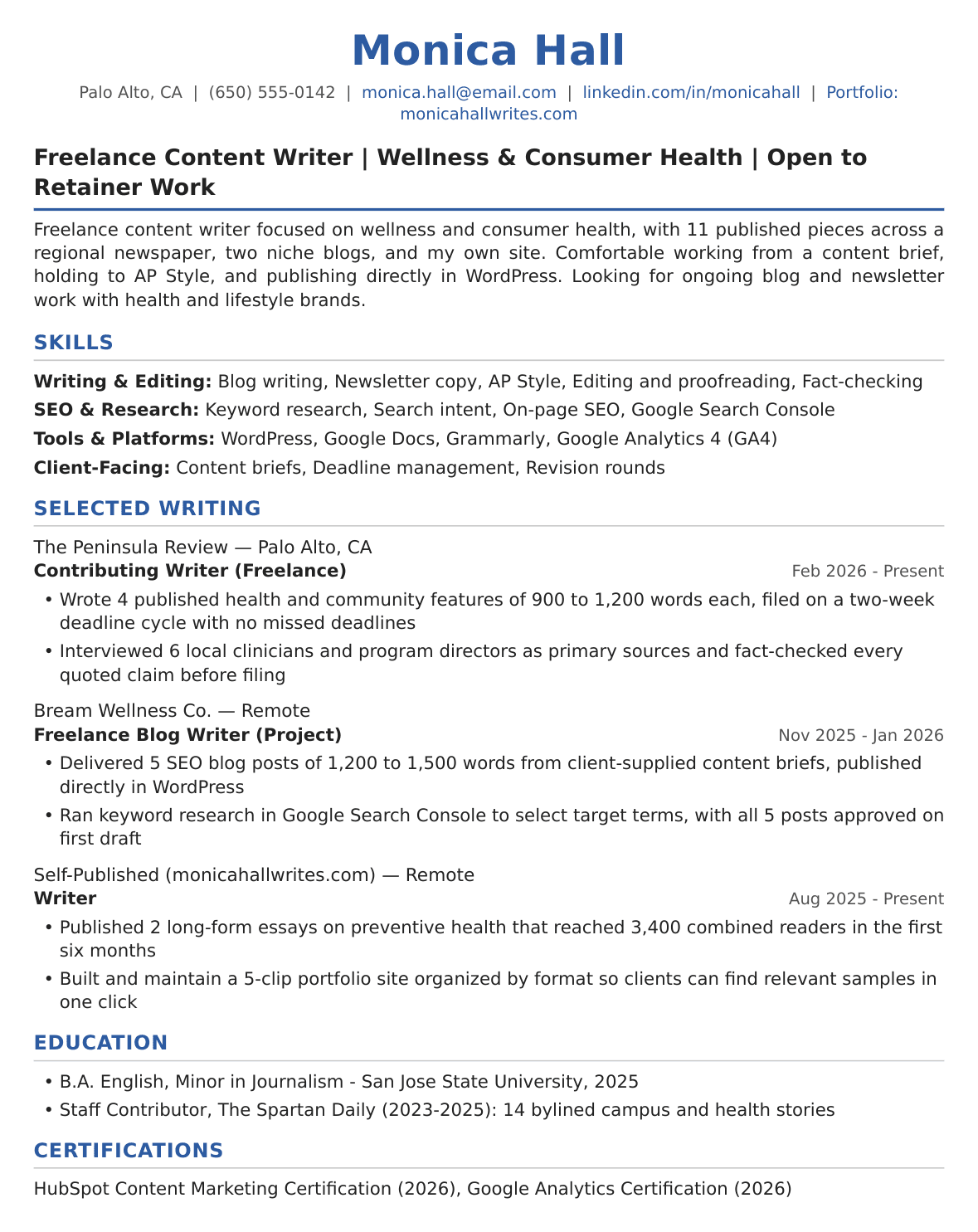
An entry-level resume leads with skills and a short niche summary, because there is not enough client history yet to carry the top of the page. Name the two or three specialties you can deliver today, then replace a formal experience section with a "Selected Writing" block of three to five pieces, each listed with the outlet, the format, and the word count. Guest posts, student publication bylines, and spec pieces belong here and should be labeled honestly rather than dressed up as retainer work. Give the tools you have used on real drafts their own line (WordPress, Google Docs, Grammarly, basic keyword research), and close with education or a content marketing certificate. At this stage you are proving that you can finish a piece to a brief and hand it in on time.
Mid-Level Freelance Writer Resume
A mid-level resume flips the order: the client work carries the page and the skills section shrinks to a scannable block. List four to six clients or retainers with their own date ranges, and lead each entry with a number, such as volume published, word counts, publishing cadence, or contract length. This is where a specialty becomes a position rather than a description, so the summary should name an industry (B2B SaaS, healthcare, fintech) and not just a format. Add the optimization stack you work in (Surfer SEO, Clearscope, Ahrefs) and the CMS you publish in directly, because mid-level postings screen on tooling. One or two outcome metrics, such as organic traffic growth or conversion lift, do more work here than a longer client list.
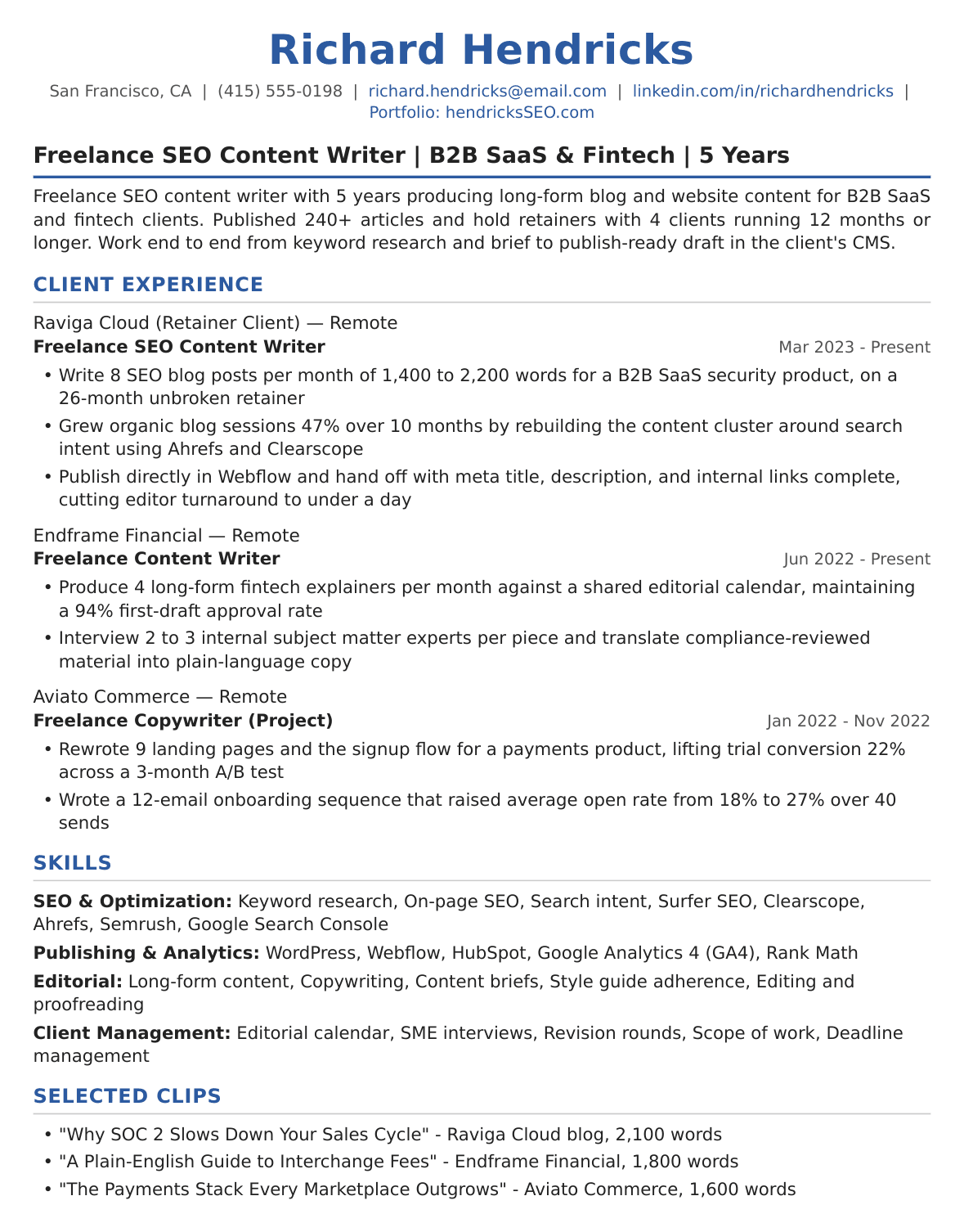
Senior-Level Freelance Writer Resume
A senior resume sells judgment and ownership rather than output. Lead with a summary that names the size of the engagements you run and the outcome you are hired for, then structure the experience section around long retainers and programs instead of individual pieces. Bullets should reach past drafting into what you own: editorial calendars, content strategy, style guides you wrote, subject matter expert interview programs, and junior writers or subcontractors you brief and edit. Name revenue or pipeline impact where a client shared it, and contract values or multi-year renewals where they did not. Keep the clip list to three flagship pieces. A hiring manager at this level assumes you can write and is checking whether you can run a content program without supervision.
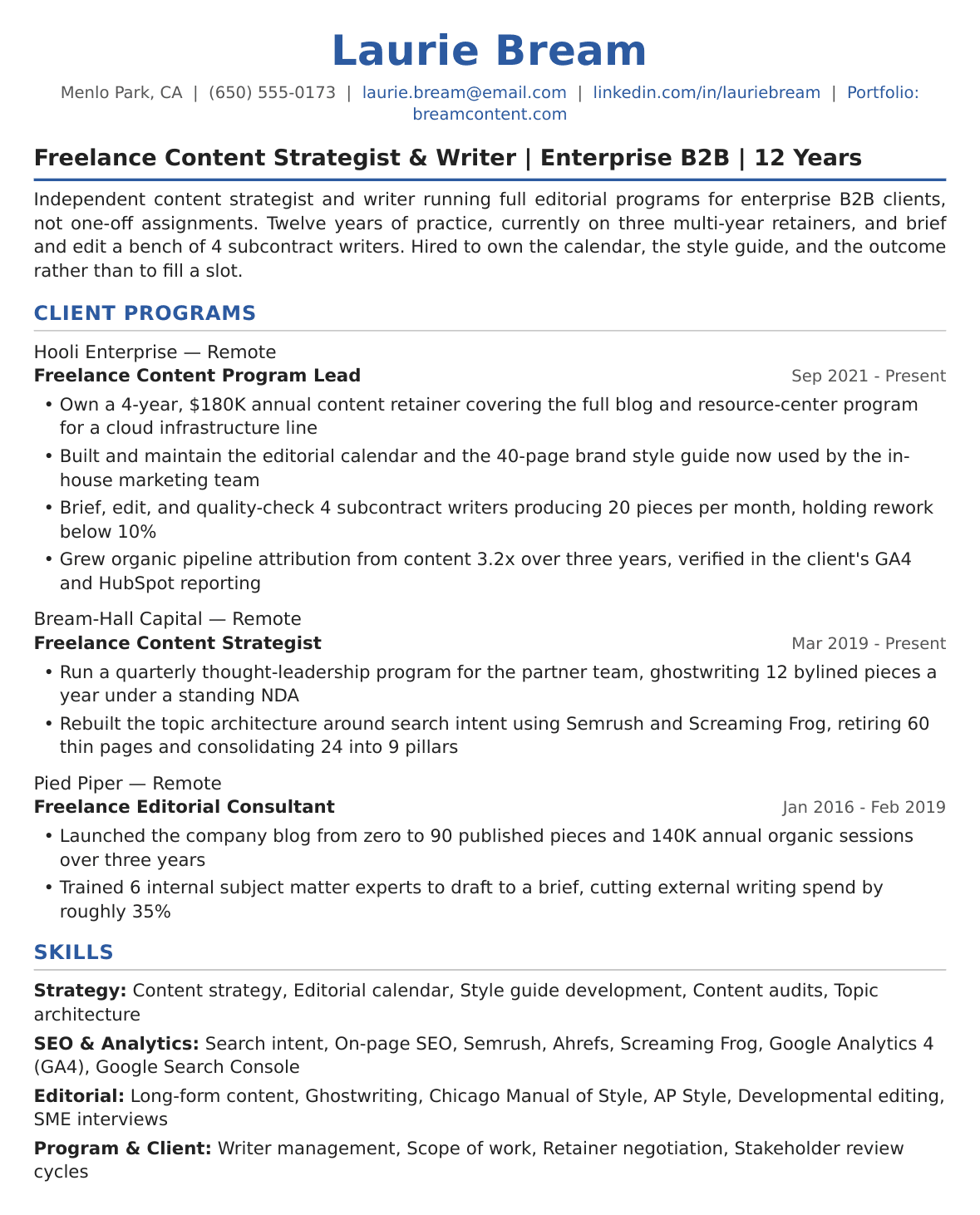
Every level uses the same underlying bullet formula and the same portfolio placement; what changes is what sits at the top of the page and how much of it is strategy rather than output. If you sit between two levels, build the resume for the level you are applying into and let the evidence section prove you belong there.
Freelance Writer Resume Keywords
Freelance writing postings are unusually specific about tooling. An agency hiring a contract SEO writer names the optimization platform its team runs, the CMS it publishes in, and the style guide its editors enforce, and a screening system then matches those strings literally rather than by meaning. Our guide to ATS resume keywords covers that matching in more detail. The table below is terminology for your skills section and header; your bullets still have to prove you used it.
| Category | Keywords |
|---|---|
| SEO and content optimization | keyword research, on-page SEO, search intent, Surfer SEO, Clearscope, Ahrefs, Semrush, Google Search Console |
| Publishing tools and platforms | WordPress, Webflow, Rank Math, Google Analytics 4 (GA4), Screaming Frog, HubSpot, Google Docs |
| Editorial craft and standards | AP Style, Chicago Manual of Style, long-form content, copywriting, editing and proofreading, fact-checking, content briefs |
| Client and project management | editorial calendar, content brief, deadline management, revision rounds, subject matter expert (SME) interviews, brand voice, scope of work |
Much of this list is situational. Rank Math and Screaming Frog appear in technical SEO postings and nowhere near a brand copywriting brief. AP Style matters to a newsroom or a PR agency, while a SaaS content team may never mention it. Put a term on the resume only if you can point to the piece you used it on.
Mirror the posting's exact string, because a parser scores literals. "SEO content writing" and "search engine optimization writing" register as two different matches, and "GA4" does not reliably register as "Google Analytics" unless you write both. If the posting says Semrush, write Semrush, even if you have typed SEMrush for years.
Common Freelance Writer Resume Mistakes to Avoid
Listing Every Client You've Ever Had Instead of the Relevant Ones
Four years of freelancing might mean thirty clients across blog posts, product descriptions, and one weird ghostwriting job for a dating app. Cramming all of them onto the resume dilutes the clients that actually match the role you want. Pick the six to eight that best show the niche and skill level you're pitching, and leave the rest off or fold them into a single "additional clients" line.
Describing Deliverables Instead of Results
"Wrote blog posts for a SaaS client" tells a hiring manager what you did, not what it was worth to them. Freelancers default to this because gigs often end with a file delivered, not a performance report. Push further: ask past clients for traffic or engagement numbers when you can, or describe the outcome even without a hard metric.
Forgetting the Portfolio Link (or Burying It)
A freelance writer's clips do more convincing than any bullet point, but the link only works if it's easy to find. Putting it at the bottom of the page or only on your LinkedIn means a busy reviewer never sees it. Place it in the header next to your email and phone number, labeled clearly as "Portfolio" or "Writing Samples."
Using One Resume for Every Type of Client or Employer
A resume built for landing SEO content retainers reads differently than one built for a content marketing manager role, even though the work history is the same. Keep one master resume with everything, then cut and reorder for each application in five minutes.
Ignoring ATS Formatting When Applying to Staff Roles
Direct clients read resumes as PDFs, so creative layouts never cause a problem. An applicant tracking system parsing that same file for a staff writer role can scramble text in headers, footers, and multi-column sections, or drop it entirely. When applying in-house, switch to a single-column layout with standard section headings.
How AI Resume Builders Can Simplify Your Freelance Writer Resume
Rewriting a resume for every new client pitch or in-house application takes time freelancers rarely have, and a single generic version submitted to a company with an ATS in place often gets filtered before a human ever reads it.
- Real-time ATS scoring: see the resume's ATS and recruiter scores update as you edit, so a portfolio of gig work gets translated into keyword-matched, screen-ready language without a download/re-upload cycle.
- Transparent suggestions: every edit comes with a plain-language "why this change?" explanation, and each one is accepted or rejected individually; no invented clients, bylines, or metrics.
- Automatic formatting: fixes tables, headers, and layout choices that confuse ATS parsers, a common risk for writers who format resumes like portfolios.
- Structure guidance: built-in recruiter best practices help decide how to group and order project-based or contract work into a coherent experience section.
- Preference memory: formatting, metrics, and reordering choices carry over across sessions, useful when the same background needs to be retailored for many different clients or roles.
The free plan includes 200 ATS scans a month, 3 tailored resumes with unlimited downloads, and no credit card required; additional resumes cost $0.50 to $1.00 each, with no subscription.
Tailor your freelance writer resume for every pitch
Get an ATS score and structured suggestions built for freelance-to-full-time transitions.