Your resume probably lists every framework, application server, and build tool you have touched across years of Spring Boot and REST work, and none of that length proves what a hiring manager actually needs to see: your language depth, the scale of systems you have owned, and how current your stack is. That gap is common for backend developers who came up through one long employer or a staffing firm, where the resume grows by accretion instead of by design.
This guide shows you how to fix that, section by section: a summary that names your stack and scope, a skills block grouped the way postings write it, and experience bullets carrying real backend numbers, plus the Java version and certification details that keep a technical reviewer from second-guessing you.
You will also get a fix for the consultancy "Client: X" resume format, a look at what your GitHub link should prove, and the ATS keywords a live Java posting screens for.
What Hiring Managers Look For in a Java Developer Resume
A reviewer opens your resume to resolve three questions: how deep is your Java (the language and the JVM, not just framework names), how big were the systems you worked on, and how current is your stack. Everything else on the page either answers those questions or gets in the way.
Java has a specific signal-to-noise problem. Dave Fecak's analysis of Java resumes found that Java developer resumes run roughly 1.5 to 2 times longer than comparably experienced developers in other languages, largely because Java developers list every application server, build tool and framework they have ever touched rather than the ones they actually work in. That habit compounds across a career: five years in, the resume already runs long on tooling history, and by year fifteen it can read like an inventory of every stack the person has ever been near. A three-page resume built from that habit reads as padded, and a padded resume gives a reviewer a reason to stop before reaching your strongest work. Fixing it means deciding, section by section, which technologies and engagements earn a line at all.
You can afford to be selective about what makes the cut. Java remains a top-tier language by professional usage: the Stack Overflow Developer Survey 2025 places it among the most-used languages, at roughly 29 to 30 percent adoption among professional developers. You are not fighting to prove Java is relevant. You are fighting to prove which parts of it you actually run, at what scale, and how recently.
That is the filter to apply to every line you keep: does this sentence show language depth, system scale, or stack currency? The rest of this guide walks through each resume section in order, with weak and strong examples for a Java backend developer at every stage.
How to Write a Java Developer Resume That Gets Interviews
A hiring manager scanning your resume wants three answers fast: what you build, how current your stack is, and what scale you have worked at. Here is how to build each section so those answers are obvious.
Write a Summary That Names Your Stack and Your Scope
A Java developer summary should establish three things: years of experience paired with the domain you worked in (payments, e-commerce, healthcare data); the actual stack you use day to day, not "Java and related technologies"; and the scale you operated at, request volume, team size, number of services owned.
A weak summary looks like this:
"Experienced Java developer with strong programming skills and a passion for building quality software."
A stronger one looks like this:
"Backend developer with 5 years building Java 17 and Spring Boot microservices for a payments platform, owning 6 services that process 2 million transactions daily. Led the migration of a monolith's checkout flow to Kafka-based event streaming."
If you are entering the field from a bootcamp, a CS degree with no experience, or a different discipline, use an objective instead.
Entry-level or career-changer objective example:
"Java developer with a CS degree and 3 personal Spring Boot projects (including a REST API deployed on AWS) seeking a junior backend role. Comfortable with Java 17, SQL, and Git, and quick to pick up a team's existing codebase."
Build a Skills Section Grouped the Way Job Postings Are Written
Java job postings group technical skills into recognizable buckets. Mirror that structure instead of running everything into one long list.
- Core Java and JVM: Java 17, Java 11, multithreading, collections framework, object-oriented design, design patterns
- Frameworks and libraries: Spring, Spring Boot, RESTful APIs, Hibernate/JPA, JUnit
- Data and messaging: Kafka, PostgreSQL, MongoDB, NoSQL, microservices architecture
- Build, cloud and DevOps: Maven, Git, Docker, Kubernetes, Jenkins, CI/CD, AWS
Only list what you can work in unaided, not a framework you touched once on a shared codebase. Mirror the posting's exact wording, since some employers write "Spring Boot" as two words and others, like OpenTable, write "SpringBoot" as one. Order the categories to match what this employer leads with: a Kafka-heavy posting earns Data and Messaging a spot near the top.
Write Experience Bullets That Carry Backend Numbers
Every bullet should follow the same formula: [action verb] + [specific system or method] + [quantifiable result or scope].
A weak bullet looks like this:
"Responsible for developing and maintaining Java applications for the backend team."
A stronger one looks like this:
"Rebuilt an order-processing service in Spring Boot, cutting average response time from 800ms to 180ms while handling 50,000 requests per hour."
Use these as templates and swap in your own numbers.
Backend and microservices
- Designed and deployed 8 Spring Boot microservices behind an API gateway, reducing deployment time from 45 minutes to 6 minutes
- Migrated a monolithic Java 8 application to Java 17 across 12 modules with zero production incidents
Full-stack Java with Angular or React
- Built a Spring Boot and Angular application used by 3,000 internal employees, cutting manual report generation time by 70%
- Delivered REST endpoints consumed by a React frontend, supporting 15,000 daily active users at 99.9% uptime
Data and streaming (Kafka)
- Built a Kafka consumer pipeline processing 2 million events daily, reducing data lag from 10 minutes to under 30 seconds
- Redesigned a batch ETL job as a streaming service, cutting nightly processing time from 4 hours to 25 minutes
Entry-level or junior
- Built a personal Spring Boot REST API with JWT authentication and PostgreSQL, deployed on AWS with CI/CD via Jenkins
- Contributed 14 merged pull requests to a team Java codebase during a 3-month internship, including a bug fix that resolved a recurring null-pointer exception
If you do not have clean metrics yet, look for scope instead of outcome: throughput, latency, request volume, team size, records migrated, incident counts, or build times.
Say Which Java Version and Which Spring You Actually Work In
Name the Java version you work in daily, not the newest one you have read about. Oracle's Java SE Support Roadmap tracks which LTS releases (8, 11, 17, 21, 25) are still under active support, and JetBrains' State of Java 2025 survey shows Java 17 and Java 21 now account for most professional usage while Java 8 shrinks. Say Java 8 if that is your day-to-day version: claiming Java 21 experience you do not have falls apart in the first technical interview.
The same discipline applies to Spring: write "Spring Boot," not bare "Spring." JetBrains' data puts Spring as the dominant framework family among Java developers, but "Spring" alone covers a decade of versions; naming it specifically tells a reviewer which ecosystem you are fluent in.
If Your Experience Is a List of Client Engagements
If you came up through a staffing firm or consultancy, your resume probably reads as a list: "Client: Acme Corp, Environment: Java, Spring, Oracle" repeated for every engagement, running three pages or more. This per-project format is most of the reason Java resumes run long.
Each engagement you keep at full depth needs the same shape as a direct-hire bullet: the client's industry and system, what you owned, the stack that mattered there, and an outcome with a number. For example: "Regional health insurer's claims-processing system (Java 11, Spring Boot, Oracle DB): owned the eligibility-check service end to end, cutting average claim turnaround from 6 days to 2." One line like that replaces a paragraph of "Environment:" text and still shows what you did.
Fix it by organizing around your actual employer of record, with each client as a sub-line rather than its own section. Keep 2 or 3 engagements at full depth, the ones with the strongest scope and numbers, and compress the rest to one or two lines each. Cut the per-project "Environment:" tech dump and replace it with a single skills block, built like the categorized block above, so a reviewer sees your full stack once instead of ten times.
Decide What Your GitHub Link Is Proving
Roughly half of the ranking guides for this keyword skip GitHub entirely, which makes a well-used link a real differentiator. Link it only if your top 2 or 3 repos are pinned, readable, and touched within the last year. A profile with a clean pinned project reads as proof; a profile with no recent activity reads as neglected.
If your best work is proprietary, link a smaller project that demonstrates the pattern you use at work: a REST API with tests, a small Spring Boot service with a real README. That README should say what the project does, what it uses (versions included), and how to run it, in a few sentences, not a wall of badges.
A link hurts when it points to abandoned tutorial forks with no commits of your own; leave it off and let your bullets carry the proof instead.
Java Developer Resume Examples
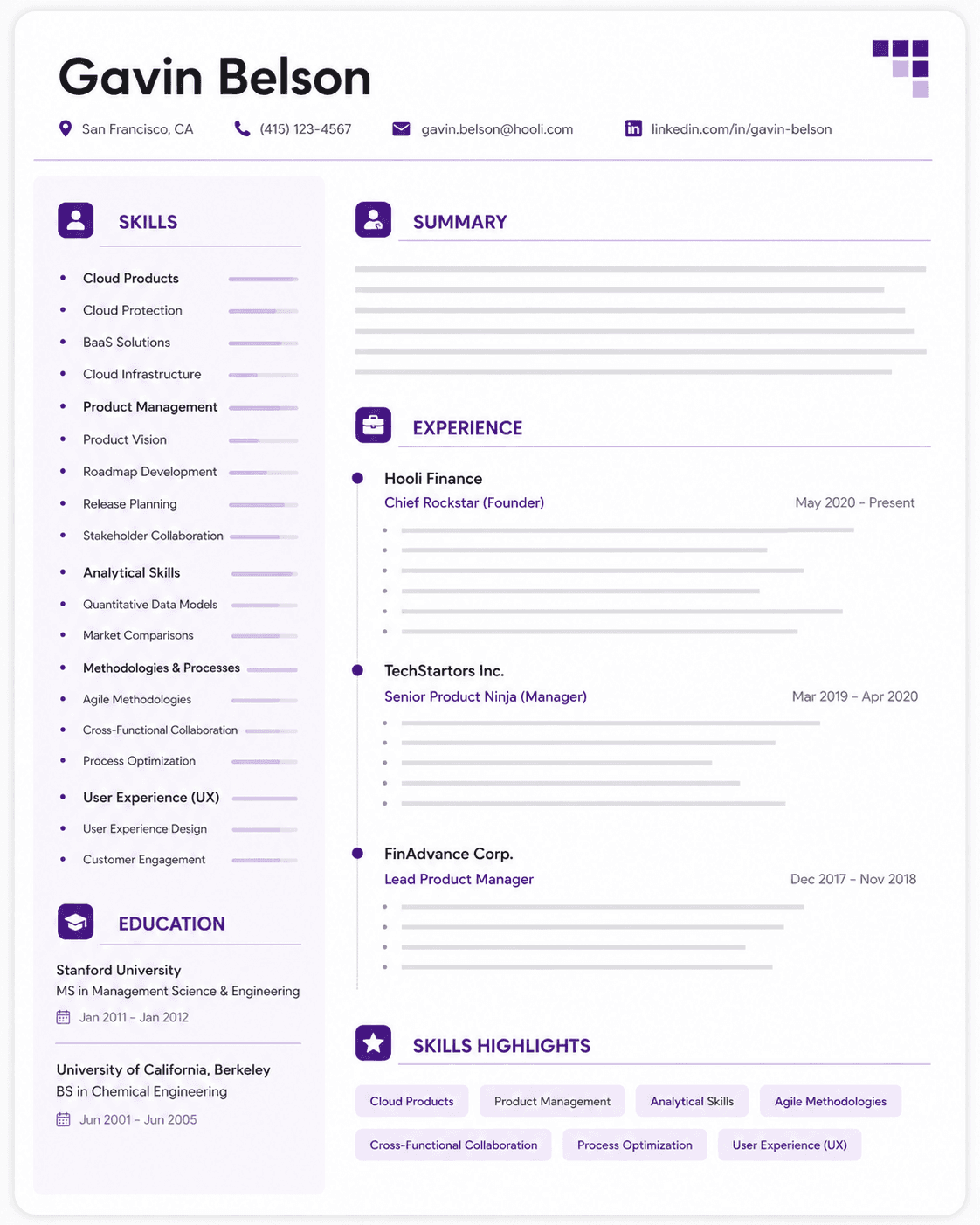
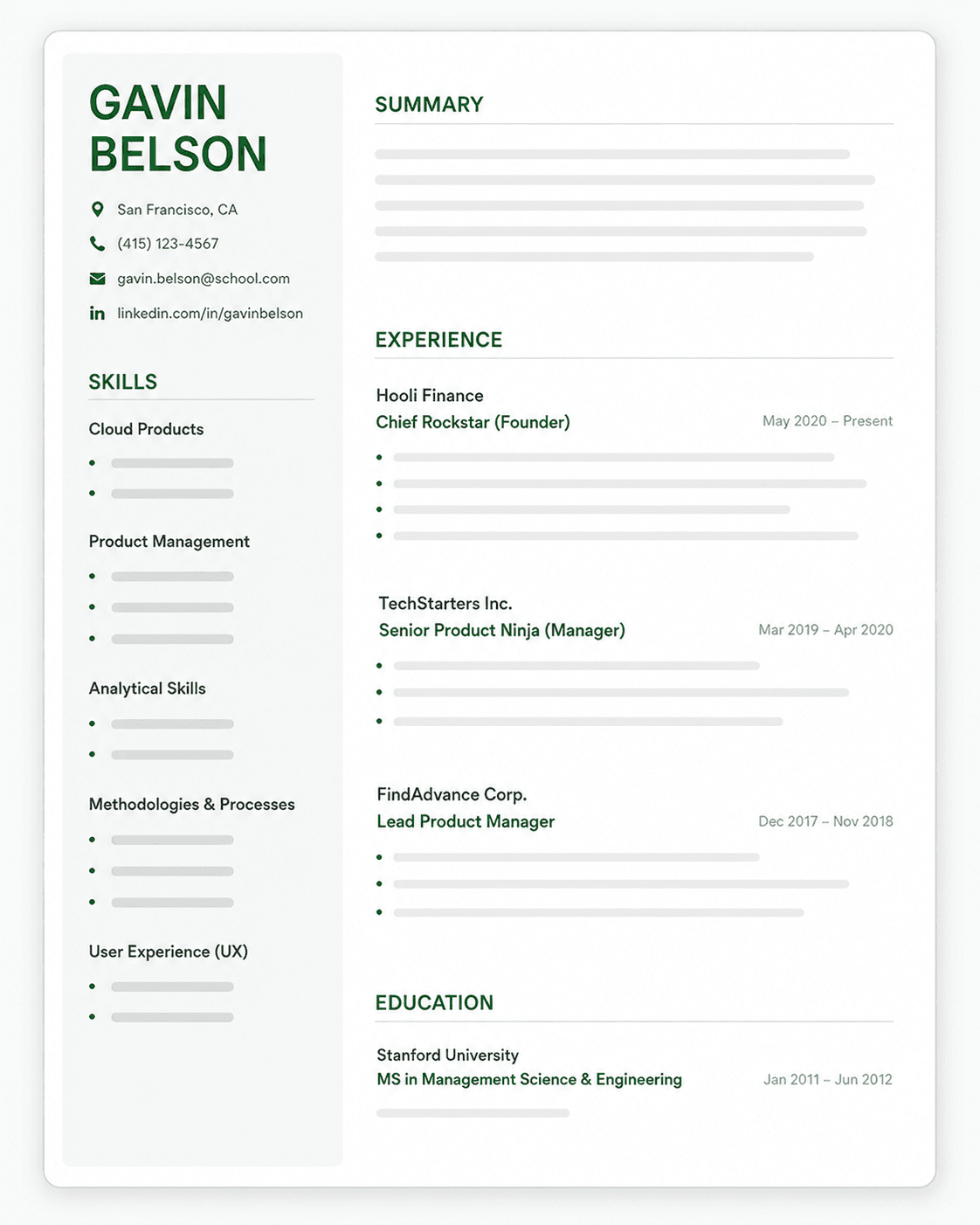
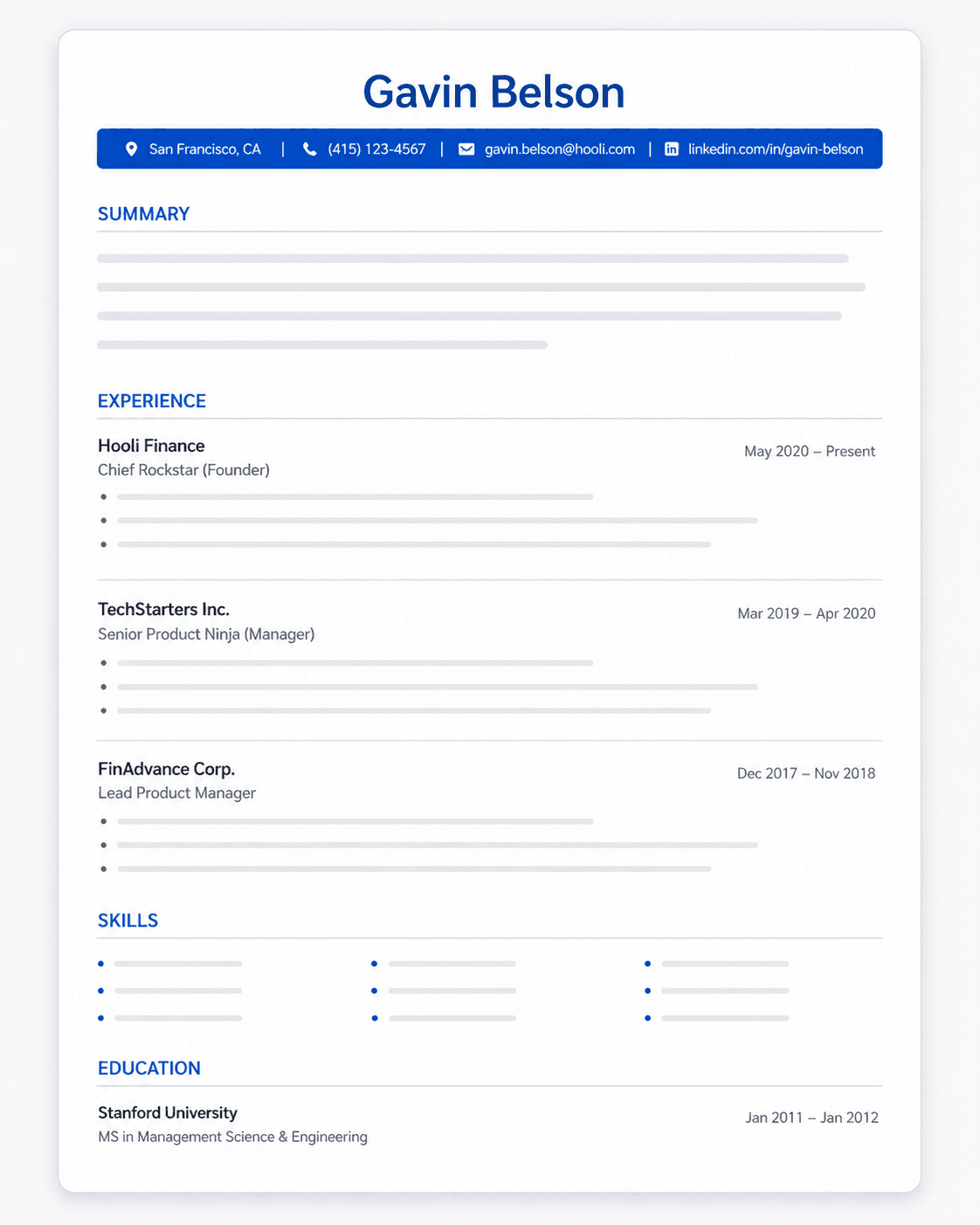
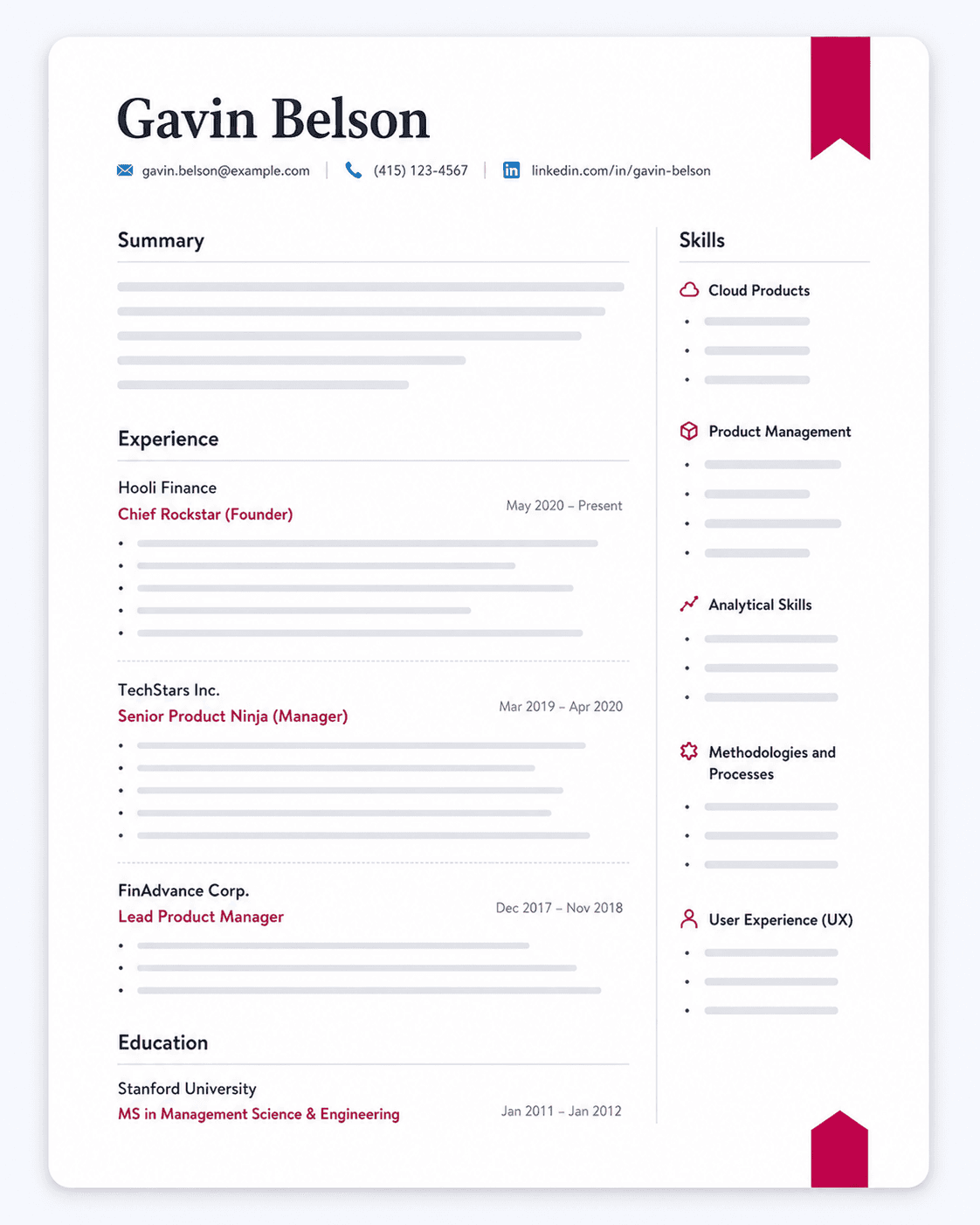
Reading a resume is faster than reading advice. Here is what a strong Java developer resume looks like at three career stages.
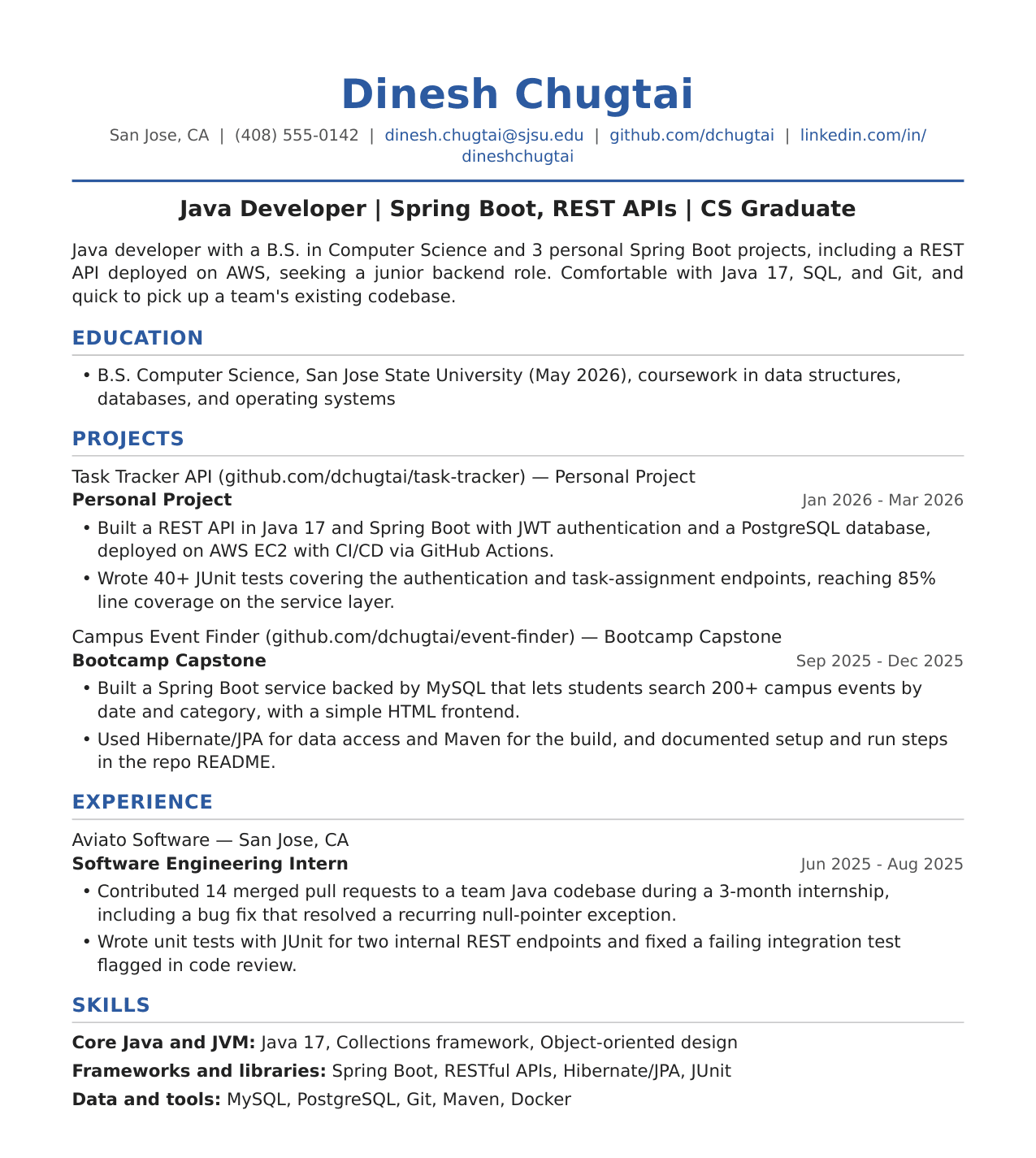
Entry-Level Java Developer Resume
Lead with education and an objective, not a summary, since you do not have production metrics yet. Name a CS degree or bootcamp, then one or two projects with a repo link and a plain sentence on what each one actually does, such as a REST API with JWT auth or a Spring Boot service backed by MySQL. List coursework-level tools directly: core Java, Spring Boot, JUnit, Git, MySQL. Skip a skills category you cannot back up in an interview. This resume is proving one thing: that you can write and ship working Java code without someone standing over you.
Mid-Level Java Developer Resume
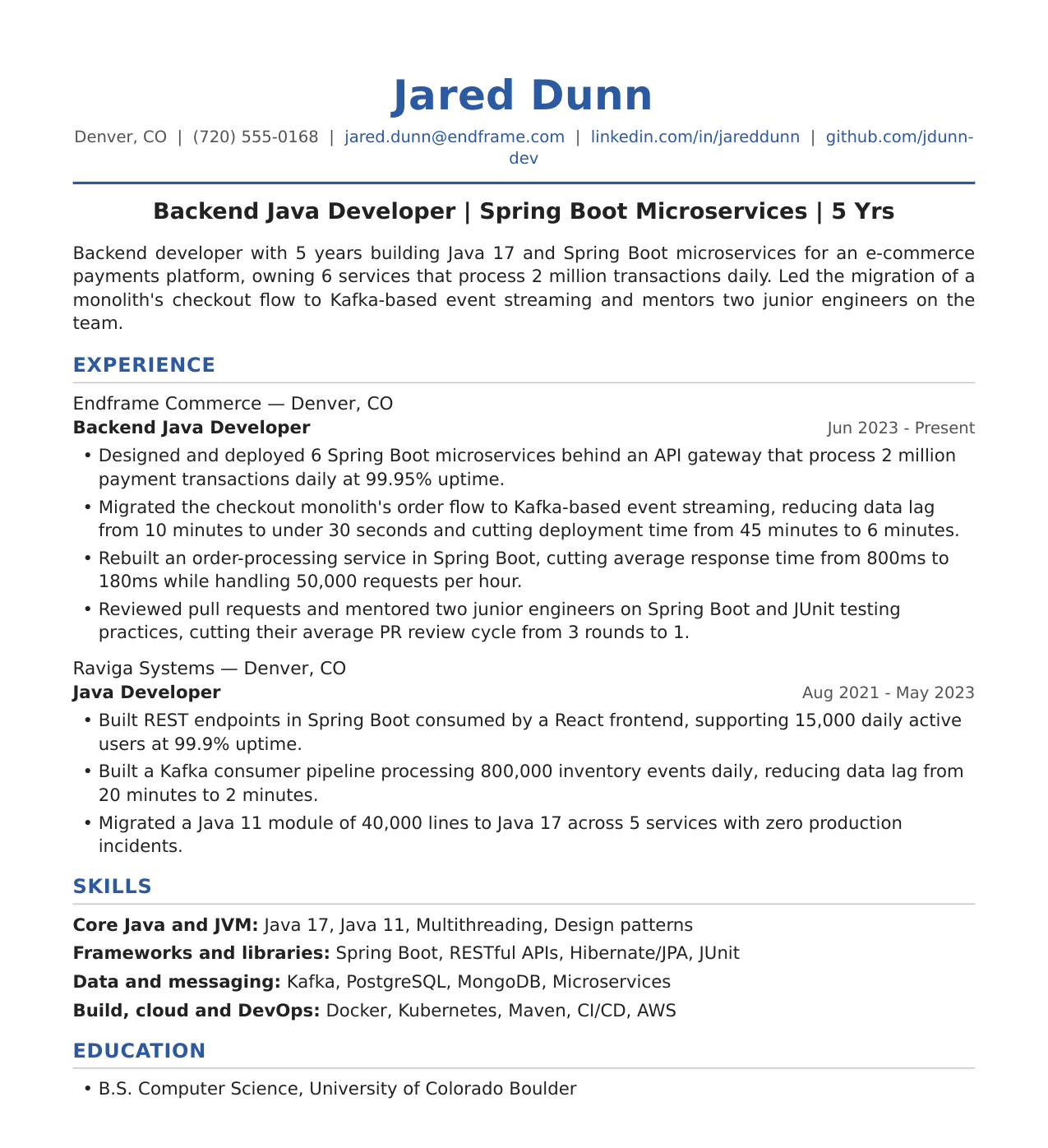
Lead with a summary naming years of experience, the domain you work in, and the stack you use daily. Experience becomes the longest section on the page, covering two or three roles, with bullets carrying throughput, latency, and service counts rather than task lists. Name Spring Boot, REST APIs, Kafka, Docker, a cloud platform (AWS, Azure, or GCP), and the specific SQL and NoSQL stores you touch, such as PostgreSQL and MongoDB. This resume is proving ownership of services running in production, not a queue of tickets closed.
Senior Java Developer Resume
Lead with scope: architecture decisions made, systems designed, migrations led, and engineers mentored. Drop coursework and personal projects entirely; they no longer carry weight at this level. Name the scale you operated at, requests per second, data volume, number of services owned, team size, and describe the trade-offs behind a decision, not just the outcome. On-call load and incident reduction belong here too. This resume is proving that you can be handed an ambiguous system problem and own the outcome.
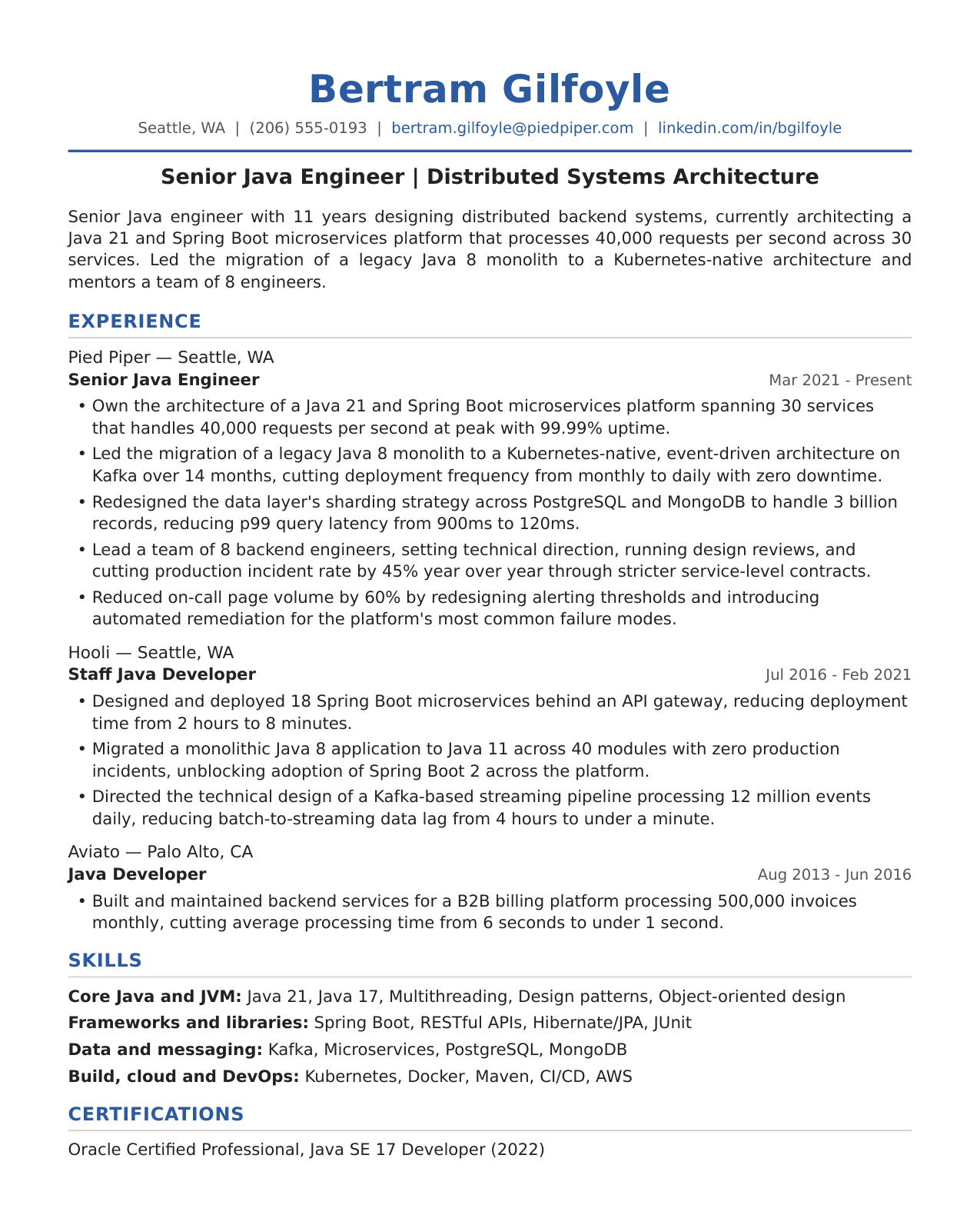
Each level shares the same backbone: one page for entry and mid-level, two pages at senior, reverse chronological order, and a stack named the way postings actually write it. What changes is which section carries the weight and how much proof stands behind it. If you sit between two levels, such as three years in with one Kafka project under your belt, borrow the mid-level summary structure and keep the scale claims modest rather than inflating your title.
Java Developer Resume Keywords
Java postings pack their requirements with specific framework, tooling, and platform names, and an ATS parser matches against that exact vocabulary before a recruiter ever opens the file, so the ATS resume keywords your resume carries decide whether it clears that first filter. The table below is vocabulary only, the precise terms nine live Java postings used; your bullets carry the numbers, years of experience, system scale, throughput, uptime, that the table cannot hold. One Java-specific note: postings frequently ask for unversioned "Java" or "Java/J2EE" rather than naming a release, so matching the posting's own wording matters more than swapping in whatever framework or version is newest on your end.
| Category | Keywords |
|---|---|
| Core Java and JVM | Java, Java/J2EE, Multithreading, Object-Oriented Programming (OOP), Design patterns and principles, Collections framework |
| Frameworks and libraries | Spring, Spring Boot, RESTful APIs, Hibernate/JPA, JUnit, Angular, React |
| Data and messaging | Kafka, Microservices, PostgreSQL, NoSQL, RabbitMQ, MongoDB |
| Build, cloud and DevOps | CI/CD, AWS, Kubernetes, Docker, Git, Maven, Jenkins |
List only the frameworks and tools you can work in unaided; a resume claiming a stack you cannot demonstrate in an interview costs more than a missed keyword ever will. Spelling varies across real postings too: most write "Spring Boot" as two words, but at least one writes "SpringBoot" as one, while "CI/CD" keeps its slash and "Microservices" stays one word everywhere it appears. Gradle never turned up across the nine postings sampled here while Maven did, so mirror what the specific posting asks for rather than assuming the newer build tool is what the employer wants.
Your Oracle Java Certification Probably Has a Different Name Now
Oracle restructured its Java certification path but left the old names circulating alongside the new ones. A developer who earned a credential a few years ago holds something real, but it now belongs to a naming scheme Oracle no longer issues. A recruiter scanning resumes for "OCP" without a version number has no easy way to tell what era that credential reflects, current Java or something from the Java 6, 7, or 8 generation.
The old path required two separately numbered exams: Oracle Certified Associate, Java SE 8 Programmer I (exam 1Z0-808), followed by Oracle Certified Professional, Java SE 8 Programmer II (exam 1Z0-809). Only passing both earned the OCP title. The current path is a single exam per version: Oracle Certified Professional, Java SE 17 Developer (exam 1Z0-829), with Oracle Certified Professional, Java SE 21 Developer (exam 1Z0-830) as its successor. Oracle's own Java SE 8 Programmer I exam page is still live, which is why both naming schemes keep circulating.
If your credential is from the Java 8 era, write it out in full with the version and the year you earned it, something like "Oracle Certified Professional, Java SE 8 Programmer" (2019), rather than shorthand like "OCPJP" or a bare "OCP." If you hold a current credential, write the full modern name the same way, for example "Oracle Certified Professional, Java SE 21 Developer," and put it in a dedicated Certifications section rather than folding it into a general skills list where the version detail gets lost.
The fix in one line: spell out the full credential name and version everywhere it appears on the resume, never a bare "OCP" or "OCPJP." Keep the framing honest too: a certification supports a resume, it doesn't substitute for shipped production work. That makes it matter most for career changers, self-taught developers, and anyone whose recent work sits under an NDA.
Java Developer Resume Mistakes to Avoid
Listing Every Framework You Have Ever Touched
List only what you can work in unaided. Everything you list is fair game in a screen, so a framework you saw once on a shared codebase can turn into a question you cannot defend.
Describing Tickets Instead of Systems
"Worked on backend services using Spring Boot" tells a reviewer nothing about what you actually built. Name the service, the load it handled, and what changed because of your work. A bullet that names a real system and a number survives a technical interview; a ticket description does not.
Leaving Java Unversioned While the Rest of the Resume Looks Modern
A resume that lists bare "Java" or "Java/J2EE" next to Kubernetes and CI/CD reads as a mismatch. Naming the LTS version you actually work in daily closes that gap and signals which release your day-to-day work runs on.
Sending One Resume to Backend, Full-Stack and Platform Roles
A backend posting, a full-stack posting with Angular or React, and a platform posting built around Kafka and Kubernetes ask for visibly different things. One resume sent to all three buries the relevant stack under the wrong emphasis. The skills block order and the summary need to move to match what each posting leads with.
Formatting That Breaks an ATS Parse
Two-column layouts, skills packed into tables or text boxes, a stack diagram rendered as a graphic, and non-standard section headings all risk a scrambled or dropped parse. A single-column layout with standard headings like "Experience" and "Skills" keeps every framework and version number machine-readable.
Writing "OCP" or "OCPJP" With No Java Version
A bare "OCP" or the older "OCPJP" abbreviation makes a real credential unreadable, since a recruiter cannot tell which Java era it belongs to. Write out the full credential name with its version instead, as covered in the certifications section above.
How AI Resume Builders Can Simplify Your Java Developer Resume
Every posting weighs your stack differently: a backend role wants Spring Boot and Kafka up front, a full-stack listing wants React alongside Java, a platform team cares more about Kubernetes. Rewriting your skills block and summary by hand for each one is slow, and a generic resume gets filtered before a recruiter opens it.
An AI resume builder built for this kind of tailoring helps in five ways:
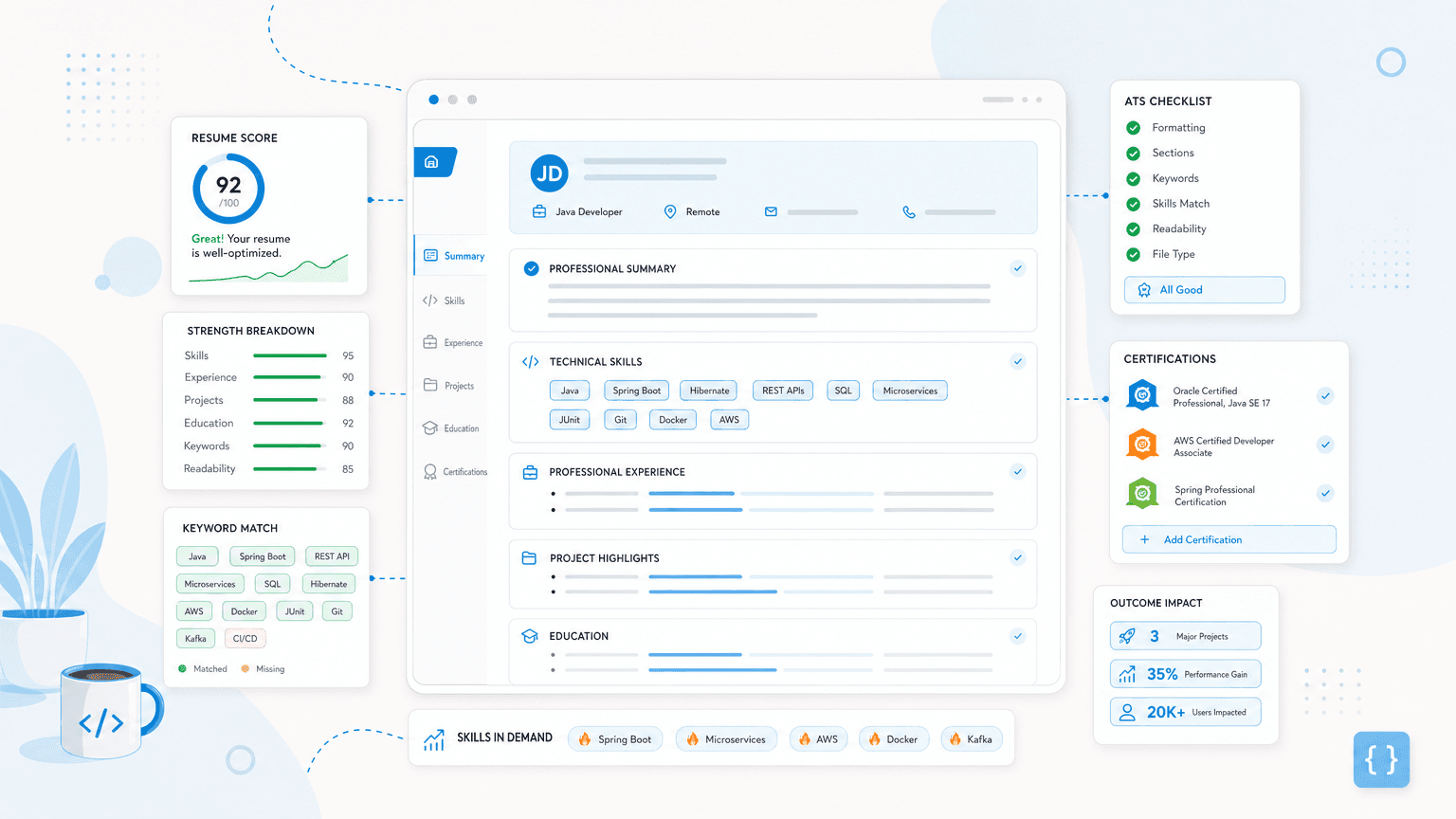
- Real-time ATS scoring: your ATS and recruiter match score update as you edit, so you know if a reordered tech stack or reworded bullet helped, no re-uploading needed.
- Transparent suggestions: every AI edit comes with a plain-language "why this change" explanation, and you accept or reject each one individually.
- Automatic formatting: your resume gets cleaned into ATS-friendly structure and design, so layout quirks that confuse parsers don't cost you a callback.
- Structure guidance: suggestions reorder content for relevance, strengthen action verbs, quantify performance gains or system scale, and flag language that could trigger bias.
- Preference memory: your formatting, metric, and reordering choices carry over between sessions.
Pricing stays honest for a job search with an end date. The free plan includes 200 ATS scans monthly, 3 tailored resumes with matching cover letters, and unlimited downloads, no credit card required. Extra resumes run $0.50 to $1.00 each, no subscription attached.
Try it on your own resume
Run a free ATS check in under ten seconds and see what's holding your resume back.