Every phlebotomist job posting seems to want the same thing: certification, plus a year of experience you don't have yet if you're just starting out. That gap is real, and it's why strong candidates get filtered out before a hiring manager even opens their resume.
The good news is that a phlebotomist resume doesn't need years of tenure to prove you're ready. It needs your credential visible, your draw numbers and accuracy quantified, and language specific to phlebotomy rather than generic healthcare filler.
This guide walks through every section of a phlebotomist resume, with real example bullets for entry-level, hospital, outpatient, and mobile draw settings, so you can build one that gets past both the applicant tracking system and the person reading it next.
How to Write a Phlebotomist Resume
The formula that gets a phlebotomist resume past both the applicant tracking system and the hiring manager is straightforward: lead with your certification, back up your experience with numbers, and skip the generic healthcare language.
Start with your credential. NHA-CPT, ASCP-PBT, or AMT-RPT should sit near the top of the resume, either in your header or your first bullet, along with issuing body and status. Most employers filter for certified candidates first.
In your experience section, replace task descriptions with metrics: draws per shift, first-stick success rate, specimen accuracy, patient volume. "Performed venipuncture" tells a hiring manager nothing. "Completed 40+ venipunctures daily with a 98% first-stick success rate" does.
Your skills section needs to name actual phlebotomy tasks (venipuncture, capillary puncture, order-of-draw, specimen labeling) instead of borrowed medical-assistant or CNA phrasing.
Use reverse-chronological format even if you're newly certified. List your clinical rotation or externship as your most recent entry, structured exactly like a job.
Write a Summary or Objective That Gets Noticed
Hiring managers scan the top third of a phlebotomist resume for seconds before deciding whether to keep reading. Your summary or objective needs to name your credential, your setting, and a real number in that window, not a string of soft-skill adjectives.
Craft a Summary for Experienced Phlebotomists
A summary works only when it replaces vague self-praise with specifics: how many draws you handle, which population you serve, and your accuracy record.
A weak summary looks like this:
"Organized and detail-oriented phlebotomist with strong communication skills and a passion for patient care."
A stronger one looks like this:
"ASCP-PBT certified phlebotomist with 3 years drawing blood in a 200-bed hospital lab, averaging 40+ venipunctures per shift with a 98% first-stick success rate. Trained 2 new hires on pediatric draws and maintained zero specimen mislabeling incidents over the past year."
The second version tells a hiring manager exactly what shift volume you can absorb and what your error rate looks like, which is what actually gets you past the first read.
Write an Objective for Entry-Level or Newly Certified Phlebotomists
If you're newly certified, skip the summary format entirely. An objective lets you lead with your credential and clinical hours instead of tenure you don't have yet.
"Recently certified phlebotomist (NHA-CPT) with 120 hours of clinical rotation experience completing venipuncture and capillary draws on adult and pediatric patients under supervision. Trained in order-of-draw protocol, specimen labeling, and chain-of-custody documentation. Seeking an entry-level phlebotomy role in a hospital or outpatient lab to apply hands-on training and grow into a high-volume draw environment."
This version turns your externship into concrete proof you've already handled real patients and real specimens, not just classroom hours.
Build a Phlebotomy Skills Section Hiring Managers Actually Scan
A skills section that says "attention to detail" and "team player" tells a hiring manager nothing. They're scanning for proof you can perform the exact draws and handle the exact systems their lab uses. Group your skills into categories, and every item should be something you can back up in an interview.
Group Your Skills So They're Easy to Scan
Clinical & Technical Skills Venipuncture (butterfly and straight-needle methods), capillary and heel-stick draws, order-of-draw protocol, vein selection for difficult draws, specimen collection and processing, centrifuge operation
Lab Systems & Compliance Epic, Cerner, and MediTech EHR/LIS navigation, specimen labeling and chain-of-custody documentation, HIPAA compliance, OSHA bloodborne pathogen standards, CLIA-waived testing procedures
Patient Care & Soft Skills Patient identification and consent verification, calming anxious or needle-phobic patients, clear pre-draw explanations, bedside manner under time pressure
Specialty Populations Pediatric and geriatric draws, oncology port access support, neonatal capillary collection, mobile and home-draw settings
Match the Skills to the Job, Not the Other Way Around
Only list a skill if you can perform it unaided on your first day. Claiming central line draws or pediatric expertise you haven't actually done will surface fast once you're on the floor.
Mirror the exact wording from the job posting. If the listing says "EMR documentation" instead of "LIS," use their term. Name the specific compliance standards and systems the posting mentions rather than a generic "knowledge of regulations."
Show Your Certifications and Credentials Near the Top
Certification is close to a requirement, not a bonus line. NHA reports that around 96% of employers require or prefer a phlebotomy certification before they'll interview you, so this section carries more weight on your resume than education or software skills.
The three credentials employers recognize most are the NHA Certified Phlebotomy Technician (CPT), the ASCP Phlebotomy Technician (PBT), and the AMT Registered Phlebotomy Technician (RPT). List whichever one you hold. If you're actively studying for one and haven't sat for the exam yet, say so plainly ("NHA-CPT candidate, exam scheduled [month/year]") rather than implying you're already certified.
Put your credential in two places. First, as a single line directly under your name in the header, right next to your phone and email (for example, "NHA Certified Phlebotomy Technician (CPT)"). Second, in its own "Certifications" section positioned near the top of the resume, right after your summary or objective, not tucked below education where hiring managers skim past it.
In that Certifications section, include the full credential name, the issuing body, a license or certification number if your state requires one for phlebotomists (check your state's requirements), the current status and expiration date, and renewal or CEU progress if the credential is close to lapsing. An expired certification without context reads as a red flag.
If you also hold BLS or CPR certification through the American Heart Association or Red Cross, list it here too. Many phlebotomy postings, especially hospital and mobile blood-draw roles, treat BLS as a standard add-on credential alongside your core phlebotomy certification.
CPT I and CPT II: Why a National Credential Stops at the California Border
Everything above this point assumes NHA-CPT, ASCP-PBT, or AMT-RPT is the finish line. In California, it is only the entry point. The state runs its own licensure system on top of national certification, and a resume built around the national credential alone will misrepresent what a California employer needs to see.
The California Department of Public Health's CPT I requirements call for 40 hours of didactic classroom training plus 40 hours of clinical practice, including at least 50 venipunctures and 10 skin punctures, on top of a passed national exam. That certificate authorizes skin puncture and venipuncture only, and it renews every year, unlike the national credentials, which run on longer cycles. NHA renews on a two-year cycle, so a California phlebotomist is tracking two renewal clocks at different speeds. CPT II adds arterial puncture, but only after 1,040 hours of on-the-job phlebotomy experience certified in writing by a laboratory director, plus 20 arterial punctures. One detail catches candidates off guard: CDPH does not count blood bank work toward that on-the-job experience. If your paid draws came from Red Cross blood drives, those hours may not transfer, because qualifying experience means blood collection for testing purposes across varying patient ages and health status, not donor collection.
If you already hold a California certificate, name CPT I or CPT II directly rather than folding it into a generic "state licensed" line, and give its annual renewal date its own entry separate from your national credential's cycle. If you are nationally certified and relocating to California, do not assume the credential transfers. Write "CA CPT I in process" instead of implying you hold it, and confirm your prior setting counts as qualifying experience before you promise an employer a start date.
If you are California-certified and applying out of state, keep the credential on the resume. CPT I and CPT II evidence a documented stick count and a credential you renew annually, which reads as rigor in the three other states that license phlebotomists and in the forty-six that do not.
Write Experience Bullets That Prove You Can Perform Under Pressure
Hiring managers scan the experience section for two things: whether you handle difficult sticks safely, and whether you move fast enough to keep a lab or unit on schedule. Vague task lists don't answer either question. Numbers do.
The Bullet Formula
Every bullet follows the same structure: [Action verb] + [specific task or technique] + [quantifiable result or scope]. Skip the formula and a bullet reads like a job description. Follow it and the same line becomes proof of performance.
A weak bullet looks like this:
"Responsible for drawing blood from patients and labeling samples correctly."
A stronger one looks like this:
"Performed 40-50 venipuncture and capillary draws per shift across adult and geriatric patients, maintaining a 98% first-stick success rate and zero specimen mislabeling incidents over 6 months."
The weak version describes a duty anyone in the role holds. The strong version proves you hold it well, with a volume, a success rate, and a timeframe attached.
Sub-Role Bullet Library
Adapt whichever variant matches your setting. Swap in your real numbers once you have them.
Entry-Level / Newly Certified (Clinical Externship)
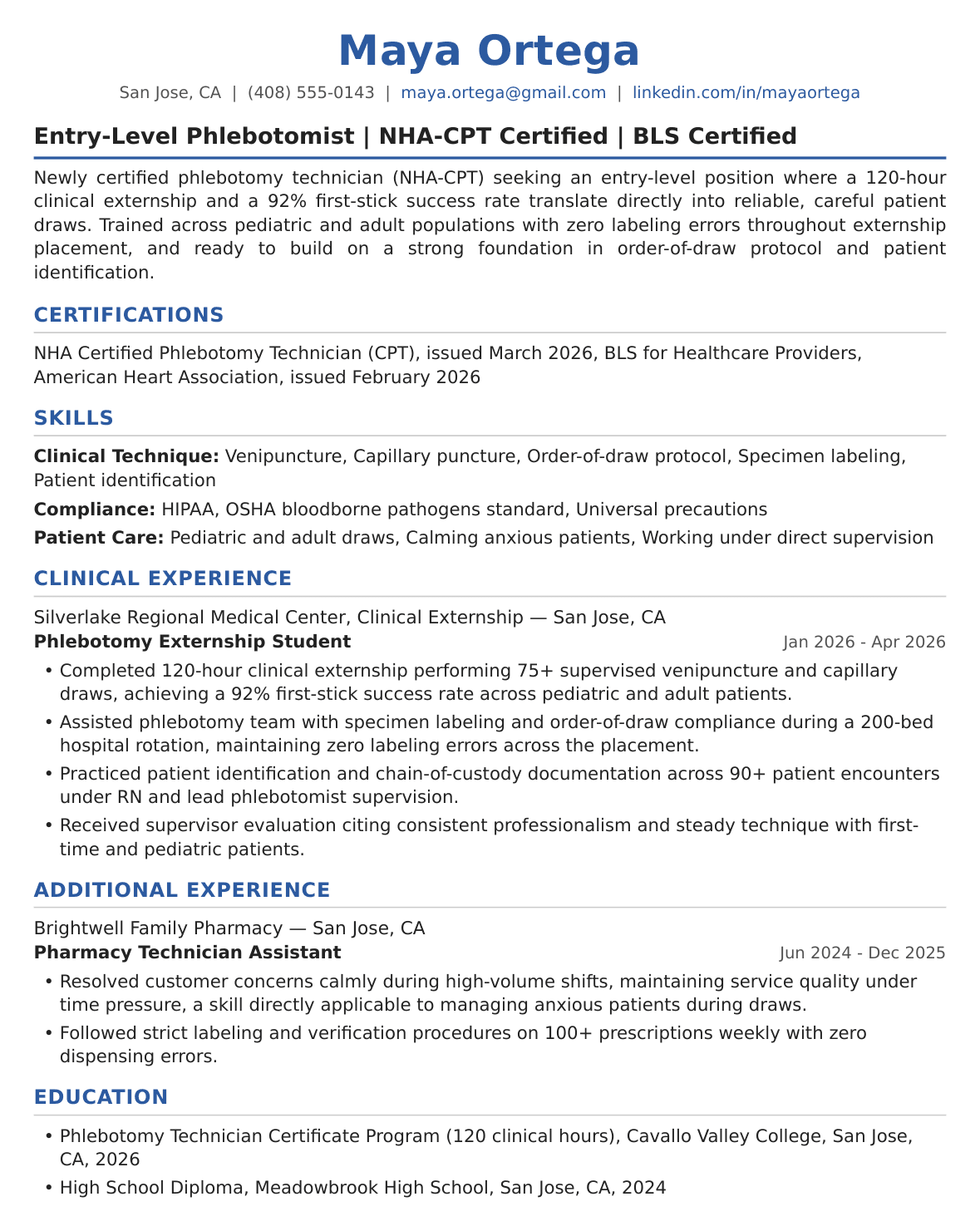
- Completed 120-hour clinical externship performing 75+ supervised venipuncture and capillary draws, achieving a 92% first-stick success rate across pediatric and adult patients.
- Assisted phlebotomy team with specimen labeling and order-of-draw compliance during a 200-bed hospital rotation, maintaining zero labeling errors across the placement.
Hospital / Inpatient Phlebotomist
- Performed 60-80 venipuncture draws per shift across med-surg, ICU, and ED units, sustaining a 97% first-stick success rate on patients with difficult venous access.
- Collaborated with nursing staff to complete STAT lab draws within a 15-minute turnaround window, supporting a 30-bed unit during overnight shifts.
Outpatient Clinic or Lab Phlebotomist
- Drew and processed 50-65 patient specimens daily in a high-volume outpatient lab, maintaining a 98% first-stick success rate and same-day specimen accuracy.
- Managed patient scheduling and specimen chain-of-custody for a clinic serving 40+ daily walk-ins, reducing average wait time by communicating draw order clearly to front-desk staff.
Mobile / Blood Drive Phlebotomist (Red Cross-style)
- Collected 30-45 whole blood and platelet donations per drive across community and corporate sites, maintaining a 96% first-stick success rate under mobile setup conditions.
- Set up and broke down mobile draw stations for 3-4 blood drives weekly, screening donors for eligibility and maintaining sterile technique with zero contamination incidents.
Quantify Scope When You Lack Clean Numbers
If you don't have precise metrics yet, quantify what you can verify: estimated draw volume based on shift length, the patient population you served, specimen accuracy over a training period, or hours of supervised practice completed. Ask a supervisor or preceptor for a rough draw count, check your program's competency logs, or calculate a daily average from shift length and typical caseload. Round down when estimating rather than guessing high.
What to Do If You Have No Phlebotomy Experience Yet
Newly certified phlebotomists run into a real bind: postings ask for "1+ year of experience" for jobs that would give you that first year. Practitioners describe this exact frustration on nursing forums, and it's a chronic, widely shared complaint, not a sign you're doing something wrong. Apply anyway to settings that hire and train newer techs, including urgent care clinics, independent labs, and blood donation organizations like the Red Cross, alongside a strong resume.
Turn Clinical Rotations, Externships, and Coursework Into Experience
Your clinical rotation or externship is work history. List it like a job: facility name (or "Regional Medical Center, Clinical Rotation" if you need to anonymize it), city and state, and the date range you completed it. Then write bullets using the same formula as any experience entry: action verb, task, scope.
For example:
- Performed 150+ venipuncture and capillary draws on adult and pediatric patients under RN supervision during a 120-hour clinical rotation
- Processed and labeled specimens per facility protocol with zero rejected samples across rotation
- Practiced order-of-draw and patient identification procedures across 40+ patient encounters
If your program tracked your stick counts, use the real number. If it didn't, describe volume honestly ("multiple daily draws" or "consistent patient contact throughout the rotation") rather than inventing a figure. Your certification exam prep also counts as content: a line noting you passed the NHA, ASCP, or AMT exam, or completed an accredited phlebotomy program with clinical hours, belongs in your certifications section, not buried in your education.
Reframe Transferable Skills From Other Jobs
Retail, food service, and caregiving jobs taught you real, transferable skills: staying steady with frustrated people, following procedures exactly, working fast without cutting corners. The trick is naming the skill in terms a hiring manager scanning for phlebotomy traits will recognize.
Weak:
"Handled customer complaints at retail job."
Strong:
"Resolved customer concerns calmly during high-volume shifts, maintaining service quality under time pressure, a skill directly applicable to managing anxious patients during draws."
Phlebotomist Resume Examples by Setting and Level
A phlebotomist resume for a busy hospital lab reads differently than one for a mobile draw service or a first job out of certification. Setting shapes what a hiring manager looks for first even when the underlying draw technique overlaps, so match your resume to where you are actually applying rather than building one generic version.
Entry-Level Phlebotomist Resume
Lead with an objective, not a summary, naming your certification status (NHA-CPT candidate or newly certified) and your clinical externship hours in the first line, since you do not have tenure to lean on yet. Put certifications and BLS directly under your header in a labeled block, ahead of any work history. List your 120-hour clinical externship as a real job entry with bullets built from your actual rotation numbers: 75+ supervised venipuncture and capillary draws, a 92% first-stick success rate, pediatric and adult exposure, zero labeling errors. Skills should cover order-of-draw protocol, specimen labeling, and patient identification rather than named lab systems, since you likely only observed Epic or Cerner during rotation. Drop a lengthy work history section entirely and put skills and certifications above the fold instead.
Hospital or Inpatient Phlebotomist Resume
Lead with a summary naming your credential (ASCP-PBT or NHA-CPT plus BLS), your bed count or unit type, and your first-stick rate in the opening two lines. Certifications sit in their own section right after the summary, with BLS listed alongside your core credential since hospital postings routinely expect both. Name Epic Beaker and Cerner explicitly in your skills section, since inpatient labs run on EHR-integrated systems and hiring managers scan for that exact terminology. Bullets should quantify shift volume (60-80 draws), difficult venous access on ICU, ED, and med-surg units, and STAT turnaround windows of 15 minutes or less, plus coordination with nursing staff. De-emphasize scheduling independence and patient-facing communication here. Scope, speed, and system fluency carry more weight than bedside manner alone.
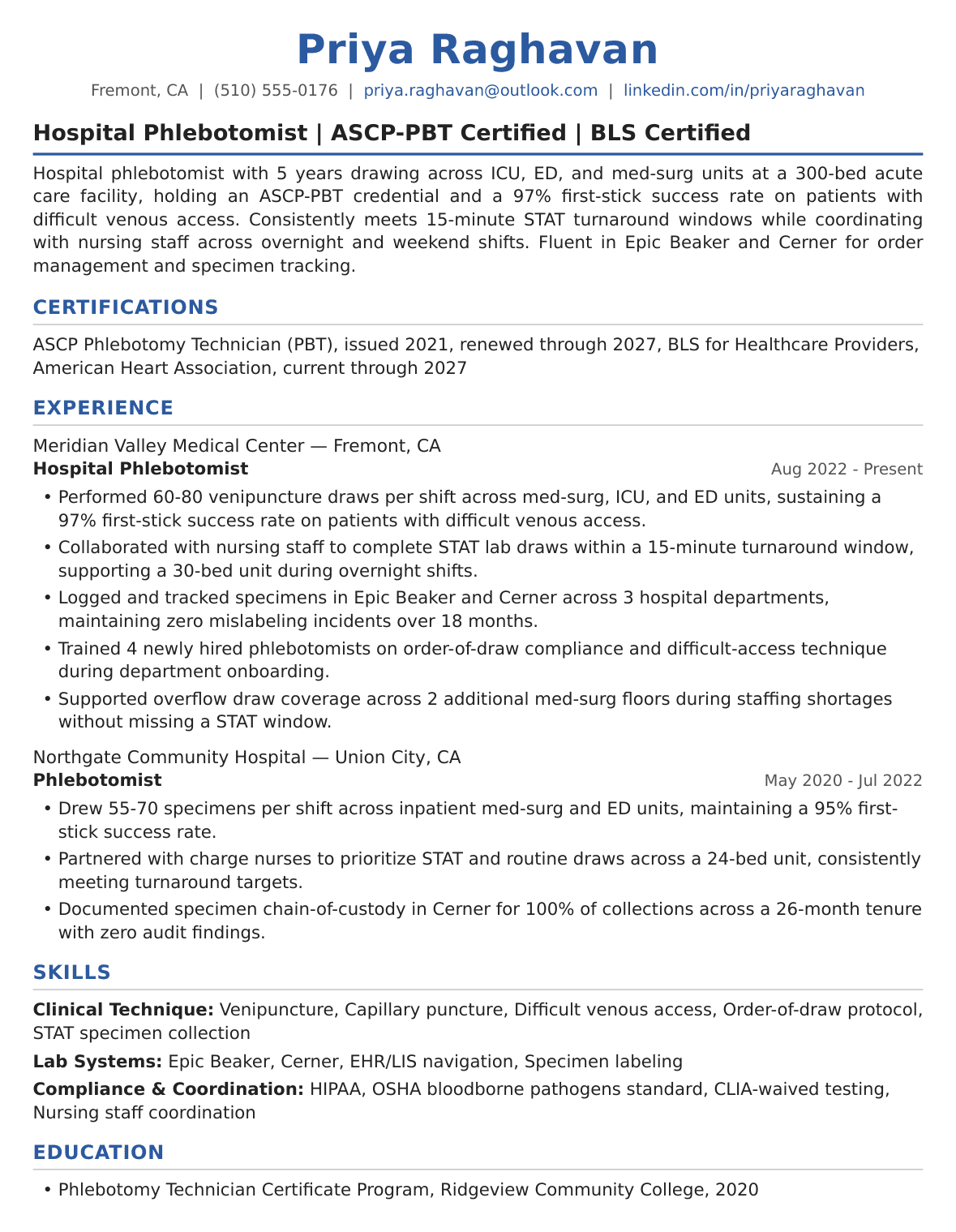
Outpatient or Mobile Phlebotomist Resume
Lead with a summary or objective naming your setting (high-volume outpatient lab or mobile blood drive), your certification (NHA-CPT or AMT-RPT, with BLS if you work blood drives), and your daily patient or donor volume. Skills should highlight patient scheduling, donor eligibility screening, and lighter standalone lab systems like MediTech rather than hospital-integrated EHRs, since outpatient and mobile sites rarely run Epic Beaker. Bullets need setting-specific volume: 50-65 specimens processed daily and 40+ daily walk-ins for outpatient clinics, or 30-45 donations per drive across 3-4 weekly mobile sites for blood-drive work, plus sterile technique and zero-contamination records. De-emphasize inpatient acuity language like difficult-stick counts on complex units. Independence, reliability, and communication with anxious or first-time donors matter more here than raw shift volume.
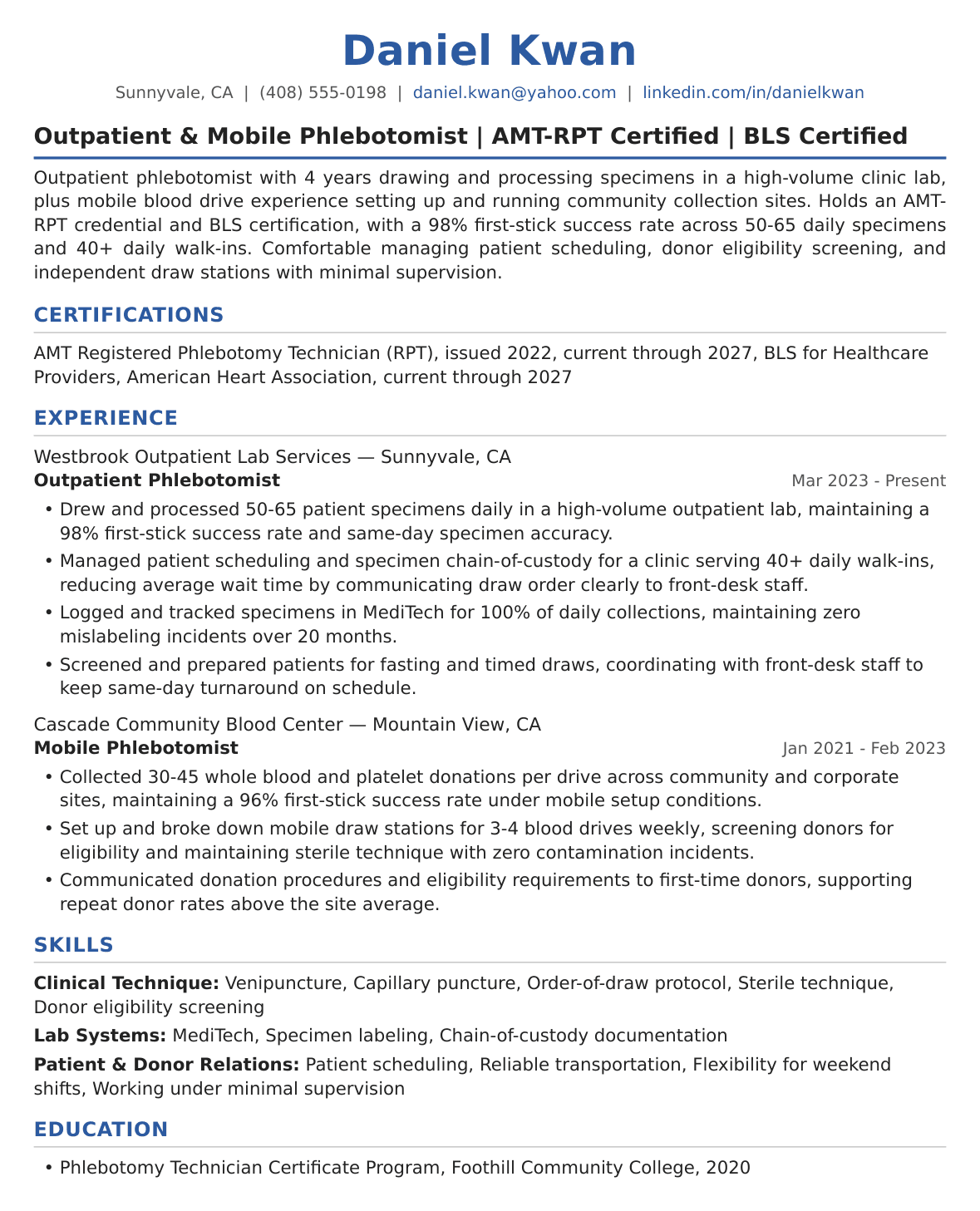
All three variants share the same core: certification up top, BLS where the setting expects it, and bullets built on the same action-verb-plus-scope formula. What changes is which numbers you lead with and which systems you name. If you sit between two settings, for example hospital experience but applying to a mobile draw service, keep your hospital draw volume and first-stick rate, then reframe the bullets around donor interaction, mobile setup, and independent scheduling so the resume reads as a fit for where you are applying rather than where you came from.
Phlebotomist Resume Keywords
Phlebotomy postings lean on a narrow, repeatable vocabulary, and most of them run through an applicant tracking system before a person reads them. Getting the ATS resume keywords right decides whether your resume reaches a lab manager at all. The table below covers the terms a parser scans for. Your experience bullets still carry the numbers behind them.
| Category | Keywords |
|---|---|
| Certifications & compliance | NHA CPT, ASCP PBT, AMT RPT, BLS, HIPAA, OSHA, CLIA-waived testing |
| Clinical & collection skills | Venipuncture, capillary puncture, order-of-draw, specimen collection and processing, chain-of-custody documentation |
| Lab systems & documentation | Epic Beaker, Cerner, MediTech, Sunquest, specimen labeling, EHR/LIS navigation |
| Patient care & reliability | Patient identification, communication skills, working under minimal supervision, reliable transportation, flexibility for weekend shifts |
Some of these terms are situational. List Sunquest only if you have actually logged specimens in it, and leave off pediatric-draw language if your training never included a pediatric patient. A system you cannot answer questions about in an interview costs you more credibility than a blank line would.
An ATS matches the literal string on the page, not the idea behind it. "Phlebotomist" and "phlebotomy technician" parse as two different strings to some systems, so use the exact title the posting has. The same applies to "capillary puncture" versus "finger stick," and "LIS" versus "EMR." A near-synonym can register as a miss even when a person reading the page would call it the same thing.
Common Phlebotomist Resume Mistakes to Avoid
Listing Tasks Instead of Results
"Performed venipuncture on patients" describes a job description, not a resume bullet. Pair every duty with a number: draws per shift, first-stick rate, or specimen accuracy.
Sending the Same Resume to Every Job
A resume built for a hospital lab won't match an outpatient clinic's posting. Mirror the exact skills and phrasing in each job description before you submit, especially around specialty populations and lab systems.
Listing Certifications Without Status or Expiration
Naming your NHA-CPT or ASCP-PBT credential isn't enough. Include the issue date, expiration date, and whether it's active, since hiring managers scan for current status first.
Using Generic "Healthcare Support" Language
Skills like "patient care" or "attention to detail" could describe any clinical role. Use phlebotomy-specific terms instead: venipuncture, capillary puncture, order-of-draw, specimen chain-of-custody.
Formatting That Confuses the ATS
Tables, text boxes, headers/footers, and graphics often don't parse correctly in applicant tracking systems. Stick to a single-column layout with standard headings so your skills and certifications get read.
Leaving Out Patient Population or Setting
A resume that never mentions pediatric, geriatric, outpatient, or ED experience gives hiring managers no way to judge fit. Name the settings and populations you've worked with directly in your bullets.
Claiming Unrealistic Stats
A "100% first-stick success rate" will read as fabricated rather than convincing. Keep numbers in a believable range, roughly 90 to 99 percent, so hiring managers trust the rest of your resume.
How AI Resume Builders Can Simplify Your Phlebotomist Resume
Rewriting a resume for every phlebotomy job, whether it's a hospital lab, a blood donation center, or a mobile draw service, takes real time, and a single generic version tends to get filtered out before a recruiter ever sees it. Upplai handles that tailoring in minutes instead of the 40-60 minutes manual editing usually takes.
- Real-time ATS scoring: see your ATS and recruiter scores update as you edit, so you know whether a change actually helped before you download anything.
- Transparent suggestions: every edit comes with a plain-language "why this change" explanation, and you accept or reject each one individually. Nothing gets rewritten behind your back, and no experience gets invented.
- Automatic formatting: choose from multiple ATS-friendly templates and color themes, with full design control and unlimited downloads in PDF, DOCX, and TXT.
- Structure guidance: content gets reordered for relevance, action verbs get strengthened, achievements get quantified, and potential bias triggers get flagged, all based on recruiter best practices.
- Preference memory: bookmark a master resume for each type of phlebotomy role you're targeting, and your formatting and phrasing choices carry over between sessions.
Pricing stays honest for a job search that has an end date. The free plan includes 200 ATS scans a month, 3 tailored resumes, and unlimited downloads, with no credit card required. Additional resume packs run $0.50 to $1.00 each, with no subscription attached.
Check your phlebotomist resume score
Upload your resume and see exactly where it stands before you apply.