"Staff accountant" covers three different jobs: rotating through client engagements at a public accounting firm, owning one company's close in private industry, or managing grant-restricted funds at a nonprofit. Whatever the setting, the hiring manager reading your resume checks the same four things: real scope in the close process, systems you already know, honest CPA status, and bullets that carry numbers instead of duty descriptions.
Generic resume advice covers format and action verbs, but it skips those specifics. It won't tell you how to word "CPA candidate" without overclaiming a license you don't have, or why listing SAP when you've only run QuickBooks signals a size mismatch.
This guide walks every section, summary, skills, bullets, and CPA-track wording, with examples at each career stage, a sub-role bullet library, and a keyword table pulled from live postings.
How to Write a Staff Accountant Resume That Gets Interviews
A hiring manager screening staff accountant resumes is checking for four things in order: whether you own real scope in the close process, which systems you already know, whether your credential status is stated honestly, and whether your bullets carry numbers instead of duty descriptions. Build each section below with those four checks in mind.
Write a Summary That Signals Scope, Not Just Duties
Your summary has one job: prove in three lines that you own accounting work, not just process transactions. Name your years of experience, the close cycle you support (month-end, quarter-end, or both), the entity structure you work within (single entity vs. multiple subsidiaries), and one system you run daily.
A weak summary looks like this:
"Detail-oriented staff accountant with strong analytical skills and experience in accounting tasks including reconciliations and journal entries."
A stronger one looks like this:
"Staff accountant with 2 years of experience owning month-end close for 3 subsidiaries, reconciling 40+ balance sheet accounts monthly in NetSuite. CPA candidate, 2 of 4 exam sections passed. Reduced close timeline from 8 to 6 business days by rebuilding the accrual schedule."
If you're a career-changer moving out of bookkeeping or AP, lead with your degree and the accounting-specific work you've already touched (reconciliations, journal entries, GAAP-based reporting) rather than years of tenure you don't have yet.
Build a Skills Section Hiring Managers Actually Scan
A skills section that lists "Excel, detail-oriented, team player" tells a hiring manager nothing an ATS or a recruiter can act on. Group your skills into categories that mirror how postings for this role are actually written, so a 6-second scan lands on the exact terms a screener is searching for.
Core Accounting & Close: Journal entries, General ledger, Account reconciliation, Month-end close, Quarter-end close, Accruals, Balance sheet reconciliation, Variance analysis
Software & Systems: QuickBooks, Xero, Sage Intacct, NetSuite, SAP, Oracle, Advanced Excel
Compliance & Standards: GAAP, SOX compliance, Internal controls, Audit support, Governmental accounting standards
Certifications & Credentials: CPA candidate, CPA Exam sections passed, Bachelor's degree in Accounting, CMA
Only list what you've done unaided, not a tool you watched a senior accountant run. Match the job posting's exact wording (if the JD says "Sage Intacct," don't write "Intacct" and hope the ATS connects the dots). List every ERP you've actually worked in, since employer size and software tier are tightly linked, covered in more detail below.
Turn Close-Cycle and Reconciliation Work Into Achievement Bullets
Every experience bullet should follow the same formula: [action verb] + [specific task or method] + [quantifiable result or scope]. "Performed reconciliations" is a task. "Reconciled 35 general ledger accounts across 2 entities every month, closing 2 days ahead of the internal deadline" is a scope statement a hiring manager can compare against other candidates.
A weak bullet looks like this:
"Responsible for month-end close activities and account reconciliations."
A stronger one looks like this:
"Owned month-end close for 4 cost centers, reconciling 30+ balance sheet accounts and preparing accrual entries that cut close time from 10 to 7 business days with zero audit adjustments."
The setting you work in changes what "scope" looks like. Use the library below as a starting point and swap in your own numbers.
Public Accounting / Audit-Adjacent
- Prepared and reviewed work papers for 15+ client engagements during audit season, tying out account balances against client-provided trial balances with a 98% first-pass accuracy rate
- Assisted senior auditors with substantive testing on cash, AP, and fixed asset accounts across 8 clients, flagging 3 reconciling items that led to material adjusting entries
Private Industry / Corporate
- Managed month-end close for 3 subsidiaries, reconciling 40+ balance sheet accounts and preparing consolidated variance analysis for the controller within a 5-day close window
- Recorded and reviewed 200+ journal entries monthly in NetSuite, maintaining a 99.5% accuracy rate across accrual, prepaid, and fixed asset schedules
Nonprofit / Governmental
- Reconciled 25 grant-restricted fund accounts monthly against award terms, supporting a clean single audit with zero findings for the fiscal year
- Prepared quarterly financial reports for a $12M operating budget across 6 program funds, in compliance with governmental accounting standards
Staff-to-senior promotion typically takes about 2 to 3 years, but tenure alone doesn't make the case for readiness. Scope does, so once you hit that mark, let bullets showing account ownership, entity count, and close-timeline impact carry the argument instead of your job title's age.
If you don't have clean metrics yet, quantify scope instead: number of accounts, entities, or funds you touched, and the close timeline you helped hit. Check prior month-end checklists, close calendars, and audit work papers; the numbers are usually already sitting in files you've already used.
Match Your Software Experience to the Employer's Size
Naming the wrong tier of software signals a company-size mismatch before a recruiter even reads your bullets. Small businesses and nonprofits commonly run QuickBooks or Xero. Mid-market companies commonly run NetSuite or Sage Intacct. Enterprise and public companies commonly run SAP or Oracle. If you've only worked in QuickBooks, don't pad your resume with SAP just because you sat in a training demo once. List the tier you can actually operate in and let your close-cycle bullets prove you're ready to grow into a bigger system.
If you're applying to a company one tier up from your current experience, say so directly in your summary or a skills note ("proficient in NetSuite; prior QuickBooks experience at a smaller entity"), rather than hoping the recruiter infers it. That framing reads as self-aware, not underqualified.
Represent CPA-Track Status Honestly (Without Claiming a License You Don't Have)
Most staff accountant postings list the CPA as a plus, not a requirement, since staff accountant is often the role you hold while working toward the credential, not after. That makes wording your status correctly one of the highest-stakes lines on the resume. Never write "CPA" unqualified unless you're licensed.
The traditional path requires 150 college credit hours, 30 more than a standard bachelor's degree, including 21 semester hours of accounting coursework and 9 semester hours of business coursework in most states; check your state board education requirements, since the accounting- and business-hour split varies. In 2025, AICPA and NASBA approved model legislation for an additional licensure pathway: a 120-hour bachelor's degree with an accounting concentration plus 2 years of qualifying experience and a passed CPA Exam, no extra 30 credit hours required. As of July 2026, 44 states have enacted this 120-credit pathway, with 4 more states considering legislation and some pathways' effective dates running through 2027, so two candidates with identical transcripts may need to word their status differently depending on where they're licensed.
Use exact, honest phrasing instead of guessing at a shortcut: "CPA candidate," "pursuing CPA licensure," or "2 of 4 CPA Exam sections passed." If you know your expected licensure date once credit hours or experience requirements are met, name it. A hiring manager reading "CPA candidate, expected licensure Q2 2027" gets a clear, checkable signal. A resume that just says "CPA" when you're not licensed gets you dropped from consideration the moment someone checks.
Staff Accountant Resume Examples
Entry-Level
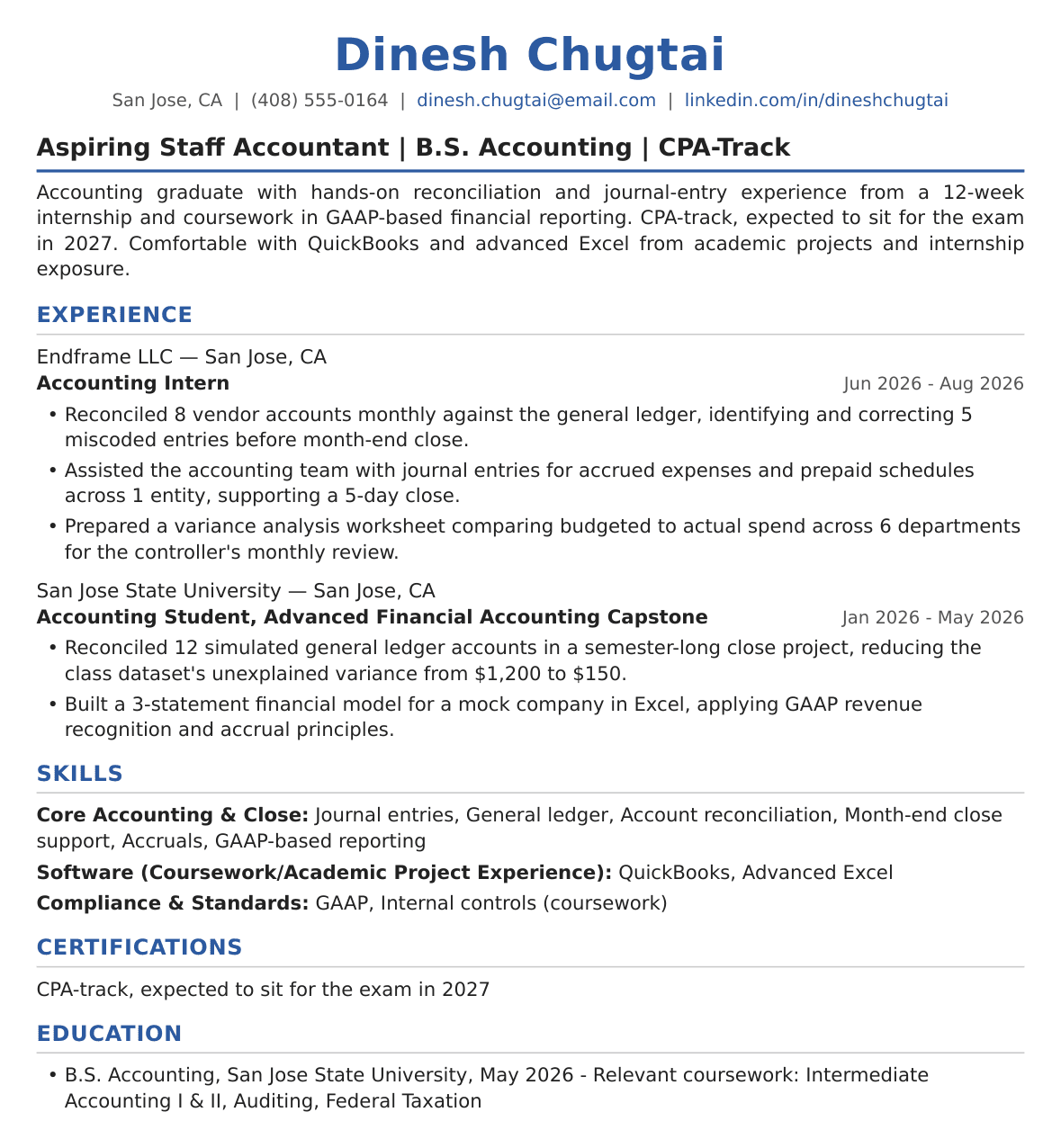
An entry-level staff accountant resume leads with education and training rather than tenure: degree, relevant coursework, internships, and any accounting-adjacent student work. The summary should name the specific skills you can already perform unaided (journal entries, reconciliations you completed during an internship, GAAP-based coursework) rather than tenure you don't have. Bullets should quantify what you handled, even at small scale, such as the number of accounts reconciled during an internship or the size of a dataset you cleaned for a class project. Software should be listed honestly: coursework exposure to QuickBooks or Excel counts, but should read as "coursework/academic project experience," not on-the-job proficiency. CPA status, if pursuing, belongs near the top: "CPA-track, expected to sit for the exam in [year]."
1 to 3 Years (CPA-Track)
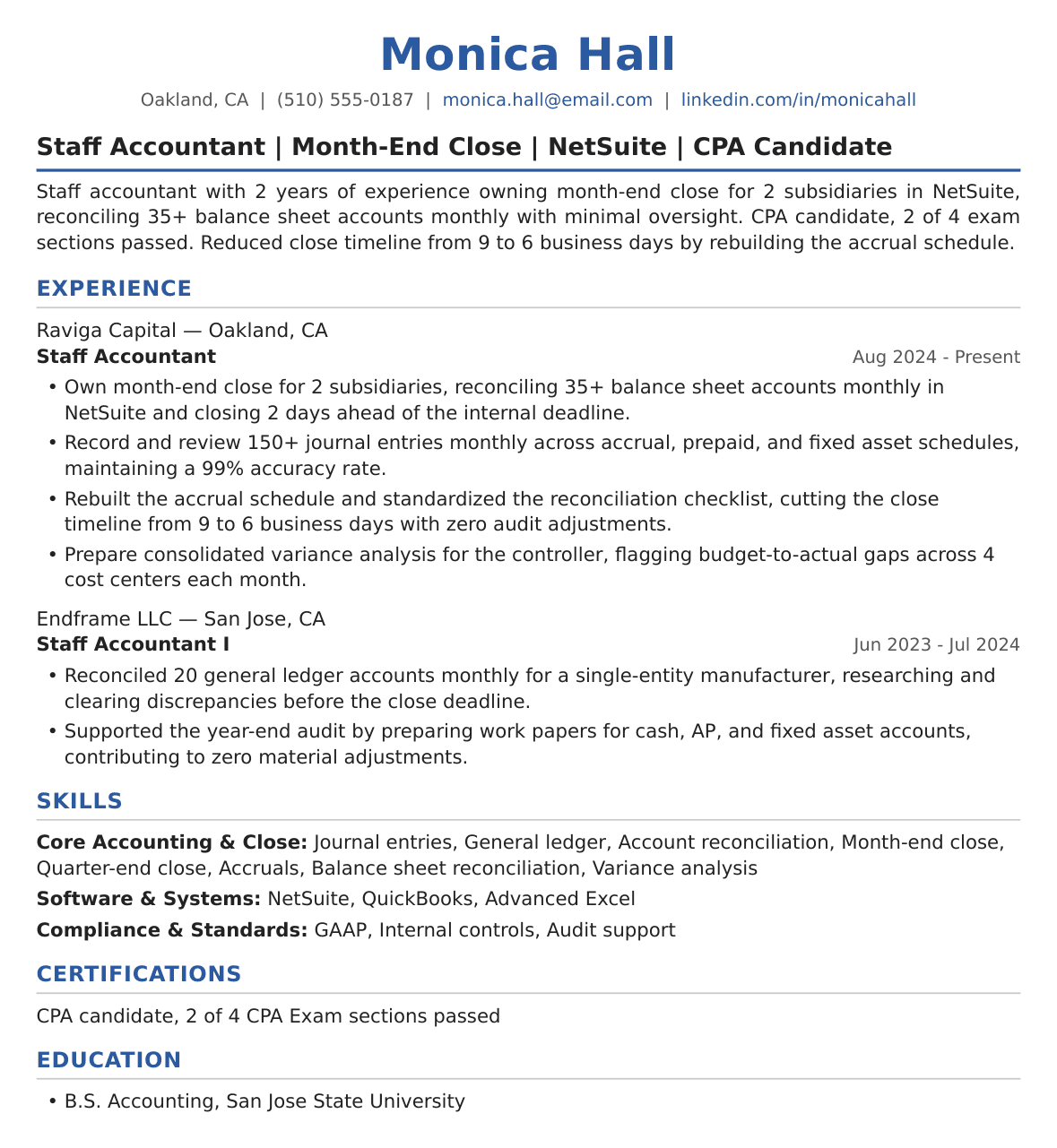
This is the resume most staff accountants are actually writing. It should prove independent ownership of a defined piece of the close, not just participation in it: a specific entity, a specific set of accounts, a specific reconciliation process you run each month with minimal oversight. The summary should name years of experience, the ERP tier used, and exact CPA-exam progress ("2 of 4 sections passed"). Bullets should carry real close-timeline numbers (days saved, accounts owned, entities covered) rather than duty descriptions. This is where the sub-role bullet library above becomes most useful, since a 1-to-3-year candidate should pick the employer setting (public accounting, private industry, or nonprofit) that matches their actual background rather than a generic blend.
Ready for Senior Accountant
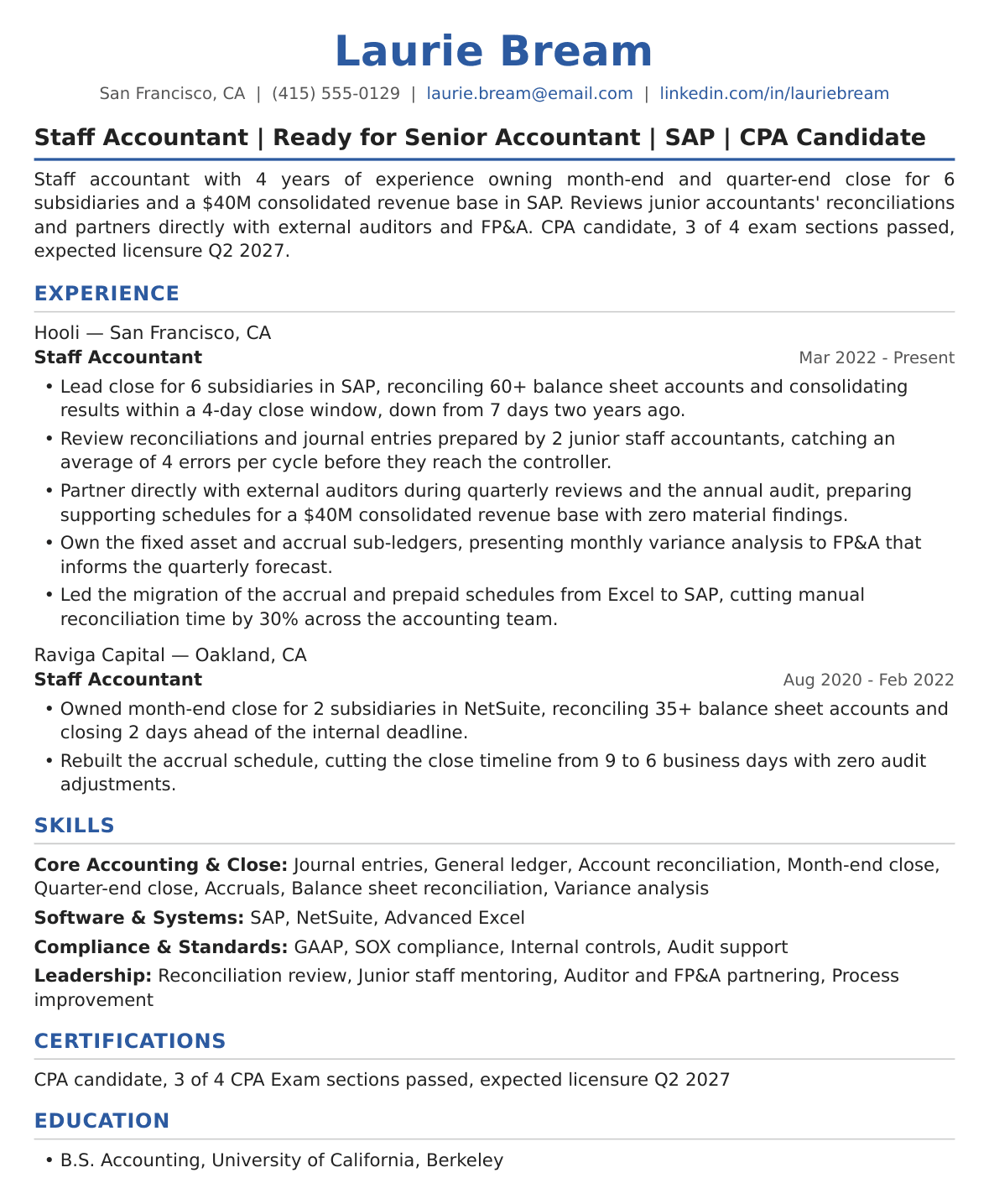
A resume aimed at a senior accountant promotion needs to prove judgment and process ownership, not just task completion. That means bullets emphasizing scope beyond a single close cycle: leading part of the close calendar, reviewing a junior accountant's work, partnering directly with auditors or FP&A, or owning a system implementation or process improvement. The summary should state total years of experience, the largest entity count or budget size managed, and CPA status at its most advanced stage (licensed, or "X of 4 sections passed, expected licensure [date]"). Software should reflect the higher ERP tier the target role runs, not just what the candidate has previously touched.
All three levels share the same backbone: a categorized skills section, honest CPA-track wording, and bullets quantified with real close-cycle numbers. If you sit between two levels, for example 18 months of experience with unusually broad entity exposure, borrow the summary structure from the level below and the bullet scope from the level above, then let the numbers make the case rather than the job title.
Turning Bookkeeping, AP, or Clerk Experience Into Staff Accountant Experience
Bookkeeping, accounts payable, and accounting clerk roles genuinely build accounting skills, but not every task on those jobs transfers to a staff accountant resume the same way. Reconciliations, journal entries you posted or reviewed, month-end support, and any GAAP-adjacent reporting work you touched are real accounting experience and belong front and center. Pure data entry, invoice filing, or check-cutting with no reconciliation or review attached is clerical work, and stretching it into "accounting experience" reads as padding to anyone who's actually done the job.
The fix is reframing, not inflating. Look at what you actually did inside a bookkeeping or AP role and surface the accounting judgment buried in it.
A bookkeeping resume bullet that undersells the work:
"Processed vendor invoices and entered payments into QuickBooks."
The same work, reframed around the accounting judgment it required:
"Reconciled vendor accounts monthly and researched discrepancies across 150+ invoices in QuickBooks, catching duplicate payments before they posted to the general ledger."
If your bookkeeping or AP role never involved reconciliations, journal entries, or discrepancy research, be honest about that gap rather than manufacturing scope that isn't there. Pair a factual bullet history with a summary that leads with your accounting degree and coursework instead, and let the combination make the case: real transferable exposure plus formal training is a legitimate path into a staff accountant role, even without the title yet.
Staff Accountant Resume Keywords
Applicant tracking systems and recruiters scan staff accountant resumes for the same core terminology, repeated across almost every posting for this role. Missing the exact wording a job description uses, even when you have the underlying skill, can knock your resume out of an ATS ranking before a person ever reads it. Use the right resume keywords below to check your resume's coverage, and remember: the table covers vocabulary, while your bullets should carry the numbers.
| Category | Keywords |
|---|---|
| Core accounting & close | Journal entries, General ledger, Account reconciliation, Month-end close, Quarter-end close, Accruals, Balance sheet reconciliation, Variance analysis |
| Software & systems | QuickBooks, Xero, Sage Intacct, NetSuite, SAP, Oracle, Advanced Excel |
| Compliance & standards | GAAP, SOX compliance, Internal controls, Audit support, Governmental accounting standards |
| Certifications & credentials | CPA (licensed or CPA-track/CPA-eligible), CPA Exam sections passed, Bachelor's degree in Accounting, CMA |
Common Staff Accountant Resume Mistakes to Avoid
Describing Tasks Instead of Impact
Listing "responsible for reconciliations" tells a hiring manager what your job title implied, not what you actually accomplished. Every bullet should name the account, entity, or timeline you affected, and the number that proves it.
Using One Generic Resume for Every Application
A resume built for a NetSuite mid-market role reads as a mismatch at a QuickBooks small business, and the reverse is just as true. Adjust your software terms, entity language, and CPA-track wording to match each posting rather than sending the same file everywhere.
Overstating CPA Status
Writing "CPA" when you're not licensed is the single riskiest mistake on this resume, since it's a factual claim a hiring manager or background check can verify. Use accurate phrasing like "CPA candidate" or "X of 4 exam sections passed" instead.
Vague or Buried Close-Cycle Claims
"Assisted with month-end close" says nothing about scope. Name the number of accounts, entities, or funds you touched and the timeline you helped hit, or the claim reads as filler.
Padding or Misrepresenting Your Software List
Listing SAP or Oracle because you sat in on a demo, rather than worked in the system, sets you up for a fast disqualification the moment an interviewer asks a follow-up question. List only the ERP tier you've actually operated in.
Listing Certifications and Software Without Specificity
"Proficient in accounting software" and "pursuing certification" tell a screener nothing searchable. Name the exact systems and the exact CPA-exam progress instead.
Ignoring ATS Formatting Issues
Tables, text boxes, columns, and graphics that look clean to a human often parse as garbled text or get dropped entirely by an ATS. Keep your staff accountant resume single-column, with standard headings and a text-based PDF or .docx file. For more detail, see our guide to ATS-friendly formatting.
Why You Should Customize Your Staff Accountant Resume for Public Accounting vs. Industry Roles
The same "staff accountant" title reads differently depending on where you're applying. A public accounting firm wants to see client-facing exposure: how many engagements you supported, whether you're comfortable with the January-to-April busy season, when staff and seniors commonly log 50 to 80-plus hours a week, and your familiarity with audit workpapers. Emphasize the audit-adjacent bullets from the library above and name your engagement count directly.
Private industry and corporate roles care more about ongoing ownership: the same close, the same entities, month after month, with systems continuity and process improvement as the differentiators. Emphasize your entity count, your close-timeline improvements, and how long you've owned a given process without handoff.
Nonprofit and governmental roles weight compliance and fund-level accuracy over volume: fund restrictions, award terms, and audit findings (or the lack of them) matter more than raw transaction counts. Emphasize accuracy and compliance language, and name the audit outcomes you supported.
Match your bullets to the employer type you're targeting, not the one you last worked for.
How AI Resume Builders Can Simplify Your Staff Accountant Resume
Every staff accountant posting wants something different: one company runs on NetSuite and expects GAAP close experience up top, another wants QuickBooks and AP/AR reconciliation, a third cares most about honest CPA-track wording. Matching your ERP terms and CPA phrasing to each posting by hand takes real time, and a generic resume that doesn't speak the employer's software gets filtered before a hiring manager sees it.
An AI resume builder built for this kind of tailoring helps in five ways:
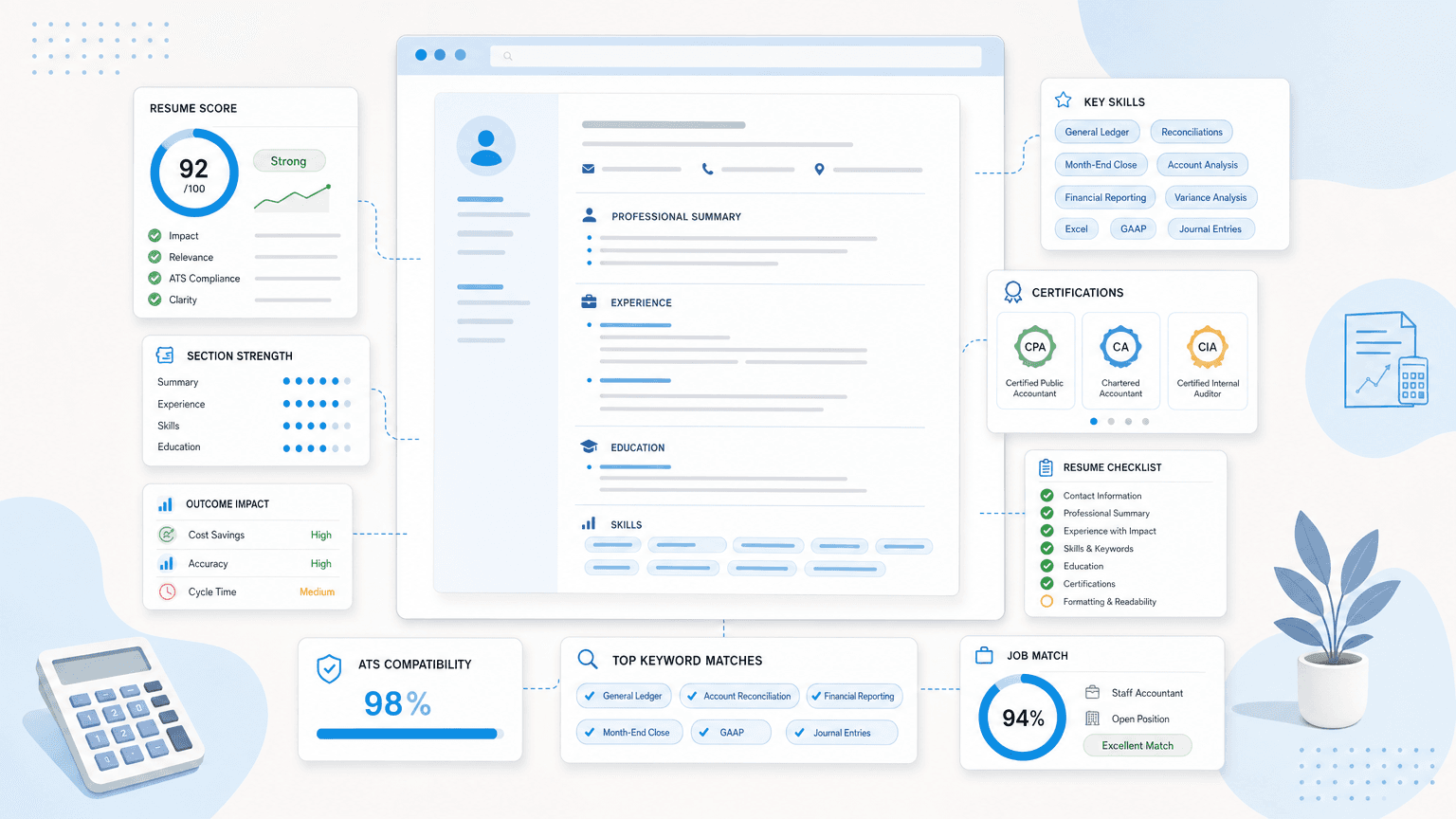
- Real-time ATS scoring: see your ATS and recruiter match score update as you edit, so you know whether swapping in the right ERP terminology actually moved the needle, no downloading and re-uploading to check.
- Transparent suggestions: every AI edit comes with a plain-language "why this change" explanation, and you accept or reject each one individually, including sensitive wording like your CPA exam status.
- Automatic formatting: your resume gets cleaned into ATS-friendly structure and design, so layout quirks that confuse scanning software don't cost you a callback.
- Structure guidance: suggestions reorder content for relevance, strengthen action verbs, quantify close-cycle results, and flag language that could trigger bias, based on recruiter best practices.
- Preference memory: your formatting, metric, and reordering choices carry over between sessions, so tailoring your fifth application isn't a fresh start.
Pricing stays honest for a job search that has an end date. The free plan includes 200 ATS scans every month, a one-time allotment of 3 tailored resumes with matching cover letters, and unlimited downloads, no credit card required. Extra resumes run $0.50 to $1.00 each, with no subscription attached.
A staff accountant resume earns an interview when it proves ownership: the accounts you reconciled, the close you ran, the systems you know, and a CPA status worded exactly as it stands today. Pick the summary, bullets, and CPA-track phrasing from this guide that match your actual scope, and skip the sections that don't apply yet. Precision, not padding, is what gets you through the screen.
Try it on your own resume
Run a free ATS check in under three minutes and see what's holding your resume back.