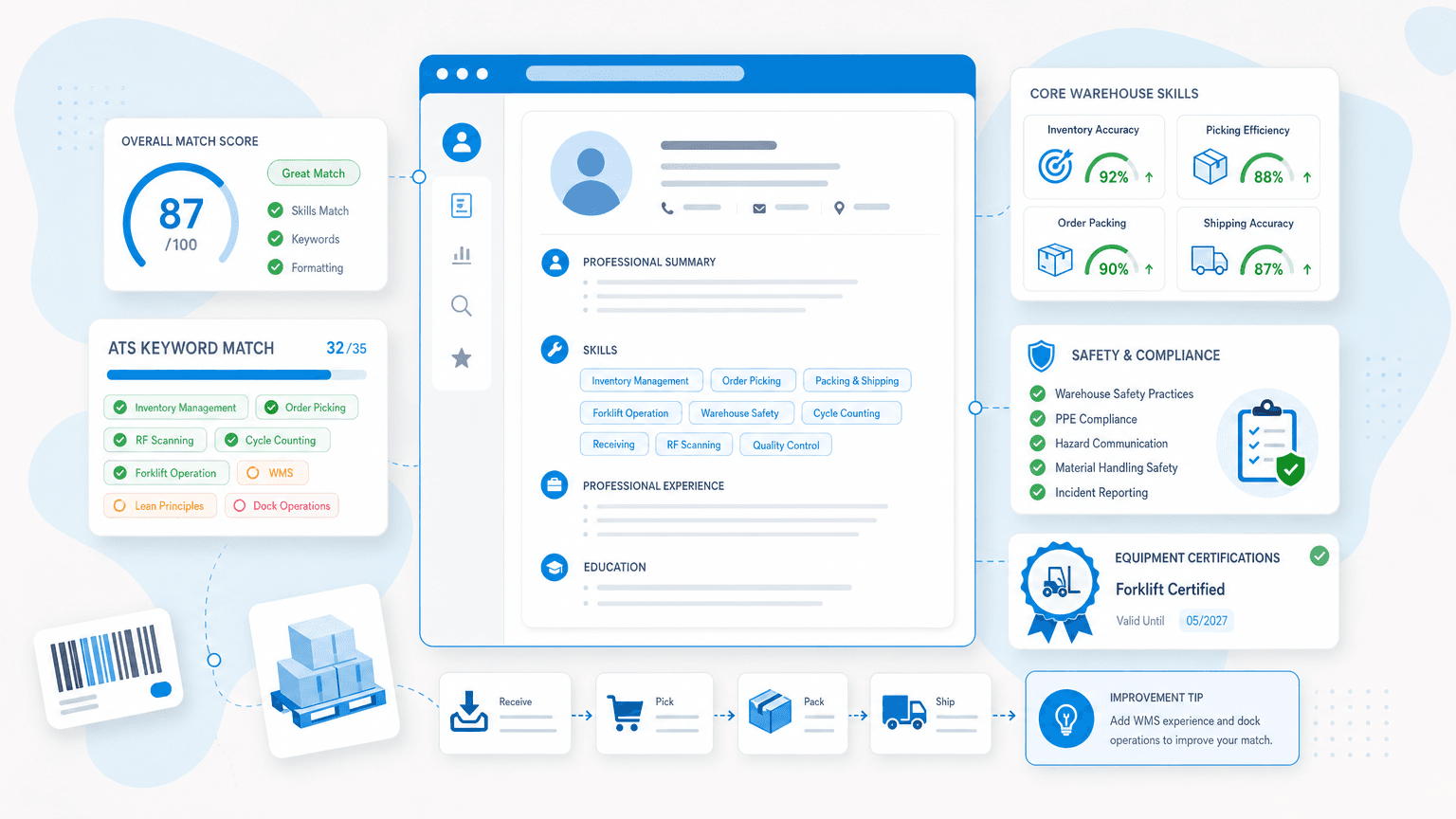
Your resume probably lists "hard worker" and "team player" while the ATS software scanning it is hunting for "RF scanner," "reach truck," and "cycle counting." That mismatch is a common reason qualified candidates never hear back, even after a dozen applications.
This guide fixes that. You'll get the exact hard skills and soft skills warehouse employers and their ATS systems look for, how to phrase them so they read as real qualifications instead of filler, and how to back them up with numbers a hiring manager can trust.
Below, you'll find the full skills list broken into hard and soft categories, certifications worth listing, a formula for weaving skills into your work experience, and skill priorities by role, whether you're picking orders, running a forklift, or working shipping and receiving.
What Skills Should You Put on a Warehouse Resume?
Hiring managers skim a resume in seconds. ATS software scans it even faster, matching your skills section against the job posting before a human ever sees it. Both are looking for the same thing: a specific, learnable mix of hard skills (equipment, software, procedures) and soft skills (how you work under pressure, with a team, and around safety rules).
"Hard worker" and "team player" don't clear either filter. They're not tied to anything measurable, and ATS software isn't parsing personality traits. What gets you flagged as a match is naming the actual equipment, systems, and procedures the job posting mentions, like "RF scanner," "cycle counting," or "reach truck."
Here's the quick-scan version. The rest of this guide breaks down each item, how to phrase it, and where it goes on your resume.
Hard skills: Forklift operation (Class I-V), pallet jack and reach truck operation, RF scanner and barcode/RFID use, WMS software (Manhattan, SAP EWM, Oracle NetSuite), inventory management and cycle counting, order picking and packing, shipping and receiving procedures, quality control and inspection, OSHA safety compliance, basic computer skills and data entry
Soft skills: Communication in fast-paced, safety-critical settings, teamwork, attention to detail, time management under deadline pressure, physical stamina and endurance, problem-solving and adaptability to new equipment
Hard Skills and Technical Skills for a Warehouse Resume
These are the skills ATS software is built to catch. List the specific equipment, software, and processes you've actually used, and mirror the exact terms from the job posting wherever you can.
Equipment Operation
Employers search for equipment names, not "machinery experience." List the exact type:
- Forklift, by class (Class I electric motor rider, Class II electric narrow-aisle truck, Class III electric motor hand truck/pallet jack, Class IV/V internal combustion)
- Pallet jacks (manual and electric)
- Reach trucks
- Order pickers
- Conveyor systems
Resume phrasing: "Forklift operator (Class III, sit-down electric) with daily use in a 50,000 sq ft distribution center."
Technology Skills
Warehouses run on software now, and hiring managers scan for it by name.
- RF scanners, barcode scanning, RFID technology
- WMS software: Manhattan Associates, SAP EWM, Oracle NetSuite, Fishbowl
- Basic computer skills, especially Excel
- Data entry
If you've used a WMS platform, name it. "Manhattan WMS" or "SAP EWM inventory processing" reads as a real qualification. "Inventory software" does not.
Inventory & Order Fulfillment Skills
This is the core of most entry-level warehouse work, so name the specific tasks:
- Inventory management and cycle counting
- FIFO/LIFO stock rotation
- Order picking and packing accuracy
- Shipping and receiving procedures
- Quality control and inspection
Resume phrasing example: "Picked and packed an average of 150 orders per shift with a 99% accuracy rate" (use your own real numbers here, not this one; a made-up stat does more harm than good if it comes up in an interview).
Safety & Compliance Skills
Safety knowledge signals you won't be a liability on day one.
- OSHA safety guidelines and compliance
- Proper lifting technique and ergonomics
- Hazardous materials handling (if the role touches HAZMAT, list it; if not, skip it)
Phrasing example: "Maintained zero safety incidents over 18 months while operating a reach truck in a high-volume fulfillment center."
Soft Skills That Warehouse Employers Actually Look For
Hard skills get you noticed. Resume soft skills are what convince a hiring manager you'll actually work out on the floor when you support them with evidence. A busy distribution center runs on people who communicate fast, stay alert for a full shift, and adjust when the plan changes.
Communication. Warehouse floors are loud: forklifts beeping, conveyors running, radios crackling. Communication here means clear, quick exchanges over a headset or hand signal, not polished emails. Try: "Relayed pick discrepancies to shift lead in real time, preventing 3 mis-ships per week" or "Communicated safety hazards immediately via radio during peak shift, maintaining zero incident reports."
Teamwork. Orders move because pickers, packers, and forklift operators sync up, especially during a rush. Show it with specifics: "Coordinated with a 6-person picking team to clear a 500-order backlog before shift end" beats "team player" every time.
Attention to detail. One wrong SKU or mislabeled pallet creates a return, a chargeback, or a safety issue. Employers want proof, not a claim: "Verified 400+ outbound orders daily against packing slips, maintaining 99.5% accuracy."
Time management. Warehouses run on cutoffs: truck departure times, shift quotas, same-day shipping windows. Frame it around deadlines: "Met same-day shipping cutoff on 98% of assigned orders during peak holiday volume."
Physical stamina. Be honest here. This work involves standing, walking, and lifting for full shifts. Say what you can actually do: "Maintained consistent pace lifting up to 50 lbs repeatedly across 10-hour shifts" or "Stood and walked warehouse floor for full 8-hour shifts, meeting daily productivity targets."
Problem-solving and adaptability. Equipment jams, volume spikes, new WMS rollouts. The floor changes daily, and increasingly involves automation and robotics. Show you adjust: "Adapted quickly to new WMS system rollout, training 4 teammates within first week" or "Resolved conveyor jam independently, minimizing line downtime to under 5 minutes."
Certifications Worth Listing on a Warehouse Resume
Certifications tell an employer you can start moving equipment or working near hazards on day one, without additional training.
OSHA Forklift Certification is the single most valuable credential you can list. Note the specific class or truck type (sit-down counterbalance, reach truck, order picker) rather than just "forklift certified."
OSHA 10-Hour or 30-Hour Safety cards show you understand general workplace hazards, not just equipment operation. The 10-hour card fits entry-level roles; the 30-hour signals more responsibility.
Certified Logistics Technician (CLT), issued by MSSC, verifies broader supply chain skills: receiving, inventory control, safety, and quality. It's less common among entry-level candidates, which makes it a strong differentiator.
WMS-specific certifications (Manhattan Associates, SAP EWM) matter less for entry-level roles but are worth listing if you've completed formal training for a larger distribution center.
List three things for any certification: issuing body, specific class or type, and current status. Example: "OSHA Forklift Certification (Class II, Reach Truck), issued 2025, valid through 2028." If a certification has lapsed, say so or leave it off.
How to List Skills on Your Warehouse Resume
Build a Categorized Skills Section
Group your skills into two clear buckets: hard skills and soft skills. Then keep the list tight, 5 to 10 items, not a wall of 20 generic terms.
A recruiter scanning for 6 seconds needs to see "forklift operation (Class III), RF scanner proficiency, cycle counting" and know immediately you're qualified. A list of 20 filler words buries the skills that actually match the job.
Format matters too. Use a simple bulleted list under a clear "Skills" heading, not paragraphs, tables with merged cells, or graphics. ATS-friendly formatting keeps the content in plain text. Avoid columns your resume builder might render as images, and skip skill "rating bars" (dots, stars) since ATS can't read them and hiring managers don't need a 4-out-of-5 on "teamwork."
Weave Skills Into Your Work Experience Bullets
A skills section alone doesn't prove anything. The real evidence goes in your work experience bullets, using this formula:
[Action verb] + [specific task or equipment] + [quantifiable result]
Weak
Responsible for operating warehouse equipment and keeping inventory accurate.
Strong
Operated a Class III forklift to move 150+ pallets per shift while maintaining 99.2% inventory accuracy across 15,000 SKUs.
The weak version tells a hiring manager nothing they can act on. The strong version names the equipment, states the volume, and proves the result with a number. Do this for at least 3 to 4 bullets across your work history, prioritizing the skills the job posting cares about most.
Tailor Skills to the Job Description
This is the tip worth repeating: match the job description's exact wording, not a synonym.
If the posting says "RF scanner," write "RF scanner," not "handheld device." If it says "reach truck," write "reach truck," not "forklift." ATS software matches on literal keyword strings. A resume that says "handheld device" won't surface in a search for "RF scanner," even though a human would read them as the same thing.
Before you submit, scan the job posting for ATS keywords, especially its specific nouns: equipment names, software platforms, certification titles. Pull those exact terms into your skills section and bullets wherever they honestly apply. This single habit, more than any other resume tweak, determines whether your application clears the ATS filter and reaches a human.
Skills by Warehouse Role
Different warehouse roles reward different skills. A picker's resume should read differently than a forklift operator's, and using the same generic list for both wastes valuable resume space. Match your skills section to the role you're actually applying for.
Picker/Packer
Speed and accuracy under a quota matter most here.
- Order accuracy and pick-rate performance
- RF scanner / handheld device proficiency
- Packing efficiency and damage prevention
Example bullet: Picked and packed 150+ orders per shift with 99.5% accuracy using RF scanner-guided picking system.
Forklift Operator
Certification and safety record carry the most weight.
- OSHA forklift certification (list the class: I, IV, V, etc.)
- Load handling and pallet placement accuracy
- Safety compliance and incident-free operation
Example bullet: OSHA-certified forklift operator (Class IV) with 2 years' experience and zero safety incidents across 500+ shifts.
Shipping & Receiving
Documentation and coordination skills separate strong candidates here.
- Bill of lading and shipping documentation accuracy
- Inbound/outbound freight coordination
- Quality inspection and damage reporting
Example bullet: Processed 80+ inbound and outbound shipments daily, verifying documentation and flagging discrepancies before they reached inventory.
Inventory Associate
Precision and system fluency drive this role.
- Cycle counting and inventory accuracy tracking
- WMS software proficiency (Manhattan, SAP EWM, or similar)
- FIFO/LIFO stock rotation knowledge
Example bullet: Maintained 98.7% inventory accuracy across 12,000 SKUs using Manhattan WMS, reducing cycle-count discrepancies by 20%.
If you're applying to a hybrid role, blend the priority skills from each relevant list rather than listing everything. A tighter, role-matched skills section reads as more credible than a sprawling one.
Warehouse Resume Keywords
These are the exact terms warehouse ATS filters and shift supervisors scan for, condensed from the skills throughout this guide. Phrase them the way the posting does and pair them with your numbers.
| Category | Keywords |
|---|---|
| Core operations | Order picking and packing, Shipping and receiving, Loading and unloading, Palletizing, Kitting and assembly, Cross-docking, Returns processing |
| Inventory & systems | Inventory management, Cycle counting, RF scanning, Warehouse management systems (SAP EWM, Manhattan), FIFO rotation, Labeling and documentation |
| Equipment & safety | Certified forklift operation, Pallet jack, OSHA compliance, PPE adherence, Ability to lift 50 lbs, Pre-shift safety checks |
| Work habits | Productivity metrics (UPH), Attention to detail, Reliability and attendance, Teamwork, Time management |
Who Actually Reads a Warehouse Resume (and Who Never Will)
Here's what no skills guide admits: the biggest warehouse employer barely uses resumes. Amazon's hourly hiring is an application flow with no resume and usually no interview; you pick a shift, pass the checks, and start. Plenty of high-volume fulfillment operations run the same way. If that's where you're applying, the application form is the resume, and this guide's skill phrasing belongs in its text fields.
The resume matters at the other doors: staffing agencies deciding which client gets you, smaller 3PLs and regional distributors where a human reads applications, and any posting above entry level, lead, inventory control, quality, ops admin. Those readers are exactly who this guide's skills lists are for.
It matters most for the move up. Promotions into lead and supervisor roles usually require a resume even inside no-resume employers, and that's where floor workers stall: two years of real numbers, nothing written down. Keep a monthly skills log, rates, accuracy, equipment certified, trainees mentored, and the promotion resume writes itself the week the posting appears. The three examples below show that resume at each of those real stages: the picker/packer application, the certified equipment-operator move, and the promotion packet that gets you off the floor.
Warehouse Resume Examples by Experience Level
Each example below assembles the skills, phrasing, and bullet formula covered so far into a full, real resume, built for the readers who actually see one: a staffing agency, a 3PL hiring coordinator, or the manager reviewing a promotion packet. Match the one closest to where you are, then use it as a structural template. Keep the section order and the discipline of naming exact equipment and numbers, but swap in your own employers, shifts, and metrics.
Warehouse Associate Resume
This is the entry-level template for a picker/packer with less than a year of warehouse experience, applying to a role at a 3PL or regional distributor where a human actually reads applications. The summary leans on scope and effort metrics, orders per shift, accuracy rate, since there's no team size or budget to cite yet, and a year of overnight retail stocking fills out the experience section as transferable warehouse-adjacent work rather than padding. Every bullet still names the equipment (RF scanner, pallet jack) instead of describing it generically.
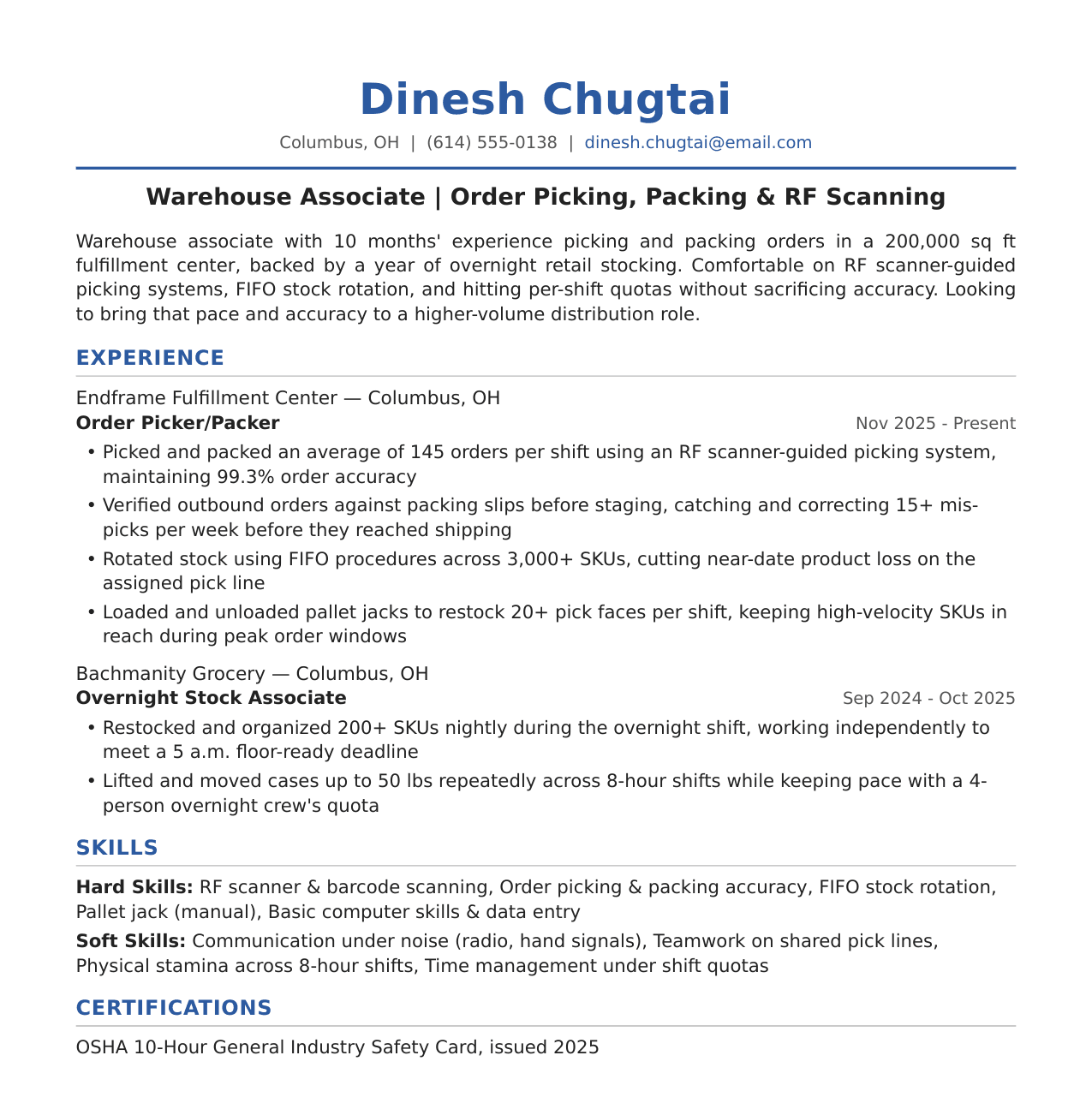
What's working here: the headline names the exact tasks (picking, packing, RF scanning) instead of a vague "warehouse worker," the retail stocking role is framed in warehouse language rather than left off, and the certifications line carries just the OSHA 10-Hour card, an honest, attainable credential for someone this early rather than a forklift certification he doesn't hold.
Forklift Operator Resume
This is the certified-equipment-operator template for someone one to three years in, using a forklift certification to move into better-paying, more specialized work. The headline leads with the certification classes, since that's the exact keyword a staffing agency or 3PL recruiter searches for first. The most recent role also names hands-on experience working pick routes around an autonomous mobile robot (AMR) fleet, the kind of automation exposure more distribution centers now expect operators to have.
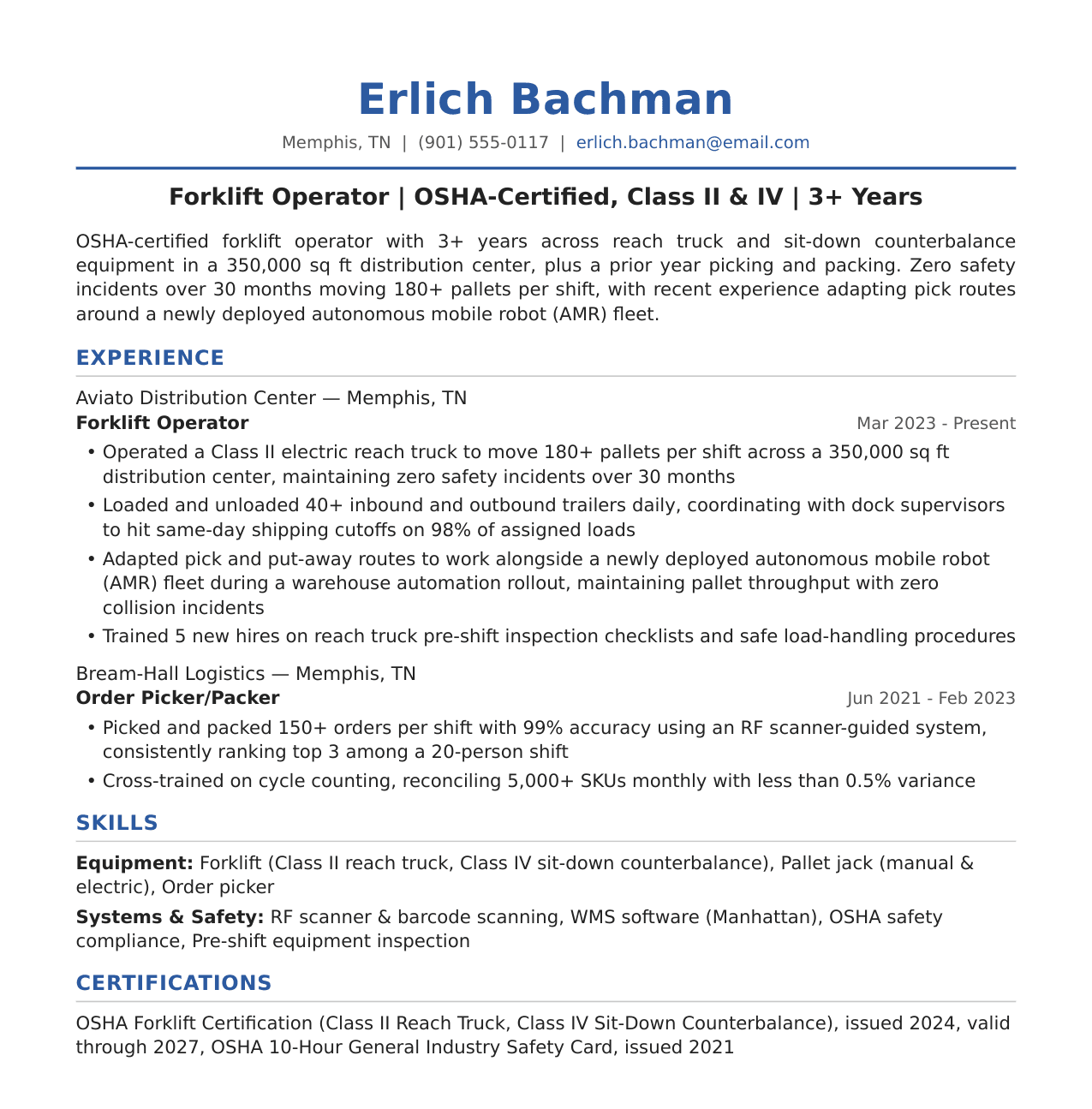
What's working here: the certification line lists the specific truck classes and an expiration date rather than just "forklift certified," the safety-incident number sits inside a bullet next to the pallet volume it's tied to, and the prior picker/packer role stays in to show trajectory rather than being cut to save space.
Refer to our article on "How to Write a Forklift Operator Resume" for additional examples.
Warehouse Shift Lead Resume
This is the promotion-track template: the resume that matters most, according to this guide's own reporting on who actually reads one. Most floor employers don't require a resume to get hired, but they do require one to move into lead or supervisor, and that's where two years of real numbers on a monthly skills log turns into a resume in an afternoon. The summary leads with team size and tenure, then the bullets shift from personal task metrics to team and system ownership: shift KPIs, a WMS exception queue, a training pipeline.
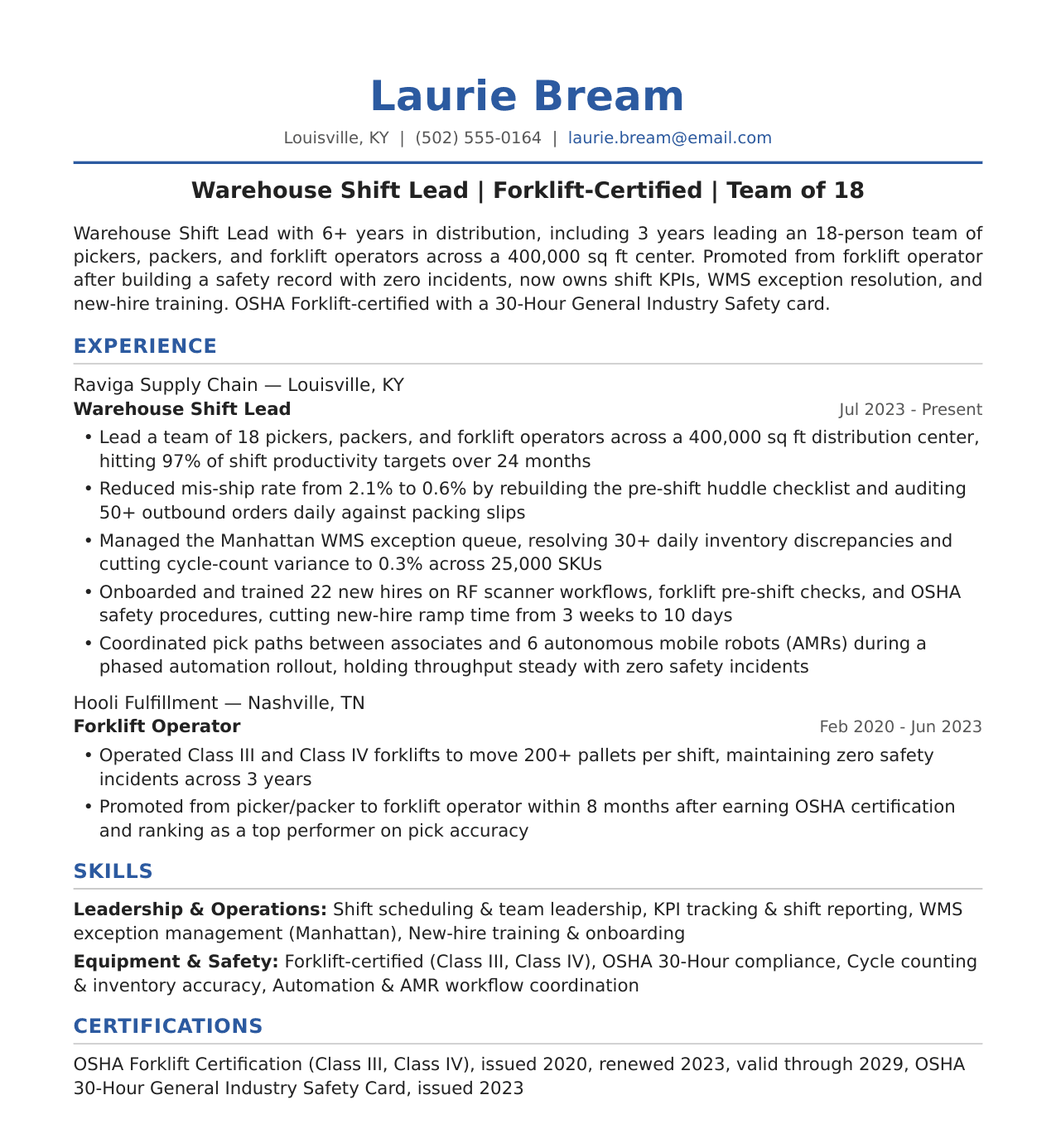
What's working here: the mis-ship rate bullet shows a before-and-after number instead of a static claim, the WMS line names the platform (Manhattan) and the SKU count it's managed against, and the earlier forklift-operator role stays on the resume to prove the promotion was earned on the floor, not assumed from a title change.
Across all three, the pattern holds: a named piece of equipment or software, a real number attached to it, and a role title the reader has actually posted before. If your background sits between two of these, for example a forklift certification but no lead experience yet, borrow the structure from the level above and keep your numbers honest rather than inflating them to match the job you want next.
Common Mistakes to Avoid on a Warehouse Resume Skills Section
Listing skills with nothing behind them. "Inventory management" on its own tells a hiring manager nothing. Attach a number or a result: "Cycle-counted 8,000+ SKUs weekly, maintaining 99% accuracy," or describe the scale, like "managed receiving for a 40,000 sq ft distribution center."
Loading the section with filler. "Hard worker," "team player," "fast learner" are the resume equivalent of white noise. Every applicant writes them, so ATS software and recruiters both tune them out. Replace each one with the specific behavior behind it: instead of "team player," write "coordinated with 3-person picking team to hit hourly quota during peak season."
Sending the same resume to every posting. A skills section built once and reused for 20 applications will always underperform one tailored to each job. Read the posting, then reorder your top 5-8 skills to match what that employer actually asked for.
Using your own vocabulary instead of the employer's. If the posting says "reach truck," don't write "forklift." If it says "RF scanner," don't write "handheld device." ATS software matches exact phrasing, not synonyms.
Assuming no warehouse job title means no relevant experience. Retail stocking, restaurant food prep, moving-company work, and military logistics all translate. Stocking shelves overnight built inventory accuracy and pace; lifting and hauling in a moving job built the physical stamina warehouses need. Frame it in warehouse-relevant language: "Restocked and organized 200+ SKUs nightly, working independently under time pressure" reads as transferable, even without a warehouse employer on the resume.
How an AI Resume Tool Can Help You Tailor Your Warehouse Skills
Rewriting your skills section for every warehouse posting, forklift certification here, RF scanner experience there, takes time you don't have between shifts. And a generic resume that lists every skill you've ever touched often gets filtered out before a recruiter sees it.
An AI resume tool built for tailoring can help:
- Real-time ATS scoring: see your score update as you edit, so you know immediately if your skills section matches the job description, no re-uploading required.
- Transparent suggestions: every recommended change comes with a plain-language "why this change" explanation. You accept or reject each one, and the AI never invents a certification or skill you don't have.
- Automatic formatting: your skills section gets formatted to avoid tables, images, and layouts that confuse ATS parsers, so your certifications and skills stay readable.
- Structure guidance: get direction on how to structure hard skills, certifications, and safety training so they show up where hiring managers look first.
- Preference memory: your formatting and reordering choices carry over to the next resume, so you're not rebuilding your skills section from scratch for every application.
Upplai's free plan includes 200 ATS scans a month and 3 tailored resumes with matching cover letters, unlimited downloads, no credit card required. If you need more tailored resumes after that, extra ones cost $0.50 to $1.00 each. No subscription.
Get your warehouse resume ATS-ready in minutes
See your ATS score and match your skills to the job description before you apply.
A warehouse resume that gets past the first filter matches every skill to the job posting's exact language and backs every claim with a number. Start with the hard skills you've actually used, name the equipment and software by their real names, and let your work experience bullets prove what your skills section states.