Every occupational therapist resume says the same thing: licensed, NBCOT-certified, passionate about patient outcomes. None of that tells a hiring manager anything, because every applicant in the pile can say it too. What actually separates candidates is setting-specific proof: the assessments you have run, the EHR you have documented in, and the population you have treated. Most OT resumes never get past the credentials to show it. If you are a new grad translating Level I and Level II fieldwork into your first professional resume, or an experienced OT trying to pivot from SNF to pediatrics or re-enter after a gap, generic resume advice leaves you guessing at exactly the details that matter most.
This guide fixes that. It walks through building an occupational therapy resume that reads as setting-specific and outcomes-driven, not just licensed and available. You will learn how to write a summary that names your population and specialty instead of your job title, how to turn fieldwork and capstone projects into real experience bullets, and how to phrase accomplishments using the assessments, treatment approaches, and documentation systems each setting actually hires for.
Ahead, we cover every section of the resume: summary, credentials and certifications, skills, work history and fieldwork, and measurable outcome bullets. You will also find a full example library organized by career stage and setting, new grad and entry-level, pediatric and school-based, geriatric, SNF, and home health, hand therapy and outpatient, and mental health and acute care, along with the mistakes that most often get an OT resume filtered out before a human ever reads it.
What Makes an Occupational Therapist Resume Effective?
Hiring managers reading OT resumes aren't scanning for polish first. They're scanning for fit to a setting.
A pediatric outpatient clinic wants to see NDT, sensory integration, or Handwriting Without Tears on the page. A SNF or home health role wants MDS familiarity and Medicare Part A/B documentation experience. A hand therapy practice wants CHT progress or splinting and modality experience. If your resume doesn't map to the setting in the first few lines, it gets set aside, even if you're a strong clinician.
License and certification come next, and they work differently than most candidates assume. NBCOT certification and your state license don't make you stand out. They make you eligible to be considered at all. Most hiring managers treat "OTR/L" (or COTA/L) as a pass/fail check, then move straight to the resume content to see who's actually a fit.
That leaves the real differentiator: how you describe your work. OT Potential, a widely-used OT resource, frames this as the difference between ordinary and extraordinary bullets. An ordinary bullet lists a task: "Provided therapy services to patients with neurological conditions." An extraordinary bullet shows impact: "Increased independence in ADLs for 85% of stroke patients on caseload, reducing average length of stay by 3 days." The clinical work behind both bullets can be identical. What changes is the signal a hiring manager picks up when comparing twenty resumes for one opening.
Setting fit gets you noticed. Credentials get you past the gate. Accomplishment framing is what actually gets the interview call.
How to Write an Occupational Therapist Resume That Gets Interviews
Write a Targeted Summary or Objective
A hiring manager scanning your resume for six seconds needs three answers fast: what setting and specialty you fit, how much experience or fieldwork you're bringing, and one thing that makes you worth a second look. Skip the personality adjectives. Lead with substance.
A weak summary looks like this:
"Compassionate and dedicated occupational therapist with strong communication skills and a passion for helping patients."
A stronger one looks like this:
"OTR/L with 3 years in skilled nursing, specializing in fall-risk reduction and post-surgical rehab for patients aged 65+. Reduced average length of stay by 4 days for a 20-patient caseload through daily functional mobility training and early discharge planning."
If you're a true new grad with no paid OT experience yet, use an objective instead of a summary. It signals direction rather than history you don't have.
New-grad objective example "Recent OTD graduate seeking a pediatric outpatient position where I can apply Level II fieldwork experience in sensory integration and fine motor intervention to support children with developmental delays."
Showcase Your NBCOT Certification and State Licensure
Your credentials are the first filter, not a footnote. Place them directly after your name and title, formatted the way hiring systems and hiring managers expect: "OTR/L" for occupational therapists, "COTA/L" for OT assistants.
Add your state license number or status ("Licensed in California, #OT12345" or "License-eligible, pending NBCOT exam date") right next to it if you're job searching across state lines or still finishing the exam. This is one of the few literal keyword matches an ATS scans for, so don't bury it in a paragraph.
If you hold a specialty certification, list it in the same header line or just below: CHT (hand therapy), SIPT or SI certification (sensory integration), LSVT BIG (Parkinson's), CLVT (low vision), or CBIS (brain injury). Only include certs relevant to the jobs you're targeting.
Build a Skills Section That Speaks to Hiring Managers
Generic skills lists ("communication," "teamwork," "patience") tell a hiring manager nothing about your clinical readiness. Group your skills by category instead, and name the actual tools and assessments you use.
Clinical & Assessment Skills
- COPM, FIM scoring, BOT-2, Beery VMI, Sensory Profile 2, manual muscle testing
EHR & Documentation Systems
- WebPT, Casamba, Rehab Optima, Net Health, Epic
Specialty & Setting Skills
- Splinting and orthotic fabrication, sensory integration therapy, home safety evaluations, low vision rehab, group programming
Core Professional Skills
- Interdisciplinary care coordination, caregiver training, caseload management, discharge planning
When describing the populations you work with, use current, respectful, setting-accurate language. "Children with autism" or "autistic clients," older adults rather than "the elderly," and terms your specific practice setting actually uses. This matters to hiring managers reading your resume just as much as it does to the families and patients you'll serve.
Write Achievement-Focused Experience Bullets
Every bullet should follow the same formula: action verb, plus the specific task or method, plus a quantifiable result or scope. Duties describe what you were assigned. Achievements describe what changed because you did it.
A weak bullet looks like this:
"Responsible for treating patients with upper extremity injuries."
A stronger one looks like this:
"Developed custom orthotic and splinting plans for 15+ post-surgical hand therapy patients monthly, improving average grip strength outcomes by 30% within 6-week treatment windows."
If you're not sure how to phrase bullets for your specific setting, the next section gives you a full library organized by pediatric, geriatric/SNF, hand therapy, and mental health roles, ready to adapt.
Turn Fieldwork and Capstone Experience Into Real Experience
If you're a new grad, your Level I and Level II fieldwork rotations and doctoral capstone project are real clinical experience, not a line buried under "Education." List each rotation as its own entry: site name, dates, practice setting or focus area, and one accomplishment-style bullet, the same way you would a paid job.
For example: "Level II Fieldwork, Sunrise Pediatric Therapy Center, Jan-Mar 2026. Focus: sensory processing and fine motor intervention. Co-treated a caseload of 8 children weekly, developing individualized sensory diets that reduced classroom meltdown frequency for 5 of 8 clients within 8 weeks."
Do the same for a capstone project: name the site or population, your specific contribution, and the outcome. A capstone that developed a fall-prevention protocol for a SNF, for instance, deserves its own entry with a measurable result, not a one-line mention.
Organize Your Work History the Right Way
List your work history in reverse-chronological order, most recent first, whether that history includes traditional jobs, fieldwork, or a gap.
If you took time away from practice, whether for family caregiving, health, or another reason, don't omit it or explain yourself. A single, factual line entry handles it: "Clinical Practice Gap, Family Caregiving, 2022 to 2023." That's it. No apology needed.
If you're switching settings, reframe your bullets around the skills that transfer, even when the clinical specifics don't. Years in a SNF built rigorous documentation habits and caseload management under high patient volume. That rigor is exactly what a pediatric outpatient clinic wants to see, even though your daily interventions will look different. Name the transferable skill directly in your bullet rather than assuming the hiring manager will infer it from your setting history alone.
The License-Eligible Trap: Your Permit Clock and Your NBCOT Clock Don't Match
"License-eligible, pending NBCOT exam date" reads like a single, portable status, and new grads write it that way because nothing on the page tells them otherwise. It isn't portable. Every state issues its own limited or temporary permit, with its own validity window, and your NBCOT exam result can void that permit the moment a failing score posts, regardless of what the state's paperwork says. A resume that states this status vaguely can misrepresent your actual availability to a hiring manager, or describe a permit that has already expired.
The gap between states is wide. California requires you to apply to NBCOT within four months of finishing fieldwork just to qualify for a limited permit, and once issued, that permit lasts only three months from issuance, or two weeks past your NBCOT eligibility-to-test window, or until a failing score arrives, whichever comes first. A failing score cancels it immediately and forfeits the fee (California Board of Occupational Therapy). New York runs on a different clock entirely: a limited permit there is valid for a full year and can be renewed once (NYS Office of the Professions). Layer NBCOT's own retake ladder on top: 30 days between a second or third attempt, 60 days between a fourth through sixth, six months for a seventh or beyond (NBCOT Certification Exam Handbook).
What goes in the credential line depends on where you actually stand. If you have already passed and hold your license, drop the eligibility language entirely and list the license number and state. If you are testing soon under a permit, name the state and both dates directly: "OTR-eligible, CA limited permit active through March 2026, NBCOT exam scheduled February 12." That gives a hiring manager a real date to plan a start around. If you are applying across state lines or waiting on a retake, don't claim a permit you haven't confirmed yet. Write "OTR-eligible, confirming permit requirements with the Texas board" and give your next NBCOT eligibility date instead of a bare "pending." Confirm the current rule with your own state board before you write a date on your resume, since permit windows and renewal terms are set state by state.
Occupational Therapist Resume Examples by Setting
OT practice looks different in every setting, and your bullets should prove you know the difference. Below are five common settings with copy-ready bullets you can adapt to your own numbers and caseload.
New Grad / Entry-Level (General Rehab or Acute-Care Rotation)
If you're building your first professional bullets from Level I/II fieldwork or an initial acute-care rotation, lean on caseload volume and the specific tools you already used under supervision.
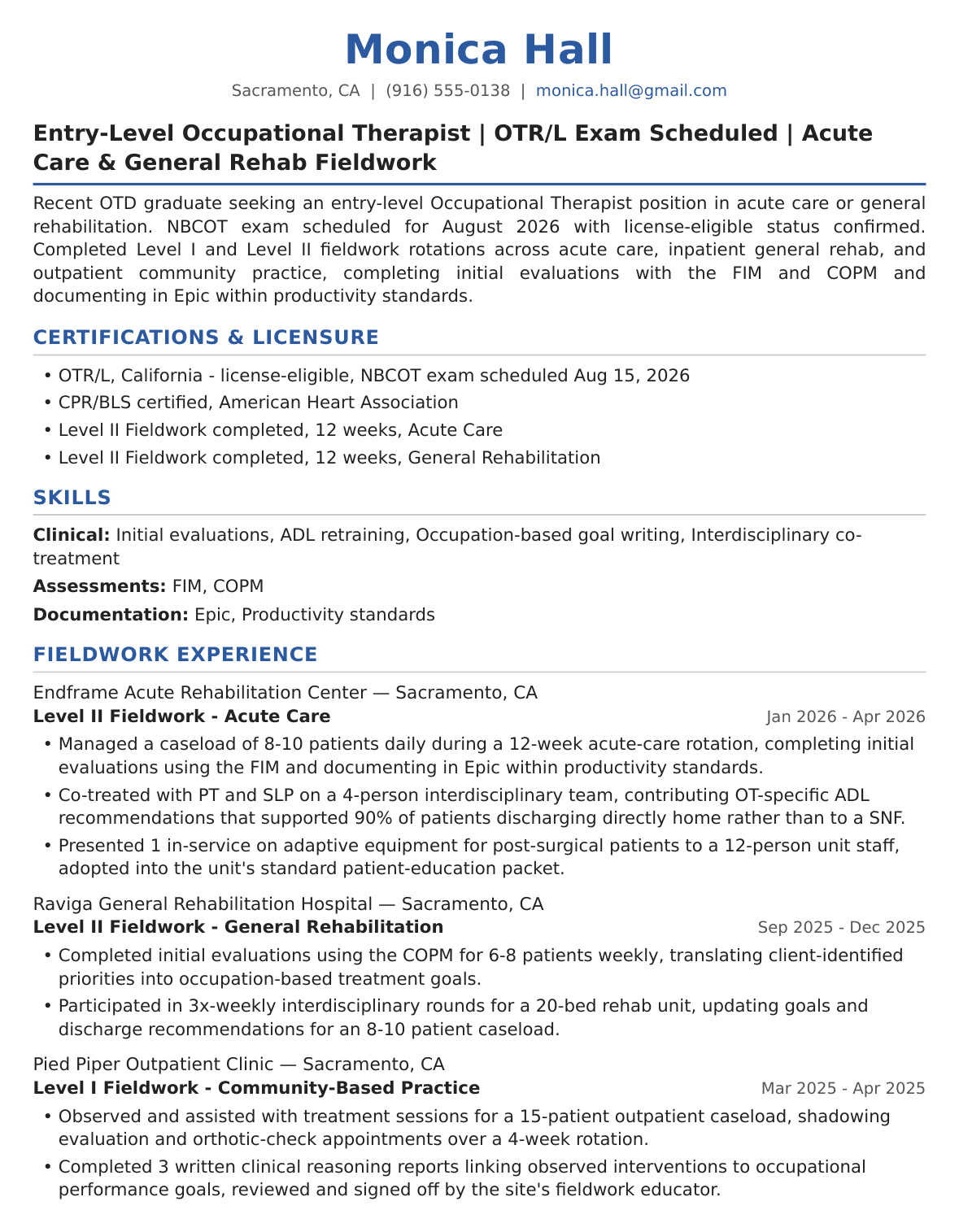
- Managed a caseload of 8-10 patients daily during a 12-week acute-care fieldwork rotation, completing initial evaluations using the FIM and documenting in Epic within productivity standards.
- Co-treated with PT and SLP on a 4-person interdisciplinary team, contributing OT-specific ADL recommendations that supported 90% of patients discharging directly home rather than to a SNF.
The full entry-level resume opens with an objective, since there is no paid caseload to summarize yet. The credential line carries OTR/L or your license-eligible status with the NBCOT exam date. Fieldwork rotations fill the experience section as dated entries with site, setting, and one quantified bullet each. Skills stay categorized and name only what you used under supervision: FIM, COPM, Epic. Education lists the OTD or MOT, the capstone title, and a GPA above 3.5.
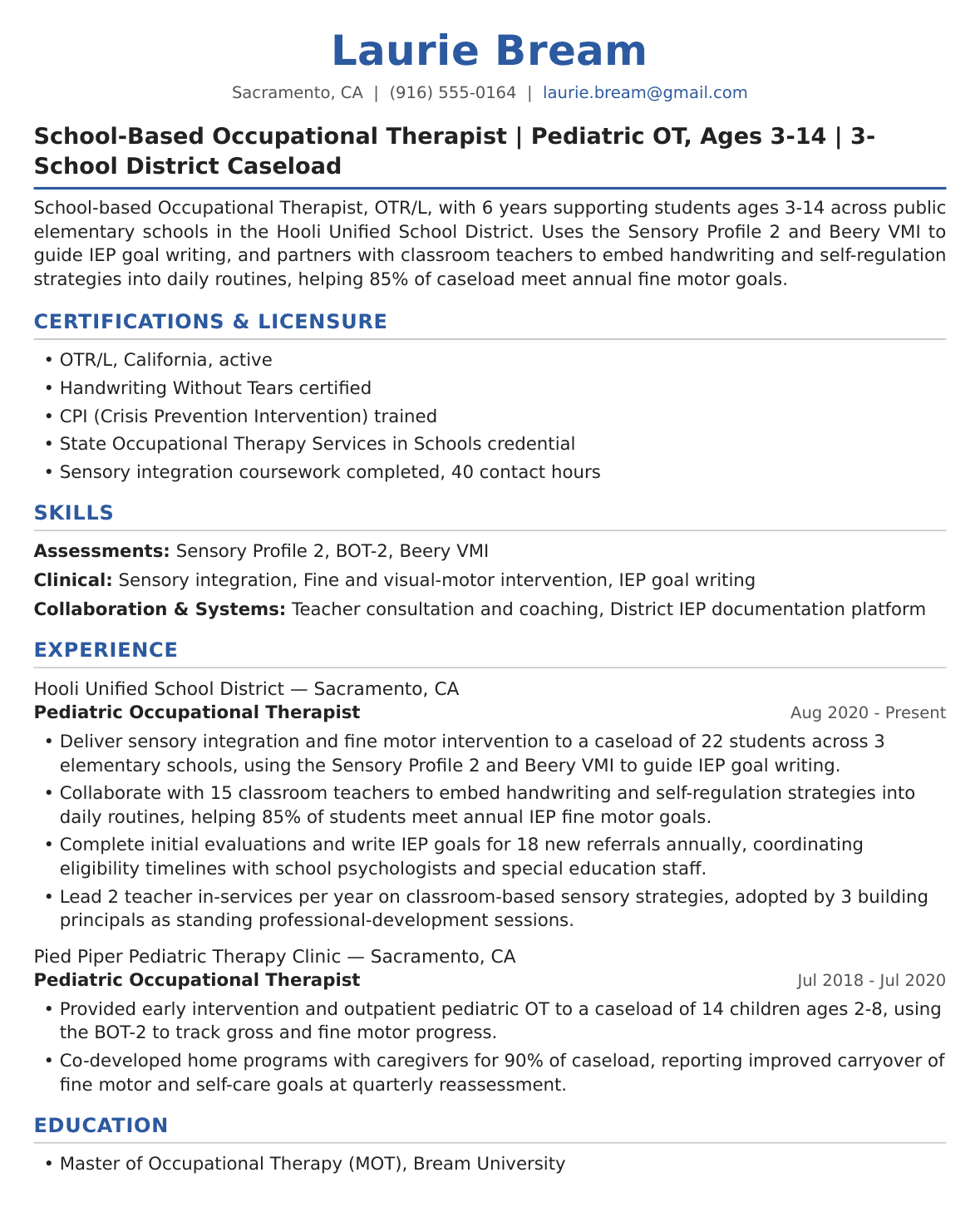
Pediatric / School-Based
School-based and pediatric OTs are evaluated on sensory integration know-how, fine motor progress, and how well they translate clinical goals into classroom-usable strategies.
- Delivered sensory integration and fine motor intervention to a caseload of 22 students across 3 elementary schools, using the Sensory Profile 2 and Beery VMI to guide IEP goal writing.
- Collaborated with 15 classroom teachers to embed handwriting and self-regulation strategies into daily routines, helping 85% of students meet annual IEP fine motor goals.
The pediatric version leads with a summary naming the age range and the setting, since a district and a private clinic hire for different things. Certifications sit high: sensory integration coursework, Handwriting Without Tears, CPI, and any state education credential you hold. Bullets carry student caseload, buildings covered, evaluations per year, and IEP goals written. Skills name Sensory Profile 2, BOT-2, Beery VMI, and the district's IEP platform.
Geriatric / SNF / Home Health
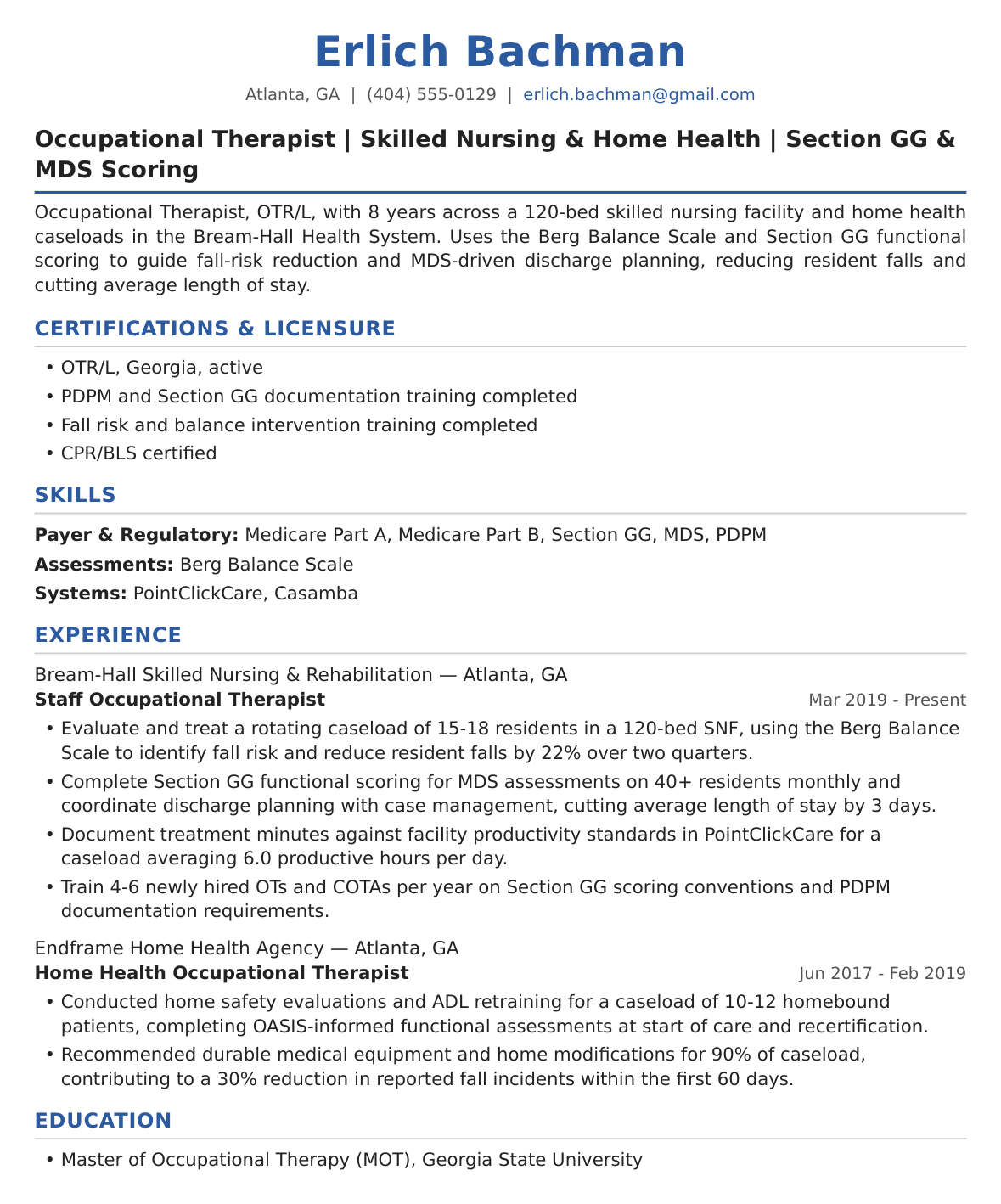
In skilled nursing and home health, hiring managers look for fall-risk reduction, ADL-focused outcomes, and documentation that supports MDS scoring and discharge decisions.
- Evaluated and treated a rotating caseload of 15-18 residents in a 120-bed SNF, using the Berg Balance Scale to identify fall risk and reduce resident falls by 22% over two quarters.
- Completed Section GG functional scoring for MDS assessments on 40+ residents monthly and coordinated discharge planning with case management, cutting average length of stay by 3 days.
The SNF and home health version is built around payer vocabulary. The summary names facility size and setting mix. Bullets carry resident caseload, treatment minutes against the productivity standard, fall reduction, length of stay, and discharge-to-home rate. Medicare Part A and Part B, Section GG, MDS, and PDPM belong in the skills or experience text because reimbursement drives the hiring. Name PointClickCare, Casamba, or Net Health as your employer named it.
Hand Therapy / Outpatient
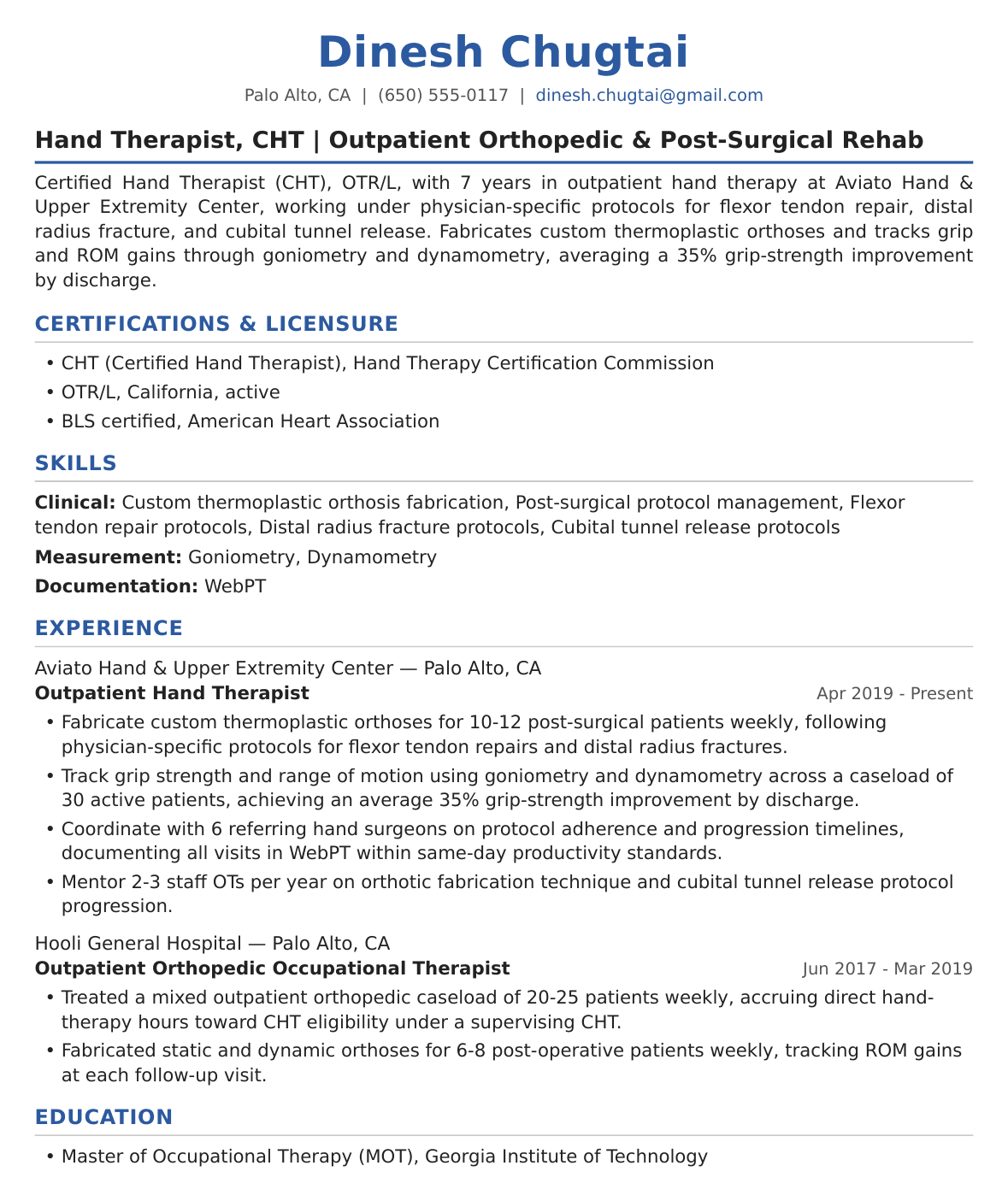
Hand therapy and outpatient roles hinge on orthotic fabrication skill, post-surgical protocol knowledge, and measurable grip and range-of-motion gains.
- Fabricated custom thermoplastic orthoses for 10-12 post-surgical patients weekly, following physician-specific protocols for flexor tendon repairs and distal radius fractures.
- Tracked grip strength and ROM using goniometry and dynamometry across a caseload of 30 active patients, achieving an average 35% grip strength improvement by discharge.
The hand therapy version proves protocol fluency before anything else. Lead the summary with CHT status, or the hand-therapy hours you have accrued toward it, then name the post-surgical protocols you work under: flexor tendon repair, distal radius fracture, cubital tunnel release. Bullets carry orthoses fabricated per week, visits per day, and measured grip and ROM gains at discharge. Skills name thermoplastic fabrication, goniometry, dynamometry, and the outpatient EHR.
Mental Health / Acute Care
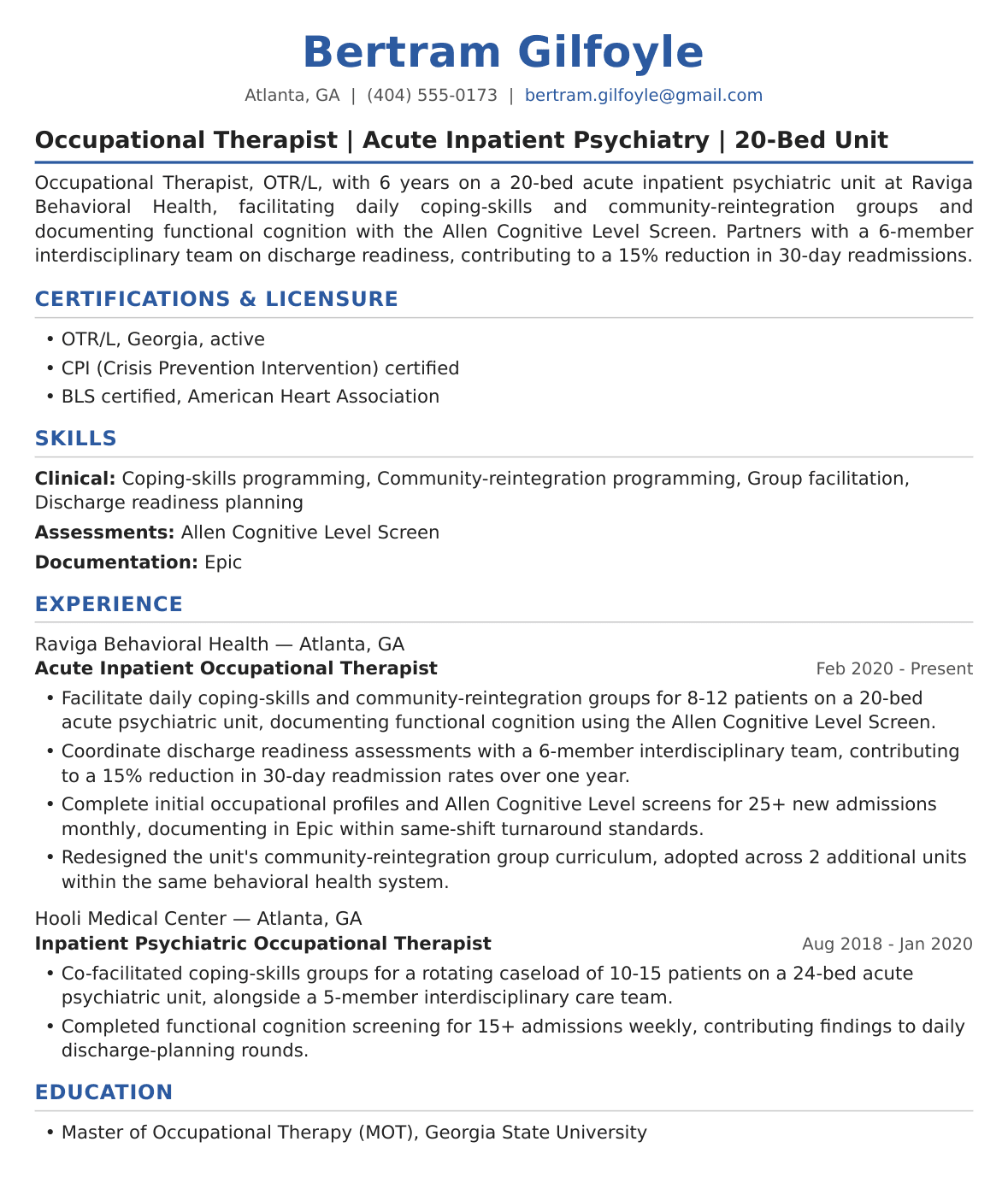
Mental health and acute psychiatric settings reward group facilitation experience, coping-skills programming, and clear discharge-readiness documentation shared across the care team.
- Facilitated daily coping-skills and community-reintegration groups for 8-12 patients on a 20-bed acute psychiatric unit, documenting functional cognition using the Allen Cognitive Level Screen.
- Coordinated discharge readiness assessments with a 6-member interdisciplinary team, contributing to a 15% reduction in 30-day readmission rates over one year.
The mental health version leads with unit type, bed count, and acuity, since a locked acute unit and a community program run differently. Certifications carry CPI or equivalent crisis-intervention training alongside BLS. Bullets carry groups per week, patients per group, functional cognition screens completed, and readmission outcomes. Skills name the Allen Cognitive Level Screen, coping-skills and community-reintegration programming, and the acute-care EHR.
All five keep credentials and categorized skills near the top and use the same bullet formula. What changes is the vocabulary and which outcomes get counted. If you sit between two settings, build from the one you actually worked in and rewrite only the outcome nouns the new setting tracks.
Occupational Therapist Resume Keywords
The same OT skill set gets described in four different vocabularies depending on who is hiring. A school district calls it IEP goal writing, a SNF calls it Section GG scoring, a hand clinic calls it splinting, and a psych unit calls it group facilitation. An ATS scanning against one of those postings does not credit a synonym borrowed from another setting. Getting the ATS resume keywords right means matching the setting's own dialect rather than occupational therapy in general. The table below covers the vocabulary; your bullets carry the caseload sizes, percentages, and outcomes.
| Category | Keywords |
|---|---|
| Licensure & certifications | OTR/L, COTA/L, NBCOT certification, State OT license, License-eligible, BLS certification, CHT |
| Clinical & assessment terms | Sensory integration, DIR/Floortime, Fine motor and visual-motor integration, IEP goal writing, Splinting and orthosis fabrication, Occupational profile, Section GG scoring, OASIS assessment |
| Settings & populations | Pediatric and early childhood special education, School-based and inclusive preschool, Skilled nursing facility, Home health and homebound care, Outpatient hand surgery practice, Inpatient acute psychiatric unit |
| Documentation & systems | CPRS, PointClickCare, Rehab Optima, Casamba, WebPT, Epic, Medicaid documentation |
List these only when they're true for you. A new grad shouldn't claim CHT, Section GG scoring, or DIR/Floortime without the fieldwork or caseload behind it, and the school and SNF rows rarely belong on the same application, since most postings expect one setting's dialect.
Mirror the posting's exact string, since an ATS matches literals, not meaning. A posting that reads "OTR/L" won't credit "occupational therapist" spelled out, and "Rehab Optima" and "Net Health" are the same product under two names, so use whichever the posting names. A district listing "IEP goal writing" won't credit a bullet that says "care planning" instead, even though the clinical work behind both is identical.
Common Occupational Therapist Resume Mistakes to Avoid
Describing tasks instead of impact. "Provided therapeutic interventions for patients with upper extremity injuries" tells a hiring manager what your day looked like, not what you achieved. Compare it to "Progressed 15 hand therapy patients per week through custom splinting protocols; 85% returned to full duty within 6 weeks." The second version proves clinical outcomes.
Using one generic resume for every setting. A pediatric OT resume and a hand therapy OT resume should not read the same way. Listing "patient care" and "documentation" with no mention of sensory integration, feeding therapy, or splinting fabrication signals to a school district or outpatient hand clinic that you have not worked in their setting.
Burying or omitting NBCOT and license status. Your credential line ("OTR/L" or "COTA/L," plus state license status) belongs directly under your name and title, not two paragraphs into a summary. ATS systems and recruiters scan for this as a literal match string, and a missing or buried credential can trigger an automatic screen-out.
Listing EHR or software names without specificity. "Proficient in documentation systems" says nothing. Name the platforms you have charted in, such as WebPT, Casamba, Rehab Optima (now Net Health), or Epic; specific system names are what ATS keyword matching actually looks for.
Using outdated language for patient populations. Terminology shifts, and preferences vary by community (many in the autism community favor identity-first language, for instance). Mirror what the setting and population use today, and drop clinical shorthand that reads as dated.
Ignoring ATS formatting. Tables, text boxes, headers and footers, columns, and embedded images often get scrambled or dropped when a system parses your resume. Stick to a single-column layout, standard fonts, and plain section headings.
Unverifiable or vague stats. "Improved patient outcomes" with no scope, timeframe, or number reads as filler. State the caseload size, percentage change, or discharge rate you tracked. Without a real number, describe the scope, such as unit size or program built, instead of inventing a statistic.
How AI Resume Builders Can Simplify Your Occupational Therapist Resume
Rewriting your resume for every setting, from pediatric clinics to skilled nursing to home health, takes time, and a single generic version often gets filtered out before a hiring manager ever opens it. Upplai's AI resume builder is built to fix that:
- Real-time ATS scoring shows your ATS and recruiter scores update instantly as you edit, so you can see how a change lands before you submit, with no download-and-reupload cycle.
- Transparent suggestions mean every edit comes with a plain-language "Why this change?" explanation, and you accept or reject each one, so nothing gets rewritten or invented behind your back.
- Automatic formatting applies multiple ATS-friendly templates like "London," "New York," and "Sydney," plus a range of color themes, alongside full design control, so your clinical experience and credentials stay clean and parseable across settings.
- Structure guidance reorders content for relevance, strengthens action verbs, quantifies outcomes, and flags potential bias triggers, reflecting recruiter best practices for OT roles.
- Preference memory keeps your formatting, metric, and reordering choices saved across sessions, so tailoring your next application starts from where you left off.
Pricing is honest: the free plan includes 3 tailored resumes with matching cover letters, 200 ATS scans a month, and unlimited downloads, no credit card required. Extra resumes cost $0.50 to $1.00 each depending on pack size, with no subscription.
Tailor your occupational therapist resume in minutes
Landing your first occupational therapy role takes patience, and a strong resume is what gets you in front of the people making hiring decisions. Focus on the fieldwork and clinical experience you do have, speak clearly to the setting you want, and keep tailoring your resume as you apply to different practices. If you're an experienced OT moving into a new setting, the same principle holds: reframe your existing skills around what the new role actually needs.